
Fat Loss Workouts For Beginners Over 40, Built For Real Weeks
JIM WENDLER
The creator of the 5/3/1 training program
Make time for it. Just get it done. Nobody ever got strong or got in shape by thinking about it. They did it.
Summary (TL;DR)
The best fat loss workouts for beginners over 40 combine full-body strength training two or three days a week with one or two short, harder interval or circuit sessions and plenty of easy daily movement. No single workout does the job on its own.
Your weekly dose, done consistently and progressed over time, is what changes your body. Below you'll find six ready-to-run sessions with home and gym options, a calorie comparison table, two sample weekly plans and simple rules for progressing safely.
After 40, strength work matters even more, because it protects the muscle that keeps your metabolism up through perimenopause.
You've done the classes. You've sweated through the YouTube videos. Maybe you've even tried the "fat-burning zone" on the treadmill. And the mirror still looks the same. That's frustrating, and it's not because you lack willpower.
Most workout advice sells you a single perfect session. The research tells a calmer story: what matters is the total work you do across a week, whether some of it builds muscle, and whether you can keep it up.
This guide shows you exactly what that looks like for fat loss workouts for beginners, set by set, with six sessions you can start today and a simple way to fit them into the week you actually have.
Medical & Referral Disclaimer
This article is for informational and educational purposes only. It is not a substitute for professional medical advice, diagnosis, or treatment. Always consult your physician or qualified health provider before starting any new diet or exercise program.
Key Takeaways
- Weekly dose beats the "best" workout: health guidelines point to 150 to 300 minutes of moderate activity plus strength work on at least 2 days a week.
- Strength training reduces body fat, including visceral fat, and protects the muscle that matters more after 40.
- HIIT saves time: HIIT and steady cardio produced similar fat loss, but HIIT took about 40% less time.
- You can't pick where fat comes off: training one body part doesn't burn fat from that spot.
- Afterburn is real but small: for most workouts it adds a modest top-up, not a day of extra burning.
- Progress beats variety: add a little load or a few reps each week and the same six workouts keep working.

What Makes A Workout “Fat Burning”?
A workout burns fat when it adds to a weekly energy deficit and helps you keep or build muscle while you lose. Intensity, sweat, and soreness don’t decide it. Total weekly work and consistency do.
Here’s the contrarian part. Every workout burns calories, and your body draws on fat stores when you’re in an overall deficit over weeks, not minutes. That’s why the “fat-burning zone” on cardio machines matters less than it looks.
Even the timing trick doesn’t move the needle: when young women did the same cardio either fasted or after a meal, both groups lost similar fat in a four-week trial of fasted versus fed exercise.
So instead of hunting for the one perfect session, you build a week. Two or three strength days. One or two harder cardio days. Lots of easy movement in between. If you also want the food side of the equation, our guide on how many calories you should be eating covers it.
Why You Can’t Burn Fat From One Spot
Working one area doesn’t burn the fat sitting on top of it. When adults trained only one leg for 12 weeks, they lost fat, but it came off their arms and trunk, not the trained leg, in a study on localized resistance training.
That’s why belly fat, hip fat, and thigh fat feel “stubborn”. Your body decides the order fat leaves, and hormones, age, and genetics all play a part. Menopause, for example, shifts more fat to the deep belly area, as Harvard Health explains in its guide to visceral belly fat.
We dig into the full picture in the truth about spot reduction, understanding targeted fat loss and how hormones affect weight loss in women. Good news, though: whole-body training does reach those areas eventually. You just can't send it there first.
The Afterburn Effect: Real, But Smaller Than You’ve Heard
Afterburn (EPOC) is the extra energy your body uses to recover after a hard session, and it’s usually a modest top-up. A review of post-exercise oxygen consumption found it typically adds about 6 to 15% of the energy cost of the workout itself.
Longer afterburn (3 to 24 hours) does happen, but only after demanding sessions, such as 50+ minutes at high effort, or repeated all-out intervals. So yes, push hard on your interval days. Just don’t count on afterburn to do the work your weekly routine should be doing.
Calorie Deficit Basics For Beginners
Fat loss is different from weight loss. Fat loss means reducing body fat while keeping or adding muscle; weight loss on the scale can also be water or muscle, which isn't what you want. Our guide to weight loss vs fat loss explains the difference.
Workouts help, but fat loss still depends on an overall calorie deficit: using a little more energy than you eat, over weeks. Whole foods, more fiber, sensible portions and water all make that deficit easier to hold.
Exercise adds to the deficit and, just as importantly, protects your muscle while you lose. For the food side, see how many calories you should be eating.
Which Workouts Burn The Most Calories?
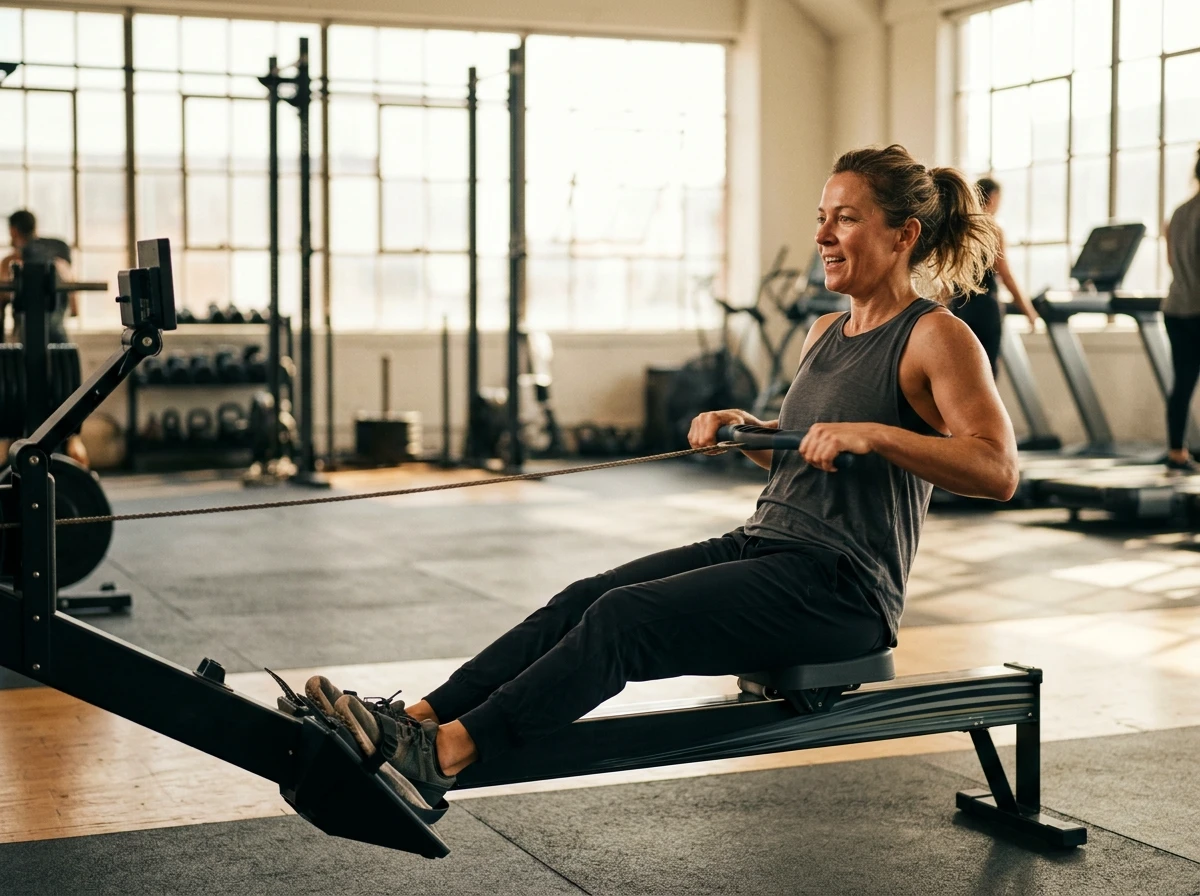
Vigorous bodyweight circuits, the elliptical, and rowing sit near the top for calories burned in 30 minutes, while lifting burns fewer calories during the session but protects muscle. The best plan uses both.
Here’s how common workout types compare, using figures for a 155-pound person from Harvard Health’s calories burned in 30 minutes table. Lighter women burn a little less; heavier women burn a little more.
| Workout Type | Calories In 30 Minutes (155 lb) | Afterburn | Main Job In Your Week |
|---|---|---|---|
| Weight lifting, general | 108 | Low to moderate | Keep and build muscle |
| Weight lifting, vigorous | 216 | Moderate | Muscle plus calorie burn |
| Calisthenics, vigorous (push-ups, jumping jacks) | 306 | Moderate | Home circuit conditioning |
| Elliptical trainer | 324 | Low (steady) to moderate (intervals) | Low-impact cardio |
| Rowing machine, moderate | 252 | Low (steady) to moderate (intervals) | Full body cardio |
| Stair step machine | 216 | Low to moderate | Leg-heavy cardio |
| Walking, 3.5 mph | 133 | Very low | Daily movement and recovery |
Notice something? Walking looks weak per session. But you can walk every day, which you can’t do with hard intervals. Over a week, that adds up. For more ways to raise your daily burn, see our calorie-burning tips for women.
The 6 Ready-To-Run Beginner Workouts
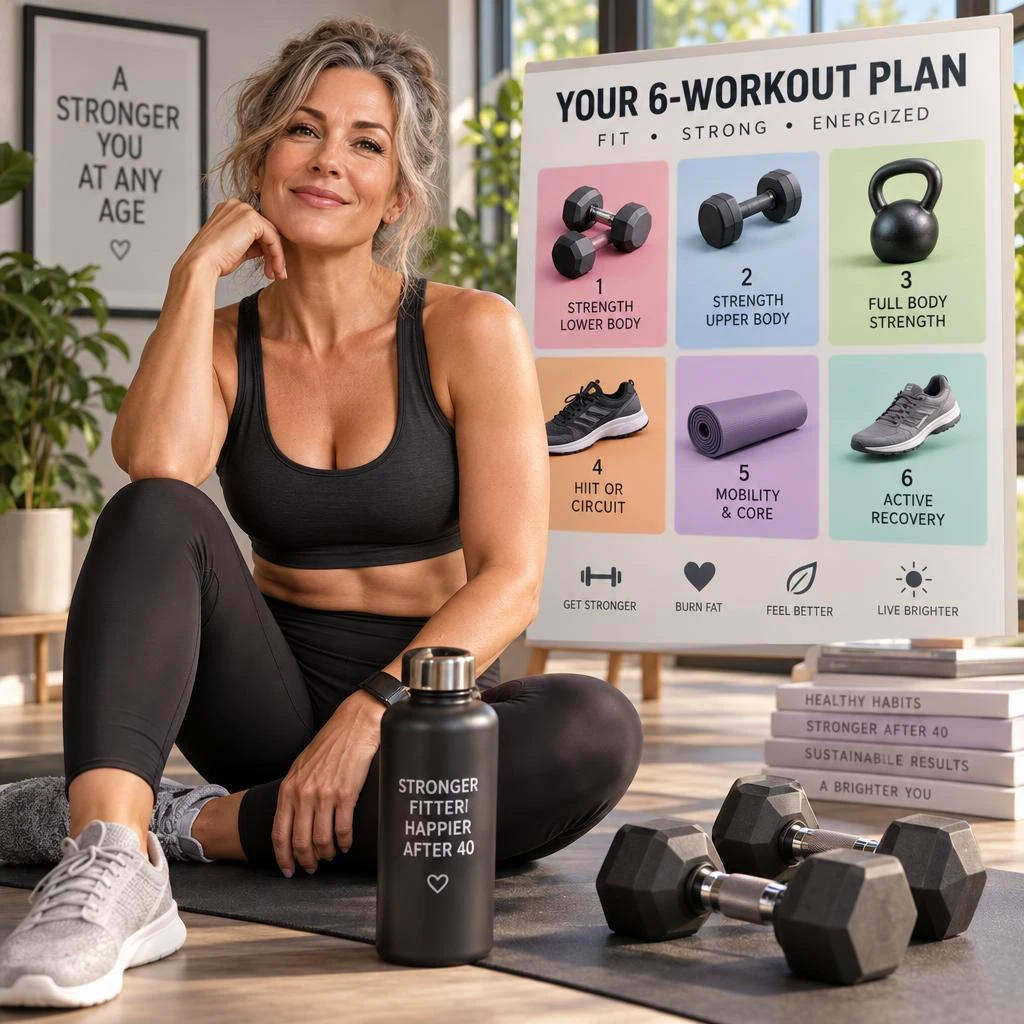
These six sessions cover strength, circuits, intervals, and recovery, so you can build a complete fat loss routine from them. Each one takes 20 to 45 minutes. Warm up for 5 minutes first (brisk walk, marching, arm circles, bodyweight squats) and cool down for 5 minutes after.
We use RPE (rate of perceived exertion) on a 1 to 10 scale. A 7 means you could do 2 or 3 more reps. A 9 means you're nearly done. Brand new to exercise? Start with Workout 6 and Workout 3, use the easier options, and add the others over a few weeks.
Workout 1: The Full Body Strength Session (Gym)
Compound lifts like squats, deadlifts, and presses train several big muscles at once, so you get more work done in less time. This is your foundation session. Do it 2 or 3 times a week on non-consecutive days.
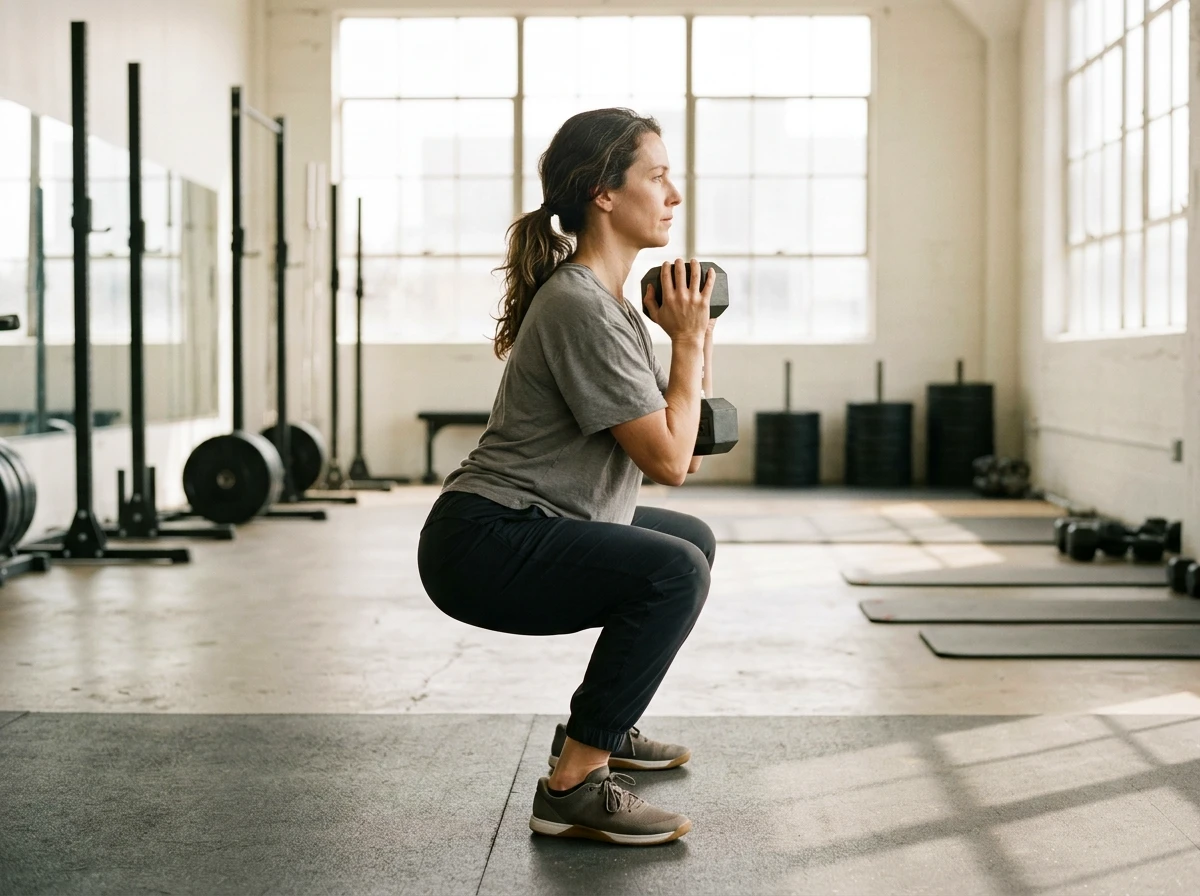
- Goblet squat: 3 sets of 8 to 12 reps (quads, glutes, core)
- Romanian deadlift: 3 sets of 8 to 12 reps (hamstrings, glutes, back)
- Dumbbell bench press: 3 sets of 8 to 12 reps (chest, shoulders, arms)
- Seated or bent-over row: 3 sets of 8 to 12 reps (upper back)
- Shoulder press: 2 sets of 8 to 12 reps
- Push-ups (from knees or a bench if needed): 2 sets to RPE 8
Rest 60 to 90 seconds between sets. The 8 to 12 rep range matches the American College of Sports Medicine’s guidance for newer lifters. Want to perfect the king of the list first? Read why squats are really good for you.
Workout 2: The Resistance Band Strength Session (Home)
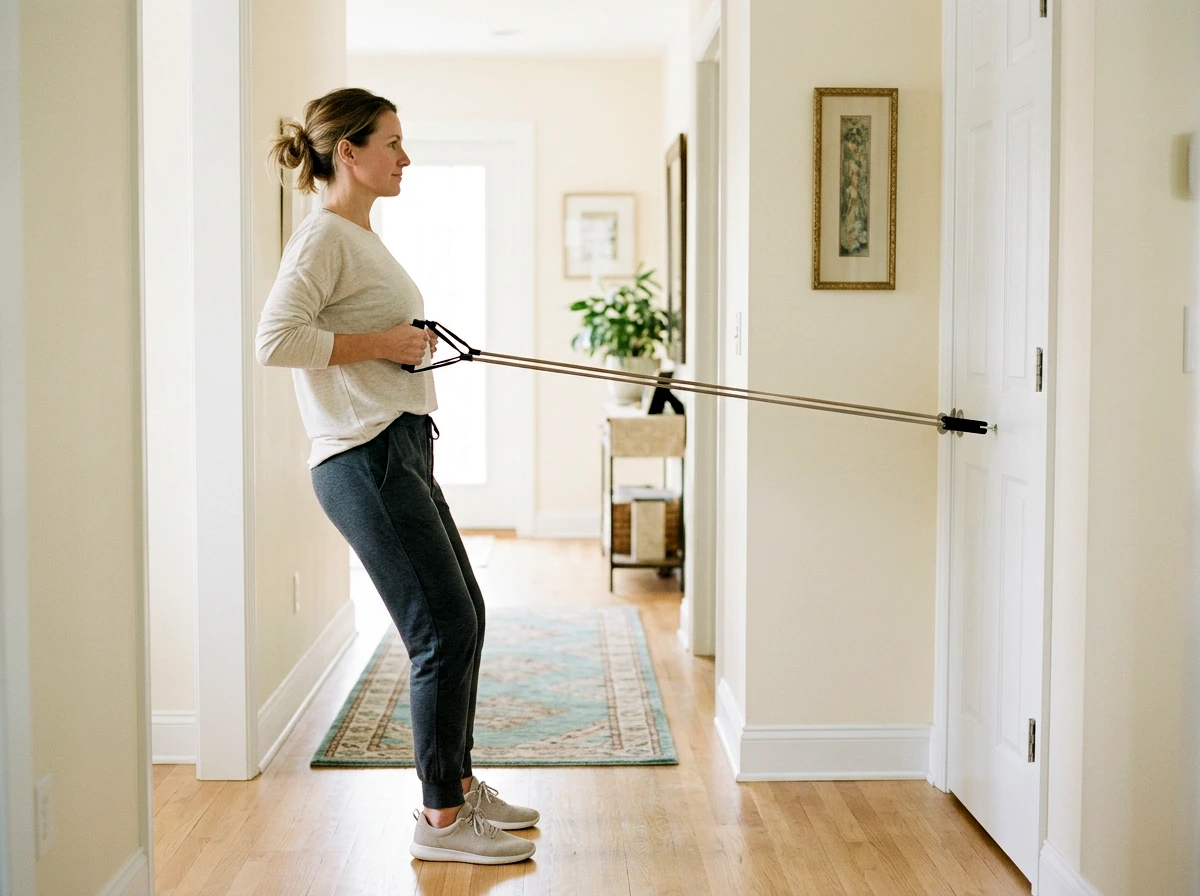
Resistance bands build strength about as well as weights, so a home band session is a real fat loss workout, not a compromise. A meta-analysis comparing elastic and conventional resistance training found similar strength gains for both upper and lower body.
Run it as 3 rounds, 10 to 15 reps each, 60 seconds rest between rounds: band squat, band glute bridge, band row (anchored to a door), band chest press, band overhead press, band pull-apart.
The only home fitness equipment you need is a set of bands and a door anchor. Pick a band that makes the last 2 or 3 reps hard. When it stops feeling hard, step further from the anchor or switch to a heavier band.

Workout 3: The 20-Minute Bodyweight Circuit (Home)
Circuit training links exercises with minimal rest, which keeps your heart rate up while your muscles work, so you get strength and cardio in one short block. No equipment needed.
Set a timer: 40 seconds work, 20 seconds rest, move to the next exercise. Complete 4 rounds.
- Squat to chair (or jump squat if your joints like it)
- Incline push-up on a kitchen counter
- Reverse lunge, alternating legs
- Plank shoulder taps (proof that core workouts don’t need crunches)
- Glute bridge
That’s exactly 20 minutes. Short on time? Even 2 rounds count.
For more no-equipment ideas, see these simple at-home exercises for weight loss.
Workout 4: The Kettlebell And Power Circuit
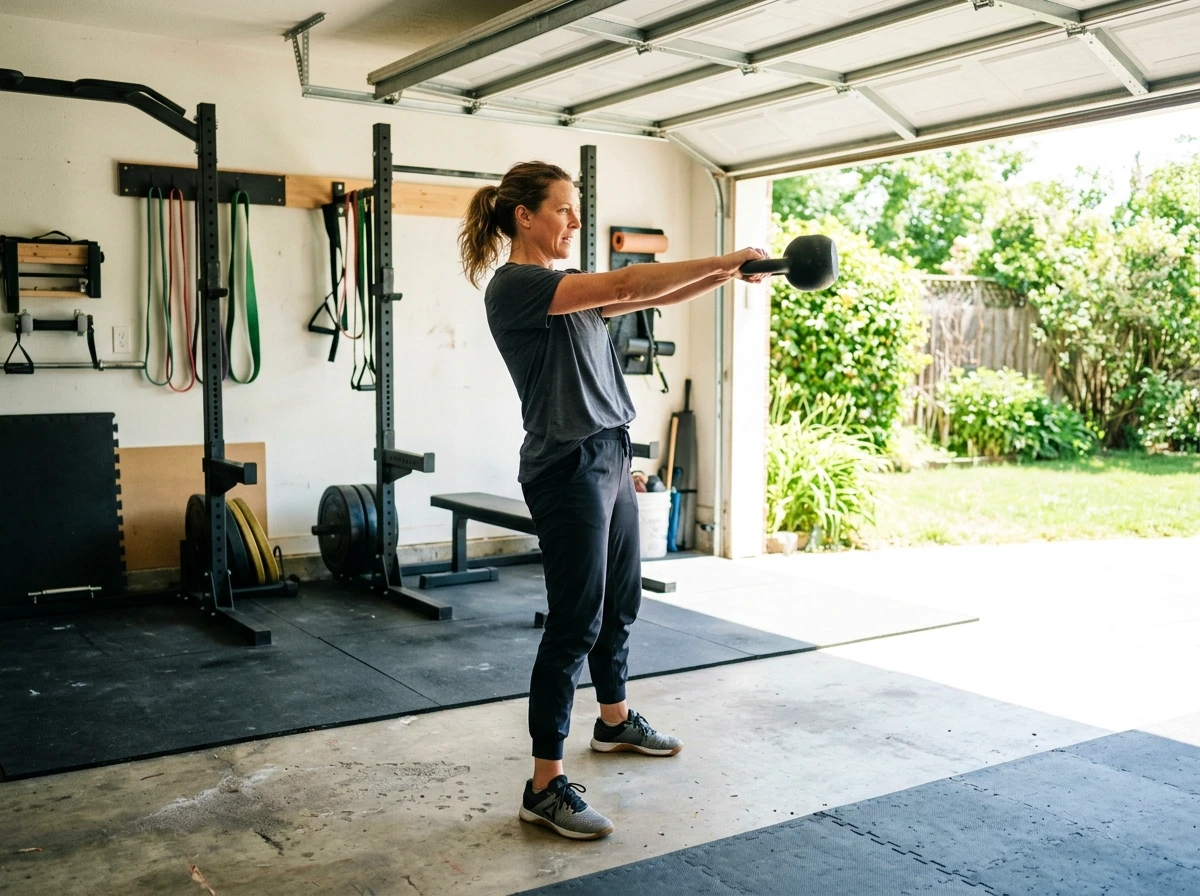
Power moves like kettlebell swings and medicine ball slams use fast, explosive effort, so they raise the intensity of a session without making it longer. Plyometrics work your quick-twitch muscle fibers, and they’re hard work for your heart and lungs too.
Do 5 rounds: 15 kettlebell swings, 8 medicine ball slams, 10 step-ups per leg, 30 seconds rest. Keep swings hip-driven, not arm-driven. If jumping hurts your knees or pelvic floor, swap slams for fast band rows and step-ups for marching.
Workout 5: The HIIT Intervals Session
High-intensity interval training gives you similar fat loss to longer steady cardio in less time. In a meta-analysis of 13 HIIT versus steady cardio trials, both reduced fat mass and waist size, with no real difference between them, but HIIT took about 40% less training time.
The format: after your warm-up, do 30 seconds hard (RPE 8 to 9), then 90 seconds easy, 8 times. That’s 16 minutes of work. So, don’t be afraid to push yourself hard on the hard bits. Hill sprints, a rower, or a running track all work.
A Detail Most HIIT Guides Leave Out
In that same analysis, running-based training produced large fat-mass reductions, but cycling-based training didn’t produce fat loss. That doesn’t mean bikes are useless (we’re fans of bike riding for weight loss). It means that if fat loss is your main goal, rotate in some weight-bearing intervals too.

Workout 6: The Active Recovery Walk
Active recovery is easy movement on rest days that helps you recover while still adding to your weekly calorie burn. Think a 30 to 45 minute brisk walk at RPE 4 to 5, where you can still hold a conversation.
This is the session people skip, and it’s the one that makes the hard days possible. It also counts toward your weekly cardio minutes.
How To Build Your Weekly Fat Loss Routine
A good weekly fat loss routine covers strength training on at least 2 days and 150 minutes of moderate activity (or 75 vigorous), spread across the week. That’s the baseline in the NHS physical activity guidelines for adults, and the US guidelines suggest building toward 150 to 300 minutes a week.
Pick the plan that matches your real week, not your ideal one.
| Day | Time-Poor Plan (About 3 Hours) | Standard Plan (About 4 Hours) |
|---|---|---|
| Monday | Workout 1 or 2 (strength), 35 min | Workout 1 (strength), 45 min |
| Tuesday | Workout 6 (walk), 30 min | Workout 5 (HIIT), 25 min |
| Wednesday | Workout 3 (circuit), 20 min | Workout 6 (walk), 40 min |
| Thursday | Rest or a 20-minute walk | Workout 2 or 1 (strength), 45 min |
| Friday | Workout 1 or 2 (strength), 35 min | Workout 4 (power circuit), 25 min |
| Saturday | Workout 6 (walk), 30 min | Workout 6 (walk), 45 min |
| Sunday | Rest | Rest |
Not sure when to fit it in? There’s no wrong answer, but we cover the trade-offs in what time of day is best for exercise.
As a beginner, two to four planned sessions a week with a rest day between hard strength days is plenty. If you want to know what to expect, read how long it takes to see results from working out as a beginner, and for the moves that give you the most return, see the best exercises for women to lose weight.
Progressive Overload: The Rule That Keeps Workouts Working
Progressive overload means doing slightly more over time, through more weight, reps, or rounds, so your body keeps adapting. Without it, the same workout gets easier, and your results stall.
The simple rule from the ACSM’s resistance training guidance: once you can do one or two reps more than your target with good form, raise the load by about 2 to 10%. For bands and bodyweight, add a round, slow the lowering phase, or move to a harder variation.
Write your numbers down. It’s the easiest motivation trick there is, and it’s why we recommend you keep your goals in front of you.
How To Gradually Increase Intensity
To see lasting results, it's important to increase the intensity of your workouts. Here are ways to do it:
- Do more repetitions of bodyweight exercises.
- Add weights to exercises like dumbbell rows and squats.
- Try different variations like staggered push-ups or lunges.
Build up step by step. Small, regular increases are safer for joints and easier to stick with than big jumps, especially if you're returning to exercise after a long break.
Cardio Versus Lifting: Do You Have To Choose?
No. Cardio burns more calories per session, while strength training reduces body fat and protects the muscle that keeps your metabolism up, so the strongest fat loss routine uses both.
The strength side is better supported than many women realize. A meta-analysis of 58 resistance training studies found lifting alone, compared with no exercise, reduced body fat percentage by about 1.5 points, fat mass by about half a kilo, and visceral fat (the deeper belly fat linked to health risks), with similar results in women and men.
Lifting also helps your metabolism. In one review of resistance training’s health effects, ten weeks of training added about 1.4 kg of lean weight, raised resting metabolic rate by 7%, and cut about 1.8 kg of fat. Your basal metabolic rate won’t skyrocket, but you hold on to more of it while you lose fat.
For the full side-by-side, read our deep dive on strength training versus cardio for fat loss and our guide to balancing cardio and strength training.
When The Scale Lies: Body Recomposition
If you start lifting and the scale stalls or creeps up, you may be losing fat and gaining muscle at the same time, which is called body recomposition. The scale can’t see the difference. Your tape measure and clothes can.
The research explains why the scale misleads: in the HIIT and steady cardio trials above, body composition improved without matching changes in body weight. For more, read what body recomposition really means for women over 40.
Track these instead of the scale alone:
- Waist measurement: once every two weeks, same time of day
- Strength numbers: are your squats or band rows going up?
- How your clothes fit: jeans don’t lie
- Energy and sleep: better recovery is a sign the plan suits you
- Progress photos: monthly, same light and angle
Fat Loss Workouts For Women Over 40
The same six workouts work at every life stage. What changes after 40 is how much recovery you need and how carefully you build up.
The older you get, the more strength training matters, because inactive adults lose muscle every decade. The resistance training review cited above puts that loss at 3 to 8% per decade in inactive adults, together with a lower resting metabolic rate and fat accumulation.
Keep two or three strength sessions in every week, even when time is short. If perimenopause has made recovery harder, swap one HIIT day for an extra walk and see how you feel.
Our guides on strength training for women in perimenopause and strength training for women over 40 go deeper on hormone-friendly training, and belly fat exercises for women over 40 cover the midsection.
A few adjustments help many women over 40 train well:
- Warm up a little longer (5 to 10 minutes) and include the movements you're about to load.
- Leave a day between hard strength sessions, and treat sleep as part of recovery.
- Choose low-impact options (step-ups instead of jumps, fast band rows instead of slams) if joints or pelvic floor complain.
- Keep lifting through busy or low-energy weeks, even if it's one shorter session.
If you've recently had a baby, start with our guide on how to restart your postpartum fitness routine and get medical clearance before jumping, swings or heavy lifting.
Exercise Motivation When Your Week Is Packed
The best fat burning workout is the one you’ll still be doing in six months, so plan for your busiest week, not your quietest one.
These daily movement hacks add to your weekly dose without another gym trip:
- Take phone calls on your feet, or while walking
- Do 10 squats every time the kettle boils
- Park at the far end of the car park
- Take the stairs for anything under three floors
- Book workouts in your calendar like meetings
Missed a session? Don't try to double up tomorrow. Just do the next one on the plan. Consistency over weeks beats one heroic day. If you're training without much support at home, read about exercise motivation without partner support and our weight loss tips for women over 40 for more ideas.
Expert Commentary: What The Research Actually Shows
The research on beginner fat loss training is more reassuring than most marketing suggests. A meta-analysis of 58 resistance training studies found lifting alone reduced body fat percentage, fat mass and visceral fat, with similar results in women and men.
For cardio, a meta-analysis of HIIT versus steady cardio trials found both reduced fat mass and waist size by similar amounts, with HIIT taking about 40% less time. And the American College of Sports Medicine's progression guidance gives beginners a simple rule: work in the 8 to 12 rep range and add load once you can beat your target with good form.
Read together, the evidence points to a plain, repeatable week rather than a perfect session: some lifting, some harder cardio, plenty of walking, and small increases over time.
The Contrarian Take: Variety Is Overrated, Progress Is Not
Fitness content loves novelty: a new routine every week, a new class, a new challenge. But your body adapts to progressive challenge, not novelty. Constantly switching workouts makes it hard to know whether you're getting stronger.
The six sessions in this guide can carry you for months if you progress them: a few more reps, a slightly heavier band or dumbbell, one more round. Write the numbers down. When they go up, the plan is working, whatever the scale says this week.
The Bottom Line
Fat-burning workouts work best as a week, not a single session: compound strength work two or three times, a short interval session or circuit, and plenty of easy movement around it.
That's the recipe for sustainable fat loss. Progress the numbers a little each week, measure more than the scale, and give it at least a couple of months before you judge it. If you want the bigger picture beyond workouts, our guide on how to lose body fat after 40 pulls it all together.
You don’t need more willpower. You need a plan that fits your life, and now you have six workouts to build your personal fitness routine.
Workouts are half the story. The other half is the habits around them. Get our free guide, 10 Actions That Support Permanent Weight Loss, for the everyday habits that keep this week's effort paying off. Get your free guide here.
Glossary Of Key Terms
- Active Recovery: Easy movement, such as walking, on rest days that aids recovery without adding strain.
- Afterburn (EPOC): Excess post-exercise oxygen consumption, the extra energy your body uses to recover after a workout.
- Basal Metabolic Rate (BMR): The calories your body needs for basic functions at complete rest.
- Body Recomposition: Losing fat and gaining muscle at the same time, often with little change on the scale.
- Circuit Training: Moving through several exercises in a row with minimal rest between them.
- Compound Exercise: A movement that works several joints and muscle groups at once, like a squat or row.
- High-Intensity Interval Training (HIIT): Short bursts of hard effort alternated with easy recovery periods.
- Progressive Overload: Gradually increasing weight, reps, or difficulty so your body keeps adapting.
- RPE (Rate Of Perceived Exertion): A 1 to 10 scale for how hard an effort feels.
- Visceral Fat: Fat stored deep in the belly around the organs, linked to higher health risks.
- Caloric Deficit: Consuming fewer calories than your body burns, essential for fat loss.
- Bodyweight Exercises: Exercises that use your body weight as resistance, such as push-ups and squats.
FAQ
What Are The Best Fat Loss Workouts For Beginners?
The best fat loss workouts for beginners combine full-body strength training two or three times a week with one or two short interval or circuit sessions and daily walking. Strength work reduces body fat and protects muscle, while intervals add calorie burn in less time.
What Should Beginners Know Before Starting Fat Loss Workouts?
Start with a simple structured plan and realistic goals, and progress slowly. Warm up before every session, learn good form with lighter loads, and get medical advice first if you have a health condition, are pregnant or postpartum, or haven't exercised in a long time.
How Many Days A Week Should I Do Fat Loss Workouts?
Aim for at least 2 strength days and 150 minutes of moderate activity (or 75 minutes vigorous) across the week. For many women, 3 to 5 planned sessions plus easy daily movement is a practical target.
Can I Do Fat Loss Workouts At Home?
Yes. Resistance bands build strength about as well as weights, and a bodyweight circuit raises your heart rate without equipment. Workouts 2, 3, and 6 in this guide need no gym.
Is HIIT Better Than Cardio For Fat Loss?
Not for total fat loss. Research comparing them found similar results, but HIIT took about 40% less time. Choose HIIT if you’re short on time, and steady cardio if you prefer it or need gentler days.
Will Lifting Weights Make Me Bulky?
It’s very unlikely while you’re eating in a calorie deficit. During fat loss, lifting mainly helps you keep muscle, which usually gives a firmer, more defined shape. The scale may move slowly because you’re holding on to muscle while losing fat.
How Long Before I See Results From Fat Loss Workouts?
Give it at least two to three months. The HIIT and steady cardio trials in this guide averaged 10 weeks of training, three sessions a week, before measuring body composition. Track your waist and strength numbers along the way so you can see progress before the mirror does.