
The Dose-And-Recovery Ladder: Which Exercises To Melt Belly Fat Are Worth Your Week
Stacy Sims, PhD
Environmental exercise physiologist & nutrition scientist
Women are not small men.
Summary (TL;DR)
The best exercises to lose belly fat, according to the research we could confirm, are steady aerobic work and intervals, backed by strength training twice a week. In a randomized trial of ab exercises, endurance improved, but the waist didn’t shrink.
Our read: the dose you can repeat and recover from, sleep included, matters more than which move you pick. This guide ranks each option, shows the weekly minutes, and flags where the evidence runs thin for perimenopause.
You searched for “exercises to melt belly fat,” so here’s the short answer: the research doesn’t show that any exercise chooses where your fat comes off, and it doesn’t crown a single move. It ranks types of exercise and, for intervals and aerobic work, estimates a minimum weekly dose.
If your routine hasn’t changed and your waistline has, you’re not imagining it. In SWAN, a long-running study of women through the menopause transition, the rate of fat gain doubled at the start of the transition, yet the rate of weight gain didn’t change. The scale keeps its usual pace while your body composition shifts underneath it.
This guide ranks the main exercise types by what the research shows and how much recovery each costs, on what we call the Dose-And-Recovery Ladder. It turns the research’s doses into minutes and places familiar moves like crunches and burpees on it.
Medical & Referral Disclaimer
This article is for informational and educational purposes only. It is not a substitute for professional medical advice, diagnosis, or treatment. Always consult your physician or qualified health provider before starting any new diet or exercise program.
Key Takeaways
- Ab exercises alone didn’t change abdominal fat. In one randomized trial, 24 adults were assigned to ab exercises five days a week for six weeks or to no intervention, and the ab group showed no significant change in abdominal fat or waist size.
- Intervals ranked first for visceral fat in a 2026 review of 61 trials, ahead of combined aerobic and strength work, steady aerobic work, and strength training alone.
- Doses differ by type: about 400 MET-minutes a week for intervals and 1,100 for steady aerobic exercise.
- Strength training ranked last for visceral fat but still makes the list: CDC recommends it twice a week, and lean mass declined at the start of the menopause transition in SWAN.
- Recovery is part of the dose. In a small experiment, two weeks of short sleep raised abdominal and visceral fat, though changes in total body fat didn’t differ between conditions.
- Your tape measure may lag. In SWAN, waist measurements were less sensitive than scans to shifts in fat distribution.
- The evidence has gaps for you. The big reviews pooled people with overweight or obesity, not perimenopausal women, so start below your ceiling.

Why Does Your Waist Change When Your Routine Doesn’t?
Your waist can change because the menopause transition is linked to more fat around the middle, even when your weight gain doesn’t speed up. In SWAN, visceral fat began rising at the transition, and waist measurements caught the shift less clearly than scans did.
“Belly fat” is really two things. Subcutaneous fat sits under your skin. Visceral fat sits deeper, around your organs, and the 2026 review describes it as metabolically active and closely associated with insulin resistance and low-grade inflammation.
A SWAN analysis of 380 women, followed with body scans for a median of 11.8 years, shows the pattern: abdominal-region (android) fat rose fastest during the transition, visceral fat began rising then, and waist circumference grew in every stage without a statistically clear difference between stages.
| What Was Measured | Before The Transition | During The Transition | After The Transition |
|---|---|---|---|
| Android (Abdominal-Region) Fat | +1.21% a year | +5.54% a year | +0.90% a year |
| Visceral Fat | Not yet rising | +6.24% a year | +1.47% a year |
| Waist Circumference | +0.55% a year | +0.96% a year | +0.55% a year |
One caution: these are group averages for the study’s White reference group, and some trajectories differed for the Black and Japanese women. The same team’s larger analysis of 1,246 women found lean mass declining at the start of the transition, which is why the strength rung exists. For why the scale hides this, see our weight loss vs fat loss guide.
An observation, not evidence: public forums show the same gap in people’s own words. One popular r/loseit post describes losing 30 pounds in five months while the waist barely budged, and a thread in the women-focused r/xxfitness community describes a goal of turning “stubborn belly fat” into muscle.
We can’t verify any of it, and forum posts skew toward frustration, but it names the feeling this guide is built around.
What Is The Dose-And-Recovery Ladder?
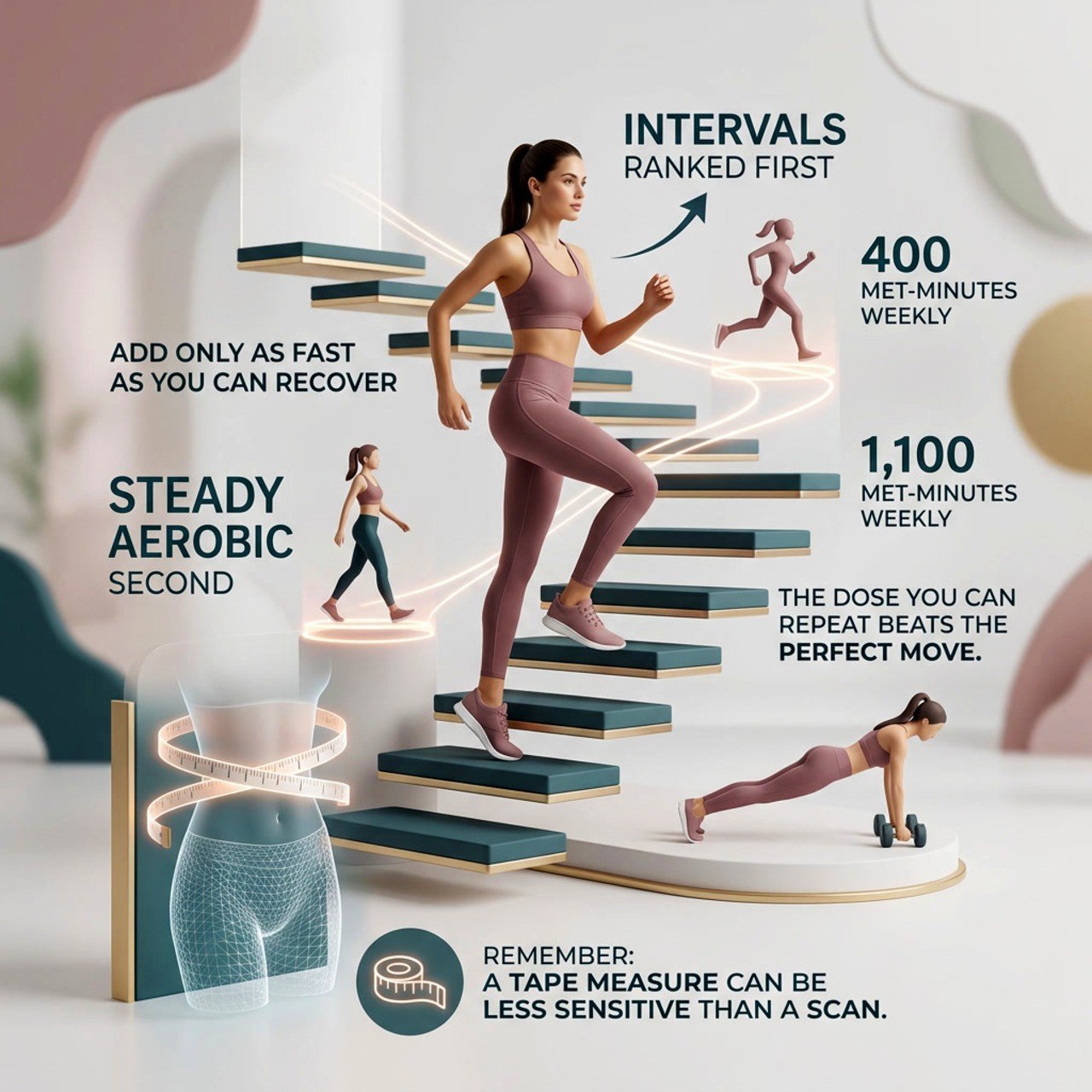
The Dose-And-Recovery Ladder ranks exercise types for belly fat by two questions: how strongly the research links each one to less visceral fat, and how much recovery each one costs. You climb only as far as you can repeat and recover from each week.
The research ranks types of exercise, not individual moves, so the ladder does too. It has four rungs (what you do) and one Recovery Rail (sleep and spacing between hard days), which decides how much of it you can use.
| Rung | Exercise Type | Visceral Fat Rank In The 2026 Review | Reported Minimum Dose | Recovery Cost (Our Judgment) |
|---|---|---|---|---|
| 1 | Steady Aerobic Base | Third of four (SMD -0.53) | About 1,100 MET-minutes a week | Low |
| 2 | Strength Training | Fourth of four (SMD -0.41) | Not reported in the abstract; CDC advises 2 days a week | Moderate |
| 3 | Intervals (HIIT) | First of four (SMD -0.84) | About 400 MET-minutes a week | Higher per session |
| 4 | Core Work | Not one of the review’s four types; one trial found no change in abdominal fat | Not applicable | Low |
The effect sizes come from a 2026 network meta-analysis of 61 randomized trials in 4,136 people with overweight or obesity (ages 10 to 70; 39% male). A more negative number means a bigger drop in visceral fat compared with people who didn’t exercise, and every type beat no exercise.
Combined aerobic and strength work ranked second (-0.54), a near tie with steady aerobic work. The rung numbers show the order we suggest you add them, not research rank. Our stance that dose and recovery matter most is our interpretation of these numbers, not a finding.
What Is A MET-Minute, And How Many Do You Need?
A MET-minute is exercise intensity multiplied by minutes, and the 2026 review’s thresholds work out to about an hour of hard interval work or roughly 3 to 6 hours of moderate aerobic exercise a week.
One MET is the energy you use sitting quietly. CDC counts 3 to 5.9 METs as moderate intensity and 6 or more as vigorous, which lets us translate the review’s numbers into minutes.
| Threshold From The Review | What It Applies To | If Vigorous (6+ METs) | If Moderate (3 To 5.9 METs) |
|---|---|---|---|
| 400 MET-minutes a week | Intervals (HIIT) | 67 minutes or fewer | Not applicable |
| 730 MET-minutes a week | Overall minimum across types | 122 minutes or fewer | 124 to 243 minutes |
| 1,100 MET-minutes a week | Aerobic, and aerobic plus strength | 183 minutes or fewer | 186 to 367 minutes |
That’s our arithmetic using CDC’s bands, not a result the review reports. Warm-ups, rests, and how trials counted volume vary, so treat the minutes as ballparks.
What Are The Best Exercises To Lose Belly Fat On Each Rung?
The best-supported exercises to lose belly fat are intervals and steady aerobic work, with strength training twice a week and core work as supporting rungs.
Rung 1: Steady Aerobic Base (Walking, Cycling, Swimming)
Steady aerobic exercise is the base of the ladder: it lowered visceral fat in the 2026 review, but it needed the most volume to get there. The reported minimum was about 1,100 MET-minutes a week, roughly 3 to 6 hours at moderate effort.
CDC counts brisk walking (2.5 miles an hour or faster), recreational swimming, cycling slower than 10 miles an hour on level ground, and active forms of yoga as moderate intensity. Your gauge is the talk test: you can talk, but not sing. These cardio workouts make up the base, and a daily walk is the easiest place to start.

CDC’s adult guideline is 150 minutes of moderate activity a week, and going beyond it adds more benefit. Our reading: 150 minutes reaches the review’s 730 mark only if you average about 4.9 METs, the upper half of the moderate band.
That’s an interpretation, not a finding, but it’s a reason to treat 150 minutes as a floor and make part of each walk brisk. For how cardio and lifting share the week, see balancing cardio and strength training.
Rung 2: Strength Training Twice A Week
Strength training earns its place on the ladder, but it’s the weakest belly fat lever in the reviews. It ranked last of four for visceral fat in the 2026 review (still better than no exercise), and a 2023 review’s subgroup analysis found no significant visceral fat improvement in women.
So why lift? CDC recommends at least 2 days of muscle-strengthening activity a week, and SWAN found lean mass declining at the start of the transition. We’d keep strength training mainly for the muscle side of body recomposition (building muscle while losing fat) and expect most of the visceral fat work to come from the other rungs.
Start with our guides to strength training for women in perimenopause, body recomposition after 40, and four full-body lifts.
Rung 3: Intervals (HIIT Exercises)
Interval training ranked first for visceral fat in the 2026 review and reached significance at the lowest dose, about 400 MET-minutes a week. That’s roughly an hour or less of hard work a week, but only if you can recover from it.
HIIT means short bursts of hard effort separated by easy recovery. Hard has a simple gauge: at vigorous intensity, you can’t say more than a few words without pausing for breath.
One limit: the trials pooled people with overweight or obesity, and the reviews don’t report results for perimenopausal women. So add intervals carefully, after the base feels easy. Here’s our starting template (not a protocol from the trials):
- Choose a low-impact vehicle first: a stationary bike, a rowing machine, or a steep walk. CDC counts cycling faster than 10 miles an hour as vigorous.
- Start small: six rounds of 30 seconds hard and 90 seconds easy, once a week for two weeks. That’s well below the reported dose, on purpose.
- Add a second session only after the recovery checks below pass, keeping at least one easy day between hard days.
- Save jumping moves for later: burpees and mountain climbers can work as intervals once your wrists, knees, and back feel fine the day after. If jumping causes leaking or pelvic pressure, stay low-impact and mention it to your healthcare provider.


Rung 4: Core Work Is The Finishing Layer
Abdominal exercises strengthen your core, but they didn’t reduce belly fat in a randomized trial. The group doing seven ab exercises five days a week for six weeks showed no significant change in abdominal fat or waist circumference, though curl-up endurance improved.
That trial randomized 24 healthy, sedentary adults ages 18 to 40 (14 men, 10 women), so it isn’t a study of midlife women, but it’s the direct test of the ab-exercise idea. Ab work is the finishing layer: it trains the muscle under your waistline, whether or not the waistline changes.
Core toning is muscle work, and how visible that muscle looks depends on the fat covering it. Our piece on toning versus building muscle unpacks that. These home ab workouts are easy on the neck and back:
- Dead bug: lie on your back with knees over hips and arms up. Lower the opposite arm and leg slowly, keeping your lower back gently flat, then switch sides.
- Incline or knee plank: hands on a counter or bench, body in one line, hold 15 to 30 seconds. Stop when your hips sag.
For seven more ab exercises with form cues, see our flat stomach exercises guide.
Where Do Crunches, Burpees, Planks, And Yoga Fit On The Ladder?
Crunches and planks sit on Rung 4, squats on Rung 2, and burpees and mountain climbers can serve as intervals on Rung 3. Yoga counts as moderate activity when it’s an active style, but we found no trial linking it to belly fat loss.
| Move | Rung | What It Does Well | Gentler Option | Honest Note |
|---|---|---|---|---|
| Crunches | 4 | Builds abdominal endurance | Dead bug | Ab training didn’t change abdominal fat in the trial above. |
| Planks | 4 | Trains trunk stability | Incline or knee plank | No trial linking planks to belly fat loss found. |
| Mountain Climbers | 3 | Raises your heart rate quickly | Slow climbers with hands on a bench | Wrists and shoulders carry the load. |
| Burpees | 3 | Full-body interval work | Step-back burpee with no jump | Higher impact; a bike does the same job. |
| Weighted Squats | 2 | Lower-body strength | Goblet squat to a chair | Start light and put form first. |
| Yoga | Optional | Counts as moderate activity in active styles | Any style you can hold comfortably | No belly fat evidence found. |

We’ve left Wheel Pose off this list: it’s an advanced backbend, and no trial we found links it to belly fat. If yoga is part of your week, our guide to avoiding yoga injuries covers safer practice.
Where Do The Big Reviews Disagree?
The two big reviews agree that intervals rank at or near the top and strength training at the bottom for visceral fat. They differ mainly in how they sort aerobic work: the 2023 review split it by intensity, and the 2026 review kept it as one type.
| Question | 2026 Review (61 Trials) | 2023 Review (84 Trials) | What We Do With It |
|---|---|---|---|
| Best Type For Visceral Fat | Intervals ranked first | Intervals and vigorous-intensity aerobic exercise ranked most likely best | Treat intervals as strong and vigorous steady work as a real alternative |
| Strength Training | Lowest of four, still better than no exercise | Least effective; no significant visceral fat change in women (subgroup) | Keep it mainly for muscle, with a modest visceral fat bonus |
Both reviews pooled people with overweight or obesity, and neither was built for perimenopause, so treat their results as a starting point.
The 2026 authors also note they worked from each trial’s averages rather than individual participants’ data, so some hidden differences between studies can’t be ruled out. That’s why the doses are ballparks, and the ladder leans on recovery checks.
Can You Target Lower Belly Fat With Specific Exercises?
No trial we found shows you can choose where fat comes off, including the lower belly. The reviews tested exercise types, and those lowered visceral fat; the 2023 review also found less subcutaneous fat.
The idea goes by two names: spot reduction and targeted fat burning. The 24-person ab trial above is the closest test: abdominal fat didn’t change, though it wasn’t a lower-belly study. One small 2025 trial in 60 women with obesity (ages 25 to 50) compared general aerobic training, regional abdominal or lower-body exercise, and a mix of both for 12 weeks.
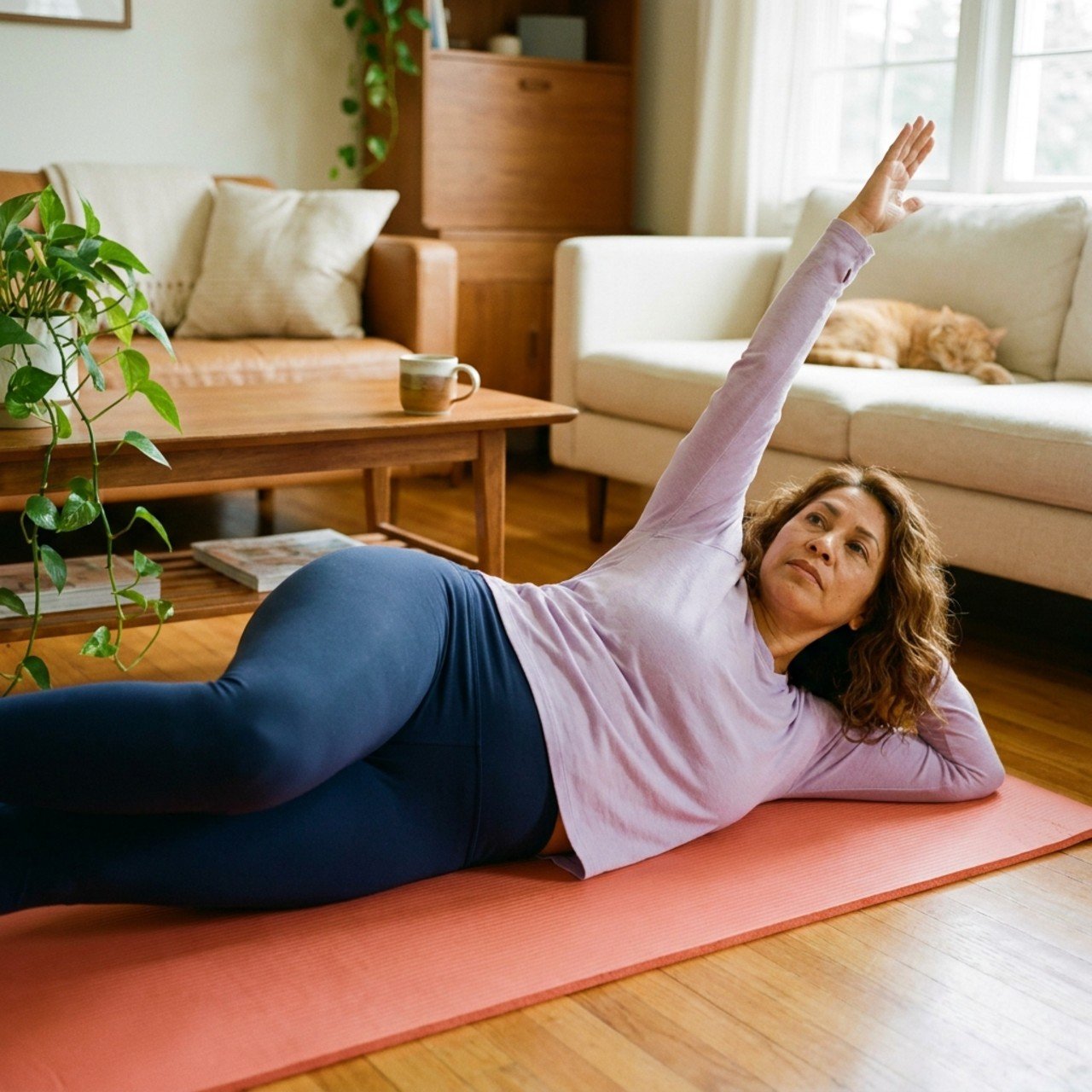
General aerobic training beat regional training alone for whole-body fat loss, and the mix showed the biggest improvements. The authors used weight, waist-to-hip ratio, and blood markers rather than scanned fat, and they call spot reduction “controversial.”
Our read: add regional moves if you like them, but don’t pay for them with time you’d otherwise spend on rungs 1 to 3. Our guides on the truth about spot reduction and targeted fat loss go deeper.
Why Does Recovery Belong In A Belly Fat Exercise Plan?
Recovery belongs because it limits how much of the plan you can repeat, and sleep may change where your body adds fat. In a small experiment, two weeks of four-hour sleep windows raised abdominal and visceral fat, though changes in total body fat didn’t differ between conditions.
In that randomized crossover study, 12 healthy, non-obese adults (nine of them men, ages 19 to 39) spent 21 days in a research unit. For 14 of those days, they had a four-hour or nine-hour sleep window. On short sleep, they ate more, and abdominal fat rose only in that condition, both subcutaneous and visceral.
It’s a small, young, mostly male sample and not a perimenopause study, so read it as a hint about direction. Our guides on how sleep affects weight loss in women and cortisol and belly fat cover the levers.
Before you climb a rung, run three safety and recovery checks (our rule of thumb, not a trial result):
- Can you repeat it? If you couldn’t do this week’s sessions again next week, the dose is bigger than your recovery.
- Is your sleep holding? If it worsens after you add intensity, or night sweats are already cutting it short, hold at your current rung and mention it to your healthcare provider.
- How do your joints feel the next day? Lingering joint pain is a signal to swap the move, not to push through. Mention pain that doesn’t settle to your healthcare provider.

What Does A Week On The Ladder Look Like?
Rungs are easy to plan on a Sunday and easy to skip by Thursday, so schedule the smallest version now: name the day, the time, and the rung.
- Rung 1, base: 150 minutes of moderate activity over most days, part of it brisk. Build toward the 186 to 367 minutes in the table above if it stays repeatable.
- Rung 2, strength: two days, covering all major muscle groups.
- Rung 3, intervals: one short session a week for two weeks, then a second only if your checks pass.
- Rung 4, core: five minutes after a strength day, twice a week.
- Recovery Rail: one easy day beside every hard day, and a bedtime you protect.
Food matters here too. We cover that side in what foods cause belly fat in perimenopause and how to get rid of belly fat naturally.
Which rung are you on this week? Pick one and put it in your calendar today. To keep the ladder going past week two, subscribe to the newsletter: we’ll send the free guide, 10 Actions That Support Permanent Weight Loss, then new research-backed pieces as they're published.
The Bottom Line
Intervals and steady aerobic work are the best-supported exercises to lose belly fat; strength training twice a week and core work support them, and you add each rung only as fast as you can recover.
In the 2026 review, intervals ranked first and reached significance at about 400 MET-minutes a week; steady aerobic work needed about 1,100; and ab exercises alone didn’t change abdominal fat in the randomised trial.
Our read: the dose you can repeat and recover from beats the perfect move. If your waist lags behind your effort, remember that a tape measure can be a less sensitive gauge than a scan.
Glossary Of Key Terms
- Body Recomposition: The process of simultaneously increasing lean muscle mass while decreasing body fat percentage.
- Dose-And-Recovery Ladder: A framework that ranks exercise types by their research-backed effectiveness for fat loss and their metabolic cost/recovery requirements.
- High-Intensity Interval Training (HIIT): An exercise strategy involving short bursts of vigorous activity (where talking is difficult) followed by periods of low-intensity recovery.
- MET-Minute: A unit used to estimate the amount of energy used during physical activity; it is calculated by multiplying the MET value of an activity by the minutes performed.
- Moderate Intensity: Physical activity performed at 3 to 5.9 METs, characterized by the ability to talk but not sing during the effort.
- Recovery Rail: A metaphorical component of the exercise ladder representing sleep and rest periods that determine how much exercise a person can effectively repeat.
- Study of Women’s Health Across the Nation (SWAN): A long-running longitudinal study that tracked women through the menopause transition, providing data on changes in fat distribution and lean mass.
- Subcutaneous Fat: Fat stored directly under the skin; it was found to decrease in the 2023 review but is distinct from the deeper visceral fat.
- Vigorous Intensity: Physical activity performed at 6 or more METs, characterized by the inability to say more than a few words without pausing for breath.
- Visceral Fat: Metabolically active fat stored deep within the abdominal cavity around internal organs, highly associated with insulin resistance and inflammation.
FAQ
What Are The Best Exercises To Lose Belly Fat For Women Over 40?
The research supports exercise types rather than single moves. For visceral fat, intervals and steady aerobic work are the best supported, with strength training twice a week and ab work as supporting layers. In the 2026 review, intervals ranked first for visceral fat and strength training last. The big reviews pooled people with overweight or obesity and didn’t report results for perimenopausal women, so start below your ceiling and build.
How Much Exercise Do You Need To Lose Belly Fat?
The 2026 review estimated that visceral fat dropped significantly at about 400 MET-minutes a week for intervals and 1,100 for steady aerobic exercise. Using CDC’s intensity bands, that’s roughly an hour of vigorous exercise or 3 to 6 hours of moderate exercise a week. CDC’s general minimum is 150 minutes of moderate exercise plus two strength days.
Do Crunches And Planks Burn Belly Fat?
Not in the ab-exercise trial we found. It randomized 24 adults to seven ab exercises five days a week for six weeks or to no intervention; the ab group showed no significant change in abdominal fat or waist circumference, though curl-up endurance improved. The abstract doesn’t name the exercises, so read crunches and planks as examples of ab work. They still build core strength.
Can You Lose Lower Belly Fat With Specific Exercises?
We found no trial showing you can choose where fat comes off, including the lower belly. One small 2025 trial in women with obesity found that regional plus general aerobic training gave the biggest improvements, but it used tape and blood markers rather than scans, so treat it as a maybe. Our spot reduction guide has the details.
Is HIIT Safe And Effective For Women In Perimenopause?
In the 2026 review, intervals ranked first for reducing visceral fat, but the trials pooled people with overweight or obesity, not perimenopausal women specifically. Start with a low-impact option like a bike, keep an easy day around each hard day, and check with your healthcare provider first if you have a heart, joint, or blood pressure concern.
Why Isn’t My Waist Shrinking When The Scale Is Going Down?
One reason can be that fat shifts toward the middle around the menopause transition: in SWAN, visceral fat began rising then, and waist measurements were less sensitive to that shift than scans. Track your waist alongside your strength and how your clothes fit, or try the 3-Dial Check (scale, tape, and strength) in our weight loss vs fat loss guide.
How Long Does It Take To See Belly Fat Change From Exercise?
No trial we confirmed provides a timeline for perimenopausal women. For context, six weeks of ab exercises in one trial produced no change in abdominal fat, while a 12-week aerobic program in women with obesity improved weight and waist-to-hip ratio. Your waist can lag your effort, so track strength, clothing fit, and your tape together over several weeks.