
Science-Backed, Hormone-Aware Ways To Reduce Belly Fat In Perimenopause, Without Extreme Diets Or Quick Fixes
Stephanie Faubion, M.D., M.B.A.
Expert in women's health, skilled in clinical research & education
We preferentially deposit fat in the middle after we lose estrogen.
Summary (TL;DR)
Your weight is roughly where it was. Your eating hasn't changed much. Yet your waistband feels tighter, and the ab workouts that used to help don't seem to touch it anymore. That isn't in your head, and it isn't a willpower problem.
In perimenopause, falling estrogen changes where your body stores fat. A four-year study that followed women through the menopausal transition found that only the women who became postmenopausal had a significant rise in visceral fat. The same women burned less energy at rest and used less fat for fuel (Lovejoy et al., 2008).
The large SWAN cohort found that the rate of fat gain doubles at the start of the transition while lean mass starts to fall, even though weight gain doesn't speed up (Greendale et al., 2019).
The good news is that the levers that work are well studied, and none of them requires extreme restriction. This guide is our hub for belly fat after 40. Each section gives you the short version and links to our in-depth guide when you want more.
Medical & Referral Disclaimer
This article is for informational and educational purposes only. It is not a substitute for professional medical advice. Always consult your physician before beginning any new diet or exercise program, particularly if you have any underlying health conditions or notice sudden changes in your waist, pain or persistent bloating.
Key Takeaways
- Belly fat changes in perimenopause. Falling estrogen shifts more fat to your middle, while age-related muscle loss lowers the energy you burn.
- Visceral fat matters most for health. It is more closely linked to blood pressure, blood sugar and blood fats than the fat you can pinch.
- Spot reduction is a myth. Ab exercises build endurance but did not reduce belly fat on their own in a controlled trial.
- Exercise reduces visceral fat even without weight loss, which is why the scale is a poor judge of progress.
- Sleep and stress are real levers, not soft extras. Short sleep shifted weight loss away from fat in a controlled trial.
- Start with one lever, not five. Pick the one that matches your situation, then add the next.

Why Belly Fat Changes After 40
If your shape has changed faster than your weight, you're seeing exactly what the research describes. Stephanie Faubion, MD, of the Mayo Clinic, puts it simply: menopause often doesn't change the scale much, but it changes where the fat goes (AARP interview).
Visceral Fat vs. Subcutaneous Fat
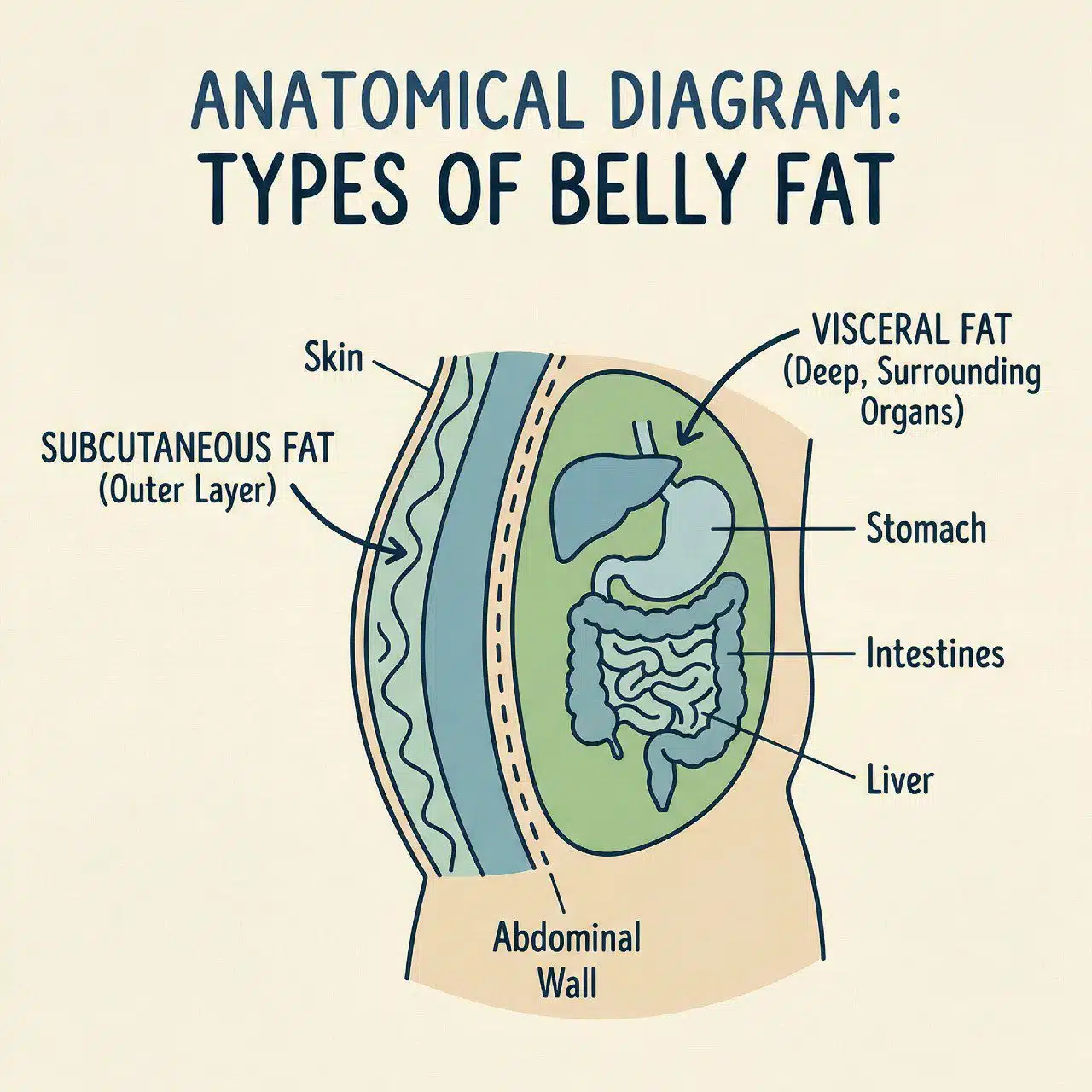
Subcutaneous fat sits under your skin. It's the soft layer you can pinch. Visceral fat sits deeper, around your liver and intestines.
In the Framingham Heart Study of 3,001 adults with an average age of 50, both types were linked to higher blood pressure, blood sugar and blood fats, but visceral fat was more strongly linked to most of these risk factors.
In women, the links between visceral fat and risk factors were consistently stronger than in men (Fox et al., 2007).
What Estrogen, Muscle And Metabolism Have To Do With It
A Mayo Clinic review explains that most midlife weight gain comes from aging itself, as muscle mass and activity fall and your body burns less energy.
The drop in estrogen then changes where that fat is stored, steering more of it to your midsection. Hot flashes, poor sleep and mood changes also make your usual routine harder to keep (Kapoor et al., 2017).
Your body isn't broken. It's responding to new conditions, and that's why losing weight feels so much harder in perimenopause. For the full picture of fat loss at this stage, see our guide to how to lose body fat after 40.
The Belly Fat Levers, In Brief
Each lever below has a full guide of its own. Here is what matters most for you in perimenopause, and where to read more.
Stress And Cortisol
When life is full, cortisol often runs high for long stretches. In a study of 59 premenopausal women, those carrying more fat around their middle released more cortisol under repeated lab stress, and lean women with central fat didn't get used to the stress over time (Epel et al., 2000).
That study shows a link, not proof of cause, but it fits what many women feel in midlife. Read why stress makes women gain weight around the middle, then work out whether you have a cortisol belly or a hormonal belly.
What You Eat
No single food burns belly fat, but two nutrients stand out. In a five-year study, every extra 10 g of soluble fiber a day was linked to a 3.7% slower build-up of visceral fat (Hairston et al., 2012).
Higher-quality protein spread across meals was linked to less central fat in another study (Loenneke et al., 2012). Both are observational, so treat them as strong hints. See which foods drive belly fat in perimenopause and our flat stomach diet for women over 40 with a 7-day plan.
Bloat Or Belly Fat?
Bloat comes and goes. If your stomach is flatter in the morning and rounder by evening, gas, fluid or digestion may be part of the story, and that calls for a different fix than fat loss. Use our guide to tell fat, bloat and a weak core apart, then follow the matching plan in how to get a flat stomach after 40.
Movement And Strength Training
Crunches build endurance, but six weeks of daily ab exercises didn't reduce belly fat in a controlled trial (Vispute et al., 2011). In a larger eight-month trial, aerobic exercise of about 12 miles a week reduced visceral fat, while strength training alone mainly reduced the fat under the skin (Slentz et al., 2011).
Strength training still matters after 40, because it protects the muscle you would otherwise lose with age. See what the research actually ranks for belly fat, start strength training in perimenopause, or follow our fat loss workouts for beginners over 40.
Sleep
Night sweats and early waking can cut your sleep short in perimenopause. In a small Mayo Clinic trial of 12 healthy adults, two weeks of restricted sleep increased fat around the belly, including visceral fat, while total body fat changed no more than with normal sleep (Covassin et al., 2022).
In another trial, when dieters had 5.5 hours of sleep opportunity instead of 8.5, the share of weight they lost as fat fell by 55% (Nedeltcheva et al., 2010). Both studies were small and included more men than women. Read how sleep affects weight loss in women.
Blood Sugar And Insulin
Long hours of sitting work against your blood sugar control. Light walking breaks during long sitting lowered blood sugar and insulin after meals more than standing breaks did (Buffey et al., 2022). Learn what insulin resistance in perimenopause means for your belly and what to do about it.

Which Lever First? Match Your Situation To Your Starting Point
You don't need to fix everything at once. Find the row that sounds most like you and start with that lever for two weeks. If more than one row fits, start with the one that feels easiest to keep.
| Your Situation | Likely Driver | First Lever To Pull | Go Deeper |
|---|---|---|---|
| Your waist is growing but your weight is steady, and your periods are changing | Fat shifting to your middle as estrogen falls, plus muscle loss | Two to three strength sessions a week and protein at every meal | Strength training in perimenopause |
| Wired at night, tired by day, with afternoon cravings | Stress and short sleep feeding each other | A fixed bedtime and a 10-minute wind-down | Cortisol and belly fat |
| Flatter in the morning, rounder by evening | Bloat rather than fat | Track meals and symptoms for a week and raise fiber slowly | Fat, bloat or core? |
| Sleepy and hungry after carb-heavy meals, and you sit most of the day | Blood sugar swings and low insulin sensitivity | A 10-minute walk after your largest meal | Insulin resistance in perimenopause |
| Hundreds of crunches and no change | Relying on spot reduction | Swap half your ab time for brisk walking or intervals | What the research ranks |
| Grazing all day and rarely full, with little protein at meals | Low protein and fiber | Build each meal around protein and a high-fiber food | Flat stomach diet and 7-day plan |
| The scale hasn't moved for weeks even though you're consistent | Measuring the wrong thing | Track waist-to-height once a month | How to track belly fat |
How To Track Belly Fat Without A Scan
You don't need a scan to follow your belly fat. Waist-to-height ratio is your waist measurement divided by your height. A review of studies covering more than 300,000 adults found it was better than BMI and waist size alone at flagging heart and blood sugar risk, in both women and men (Ashwell et al., 2012).
A simple guide is to keep your waist under half your height. In UK survey data, 35% of adults judged to be at no increased risk by BMI and waist size had a ratio of 0.5 or above (Ashwell and Gibson, 2016).
- Measure once a month, in the morning, before eating, at the same point in your cycle if you still have one.
- Keep the tape level around your middle, midway between your lowest rib and the top of your hip bone, and breathe out normally before reading it.
- Do the maths: if you're 165 cm (65 in) tall, half your height is 82.5 cm (32.5 in).
- Watch the trend, not single readings. Bloat can change your reading from day to day.
Your 5-Step Natural Belly Fat Reduction Protocol
Here is everything above in five daily priorities. Each one makes the others easier, so you get more from doing all five moderately than one perfectly.
Step 1: Eat Protein And Fiber At Every Meal
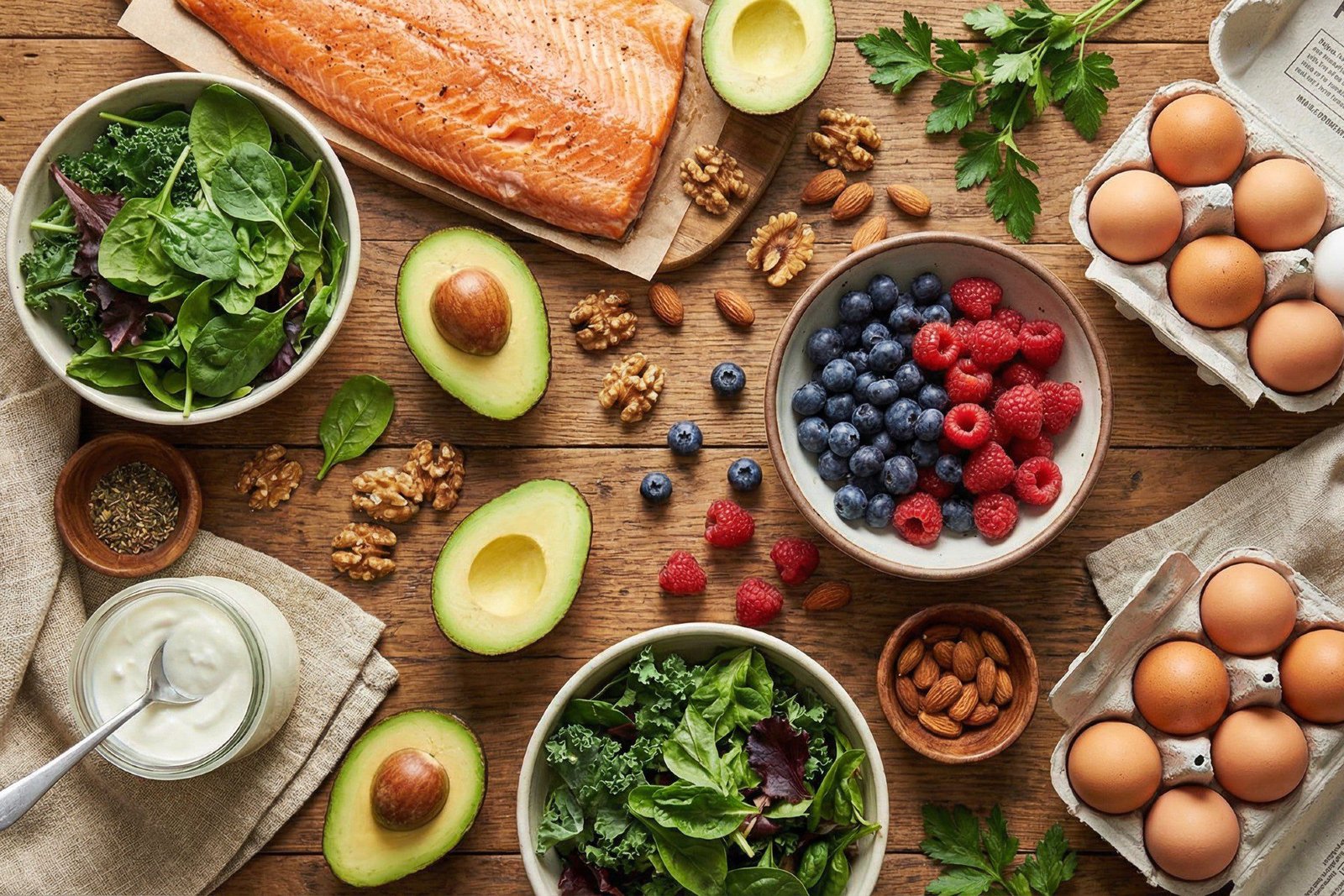
Build each meal around a palm-sized portion of protein and a high-fiber food such as beans, lentils, oats, vegetables or berries. Raise fiber slowly over a few weeks to avoid bloating.
Keeping it simple works: in a 12-month trial, adults with metabolic syndrome given one goal, to eat more fiber, lost nearly as much weight as those following the full American Heart Association diet (Ma et al., 2015).
Step 2: Strength Train Two To Three Times Per Week
US guidelines recommend muscle-strengthening work on at least two days a week (Physical Activity Guidelines for Americans, 2018). Focus on squats, hinges, rows and presses. Muscle protects your metabolism as you age and makes daily life easier.
Step 3: Move Every Day, Not Just On Workout Days
Aim for 150 to 300 minutes of moderate activity a week, such as brisk walking (Physical Activity Guidelines for Americans, 2018). Break up long sitting with short walks, especially after meals.
Step 4: Make Sleep Part Of Your Plan
Keep a consistent bedtime, a cool, dark room and a short wind-down. If night sweats or insomnia keep waking you, raise it with your doctor, because better sleep makes every other step easier.
Step 5: Manage Stress In Small Daily Doses
Ten minutes of slow breathing, a walk outside or journaling counts. You don't need an hour of meditation. You need a reset you'll actually do on a busy day.

Your First 30 Days: What To Change Week By Week
The most common reason a plan fails is changing everything at once. Add one layer a week so each habit sticks before you add the next.
- Week 1: Protein at every meal and a short walk after your largest meal.
- Week 2: Add soluble fiber gradually and drink a glass of water with each meal.
- Week 3: Protect your sleep with a set bedtime and a 10-minute wind-down.
- Week 4: Add two strength sessions and one daily stress reset, such as slow breathing or a walk outdoors.
Leave bigger changes such as intermittent fasting until month two, if you try them at all. Once the basics are steady, it's much easier to judge whether a new approach actually suits you. Take your first waist-to-height measurement on day one and your next on day 30.
Expert Commentary: What The Research Actually Shows
Strongest evidence. Visceral fat rises through the menopausal transition (Lovejoy et al., 2008; Greendale et al., 2019), and exercise reduces it. A meta-analysis of 117 studies found that both diet and exercise lower visceral fat, with exercise tending to have the larger effect (Verheggen et al., 2016).
Promising but observational. The fiber and protein findings come from people who were followed or surveyed, not randomized to eat differently (Hairston et al., 2012; Loenneke et al., 2012). They fit with trial evidence that simple, high-fiber eating supports weight loss (Ma et al., 2015).
Early but consistent. The sleep trials are short and small, with mostly male participants (Covassin et al., 2022; Nedeltcheva et al., 2010). They point the same way, and better sleep is worth having for its own sake.
What about hormone therapy? Mayo Clinic researchers note that menopausal hormone therapy doesn't change weight, though it may improve body composition, and it isn't recommended for weight management (Kapoor et al., 2017). If you're considering it for symptoms, that's a conversation for your doctor.
The Contrarian Take: Your Scale Is The Wrong Judge Of Belly Fat
Most belly fat advice is measured in pounds. The research suggests that's the wrong yardstick after 40.
In the SWAN cohort, weight gain didn't speed up at the menopause transition, but fat gain doubled while muscle declined (Greendale et al., 2019). The scale missed the change entirely.
It works the other way too. When exercise didn't lead to weight loss, it was still linked to about a 6% drop in visceral fat, while diet without weight loss changed it by about 1%. The authors concluded that body weight may be a poor marker of the benefits (Verheggen et al., 2016).
So if you're walking, lifting and sleeping better and the scale won't budge, don't quit. Measure your waist instead.
A New Perspective On Your Belly
The belly fat you're frustrated by is not a character flaw. It's a signal that your body is working under new conditions: shifting hormones, less muscle, shorter sleep and a fuller life.
Every one of those is workable without extreme restriction, punishing workouts or giving up the foods you love. You don't have a willpower problem. You need a plan that fits the body you have now.
The Bottom Line
Getting rid of belly fat naturally after 40 comes down to a few habits working together:
- Eat for fullness and muscle: protein and fiber at every meal.
- Move daily and lift twice a week: walking for visceral fat, strength training for muscle.
- Protect your sleep and give stress a daily outlet.
- Start with one lever from the Which Lever First table, then add the next.
- Track your waist-to-height ratio monthly, not just your weight.
Give each change at least a month. Belly fat came on gradually, and it comes off gradually, but it does respond.
Want the habits behind lasting weight loss? Get our free PDF, 10 Actions That Support Permanent Weight Loss: no restriction plans, no guilt, just what actually works for real women. Send Me The Free Guide.
Glossary Of Key Terms
- Visceral Fat: Deep abdominal fat around your organs, more closely linked to metabolic risk.
- Subcutaneous Fat: The fat just under your skin, the part you can pinch.
- Perimenopause: The years before your final period, when estrogen levels fluctuate and then fall.
- Estrogen: A sex hormone that rises and falls unevenly through perimenopause, then declines, and helps decide where your body stores fat.
- Lean Mass: The non-fat part of your body, including your muscle, which tends to shrink with age unless you challenge it with strength training.
- Waist-To-Height Ratio: Your waist measurement divided by your height. Under 0.5 is a common guide.
- Spot Reduction: The idea that working one area, such as doing crunches, burns the fat over it, which research does not support.
- Soluble Fiber: Fiber that forms a gel in water, found in oats, beans, lentils and many fruits.
- Insulin Sensitivity: How well your cells respond to insulin to move sugar out of your blood.
- Cortisol: A stress hormone that rises with physical or emotional strain and follows a daily rhythm.
FAQ
How Long Does It Actually Take To Lose Belly Fat Naturally?
Expect weeks to months, not days. In the trials above, changes in visceral fat were measured after eight months of exercise (Slentz et al., 2011) and over five years of lifestyle habits (Hairston et al., 2012). Measure your waist monthly so you can see progress the scale may miss.
Can You Get Rid Of Belly Fat Naturally Without Exercise?
Yes, diet alone can lower visceral fat, mostly through overall weight loss. Exercise adds something diet can't: it reduced visceral fat even when weight didn't change (Verheggen et al., 2016). If an injury limits you, see what diet works best when you can't exercise.
Why Is My Belly Fat Not Going Away Despite Diet And Exercise?
Common reasons are relying on ab exercises, short sleep, low protein, and judging progress by the scale alone. Perimenopause also shifts fat toward your middle while muscle declines (Greendale et al., 2019). Use the Which Lever First table above, and read why weight loss feels harder in perimenopause.
Does Drinking Water Help Reduce Belly Fat?
Water doesn't target belly fat, but it can help with overall fat loss. Adults aged 55 to 75 on a reduced-calorie diet who drank 500 ml of water before each main meal lost about 2 kg more over 12 weeks than those who didn't (Dennis et al., 2010).
What Causes Belly Fat In Women Specifically?
Mostly aging, with less muscle and less activity, combined with falling estrogen, which steers fat toward your midsection (Kapoor et al., 2017; Lovejoy et al., 2008). Short sleep, stress and long hours of sitting add to it.
Is Bloating The Same As Belly Fat?
No. Bloat changes through the day and often eases overnight, while fat changes slowly over weeks. If your stomach is flat in the morning and rounder by evening, bloat is likely part of it. See fat, bloat or core to tell them apart, and talk to your doctor if bloating is persistent or painful.
Where Does Belly Fat Go First When You Lose Weight Naturally?
You can't choose where you lose fat first, and ab exercises won't steer it (Vispute et al., 2011). The encouraging part is that deep visceral fat responds to exercise, even before the scale moves much (Verheggen et al., 2016).