
Hit A Weight Loss Plateau? Here's How To Push Through Without Punishing Yourself
Chuck Norris
American martial artist & actor
If you want to accomplish anything in life, you can’t just sit back and hope it will happen. You’ve got to make it happen.
Summary (TL;DR)
A weight loss plateau happens when your body adapts to your lower weight by burning fewer calories, moving less without you noticing, and turning up your hunger signals, so the deficit that used to work quietly disappears. For women over 40, declining oestrogen adds a second layer: faster muscle loss and more fat stored around the middle.
The fix is not to slash your food and punish yourself. It's to confirm it's a real plateau, then make small, targeted changes: track honestly, adjust calories up or down (or take a short diet break), train with progressive overload, move more all day and protect your sleep. Plateaus are normal, temporary and workable. Here's the science, the perimenopause factor and the exact plan.
You've been doing everything right. The scale was moving, your clothes were looser, and then nothing. Two weeks pass. Three. The number won't budge, and that quiet voice starts up: am I doing something wrong? Is my body broken? Was all of this for nothing?
First, breathe. You are not failing, and your body is not betraying you. A weight loss plateau is one of the most predictable, well-documented events in the entire weight loss process. It is so common that researchers consider it a normal phase rather than a problem. Crucially, it is one you can break through with a few precise changes rather than a crash diet.
What you're feeling (the frustration, the confusion, the temptation to throw in the towel) is real and valid. But the plateau itself is just biology doing exactly what biology does.
Below, we'll explain why it happens (so it stops feeling personal), show you why perimenopause changes the picture, give you our Plateau vs. Pause Method to figure out what you're actually dealing with, and walk through four science-backed ways to start losing again.
Medical & Referral Disclaimer
This article is for informational and educational purposes only. It is not a substitute for professional medical advice, diagnosis, or treatment. Always consult your physician or qualified health provider before starting any new diet or exercise program, particularly if you have an underlying health condition.
Key Takeaways
- A weight loss plateau is caused mainly by metabolic adaptation: as you lose weight, your body burns fewer calories, erasing your old deficit.
- Hunger hormones push back. Ghrelin rises and leptin falls as you lose fat, which is why a plateau can feel harder mentally than the early weeks.
- Perimenopause changes the equation. Declining oestrogen speeds up muscle loss and shifts fat storage toward the abdomen, which can make plateaus longer for women over 40.
- Plateaus commonly show up around the 6-month mark of a diet. Eating less and less is usually the wrong move; a short diet break at maintenance can work better than deeper restriction.
- Use the Plateau vs. Pause Method to confirm you're truly stuck before changing anything, because many short "plateaus" are really measurement noise.
- The levers that work: honest tracking, calorie recalibration, progressive strength training, more daily movement (NEAT), and protected sleep.

What A Weight Loss Plateau Actually Is (And Why It's Not Your Fault)
A weight loss plateau is when weight loss stalls for several weeks even though you're sticking to your plan, and it happens because your body has adapted to weigh less. As you shed pounds, you carry less mass around, so you simply need fewer calories to run. The calorie deficit that was melting fat in month one quietly closes on its own.
This isn't a willpower failure. It's a measurable physiological process called metabolic adaptation (or adaptive thermogenesis).
According to the clinical reference StatPearls' Management of Weight Loss Plateau, the plateau is driven by biological adaptations, a decreased resting metabolic rate, and hormonal changes that together slow continued weight loss, and they note the abrupt halt can also lead to real psychological discouragement.
In other words: science already knows the plateau messes with your head as much as your waistline. You're not imagining the frustration.
Here's the part that makes it click. Research on adaptive thermogenesis in humans shows that maintaining a 10%-or-greater drop in body weight is accompanied by roughly a 20 to 25% fall in 24-hour energy expenditure, and a chunk of that decline is bigger than your smaller body alone would explain.
Your body actively becomes more fuel-efficient to defend against further loss. It's an ancient survival feature, not a flaw in you.
When Plateaus Tend To Hit
You're statistically most likely to stall around the half-year mark. Diet studies repeatedly find weight loss flattening near 6 months in, as the gap between what you eat and what you burn closes.
Knowing the timing helps, because a stall at month six isn't a sign your diet stopped working; it's the textbook moment it was always going to get harder.
| What the research shows | The number | Why it matters to you |
|---|---|---|
| When plateaus typically appear | ~6 months in | Expect it. Plan for it instead of panicking. |
| Drop in 24-hr energy expenditure after ≥10% loss | ~20 to 25% | Your old deficit shrinks on its own; this is the core mechanism. |
| Portion of that drop beyond body-size change | Adaptive (extra) | Your body is actively defending its weight. |
Figures drawn from StatPearls and adaptive thermogenesis research.

Why Weight Loss Plateaus Happen: The Science Your Body Is Running
Three systems shift as you lose weight, and they all move in the same direction: toward burning fewer calories and wanting to eat more.
Metabolic Adaptation: Your Body’s Efficiency Upgrade
As you lose weight, your resting metabolic rate drops by more than your smaller body alone would predict, a well-documented response called metabolic adaptation. Your body becomes more efficient at running on fewer calories, which quietly narrows the deficit that was driving your progress.
A 2023 study in the American Journal of Clinical Nutrition found that the more pronounced this adaptation is, the greater the increase in hunger and appetite. Your body isn't just burning less; it's nudging you to eat more. That combination is exactly what a plateau feels like from the inside.
It's also why a calorie target you set months ago goes stale. It was calculated for your old weight and your old metabolism, so re-run it every 10 to 15 pounds lost.
Appetite Hormones Turn Up The Volume
Ghrelin, the hormone that signals hunger, rises as you lose weight, while leptin, the fullness hormone made by fat tissue, falls as fat mass drops. In the same research, these shifts tracked with people’s hunger ratings. This is a physiological signal, not a lack of discipline, which is why white-knuckling through a plateau on willpower alone tends to fail.
NEAT: The Calories You Stop Burning Without Noticing
Non-exercise activity thermogenesis (NEAT), the energy you burn walking, fidgeting and standing, tends to fall during a diet without you deciding to move less. Research on NEAT shows this unconscious drop can account for a meaningful share of the energy gap behind a stall. Step #4 below shows you how to win it back.
The Perimenopause Factor: Why Plateaus Hit Women Over 40 Differently
In perimenopause, a plateau is rarely just about calories in and calories out. Declining oestrogen reshapes body composition and fat storage, layering a second metabolic shift on top of the one every dieter experiences.
A four-year study in the International Journal of Obesity followed women through the menopausal transition and found an increase in visceral fat alongside a decrease in total energy expenditure. So if a plan that worked in your 30s has stopped delivering, it isn't because your effort has changed.
Here's the mechanism: oestrogen supports muscle protein synthesis, so as it declines, muscle tends to erode faster. Muscle is more metabolically active than fat, which is a big part of why metabolic adaptation hits harder in midlife.
Stress matters more now, too. Research in premenopausal women with obesity linked higher cortisol to greater abdominal fat storage, and midlife is often when caregiving, work pressure and broken sleep all peak at once. Blood sugar handling can shift as well; our guide to insulin resistance in perimenopause explains what to watch for.
What needs to change here isn't your discipline; it's your emphasis. Start with resistance training built for perimenopause, and get honest about what body recomposition looks like after 40. For the full hormonal picture, read why it’s so hard to lose weight in perimenopause.
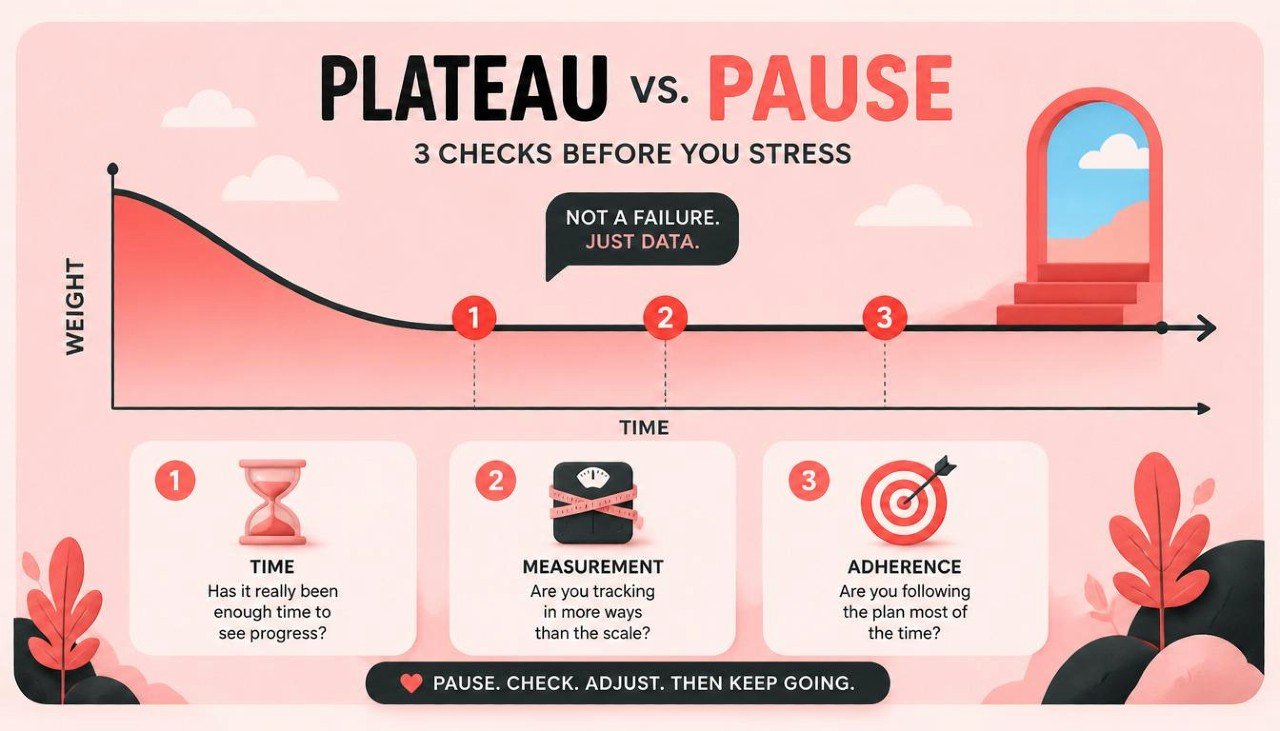
First, Is It Even A Real Plateau? The Plateau vs. Pause Method
Before you change a single thing, find out whether you're truly stuck, because most "plateaus" are just normal weight noise, and panic-cutting calories over a fake plateau is how good progress gets wrecked.
Here at Women's Lean Body Formula, this is the first thing we tell every woman who messages us in a panic. Run these three checks:
| Check | Ask yourself | If yes → |
|---|---|---|
| 1. The Time check | Has the scale genuinely not moved for 4+ weeks (not 4 days)? | It may be a real plateau. Under 3 weeks = likely a pause. |
| 2. The Measurement check | Are you weighing under the same conditions, and tracking inches and photos, not just the scale? | Water, hormones, and salt can swing the scale by several pounds. The tape may still be dropping. |
| 3. The Adherence check | Have portions, "just a bite," and weekend meals quietly crept up? | Your deficit may have closed without you noticing. Track for a week before assuming biology. |

If all three point to a genuine, weeks-long, well-measured, honestly tracked stall, then you have a real weight loss plateau worth solving. The four tips below are your toolkit. If even one check fails, you probably just need patience and consistency, not a new plan.
If you want a simple system for the measurement check, our guide on how to track your weight loss progress walks you through it, and weight loss vs fat loss explains why the scale and your body fat don't always move together.
How Long Do Weight Loss Plateaus Usually Last?
Most genuine plateaus resolve within a few weeks to a couple of months once you make a deliberate adjustment. A stall of a few days to two weeks is usually normal fluctuation, a pause rather than a plateau. How long a real one lasts depends mainly on:
- How close you are to your goal: the nearer you are to your body's natural range, the more resistance you're likely to meet.
- How stale your routine is: an eating or training pattern that hasn't changed in months gives your body nothing new to respond to.
- Your hormonal stage: perimenopause and postmenopause tend to make plateaus last longer, for the reasons above.
- Sleep and stress: both can quietly work against you, even when food and training are dialled in.
Expecting a plateau, and having a plan for it, is protective in itself. It stops a normal stall from feeling like proof that your approach has failed.
#1. Track Your Intake Honestly, For One Full Week
The fastest way to break a weight loss plateau is to find out where your calories are actually coming from, because they're rarely where you think.
Maybe you've been faithful to your lower-calorie diet, or maybe a birthday dinner, a few "just a taste" moments, and bigger pours of oil and dressing have quietly added up. Both are completely human.
When the scale stalls, log everything you eat for seven days using a food journal and a calorie-counter app. Weigh portions rather than eyeballing them, because research on dietary self-report consistently shows people underestimate what they eat, sometimes dramatically.

This isn't about guilt. It's evidence-gathering. The log will show you, in black and white, whether your deficit has quietly closed, which then tells you whether the real fix is tightening your eating habits or something else entirely.
#2. Recalibrate Your Calories, Up Or Down (The Contrarian Bit)
The instinct at a plateau is to eat less and less, and that's often exactly the wrong move. Because your metabolism falls as you lose weight, your calorie target genuinely does need updating, but the direction isn't always "down."
As Dr. Kevin Hall's research on metabolic adaptation makes clear, your energy needs shrink as your body shrinks, so the calorie intake that worked at your starting weight will eventually stop producing a deficit.
If your honest week of tracking (Tip #1) shows you're genuinely eating at maintenance for your new weight, a small trim helps: re-estimate your needs with a calorie calculator and cut modestly, but never crash. Sustainable, lasting fat loss rarely comes from severe restriction.
Here's the contrarian flip. If your tracking shows you've been eating very little for a long time, the smarter move can be to add calories back, not remove them. A chronically aggressive deficit drives the steepest metabolic adaptation and leaves you exhausted, ravenous, and stalled.
A short period of eating a bit more (especially protein) can settle hunger hormones and make a renewed, gentler deficit far easier to hold. Eating more to lose more sounds wrong; for over-restricted dieters, it's frequently the unlock.
This is the single most common mistake we see at Women's Lean Body Formula. A woman hits a stall, panics, and drops to 1,000 calories, and the plateau digs in harder, because her body reads the deeper cut as a bigger threat and clamps down further.
The lesson isn't "diet harder." It's "diet smarter": protect your metabolism instead of bullying it. Think of your calorie target like a thermostat, not a switch: small, evidence-led adjustments in the right direction, reassessed every two weeks, beat one dramatic cut every single time.
Diet Breaks Over Deeper Restriction
A structured diet break, a short planned period of eating at maintenance calories, can work better than pushing through with continuous restriction.
In the MATADOR trial published in the International Journal of Obesity, people who alternated two-week blocks of dieting with two-week blocks of maintenance eating lost more total weight (14.1 kg vs 9.1 kg) and preserved more resting energy expenditure than a matched group who dieted continuously.

In practice, a planned week or two at maintenance when you hit a genuine plateau isn't a setback. It can make the next phase of your deficit more productive, and it gives you a clean baseline to see how much protein, carbohydrate and fat you actually eat before you drop back into a deficit.
#3. Change The Stimulus, Not Just The Effort
To break a training plateau, change what you ask your body to do, not simply how hard you flog yourself. Increasing exercise duration or intensity burns more calories and nudges your metabolism, but the bigger win for women is building muscle, because muscle is metabolically active tissue that raises what you burn even at rest.
Some ways to shift the stimulus:
- Add 15 to 30 minutes to a session, or insert short bursts of higher-intensity exercise between steadier work.
- Prioritise strength training: progressively heavier resistance is the single most underused plateau-breaker for women.
- If you've run the same routine for months, change it: new movements, new rep ranges, new workout structure. A body that's adapted to your workout has stopped being challenged by it.
The principle is simple: your body adapts to repeated stress. Give it a new stress, and it has to respond again, which is exactly what you want at a plateau.
Progressive Overload Beats More Cardio
Adding more cardio is one of the most common plateau responses, and one of the least effective, because it does little to protect the muscle that sets your resting metabolic rate.
A 2025 review in Frontiers in Endocrinology found that combining a calorie deficit with structured strength training preserves substantially more lean mass than dieting alone or dieting with cardio only.
The practical lever is progressive overload: gradually increase the weight, reps or sets you lift over time instead of repeating the same session. If your workout plan hasn't changed in months, fix that before you touch your calories again.

#4. Move More All Day (The NEAT Factor)
The calories you burn outside the gym often matter more than the workout itself, and they're the first thing to quietly drop at a plateau. This is NEAT (non-exercise activity thermogenesis): every step, fidget, stair, and bit of standing.
As your body conserves energy during a diet, you unconsciously move less (slumping more, walking slower), which shrinks your burn without you noticing. Counter it deliberately:
- Stand and stretch every 30 minutes.
- Take calls on your feet and walk while you talk.
- Walk for short errands, take the stairs, park further away, and bank the steps.
None of these feels like "exercise," and that's the point. Reclaiming the NEAT your body has quietly switched off can reopen a meaningful deficit and help you keep burning unwanted fat, no extra sweaty sessions required.
Don't Forget Sleep And Stress
Two things silently sabotage a weight loss plateau even when your diet and training are perfect: poor sleep and chronic stress. High stress raises cortisol, which encourages fat storage (especially around the middle), while short sleep disrupts the hormones that govern hunger and fullness, so you feel hungrier and reach for more.
If you've tightened the four levers above and still feel stuck, look here next. Protecting 7 to 9 hours of sleep and lowering daily stress is not a "nice to have" at a plateau; it's often the missing lever.
The evidence here is strong. In a 2022 randomised trial in JAMA Internal Medicine, adults who extended their sleep by roughly an hour a night cut their daily energy intake by about 270 calories, with no other change beyond a sleep-hygiene coaching session.
Keep the stress tools simple and repeatable: a short yoga practice done safely or a few minutes of daily meditation fits into a full day without adding another big task.
Join our mailing list and grab our free guide: 10 Actions That Support Permanent Weight Loss. It covers the practical, sustainable habits that turn everything you just read into real, lasting results. Click Here To Join.

Common Mistakes That Keep You Stuck In A Plateau
Most plateau responses backfire because they pile more restriction onto a body that is already defending itself. These three show up most often:
- Over-restricting calories or cutting whole food groups. This can slow your metabolism further and leave gaps in your nutrition, and in more extreme cases it raises the question of whether the pace of weight loss has become unhealthy. Focus on food quality: protein, vegetables and whole grains. If you prefer structure to constant restriction, a well-designed intermittent fasting approach is one alternative to explore.
- Judging progress by the scale alone. Measurements, photos, how your clothes fit and your strength in the gym often keep moving when the scale doesn't.
- Repeating the same workout indefinitely. A routine your body has fully adapted to stops giving it a reason to change.
For the wider list of habits and myths that hold women back after 40, read the worst weight loss mistakes and myths.
When To Seek Professional Help
Most plateaus are a normal physiological response you can work through on your own, but some signs mean it's time to involve a healthcare professional.
- Disordered eating patterns. If you notice obsessive calorie counting or restrictive behaviours around food, speak with a professional before changing anything else. Understanding the psychology of weight loss can help too.
- Possible hormonal or thyroid issues. Thyroid disorders, PCOS and perimenopausal shifts can all make weight loss harder. If your plateau comes with fatigue, hair thinning or cycle changes, ask your doctor about testing.
- Medications. Some prescriptions can affect appetite or weight. Never stop or change a medication on your own; raise it with your prescriber.
- Emotional struggles. Negative body image, depression or anxiety can complicate weight loss and deserve support in their own right. Exploring the role of emotions in eating is often a useful first step.




Expert Commentary: What The Research Agrees On
The research teams behind the studies in this article reach strikingly similar conclusions, and none of them points to a lack of willpower.
Metabolic adaptation research shows that energy expenditure falls by more than body size alone explains after weight loss, and the 2023 American Journal of Clinical Nutrition work links that adaptation to rising hunger. Menopause researchers measured visceral fat rising and energy expenditure falling through the transition.
The MATADOR trial found that planned breaks from dieting beat continuous restriction, and the JAMA Internal Medicine sleep trial showed that more sleep alone reduced daily calorie intake. Taken together, the evidence favours adjusting gently and protecting muscle and sleep over cutting harder.
Contrarian Take: Holding Steady Can Be Progress
Most plateau advice treats every week without a loss as a problem to fix. We think that misses something. Holding a new, lower weight steady for a few weeks is practice for the skill you'll need for the rest of your life: maintenance.
A planned stretch at maintenance, while you keep lifting and protect your sleep, isn't lost time. For many women over 40, it's what makes the next phase of loss possible, and what keeps the weight off once you get there.
Want The Practical Next Steps? Get Our Free Guide
Everything in this article, from metabolic adaptation to the perimenopause factor, comes together in our free guide, 10 Actions That Support Permanent Weight Loss. No restriction plans. No guilt. Just what actually works for real women with real lives.
The Bottom Line
A weight loss plateau is frustrating, discouraging, and, please hear this, completely normal. It is not proof that you've failed or that your body is broken. It's the predictable, well-studied point where biology adapts and your old deficit closes.
The women who break through aren't the ones who punish themselves hardest; they're the ones who pause, confirm it's a real plateau, and make small, smart adjustments: track honestly, recalibrate calories in the right direction, change their training stimulus, and move more all day.
Be proud of the progress that got you here: every pound you've lost is real. Then run the Plateau vs. Pause Method, pick the lever that fits, and start losing again. You've got this.
Glossary Of Key Terms
- Weight Loss Plateau: A period of several weeks where weight loss stalls despite adherence to a diet and exercise plan, caused by the body adapting to a lower weight.
- Metabolic Adaptation: A measurable physiological process (also called adaptive thermogenesis) where the body burns fewer calories as it loses mass and becomes more fuel-efficient.
- NEAT (Non-Exercise Activity Thermogenesis): The energy expended for everything we do that is not sleeping, eating, or sports-like exercise, such as walking, standing, and fidgeting.
- Plateau vs. Pause Method: A three-step diagnostic tool involving time, measurement, and adherence checks used to determine if a weight stall is genuine.
- Calorie Deficit: A state where you burn more energy than you consume; the closing of this gap is the primary reason for a plateau.
- Resting Metabolic Rate: The rate at which the body burns energy while at rest; this rate typically decreases as body weight drops.
- Ghrelin: A hormone produced in the gut that signals hunger. It rises as you lose weight.
- Leptin: A hormone produced by fat cells that signals fullness. It falls as fat mass drops.
- Oestrogen: A primary female sex hormone that supports muscle protein synthesis; its decline in perimenopause can speed muscle loss and increase visceral fat.
- Visceral Fat: Fat stored inside the abdominal cavity around the internal organs, which often increases during the menopausal transition.
- Cortisol: A hormone released in response to stress that can encourage fat storage, particularly in the abdominal area.
- Training Stimulus: The specific type of physical stress applied to the body during exercise; changing this (e.g., new movements or weights) is required to prompt new adaptations.
- Progressive Overload: Gradually increasing the weight, reps or sets in your strength training to keep challenging your body.
- Diet Break: A planned, temporary period of eating at maintenance calories to ease metabolic adaptation and hunger signals.
- Maintenance Calories: The number of calories needed to keep your current weight steady.
- Adherence Check: An honest evaluation of whether calorie intake has quietly increased over time through unlogged snacks or larger portion sizes.
- 10% Rule: The observation that a 10% or greater drop in body weight often triggers a disproportionate 20 to 25% drop in total daily energy expenditure.
FAQ
What Is A Weight Loss Plateau, And Why Does It Happen?
A weight loss plateau is when weight loss stalls for several weeks despite sticking to your diet and exercise. It happens because your metabolism adapts to your lower weight, burning fewer calories, so the deficit that once worked closes. Falling resting metabolic rate, hormonal shifts, and small drops in adherence all feed into it.
How Long Does A Weight Loss Plateau Last?
It varies, but a genuine plateau commonly lasts several weeks before progress resumes, especially once you make small adjustments that reopen a calorie deficit. If the scale has only been still for a few days to two weeks, it's usually normal fluctuation, a pause, not a plateau.
How Do I Know If It's A Real Plateau Or Just Water Weight?
Use the Plateau vs. Pause Method: confirm the scale hasn't moved for 4+ weeks, weigh under consistent conditions while also tracking inches and photos, and honestly check whether portions have crept up. Water, salt, and hormonal shifts can mask fat loss on the scale for days at a time.
Can A Weight Loss Plateau Be A Sign Of A Larger Health Issue?
Occasionally. If your plateau lasts far longer than expected or comes with other symptoms like fatigue, hair thinning or cycle changes, it's worth ruling out a thyroid disorder, PCOS or another hormonal condition with your doctor.
Are Weight Loss Plateaus Different For Women In Perimenopause?
Yes. Declining oestrogen speeds up muscle loss and shifts fat storage toward the abdomen, which adds to the standard metabolic adaptation every dieter experiences and can make plateaus longer and more frequent.
Do Diet Breaks Actually Help Break A Plateau?
They can. Research on structured diet breaks shows they can preserve more resting metabolic rate than continuous dieting, and in at least one controlled trial they led to greater total weight loss over the same period.
Is Strength Training Really Necessary To Break A Plateau?
It isn't strictly required to lose the first pounds, but it becomes increasingly important at a plateau because it's your main lever for preserving the muscle that sets your resting metabolic rate. That protects the deficit you're relying on.