
How Your Brain Makes You Fat — And The "All-Or-Nothing" Trap That Keeps You There
Shannon Miller
Olympic Gold Medalist
There is always going to be a reason why you can’t do something; your job is to constantly look for the reasons why you can achieve your dreams.
Summary (TL;DR)
Your brain makes you fat less through hunger and more through a thinking bug: the "all-or-nothing" reflex. One cookie at 10 a.m. gets filed as "day ruined," so you eat freely until midnight and restart "tomorrow." Researchers call the spiral after a slip the abstinence violation effect, and it predicts less weight loss. The fix isn't more willpower — it's treating each new five minutes as a clean slate. Your body fat reflects the cumulative total of your choices, not how many "perfect" days you string together.
Have you ever written off an entire day of eating before lunch — just because of one doughnut? That single mental move, repeated over months, does more to keep body fat on your frame than the doughnut ever could. This article is about how your brain makes you fat through that pattern, and the small, evidence-backed reset that breaks it.
Weight gain looks like a belly-and-diet problem. But one of your biggest obstacles lives between your ears. How you eat, how you feel after you eat, and how you react to a slip all shape whether the fat stays or goes. Here's how your mind quietly runs your body — and the practical thing you can do about it starting today.
You're not lazy, and you don't lack discipline. You've been fighting a wiring quirk that almost every woman who has ever dieted knows by heart. Once you can see it, you can out-think it.
Medical & Referral Disclaimer
This article is for informational and educational purposes only. It is not a substitute for professional medical advice, diagnosis, or treatment. Always consult your physician or a qualified health provider before starting any new nutrition or exercise programme — especially if you have a history of disordered eating.
Key Takeaways
- The real saboteur is a category, not a craving. Your brain loves to file things as "ruined" so it can stop trying — and a half-eaten cookie is enough to trigger it.
- The all-or-nothing spiral has a name. The abstinence violation effect is the guilt-and-give-up reaction after a slip; in dieters, it predicts smaller weight loss.
- Body fat is cumulative, not categorical. What you weigh depends on the running total of your decisions — not on collecting flawless 24-hour periods.
- Self-criticism backfires; self-compassion works. In a controlled study, women who were coached to be kind to themselves after "breaking" their diet ate less afterwards rather than more (Adams & Leary, 2007).
- The reset beats the restart. Treat every five minutes as a fresh mini-day. The cookie you ate has zero bearing on the cookies you won't eat next.

How Your Brain Makes You Fat: The Real Mechanism
Your brain doesn't make you fat by being weak. It makes you fat by being efficient. The human brain is a relentless sorting machine — it categorises things so it can stop spending energy on them and move on. And one of its favourite folders is labelled hopeless case.
In evolutionary terms, that shortcut kept us alive. No sense chasing a prey animal that's simply too fast. The problem is that the same brain now applies give-up, its gone logic to a day of eating — and a day of eating is not a gazelle. It's fully within your control, right up until you decide it isn't.
So before we talk about hormones and dopamine, understand the headline: the most fattening thing your brain does isn't generating hunger. It's quietly dropping your effort into the "cannot change" folder the moment you slip.
Categorising Things: Why One Slip Feels Like A Ruined Day
The brain files a single slip as total failure because it craves a clean binary — and "ruined" is simpler to store than "mostly good with one wobble."
Think about how many diet days you've abandoned before 10 a.m. — even after a brilliant start. You woke to yoghurt and tea, made it to the gym before work, felt clean and capable. Then someone left doughnuts in the kitchen. One bite, and that lovely feeling of purity is "gone." By lunch you're thinking, might as well have the burger and dessert too.
It's an oddly religious sentiment when you look at it head-on. We treat our days like souls: once stained, useless — so we might as well stain them some more. That's not biology talking.
That's the categorising brain, and the old prayer makes it worse: grant me the serenity to accept the things I cannot change. Lovely words — but we're far too quick to shove things we can still control into the "cannot change" box.

Symptom Of Perfectionism: The Hidden Driver
All-or-nothing eating is usually perfectionism wearing a disguise — and the stronger the need to be "perfect," the longer the binge that follows a slip.
Cognitive behavioural therapists have long flagged all-or-nothing thinking as a hallmark of perfectionism. And here's the cruel irony: the more fiercely you need the day to be flawless, the more completely you write it off once it isn't. You'll keep eating "badly" for a full 24 hours, waiting for the clean slate of a brand-new morning to be perfect all over again.
But your metabolism is not a perfectionist. Your sugar metabolism may affect your mood, but it is not itself a mood. It has no sense of purity. It doesn't get disgusted with itself when a cookie arrives — and it certainly doesn't demand more cookies to keep the first one company. The shame is something your mind adds. Your body just quietly processes the calories and waits for the next instruction.
This is also why "I lost my motivation" is rarely the true story. Search the questions women actually type — lost my motivation to lose weight, no motivation, how to find it again — and underneath most of them is this same perfectionist reflex: one imperfect day convinced them the whole effort was pointless.
The "Ruined Day Reflex": A Simple Framework For The Spiral
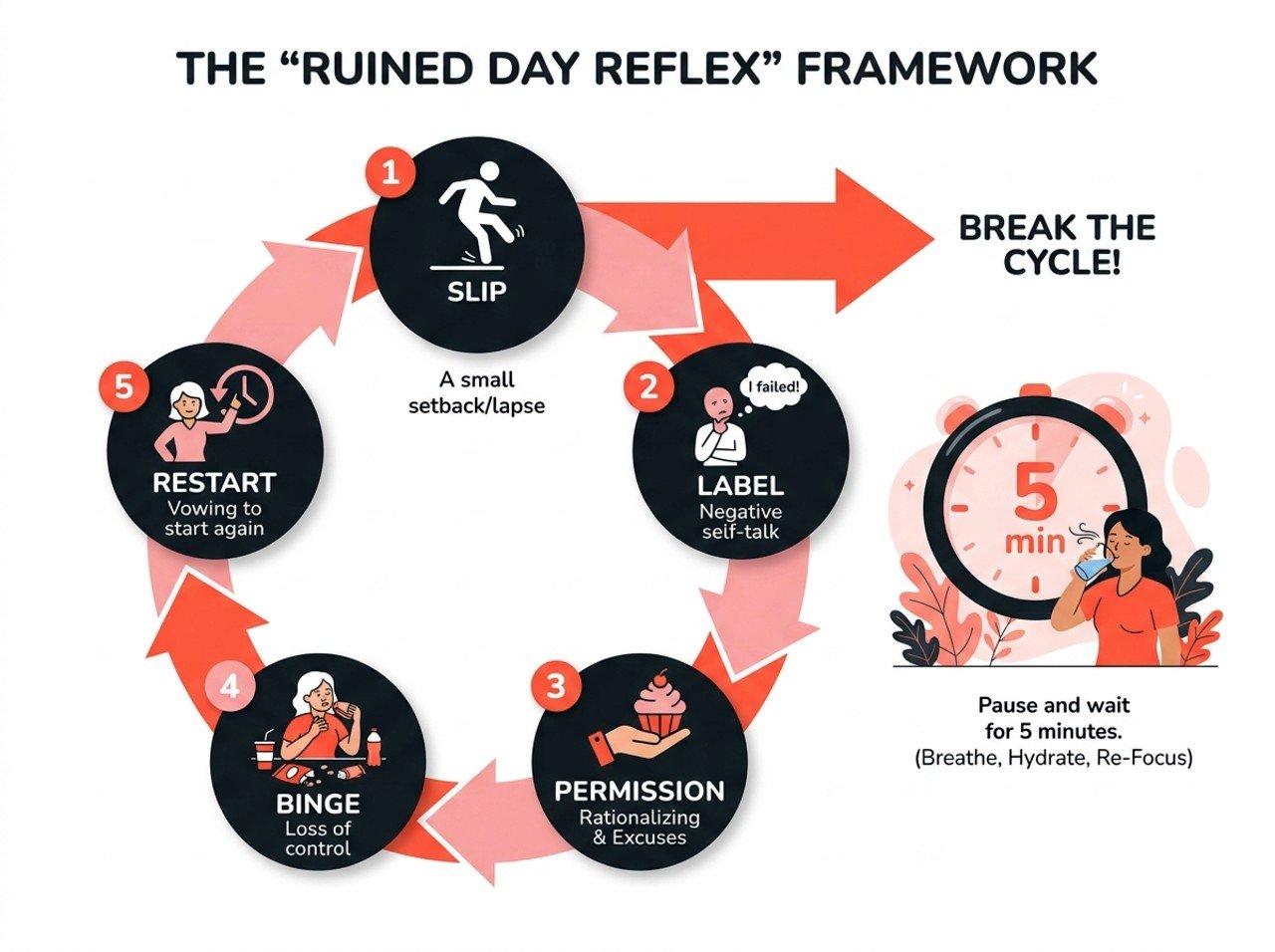
The Ruined Day Reflex is the chain reaction that turns one small slip into a wasted day — and it runs on autopilot until you name it.
We coined this term inside the Women's Lean Body Formula community because women kept describing the same sequence, in the same order, almost word for word. Naming it matters: you can't interrupt a pattern you can't see. Here's the chain:
- Slip — one off-plan bite (the doughnut).
- Label — the brain files the day as "ruined / impure."
- Permission — "it's already blown, so why not."
- Binge — hours of free eating until bedtime.
- Restart vow — "I'll be perfect tomorrow / Monday."
Each loop feels like a fresh failure, which feeds the perfectionism, which primes the next loop. The damage was never the single slip in step one. It was steps three and four — the reaction — repeated week after week.
This isn't just a tidy story. The reaction in steps two and three has been measured in a lab, and it has a clinical name.

Fat And Cumulative Effects: What Actually Determines Your Weight
Your body fat depends on the running total of every choice you make — not on how many flawless 24-hour periods you can collect.
This is the single most freeing fact in this entire article, so read it twice. What you weigh, and the percentage of body fat you carry, is a sum. It adds up thousands of small decisions. It does not award bonus points for purity or deduct your whole balance for one mistake.
The global health data lands in the same place. The World Health Organization describes overweight and obesity as resulting from a long-run imbalance between energy taken in and energy used — a cumulative equation across time, not a single catastrophic day. One doughnut cannot tip that ledger. Forty consecutive "well, the day's ruined anyway" evenings absolutely can.
So if you can't stop sorting your eating into pure and impure — with "impure" handing you a green light to make it worse — at least shrink the unit. Stop thinking in days. Start thinking in five-minute windows. Fine: five minutes ago was a mess of Oreos. That has no bearing whatsoever on the next five minutes. None.
The Science Of The Spiral: The Abstinence Violation Effect
The abstinence violation effect is the guilt-plus-"why-bother" reaction after breaking a rule — and in dieters, the stronger it is, the less weight they lose.
This is where the research gets specific. In a study of 76 patients on a very-low-calorie programme, those who blamed a lapse on their own character ("I'm a failure, I have no willpower") lost a smaller percentage of their excess weight than those who saw the same slip as a one-off situation (Mooney et al., 1992). The slip itself wasn't decisive. The story they told about it was.
That's the Ruined Day Reflex with a citation attached. The lapse is survivable. The characterological verdict — this proves I can't do this — is what predicts the worse outcome.

Self-Compassion Beats Self-Criticism (And There's Proof)
Being kind to yourself after a slip makes you eat less, not more — the opposite of what most dieters fear.
If you've ever assumed that going easy on yourself is "letting yourself off the hook," here's the plot twist. Researchers had women with strict, rule-bound eating habits eat a doughnut — a classic "forbidden food."
Half were gently coached to be self-compassionate about it ("everyone eats unhealthily sometimes; don't be hard on yourself"). The other half got nothing. In a later "taste test," the self-compassion group ate less than the control group (Adams & Leary, 2007).
Read that again, because it rewires everything. The kindness didn't trigger a binge. The guilt did. Self-criticism is not the brake on overeating — it's frequently the accelerator.
A Quick Word On Dopamine And Cravings
Dopamine doesn't measure pleasure so much as prediction — it spikes in anticipation of a reward, which is why the craving often hits harder than the cookie itself.
There's a real neurochemical layer here, and it's worth understanding so you stop blaming your character for it. Highly palatable foods — sugar, salt, fat together — reliably trigger dopamine, the brain's reward-and-motivation signal.
Brain-imaging research has linked obesity to altered dopamine reward circuitry, with some people effectively seeking food to top up an under-responsive reward system (Volkow, Wang & Baler, 2011).
But notice what this does and doesn't mean. It means cravings are partly biological — not a personal moral failing. It does not mean you're doomed. Dopamine responds to patterns, and patterns are exactly what the five-minute reset rebuilds.
Join Our Mailing List
Join thousands of women inside our community and receive our free guide, 10 Actions That Support Permanent Weight Loss — the exact behavioural shifts that make the difference between a two-week attempt and a lasting transformation.
No restriction plans. No guilt. Just what actually works — for real women with real lives.
The Reset, Not The Restart: Your Practical Fix
Instead of waiting for a perfect tomorrow, restart your next five minutes — the smallest unit small enough that no slip can "ruin" it.
This is the habit we teach inside the Women's Lean Body Formula community, and it works precisely because it's almost insultingly small. The "restart Monday" plan fails because it leaves you a free-eating window of hours or days. The reset closes that window to five minutes. Here's how to run it:
- Name the reflex out loud. "That's the Ruined Day Reflex." Naming it strips its power and pulls you out of autopilot.
- Accept the slip, refuse the verdict. Use the serenity idea correctly: accept the cookie you already ate (you can't change it) — and reject the lie that it dictates the next bite.
- Reset to the next five minutes. Not tomorrow. Not Monday. The next five minutes is a fresh mini-day, and you're fully in charge of it.
- Swap the guilt script for the kind one. "Everyone slips. This is normal. Moving on." The research says this makes you eat less, not more.
- Surf the day in hours. Don't white-knuckle 24 hours. Get through this hour, then the next.
Ruined Day Reflex vs. The Reset Mindset
This table is built to be screenshotted and stuck on your fridge.
| Situation | Ruined Day Reflex (keeps fat on) | Reset Mindset (takes fat off) |
|---|---|---|
| You eat one doughnut at 10 a.m. | "Day's ruined. Start over Monday." | "One slip. The next five minutes are clean." |
| You feel guilty afterward | Spiral into more eating | "Guilt's the trap. Be kind, move on." |
| Lunchtime arrives | "Already blown — get the burger too." | "Fresh hour. Order what I planned." |
| You think about your weight | "I have no willpower." | "My weight is a running total, not one day." |
| Tomorrow morning | Restart the perfect-or-nothing cycle | Keep surfing, hour by hour |

How Your Brain Sabotages Weight Loss: At A Glance
A fast reference for the mechanisms covered above and what to do about each.
| Brain mechanism | What it does | Your counter-move |
|---|---|---|
| Categorising reflex | Files a slip-up day as "hopeless," ending effort | Shrink the unit to five minutes |
| Perfectionism | Demands flawless days; one slip = total write-off | Aim for "good enough, most of the time" |
| Abstinence violation effect | Guilt + self-blame after a lapse → worse results | Blame the situation, not your character |
| Self-criticism | Feels like discipline; actually fuels overeating | Self-compassion script after a slip |
| Dopamine reward | Drives anticipation and cravings | Rebuild patterns; don't moralise the craving |
Join thousands of women inside our community and get our free guide, 10 Actions That Support Permanent Weight Loss — the practical, sustainable habits that turn everything you just read into real, lasting results.
The Bottom Line
Now you can see the machinery — and seeing it is most of the battle. Your brain makes you fat not by being hungry, but by being a tidy little filing clerk that drops your whole day into the "ruined" folder the second you slip.
The way out isn't a stricter diet or a deeper reserve of willpower you've somehow been hiding. It's a quieter, kinder, far more powerful skill: accepting the mistake you just made without pre-spending the mistakes you haven't made yet.
Until you start treating your body as an organism rather than a temple, fat loss will feel like an exhausting tightrope between "perfect" and "ruined." Step off the rope.
Trade the restart for the reset, the guilt script for the kind one, the 24-hour verdict for the five-minute fresh start. Peace with your body isn't only about forgiving the last slip — it's about refusing to let it write the next chapter.
You've got the why. Now let's give you the how.
Glossary Of Key Terms
- Abstinence Violation Effect: A psychological phenomenon where a lapse in a self-imposed rule leads to feelings of guilt and a subsequent loss of control, resulting in further rule-breaking.
- All-or-Nothing Thinking: A cognitive distortion where things are seen in black-and-white categories (e.g., "perfect" vs. "ruined"), leading to the abandonment of goals after a minor setback.
- Cumulative Total: The sum of all dietary and lifestyle choices over a long period, which determines body weight more than any individual day of eating.
- Dopamine: A neurochemical responsible for reward and motivation that spikes in anticipation of rewards, reinforcing patterns of behavior and cravings.
- Five-Minute Reset: A practical strategy of treating every five-minute window as a fresh start, preventing a single slip from influencing future choices.
- Leptin: A hormone tracked by the brain to monitor fat stores; when levels drop, the brain may signal the body to eat more and burn less energy.
- Perfectionism: In this context, a hidden driver of overeating that demands flawless adherence to a diet, ironically leading to longer binges when a slip occurs.
- Ruined Day Reflex: A term used to describe the automated chain reaction where one off-plan bite leads to a labeled "ruined" day and subsequent hours of unrestricted eating.
- Self-Compassion: The practice of being kind to oneself after a mistake; research shows it reduces subsequent overeating by eliminating the guilt that fuels binges.
- The Reset Mindset: A cognitive approach focused on the immediate next choice rather than waiting for a "restart" (like a new morning or Monday) to resume healthy habits.
FAQ
Can Too Much Thinking Really Make You Fat?
Not "thinking" itself — but a specific pattern of thinking can. The all-or-nothing reflex turns one small slip into a whole day of overeating, and repeated over months, that pattern adds far more body fat than any single food. Separately, your brain defends its fat stores by tracking the hormone leptin, nudging you to eat more and burn less when levels drop. Both are brain-driven — and both can be worked with.
What Is The Abstinence Violation Effect?
It's the burst of guilt and self-blame you feel after breaking a diet rule, followed by "well, I've blown it, so why bother?" In a study of 76 dieters, those who blamed their own character for a lapse lost less weight than those who chalked it up to circumstances. The slip is survivable; the self-condemnation is what does the damage.
What Role Does Dopamine Play In Weight Gain?
Dopamine is your brain's reward-and-motivation chemical. Foods high in sugar, salt and fat trigger it, which reinforces the urge to eat them again — and brain-imaging research links obesity to altered dopamine reward circuitry (Volkow, Wang & Baler, 2011). The useful takeaway: cravings are partly biological, not a character flaw — and patterns, not punishment, are what reshape them.
Does Being Kind To Myself After A Slip Just Make Me Eat More?
The opposite, according to the research. Women coached to be self-compassionate after eating a "forbidden" food went on to eat less than those given no strategy (Adams & Leary, 2007). Guilt is the accelerator for overeating; self-compassion is the brake.
What Actually Determines My Weight, Then?
The cumulative balance of energy in versus energy out over time — not how many "perfect" days you string together. The World Health Organization frames overweight as a long-run energy imbalance. Your weight is a running total, which is exactly why a single slip can't break it.
How Do I Stop The All-Or-Nothing Cycle?
Shrink the unit. Instead of writing off the whole day and "restarting Monday," reset your next five minutes. Name the reflex when it shows up, accept the slip you already made, swap the guilt script for a kind one, and surf the day hour by hour. Small unit, fresh start, no waiting.
What If My Motivation To Lose Weight Is Just Gone?
"Lost motivation" is often the Ruined Day Reflex in disguise — one imperfect stretch convinced your brain the whole effort is pointless. You don't need to summon a heroic surge of willpower. You need a smaller restart point. Reset the next five minutes, rebuild one easy habit, and let consistency — not intensity — do the work.