

Understanding The Science Behind Why Diets Make You Fatter

I grew up with the belief that good health is about moderation in all things.
Pippa Middleton ‧ British socialite, author and columnist
Summary (TL;DR)
Moderation is easy to say and hard to practice once a diet has already convinced your body it's starving, which is exactly the bind this article is about. Nobody said life was fair. After weeks of deprivation on some crazy diet (again) and minimal weight loss (again), you lost control and ate like nuts for a week, and now you’re even fatter.
Again… But quit banging your head on your desk for a second and listen, because it isn’t a willpower problem. It’s biology, and it’s measurable.
Medical & Referral Disclaimer
This article is for informational and educational purposes only. It is not a substitute for professional medical advice, diagnosis, or treatment. Always consult your physician or a qualified health provider before starting any new diet or exercise program, particularly if you have a history of disordered eating or an existing thyroid, hormonal, or cardiovascular condition.
Key Takeaways
- Severe restriction lowers leptin and raises ghrelin, which is why hunger gets more intense the longer a crash diet runs, not less.
- A very low-calorie diet can suppress T3 thyroid hormone by more than half within weeks, slowing the rate you burn calories at rest.
- Weight cycling is associated with worse cardiovascular health scores in women, according to Columbia University research presented to the American Heart Association.
- Qualitative research from North Carolina State University found that weight stigma, not lack of willpower, is what pulls most people back into the cycle.
- Sustainable results come from a moderate, livable deficit combined with self-compassion, not from finding a stricter plan.

Why Restrictive Diets Keep Backfiring On You
Diets keep backfiring because your body treats severe calorie restriction as a threat and fights back, not because you lack discipline. If you’ve dieted hard, lost weight, and then watched it come back with reinforcements, you ran into a well-documented physiological response that researchers have been measuring for decades.
This article breaks down what’s actually happening inside your body and mind when a diet backfires, introduces a framework we use at Women’s Lean Body Formula to help women recognize the pattern before it repeats, and walks through what the research says actually works instead, including a real story from inside our own coaching community.
We’re also going to talk about the part most weight-loss content skips: the intimidation, frustration, and confusion that come with feeling like your body is working against you. That reaction is normal. It’s also fixable.
What Actually Happens Inside Your Body When You Diet Too Hard
Severe calorie restriction sets off a chain of hormonal changes designed to protect you from what your body reads as famine, and those changes are the direct mechanism behind why diets make you fatter over time. Three systems shift almost immediately: your appetite hormones, your stress hormone, and your thyroid.
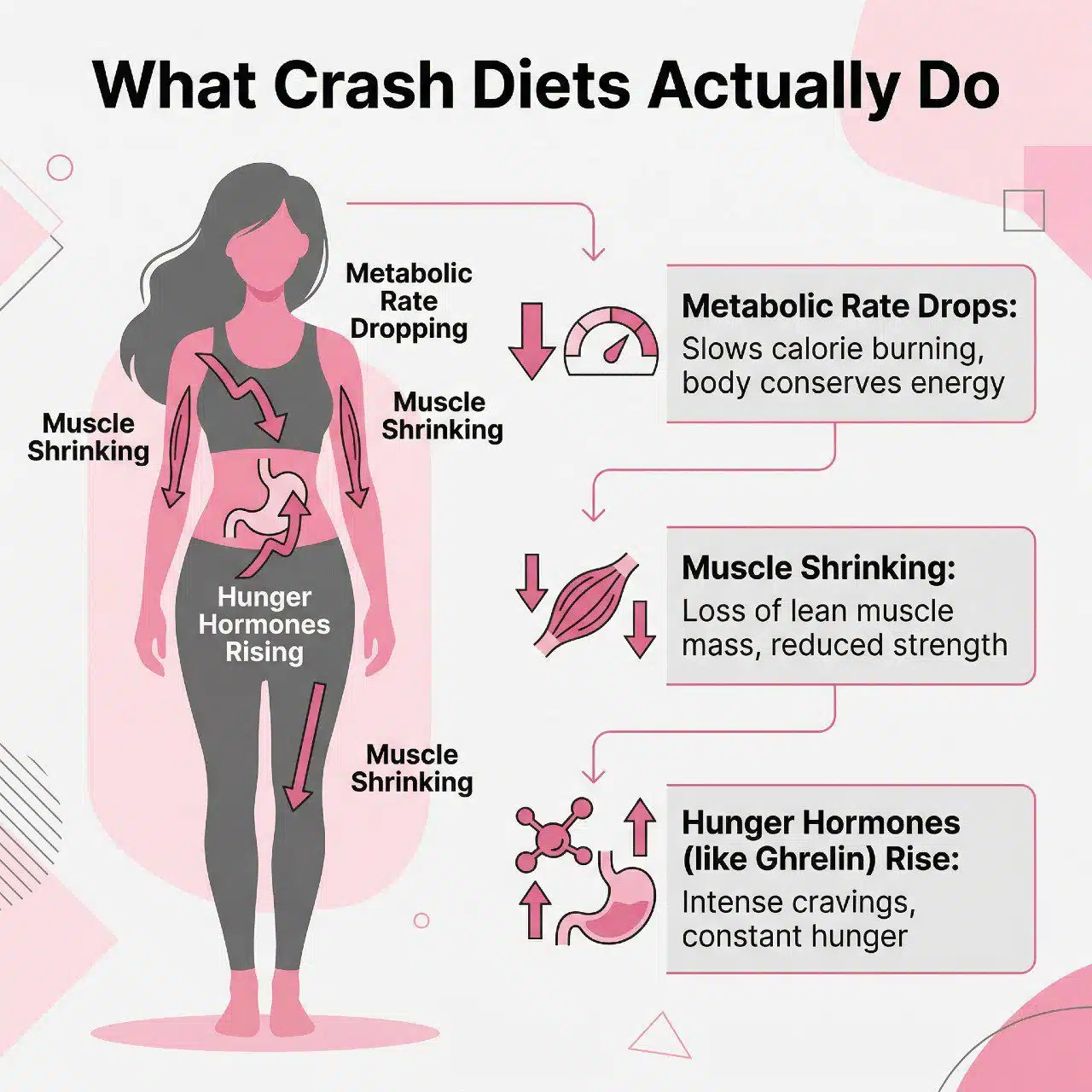
Cutting calories hard drops leptin, the hormone that signals fullness, while raising ghrelin, the hormone that drives hunger. That combination is confirmed in controlled calorie-restriction research on leptin suppression during restriction.
Ghrelin doesn’t just make you hungrier; it also triggers a measurable spike in cortisol, your primary stress hormone, which increases appetite and encourages your body to store fat around the abdomen rather than release it.
Meanwhile, your thyroid throttles back. In a controlled study of women on a very low-calorie diet, T3 thyroid hormone dropped by as much as 66 percent, and even after refeeding, it remained more than 20 percent below baseline. T3 governs how fast you burn calories at rest, so when it drops, your resting metabolism drops with it.
A 2024 analysis of the CALERIE-2 trial, one of the longest controlled calorie-restriction studies in humans, confirmed this metabolic adaptation persists well beyond the diet itself, and a 2024 review of individual variability in weight management found these hormonal adaptations differ significantly from woman to woman, which is exactly why the same diet can flatten one friend and barely touch another.
| What’s Shifting | What The Research Shows | How It Feels To You |
|---|---|---|
| Leptin (fullness signal) | Drops with severe calorie restriction | You never feel satisfied, even after eating |
| Ghrelin (hunger signal) | Rises, and stimulates cortisol release | Constant, intrusive thoughts about food |
| Cortisol (stress hormone) | Elevated by both restriction and the stress of dieting | Cravings, poor sleep, stubborn midsection fat |
| T3 (thyroid hormone) | Can fall by 50–66% on very low-calorie diets | Feeling cold, sluggish, and stuck despite eating less |

Does Yo-Yo Dieting Permanently Slow Your Metabolism?
Not permanently for most women, but repeated cycles raise your cardiovascular risk even if your metabolism itself recovers.
A Columbia University study presented to the American Heart Association followed 485 women and found that more than 70 percent had experienced at least one episode of weight cycling, and those with the most episodes scored worse on standard cardiovascular health measures: 82 percent less likely to have an optimal BMI, regardless of menopause status.
Earlier research on lean women found a similar mechanism at a body-composition level: repeated cycles of loss and regain can gradually shift the fat-to-muscle ratio, which is how dieting can make even naturally lean bodies fatter over time.
The metabolism bounces back faster than the cardiovascular strain does, which is the part most diet culture conversations leave out entirely.
The Diet Backfire Loop: An Original Framework For What’s Really Happening
The Diet Backfire Loop is the six-stage pattern we use at Women’s Lean Body Formula to help clients see the cycle from the outside, because once you can name a stage, you can interrupt it.
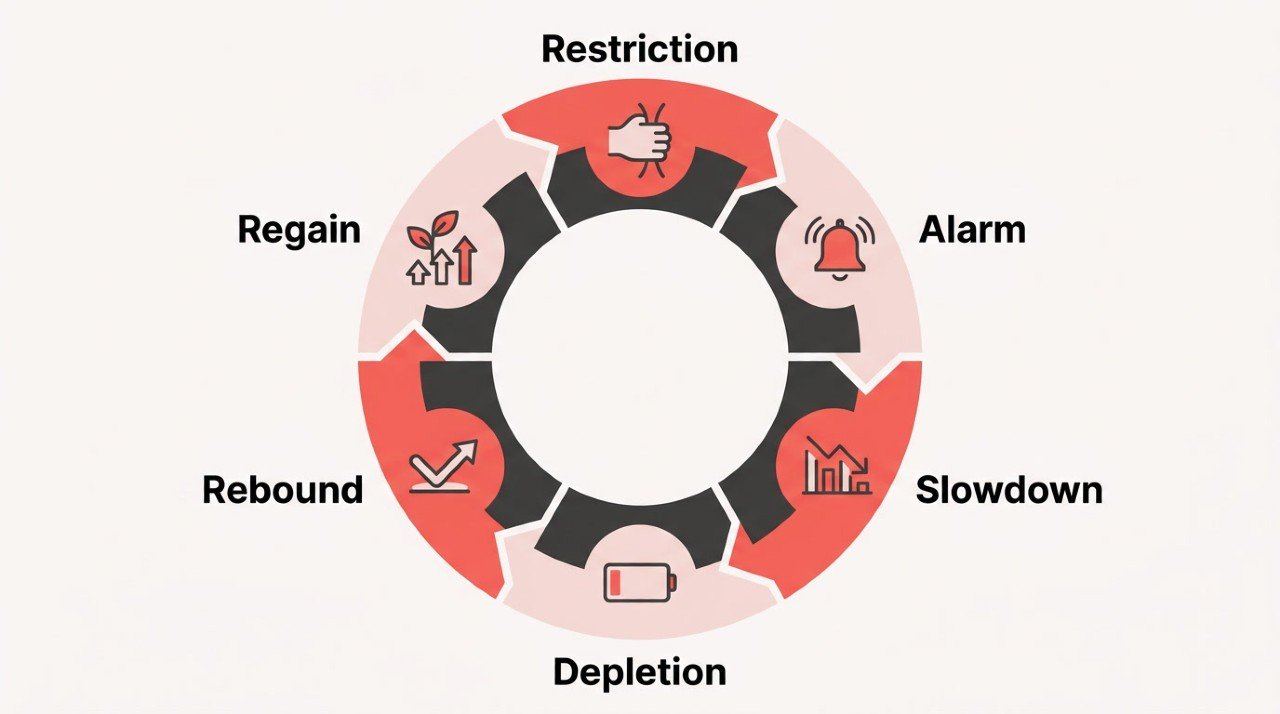
- Restriction. You cut calories hard, often to hit a deadline: a wedding, a holiday, a milestone birthday.
- Physiological Alarm. Leptin drops, ghrelin and cortisol rise within days, not weeks.
- Metabolic Slowdown. Thyroid output falls, and your resting calorie burn quietly drops with it.
- Psychological Depletion. Food becomes the only thing you can think about, a documented effect of prolonged restriction, not a character flaw.
- Rebound Eating. Your body, now primed by weeks of hormonal alarm signals, drives you toward calorie-dense food to correct the perceived famine.
- Regain & Self-Blame. Weight returns, often with a little extra, and shame sets the stage for the next round of restriction.
That last stage is where the loop gets its power: shame is what sends most people back to Stage 1.
The Emotional Weight Nobody Talks About
The frustration and confusion you feel after a diet backfires are a documented, common response, not a sign you did something wrong.
A 2024 qualitative study out of North Carolina State University interviewed 36 adults who had experienced weight cycling and found that almost none of them started dieting for health reasons; nearly all cited social pressure and comparison to peers or celebrities.

Regaining the weight, the researchers found, led to shame that “left study participants feeling worse about themselves than they did before they began dieting,” which in turn pushed many toward more extreme behavior next time. That’s the exact mechanism behind Stage 6 of the Diet Backfire Loop above.
If you’re worried that people are judging your body, here’s a new motto: stuff ’em if they can’t deal. If they have a problem, they have a problem. Not you.
Most people are far more preoccupied with their own reflection than with yours, and the research backs this up directly: women who respond to a dietary lapse with self-compassion rather than self-criticism report higher confidence and stronger follow-through afterward, while those who respond with harsh self-judgment are more likely to spiral into a full binge.
Real Story: How One Client Broke The Cycle
The name and identifying details below are changed, and the story is a composite drawn from patterns we see often in our coaching community, though every element reflects a real client experience.
“Sarah,” 47, came to us six weeks before her daughter’s wedding wanting to drop a dress size fast. She landed on a 900-calorie plan she found online and lost 12 pounds in five weeks. Then she spent the next three months watching 18 pounds come back, plus two more she called “interest.” She described feeling “furious at my own body,” convinced she’d simply failed.
What actually happened was textbook Diet Backfire Loop: severe restriction, a hormonal alarm response, and a rebound that overshot her starting weight. When we worked together afterward, the plan wasn’t stricter.
It was a moderate 300–400 calorie deficit, two strength-training sessions a week, and an explicit rule that a single “off” meal wasn’t a failure requiring punishment. Eight months later, she was down 14 pounds from her original starting point and, more importantly, had gone a full year without a single binge-restrict cycle for the first time in over a decade.




What Diet Culture Promises vs. What The Research Actually Shows
| The Promise | What The Evidence Shows |
|---|---|
| “Cut calories drastically and the weight stays off.” | Weight regain within 4–6 months is common across restrictive calorie regimens, often returning close to baseline. |
| “If you regain weight, you just lacked discipline.” | Hormonal changes (lower leptin, higher ghrelin and cortisol, suppressed T3) actively work against you after restriction. This is physiology, not willpower. |
| “Low-fat and fat-free products are the safe choice.” | Essential fatty acids support hormone production; cutting them too aggressively can intensify the body’s stress response to restriction. |
| “A stricter next diet will finally fix it.” | Each cycle of weight loss and regain is linked to worse cardiovascular health markers, not better outcomes. |
The Pleasure Principle: Giving Yourself Permission To Stop Restricting
You break the obsessive restrict-and-punish pattern by finding pleasure outside of food, not by finding more willpower around it.
This idea, sometimes called the pleasure principle of weight loss, sounds soft until you look at what obsessive restriction actually does to your brain: when you’re fixated on deprivation, food becomes the only thing you can think about. It’s the classic white-bear problem: tell yourself not to think about something, and it’s all you can think about.
You may subconsciously believe that a facial, a quiet afternoon, or ten minutes away from your inbox are treats you haven’t earned because you’re “not there yet.” But it’s only by learning to give yourself comfort in ways that don’t involve food that you interrupt the obsessive mind-body pattern that keeps you locked in the cycle of indulgence and penance.

And you’re never going to lose weight for good until you permit yourself to receive comfort and nurturing in a way that isn’t self-destructive.
Can Nutrient Deficiencies From Restrictive Diets Cause Weight Gain?
Yes. When a diet eliminates entire food groups, the resulting nutrient gaps can trigger the body to hold onto weight and intensify cravings for whatever’s missing.
Diets that slash energy availability too aggressively leave you with nothing left for training, which removes one of the most enjoyable, sustainable ways to manage weight: movement you actually want to do.
And extreme low-calorie plans in the magazines remain, frankly, unrealistic. Almost nobody can function well until dinner on 300 calories, aside from infants.
Diets In Moderation: What Actually Works Instead
Receiving comfort from food occasionally is fine. The problem is using food to punish yourself afterward, which is as damaging to your spirit as extreme restriction is to your cardiovascular health. Punitive, all-or-nothing thinking about “good” and “bad” foods doesn’t serve you; it mostly serves whoever is selling the diet.
Join Our Mailing List
Join thousands of women inside our community and receive our free guide, 10 Actions That Support Permanent Weight Loss — the exact behavioural shifts that make the difference between a two-week attempt and a lasting transformation.
No restriction plans. No guilt. Just what actually works — for real women with real lives.
Instead, the research and our own coaching experience point to the same handful of levers, over and over:
- A moderate deficit (roughly 300–500 calories under maintenance) rather than a drastic one, to avoid triggering the hormonal alarm response covered above.
- Resistance training twice a week, to protect the muscle mass that keeps your resting metabolism higher.
- Treating a single off-plan meal as data, not a failure, since the self-compassion research above shows this single mindset shift predicts whether people recover or spiral.
- Working with, not against, your hormonal reality, especially through perimenopause and menopause, when the margin for error on aggressive restriction shrinks further.
- Building in real recovery time between any deliberate deficit phase and the next, so your thyroid and appetite hormones can reset.
Why Does Stress Make Dieting So Much Harder?
Stress raises cortisol, and elevated cortisol increases appetite while promoting fat storage around your midsection, which means the more stressful you make a diet, the harder your body works against it.
Dieting itself is a physical and psychological stressor, so an extreme plan doesn’t just fail to account for stress; it actively manufactures more of it. That’s also why emotional regulation tends to matter more for long-term results than any specific meal plan.
Join thousands of women inside our community and get our free guide, 10 Actions That Support Permanent Weight Loss: the practical, sustainable habits that turn everything above into results that actually stick. Click here to get your guide.
Related Articles
The Bottom Line
Feed your body and your mind consistently, and sustainable results follow- maybe not as fast as a crash diet promises, but they follow, and they stay. Diets remain one of the most common tools people reach for to lose weight, and they’re marketed as the fastest route there.
The research above tells a more complete story: severe restriction reliably triggers the exact hormonal and psychological responses that put the weight back on, often with extra.
There is no single diet that works for every woman, but there is a pattern, the Diet Backfire Loop, that predicts why the harshest ones keep failing the same way. Once you can see the loop, you can step out of it.
Glossary Of Key Terms
FAQ
Overly restrictive diets slow your metabolism through hormonal changes (lower leptin, higher ghrelin and cortisol, and reduced thyroid output) while also increasing the odds of a rebound binge that overshoots your original weight.
Research on restrictive calorie regimens shows that regain is common within four to six months, often bringing weight close to or above where it started.
For most women, no. But repeated cycles are linked to worse cardiovascular health markers regardless of whether metabolism itself fully recovers, according to Columbia University research on weight cycling in women.
Fad diets and extreme plans are hard to maintain by design, which sets up the exact restrict-rebound pattern behind the Diet Backfire Loop. A moderate, livable approach avoids triggering that response in the first place.
Yes. Eliminating entire food groups can create deficiencies that push your body to hold onto weight and intensify cravings for the missing nutrients, often leading to overconsumption later.
Aim for a moderate 300–500-calorie deficit, add resistance training twice a week, and treat any off-plan meal as information rather than failure. That’s the combination the research and our coaching experience both point to.
Name the stage you’re in, replace punishment with self-compassion after a lapse, and give your hormones time to reset between deficit phases instead of immediately starting a stricter plan.