
The Hormonal Truth Behind Your Stubborn Belly Fat, Slower Metabolism, And How To Finally Lose Weight In Perimenopause
Carl Rogers
Psychologist
The curious paradox is that when I accept myself just as I am, then I can change.
Summary (TL;DR)
Losing weight in perimenopause feels impossible because your body's metabolic operating system has fundamentally changed. Estrogen decline slows your resting metabolism by up to 300 calories a day, visceral belly fat storage increases, insulin sensitivity drops, cortisol rises, and muscle mass erodes.
The calorie-cutting approach that worked in your 30s is now actively working against you. The solution is not eating less. It is strategically rebuilding your metabolic foundation through strength training, higher protein intake, blood sugar stability, and targeted sleep improvement.
You're doing everything right. You're eating less than you ever have. You gave up the wine, swapped the pasta for salad, and started showing up to the gym consistently. And somehow, the scale is going in the wrong direction.
Sound familiar?
If you've hit your 40s and suddenly feel like your body is ignoring all the rules it used to follow, you're not imagining it. You're not lazy. And this is not a willpower problem. Perimenopause physically rewrites your body's metabolic rulebook. Most standard weight loss advice completely fails to account for that.
This post breaks down exactly what is happening inside your body during perimenopause and, more importantly, what you can do about it. Not generic advice. Not "eat less and move more." The specific, evidence-based shifts that account for the hormonal reality you're living in right now.
Medical & Referral Disclaimer
This article is for educational and informational purposes only. It is not a substitute for professional medical advice, diagnosis, or treatment. The information provided reflects current research, but individual experiences vary. Always consult a qualified healthcare professional before making significant changes to your nutrition strategy, exercise routine, or considering any medical interventions, including hormone therapy.
Key Takeaways
- Around 70% of women gain weight during the perimenopause and menopause transition, with an average of 5+ pounds gained.
- Declining estrogen slows your resting metabolism by roughly 200–300 calories per day compared to your pre-perimenopause baseline.
- Visceral (belly) fat increases from approximately 5–8% to 15–20% of total body fat during the menopausal transition.
- Insulin resistance rises during perimenopause, meaning your cells become less responsive to glucose, making fat storage more likely.
- Muscle loss accelerates at approximately 0.6% per year post-menopause, which further slows metabolism.
- Poor sleep (affecting 47–60% of perimenopausal women) disrupts hunger hormones and elevates cortisol, compounding fat storage.
- Aggressive calorie cutting backfires: it accelerates muscle loss and triggers a stress response that signals fat storage.
- The most effective approach combines strength training, higher protein intake, blood sugar stability, and sleep improvement.

Does Perimenopause Actually Cause Weight Gain?
Around 70% of women gain weight during the perimenopause and menopause transition. The average gain is roughly 5 pounds, but 20% of women gain 10 pounds or more. This is not a myth, and it is not purely about getting older. Hormonal changes play a direct, measurable role in how and where your body stores fat.
So what does the research actually show?
A landmark study tracking thousands of women through the menopausal transition found that the rate of fat gain doubled at the onset of perimenopause, while lean muscle mass declined simultaneously. That's not a small shift. It's a fundamental change in how the body processes and stores energy.
One of the most striking findings is what happens to belly fat specifically. Research shows that visceral fat increases from roughly 5–8% of total body fat in the premenopausal years to 15–20% during the menopausal transition. This is the deep abdominal fat that wraps around your organs. It's far more metabolically disruptive than the subcutaneous fat stored elsewhere on your body.
Why does belly fat increase so dramatically in perimenopause? Estrogen plays a key role in directing where fat is stored. When estrogen is plentiful, your body tends to distribute fat to the hips and thighs. As estrogen declines, the distribution shifts toward the abdomen. It's not a character flaw. It's biology responding to a changed hormonal signal.
The Mayo Clinic confirms that weight gain tends to continue at roughly 1.5 pounds per year through a woman's 50s, and that while aging plays a role, the hormonal shift of perimenopause substantially amplifies central abdominal fat accumulation.
The bottom line: if you're gaining weight around your middle and it feels like nothing is working, you're dealing with a genuine hormonal shift, not a failure of effort.
What Is Actually Happening To Your Metabolism During Perimenopause?
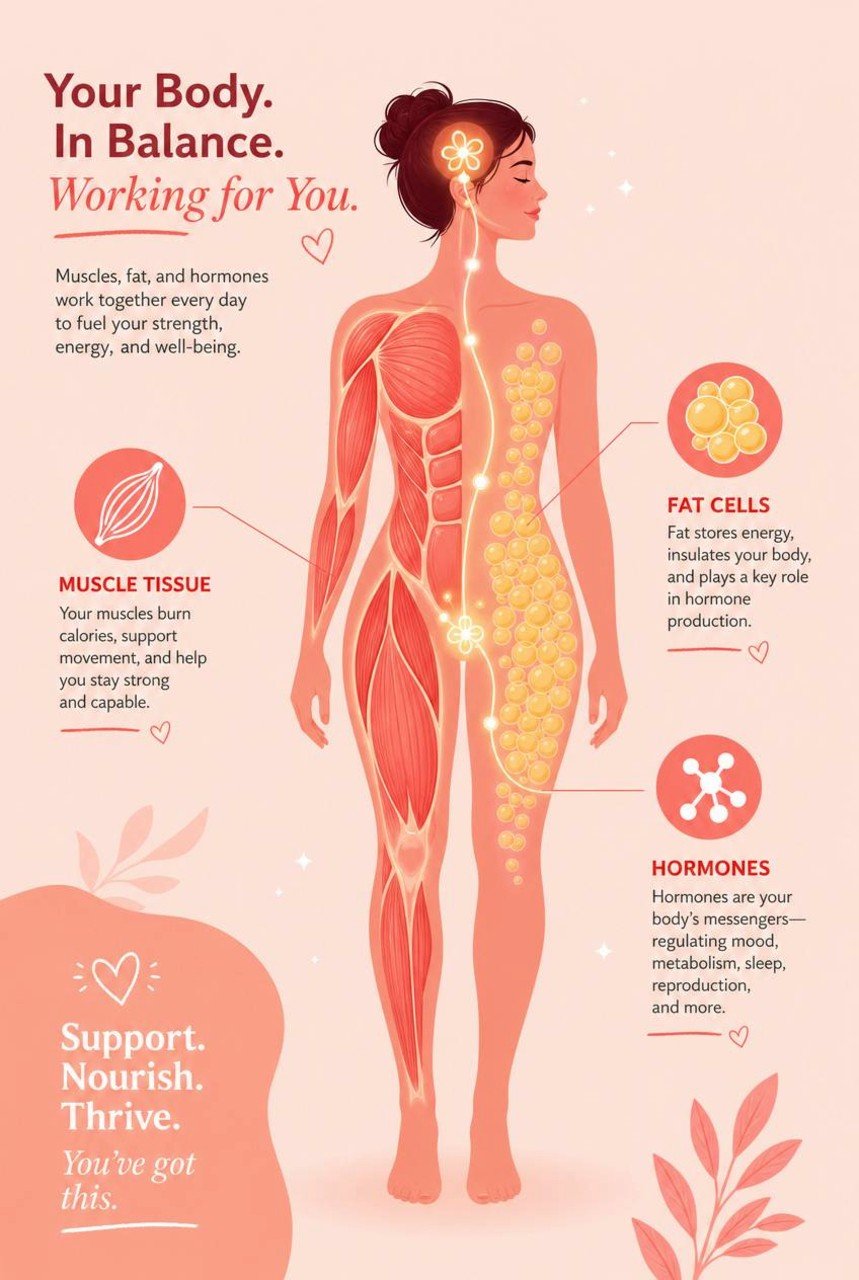
Estrogen decline during perimenopause triggers a cascade of metabolic changes. Your resting metabolic rate slows, your body burns fewer calories at rest, your cells redistribute fat to the abdomen, and every system that estrogen once helped regulate (including blood sugar, thyroid function, and hunger signalling) becomes less efficient.
Let's break this down because understanding it changes everything about how you approach fat loss.
The estrogen-metabolism connection is deeper than most people realise. Estrogen receptors exist on skeletal muscle, fat tissue, the brain, and metabolic organs. When estrogen declines, its regulatory effects on metabolism, fat distribution, and energy expenditure diminish across all of these systems simultaneously. You're not just dealing with one broken lever. You're dealing with several at once.
Progesterone also plays a role that's easy to overlook. During the normal menstrual cycle, the luteal phase (roughly the two weeks before your period) burns an extra 50 calories or so per day. As progesterone drops in perimenopause and cycles become irregular, that built-in metabolic boost disappears. It's a small number on paper, but over months and years it adds up.
What hormones are responsible for perimenopause weight gain? It isn't just estrogen. FSH (follicle-stimulating hormone) rises significantly during perimenopause, and research indicates it may have an independent effect on energy homeostasis, meaning it may directly influence how your body regulates and stores energy, separate from estrogen's effects.
The University of Chicago Medicine notes that declining estrogen also slows thyroid function in some women, adding another layer of metabolic drag to an already challenging picture.
The practical reality: your body may now be burning 200–300 fewer calories per day at rest than it was five years ago. That's without any change in your behaviour. That's the biology you're working against, and it's why the old approach of "a little less food and a little more cardio" has stopped producing results.
Why Did Your Old Calorie Strategy Stop Working?
During perimenopause, insulin sensitivity decreases, meaning your cells become less efficient at absorbing glucose from the bloodstream. Your body responds by releasing more insulin, which is a fat-storage hormone. Even a moderate calorie deficit can trigger a stress response that signals the body to hold onto fat rather than burn it.
This is one of the most frustrating and least-talked-about pieces of the perimenopause weight puzzle.
Does insulin resistance cause weight gain in perimenopause? Yes, and significantly. A 2025 study of nearly 1,000 women confirmed that early menopausal women showed a significantly higher rate of insulin resistance compared to non-menopausal women. When insulin resistance rises, glucose stays in the bloodstream longer, more insulin gets released to compensate, and that excess insulin signals fat cells to store more fat, particularly in the abdomen.
There's also a leptin problem. Leptin is the hormone that tells your brain you're full. As estrogen drops, your brain can become partially resistant to leptin's signal. The practical effect: you feel hungrier than you should, even when you've eaten enough.
Why does calorie cutting stop working during perimenopause? When you aggressively cut calories during perimenopause, your body (already under hormonal stress) can interpret the deficit as a threat. The result is metabolic adaptation: your body slows its metabolism further, burns muscle tissue for energy instead of fat, and increases cortisol production. You end up losing muscle (which further slows your metabolism) while body fat is preserved.
A clinical review in the PMC Weight Management Module for Perimenopausal Women recommends a moderate deficit of approximately 250–400 calories per day for this reason. Aggressive restriction does more harm than good at this stage.
The goal is not to eat as little as possible. The goal is to eat in a way that keeps insulin low, preserves muscle, and supports hormonal balance. Those are very different targets.
| What Worked Before | Why It Stopped Working | What Works Now |
|---|---|---|
| Large calorie deficit (500–700 kcal/day) | Triggers muscle loss and metabolic adaptation | Moderate deficit (250–400 kcal/day) |
| Cardio-first approach | Burns calories but accelerates muscle loss | Strength training 3x/week + cardio as supplement |
| Low-fat diet | Fat is needed for hormone production | Higher protein (1.0–1.2g/kg), moderate healthy fats |
| Skipping meals to reduce intake | Spikes cortisol and disrupts blood sugar | Regular meals with protein at each sitting |
| Tracking calories only | Ignores insulin response and muscle signal | Track protein first; calories second |
You can learn more about losing weight during perimenopause without starving yourself on the site, which goes deeper into the nutrition strategy side.

The Cortisol And Sleep Connection You Cannot Ignore
This one doesn't get nearly enough attention, and it's often the missing piece for women who feel like they're doing everything right but still not seeing results.
Estrogen acts as a natural buffer for the HPA axis (the brain-adrenal system that regulates your stress response). When estrogen declines, that buffering weakens. Your body becomes more sensitive to stress, and cortisol levels rise more easily and stay elevated longer.
The SWAN (Study of Women's Health Across the Nation), one of the longest-running studies of women through the menopausal transition, found that cortisol levels increase measurably as estrogen declines during perimenopause, with cortisol rising from approximately 43 mg in the late reproductive stage to around 45.5 mg at early menopause.
How does cortisol affect weight during menopause? When cortisol is chronically elevated, it disrupts how your body processes fat, carbohydrates, and protein. Instead of burning nutrients efficiently for energy, your body shifts into fat-storage mode, specifically targeting visceral abdominal fat. High cortisol also accelerates muscle breakdown, which, as we'll explore next, has a compounding effect on your metabolism.
And then there's sleep.
Poor sleep affects 47–60% of perimenopausal women, largely driven by night sweats, hot flashes, and the elevated evening cortisol that should naturally be declining before bedtime. When sleep is disrupted, two things happen to your hunger hormones: ghrelin (the hunger hormone) rises, and leptin (the fullness hormone) falls. You wake up hungry, you feel less satisfied after eating, and your body is operating in a cortisol-elevated fat-storage state all day.
This is a vicious cycle. Estrogen drops, cortisol rises, sleep breaks down, hunger hormones go haywire, and fat storage increases, all feeding each other.
Read more about how cortisol drives belly fat storage and the sleep and weight loss connection for a deeper dive on each of these levers.

Why Muscle Loss Is the Hidden Driver Of Everything
Women lose approximately 0.6% of muscle mass per year after menopause. That might sound small, but muscle is your body's primary metabolic engine. Less muscle means a slower resting metabolism, less glucose uptake from the bloodstream, and a body that stores fat far more readily. You cannot outrun a muscle-loss problem with cardio.
This is the piece that changes the entire strategy for most women.
Why does muscle loss accelerate in perimenopause? Estrogen directly supports muscle protein synthesis, which is the process by which your body builds and maintains muscle tissue. It also helps regulate growth hormone and IGF-1, both of which are critical for muscle health. As estrogen declines, these protective effects diminish.
Research published in PMC on sarcopenia in menopausal women confirms that menopause accelerates muscle loss, with the hormonal change acting as an independent driver of the process beyond normal aging.
What this means practically: if you're spending most of your gym time on cardio, you may be burning some calories in the short term while your muscle mass is quietly eroding. Each bit of muscle you lose makes the metabolism slower, makes insulin resistance worse, and makes future fat loss harder.
Does strength training help with perimenopause weight loss? Yes, significantly. A 20-week randomised controlled trial found that resistance training effectively counters the muscle and strength losses associated with perimenopause in middle-aged women. Strength training builds muscle, and muscle tissue is metabolically active: it burns calories even while you're sitting still.
Strength training for women over 40 doesn't mean bulking up. It means preserving and gradually building the metabolic engine that makes fat loss possible.
And protein matters at least as much as the training itself. Without adequate protein, your body can't build or maintain muscle even if you're lifting consistently.
How much protein does a perimenopausal woman need? Research consistently recommends 1.0–1.2g of protein per kg of body weight per day for women in perimenopause, significantly higher than the standard adult RDA of 0.8g/kg. For context, a 70kg (154 lb) woman needs roughly 70–84g of protein per day minimum, distributed across meals.
A high-protein nutrition strategy is one of the highest-leverage changes you can make right now.
| Body Weight | Minimum Protein (1.0g/kg) | Optimal Protein (1.2g/kg) |
|---|---|---|
| 55 kg (121 lbs) | 55g/day | 66g/day |
| 65 kg (143 lbs) | 65g/day | 78g/day |
| 75 kg (165 lbs) | 75g/day | 90g/day |
| 85 kg (187 lbs) | 85g/day | 102g/day |
| 95 kg (209 lbs) | 95g/day | 114g/day |
The RESET Method: A Practical Perimenopause Fat Loss Framework
I want to be honest with you about something. When I first started tracking what actually moved the needle for women navigating perimenopause, I kept seeing the same pattern. The women who made real, sustainable progress weren't the ones cutting the most calories. They were the ones who had stopped fighting their biology and started working with it instead.
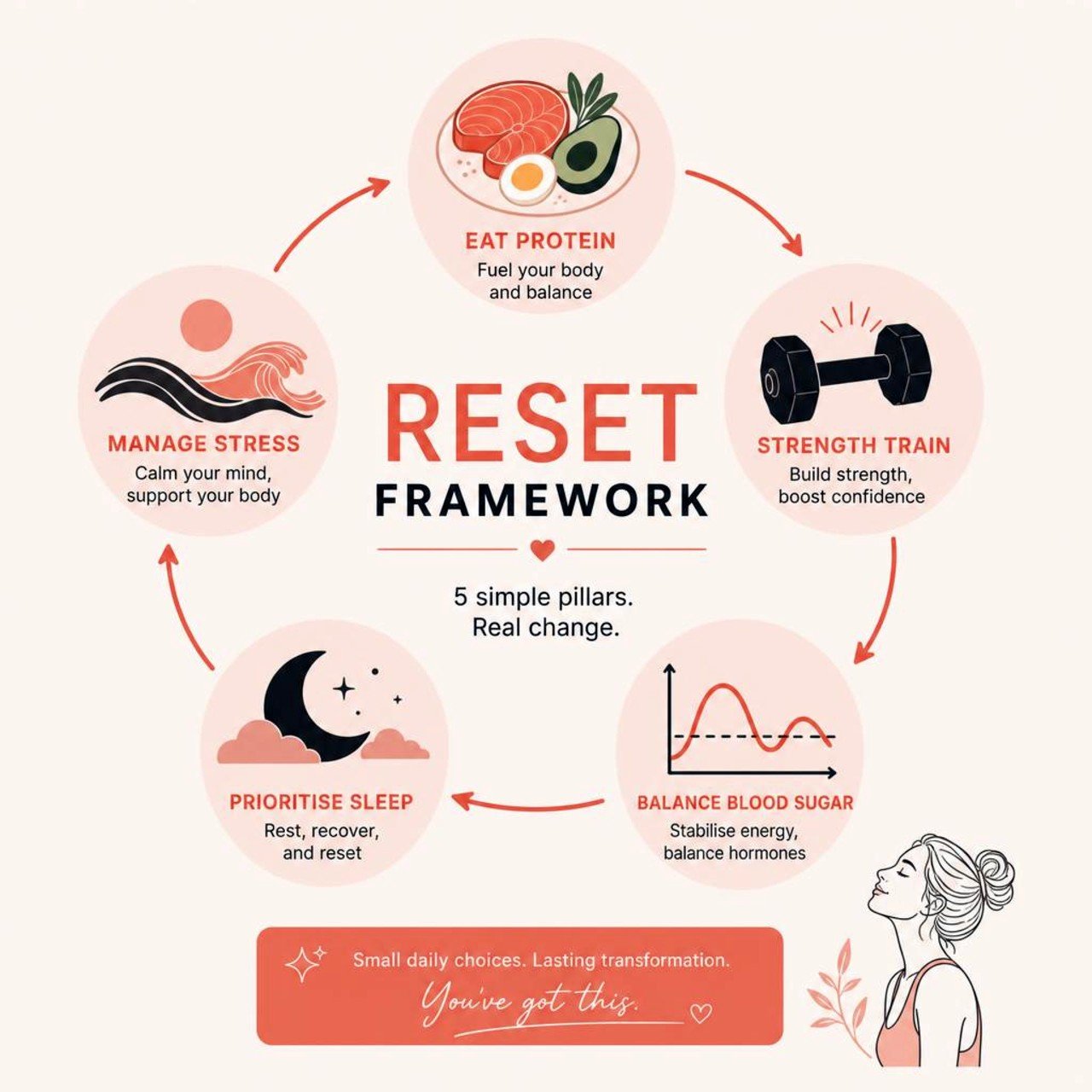
That shift in approach is what the RESET Method is about. It's not a diet plan. It's a five-part recalibration of your metabolic environment.
R: Recalibrate Your Protein Intake
Start by getting protein right before you touch anything else. Aim for at least 1.0–1.2g per kg of bodyweight per day, spread across three or four meals. Prioritise protein at breakfast specifically: this stabilises blood sugar for the rest of the day. Think eggs, Greek yogurt, cottage cheese, chicken, or legumes. This single change often reduces hunger naturally and starts supporting muscle retention within weeks.
E: Emphasise Strength Training Three Times Per Week
Cardio is not the enemy, but it should not be your primary fat loss tool in perimenopause. Resistance training three times per week builds the metabolic engine that burns fat around the clock. You don't need a gym. Bodyweight exercises, resistance bands, or free weights all work. The key is progressive overload: gradually making the work a little harder over time. The work you do working with your hormonal cycle can also help you time your hardest sessions for when your energy is highest.
S: Stabilise Your Blood Sugar
This one is quieter than the others but just as important. Eating in an order that prioritises fibre and protein before carbohydrates significantly reduces the insulin spike from a meal. Including vegetables or protein at every meal, choosing complex carbohydrates over refined ones, and avoiding long gaps between meals (which spike cortisol) all help keep insulin low and fat burning active.
E: Eliminate Sleep Debt
Sleep is not a nice-to-have. In perimenopause, it's a fat loss intervention. Prioritise 7–8 hours of sleep consistently. Practical steps that help: keep the bedroom cool (hot flashes worsen with a warm room), avoid screens for 60 minutes before bed, and avoid alcohol in the evenings (it disrupts sleep architecture even when it feels like it helps you fall asleep). If night sweats are severely disrupting sleep, talk to your doctor about options, including hormone therapy.
T: Temper Cortisol with Intentional Recovery
This doesn't mean doing less. It means building recovery into your routine as deliberately as you build workouts. Ten minutes of intentional breathing, a daily walk in natural light, and limits on screen time in the morning. These are not soft extras. They directly lower cortisol, which directly supports fat loss in perimenopausal women. Even a single 20-minute walk outside has been shown to measurably reduce cortisol levels.
Want more evidence-based strategies designed specifically for your stage of life? Join our newsletter for guidance on hormones, nutrition, and fat loss for women. No generic advice. Just what actually works.
Want The Habits Behind Lasting Weight Loss? Get the free guide: 10 research-backed habits that help women lose body fat and keep it off, with no extreme diets. Send Me The Free Guide.
The Bottom Line
Perimenopause does not make fat loss impossible. But it does make the old approach obsolete.
Your body has genuinely changed. The metabolism is slower, insulin is less responsive, cortisol is higher, sleep is harder to come by, and the muscle that once kept everything ticking is quietly declining. None of that is your fault. All of it is workable.
The shift that makes the real difference is this: stop trying to eat your way out of a hormonal problem and start building your way out of it. More protein. More strength training. Smarter stress and sleep management. A moderate calorie deficit, not an aggressive one.
Progress may be slower than it once was. That doesn't mean it's not real. A 1-pound loss per month with muscle preserved is a far better outcome than a 5-pound loss with muscle lost.
You're not starting over. You're starting smarter. And the research is firmly on your side.
Glossary Of Key Terms
- Visceral Fat: Deep abdominal fat that wraps around internal organs; it is more metabolically disruptive than fat stored under the skin.
- Insulin Resistance: A condition where cells become less responsive to glucose, leading the body to release more insulin, which promotes fat storage.
- Perimenopause: A transitional period lasting 4–10 years before menopause characterized by significant hormonal fluctuations and metabolic changes.
- Cortisol: A stress hormone regulated by the HPA axis; when chronically elevated, it accelerates muscle breakdown and targets the abdomen for fat storage.
- Muscle Protein Synthesis: The process by which the body builds and repairs muscle tissue, a process directly supported by estrogen.
- Leptin: The "fullness hormone" that signals the brain to stop eating; its signal can be weakened during perimenopause.
- Ghrelin: The "hunger hormone" that increases when sleep is disrupted, leading to increased appetite.
- HPA Axis: The brain-adrenal system (hypothalamic-pituitary-adrenal) that regulates the body's response to stress.
- FSH (Follicle-Stimulating Hormone): A hormone that rises significantly during perimenopause and may independently influence how the body stores energy.
- Progressive Overload: The practice of gradually increasing the difficulty of strength training exercises to continue building or preserving muscle mass.
FAQ
Why Am I Gaining Belly Fat Even Though I Haven't Changed My Diet?
Your diet hasn't changed, but your hormonal environment has. As estrogen declines, your body shifts fat storage from the hips and thighs toward the abdomen. Simultaneously, rising cortisol and increasing insulin resistance both promote visceral fat accumulation. Your calorie intake may be identical to what it was five years ago, but the hormonal signals now direct a greater proportion of energy toward abdominal fat storage. This is why the same diet produces different results at different life stages. The fix is not necessarily eating less: it's addressing the hormonal drivers directly through strength training, blood sugar stabilisation, sleep improvement, and cortisol management.
Does Hormone Replacement Therapy (HRT) Help With Perimenopause Weight Gain?
Evidence suggests it can, particularly for insulin resistance and fat redistribution. A 2024 meta-analysis of 17 randomised controlled trials covering more than 29,000 participants found that hormone therapy significantly reduced insulin resistance in healthy postmenopausal women. Research also indicates that HRT can help prevent the shift toward central fat distribution that occurs during early menopause. However, HRT is not a weight loss treatment on its own, and it's not appropriate for everyone. It's worth having a detailed conversation with your doctor about whether it's right for you based on your full health picture.
What Is The Best Exercise To Lose Weight In Perimenopause?
Resistance training is the most evidence-backed approach for perimenopausal fat loss, because it directly addresses the muscle loss that drives metabolic slowdown. Aim for three sessions per week, targeting all major muscle groups. Compound movements (squats, deadlifts, rows, presses) give you the most metabolic return for time invested. Cardio is still valuable for cardiovascular health and calorie burning, but it should support the resistance training rather than replace it. Walking, in particular, is excellent for cortisol management and should be considered a daily recovery tool rather than a primary fat loss strategy.
How Much Protein Should I Eat In Perimenopause?
Current research supports a target of 1.0–1.2g of protein per kilogram of body weight per day, significantly higher than the standard adult RDA of 0.8g/kg. For a 70kg woman, that's 70–84g of protein daily, distributed across meals. Including protein at breakfast is particularly important for blood sugar stability and reducing total daily calorie intake naturally. Good sources include eggs, Greek yogurt, cottage cheese, chicken, fish, legumes, and tofu. Protein powder can be a convenient top-up, but should not be the primary source.
Does Intermittent Fasting Work In Perimenopause?
It can work for some women, but it needs to be approached carefully. The main concern with extended fasting windows during perimenopause is the cortisol spike that comes with skipping meals, especially breakfast. For women who are already dealing with elevated cortisol and disrupted sleep, a morning fast can worsen the hormonal picture. If you want to try intermittent fasting, a shorter eating window (12:12 rather than 16:8) is a gentler entry point. Prioritise protein within your eating window. Pay attention to whether your energy, sleep, and hunger levels improve or worsen, and adjust accordingly. What works depends heavily on your individual stress load and hormone profile.
Why Does My Weight Fluctuate So Much During Perimenopause?
Hormonal fluctuations during perimenopause directly affect fluid retention. Estrogen and progesterone both influence how the body manages water, so as these hormones swing unpredictably from cycle to cycle, your body weight can shift by 2–5 pounds within days. This is fluid, not fat. It can be frustrating when you're tracking scale weight, because genuine fat loss can be masked by fluid shifts. Weighing yourself consistently at the same time of day (ideally first thing in the morning) and looking at weekly averages rather than daily readings will give you a much more accurate picture of your actual progress.
How Long Does Perimenopause Weight Gain Last?
Perimenopause typically lasts 4–10 years, and weight gain tends to be most pronounced during the active hormonal transition. The good news is that the rate of change usually stabilises after menopause (12 months without a period). However, without dietary and lifestyle adjustments, weight gain can continue at roughly 1.5 pounds per year through the 50s. Women who implement the kind of metabolic recalibration outlined in this article (higher protein, strength training, sleep optimisation, and cortisol management) report significantly better weight stability both during and after the perimenopause transition.