
Why Fitness Motivation For Women Who Work From Home Feels So Hard And How To Fix It
Marcus Tullius Cicero
Roman statesman and philosopher
It is exercise alone that supports the spirits and keeps the mind in vigour.
Summary (TL;DR)
Working from home sounds like a freedom dream. In reality, it's one of the most sedentary environments your body can live in. WFH workers are twice as likely to sit 8+ hours a day, with physical activity dropping 20% after going remote. This isn't a motivation failure; it's a structural one. The 3M Method (Micro, Macro, Mindset) is a movement system built on behavioral science, not willpower, so you can feel energised, strong, and consistent. Starting today.
I remember the first month I went fully remote. I told myself this was finally my chance. No commute drains my energy. No office politics are burning me out before noon. I'd work out every single morning before my laptop even opened. My trainers sat by the door for two weeks straight. Unworn.
Sound familiar? If you're working from home and feeling like you've completely lost your body somewhere between your desk chair and the sofa, you're not alone. And you're definitely not lazy.
The truth is that fitness motivation for women who work remotely is failing for a very specific reason, one that almost no fitness advice addresses. Your home office has quietly dismantled every environmental trigger that used to move happen automatically.
This post names that problem, gives it a framework, and hands you a system that works around your real schedule, your hormones, and your actual energy levels.
Medical & Referral Disclaimer
This article is for educational and informational purposes only. It is not intended as medical advice, diagnosis, or treatment. The strategies and information shared here are based on published research and general wellness principles. Always consult a qualified healthcare professional before starting any new exercise programme, particularly if you have existing health conditions, are pregnant, or are navigating hormonal changes such as perimenopause or menopause.
Key Takeaways
- WFH workers are twice as likely to sit 8+ hours a day compared to office workers.
- Sedentary behavior increased 16%, and moderate-to-vigorous activity dropped 20% after the shift to remote work.
- Sitting more than 10.6 hours a day is linked to a 40-60% higher risk of heart failure in women, independent of regular exercise.
- Motivation is a finite, unreliable resource. The fix is environment design, not willpower.
- Exercise snacks (1-5 minutes every 30 minutes) have been shown to lower blood sugar and insulin responses after meals.
- The 3M Method (Micro, Macro, Mindset) gives WFH women a sustainable daily movement system grounded in behavioral science.
- Women in perimenopause face compounded fatigue and motivation dips, and solutions need to account for this, not ignore it.
- Consistent partial effort (70% compliance) always beats occasional perfect effort.
Is Working From Home Making You Less Active?
If you feel less fit since going remote, you're not imagining it. A 2025 systematic review and meta-analysis published in BMC Public Health found that working from home is associated with a 16% increase in sedentary behavior and a 20% drop in moderate-to-vigorous physical activity compared to office-based work. WFH workers are also twice as likely to sit for 8 or more hours per day. Your body doesn't know you're "at home." It just knows it isn't moving.
It gets more serious. A 2024 Harvard study found that sitting more than 10.6 hours a day is linked to a 40-60% higher risk of heart failure and cardiovascular death, even in people who meet the standard weekly exercise recommendations. That means your Friday evening gym session isn't cancelling out 40 hours of sitting. The way movement is distributed across the day matters enormously.
Here's what most WFH fitness conversations miss: the average US adult already logs 12.3 sedentary hours per waking day. Remote work pushes that figure even higher. And for women in their 40s and 50s navigating perimenopause, the hormonal picture makes prolonged sitting even more damaging to metabolic health.
Why Fitness Motivation For Women Fails Before Lunch
Motivation isn't broken in you. It was never designed to carry this load. According to BJ Fogg's Behavior Model at Stanford, behavior only happens when motivation, ability, and a prompt converge at the same moment. Most WFH fitness plans only engineer the motivation piece, while ignoring the other two. When your energy dips (and it will), nothing else is holding the habit up.
For women specifically, this is compounded by biology. Research from Strength Ambassadors found that 51% of women cite lack of motivation as their top barrier to exercise. But the real driver is usually a combination of decision fatigue, cortisol buildup from back-to-back video calls, and hormonal fluctuations that drop serotonin and raise fatigue.
Especially during the luteal phase (roughly days 15-28 of the cycle), energy reserves are genuinely lower. That's not a weakness. That's biology that generic fitness advice consistently ignores.
The good news is that Stanford's research on habit formation confirms that the smallest possible actions, repeated consistently, restructure neural pathways just as effectively as ambitious ones. You don't need a burst of motivation to build a movement habit. You need a well-designed trigger. That's a very different problem to solve.
And there's one more factor at play. To understand how stress and cortisol affect fat gain, you first need to see how your home office is silently manufacturing both.




The Proximity Paradox: Why Your Home Office Is Your Biggest Fitness Enemy
Here's the contrarian truth no one tells you: working from home didn't give you more time to exercise. It removed the invisible scaffolding that was moving automatically.
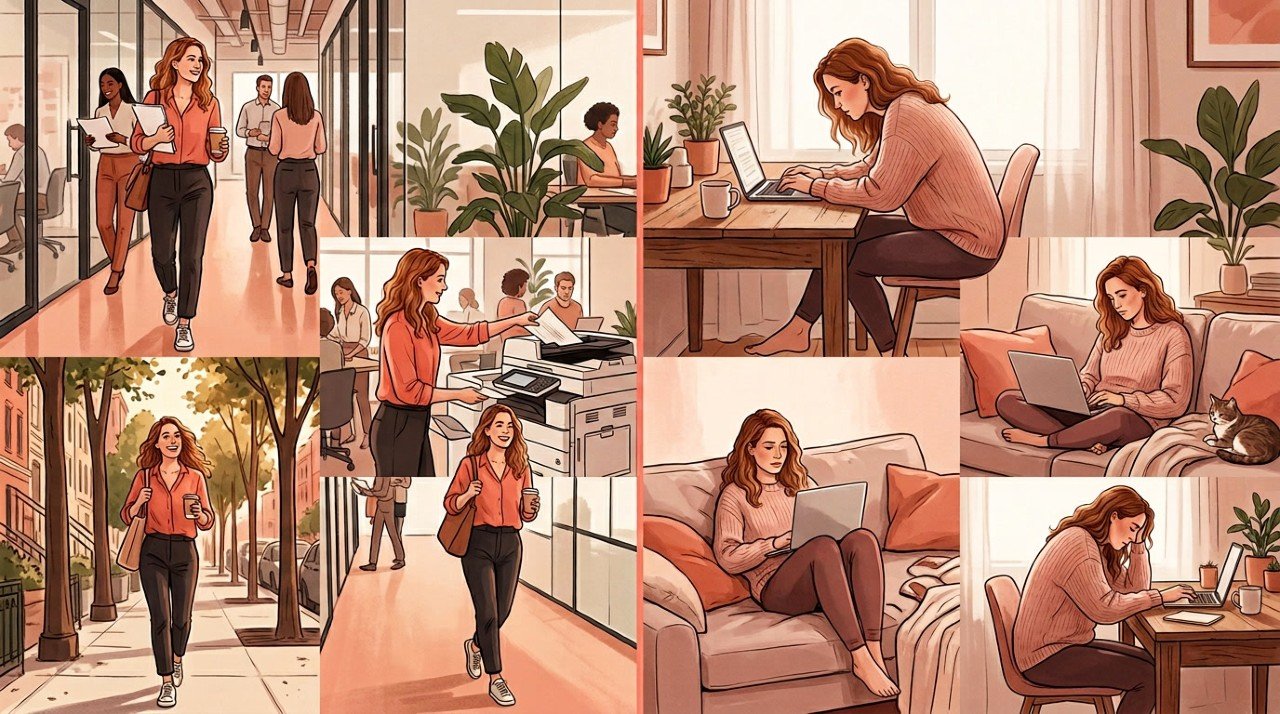
Think about a typical office day. You walked to the car or the bus stop. You walked from the car park to the building. You walked to the meeting rooms. You stood at the printer, the coffee machine, and the colleague's desk three rows over. You took the stairs because the lift was slow.
None of that felt like "exercise." But it was movement: hundreds of small moments that added up to thousands of steps and hours on your feet, without you ever scheduling a workout.
Now compare that to a WFH day. You walk from your bedroom to your desk. You sit. You stay sitting. The printer is your home printer, five steps away. The meeting is a Zoom call. The commute is gone. You've lost the entire architecture of incidental movement, and nobody warned you it was happening.
This is the Proximity Paradox: the closer you are to everything, the less you move. Your home office is convenient and comfortable, and, for your body, quietly catastrophic.
| Movement Type | Typical Office Day | Typical WFH Day |
|---|---|---|
| Morning commute steps | 1,500-3,000 | 0-50 |
| Walking to meetings | 500-1,000 | 0 |
| Standing/walking breaks | 200-400 per hour | Near zero |
| Lunchtime movement | 500-2,000 | Minimal |
| Afternoon commute | 1,500-3,000 | 0 |
| Estimated total incidental steps | 4,200-9,400 | Under 500 |
You haven't lost your fitness drive. You've lost your movement triggers. That's a systems problem, and it has a systems solution.
The 3M Method: A Movement System Built For Women Who Work From Home
This is the framework built around how WFH women's energy and schedules actually work. The 3M Method runs on behavioral science, not willpower, and it replaces the movement triggers your home office took away.
Micro Moves are the foundation. These are 1-5 minute movement bursts every 25-30 minutes throughout your workday. They don't require a gym, a sports bra change, or a recovery drink. Ten squats at your desk. A set of wall push-ups after a call. A two-minute walk to the kitchen and back.
Research from the University of Toronto found that short exercise snacks after meals significantly improve blood sugar regulation. UPMC confirms these micro sessions also support cardiovascular health, mood, and focus. This is your movement floor: the daily minimum that keeps your metabolism active and your brain sharp, no matter how busy the day gets.
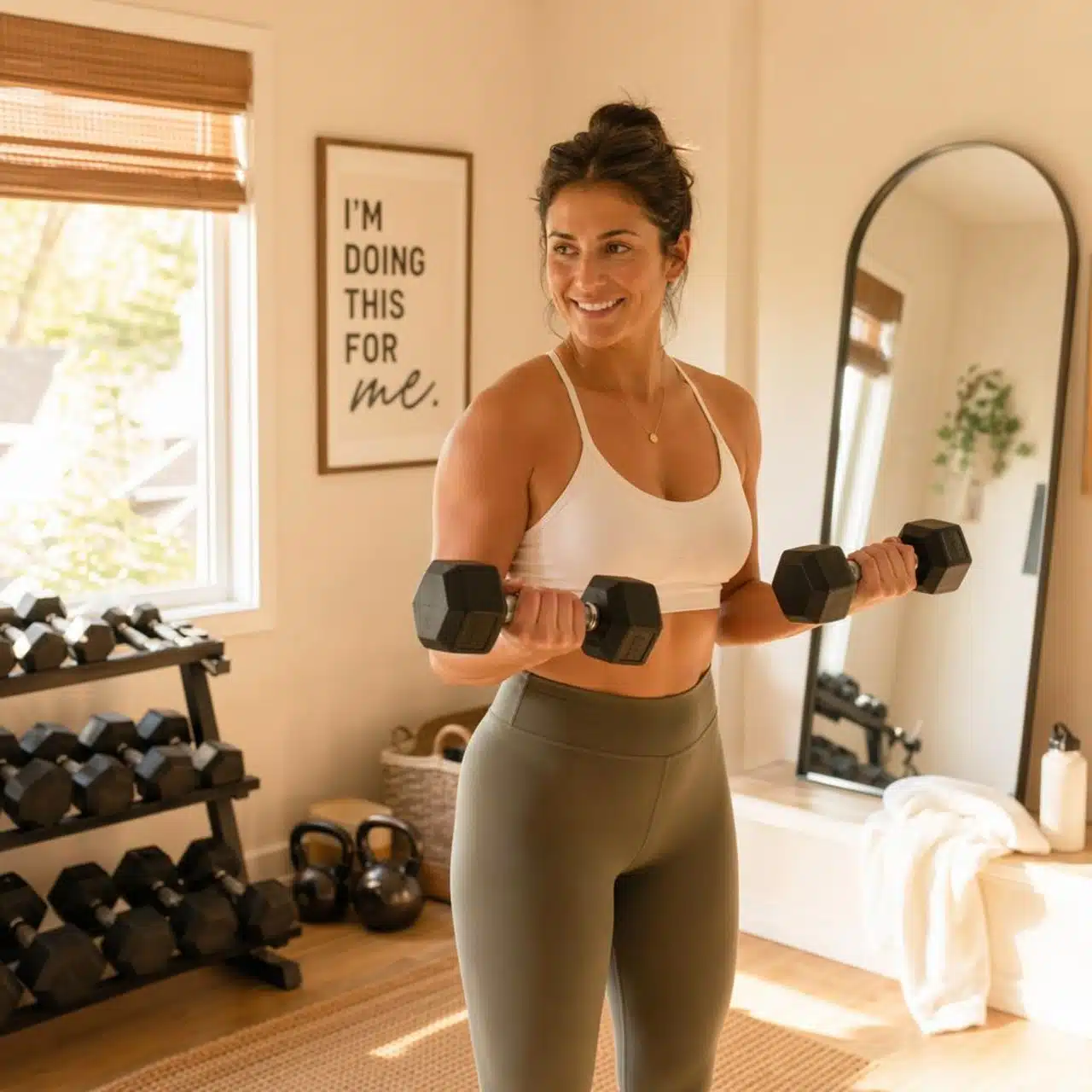
Macro Moves are your one intentional workout block per day. Not two hours. Not an intense HIIT session when you're running on empty. Twenty to forty minutes, timed to match your actual energy rhythms. If you're in perimenopause, morning is often stronger for strength work, while lighter movement suits the luteal phase better.
Strength training for women over 40 is the most evidence-backed Macro Move for preserving lean muscle, supporting bone density, and improving metabolic rate, all critical in your 40s and 50s. For guidance on finding the best time of day to work out based on your energy rhythms, that article breaks it down clearly.
Mindset Moves are the identity layer. This is where lasting change lives. Instead of saying "I need to work out more," you shift to "I'm a woman who moves every day." The language feels small. The neurological effect is not. When your identity is anchored to movement, the decision to do it stops being a negotiation.
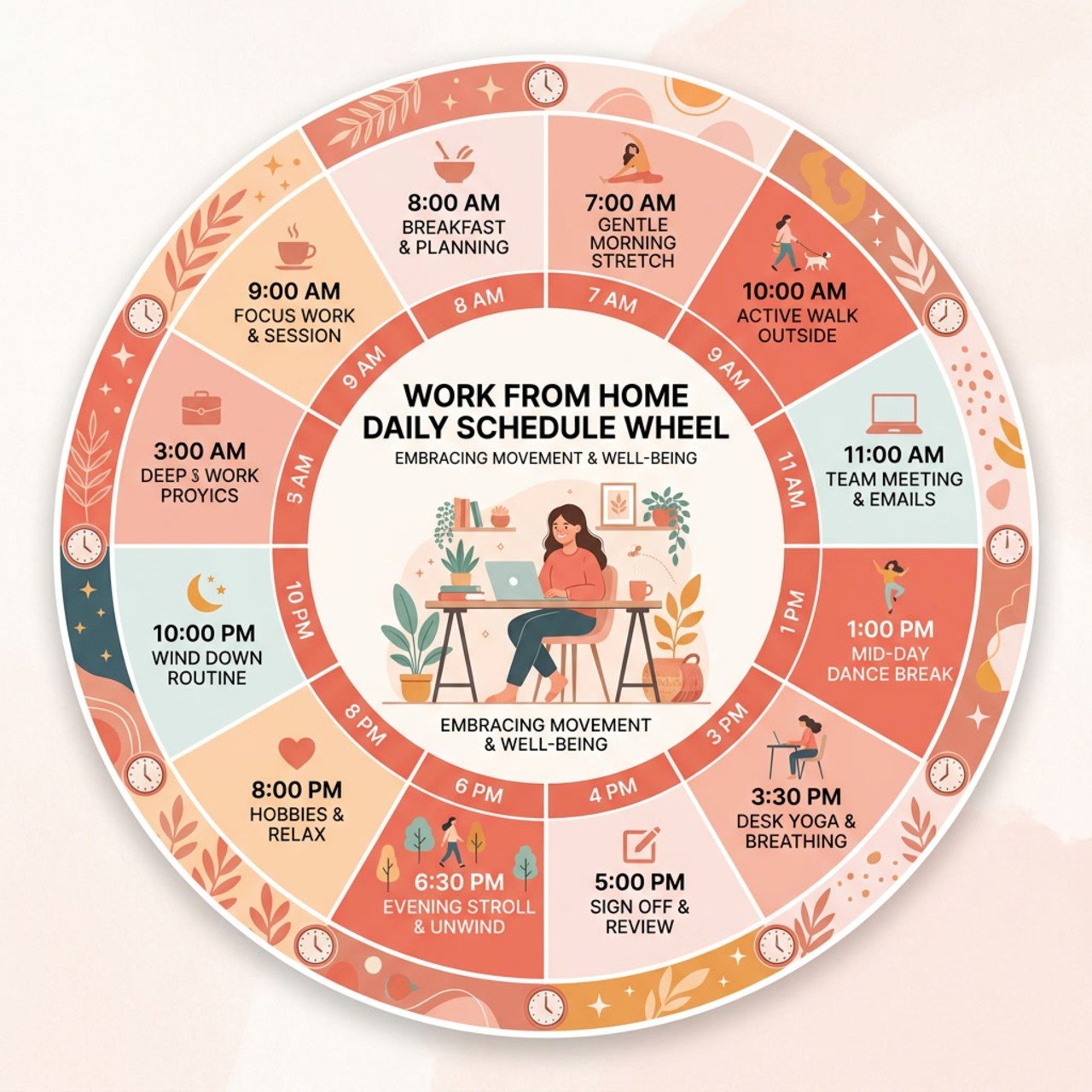
Here's how the 3M Method maps onto a real WFH day:
| Time | 3M Action | What It Looks Like |
|---|---|---|
| 8:00 am | Macro Move | 25-min strength session or walk before laptop opens |
| 9:30 am | Micro Move | 10 squats and 10 calf raises at desk |
| 11:00 am | Micro Move | 2-min walk and shoulder rolls |
| 12:30 pm | Micro Move | Walk during lunch break (even 5 mins counts) |
| 2:00 pm | Micro Move | 10 desk push-ups and 1-min plank hold |
| 3:30 pm | Micro Move | Bodyweight lunges down the hallway |
| 5:00 pm | Mindset Move | Journal one line: "I moved today." |
For further strategies on balancing work and fitness, especially when schedules shift week to week, that article goes deeper into the time-management side.
Does Exercise Really Help When You're Already Exhausted?
Yes, but the dose and the timing matter far more than the intensity. This is one of the most important reframes for WFH women who end the day feeling genuinely depleted. The instinct is to rest. The research says a small amount of movement will actually generate more energy than it costs.
A 2024 systematic review on perimenopause and exercise confirmed that regular physical activity significantly reduces fatigue, mood disruption, and sleep quality issues during the menopause transition. And if you need a number to make your jaw drop: a December 2024 University of Sydney study found that women who averaged just 3.4 minutes of vigorous incidental activity per day were 51% less likely to have a heart attack, even with no structured exercise at all. That's not a typo. Three and a half minutes.
When you're in perimenopause and fatigue is real, the answer isn't to push harder. It's to move smarter. Five minutes of movement will reliably shift cortisol, boost endorphins, and clear the mental fog that makes everything feel impossible. Scheduling your Macro Move to coincide with your natural energy peak (usually mid-morning for most women) also plays a significant role. It removes the battle of forcing yourself through a session when you're running on empty.
Here are some practical Micro Move options matched to energy level:
| Energy Level | Micro Move Option | Duration |
|---|---|---|
| Low | Seated neck rolls and shoulder stretches | 2 min |
| Low | Slow walk around the block | 5 min |
| Medium | Desk push-ups and wall sit | 3 min |
| Medium | Bodyweight squats and calf raises | 4 min |
| High | Jump squats and plank hold | 3 min |
| High | Short stair repeats at home | 5 min |
How To Build Fitness Motivation That Lasts (Not Just A Monday Spike)
Lasting fitness motivation isn't something you find. It's something you build, one tiny decision at a time. The research on behavior change is consistent: motivation follows action, it doesn't precede it. Waiting until you "feel like it" is a trap that WFH life makes especially deep, because the environmental cues that used to force action are completely gone.
To build successful fitness motivation, please consider the following:
- The most effective method is habit stacking
- Anchor a new Micro Move to something you already do every day without thinking
- After you pour your morning coffee → do ten squats
- After every video call ends → stand up and do a one-minute stretch
- After lunch → take a five-minute walk before returning to your desk
- The habit isn't floating in your to-do list — it's attached to something solid
Research confirms this timing advantage: exercise snacks taken after meals produce measurable metabolic benefits, making the post-meal anchor both behaviorally and physiologically smart.
The identity layer matters just as much. Start describing yourself as "someone who moves every day," even on the days your Macro Move doesn't happen. When identity and behavior align, the motivation question dissolves. For sustainable workout motivation strategies that go deeper into the psychological side of consistency, that article covers the full habit-building toolkit.
One more thing: celebrate the 70%. If you hit your 3M targets five days out of seven, that's a win. That's consistency. Perfectionism is what breaks habits, not imperfection. For everything you need to know about how to actually finish your workouts once you've started, that post lays out the psychology in detail. And for fitness habits that stick long-term, building them small and consistently is always the answer.
Want more evidence-based movement strategies, weekly workout drops, and WFH fitness tips designed specifically for women? Join our newsletter and get it straight to your inbox every week.
Want The Habits Behind Lasting Weight Loss? Get the free guide: 10 research-backed habits that help women lose body fat and keep it off, with no extreme diets. Send Me The Free Guide.
The Bottom Line
You don't have a motivation problem. You have a missing-structures problem. The WFH lifestyle quietly removed every trigger that made movement automatic, and no amount of willpower fills that gap. What fills it is a system designed for your actual day.
Start with one Micro Move this afternoon. After your next video call, stand up and do ten squats. That's it. That's how the 3M Method begins. The research backs it. The biology supports it. And your future, more energised self will thank you for starting small instead of waiting for perfect.
Glossary Of Key Terms
- 3M Method: A three-tiered movement system consisting of Micro Moves (frequent bursts), Macro Moves (intentional workouts), and Mindset Moves (identity shifts).
- Exercise Snacks: Short, 1–5 minute bouts of physical activity performed multiple times a day to break up sedentary periods and improve metabolic health.
- Habit Stacking: A behavioral science technique where a new habit is "stacked" onto an existing, established daily routine to ensure consistency.
- Incidental Movement: Physical activity that occurs naturally throughout the day, such as walking to a car or a printer, which is not part of a structured workout.
- Luteal Phase: The latter half of the menstrual cycle (approx. days 15–28) is often characterized by lower energy reserves and higher fatigue.
- Macro Moves: Dedicated 20–40 minute blocks of intentional exercise, such as strength training or a brisk walk, timed to coincide with energy peaks.
- Micro Moves: Brief (1–5 minute) movement interruptions, like squats or stretching, performed every 30 minutes to counteract prolonged sitting.
- Mindset Moves: The practice of using identity-based language and journaling to anchor a person's self-image to their physical activity goals.
- Proximity Paradox: The phenomenon where being close to all necessities in a home environment leads to a catastrophic drop in daily movement triggers.
- Sedentary Behavior: Activities involving sitting or reclining with low energy expenditure; WFH workers are twice as likely to log 8+ hours of such behavior daily.
FAQ
What Is The Best Exercise For Women Who Work From Home All Day?
The best exercise for WFH women is a combination of regular movement, snacks throughout the day, and one dedicated strength or cardio session per day. Research consistently shows that strength training (particularly for women over 40) delivers the most benefit for metabolism, bone density, and lean muscle preservation. However, the most effective exercise is ultimately the one you'll actually do. If you're starting from zero, a daily 20-minute walk plus micro-movements every 30 minutes is a powerful and evidence-supported foundation. Build the habit first, then increase intensity over time.
How Do I Find Motivation To Exercise When I Work From Home?
Stop looking for motivation and start designing for it. Motivation is unreliable and fluctuates with your hormonal cycle, sleep quality, and daily stress levels, all of which are especially variable for women in their 40s. Instead, use habit stacking: attach a small movement to something you already do automatically, like standing up after every video call or doing squats while your coffee brews. When the behavior is triggered by an existing habit rather than a feeling, you don't need motivation to start. Over time, the action creates the motivation, not the other way around.
How Many Hours Of Sitting Is Too Much For Women?
Research published in the Journal of the American College of Cardiology found that more than 10.6 hours of sedentary time per day is significantly associated with a higher risk of heart failure and cardiovascular death in women, even for those who exercise regularly. Most WFH women comfortably exceed this threshold without realising it. The solution isn't just to add a workout; it's to break up sitting time throughout the day with regular movement. Even one or two minutes of standing or light movement every 30 minutes produces measurable metabolic benefits, according to multiple studies.
Can Short Workouts (10 Minutes Or Less) Actually Work For Fat Loss?
Yes, but with an important nuance. Short, frequent bouts of movement do support metabolic health, blood sugar regulation, and caloric expenditure. They are not a replacement for structured weekly exercise, but they are a genuine and clinically supported addition to it. A 2025 meta-analysis in Frontiers in Nutrition confirmed that exercise snacks reduce postprandial glucose and insulin responses in adults. For fat loss specifically, consistency over weeks and months matters far more than session duration on any given day. Ten minutes done daily beats 60 minutes done twice a month every time.
How Does Perimenopause Affect Exercise Motivation?
Perimenopause significantly affects motivation through multiple hormonal pathways. Declining estrogen reduces serotonin production, which directly impacts mood and drive. Rising cortisol sensitivity means stress hits harder. Disrupted sleep (one of the most common perimenopausal symptoms) compounds fatigue and decision fatigue, making it harder to initiate exercise, especially later in the day. A 2024 study on women aged 40-65 found that 49% of women in this age group cited feeling too tired as a barrier to exercise. The most effective response is to schedule your most demanding movement for your energy peak (usually mid-morning), reduce intensity during the luteal phase, and remove all barriers to starting.
What Are Exercise Snacks And Do They Actually Work?
Exercise snacks are short bouts of physical activity (typically 1-5 minutes) performed multiple times throughout the day rather than in one continuous session. Yes, they work. Research from the University of Toronto showed that exercise performed after meals significantly improves blood sugar regulation. A network meta-analysis found that interrupting sitting every 30 minutes with brief movement was the most effective intervention for improving postprandial blood glucose and insulin levels. Exercise snacks are not a replacement for structured workouts, but they meaningfully reduce the metabolic damage of prolonged sitting, making them especially valuable for WFH women who can't always commit to a full session.
How Can I Build A Consistent Workout Habit When My Schedule Changes Every Day?
Attach your movement to fixed daily anchors rather than fixed time slots. Instead of scheduling a workout at 9 am, schedule it before your first meeting or after lunch. When the anchor shifts, the habit moves with it. This approach, grounded in BJ Fogg's Tiny Habits methodology, is more resilient than calendar-based scheduling, which falls apart the moment the day changes. One more trick: keep a minimum viable version of your habit in reserve. Even two minutes of movement counts as showing up. Showing up consistently, even briefly, builds identity. And it's identity, not discipline, that creates long-term exercise consistency.