
Your Step-By-Step Guide To Petite Woman Weight Loss Without Sacrificing Your Metabolism

Everything in food works together to create health or disease. The more we think that a single chemical characterizes a whole food, the more we stray into idiocy.
T. Colin Campbell ‧ American biochemist and Professor Emeritus of Nutritional Biochemistry at Cornell University
Summary (TL;DR)
Most petite women need between 1,200 and 1,500 calories a day to lose weight safely, but the right number depends on your height, weight, age, and activity level. Going below 1,200 calories without medical guidance risks nutrient deficiencies and metabolic slowdown. This guide walks you through calculating your personal calorie target, setting a sustainable deficit, and prioritising protein so you lose fat, not muscle.
You typed your stats into a calorie calculator. It spat back 1,150 calories. You stared at the screen and thought: That can't be right.
If you're a petite woman, that scenario is painfully familiar. Standard calorie advice assumes an average body. Your body isn't average. It's smaller, it burns fewer calories at rest, and it doesn't respond well to the same aggressive deficits that work for taller women.
Here's the thing: the problem isn't you. It's the formula. Most popular calorie calculators were built on data from populations that skew taller, heavier, and younger. For women under 5'4", those numbers can be off by 200 to 400 calories in either direction, and that gap matters more than you'd think.
A petite woman's weight loss isn't about eating as little as possible. It's about eating the right amount to create a sustainable deficit while protecting your muscle, your metabolism, and your sanity. This guide gives you the exact framework to find that number and make it work for your body.
Medical & Referral Disclaimer
The information in this article is for educational purposes only and does not constitute medical or nutritional advice. Every woman's body is different, and individual calorie needs vary based on health status, medications, and medical history. Please consult a registered dietitian or healthcare provider before making significant changes to your calorie intake, especially if you have an underlying health condition.
Key Takeaways
- Petite women are typically defined as under 5'4" (163 cm) and have a lower baseline calorie burn than taller women.
- Most petite women's TDEE (total daily energy expenditure) falls between 1,300 and 2,000 calories, depending on height, weight, age, and activity.
- A safe and sustainable weight loss deficit for petite women is 250 to 350 calories per day, targeting roughly 0.5 lb of fat loss per week.
- Never drop below 1,200 calories without medical supervision. Research shows it's nearly impossible to meet micronutrient needs below this level.
- Protein intake of 1.2 to 1.6 g per kg of body weight is essential to preserve muscle during calorie restriction.
- Perimenopause can lower BMR by 5 to 10%, making modest deficits and strength training more important than ever.
- NEAT (non-exercise activity thermogenesis) can add 200 to 350 extra calories of daily burn without a single gym session.

Why Generic Calorie Advice Fails Petite Women
You didn't fail the calorie calculator. The calorie calculator failed you.
Most standard formulas, including the ones baked into popular apps, are calibrated on data from study populations where the average woman is around 5'4" to 5'6" and weighs 140 to 165 pounds. When a 5'1" woman plugs her stats in, the formula extrapolates downward, and small errors in the original coefficients become big errors in the final output.
The result? Petite women are routinely handed a calorie target that's either too aggressive (triggering muscle loss and metabolic adaptation) or so low it's practically impossible to hit adequate protein and micronutrient targets.
Here's what makes the situation even harder: petite women are mathematically the group with the lowest daily calorie burn. Larger bodies require more energy to keep running at rest. So, as a petite woman, your TDEE is already lower than average before you factor in activity level. A 500-calorie deficit that feels manageable for a 5'7" woman represents a proportionally much bigger cut for someone burning 300 fewer calories per day to begin with.
This is where the standard advice breaks down. The standard 500-calorie daily deficit is widely recommended for weight loss, but for a petite sedentary woman with a TDEE of 1,400 calories, cutting 500 means eating just 900 calories a day. That's not a nutrition strategy. That's fast.
The smarter path is a smaller deficit, more daily movement, and a nutrition plan built around your actual energy needs. Let's calculate those first.
How Many Calories Does A Petite Woman Actually Need Each Day?
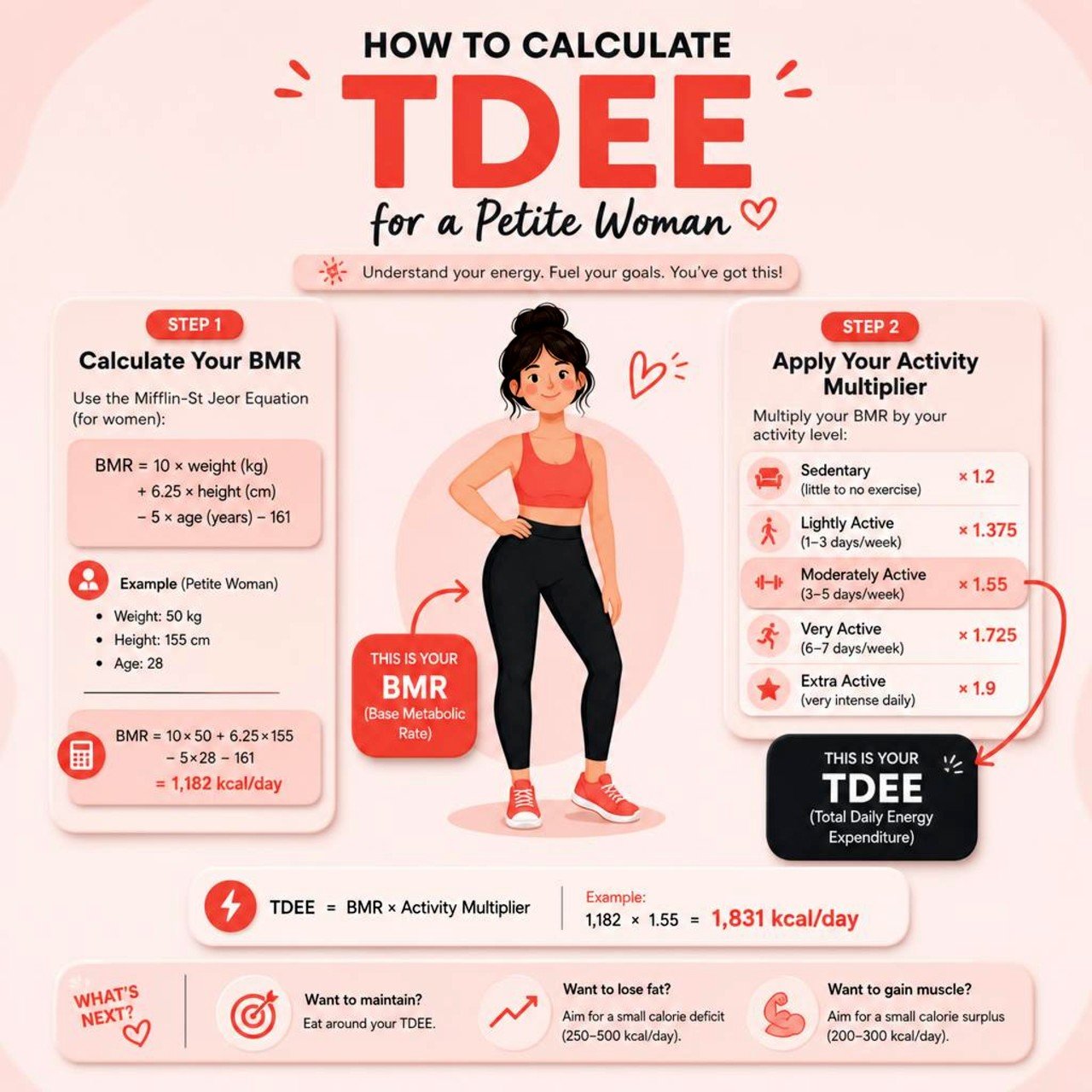
Most petite women under 5'4" have a TDEE of 1,300 to 2,000 calories per day, depending on height, weight, age, and activity level. Your BMR (basal metabolic rate) is the starting point, and the Mifflin-St Jeor equation is currently the most validated formula for estimating it in women across a wide range of body sizes.
Research confirms that the Mifflin-St Jeor equation predicts resting metabolic rate within 10% of measured values for 71% of women across varying body compositions, making it a stronger starting point than the older Harris-Benedict formula for petite woman weight loss planning.
Here's the formula:
BMR (cal/day) = (10 x weight in kg) + (6.25 x height in cm) − (5 x age) − 161
Once you have your BMR, multiply it by your activity factor to get your TDEE:
- Sedentary (desk job, minimal movement): BMR x 1.2
- Lightly active (light exercise 1 to 3 days a week): BMR x 1.375
- Moderately active (exercise 3 to 5 days a week): BMR x 1.55
Worked example: A 5'2" petite woman, 135 lb (61 kg), age 38: BMR = (10 x 61) + (6.25 x 157) − (5 x 38) − 161 = 1,242 calories. TDEE (lightly active): 1,242 x 1.375 = ~1,708 calories per day
Use Table 1 below to find an estimate close to your profile.
Table 1: Estimated TDEE For Petite Women (Mifflin-St Jeor Equation)
| Profile | Sedentary TDEE | Lightly Active TDEE | Moderately Active TDEE |
|---|---|---|---|
| 5'0", 120 lb, age 35 | ~1,390 cal | ~1,592 cal | ~1,795 cal |
| 5'0", 120 lb, age 48 | ~1,312 cal | ~1,503 cal | ~1,694 cal |
| 5'2", 135 lb, age 38 | ~1,490 cal | ~1,708 cal | ~1,925 cal |
| 5'2", 135 lb, age 50 | ~1,418 cal | ~1,625 cal | ~1,832 cal |
| 5'3", 145 lb, age 42 | ~1,546 cal | ~1,771 cal | ~1,996 cal |
Estimates based on the Mifflin-St Jeor equation. These are starting points, not exact prescriptions. Individual metabolic rate varies based on body composition and health status.

What Is A Safe Calorie Deficit For A Petite Woman?
For most petite women, a deficit of 250 to 350 calories per day is the sweet spot for safe fat loss. This produces roughly 0.5 lb of weight loss per week, which is sustainable, protective of your muscle mass, and realistic on a calorie intake that still supports your nutritional needs.
This is more conservative than the standard 500-calorie deficit you'll see on most fitness sites, and for good reason.
Research consistently shows that a 300 to 500 calorie daily deficit leads to 0.5 to 1 lb of weekly fat loss while protecting hormones, muscle, and energy. For petite women, the lower end of that range is often the smarter choice. Your TDEE is already below average, so a 500-calorie cut can push your intake to levels where meeting micronutrient requirements becomes nearly impossible from food alone.
Going too low also triggers adaptive thermogenesis. Your body interprets prolonged severe restriction as a threat and responds by lowering its metabolic rate to conserve energy. The result: you're eating less but losing less, because your metabolism has downshifted to compensate.
The minimum safe floor for most women is 1,200 calories per day. Below this level, it becomes extremely difficult to get adequate fibre, vitamins, minerals, and protein from food. This is an absolute floor, not a daily target.
If your TDEE calculations suggest a weight loss target near or below 1,200 calories even without a deficit, that's a clear signal to work with a registered dietitian rather than self-directing a cut. It's also worth checking whether you're falling into any of the common calorie-cutting mistakes that stall progress before it starts.
Table 2: Recommended Calorie Targets For Petite Women (300-Calorie Deficit Applied)
| Profile | Sedentary Target | Lightly Active Target | Moderately Active Target |
|---|---|---|---|
| 5'0", 120 lb, age 35 | 1,090 cal* | 1,292 cal | 1,495 cal |
| 5'0", 120 lb, age 48 | 1,012 cal* | 1,203 cal | 1,394 cal |
| 5'2", 135 lb, age 38 | 1,190 cal* | 1,408 cal | 1,625 cal |
| 5'2", 135 lb, age 50 | 1,118 cal* | 1,325 cal | 1,532 cal |
| 5'3", 145 lb, age 42 | 1,246 cal | 1,471 cal | 1,696 cal |
*Targets marked with an asterisk fall below 1,200 calories and should be reviewed with a healthcare provider before proceeding.
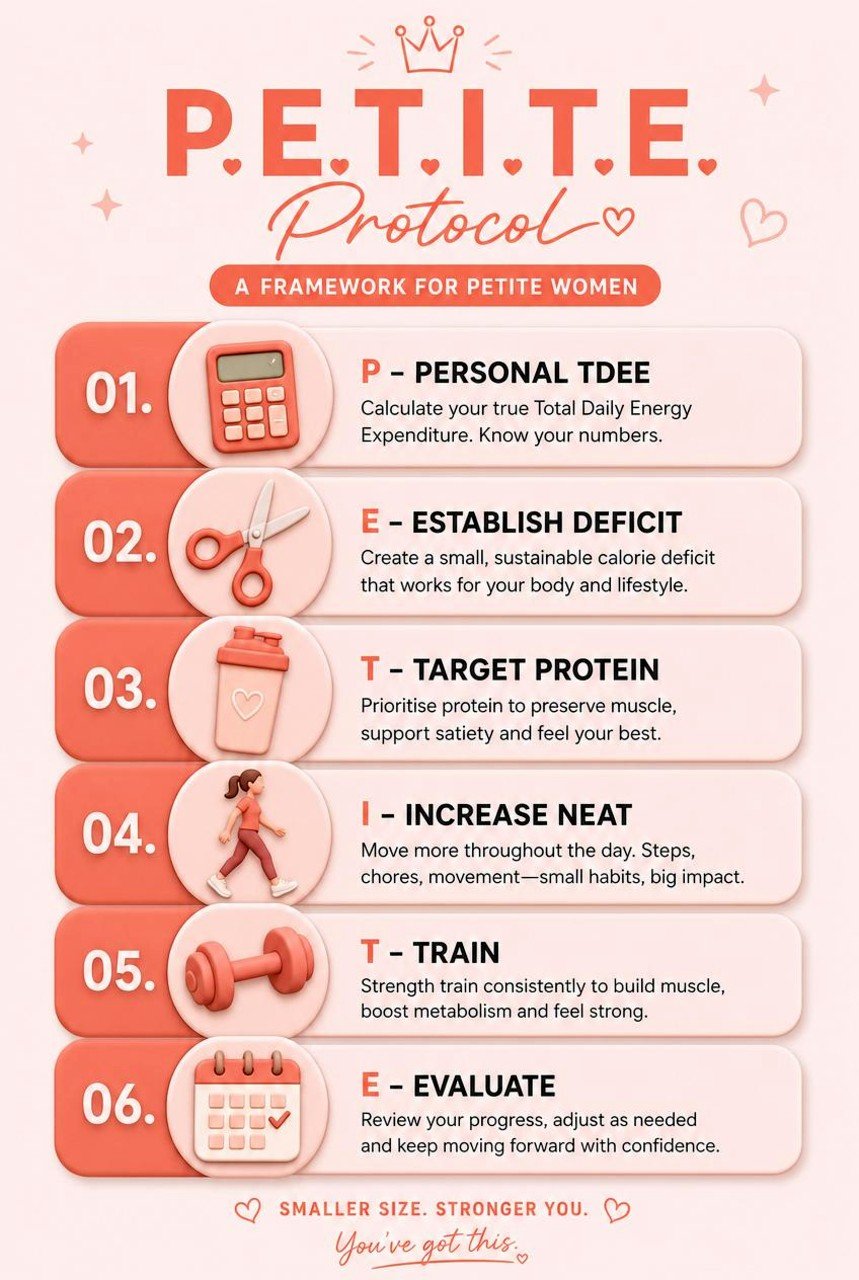
The Petite Woman Calorie Blueprint: The P.E.T.I.T.E. Protocol
Here's something most calorie guides won't tell you: a number on its own won't get you where you want to go. What matters is what you build around that number.
This is the framework we use at Women's Lean Body Formula for sustainable petite woman weight loss. It treats your calorie target as the foundation, not the finish line.
P — Personal TDEE. Calculate your individual TDEE first, using the formula and tables above. Don't copy a friend's target or rely on a generic "1,200 calorie plan." A 5'3" sedentary woman has meaningfully different needs than a 5'3" woman who walks 12,000 steps a day.
E — Establish A Modest Deficit. Subtract 250 to 350 calories from your TDEE. This is your daily calorie target for fat loss. Keep it above 1,200 calories without medical supervision, and build sustainably from there.
T — Target Protein First. Before filling in carbs and fats, hit your protein target: 1.2 to 1.6 g per kg of bodyweight, spread across 3 to 4 meals with 25 to 30 g per sitting. Protein is the most critical lever for petite women because it keeps you full and preserves muscle when calories are lower.
I — Increase NEAT Daily. Non-exercise movement is a game-changer for petite women with a lower baseline burn. Walking, standing, household tasks, taking the stairs — these create meaningful calorie burn without requiring gym time. Aim to add 2,000 to 4,000 steps to your current daily baseline.
T — Train With Strength Work. Add 2 to 3 sessions of resistance training per week. Strength training protects lean muscle mass during a calorie deficit, helping keep your metabolic rate from adapting downward. It also means more of the weight you lose comes from fat rather than muscle. These weight loss exercises for women give you a solid starting point.
E — Evaluate And Adjust Every 3 To 4 Weeks. Your TDEE isn't fixed. As you lose weight, your BMR decreases because your body is smaller and lighter. Recalculate every 3 to 4 weeks and nudge your intake down by 50 to 100 calories if progress stalls. Small, frequent adjustments beat one dramatic cut every time.

Does Perimenopause Change How Many Calories You Need?
Yes, and more than most calorie guides account for. During perimenopause (typically ages 40 to 55), declining oestrogen accelerates muscle loss, lowers resting metabolic rate, and alters how the body processes food. For most petite women in this life stage, BMR can shift by 5 to 10%, which means your calorie needs may drop by 50 to 150 calories even if your activity level stays exactly the same.
This is one of the most common reasons petite women in their 40s and 50s suddenly stop seeing results. The calorie target that worked at 38 genuinely doesn't work at 48. Not because discipline disappeared, but because the metabolic reality changed.
Research published in eBioMedicine found that menopause triggers significant metabolic shifts, including changes in postprandial glucose responses and how the body distributes fat. A separate study confirmed that postmenopausal women have measurably lower resting energy expenditure than premenopausal women of similar body composition.
Muscle loss is the key driver. As the Mayo Clinic explains, muscle mass decreases with age while fat increases, and this process accelerates significantly during perimenopause. Less muscle means a lower metabolic rate, which means a lower TDEE even at the same bodyweight.
For perimenopausal petite women, this means:
- Recalculate your TDEE using your current age, not the figure from five years ago.
- Consider a slightly smaller deficit of 200 to 250 calories to avoid triggering adaptive thermogenesis.
- Prioritise protein above everything else (see the next section).
- Add or increase strength training to slow the rate of muscle loss.
More restrictions aren't the answer here. A smarter strategy is. For a broader overview of what actually moves the needle for women, the evidence-based weight loss strategies guide goes deeper into the hormonal picture.
Join Our Mailing List
Join thousands of women inside our community and receive our free guide, 10 Actions That Support Permanent Weight Loss — the exact behavioural shifts that make the difference between a two-week attempt and a lasting transformation.
No restriction plans. No guilt. Just what actually works — for real women with real lives.

How Much Protein Should A Petite Woman Eat To Lose Weight?
Aim for 1.2 to 1.6 grams of protein per kilogram of bodyweight daily, split across 3 to 4 meals with 25 to 30 grams per sitting. For a 135 lb (61 kg) petite woman, that's roughly 73 to 98 grams of protein per day. Hit this target before filling in anything else on your plate.
This might be the single most underrated lever in petite women's weight loss. At 1,300 to 1,500 calories, every calorie needs to earn its place. Protein does this better than any other macronutrient: it preserves lean muscle during a calorie deficit, reduces hunger hormones, and costs more energy to digest than carbohydrates or fat.
A 2024 systematic review and meta-analysis published in Clinical Nutrition ESPEN found that protein intake above 1.3 g/kg per day was associated with increased muscle mass during weight loss, while intake below 1.0 g/kg carried a significantly higher risk of muscle loss. A separate randomised controlled trial in postmenopausal women on calorie-restricted diets found that elevated protein consistently preserved lean mass compared to standard protein intakes.
In practical terms, that looks like:
- Breakfast: 3 eggs or Greek yogurt with berries (25 to 30 g protein)
- Lunch: Chicken or tuna salad with leafy greens (30 g protein)
- Dinner: Salmon or lean turkey with roasted vegetables (30 g protein)
- Optional snack: Cottage cheese or a protein shake (15 to 20 g protein)
Hitting your protein target is especially critical when total calories are already limited. A high-protein nutrition plan for women makes this much easier to structure day to day without obsessing over every gram.

NEAT: The Petite Woman's Most Underused Calorie Burner
Here's a number that might change how you think about weight loss: NEAT (non-exercise activity thermogenesis) varies by up to 2,000 calories per day between two people of similar size.
NEAT covers everything you do that isn't sleeping, eating, or deliberate exercise: walking to your car, fidgeting at your desk, doing laundry, standing on a phone call. For petite women with a lower baseline calorie burn, NEAT isn't just a bonus. It's one of the most powerful levers you have.
Research shows that leaner individuals naturally sit approximately 2.5 hours less per day than those with higher body fat percentages. NASM data also shows that small, consistent changes to daily movement, like standing instead of sitting during office tasks, can add meaningful calorie burn every single week without adding a single scheduled workout.
For petite women, this matters because your calorie target is already lower than average. Adding 200 to 350 calories of NEAT effectively widens your deficit without requiring you to eat any less. That's a genuinely meaningful difference on a smaller frame.
Practical ways to boost your NEAT today:
- Walk for 10 minutes after each main meal
- Take calls standing or walking instead of sitting
- Use stairs consistently instead of lifts
- Add a 20-minute walk to your morning or evening routine
- Set an hourly reminder to stand and move for 2 to 3 minutes
You don't need to overhaul your schedule. You need to shift your default from sitting to moving. And once you're ready to layer in structured training on top of that, these weight loss exercises for women give you a clear place to start.
Want The Habits Behind Lasting Weight Loss? Get the free guide: 10 research-backed habits that help women lose body fat and keep it off, with no extreme diets. Send Me The Free Guide.
The Bottom Line
A petite woman's weight loss isn't about eating as little as possible. It's about eating the right amount for your specific body.
Your calorie target starts with a TDEE calculation built for your height, weight, age, and activity level. From there, a 250 to 350 calorie daily deficit creates steady, sustainable progress without tanking your metabolism or costing you muscle. Protein comes first. NEAT fills the gap. Strength training protects what you've built. And every 3 to 4 weeks, you check in and adjust.
The P.E.T.I.T.E. Protocol puts all of this together in a system you can actually live with, not just white-knuckle your way through. You've been told to eat less. It's time to eat smarter.
Glossary Of Key Terms
- Adaptive Thermogenesis: A process where the body lowers its metabolic rate in response to prolonged calorie restriction to conserve energy.
- Basal Metabolic Rate (BMR): The number of calories the body burns at rest to maintain basic physiological functions like breathing and circulation.
- Mifflin-St Jeor Equation: A validated formula used to estimate BMR based on weight in kilograms, height in centimeters, age, and a gender-specific constant.
- Micronutrient Deficiency: A lack of essential vitamins and minerals, which becomes a high risk when calorie intake drops below 1,200 per day.
- NEAT (Non-Exercise Activity Thermogenesis): Energy expended for everything done that is not sleeping, eating, or sports-like exercise.
- Petite Woman: In a nutritional context, typically defined as a woman under 5'4" (163 cm) in height.
- Postprandial Glucose Response: The change in blood sugar levels that occurs after eating, which can be altered by hormonal changes like menopause.
- P.E.T.I.T.E. Protocol: A framework for sustainable weight loss involving Personal TDEE, Establishing a deficit, Targeting protein, Increasing NEAT, Training with strength, and Evaluating progress.
- Resistance Training: Exercise designed to improve muscular strength and preserve lean mass, essential for maintaining metabolic rate during weight loss.
- Total Daily Energy Expenditure (TDEE): The total number of calories burned in a 24-hour period, calculated by multiplying BMR by an activity factor.
FAQ
What Is The Minimum Safe Calorie Intake For A Petite Woman Trying To Lose Weight?
The widely accepted minimum safe calorie intake for women is 1,200 calories per day without medical supervision. This threshold exists because research shows it becomes extremely difficult to meet micronutrient needs below this level. A published analysis on micronutrient deficiency in popular diet plans found that reaching 100% sufficiency in 21 key micronutrients from food alone required an average intake of around 3,475 calories, highlighting how quickly nutritional gaps open at very low calorie levels. For petite women whose TDEE is already lower than average, 1,200 calories is a real constraint rather than a conservative guideline. If your calculations suggest a weight loss target near 1,200 even before applying a deficit, work with a registered dietitian who can structure a plan that meets both your calorie and nutrient requirements safely.
Should A Petite Woman Eat Less Than 1,200 Calories To Lose Weight Faster?
No. Going below 1,200 calories is counterproductive for most petite women and carries real health risks. In the short term, very low-calorie intakes can cause fatigue, nutrient deficiencies, hair thinning, and hormonal disruption. In the longer term, they trigger adaptive thermogenesis: your body lowers its metabolic rate to conserve energy, making further fat loss progressively harder. You may lose weight initially, but much of it comes from muscle rather than fat, which further lowers your calorie burn. The smarter approach is a modest 250 to 350 calorie deficit that keeps your metabolism stable, your muscles intact, and your nutrient intake adequate. Faster is rarely actually faster when your body adapts against you.
How Do I Calculate My TDEE As A Petite Woman?
Start with the Mifflin-St Jeor formula: BMR = (10 x weight in kg) + (6.25 x height in cm) − (5 x age) − 161. This gives you your basal metabolic rate. Then multiply by your activity level: 1.2 for sedentary (mostly sitting throughout the day), 1.375 for lightly active (light exercise 1 to 3 days a week), or 1.55 for moderately active (exercise 3 to 5 days a week). The result is your estimated TDEE. For example, a 5'2", 135 lb woman aged 38 has a BMR of approximately 1,242 calories and a lightly active TDEE of around 1,708 calories per day. Use this as your maintenance baseline, then subtract 250 to 350 calories to get your fat loss target. Recalculate every 3 to 4 weeks as your weight changes.
Why Am I Not Losing Weight Even At 1,200 Calories?
Several factors can stall weight loss at low calorie intakes. First, underestimating portion sizes or overestimating exercise burn can mean you're eating more than you think — this is one of the most common calorie-cutting mistakes women make. Second, adaptive thermogenesis may have lowered your TDEE to the point where 1,200 calories is no longer a meaningful deficit for your body. Third, water retention from hormonal fluctuations or starting strength training can mask fat loss on the scale for two to three weeks at a time. If you've been at 1,200 calories for an extended period with no movement, try increasing protein, adding structured strength work, and boosting daily NEAT rather than cutting further. A maintenance break for one to two weeks can also help reset adaptive responses.
How Does Perimenopause Affect Calorie Needs For Petite Women?
Perimenopause lowers calorie needs through two main mechanisms. Declining oestrogen accelerates muscle loss, and reduced muscle mass directly lowers resting metabolic rate. Research confirms that postmenopausal women have measurably lower resting energy expenditure than premenopausal women of similar body composition. For petite women in perimenopause, the TDEE from your mid-30s may overestimate your actual needs by 100 to 200 calories by your late 40s. Recalculate using your current age and weight. Prioritise protein at 1.2 to 1.6 g/kg to slow muscle loss. Focus on resistance training 2 to 3 times per week. And resist the urge to simply cut more calories: the hormonal environment during perimenopause makes aggressive restriction harder to sustain and more likely to trigger the adaptive responses that stall progress.
What Is The Best Macro Split For Petite Woman Weight Loss?
There isn't one universally optimal split, but for petite women in a calorie deficit, prioritising protein is the most evidence-backed starting point. Aim for protein to represent 30 to 35% of your total daily calories. At 1,400 calories, that's roughly 105 to 122 grams of protein per day. From there, distribute the remaining calories between carbohydrates and fat based on personal preference and what keeps you full. Many petite women find a moderate approach of around 35% carbohydrates and 30 to 35% fat works well for sustained energy and satiety. Hit your protein target first, since it has the greatest impact on muscle preservation and hunger management at lower calorie intakes. Find what feels sustainable week to week, and the results will follow.
How Long Will It Take A Petite Woman To Lose Weight On A 300-Calorie Deficit?
At a 300-calorie daily deficit, the theoretical rate of fat loss is approximately 0.4 to 0.5 lb per week, since a 3,500-calorie total deficit roughly equates to 1 lb of fat. In practice, most petite women see consistent progress of 1 to 2 lb per month with this approach. The first week may show faster scale movement due to water and glycogen loss, while other weeks may show no change due to hormonal water retention or muscle gain from strength training. Expect the process to be non-linear. Four to six weeks is the minimum realistic timeframe to evaluate whether your calorie approach is working. If the scale hasn't shifted after six weeks with no changes to your intake or activity, recalculate your TDEE and review your moderate calorie deficit approach to check for gaps.