The Worst Weight Loss Mistakes And Myths That Look Like Healthy Habits
LEA MICHELE
American actress, singer, songwriter
Working out for me is something I do when I feel like it. But it’s really about feeling good and taking care of my body rather than having to fit into any sort of model or anything like that. I try to eat well, and everything I do is really just to make me feel my best.
Summary (TL;DR)
The worst weight loss mistakes after 40 rarely look like mistakes. They look like discipline: treating every morning weigh-in as a verdict, eating as little as possible, choosing “light” products and training harder. Each one quietly works against you, and the menopause transition makes them costlier, because fat gain speeds up and lean mass starts to fall. This guide covers nine hidden mistakes and six stubborn myths, why each one backfires, and the simple fix for each.
You’re doing everything “right”. You swapped full-fat yoghurt for the low-fat one, you added an extra spin class, and you’ve trimmed lunch down to a salad. Yet the scale won’t move, or it moves up. That says nothing about your willpower.
Most weight loss mistakes are easy to spot: the crash diet, the takeaway habit, the gym membership you never use. The ones that really stall progress are harder to see because they feel virtuous. For the bigger picture on restrictive plans, see why diets fail women over 40. This article goes after the quiet saboteurs, plus the myths that keep them going.
Key claims below link to the research behind them. Where the evidence is thin, we say so. Let’s get into it.
Medical & Referral Disclaimer
This article is for informational and educational purposes only. It is not a substitute for professional medical advice, diagnosis, or treatment. Always consult your physician or qualified health provider before starting any new diet or exercise program, especially if you have a medical condition, take medication, or have a history of disordered eating.
Key Takeaways
- Your scale reading is not your fat loss. Water, food in your gut and your cycle can shift it day to day, so judge the weekly trend instead.
- Most of us eat more than we think. In one classic study, people who said they couldn’t lose weight were underreporting their food by almost half.
- “Healthy” labels make us eat more. Women ate about 35% more of a snack when they believed it was healthy.
- Low-fat often means higher sugar, and ultra-processed “diet” foods make overeating easy.
- More exercise doesn’t burn proportionally more. Your body compensates for roughly a quarter of the extra calories.
- Protein and fibre are your two biggest allies after 40, because they protect muscle and keep hunger quiet.
- Sleep is part of the plan. Short or broken sleep shifts your hunger hormones, and perimenopause night sweats make good sleep harder to come by.
- The popular myths fall apart on inspection. You can’t spot reduce, you don’t need to cut out carbs, and slow loss is the kind that tends to last.

Why The Worst Weight Loss Mistakes Look Like Good Habits
The most damaging mistakes are the ones that feel like effort, so you keep doing them. After 40, the margin for error shrinks, which is why habits that worked at 30 can stall you at 45.
Weight is a national struggle, not a personal failing. The 2022 Health Survey for England found that 64% of adults in England were overweight or living with obesity, including 61% of women.
Midlife adds a biological layer. In the long-running SWAN study, researchers tracked women through menopause with body scans. At the start of the menopause transition, the rate of fat gain doubled and lean mass began to decline, a pattern that continued until about two years after the final period.
If it feels as though your body changed the rules overnight, you aren’t imagining it. Our guide to why it’s so hard to lose weight in perimenopause explains the hormonal side in depth. This article focuses on the everyday habits and beliefs you can change, starting this week.
That means any habit that costs you muscle or quietly adds calories hits harder now. Here are the nine hidden mistakes at a glance.
| Hidden Mistake | Why It Feels Right | What It Actually Does |
|---|---|---|
| 1. Letting the scale decide | Feels like accountability | Turns normal water swings into “failure” |
| 2. Eating too little (or guessing) | Feels like discipline | Erodes muscle and invites rebound eating |
| 3. Trusting the “healthy” halo | Feels like good choices | Encourages bigger portions and hidden calories |
| 4. Relying on “diet” foods | Feels like a safe swap | Adds sugar and makes overeating easier |
| 5. Exercising at extremes | Feels like commitment | Triggers compensation, fatigue or no progress |
| 6. Treating protein as an afterthought | Feels like “eating light” | Leaves you hungrier and loses lean mass |
| 7. Running low on fibre | Feels like cutting carbs | Removes a nutrient strongly linked to weight loss |
| 8. Rewarding workouts with food | Feels like a fair trade | Quietly cancels the energy you just used |
| 9. Short-changing sleep | Feels like making more time | Turns up hunger and cravings the next day |
Mistake #1: Letting The Scale Decide Whether You’re Succeeding
The scale measures everything you weigh, not just fat, so a single morning reading can’t tell you whether your plan is working. Treating it as a daily verdict is one of the fastest routes to giving up on a plan that was actually working.
Scale fixation means letting one number decide your mood, your next meal and whether you “deserve” to keep going. A scale can’t tell the difference between fat, muscle, water and last night’s dinner. So when the number jumps after a salty meal, it feels like failure, even though your body composition may be improving underneath.

Why The Scale Lies More After 40
Water shifts, your cycle and new muscle can all push the number up while you’re losing fat. In perimenopause, cycles can become irregular, so these swings feel less predictable.
In a year-long study of 62 women, self-reported fluid retention peaked on the first day of the period. Add a high-sodium meal or a hard leg session, and a noticeable jump overnight is normal. It isn’t fat.
| Factor | What Happens | Effect On The Scale |
|---|---|---|
| Water retention | Rises with salty meals and around your period | Temporary gain, not fat |
| Muscle gain | Builds with strength training | Number may hold steady while your waist shrinks |
| Food intake | Recent meals are still in your system | Short-term rise that passes |
| Time of day | Food, drink and activity accumulate | Evening weight reads higher than morning |
How To Weigh Yourself Without Letting It Weigh On You
Keep the scale, but read the trend, not the day. Self-weighing works when it’s treated as data.
Here’s the twist. In a six-month trial, daily weighers lost 6.1 kg more than people who weighed less often, and they adopted more healthy habits. So keep the scale and change how you read it.
- Weigh at the same time: first thing in the morning, after the loo, before breakfast.
- Compare weekly averages: add up the week’s readings, divide by the number of days, and compare that to last week.
- Add a tape measure: check your waist once a fortnight. It often moves when the scale doesn’t.
- Track non-scale wins: energy, sleep, how your jeans fit, how many stairs you climb without stopping.
- Skip it when it hurts: if a reading wrecks your day, weigh weekly instead. Your mental health counts too.
For more ways to measure progress, see how to track your weight loss progress.
Mistake #2: Eating Too Little, Or Not Knowing How Much You Eat
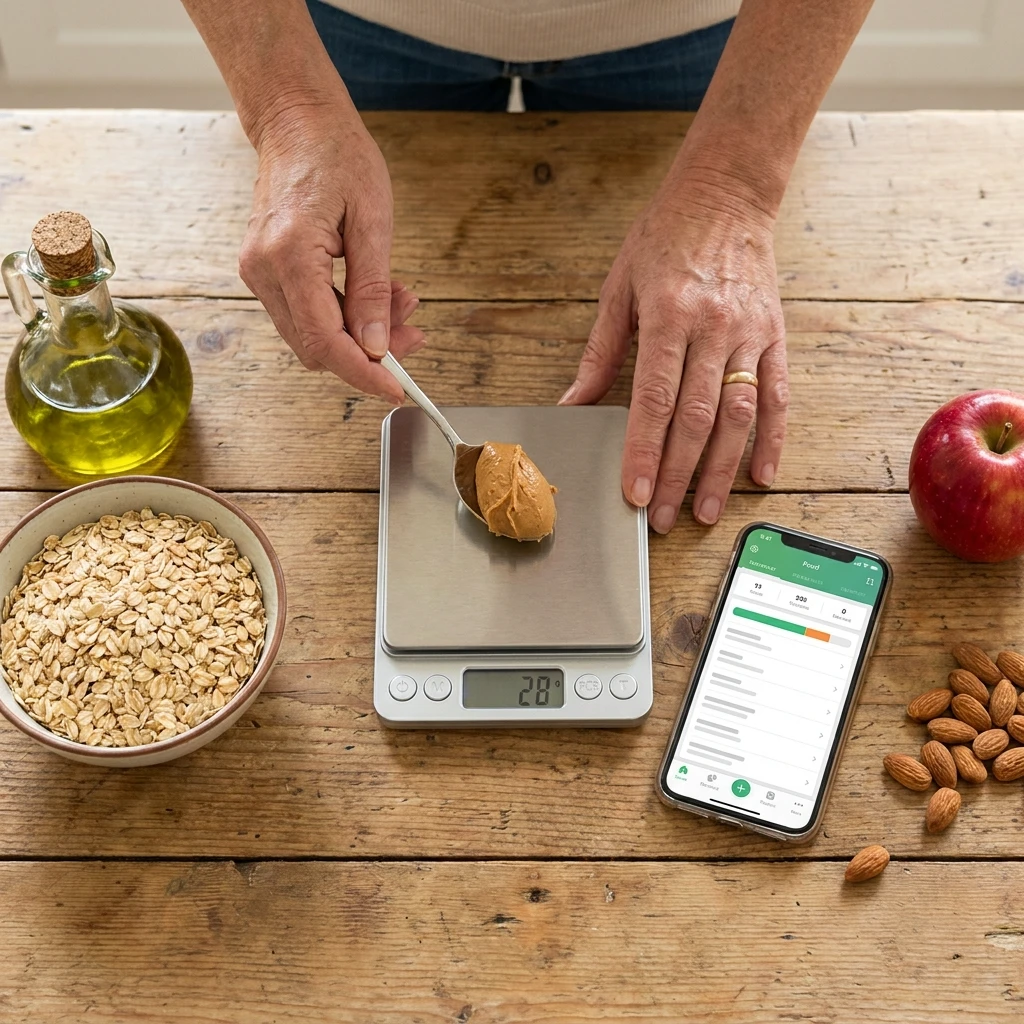
Severe restriction and guesswork are two sides of the same mistake: you don’t actually know your calorie intake, so you can’t fix it. Some women eat far too little and lose muscle; others eat more than they realise and blame their metabolism.
A landmark study in the New England Journal of Medicine looked at people who said they couldn’t lose weight on fewer than 1,200 calories a day. Their metabolism turned out to be normal, within 5% of predicted values.
What they had done was underreport their food by an average of 47% and overreport their exercise by 51%. The study doesn’t point to dishonesty. Bites, tastes, drinks and “just a handful” are easy to forget.
At the other extreme sit crash diets. Eating very little feels productive, but after 40 it works against the muscle you’re already starting to lose. Expert guidance for older adults from the PROT-AGE study group recommends more protein, not less, at 1.0 to 1.2 g per kilogram of body weight daily.
That’s hard to reach on a very low intake, and many women find severe restriction ends in rebound eating, which is why we favour a moderate calorie deficit over a dramatic one.
The long-term evidence on crash dieting is sobering. A six-year follow-up of contestants from an extreme weight-loss competition, published in the journal Obesity, found their resting metabolic rate was still running roughly 500 calories a day below what would be expected for their body size, and most had regained a significant portion of the weight.
That is an extreme example, but it shows the direction of travel: the harder you cut, the harder your body works to win the weight back.
Fast early results are misleading too. Much of what drops in the first week of a very low-calorie plan is water, not fat, so a slower second week feels like failure when it’s really the start of genuine progress. A plan built on all-or-nothing rules is built for a sprint, and weight loss in midlife is not a sprint.
- Do a one-week audit: log everything for seven days, including drinks, oils and tastes while cooking. Then stop if you want.
- Weigh your top three foods once: cereal, oil and nut butter are the usual surprises.
- Set a floor, not just a ceiling: every meal needs a palm of protein and a fist of vegetables.
- Aim for a modest deficit: slow, steady fat loss protects muscle and is easier to keep up.
Prefer not to count at all? Our guide to weight loss without counting calories shows a plate-based alternative.
Mistake #3: Trusting The “Healthy” Halo
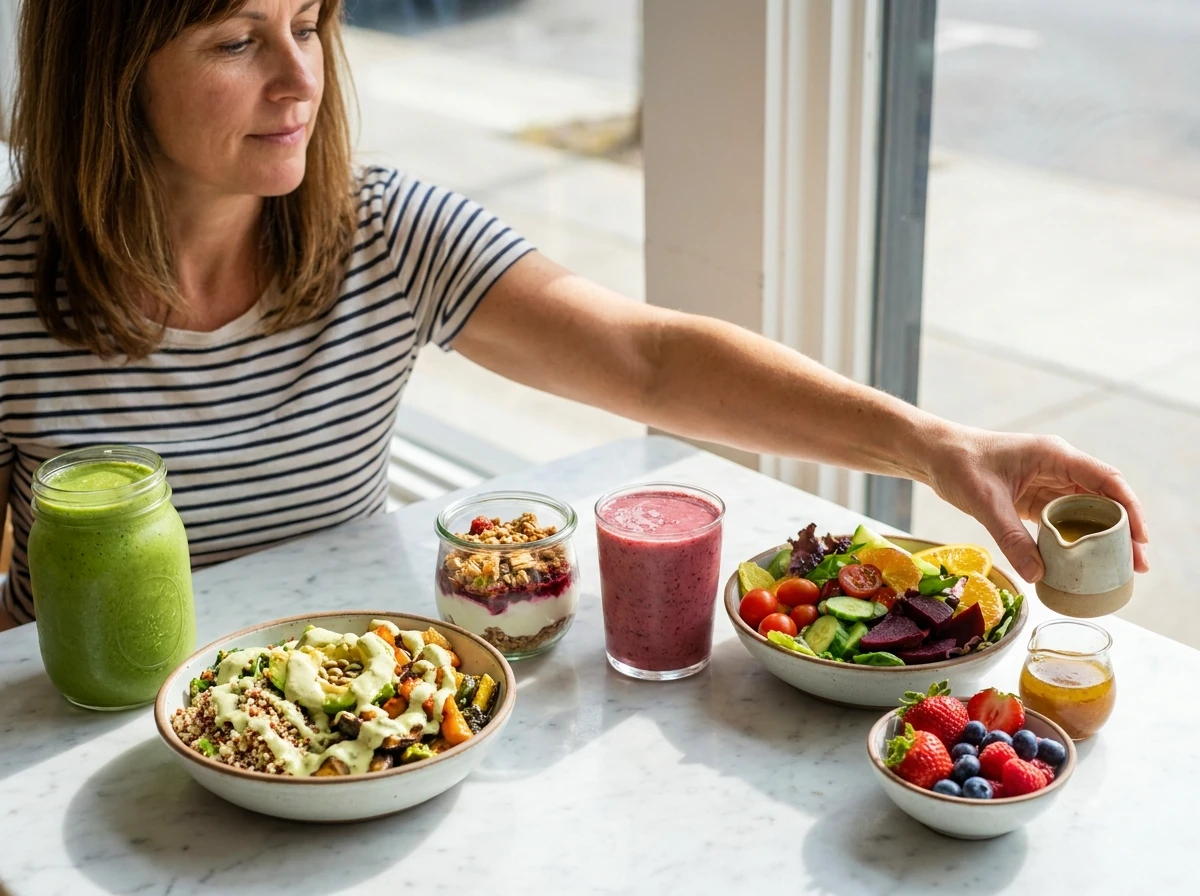
When a food feels healthy, we permit ourselves to eat more of it. Granola, smoothies, nut butter and salad dressings are nutritious, but they’re also calorie-dense, and the halo hides that.
Researchers at the University of Toronto showed how strong this effect is. When 99 women tasted the same cookies, they ate about 35% more when told the snack was healthy. Same cookie, different label, bigger portion.
Drinks are the sneakiest version of this. In a crossover study, people given extra calories as fizzy drinks didn’t eat less afterwards, but when the same calories came as solid sweets, they naturally compensated.
Body weight rose only during the liquid phase. Smoothies, flavoured lattes and juice don’t register as food, so they add up quietly. See healthy drinks that aren’t so healthy for the usual suspects.
Where Hidden Calories Hide In “Healthy” Meals
The base food is rarely the problem; the add-ons are. Reading nutrition labels and measuring toppings for a week is usually enough to spot the leaks.
| “Healthy” Meal | The Hidden Add-On | Easy Fix |
|---|---|---|
| Greek yoghurt bowl | Generous honey and granola | Swap granola for berries and a spoon of seeds |
| Caesar or grain salad | Creamy dressing, croutons, cheese | Dressing on the side; dip, don’t pour |
| Wholemeal toast | Butter plus jam or thick nut butter | Measure one level tablespoon of nut butter |
| Green smoothie | Juice base, banana, nut butter, oats | Use water or milk and keep fruit to one portion |
| Afternoon latte | Syrup, whipped cream, large size | Go small and unsweetened |
After 40, the margin is smaller. With fat gain speeding up during the menopause transition, as the SWAN data above shows, a few hundred hidden calories a day matter more than they did at 30.
Portion control and mindful eating work best together here: plate your food, sit down and eat without a screen. You’ll notice fullness long before the bowl is empty.
Mistake #4: Swapping Real Food For Processed “Diet” Foods
“Low-fat” and “light” labels often mean more sugar, and heavily processed foods make it easy to overeat without noticing. The swap feels responsible, but it can cost you more calories than it saves.

The Sugar Trap In Low-Fat Options
When manufacturers remove fat, they usually add sugar back for taste. That’s not a myth.
A Stanford comparison of foods in the USDA nutrient database found that low-fat and fat-free versions contained more sugar than the regular versions of the same foods. A “light” label tells you about the fat, not the whole recipe.
Why Ultra-Processed Foods Make Overeating Effortless
Ultra-processed foods are soft, fast to eat and easy to overdo, even when the nutrition panel looks similar. One small but tightly controlled trial shows this clearly.
In a tightly controlled NIH inpatient trial, 20 adults offered ultra-processed meals ate about 500 more calories a day than when offered unprocessed meals matched for sugar, fat, fibre and salt. Their weight changes closely tracked how much they ate.
| “Diet” Product | The Catch | Real-Food Alternative | Why It’s Better |
|---|---|---|---|
| Low-fat flavoured yoghurt | Added sugar | Plain Greek yoghurt with fruit | More protein, you control the sweetness |
| Diet biscuits or snack bars | Refined flour, easy to overeat | A small handful of unsalted nuts | Healthy fats and fibre that fill you up |
| Fat-free salad dressing | Often sweetened | Olive oil and vinegar | Simple ingredients, helps absorb vitamins |
| Diet soft drinks | Keeps the sweet habit alive | Water infused with citrus or mint | Hydrating, no added sugar |
You don’t need to cut out every packet. Aim for most of your plate to be food your grandmother would recognise: vegetables, fruit, whole grains, beans, eggs, fish and lean meat. That nutrient density is what keeps you full on fewer calories, which matters more in midlife when you’re also trying to fit in enough protein for your muscles.
Mistake #5: Exercising At Extremes
Too much exercise and too little both stall fat loss, just for different reasons. The sweet spot is regular, varied training you can actually sustain, with strength work at its centre.
Doubling your cardio feels like doubling your results. It isn’t. A study of 1,754 adults found the body compensates for about 28% of the extra calories burned through activity, so only around 72% of that effort shows up in your daily energy burn.
Your body quietly turns down its energy use elsewhere. On the other side, sporadic workouts with long gaps give your body no reason to change.
| Aspect | Overexercising | Underexercising | What Works Better |
|---|---|---|---|
| Duration | Hours a day | Minimal or none | Consistent, moderate sessions |
| Intensity | Always hard, little rest | Always easy, no progression | Mixed intensity with rest days |
| Frequency | Several sessions daily | Sporadic, long gaps | A planned weekly routine |
| How you feel | Drained, sore, obsessive | Unmotivated, stuck | More energy, better mood |

Why Strength Training Matters More After 40
Strength training is the best way to hold on to the muscle that menopause starts to take. It won’t turbo-charge your metabolism overnight, but it protects the body you’re building.
Let’s be honest about the numbers. Muscle burns about 13 calories per kilogram per day at rest, compared with about 4.5 for fat. Adding a couple of kilos of muscle won’t transform your daily burn.
What it does is fight sarcopenia, the age-related muscle loss that makes everyday life harder, and it keeps the weight you lose coming from fat rather than muscle. You also get a small afterburn from excess post-exercise oxygen consumption (EPOC).
- Two to three strength sessions a week: squats, lunges, rows, presses and hip hinges cover most of your body.
- Daily walking: steady steps add up without leaving you exhausted or ravenous.
- One or two harder cardio sessions: cycling, swimming or intervals for heart health.
- At least one full rest day: recovery is when your body adapts.
For the full breakdown, read strength training vs cardio for fat loss and how to balance cardio and strength training.
The Cardio Trap: Why Lifting Won’t Make You Bulky
Many women were taught to favour cardio and avoid weights because lifting would make them “bulky”. In perimenopause, that belief costs more than ever. Building visible bulk takes years of targeted training and eating, while two or three strength sessions a week simply help you keep the muscle that the menopause transition makes harder to hold on to.
Cardio still matters for your heart. The mistake is doing only cardio, at the same pace, week after week. Keep your walks and classes, and add strength work so your body has a reason to keep its muscle.
Mistake #6: Treating Protein As An Afterthought
Light meals like salads, toast and fruit are often low in protein, which leaves you hungrier and makes muscle loss more likely. After 40, protein needs a seat at every meal, not just dinner.
The UK reference intake for adults is 0.75 g of protein per kilogram of body weight, but that’s a minimum to prevent deficiency. The PROT-AGE recommendation of 1.0 to 1.2 g per kilogram, mentioned above, is aimed at people over 65.
For women in perimenopause, it’s a sensible direction of travel rather than a hard rule. Too little is far more common than too much.
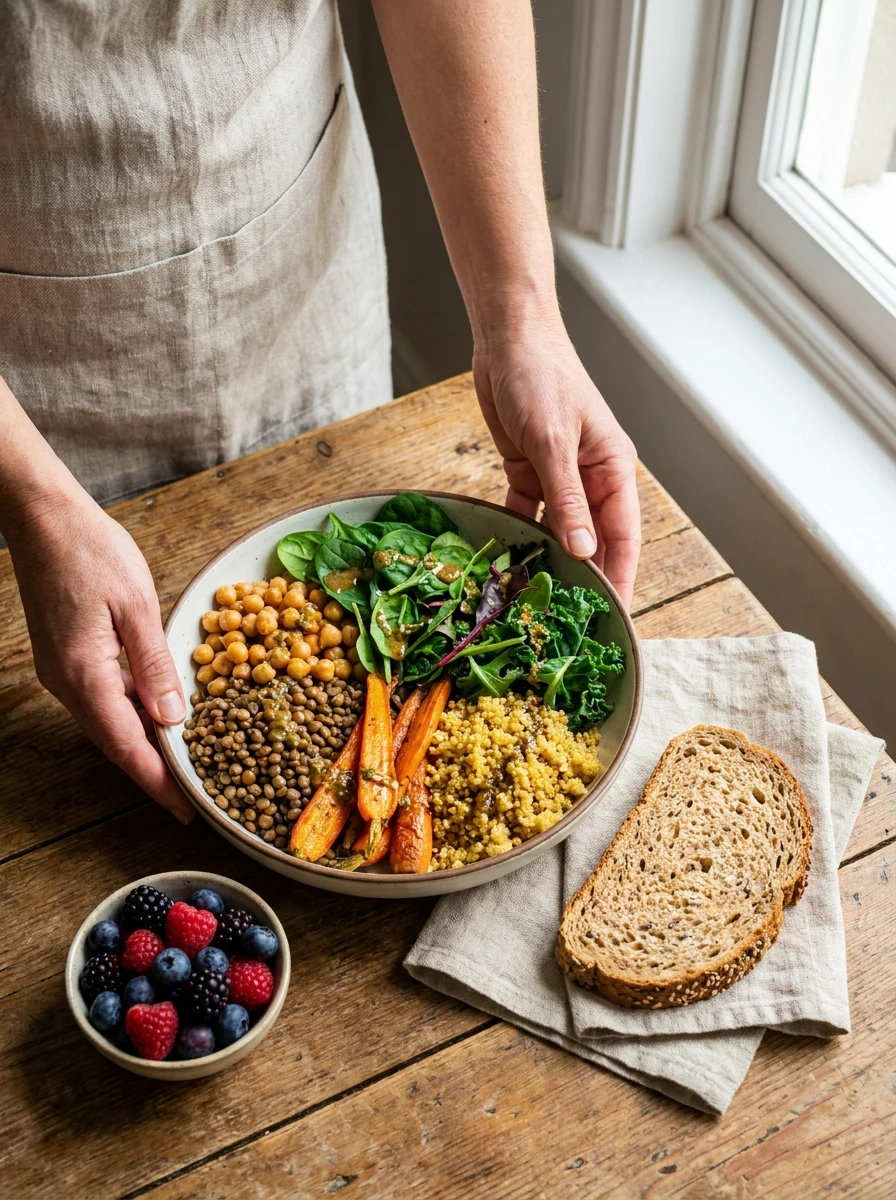
Protein bars and shakes make it easy to believe that more is always better, but there’s no bonus for eating far beyond your needs, and the extra still counts towards your total calories. The simple fix is a palm-sized portion of protein at every meal. Breakfast and lunch are usually where intake falls short, so start there. Our guide to protein foods for dieting has easy options.
Plant-based or mixing it up? Here’s what common foods deliver, per 100 g, according to the British Nutrition Foundation.
| Protein Source | Protein Per 100 g |
|---|---|
| Chicken breast (grilled, no skin) | 32.0 g |
| Salmon (grilled) | 24.6 g |
| Almonds | 21.1 g |
| Egg (boiled) | 14.1 g |
| Cottage cheese | 9.4 g |
| Tofu (steamed) | 8.1 g |
| Red lentils (boiled) | 7.6 g |
| Chickpeas (canned) | 7.2 g |
Build each meal around one of these, and you’ll find healthy snack ideas matter less, because you won’t be hunting for food at 4 pm.
Mistake #7: Running Low On Fibre
Fibre is the most overlooked tool in weight loss: in one large trial it was the most influential dietary predictor of weight loss. Cutting carbs often cuts fibre with them.
In the POUNDS Lost trial, 345 adults with an average age of 52 followed calorie-reduced diets for six months. Fibre intake was the most influential dietary predictor of weight loss, independent of calories and macronutrient balance, and it was strongly linked to sticking with the diet.
Meanwhile, UK adults are advised to eat 30 g of fibre a day, yet most of us manage around 20 g or less. Notice the age group in that trial, too: an average of 52, right in the menopause years. Fibre-rich foods are also bulky and slow to eat, so they fill the plate without crowding out protein.
| Food | Portion | Fibre Per Portion |
|---|---|---|
| Lentils | 120 g | 8.1 g |
| Quinoa | 180 g | 6.3 g |
| Chickpeas | 120 g | 6.2 g |
| Wholemeal bread | 80 g | 5.8 g |
| Oats | 45 g | 3.5 g |
| Berries | 80 g | 3.3 g |
| Carrots | 80 g | 3.1 g |
| Almonds | 20 g | 2.0 g |
- Breakfast: oats with berries instead of a cereal bar.
- Lunch: add half a tin of chickpeas or lentils to your salad or soup.
- Dinner: fill half the plate with vegetables before anything else goes on.
- Go slowly: increase fibre over a couple of weeks and drink plenty of water to keep digestion comfortable.
Mistake #8: Rewarding Your Workouts With Food
Treating food as the prize for exercise quietly cancels the work you just did, and it turns training into a debt you have to pay off. After a tough session, it’s easy to slip into calorie bargaining: you earned the muffin, so you have it.
As Mistake #5 showed, your body already compensates for part of the extra energy you burn. Add a reward snack on top, and the gap can close completely. The higher cost is how it feels. When exercise becomes a punishment that earns food, you start to dread both, and neither habit lasts.
- Pick non-food rewards: a bath, a new podcast, an early night or time for a hobby.
- Plan the meal after training: make it a normal meal with protein, not a bonus snack.
- Reframe the session: you train to stay strong through midlife, not to pay for dinner.
Mistake #9: Short-Changing Your Sleep
Sleep is a weight loss tool, not a luxury, and perimenopause makes it easier to lose. Night sweats, hot flushes and early waking can chip away at your rest for months at a time.
Short sleep shifts the hormones that steer your appetite. Your body tends to make more ghrelin, the hormone that drives hunger, and less leptin, the one that tells you you’ve had enough. The result is a day of stronger cravings and weaker fullness signals, and that has nothing to do with willpower.
- Keep your bedroom cool: use layers you can throw off during a night sweat.
- Keep a regular wake-up time: even after a bad night, so your body clock stays steady.
- Watch late caffeine and alcohol: both can make broken sleep worse.
- Ask for help: if night sweats or insomnia disrupt your sleep most nights, talk to your doctor. You don’t have to just put up with it.
The Pace Of Progress: How Fast Should You Lose Weight After 40?
A steady pace of about 1 to 2 lb (0.5 to 0.9 kg) a week is healthy, and slower is normal after 40. If the first week was dramatic and the second barely moved, nothing has gone wrong.

Early losses on any new plan are often water rather than fat. After that, a rate of no more than about 0.9 kg (2 lb) a week suggests you’re losing fat and building habits you can keep. In perimenopause, water swings around an irregular cycle can hide that progress for a week or two, so judge your trend over a month, not a weekend.
Six Weight Loss Myths Women Over 40 Still Believe
Mistakes are things you do. Myths are the beliefs that make those mistakes feel sensible. These six come up again and again, and each one falls apart when you look at the evidence.
Myth 1: You Can Burn Belly Fat With Targeted Exercises
You can’t choose where your body loses fat. A 12-week clinical trial and a 2021 meta-analysis of 13 studies, summarised by the University of Sydney’s Charles Perkins Centre, both found that training one area didn’t produce extra fat loss in that area. Fat is released from stores all over your body.
Core work still builds strength and supports your posture and back, which matters in midlife, but it won’t out-train a calorie surplus. Read more in the truth about spot reduction.
Myth 2: Skipping Meals Speeds Up Weight Loss
When researchers randomly assigned people to eat or skip breakfast, rather than just observing their habits, skipping it showed no weight-loss benefit, according to an analysis covered in Nature Reviews Endocrinology.
What skipping meals does reliably is leave you ravenous by late afternoon, when the fastest, most calorie-dense option tends to win. Regular meals with protein keep your decisions calm. If you prefer a shorter eating window, that’s fine, as long as the meals you do eat are proper ones.
Myth 3: You Have To Cut Out Carbs Completely
Carbs aren’t the enemy. Refined carbs in large amounts can make a deficit harder to keep, but the USDA’s MyPlate guidance lists grains as a core food group and recommends making at least half of them whole grains.
Cutting carbs also tends to cut fibre, which, as Mistake #7 showed, is one of your best allies. Build meals around oats, brown rice, quinoa, sweet potatoes, beans, lentils, fruit and vegetables, and keep white bread, pastries and sugary cereals as occasional foods.

Myth 4: Supplements Are A Safe Shortcut
The NIH Office of Dietary Supplements says plainly that there’s little scientific evidence that weight-loss supplements work, and it flags real safety concerns, including products adulterated with undisclosed prescription drugs.
If you take any regular medication, talk to your doctor or pharmacist before trying anything sold as a fat burner or metabolism booster. Our guide to fat loss supplements covers the riskiest categories.
Myth 5: Slow Weight Loss Won’t Last
Slow loss isn’t a sign you’re failing. Nutrition.gov recommends roughly 1 to 2 pounds a week as reasonable and sustainable, slow enough for your habits to catch up.
Rapid loss tends to take water and muscle with it, and after 40, muscle is the last thing you want to lose. If your progress feels slow, it may be the best sign that what you’re doing is built to last.
Myth 6: Cutting 3,500 Calories Always Equals One Pound
This popular rule treats your body like a fixed calculator. According to the American Institute for Cancer Research, research testing it found that most people lost far less weight than it predicted, because your body needs fewer calories as you get lighter, and the same cut tends to produce slower loss in women and in older adults.
If your results slow while your habits stay the same, that’s adaptation, not failure. It’s also a cue to protect muscle with protein and strength work rather than cut even harder.
| Myth | Reality | Do This Instead |
|---|---|---|
| You can spot reduce belly fat | Fat loss happens across your whole body | Pair core work with strength training and a modest deficit |
| Skipping meals speeds things up | No reliable weight benefit, more late-day hunger | Eat regular meals built around protein |
| You have to cut out carbs | Whole grains and fibre support weight loss | Swap refined carbs for whole-food carbs |
| Supplements are a safe shortcut | Little evidence and real safety concerns | Talk to your doctor or pharmacist first |
| Slow loss won’t last | 1 to 2 lb a week is a sustainable pace | Judge your monthly trend |
| 3,500 calories equals one pound | Your body adapts as you lose | Protect muscle instead of cutting harder |
What We See Women Get Wrong Most Often
The most common mistake we see isn’t any single one of the above. It’s deciding a plan has failed after a week or two and switching to something more extreme.
That instinct is understandable, especially when your body already feels unfamiliar. But it’s usually the moment a sensible approach gets abandoned, right before it would have started paying off. Before you change course, look for signs that change is already happening.
Signs Of Real Progress To Track Before The Scale Moves
- Better sleep: often one of the first things to improve once meals become more regular.
- Steadier energy: no more post-lunch crash in the afternoon.
- Fewer cravings: especially the late-evening ones driven by daytime under-eating.
- Clothes fitting differently: a sign your body composition is shifting even when your weight looks flat.
Want The Habits Behind Lasting Weight Loss? Get the free guide: 10 research-backed habits that help women lose body fat and keep it off, with no extreme diets. Send Me The Free Guide.
Expert Commentary: What The Research Agrees On After 40
Across the studies in this article, the researchers point in the same direction, and it isn’t “eat less and try harder”.
The SWAN team documented faster fat gain and falling lean mass from the start of the menopause transition. The PROT-AGE study group recommends more protein for older adults, not less.
The NIH Office of Dietary Supplements warns that weight-loss pills have little evidence behind them. And the POUNDS Lost researchers found fibre was the most influential dietary predictor of weight loss in a trial whose participants averaged 52.
Put together, the evidence says the same thing: protect your muscle, eat enough protein and fibre, sleep as well as you can, and stay consistent long enough for it to work.
Contrarian Take: Stop Hunting For The One Big Mistake
Articles like this one are lists, and lists make it tempting to believe there’s one hidden error that, once fixed, unlocks everything. In our experience, that’s rarely how it works after 40. Progress usually comes from fixing two or three small things and then leaving them alone long enough to work.
So don’t try to fix all nine mistakes and six myths this week. Pick the one that made you wince, change it for a month, and judge the result by your waist, your energy and your strength as well as the scale.
The Bottom Line
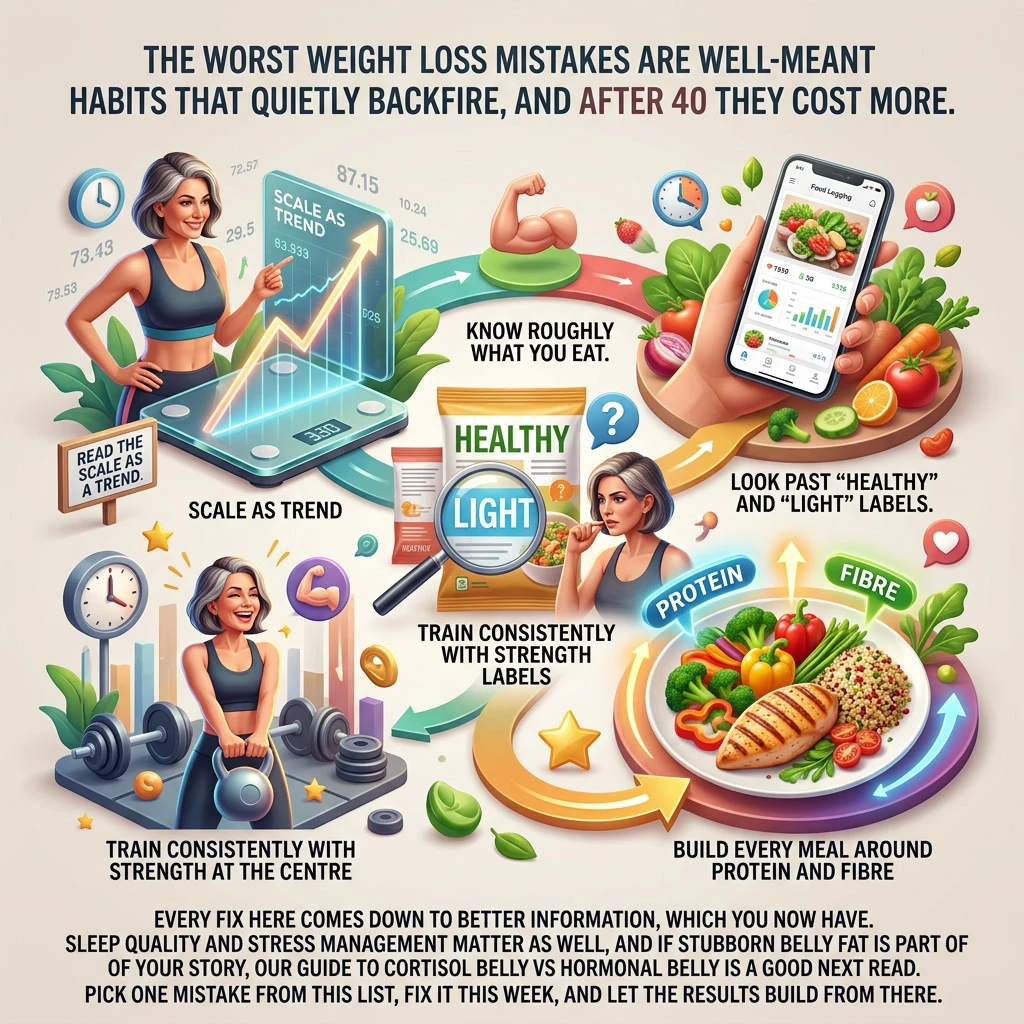
The worst weight loss mistakes are well-meant habits that quietly backfire, and after 40 they cost more. Read the scale as a trend, know roughly what you eat, look past “healthy” and “light” labels, train consistently with strength at the centre, build every meal around protein and fibre, and protect your sleep. Let go of the myths too: you can’t spot reduce, you don’t need to fear carbs, and slow progress is real progress.
Every fix here comes down to better information, which you now have. Sleep quality and stress management matter as well, and if stubborn belly fat is part of your story, our guide to cortisol belly vs hormonal belly is a good next read. Pick one mistake from this list, fix it this week, and let the results build from there.
Not sure which of these is costing you the most? Grab our free guide, 10 Actions That Support Permanent Weight Loss, and swap the habits that look healthy for ten small actions that hold up after 40.
Glossary Of Key Terms
- Body composition: The proportion of fat, muscle, bone and water in your body. A better guide to health than total weight.
- Calorie deficit: Taking in fewer calories than your body uses, which is required for fat loss.
- Energy compensation: The body’s tendency to offset some of the calories burned through extra activity, partly by lowering other energy use.
- Ghrelin: A hormone that drives hunger. It tends to rise when you’re short on sleep or eating very little.
- Health halo: The tendency to underestimate calories, or eat more, when a food is seen as healthy.
- Lean mass: Everything in your body that isn’t fat, including muscle, organs and bone.
- Leptin: A hormone that signals fullness. It tends to fall with short sleep and severe calorie cuts.
- Menopause transition: The years of changing hormones leading up to a woman’s final period, also called perimenopause.
- Sarcopenia: Age-related loss of muscle mass and strength.
- Scale fixation: Relying on daily scale readings to judge success, often leading to frustration over normal fluctuations.
- Spot reduction: The idea that exercising one body part burns fat from that area. Research does not support it.
- Ultra-processed foods: Industrially made products built from refined ingredients and additives, typically easy to overeat.
- Underreporting: Recording or remembering less food than you actually ate, a common reason for stalled progress.
FAQ
What Is The Biggest Weight Loss Mistake Women Make After 40?
Eating too little protein while cutting calories hard is one of the most costly mistakes, because the menopause transition already speeds up muscle loss. Losing muscle makes it harder to stay strong and active. Aim for a moderate deficit with protein at every meal and regular strength training.
Why Am I Not Losing Weight In A Calorie Deficit?
Often the deficit is smaller than you think. In one study, people who believed they ate under 1,200 calories were underreporting their food by almost half. Water retention can also hide fat loss for a week or two. Track honestly for seven days and judge your weekly average weight.
Can I Lose Belly Fat By Doing Ab Exercises?
Not on their own. Research on spot reduction shows that training one area doesn’t burn extra fat from that area. Ab work strengthens your core, which supports your posture and back, but belly fat comes off as part of overall fat loss through food, strength training, daily movement and sleep.
Is Intermittent Fasting A Mistake After 40?
It isn’t a mistake, but it isn’t magic either. In a 12-week trial, 16:8 time-restricted eating was no more effective for weight loss than three regular meals, and the fasting group lost more lean mass. If you fast, make sure your eating window includes enough protein.
Does Poor Sleep Make It Harder To Lose Weight In Perimenopause?
It can. Short sleep tends to raise ghrelin, which drives hunger, and lower leptin, which signals fullness, so cravings feel stronger the next day. Night sweats make good sleep harder to come by in perimenopause, so a cool bedroom, a regular wake-up time and a chat with your doctor if your sleep is badly disrupted all count as part of your weight loss plan.
Does Drinking More Water Help With Weight Loss?
It may help a little. In a trial of adults aged 55 to 75, drinking 500 ml of water before each meal alongside a reduced-calorie diet led to about 2 kg more weight loss over 12 weeks. Swapping sugary drinks for water also removes easy-to-miss liquid calories.
How Do I Get Past A Weight Loss Plateau?
Check the hidden mistakes first: portion creep, liquid calories, low protein and less movement outside workouts. Then give changes three to four weeks before judging them. Our guide on how to overcome a weight loss plateau walks through the next steps.