
How The 0-15-60 Plan Turns Healthy Diet Meal Plans For Busy Lives Into Something You Actually Follow
Michael Pollan
Journalist & author of In Defense Of Food
Eat food. Not too much. Mostly plants.
Summary (TL;DR)
You open the fridge at 7:40 pm. There’s half a bag of spinach, a yogurt, and a jar of something from last month. The plan you made on Sunday assumed you’d be home at 6 and in the mood to cook. You weren’t, and you aren’t.
Discipline has very little to do with it. Most meal plans are written for a week with no surprises, and real weeks don’t look like that. When a plan only works on a good day, it fails by Wednesday, and you’re left thinking you failed.
This guide gives you a plan built the other way round. Every meal is sorted by how many minutes it takes, so on a bad night you still have a healthy option that takes zero effort. You’ll get the full 7-day plan, a grocery list, a timed prep schedule, and the protein and fiber numbers that matter most for women over 40.
Medical & Referral Disclaimer
This article is for informational and educational purposes only. It is not a substitute for professional medical advice, diagnosis, or treatment. Always talk to your doctor or a registered dietitian before changing your diet, especially if you have kidney disease, diabetes, food allergies, or take prescription medication.
Key Takeaways
- Plan by time first and recipes second: decide how many minutes each night allows, then pick the meal.
- Keep at least two zero-cook dinners in every week so a late night never sends you to the drive-through by default.
- Spend 60 minutes a week on prep, split into two 30-minute blocks, so food stays inside the 3–4 day fridge window.
- Build each meal around a protein anchor of roughly 25–45 g, depending on your body weight.
- Fight meal-prep boredom with sauces and toppings, not with more recipes.
- Stock a few freezer backup meals for the weeks when even the plan falls apart.
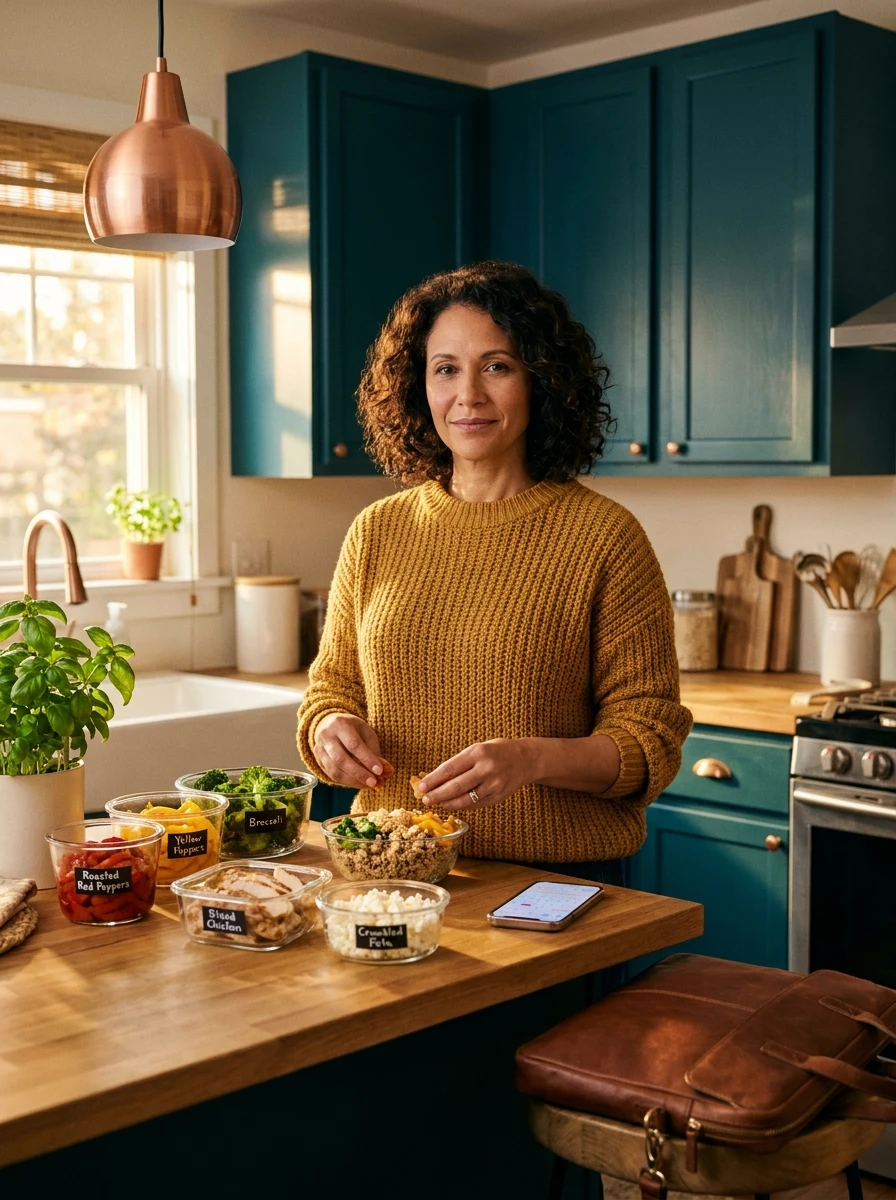
What Makes Healthy Diet Meal Plans Work For Busy Lives?
Healthy diet meal plans work for busy lives when they cut the number of food decisions you make on tired evenings. Large studies link meal planning and home cooking with better diet quality, and the plans that last are the ones that fit your real schedule.
The evidence here is encouraging. A French study of 40,554 adults found that people who planned meals were more likely to have higher diet quality and more food variety. In women, planning was linked with about 8% lower odds of being overweight and 21% lower odds of being obese. The same researchers named time scarcity as one of the most common barriers to cooking at home.
Home cooking matters too. Johns Hopkins researchers analyzing U.S. national survey data from more than 9,000 adults found that people who cooked dinner 6–7 times a week ate about 2,164 calories a day, compared with 2,301 for people who cooked dinner once a week or less, along with less sugar and fat.
Both studies are observational, so they show a link, not proof that planning causes weight loss. Still, the pattern is consistent. If you want the full psychology of why planning works, our guide to the benefits of meal planning covers it. This page is about making a plan you can follow when your week is packed.
The 0-15-60 Plan: Healthy Meals Sorted By The Minutes You Have
The 0-15-60 Plan sorts every meal by hands-on time: 0 minutes for assembly meals, 15 minutes for one-pan cooking, and 60 minutes a week for batch prep. You check the clock, pick the tier, and the healthy choice is already made.
Most simple diet plans start with recipes. This one starts with time, because time is what runs out first on a busy day. Here’s how the three tiers compare.
| Tier | Hands-On Time | What It Looks Like | Use It When |
|---|---|---|---|
| 0 | 0–5 minutes | Assemble ready foods: rotisserie chicken, canned fish, bagged salad, Greek yogurt, prepped grains | You’re home late, worn out, or eating at your desk |
| 15 | 10–15 minutes | One pan or the microwave: stir-fry with frozen vegetables, salmon with a rice pouch, a veggie omelet | A normal weeknight with a little energy left |
| 60 | 60 minutes a week, as two 30-minute blocks | Batch a protein, a grain, a tray of roasted vegetables, a pot of chili | Twice a week, for example Sunday and Wednesday |
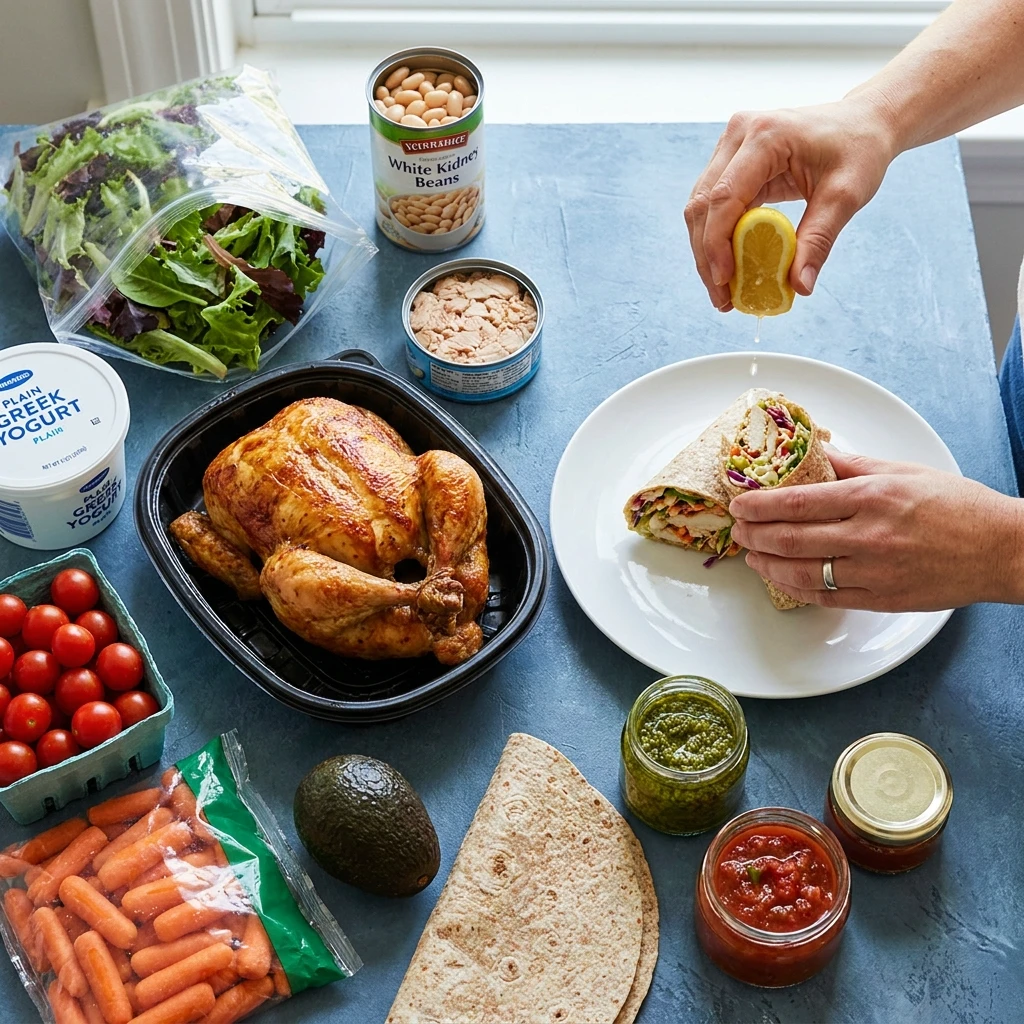
The 0 Tier: Assemble, Don’t Cook
A zero-cook meal is still a real meal if it has a protein, a vegetable or fruit, and something filling. You’re putting food on a plate, not following a recipe, so it works even on your worst night.
- Protein anchors: rotisserie chicken, canned tuna or salmon, hard-boiled eggs, Greek yogurt, cottage cheese, deli turkey, canned beans.
- Vegetables with no chopping: bagged salad, baby carrots, cherry tomatoes, snap peas, pre-cut slaw mix.
- Filling extras: whole-grain wraps, microwave rice pouches, prepped quinoa, hummus, avocado.
- Flavor in seconds: pesto, salsa, tahini, lemon, everything bagel seasoning.
Keep at least two 0-tier dinners in every week. They’re your insurance policy, and they stop a late meeting from turning into takeout by default.
The 15 Tier: One-Pan Weeknights
Fifteen-minute dinners rely on frozen vegetables, quick-cooking proteins, and a single pan. These low-prep dinners give you a hot meal with very little cleanup on a tired weeknight.
Shrimp, eggs, salmon fillets, tofu, and thin chicken cutlets all cook in under 15 minutes. Pair them with a bag of frozen stir-fry vegetables and a microwave grain, and you have a balanced plate. Frozen vegetables count toward your vegetables for the day, and they skip the chopping board entirely.
The 60 Tier: Your Weekly Prep Budget
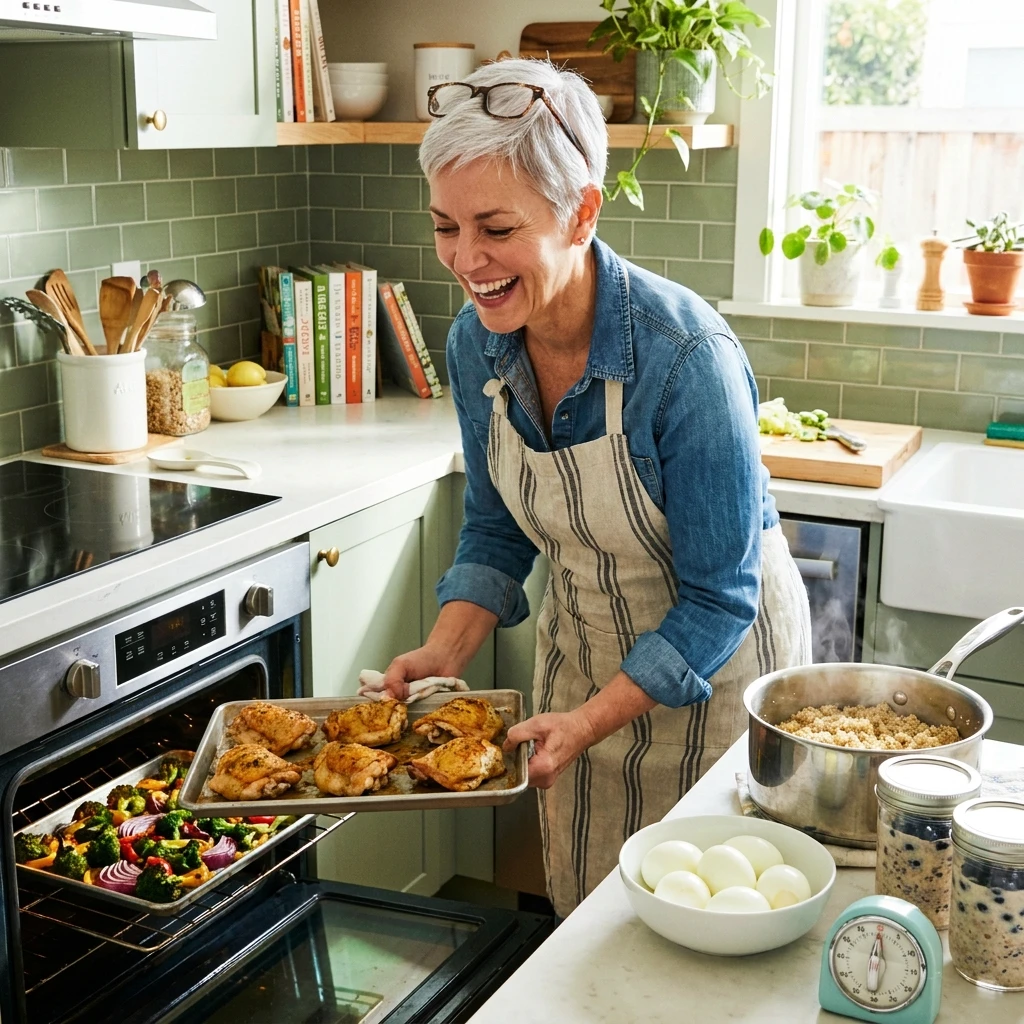
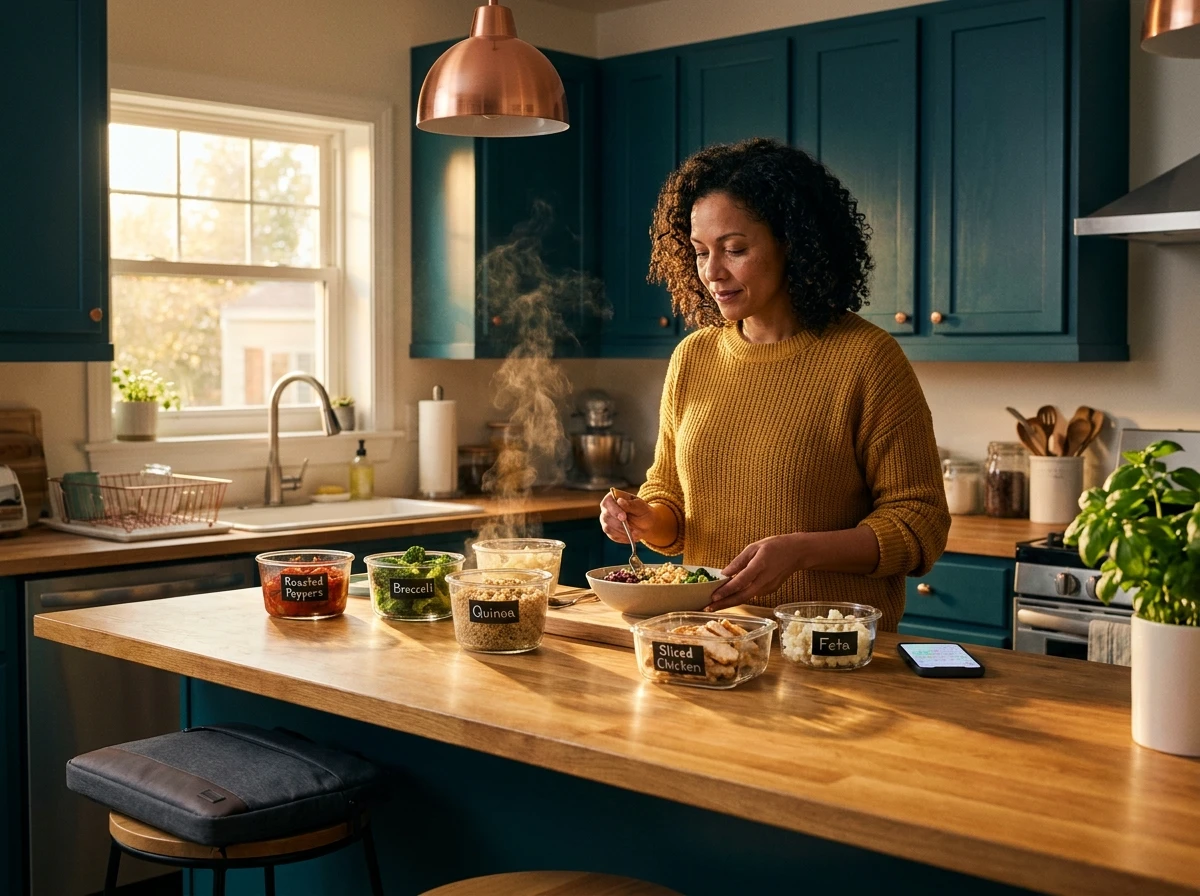
Your whole week of prep takes 60 minutes, split into two 30-minute blocks. The Sunday block feeds that night’s dinner plus Monday to Wednesday, and the Wednesday block makes that night’s dinner plus Thursday to Saturday, so nothing sits in the fridge for longer than a few days.
Here’s how a 30-minute Sunday block runs. Most of the time is oven time, not effort.
- Minutes 0–5: Heat the oven. Put chicken thighs on one tray and chopped peppers, onion, and broccoli on a second. Sunday’s dinner (tofu or chicken with extra vegetables) goes on a third. Toss everything in olive oil and salt.
- Minutes 5–8: All three trays go in the oven. Start a pot of quinoa.
- Minutes 8–12: Put 6 eggs on to boil.
- Minutes 12–20: Make 2 jars of overnight oats with milk or yogurt, chia, and berries.
- Minutes 20–30: Cool the eggs, take out the trays, portion everything into containers, and label them.
The Wednesday block is even simpler: a big pot of turkey and bean chilli, with half portioned for lunches and half frozen. For more batch cooking tips and recipe ideas, see our weight loss meal prep ideas for women.
The Contrarian Take: Skip The Sunday Meal Prep Marathon
Two 30-minute prep blocks beat one three-hour Sunday cook-up, because Sunday’s food is past the recommended fridge window by Friday. A session that big is also the easiest one to skip on a busy weekend.
The usual advice is to give up your Sunday afternoon and cook everything at once. We think that’s a big reason so many meal prep strategies fizzle out.
Start with food safety. FoodSafety.gov says cooked meat and poultry leftovers keep 3 to 4 days in the refrigerator. Chicken you roast on Sunday is ideal for Monday to Wednesday. By Friday it’s past that window, so a single big session pushes you to freeze half of it or eat it later than you should.
Then there’s habit. A big session only happens when you have a free afternoon, and busy women rarely do. A short block is easier to repeat. In a well-known UCL study on how habits form, missing one opportunity to do a new behavior did not materially affect habit formation.
So if you miss Wednesday’s block, the week isn’t lost. You simply lean on your 0-tier meals and pick up again on Sunday.
Your 7-Day Healthy Diet Meal Plan
This 7-day plan uses two 30-minute prep blocks, at least two zero-cook dinners, and a protein source at every meal. Swap any meal for another one from the same tier and the week still works, so it doubles as a reusable weekly meal planner.
| Day | Breakfast | Lunch | Dinner (Tier) | Snack |
|---|---|---|---|---|
| Monday | Greek yogurt, berries, walnuts | Quinoa bowl with roasted chicken, vegetables, feta | Salmon, microwave green beans, rice pouch (15) | Apple and cheese |
| Tuesday | Overnight oats | Bagged salad with chicken, chickpeas, a hard-boiled egg | Shrimp stir-fry with frozen vegetables (15) | Hummus and baby carrots |
| Wednesday | 2 hard-boiled eggs, whole-grain toast, tomato | Leftover quinoa bowl | Turkey and bean chili, made in prep block 2 (60) | Cottage cheese and pineapple |
| Thursday | Overnight oats | Chili leftovers | Rotisserie chicken wraps with slaw mix, chicken bought that day (0) | A small handful of almonds |
| Friday | Greek yogurt bowl | Tuna and white bean salad (0) | Veggie omelet with spinach and peppers (15) | Edamame |
| Saturday | Greek yogurt, banana, a spoonful of nut butter | Baked potato topped with chili (microwave) | Canned salmon, white beans, and bagged greens with lemon, or eat out (0) | Fruit |
| Sunday | Eggs and avocado on whole-grain toast | Snack plate: deli turkey, crackers, vegetables, hummus (0) | Sheet-pan tofu or chicken with vegetables, roasted during prep block 1 (60) | Greek yogurt |
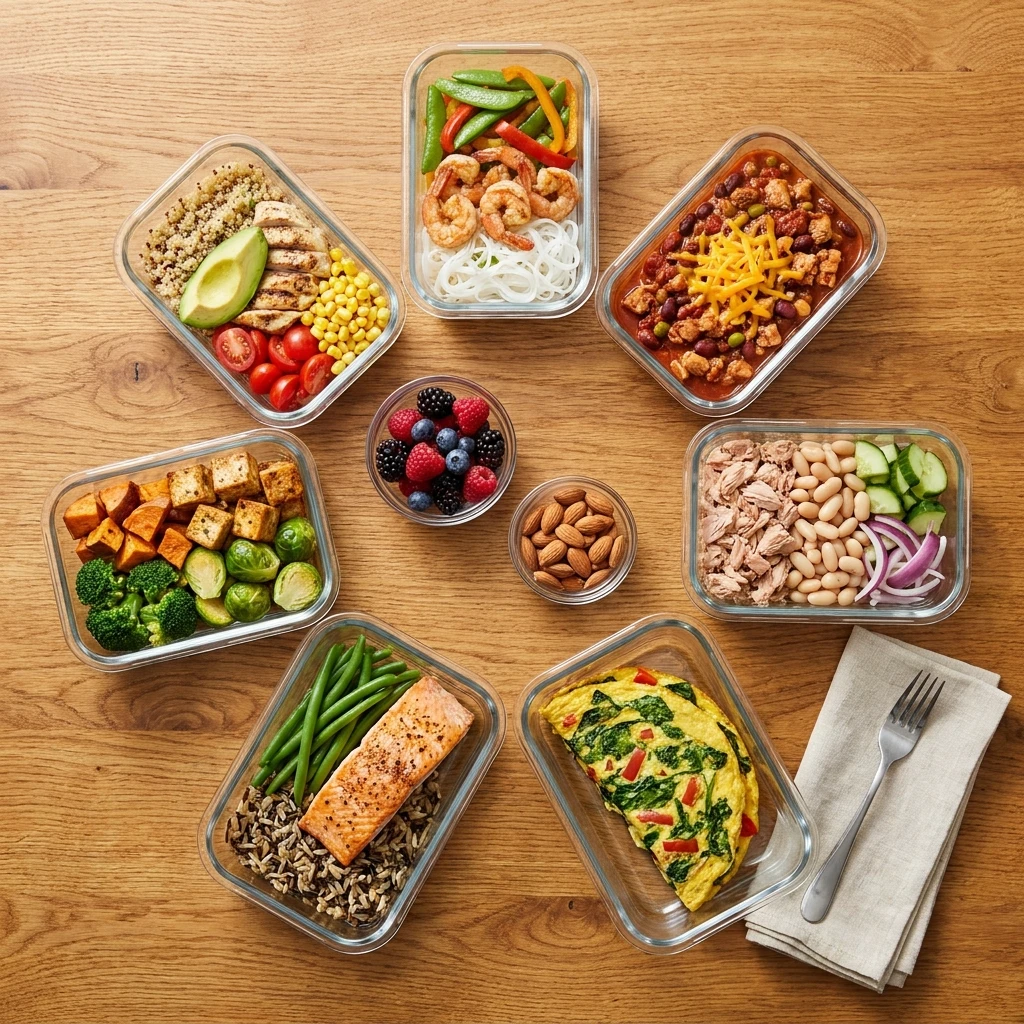
Notice what’s missing: calorie counts and macro tracking. You don’t need either to follow this plan. Portion control comes from the plate itself: a palm or two of protein, half the plate as vegetables, and a fist-sized portion of grains or potatoes.
If you need different diet styles, such as vegetarian or low-carb, our guide to healthy meal plans for every lifestyle covers them.
Your Grocery List For The Week
One shop covers the whole plan if you buy by store section. Most items do double duty across meals, which keeps the list short and cuts down on waste.
- Protein: chicken thighs (about 2 lb), 1 rotisserie chicken (buy it on Thursday), frozen salmon fillets, firm tofu, 1 bag of frozen shrimp, 1 lb lean ground turkey, 2 cans of tuna, deli turkey.
- Dairy and eggs: 18 eggs, a large tub of plain Greek yogurt, cottage cheese, feta, cheese for snacks, milk.
- Produce: bagged salad, spinach, peppers, onion, broccoli, cherry tomatoes, baby carrots, slaw mix, avocados, apples, berries, lemons, potatoes.
- Pantry: quinoa, rolled oats, chia seeds, canned kidney and white beans, chickpeas, crushed tomatoes, whole-grain bread and wraps, crackers, walnuts, almonds, hummus, salsa.
- Freezer: stir-fry vegetables, green beans, edamame, microwave rice pouches.
If cost is a worry, our guide to eating healthy on a budget shows how to build a cheaper weekly cart.
How Much Protein And Fiber Do Women Over 40 Need From A Meal Plan?
The 2025–2030 Dietary Guidelines set protein at 1.2–1.6 g per kilogram of body weight a day and ask you to eat protein at every meal. For fiber, women aged 31–50 are advised to eat 25 g a day and women 51 and over 21 g.
The 2025–2030 Dietary Guidelines for Americans tell you to prioritize protein foods at every meal, from eggs, poultry, seafood, and red meat to beans, lentils, nuts, seeds, and soy.
Spreading protein out may also matter. In a small study of 8 adults, eating about 30 g of protein at each of three meals led to 25% higher muscle protein synthesis over 24 hours than eating most of it at dinner. Not every trial agrees, so treat this as a sensible habit rather than a rule.
Here’s what the guideline range works out to per day and per meal.
| Body Weight | Daily Protein (1.2–1.6 g/kg) | Per Meal (3 Meals) |
|---|---|---|
| 130 lb (59 kg) | 71–94 g | About 24–31 g |
| 150 lb (68 kg) | 82–109 g | About 27–36 g |
| 170 lb (77 kg) | 92–123 g | About 31–41 g |
| 190 lb (86 kg) | 103–138 g | About 34–46 g |
The guidelines say to adjust this to your calorie needs, and if you have kidney disease, check your protein target with your doctor first. Roasting a tray of protein in your prep block is the simplest form of high-protein meal prep. For a deeper look at hitting these numbers, see our high-protein diet plan for women.
Fiber is easy to miss when you’re short on time. According to the U.S. Administration for Community Living, 95% of adults don’t eat enough fiber. The 7-day plan above leans on nutrient-dense foods like beans, oats, chia, vegetables, and fruit to close that gap without extra cooking. Add fiber gradually and drink water with it if your current intake is low.
How Do You Stop Getting Bored Of Eating The Same Meal Prep?
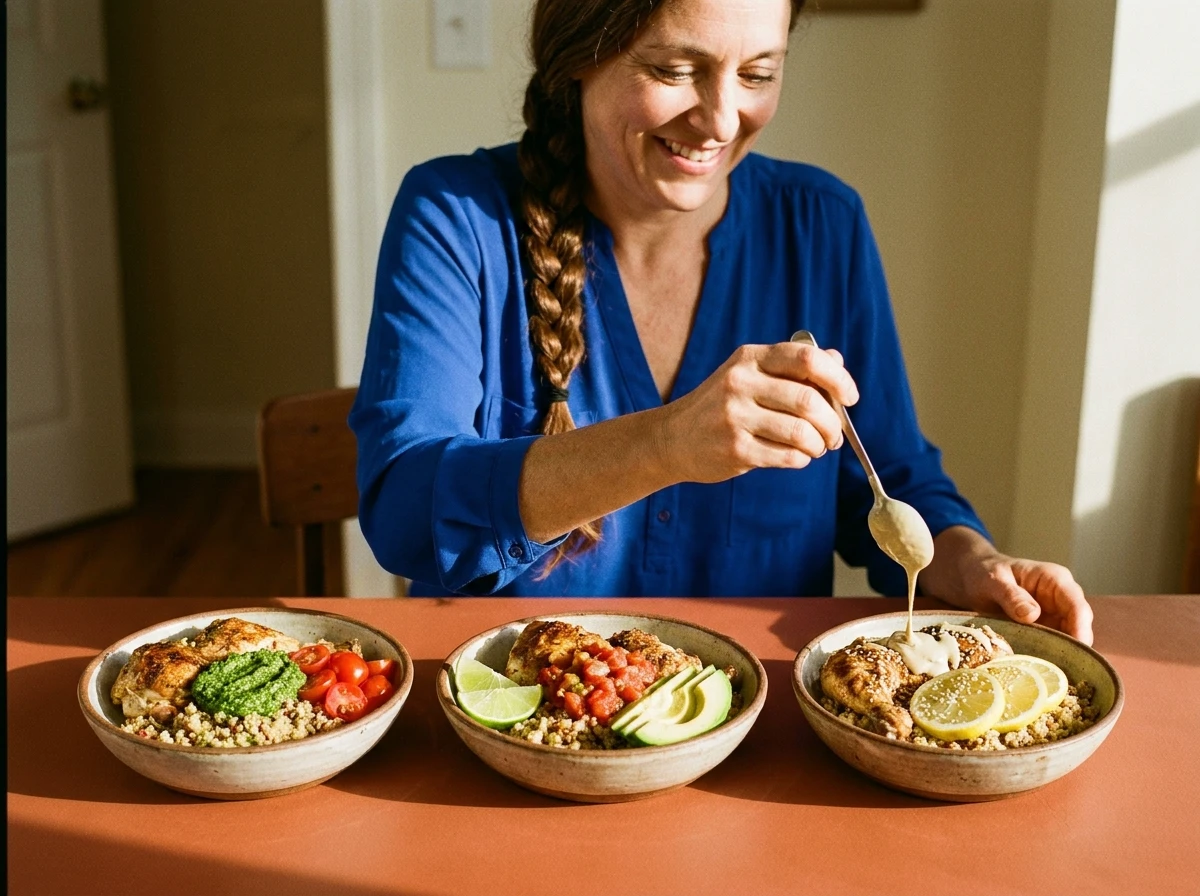
Keep the base and change the flavor. Cook one plain protein and grain, then finish each portion with a different sauce, topping, or format, so Tuesday’s chicken bowl and Thursday’s chicken wrap feel like different meals.
Boredom is where a lot of meal prep quietly ends. By day three, the fifth identical container of chicken and rice can make takeout feel like the only option left. The fix is more variety on top of the same base, and it takes no extra recipes.
- Rotate three sauces: pesto on Monday, salsa and lime on Tuesday, tahini and lemon on Thursday.
- Change the format: the same roasted chicken becomes a grain bowl, a salad topper, a wrap, and an omelet filling.
- Add one fresh thing at serving: avocado, herbs, a squeeze of citrus, or a handful of crunchy seeds.
- Swap one tier meal each week: trade the omelet for a frittata or the shrimp for tofu, and keep the rest of the plan the same.
Snacks are another easy place to add variety. Our guide to healthy snack options explains which ones actually keep you full.
How Long Does Meal Prep Last In The Fridge And Freezer?
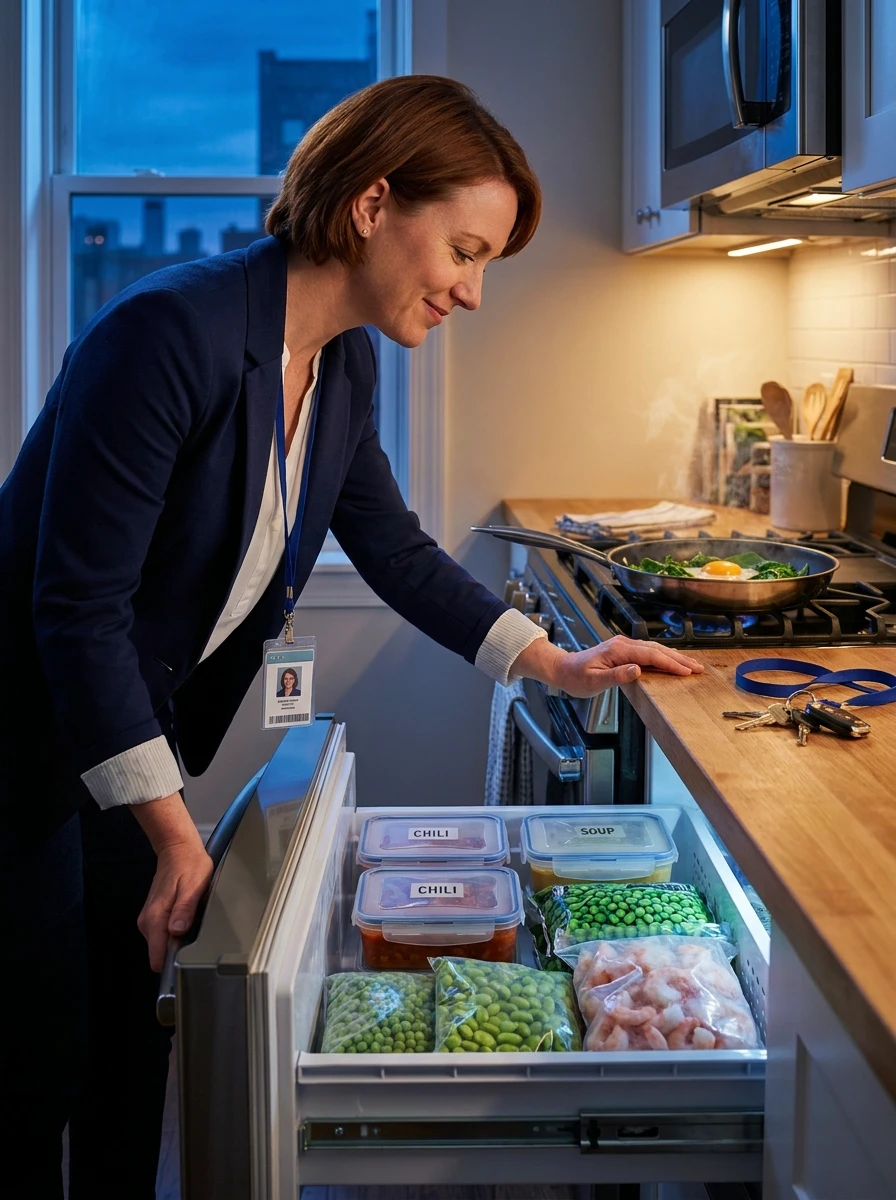
Most cooked meal prep lasts 3–4 days in the fridge, and hard-cooked eggs last about a week, according to FoodSafety.gov. Frozen food kept at 0°F stays safe indefinitely, although its quality slowly drops.
| Food | Refrigerator | Freezer |
|---|---|---|
| Cooked meat or poultry leftovers | 3–4 days | 2–6 months |
| Soups, stews, and chili | 3–4 days | 2–3 months |
| Hard-cooked eggs | 1 week | Do not freeze |
| Chicken, tuna, or egg salad | 3–4 days | Does not freeze well |
These times come from the FoodSafety.gov cold food storage chart, which notes that freezer times are for quality only. Label every container with the date you cooked it, and you’ll never have to guess.
Expert Commentary: What The Research Actually Shows
The research supports planning and home cooking, with honest limits. The big studies are observational, and the protein-timing evidence comes from small trials, so the strongest case is for habits you can keep, not for one perfect plan.
Julia A. Wolfson, lead author of the Johns Hopkins home-cooking study, summed up the main finding: “When people cook most of their meals at home, they consume fewer carbohydrates, less sugar and less fat than those who cook less or not at all – even if they are not trying to lose weight.”
That last part matters if you’re tired of dieting. Frequent home cooks ate better without trying to cut back. The French meal-planning study points the same way, with planners eating a more varied diet. Neither study proves cause and effect, because people who plan and cook may differ in other ways too.
The protein evidence is promising but smaller. The 25% muscle-synthesis result came from just 8 people, and a 16-week trial in 43 women aged 20–44 found that protein distribution didn’t change body composition during weight loss when total protein was the same. The guideline target of 1.2–1.6 g/kg a day is the safer number to plan around. Spreading it over three meals is a practical way to reach it.
What To Do When The Week Falls Apart
Have a Plan B ready before you need it: two or three freezer backup meals, one zero-cook dinner you can always make, and a short list of decent takeout orders. Missing a prep block costs you a meal or two, and the rest of the week still holds.
- Freezer backups: double the chili on a good week and freeze it in single portions. Frozen soups and stews keep 2–3 months for best quality.
- The always-there dinner: eggs, a bag of salad, and whole-grain toast. It takes 10 minutes, and you almost always have the ingredients.
- Your takeout shortlist: pick 2–3 local orders built around grilled protein and vegetables, and save them on your phone so you’re not deciding while hungry.
If busy weeks are getting in the way of your bigger goals, our guide to losing weight when busy life gets in the way goes beyond food. And if you’re in perimenopause and want a ready-made sample menu, try our menopause diet 5-day plan.
Want The Habits Behind Lasting Weight Loss? Get the free guide: 10 research-backed habits that help women lose body fat and keep it off, with no extreme diets. Send Me The Free Guide.
The Bottom Line
Healthy diet meal plans for busy lives don’t have to look like a magazine spread. They have to work at 7:40 pm on a Wednesday when you’re tired and hungry.
The 0-15-60 Plan does that by sorting every meal by the time it takes. Keep two zero-cook dinners in every week. Cook 15-minute meals on normal nights. Spend 60 minutes on prep, split into two blocks so your food stays fresh. Anchor every meal with protein, lean on beans, oats, and vegetables for fiber, and change the sauces when the containers start to feel repetitive.
Start with one week. Use the plan exactly as written, notice which meals you actually ate, and swap out the ones you skipped. After a few weeks, the habit will carry most of the weight the plan carries now.
Want the habits that make a plan like this stick long after week one? Join our mailing list and get our free PDF, 10 Actions That Support Permanent Weight Loss. It has no restriction rules and no guilt, just the small, repeatable actions that fit around a full life. It takes less time to read than this week’s Sunday prep block.
Glossary Of Key Terms
- 0-15-60 Plan: A meal-planning method that sorts meals by hands-on time: zero-cook assembly meals, 15-minute cooked meals, and a 60-minute weekly prep budget.
- Assembly Meal: A meal put together from ready or pre-cooked foods with no cooking, such as a rotisserie chicken wrap.
- Batch Cooking: Cooking a larger quantity of a protein, grain, or dish at once so it covers several meals.
- Ingredient Prep: Washing, chopping, and portioning ingredients ahead of time so meals come together faster.
- Protein Anchor: The main protein food a meal is built around, such as eggs, fish, chicken, beans, or Greek yogurt.
- Protein Distribution: How your daily protein is spread across meals, for example evenly over breakfast, lunch, and dinner.
- Dietary Fiber: The part of plant foods your body doesn’t digest. It supports fullness and digestion and is found in beans, oats, vegetables, and fruit.
- Portion Control: Matching how much you eat to your needs, often using simple visual guides like half a plate of vegetables.
- Freezer Backup Meal: A pre-cooked, frozen portion kept for weeks when there’s no time or energy to cook.
- Meal Planning: Deciding ahead of time what you’ll eat over the coming days, including shopping and prep.
FAQ
What Is The Easiest Healthy Meal Plan For A Busy Woman?
The easiest plan is one sorted by time. Keep two or three zero-cook dinners each week, such as rotisserie chicken wraps or a tuna and bean salad, add a few 15-minute one-pan meals, and do two short prep blocks for lunches and breakfasts.
How Long Does It Take To Meal Prep For A Week?
With the 0-15-60 Plan, about 60 minutes a week, split into two 30-minute blocks. Most of that time is the oven or stove doing the work while you portion food or make overnight oats.
How Many Days Does Meal Prep Last In The Fridge?
Most cooked meat, poultry, soups, and stews last 3–4 days in the refrigerator, according to FoodSafety.gov. Hard-cooked eggs last about a week. Freeze anything you won’t eat within that window.
How Much Protein Should A Woman Over 40 Eat Per Meal?
The 2025–2030 Dietary Guidelines recommend 1.2–1.6 g of protein per kilogram of body weight a day. Spread over three meals, that’s roughly 24–31 g per meal for a 130 lb woman and 31–41 g for a 170 lb woman. Check with your doctor if you have kidney disease.
Is It Okay To Eat The Same Meals Every Day?
Repeating weekday breakfasts and lunches is fine and saves time, as long as your week still includes a range of vegetables, fruits, proteins, and whole grains. Change sauces and toppings to keep meals interesting and your nutrients varied.
Can Healthy Meal Plans Help With Weight Loss?
They can help. In a large French study, women who planned meals had lower odds of obesity, and frequent home cooks in a U.S. study ate fewer calories. These studies show a link rather than proof, so think of planning as a tool that makes sustainable weight loss easier, not a guarantee.
What Should I Keep In My Freezer For Busy Weeks?
Keep frozen vegetables, frozen shrimp or fish fillets, microwave rice pouches, edamame, and two or three single portions of soup or chili. With those on hand, you can always put together a balanced 15-minute dinner.