
Why Most Healthy Snacks Are Working Against You (And What Women Over 40 Actually Need)

I don't go long without eating. I never starve myself: I grab a healthy snack.
Vanessa Hudgens
Summary (TL;DR)
Most snacks labelled "healthy" are cleverly packaged ultra-processed products that spike blood sugar, trigger cravings, and actively work against your goals. For women over 40, the stakes are higher: as estrogen declines, blood-sugar management becomes harder, and the wrong snack amplifies fat storage and energy crashes. This guide gives you a science-backed scoring framework plus a clear list of snacks that work with your hormones, not against them.
You've stood in that aisle.
The one lined with "all-natural," "low-sugar," "made with real fruit" packaging. You reach for a granola bar, a fruit-flavoured yogurt, or a bag of veggie chips and feel genuinely good about it. Like you made a responsible, informed choice.
Here's what the packaging didn't tell you: ultra-processed foods account for nearly 60% of the daily calories consumed by US adults, and a significant proportion of those foods sit right in the "health food" aisle.
For women over 40, this matters more than any other demographic. As estrogen levels fluctuate and decline during perimenopause, your body becomes more sensitive to blood-sugar swings. A snack that barely registered in your 20s now triggers fat storage, energy crashes, and cravings that feel relentless. That's not a willpower failure. It's physiology.
Knowing what to look for changes everything. This guide cuts through the marketing noise with a practical framework, solid research, and a snack list you can actually use.
Medical & Referral Disclaimer
This article is for informational and educational purposes only. It is not intended as personalised medical or nutritional advice. Every woman's body, health history, and hormonal profile is different. If you are managing a medical condition, experiencing perimenopausal symptoms, or have specific dietary requirements, please consult a qualified healthcare professional or registered dietitian before changing your nutrition strategy.
Key Takeaways
- Nearly 60% of US adult calories come from ultra-processed foods, many of which carry health-food branding.
- Declining estrogen during perimenopause reduces insulin sensitivity, making blood-sugar spikes particularly disruptive for women over 40.
- A genuinely healthy snack delivers at least 10g of protein, 3g+ of fibre, and a quality fat source.
- Research confirms that nutrient-dense snacks are linked to weight loss, while energy-dense snacks are linked to weight gain.
- Common "health" products, including granola bars, flavoured yogurts, and veggie chips, score poorly on ingredient quality and blood-sugar impact.
- The Snack Scoring Framework gives you a fast, reusable method to evaluate any snack in under 60 seconds.
- Prepping three snacks on Sunday removes daily decision fatigue and makes the good choice the easy one.
What Makes A Snack Actually Healthy (Not Just Marketed That Way)?
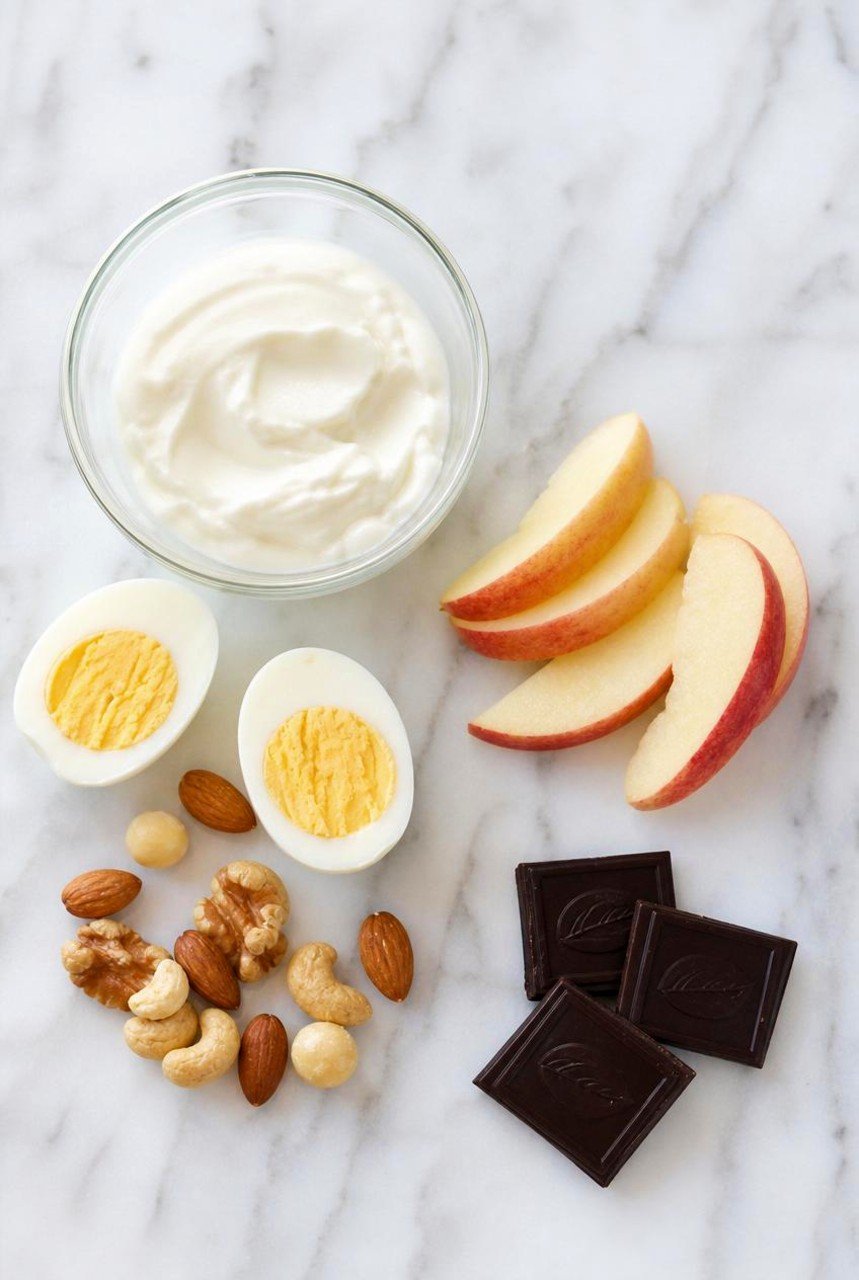
A snack is genuinely healthy when it delivers protein, fibre, and/or healthy fat without excessive added sugars, refined starches, or artificial additives. For women over 40, blood-sugar stability is a fourth criterion: if it spikes your glucose, it's working against you regardless of what the front of the packet claims.
The food industry has a legal right to call products "natural," "wholesome," and "made with real fruit" even when those products contain more added sugar than a candy bar. Understanding that gap is the first step.
Three things to look for in any snack:
- Protein slows digestion, supports lean muscle retention, and triggers the release of satiety hormones like GLP-1 and PYY, which signal fullness to your brain. A 2025 clinical trial confirmed that high-protein snacks significantly increase these satiety hormones compared to high-fat alternatives.
- Fibre slows the release of glucose into your bloodstream, feeds beneficial gut bacteria, and keeps you fuller for longer. The 2020-2025 Dietary Guidelines recommend 28g of fibre per day for a 2,000-calorie diet, yet over 90% of US adults consistently fall short.
- Healthy fats from whole food sources such as nuts, seeds, avocado, and eggs support hormone production, slow digestion, and help your body absorb fat-soluble vitamins. The enemy isn't fat. It's refined oils and trans fats.
A quick label-reading rule: if a snack has more than five ingredients you can't picture in their whole form, it's more processed than it looks.
Why Snacking Hits Differently After 40
Estrogen helps regulate how your cells respond to insulin. As estrogen declines during perimenopause, insulin sensitivity drops and blood-sugar management becomes harder. A snack that barely registered in your 30s can now trigger stronger glucose spikes, more aggressive fat storage, and cravings that feel out of proportion. This is biology, not a willpower problem.
Estrogen does far more than regulate the reproductive system. It actively improves your cells' ability to take up glucose efficiently. When estrogen starts to fluctuate and decline, that efficiency drops. Many women in perimenopause become mildly insulin-resistant without ever getting a diagnosis, because fasting glucose levels can still look normal on standard blood tests.
So the same granola bar you ate at 32 hits very differently at 44. Your blood sugar spikes higher and stays elevated longer. Your body stores more of that glucose as fat, particularly around the abdomen. Then the crash arrives, bringing cravings for more sugar or refined carbohydrates. It's a loop that the wrong snack keeps reinforcing.
There's a cortisol dimension here, too. Chronic stress elevates cortisol, which further disrupts blood sugar and drives stress-related eating. If you consistently reach for snacks during stressful afternoons, the connection between stress-driven snacking and belly fat is worth understanding before you write it off as a discipline issue.
Muscle mass also begins to decline at roughly 3-5% per decade after your 30s without active resistance training. Less muscle means a slower resting metabolism. This is precisely why protein targets for fat loss increase, not decrease, as you get older. Protein-rich snacks are one of the simplest ways to support that goal between meals.
Your hormone-balancing breakfast choices and your snacking strategy are more connected than most nutrition content acknowledges. Both shape your blood-sugar rhythm for the entire day.

The Snack Scoring Framework
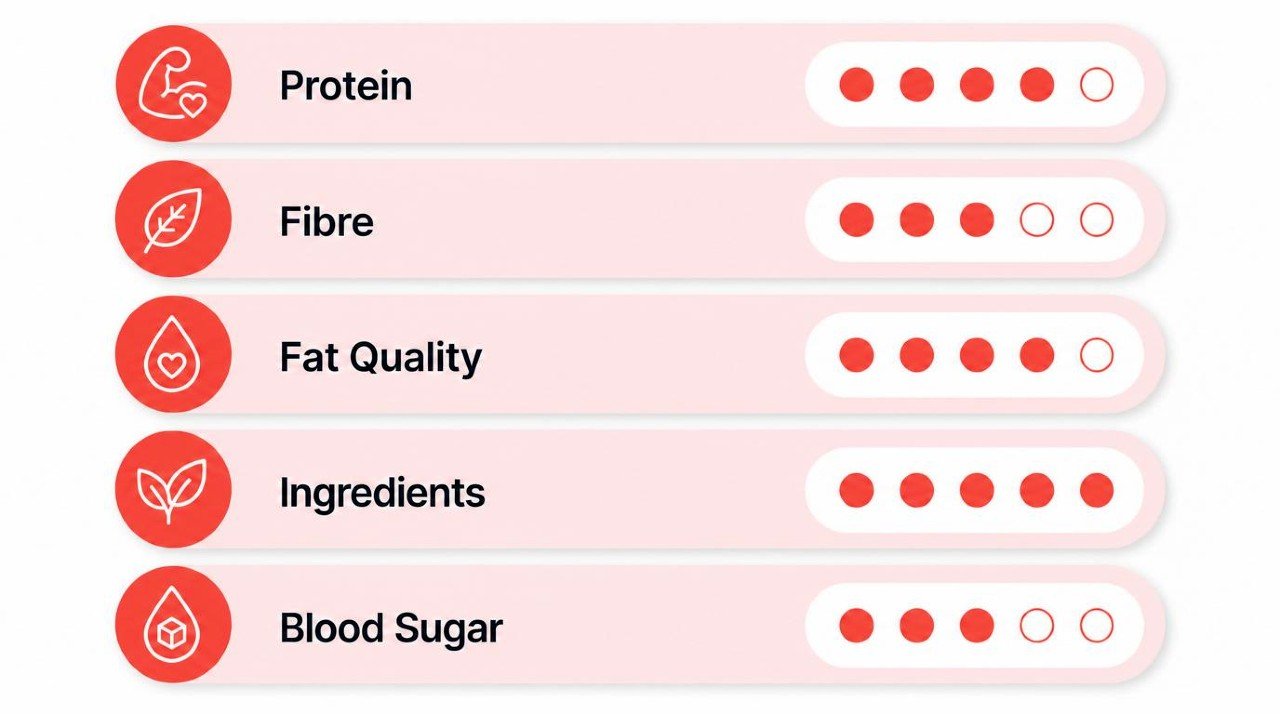
Not every snack is easy to evaluate at a glance. Here's an original scoring tool you can apply to any product in about 60 seconds. Score out of 10 across five criteria. Anything scoring 7 or above is a solid choice. Below 5 is usually a processed product dressed up in health-food packaging.
| Scoring Criterion | 0 Points | 1 Point | 2 Points |
|---|---|---|---|
| Protein content | Less than 5g | 5g to 9g | 10g or more |
| Fibre content | Less than 2g | 2g to 4g | 5g or more |
| Fat quality | Refined oils or trans fats | Mixed sources | Whole-food fats only (nuts, eggs, avocado) |
| Ingredient clarity | 10+ ingredients with additives | 5 to 9 ingredients | 4 or fewer whole-food ingredients |
| Blood-sugar impact | High sugar or high glycaemic | Moderate sugar, some fibre buffer | Low sugar, protein or fibre buffered |
Here's how 10 popular snacks score when you run them through the framework, honestly:
| Snack | Protein | Fibre | Fat | Ingredients | Blood Sugar | Total /10 |
|---|---|---|---|---|---|---|
| Plain Greek yogurt (150g) | 2 | 0 | 2 | 2 | 2 | 8 |
| Apple + almond butter (2 tbsp) | 1 | 2 | 2 | 2 | 2 | 9 |
| Edamame, shelled (100g) | 2 | 2 | 2 | 2 | 2 | 10 |
| Mixed nuts (30g) | 1 | 1 | 2 | 2 | 2 | 8 |
| Hard-boiled eggs (x2) | 2 | 0 | 2 | 2 | 2 | 8 |
| Hummus + vegetable sticks | 1 | 2 | 2 | 2 | 2 | 9 |
| Granola bar (mass-market) | 0 | 1 | 1 | 1 | 0 | 3 |
| Commercial flavoured protein bar | 1 | 1 | 1 | 0 | 1 | 4 |
| Bagged veggie chips | 0 | 0 | 1 | 0 | 1 | 2 |
| Rice cake + fruit jam | 0 | 0 | 0 | 1 | 0 | 1 |
The pattern holds every time. Whole-food snacks score high. Ultra-processed products, regardless of the marketing language on the front, score low.
What Are The Best Healthy Snacks For Women Over 40?
The best snacks for women over 40 pair at least 10g of protein with 3g or more of fibre and a quality fat source. Top options include plain Greek yogurt with berries, edamame, hard-boiled eggs, a small handful of mixed nuts, and apple slices with almond butter. All of these stabilise blood sugar, support lean muscle retention, and keep hunger hormones in check between meals.
The research backs this up. A 2025 randomised controlled trial found that high-protein snacks like Greek yogurt significantly increase satiety hormones GLP-1 and PYY compared to higher-fat alternatives. Those hormones tell your brain you're full. When they're active, cravings quiet down.
Pairing protein with fibre is particularly powerful for women in perimenopause. Nutrition research on perimenopause and insulin resistance consistently shows that this combination slows the release of glucose into the bloodstream, which directly counters the blood-sugar volatility that comes with estrogen decline.
Here's a reference guide for the snacks that actually deliver:
| Snack | Protein | Fibre | Approx. Calories | Best Timing |
|---|---|---|---|---|
| Plain Greek yogurt (150g) | 15g | 0g | 90 kcal | Any time, post-workout |
| Edamame, shelled (100g) | 11g | 5g | 121 kcal | Afternoon |
| Apple + 2 tbsp almond butter | 7g | 4g | 200 kcal | Pre-workout |
| Hard-boiled eggs (x2) | 13g | 0g | 140 kcal | Morning, pre-gym |
| Mixed nuts (30g) | 5g | 2g | 185 kcal | Afternoon, travel |
| Cottage cheese (100g) | 11g | 0g | 98 kcal | Evening, post-workout |
| Hummus + vegetable sticks | 5g | 5g | 130 kcal | Afternoon |
| Dark chocolate (85%+) + 10 almonds | 4g | 3g | 165 kcal | After dinner |
| Berries + Greek yogurt | 17g | 3g | 130 kcal | Breakfast or mid-morning |
| Celery + natural peanut butter | 4g | 2g | 130 kcal | Any time |
On dark chocolate: the benefits are real, but they depend on at least 85% cocoa content. Below that threshold, you're often eating more added sugar than antioxidants. Pair it with almonds to buffer the blood-sugar impact.
For more on how snacking fits your overall approach, our guide to smart snacks for weight management covers portion strategy and timing in more detail.
12 Healthy Smoothies
TIP: Natural smoothies are healthy for you, and they will keep you full throughout the day.
Which Popular "Healthy" Snacks Are Actually Ultra-Processed Traps?
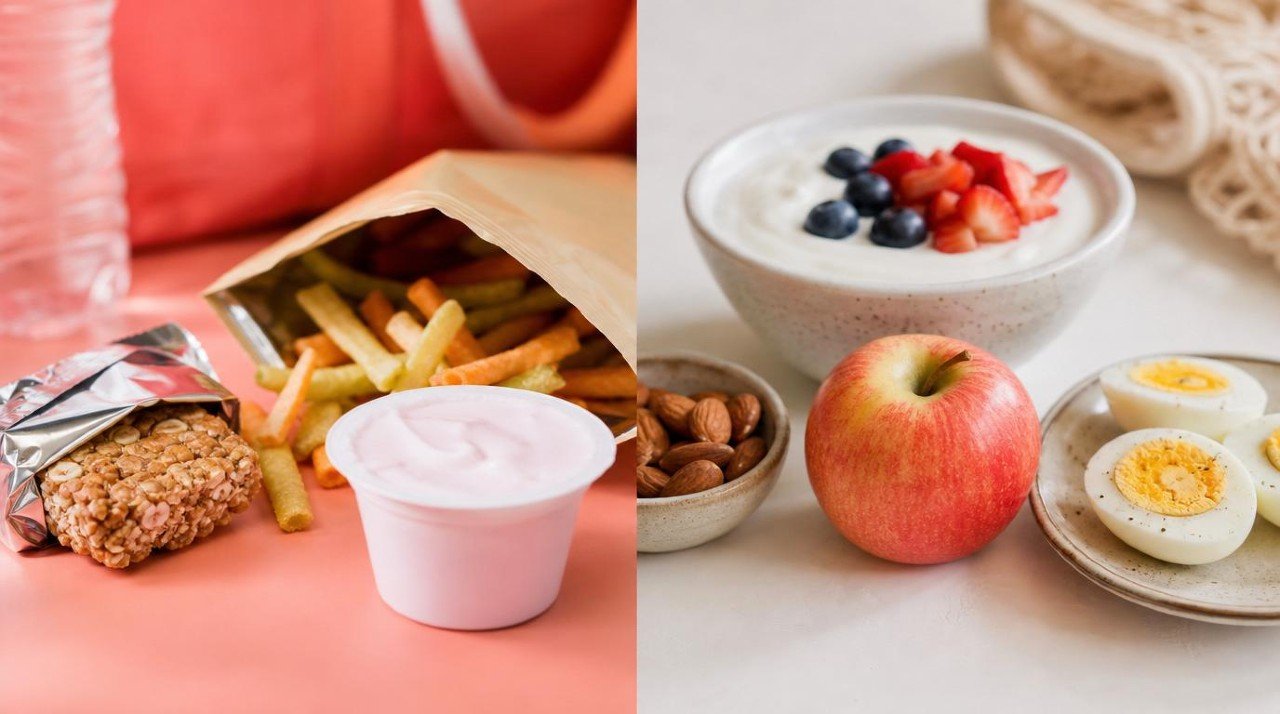
Granola bars, fruit-flavoured yogurts, rice cakes, veggie chips, and most commercial protein bars are frequently ultra-processed products with more added sugar and refined starch than their packaging suggests. In July 2025, the US Department of Agriculture, the FDA, and the Health and Human Services issued a joint statement identifying ultra-processed foods as a leading driver of chronic disease in America.
Let's walk through the most common traps:
- Granola bars: Most mass-market granola bars contain concentrated syrups, refined oils, and flavourings that push total sugar well above 10g per bar, with some hitting 30g. The oats offer some fibre, but rarely enough to offset the blood-sugar impact. A 3 out of 10 on the framework is generous.
- Fruit-flavoured yogurts: The "fruit" is typically a processed fruit preparation loaded with added sugar. A single serving can contain 15-25g, which turns a protein-rich food into a dessert in disguise. Choose plain Greek yogurt and add your own berries.
- Veggie chips: Most bagged varieties contain less than 1g of fibre per serving, are fried in refined oils, and offer virtually no protein. The "made with real vegetables" claim is accurate but misleading. The vegetable content is usually a fraction of the product.
- Rice cakes: Low in calories, yes. But also extremely low in protein, fibre, and healthy fat. On their own, they cause rapid blood-sugar spikes. The problem compounds when paired with high-sugar toppings like jam.
- Commercial protein bars: Many contain 20-30 ingredients, including sugar alcohols, artificial flavourings, and refined syrups. Some score reasonably on protein but poorly on everything else. The flavour engineering in many bars triggers the same eating patterns found in other ultra-processed foods.
This connects directly to the evidence linking ultra-processed foods to poor health outcomes across multiple systems. Compare this list against the metabolism-damaging eating habits that accumulate quietly over the years when you're trusting packaging over ingredients.
How Do I Build A Smarter Snacking Habit That Sticks?
Most people assume snacking is a self-control issue. It's not. It's an availability issue.
The biggest predictor of what you reach for when hunger hits isn't what you intend to eat. It's what's sitting on the counter versus what requires three extra steps. If the granola bar is within arm's reach and the Greek yogurt is at the back of the fridge behind three other things, you'll choose the granola bar most days. That's not a weakness. That's how decisions work when you're tired, distracted, or just hungry.
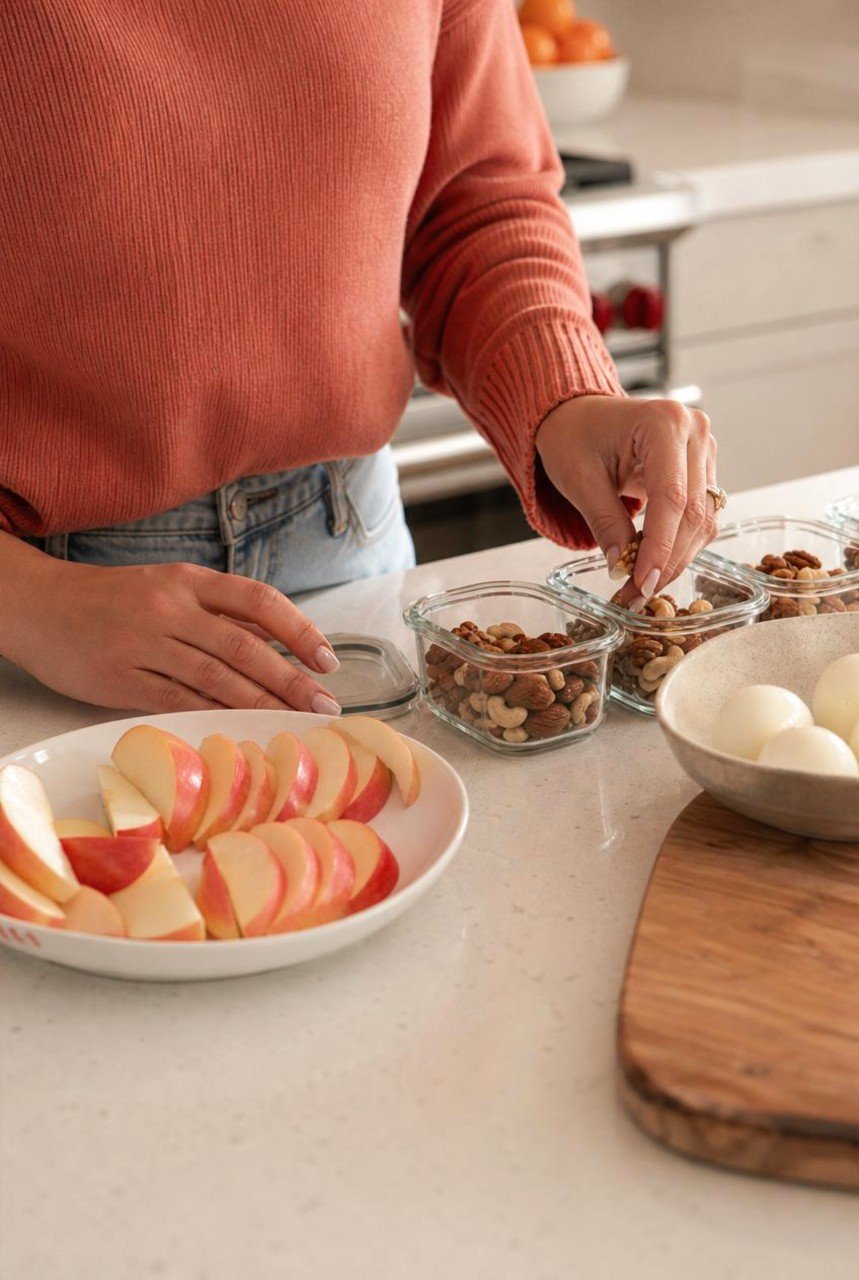
A practical system that takes about 20 minutes on Sunday and pays off for the entire week:
- Step 1: Choose three snacks. Pick one protein-forward option such as Greek yogurt, hard-boiled eggs, or edamame. One fat-forward option like mixed nuts or nut butter. One combination option, such as hummus with vegetable sticks or an apple with almond butter.
- Step 2: Prep in bulk. Hard-boil six to eight eggs. Portion nuts into small containers. Wash and cut vegetable sticks. Put everything at eye level in the fridge. What you see first is what you'll eat first.
- Step 3: Reduce friction for good options; add friction for the rest. This doesn't mean throwing processed snacks away. It means keeping them out of arm's reach. If you have to look for it, you're far less likely to grab it automatically.
- Step 4: Pause before you eat. Before snacking, give yourself 60 seconds. Are you physically hungry? Or is this a stress response, a work-break ritual, or boredom? Both are valid. Knowing which one shifts the choice from automatic to conscious.
If cravings spike at predictable times like 3 pm or after dinner, that's a pattern worth examining. Our guide to taming your sugar cravings covers five practical approaches that don't rely on restriction. This system also fits naturally into a broader eating strategy for women over 40 that takes hormonal changes seriously rather than ignoring them.
Want evidence-based nutrition and fitness content built specifically for women over 40, delivered straight to your inbox every week? Join our community and get started today.
The Bottom Line
The healthy snack aisle is not your friend. At least not without a filter.
Most products marketed as healthy are engineered to look like good choices while delivering blood-sugar spikes, addictive flavour hits, and refined ingredients your body doesn't need. For women over 40, when hormones are already shifting, and insulin sensitivity is changing, the gap between a genuinely healthy snack and a processed one has real consequences.
The Snack Scoring Framework isn't complicated. Score any snack out of 10 across protein, fibre, fat quality, ingredient clarity, and blood-sugar impact. Anything above 7 is a genuine choice. Below 5 is a marketing story.
Your assignment this week: pick two snacks from the Best Snacks table above, prep them this Sunday, and put them at the front of your fridge. Two snacks. Twenty minutes. That's a real start.
Glossary Of Key Terms
- Insulin Sensitivity: The efficiency with which the body's cells respond to insulin to take up glucose; this typically declines in women as estrogen levels fluctuate during perimenopause.
- Ultra-Processed Foods (UPF): Food products engineered with multiple additives, refined oils, and sugars that account for nearly 60% of daily calories for US adults and are linked to chronic disease.
- Perimenopause: The transitional phase leading up to menopause characterized by declining estrogen levels, which impact metabolism, blood sugar regulation, and muscle mass.
- Satiety Hormones (GLP-1 and PYY): Hormones triggered by protein intake that signal fullness to the brain and help regulate appetite.
- Snack Scoring Framework: A tool used to evaluate snacks based on five criteria—protein, fiber, fat quality, ingredient clarity, and blood-sugar impact—to determine their true health value.
- Glucose Spike: A rapid increase in blood sugar levels, often caused by refined starches or added sugars, which can lead to energy crashes and increased fat storage.
- Muscle Protein Synthesis: The process of building or repairing muscle tissue, which protein-rich snacks support, especially during the overnight period.
- Hyper-palatable: A term describing engineered foods designed to override the brain's natural fullness signals, making them difficult to stop eating.
- Decision Fatigue: The mental exhaustion caused by making repeated choices throughout the day, which often leads to poor, impulsive snacking decisions.
- Refined Oils: Processed fats, often found in veggie chips and granola bars, that are considered lower quality compared to whole-food fat sources like nuts and avocados.
FAQ
What Is The Healthiest Snack For Weight Loss In Women Over 40?
Plain Greek yogurt with a handful of berries consistently ranks among the top choices for women over 40. It delivers around 15-17g of protein per serving, which triggers the release of satiety hormones GLP-1 and PYY to signal fullness to your brain. The berries add fibre and antioxidants without significantly impacting blood sugar. Together, they address two of the biggest challenges for perimenopausal women: blood-sugar stability and muscle-supporting protein intake. A 2025 clinical trial confirmed that protein-rich snacks like Greek yogurt significantly outperform high-fat alternatives for appetite control. Choose plain yogurt over flavoured versions, which often contain 15-25g of added sugar per serving.
How Many Snacks Should I Eat Per Day To Lose Weight?
Snack frequency matters far less than snack quality. A 2024 systematic review and meta-analysis found that meal timing and frequency have modest effects on weight outcomes compared to overall calorie intake and food quality. If you're genuinely hungry between meals, one well-composed snack with protein and fibre is beneficial. If you're snacking out of habit or stress rather than physical hunger, adding frequency can work against your goals. Most women do well with one to two structured snacks per day, chosen deliberately rather than grabbed opportunistically. Focus on snacks that score 7 or higher on the Snack Scoring Framework.
Are Protein Bars Actually Healthy?
Some are genuinely useful. Many are not. The format allows manufacturers to include 20-30 ingredients, including added sugars, sugar alcohols, flavour enhancers, and refined oils, while still marketing the product as a health food. Before buying any protein bar, check three things: protein content (aim for 15g or more), total sugar (under 5g ideally), and the ingredient list (if you can't picture most of what's listed, put it back). A hard-boiled egg or a small container of plain Greek yogurt almost always beats a commercial protein bar on every metric. Bars are best used as a convenience backup when whole-food options simply aren't available.
What Snacks Won't Spike My Blood Sugar During Perimenopause?
The most blood-sugar-stable snacks share three characteristics: protein, fibre, and minimal added sugar. Top choices include plain Greek yogurt, hard-boiled eggs, edamame, mixed nuts, and hummus with vegetable sticks. Protein triggers GLP-1 release, which directly moderates blood-sugar response. Fibre physically slows digestion and glucose absorption. Avoid any snack that leads with refined carbohydrates without a protein or fibre buffer, such as rice cakes, crackers, fruit juice, or low-fat flavoured yogurt. Pairing any carbohydrate source with protein or fat also significantly reduces its individual blood-sugar impact. Even swapping apple-alone for apple with almond butter makes a measurable difference.
Can Snacking At Night Cause Weight Gain?
Evening snacking can contribute to weight gain, but it's not about the clock. It's about calorie context and food type. If your total daily calorie intake is appropriate for your goals, a sensibly portioned evening snack won't cause weight gain on its own. The risk comes from late-night snacking being tied to high-calorie, ultra-processed foods eaten out of habit or stress rather than genuine hunger. For women over 40, keeping evening snacks protein-forward, such as cottage cheese, a small handful of nuts, or plain Greek yogurt helps preserve overnight muscle protein synthesis, which actively supports metabolism. High-sugar snacks late at night can also disrupt sleep quality through blood-sugar spikes and subsequent crashes.
What's A Good High-Protein Snack That Doesn't Need Refrigeration?
Several solid options travel well without refrigeration. A 30g portion of mixed nuts provides around 5-6g of protein alongside healthy fats and works for travel, the office, or the gym bag. Single-serve natural nut butter sachets paired with an apple or banana provide a reasonable protein and fibre combination with no refrigeration needed. Roasted edamame (the dried, packaged version) is consistently underrated: 100g delivers around 13g of protein and 9g of fibre. Pumpkin seeds are another option, with around 7g of protein per 30g serving. Avoid nut products coated in flavouring or added sugar, which undermine the nutritional profile considerably.
How Do I Stop Craving Unhealthy Snacks?
Cravings for ultra-processed snacks are not a character flaw. These products are specifically engineered to be hyper-palatable, designed to override your brain's normal fullness signals. The most effective strategy combines three things: ensuring your meals are genuinely satisfying with adequate protein and fibre (which reduces cravings for hours after eating), removing friction from healthy alternatives by prepping snacks and keeping them at eye level in the fridge, and adding friction to processed options by simply not keeping them within easy reach. If cravings spike at predictable times, that's a pattern. Blood-sugar crashes, habit loops, and emotional triggers each create cravings at specific times of day, and each has a different solution. Our guide to managing sugar cravings covers practical, non-restrictive strategies that work.