
A Flat Stomach Workout Plan Built On Strength, Steady Cardio, And Deep-Core Control, Not Daily Crunch Marathons
MICHAEL PHELPS
Former competitive swimmer & Olympic champion
You dream. You plan. You reach. There will be obstacles. There will be doubters. There will be mistakes. But with hard work, with belief, with confidence and trust in yourself and those around you, there are no limits.
Summary (TL;DR)
Did you know that strong core muscles help more than you think? They hold you upright, protect your back and make every other workout feel steadier. But if you’ve done the planks, the crunches and the 30-day challenges and your lower belly still looks the same, you’re not imagining it, and you’re not alone.
A popular recent thread (284 comments) on r/PetiteFitness asked women what finally worked for their lower-belly pooch. The poster already knew you can’t spot reduce and already knew the calorie basics. Her problems were time (no 90-minute gym sessions) and the fact that everything online contradicts everything else. Sound familiar?
This flat stomach workout plan fixes both. It gives you a clear six-week schedule with exact sets, reps and minutes, and it explains why each piece is there, so you can stop guessing. If you want a strong core and a flatter stomach without living in the gym, you’re in good hands.
Medical & Referral Disclaimer
This article is for informational and educational purposes only. It is not a substitute for professional medical advice, diagnosis, or treatment. Always consult your physician or qualified health provider before starting any new diet or exercise program, especially if you are pregnant, postpartum, have a heart condition, or have back, joint or pelvic floor problems.
Key Takeaways
- A flat stomach workout plan works by combining fat loss from your whole week with core strength, not by burning fat from your belly directly.
- Strength training reduces body fat and visceral fat in research, and a band works as well as dumbbells for building strength.
- Gentle “draw-in” core drills such as side planks and bird dogs train your deepest ab muscle, the transverse abdominis.
- Steady cardio you enjoy matches HIIT for fat loss, so intervals are a choice, not a requirement.
- Six weeks is long enough to build the habit and get stronger; visible change in your waist depends on your overall fat loss.
What Can A Flat Stomach Workout Plan Actually Do?
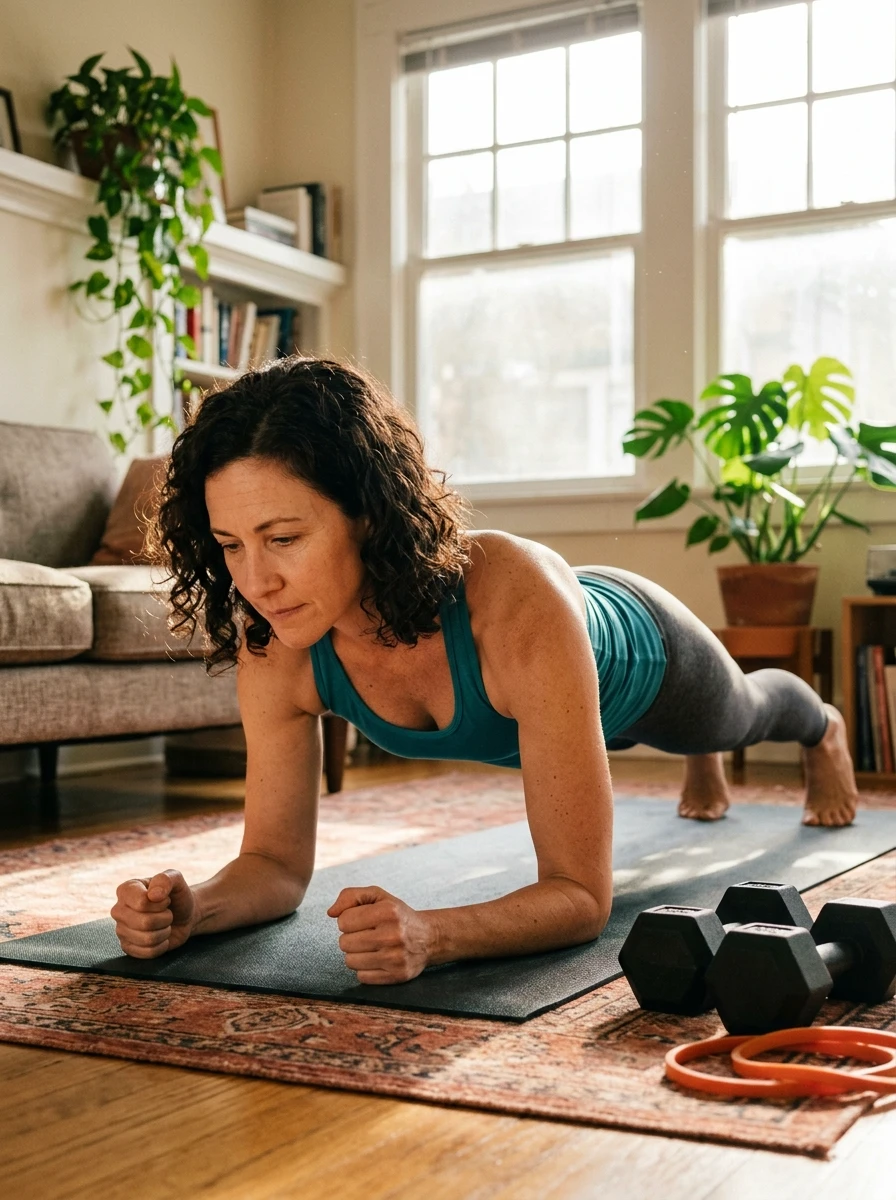
A flat stomach workout plan can strengthen your core, improve posture and support overall fat loss, but it can’t burn fat from your belly specifically. Belly fat shrinks when your total body fat goes down, which is why this plan trains your whole body, not just your abs.
In a six-week trial on abdominal exercises, adults did seven ab moves five days a week while keeping their diet steady. Their ab endurance improved, but belly fat, waist size and body fat percentage didn’t change significantly. A 12-week study in overweight women found the same thing: adding ab training to a diet didn’t reduce belly fat any more than the diet alone.
So why train your core at all? Because stomach toning and strength are real benefits, and a strong core does real work. Your core isn’t just your abdominals; it includes your back, hips and pelvis. Core strengthening helps you stand taller, lift safely and hold your midsection firmer.
As Mayo Clinic puts it, ab exercises can strengthen and tone your muscles, but “doing those exercises alone won’t get rid of belly fat.” For the full story on why, see the truth about spot reduction.
Why Your Workout Plan Needs To Change After 40
Your plan needs to change after 40 because the midlife transition shifts where your body stores fat and starts to erode muscle. That makes strength training more important and makes all-out exercise without recovery a harder sell.
A four-year study of women approaching menopause found that only the women who became postmenopausal had a significant rise in visceral fat, the deeper fat around your organs. The same study noticed that physical activity dropped about two years before menopause.
In the large SWAN study, the rate of fat gain doubled, and lean mass started to decline at the start of the menopause transition.

None of this means your metabolism is broken. It means the old “more cardio, more crunches” approach to fitness for women was built for a different body. Core training for women after 40 should lean on strength and recovery instead.
After 40, the smart move is to protect muscle, keep moving every day and recover well enough to show up again next week. If you’re in the thick of it, our guide to strength training in perimenopause goes deeper.
The C.O.R.E. Week Framework
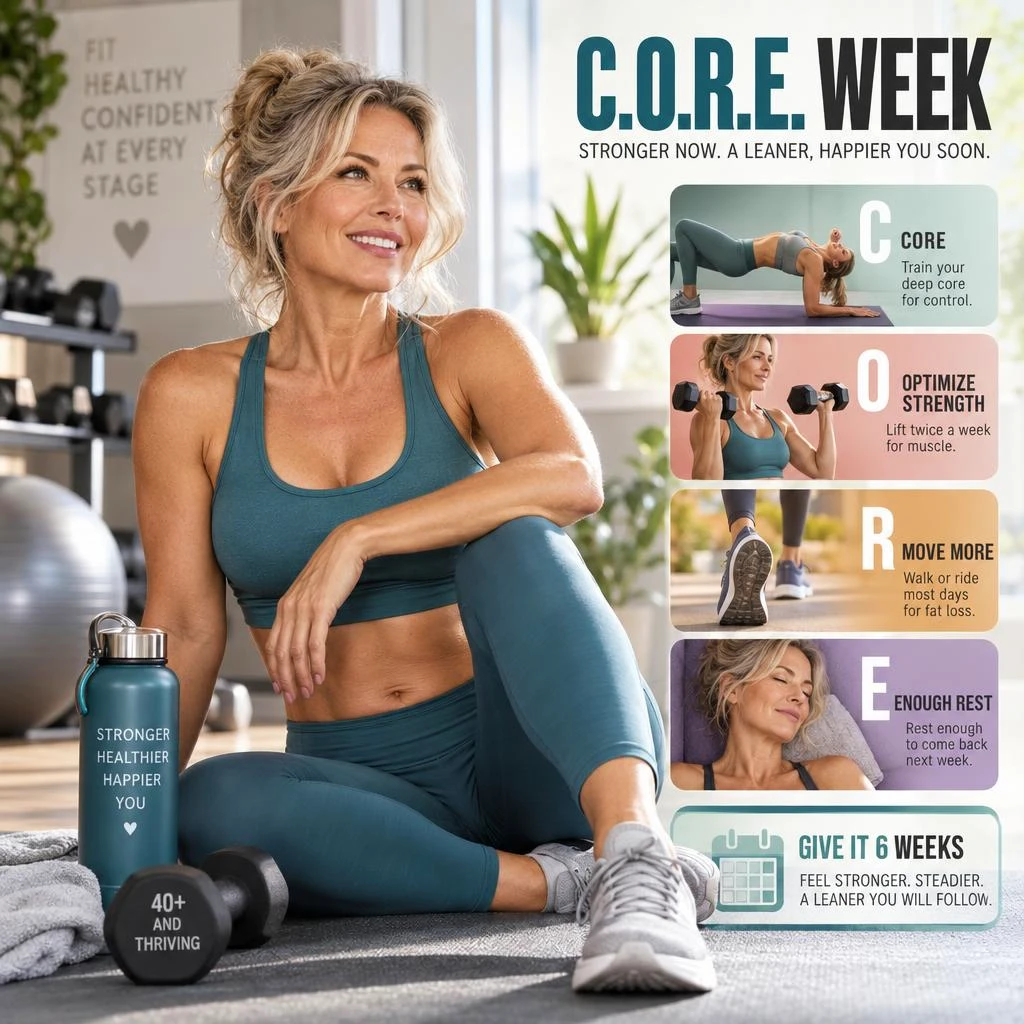
C.O.R.E. Week is our four-part flat stomach workout plan: Control, Overload, Rhythm and Ease. Each part has its own job, and together they cover your core, your muscle, your fat loss and your recovery.
Most plans throw everything at your abs. This one splits the job, because a flatter, stronger midsection has more than one cause. Here’s how the four parts fit together:
| Part | What You Do | How Often | What It Does For You |
|---|---|---|---|
| C: Control | Deep-core drills: belly-breath draw-in, dead bug, side plank, bird dog | 8 to 10 minutes, every training day | Core stability, posture improvement, lower-back support |
| O: Overload | Strength training with a band and dumbbells | 2 sessions a week, 30 to 40 minutes | Muscle, lower body fat, a firmer midsection |
| R: Rhythm | Brisk walking or steady cardio, optional intervals | Build to 150 minutes a week by Week 5 | Calorie burn, heart health, fat loss |
| E: Ease | Rest days, easy walks, mobility | 2 to 3 days a week | Recovery, so you can keep going |
Control: Deep-Core Drills For Core Stability
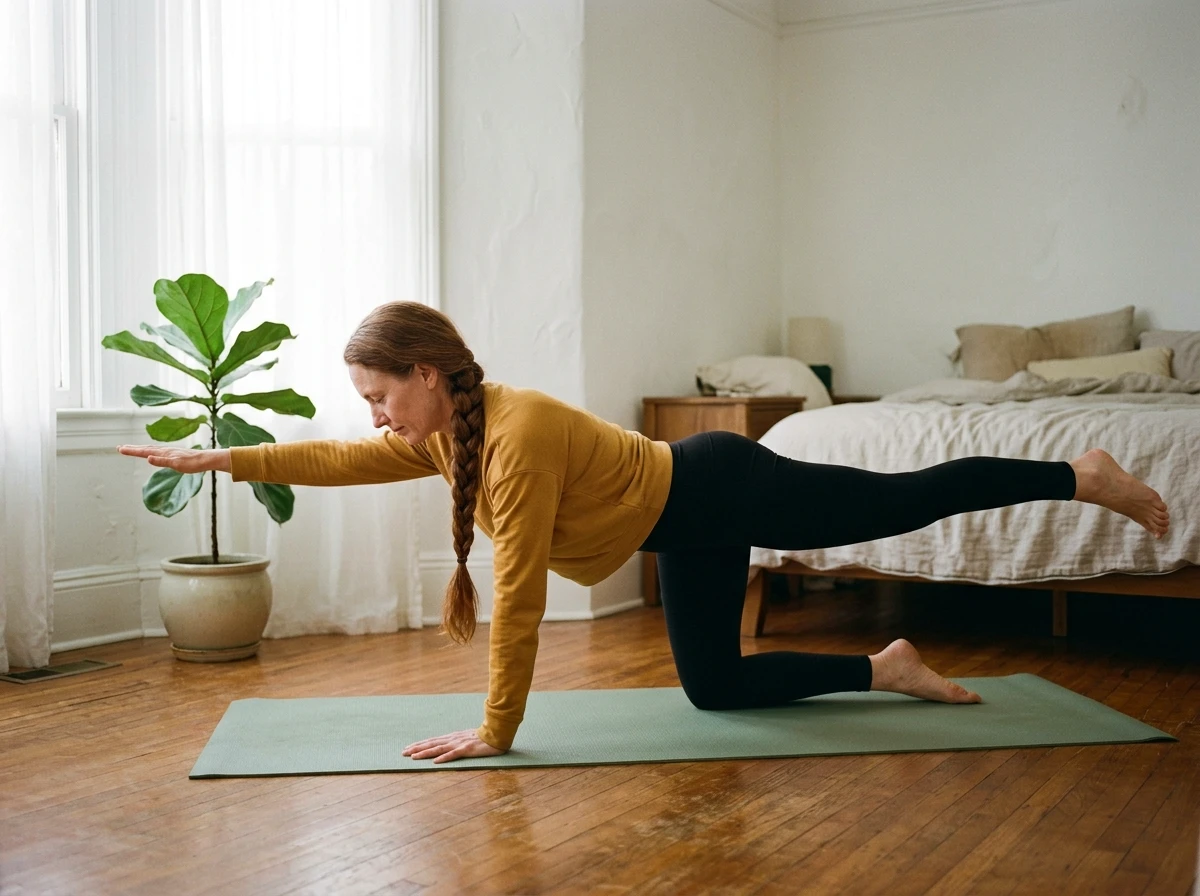
Control means short, slow drills that train your transverse abdominis, the deep muscle that wraps around your middle like a corset. A gentle draw-in works it harder than bracing as tight as you can.
A 2024 ultrasound study compared seven popular core moves in healthy young adults. With a gentle “hollowing” draw-in, bird dogs and side planks produced the biggest increase in deep-core muscle thickness, and hollowing beat hard bracing for the transverse abdominis.
This is core strengthening at its gentlest, so it doesn’t need to burn. Breathe out on the hard part and keep it smooth. Can’t talk? You’re bracing too hard.
Overload: Strength Training With Bands And Dumbbells
Overload means two full-body strength sessions a week where the work gets a little harder over time. Strength training lowers body fat and visceral fat, and resistance bands build strength as well as weights do.
A 2022 meta-analysis of 58 studies found that full-body resistance training reduced body fat percentage, fat mass and visceral fat compared with not exercising, and the effect didn’t depend on sex. There’s no special visceral fat-burning move; training your whole body is what showed up in the data.
No gym? A review of eight studies found that elastic bands and tubes produced similar strength gains to dumbbells and machines. That’s why this plan uses a resistance band core and full-body home workout routine that fits in your living room. Want the bigger picture? Read why strength training burns fat.
Rhythm: Walking, Steady Cardio And Optional Intervals
Rhythm means building up to about 150 minutes of moderate cardio across your week, most of it as walking or another activity you actually enjoy. Intervals are an optional add-on, not the engine of the plan.
The CDC guidelines recommend at least 150 minutes of moderate activity a week plus two days of muscle strengthening, which is exactly what C.O.R.E. Week builds toward.
Steps count too: a Lancet analysis of 15 studies linked more daily steps with lower mortality, leveling off around 8,000 to 10,000 steps for adults under 60. Choose cardio exercises that you like and can continue. Enjoying them is what keeps you coming back.
Ease: Recovery Days That Count
Ease means two or three lighter days a week, with at least one rest day between hard sessions. Recovery is when your muscles adapt, and it’s what keeps a six-week plan from turning into a two-week burnout.
Easy days aren’t lazy days. A relaxed walk, some stretching or a few Pilates core moves all count. If you love Pilates, our guide to Pilates for fat loss shows how it fits around strength work. Consistency over months beats daily burnout.
Your 6-Week Flat Stomach Workout Plan
The six weeks run in three two-week phases: Foundation, Build and Strengthen. You train four days a week, and each phase adds a little more time, load or challenge so your body keeps adapting.
Start slow with good form. Then, bump up the effort once you’re comfortable. Here’s the big picture:
| Phase | Strength (Sessions A And B) | Core Finisher | Cardio (Rhythm) | Weekly Goal |
|---|---|---|---|---|
| Weeks 1 to 2: Foundation | 2 sets of 10 to 12 reps, light band or dumbbells | 2 rounds, easier versions | 3 brisk 20-minute walks, plus daily steps | Learn the moves, finish every session |
| Weeks 3 to 4: Build | 3 sets of 10 to 12 reps, moderate load | 3 rounds, standard versions | 3 walks of 30 minutes, or 1 optional interval session | Add load or reps each week |
| Weeks 5 to 6: Strengthen | 3 sets of 8 to 10 reps, heavier band or dumbbells | 3 rounds, harder versions | 150 minutes total, optional 1 to 2 interval sessions | Beat your Week 1 numbers |
Your Weekly Schedule
Your week has four training days and three recovery days: two strength days, one cardio day and one mixed day. Swap days to fit your life, but keep a rest day between the two strength sessions.
- Monday: Session A (upper body strength) plus Control drills.
- Tuesday: Brisk walk or steady cardio, plus Control drills and the core finisher.
- Wednesday: Ease day: rest or an easy walk.
- Thursday: Session B (lower body strength) plus Control drills.
- Friday: Full-body cardio day: a brisk walk or an optional interval session (a bike works well), plus Control drills and the core finisher.
- Saturday: Optional active recovery: a longer easy walk or a Pilates video.
- Sunday: Full rest.
Short on time? Each training day takes 30 to 40 minutes. On a really busy day, do just the 10-minute Control drills. Done beats perfect, and a short daily ab routine of drills still counts.
Session A: Upper Body Plus Core
Session A trains your back, chest and shoulders, with core work built into every move. Rest 60 to 90 seconds between sets.
No band yet? In Weeks 1 to 2, most of these work as bodyweight exercises.
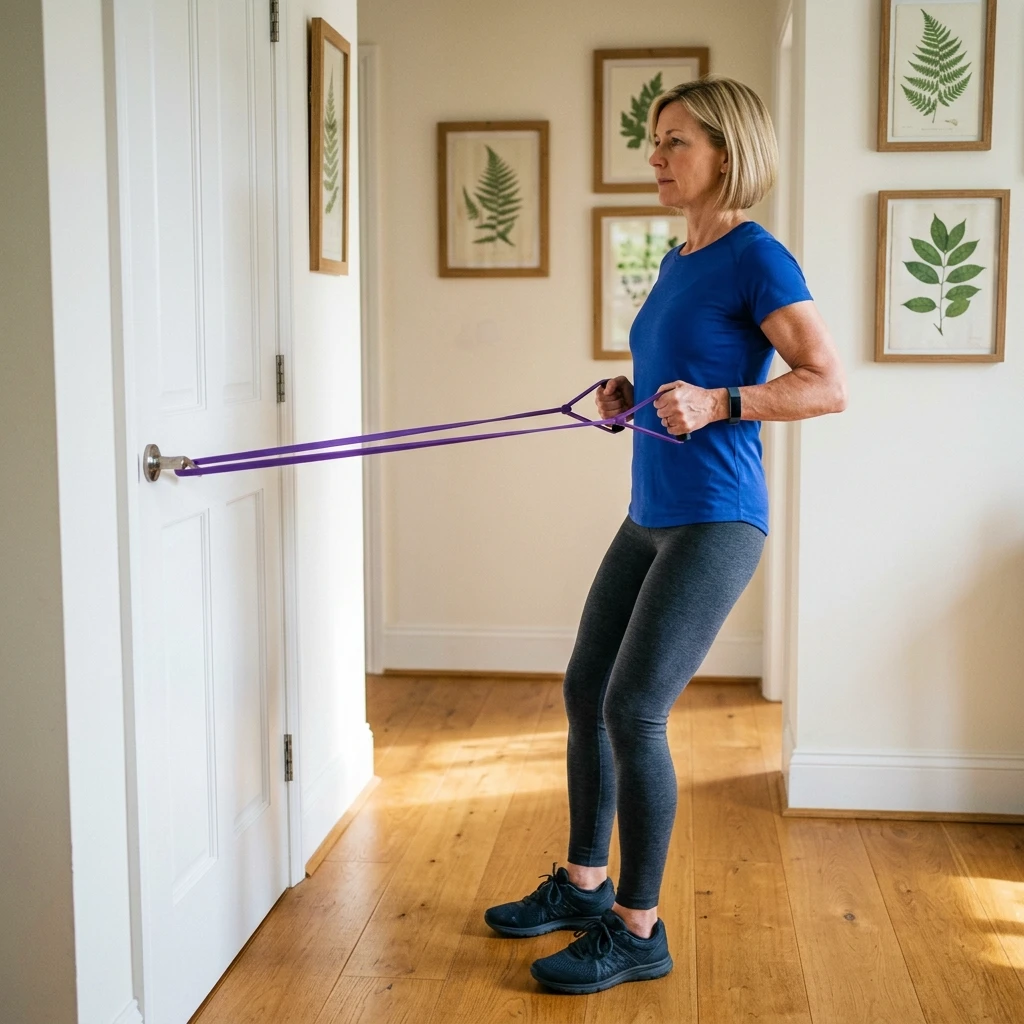
- Band row: Anchor the band at chest height, pull your elbows back and squeeze your shoulder blades.
- Push-up: Start on a wall or kitchen counter, then move to your knees, then the floor as you get stronger.
- Dumbbell overhead press: Seated or standing; keep your ribs down so your back doesn’t arch.
- Band pull-apart: Arms straight, pull the band to your chest. It’s great for your posture.
- Suitcase carry: Hold one dumbbell at your side and walk for 30 seconds per side without leaning. Your obliques do the work, and it’s functional fitness: it’s how you carry groceries.
Session B: Lower Body Plus Core
Session B trains your glutes and legs, your biggest muscles, which is why it matters so much for overall fat loss. Rest 60 to 90 seconds between sets.
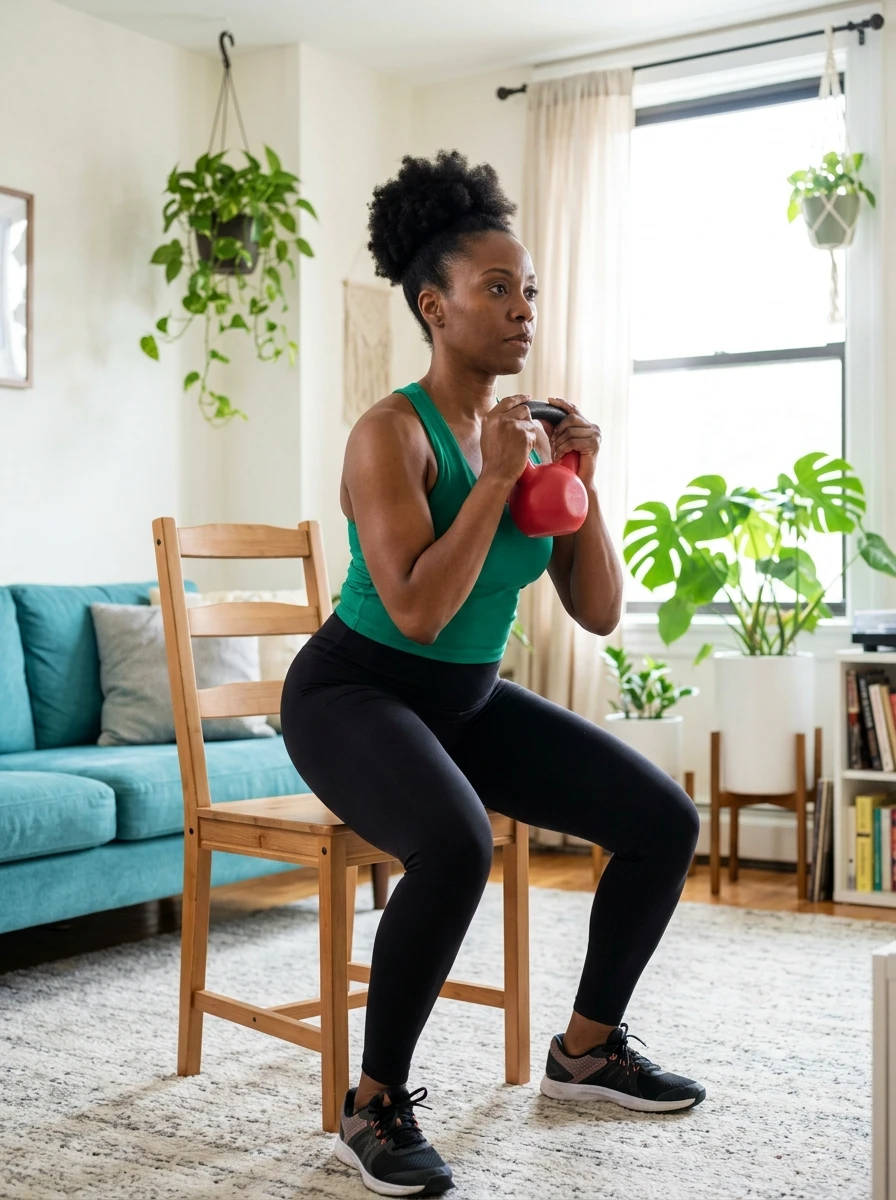
- Goblet squat: Hold a dumbbell at your chest and sit back to a chair if you need a guide.
- Dumbbell Romanian deadlift: Push your hips back with a flat back until you feel your hamstrings.
- Reverse lunge: Hold the wall or a chair for balance at first.
- Banded glute bridge: Band above your knees, press your knees out and squeeze at the top.
- Dead bug: 6 to 8 slow reps per side, lower back gently on the floor. This doubles as a lower ab workout.
The Core Finisher: Four Classic Moves, Upgraded
The core finisher uses four classic abdominal exercises for 5 to 8 minutes after your Tuesday and Friday sessions. Pick the version that matches your phase, and move slowly.

| Exercise | What It Works | Easier (Weeks 1 to 2) | Harder (Weeks 5 to 6) |
|---|---|---|---|
| Plank | Whole core, shoulders, glutes | Knees down, 3 x 20 seconds | Toes, 3 x 45 seconds |
| Russian twist | Obliques, rotation control | Feet down, no weight, 8 per side | Feet down, light dumbbell, 12 per side |
| Superman | Lower back, glutes | Lift arms only, 8 reps | Arms and legs, 3-second hold, 10 reps |
| Stability ball rollout | Front core, stability | Skip; do a bird dog instead | Kneeling, short roll, 8 reps |
A fun challenge is the stability ball rollout. It works your belly but also tests your steadiness. Save it for Weeks 5 to 6, and stop the roll before your lower back sags. If twists bother your back, swap them for a side plank.
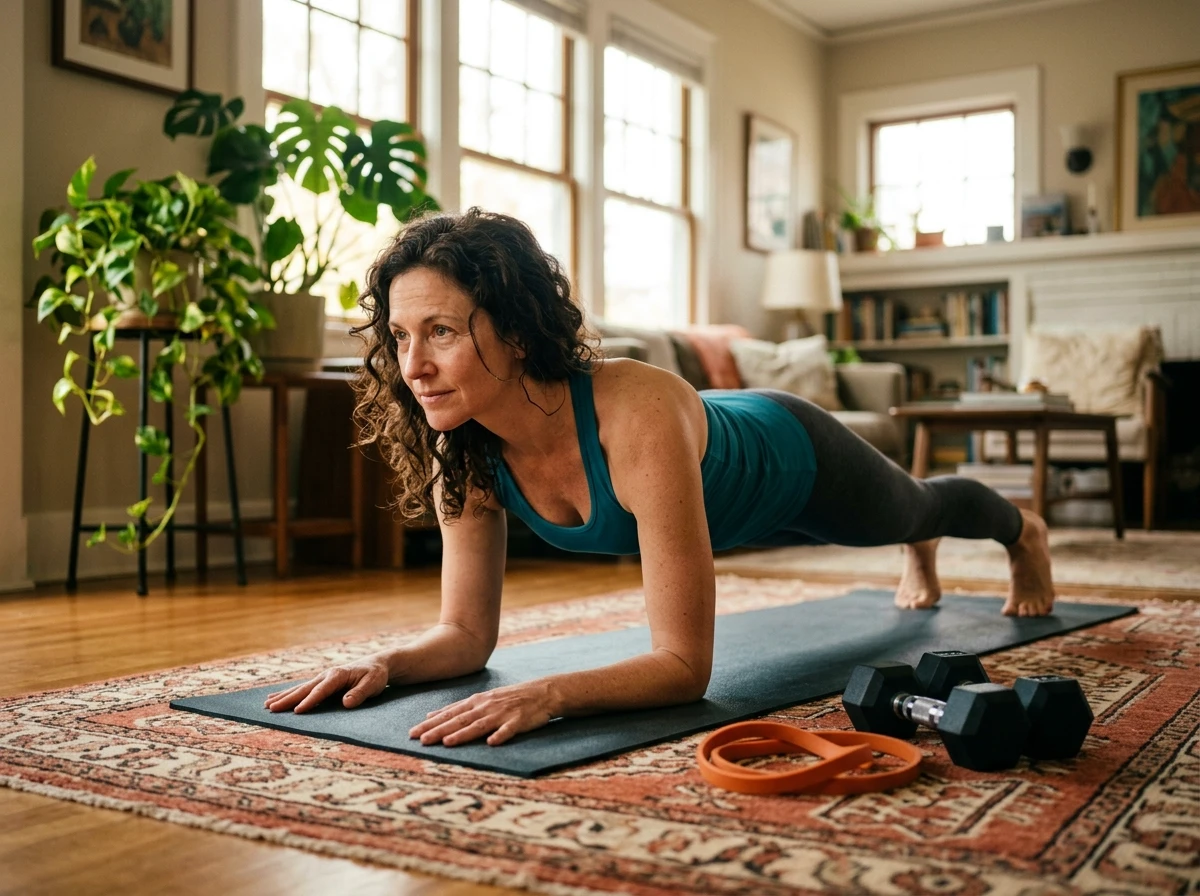
Plank Variations: Your 6-Week Progression Ladder
Plank variations let you make your core work harder without doing more reps. Move up one rung when you can hold good form for the full time on two sessions in a row.
- Rung 1, low plank: On forearms and knees, then forearms and toes.
- Rung 2, high plank: Arms straight under your shoulders, body in one line.
- Rung 3, side plank: On your forearm, knees bent first, then legs straight.
- Rung 4, long-lever plank: Elbows a few inches ahead of your shoulders. In one study, this version activated the abs and obliques significantly more than a standard plank.
- Rung 5, Spiderman plank: From high plank, bring one knee toward the same elbow, slowly.
- Rung 6, plank jacks: An optional high-intensity core move with more impact. Step your feet out and in if jumping bothers your joints or pelvic floor.
Always keep your body straight and your core tight but not rigid.
The Contrarian Take: HIIT Is Optional After 40
HIIT works, but it isn’t required for a flatter stomach after 40. When researchers compared interval training with steady moderate cardio, the two produced similar fat loss, so the best cardio is the one you’ll keep doing.
HIIT gets sold as the ultimate belly fat burner, and you’ll often hear that it keeps you burning calories for hours. The research is more modest.
A meta-analysis of 31 studies found “no differences” between interval training and moderate continuous cardio for any body fat outcome. An earlier review found HIIT did save about 40% of training time, which is a real perk if you like it.
A HIIT core workout of jumping planks won’t change that math either. And the afterburn? A review of exercise afterburn research concluded it adds only about 6 to 15% of the exercise’s own energy cost, and that hopes for a big afterburn effect on weight loss are “generally unfounded.”
And for women after menopause specifically, the evidence is thinner. A 2020 meta-analysis of HIIT in women found it reduced total and abdominal fat overall, but the effect was only significant before menopause. Cycling intervals seemed to work better than running, especially after menopause.
So if you love intervals, keep them, ideally on a bike: once a week from Week 3, up to twice in Weeks 5 to 6. If burpees make your knees ache or leave you wiped out for days, a brisk walk is a perfectly good choice. That’s choosing the cardio you’ll still be doing in six months.
Expert Commentary: What The Research Actually Shows
Here’s the pattern the research keeps showing: your whole week of training and eating changes your waistline. Your core work changes how strong and steady your middle feels.
- Ab-only training: improves ab endurance but didn’t reduce belly fat in controlled trials.
- Strength training: reduces body fat and visceral fat, with no difference between men and women.
- Cardio type: HIIT and steady cardio produce similar fat loss; HIIT can save time in some trials.
- Deep core: gentle draw-in drills train the transverse abdominis better than hard bracing, though that study was in young adults.
- After menopause: visceral fat tends to rise, so protecting muscle and staying active matter more, not less.
One honest caveat: most of these studies ran 6 to 12 weeks. That’s long enough to get stronger, but visible waist change usually takes longer and depends on your food as much as your workouts.
How To Track Your Progress Without Obsessing Over The Scale
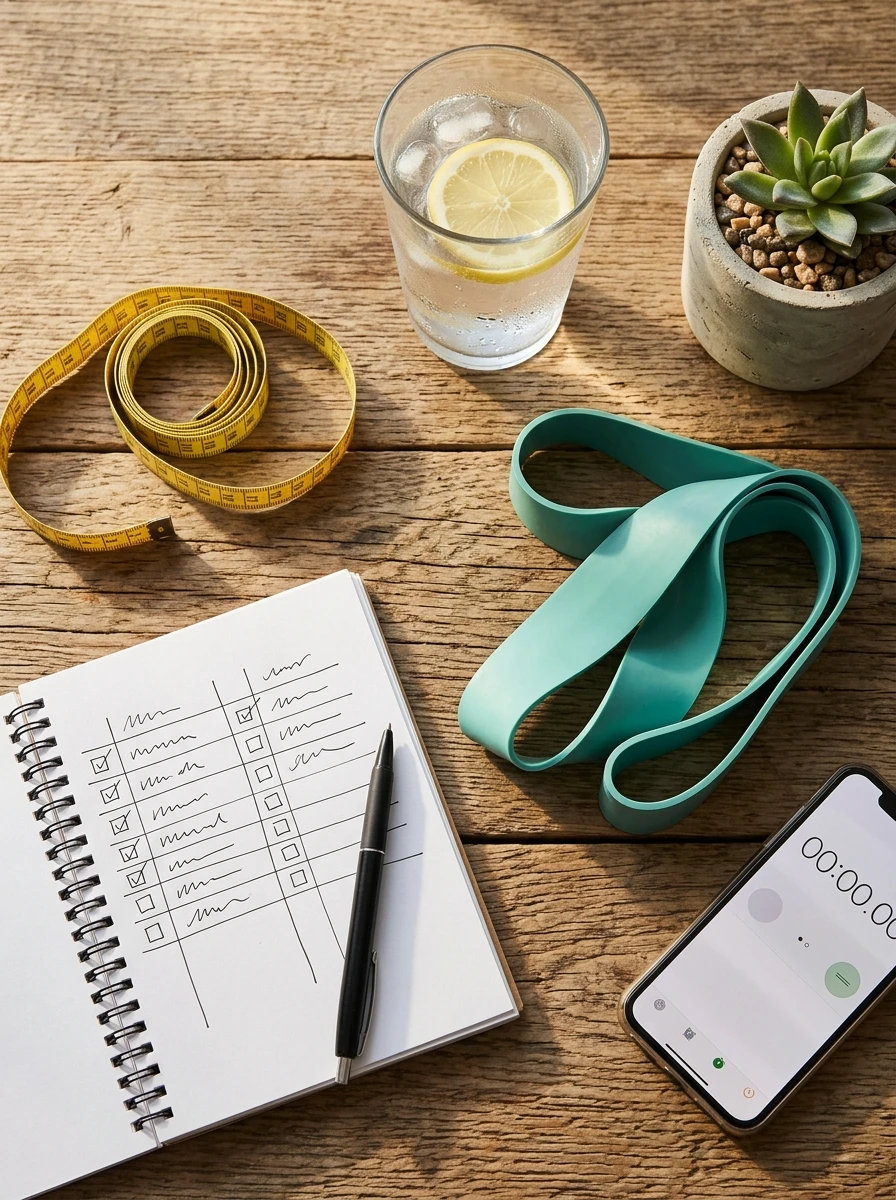
Track your waist, your plank time and your completed sessions instead of relying on the scale. These show changes in fat, strength and consistency that your weight can hide.
| Marker | How To Measure | How Often | What Good Looks Like |
|---|---|---|---|
| Waist | Tape at your belly button, relaxed, same time of day | Every 2 weeks | A slow downward trend; Mayo Clinic flags over 35 inches as a health risk |
| Plank hold | Longest hold with good form | Start of each phase | Longer holds or a higher rung |
| Strength | Reps or load on goblet squat and band row | Weekly | More reps or a heavier band |
| Sessions done | Tick off each training day | Weekly | At least 3 of 4 most weeks |
For more ways to measure, see how to track your weight loss progress.
Where Nutrition Fits In
Food and movement work together for fat loss, so this plan works best alongside a modest calorie deficit with enough protein. You don’t need a crash diet; you need a steady, livable one.
Workouts build the muscle and the habit; your plate drives most of the change in your waist. Our flat stomach diet guide has a 7-day plan, and how many calories you should be eating helps you find your number.
Safety Check: Diastasis, Pelvic Floor And Joint Pain
If you’ve had a baby, notice a ridge or doming down the middle of your belly, or leak when you jump, check in with a physiotherapist before the harder rungs. This plan’s control drills are a gentle start, but they aren’t a treatment.
Abdominal separation is common. In one study of 300 first-time mothers, about a third still had it 12 months after birth, and it also occurs in postmenopausal women. A systematic review found only very low-quality evidence for any specific exercise program to treat it, which is why individual advice matters.
Our guide to exercises for a flat stomach has a diastasis-safe section, and these tips to avoid common workout injuries apply to every phase.
The Bottom Line
A flat stomach workout plan works when it stops treating your belly as the only target. Train your deep core for control, lift twice a week for muscle, walk or ride most days for fat loss, and rest enough to come back next week. That’s C.O.R.E. Week, and it’s how a lean midsection gets built.
Give it six weeks. You’ll likely feel stronger and steadier before you see your waist change, and that’s the order it usually happens in. Stick with it and stay focused. The strength shows up first, and that’s your sign it’s working.
Your six-week plan covers the workouts. What about the other 23 hours of the day? Our free guide shares 10 research-backed habits that help women lose body fat and keep it off, with no extreme diets and no daily guilt. Send Me The Free Guide.
Glossary Of Key Terms
- Core Muscles: The muscles of your abdominals, back, hips and pelvis that stabilize your spine and help you balance.
- Transverse Abdominis: Your deepest ab muscle, which wraps around your middle like a corset.
- Core Stability: Your ability to keep your trunk steady while your arms and legs move.
- Hollowing (Draw-In): Gently pulling your lower belly toward your spine, without bracing hard.
- Visceral Fat: Deeper belly fat stored around your organs, linked to higher health risks.
- Spot Reduction: The myth that exercising one body part burns the fat on top of it.
- Progressive Overload: Making a workout gradually harder with more reps, load or time.
- HIIT (High-Intensity Interval Training): Short bursts of hard effort followed by easier recovery periods.
- MICT (Moderate-Intensity Continuous Training): Steady cardio such as brisk walking or cycling at a pace where you can still talk.
- Calorie Deficit: Taking in slightly less energy than your body uses, which leads to fat loss over time.
FAQ
What Is The Best Flat Stomach Workout Plan For Women Over 40?
The best plan combines two strength sessions, building to about 150 minutes of walking or steady cardio, short deep-core drills and real rest days. That mix supports fat loss and core strength together.
How Long Does It Take To See Results From A Flat Stomach Workout Plan?
Many women feel stronger within a few weeks. Visible waist changes usually take longer and depend on your overall fat loss and diet.
Can You Get A Flat Stomach With Ab Workouts Alone?
No. Trials show ab exercises build endurance but don’t reduce belly fat on their own. You need whole-body training and a modest calorie deficit.
Do I Need HIIT To Lose Belly Fat?
No. Research found steady cardio and HIIT produce similar fat loss. HIIT can save time in some trials, so choose the cardio you enjoy.
Can I Do This Flat Stomach Workout Plan At Home?
Yes. You only need a resistance band, a pair of dumbbells and a mat. Bands build strength about as well as dumbbells.
Is It Safe To Do Core Exercises With Diastasis Recti?
Gentle draw-in drills are a common starting point, but see a physiotherapist first. Skip planks or rollouts that make your belly dome.
How Often Should I Do The Flat Stomach Workout Plan Each Week?
Train your core 2 to 4 times per week with at least one rest day between hard sessions so muscles can recover. Combine that with 2 to 3 cardio or HIIT sessions and keep overall volume sustainable. Consistency over months beats daily burnout.