
Hydration And Health: How Much Water Should You Drink Every Day After 40

Drinking water is like washing out your insides. The water will cleanse the system, fill you up, decrease your caloric load, and improve the function of all your tissues.
Kevin R. Stone ‧ Orthopaedic surgeon
Summary (TL;DR)
Most water advice was written for a 25-year-old with a normal thirst response and no hormonal fluid shifts.
The National Academies of Sciences puts the baseline at about 9 cups (2.1 litres) of total water a day for women, but your real number depends on activity, climate, and, after 40, a set of physiological changes that generic advice skips entirely: a blunted thirst signal, hot flash–driven fluid loss, and a sodium and water balance that can leave you puffy even when you are drinking “enough.”
This guide gives you the actual research-backed number, why the 8 glasses rule and thirst alone both fall short after 40, and the sodium-first framework that explains why more water is not always the fix for perimenopausal bloating.
If you have ever stood in the beverage aisle wondering whether you should be drinking half your body weight in ounces, a full gallon, or just “whenever you feel thirsty,” you are not alone, and you are not overthinking it. The advice genuinely contradicts itself. One source says 8 glasses. Another says a gallon.
A fitness influencer says drink until your urine is completely clear. A different one warns that it is dangerous. For women navigating perimenopause, there is an added layer of confusion that most hydration content never addresses at all: you can drink consistently, hit whatever number you have chosen, and still feel puffy, foggy, or swollen by 3 pm.
That gap between “doing everything right” and “still feeling off” is not in your head, and it is not a willpower problem. It is normal to feel confused by contradictory numbers, frustrated when a habit you are keeping up with does not seem to work, and a little intimidated by the idea you now need a spreadsheet to drink water correctly.
You do not. What you need is the physiology most water guides skip, because they are not written for a 40-plus, hormonally shifting body. There is real, published research on why thirst becomes a less reliable guide as you age, why hot flashes quietly drain more fluid than people realise, and why the water-retention paradox of perimenopause has almost nothing to do with drinking too much water and almost everything to do with sodium.
This guide walks through the actual number the research supports, why “just drink when you’re thirsty” is weaker advice after 40 than it is at 25, and a practical framework for figuring out what your body needs instead of guessing. No gimmicks, no miracle hydration hacks, just what the evidence actually says.
Medical & Referral Disclaimer
This article is for informational and educational purposes only. It is not a substitute for professional medical advice, diagnosis, or treatment. Always consult your physician or a qualified health provider before making significant changes to your fluid, sodium, or supplement intake, particularly if you have a kidney, heart, thyroid, or liver condition, or take medications that affect fluid balance.
Key Takeaways
- The evidence-based baseline is about 9 cups (72 oz, roughly 2.1 litres) of total daily water for women, per the National Academies of Sciences, Engineering, and Medicine, not the popularised “8 x 8” rule.
- Thirst gets less reliable with age. A classic study in the New England Journal of Medicine found older adults feel less thirsty after fluid loss than younger adults do, even though their bodies need the water just as much.
- Hot flashes and night sweats add a real, measurable fluid cost. Research shows postmenopausal women with hot flash symptoms sweat roughly twice as much as symptom-free women during a temperature trigger.
- Water retention in perimenopause is usually a sodium and hormone problem, not a “too much water” problem. Declining estrogen and progesterone change how your kidneys handle sodium and fluid.
- Pre-meal water can modestly support weight management in midlife adults specifically, according to a randomised controlled trial, though the effect is not dramatic on its own.

How Much Water Should You Actually Drink?
Start here, because most of the confusion clears up once you have the real number in front of you. According to a landmark report from the National Academies of Sciences, Engineering, and Medicine (formerly the Institute of Medicine), women who are adequately hydrated consume an average of about 2.7 litres (roughly 91 ounces) of total water a day, counting everything you eat and drink.
About 80% of that comes from beverages, including coffee and tea, and the remaining 20% comes from food. Broken down to just beverages, the Harvard T.H. Chan School of Public Health puts the adequate intake at about 9 cups (72 oz) a day for women 19 and older, versus 13 cups for men.
Why This Number Beats The 8 Glasses Rule
The “8 x 8” rule (eight 8-ounce glasses) is easy to remember, which is exactly why it stuck, but it was never based on a controlled study of what women specifically need.
The National Academies panel did not set a single glasses-per-day target because hydration needs can be met through food, milk, tea, coffee, and other beverages, not just plain water, and because needs vary by body size, activity, and climate. Very active people or those in hot climates often need well above 3 litres a day, sometimes 6 or more.
A Practical Starting Point, Not A Rulebook
Some dietitians use a rough per-kilogram formula (roughly 30 to 35 millilitres per kilogram of body weight) as quick mental math for a personal target, and you genuinely do not need a dedicated water intake calculator app to use it.
Treat it as a starting estimate, not a clinical prescription. The two numbers worth trusting for your daily fluid intake are the National Academies baseline above and your own body’s signals, discussed next.

| Life Stage Or Situation | Daily Total Water Target | Source |
|---|---|---|
| Women 19+, average activity, temperate climate | About 9 cups (72 oz / ~2.1 L) from beverages, more from food | National Academies / Harvard T.H. Chan |
| Very active or hot climate exposure | Often 6+ litres total for very active adults in continuous heat | National Academies |
| Frequent hot flashes or night sweats | Add roughly 8–16 oz per significant flash episode as a practical buffer | Estimated from sweat-loss research, not an official guideline |
| Pregnant | 10 cups (80 oz) | National Academies / Harvard T.H. Chan |
| Breastfeeding | 13 cups (104 oz) | National Academies / Harvard T.H. Chan |
One more myth worth retiring while we are here: caffeine. The National Academies panel found no convincing evidence that normal caffeine intake causes cumulative dehydration, so your morning coffee counts toward your total, not against it.
Why “Just Drink When You’re Thirsty” Gets Weaker After 40
This is the piece most hydration articles skip entirely, and it is the reason generic advice feels like it stops working as you get older. It is not your imagination.
Your Thirst Signal Actually Gets Quieter With Age
A classic, still-cited study in the New England Journal of Medicine compared healthy elderly men to healthy young men after 24 hours of water deprivation. Both groups lost the same amount of fluid, but the older group reported feeling less thirsty and drank less to replace it, even though their blood chemistry showed they needed the water just as much.
The researchers concluded there is a genuine deficit in thirst and water intake that develops with age, separate from any illness. The Harvard T.H. Chan School of Public Health notes the same pattern shows up in broader reviews, and that commonly used dehydration indicators (urine colour, feeling thirsty) become less reliable in older adults and should not be relied on alone.
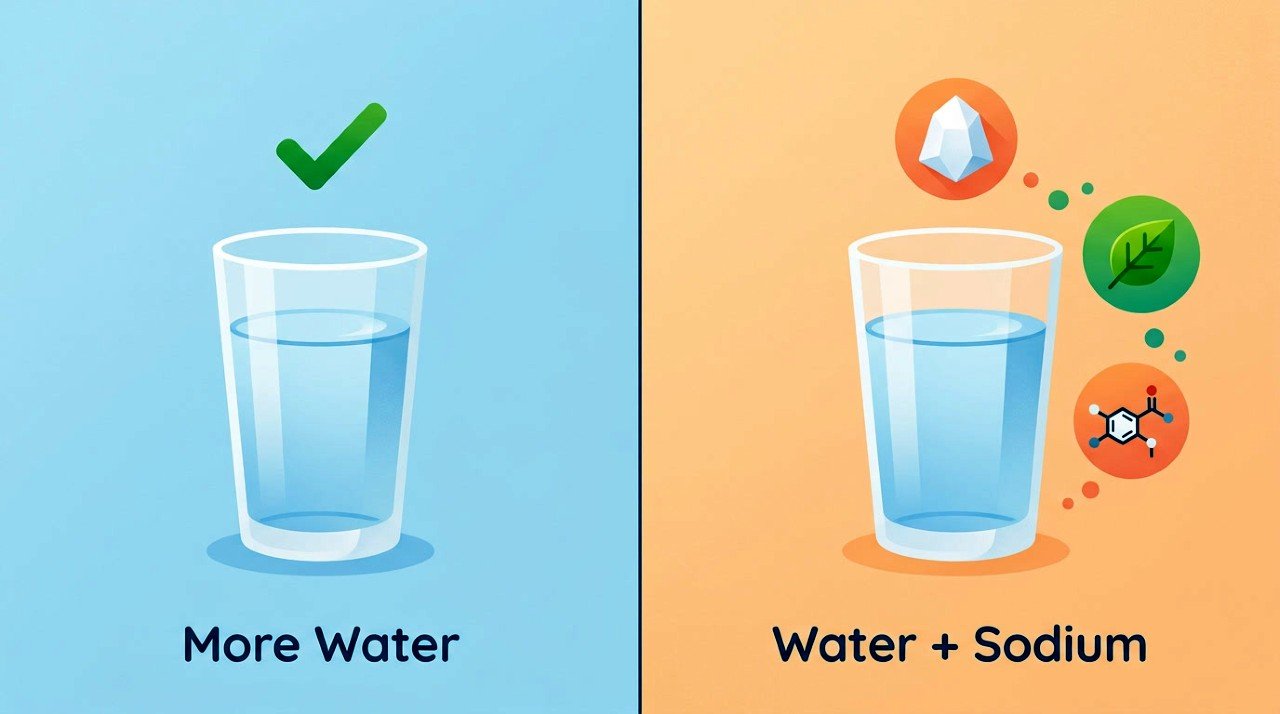
In plain terms: the advice to “just drink when you’re thirsty” assumes a thirst mechanism that is still working at full strength. After 40, for many women, it is not, which is exactly why a habit-based approach (discussed below) beats waiting for a signal that may not show up until you are already behind.
The Small Fixes That Compensate
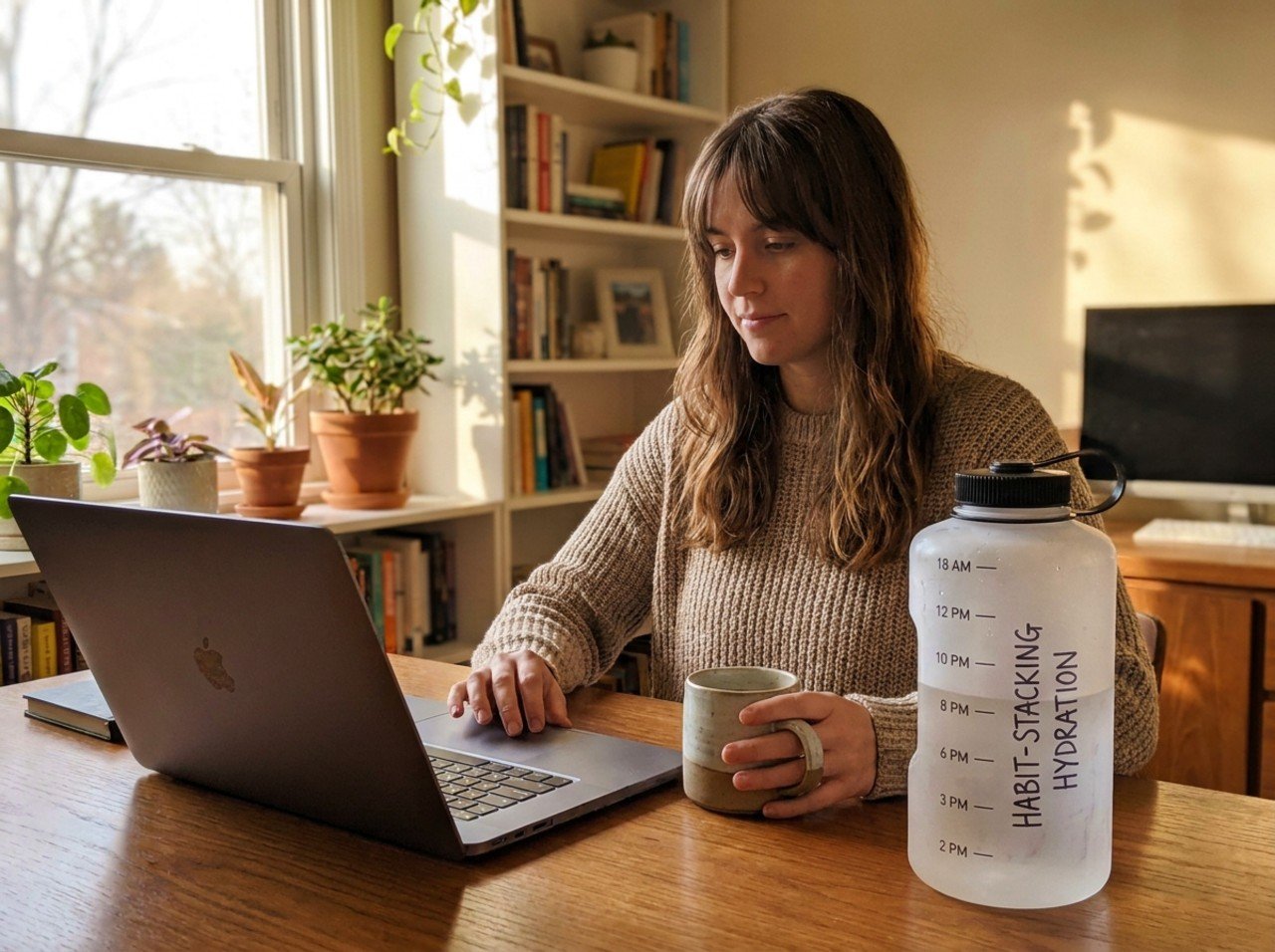
- Anchor water to existing habits. A glass with your coffee, a glass with each meal, and a glass before bed builds in three to four cups without relying on thirst at all.
- Use a marked bottle. Filling a 20 to 32-ounce bottle and aiming to empty it two to three times a day removes the guesswork.
- Watch your urine colour, not your thirst. Pale yellow is the target; this remains a decent proxy even when thirst itself is unreliable.
- Set two or three phone reminders at points in the day when you know you tend to forget, rather than a constant nag every hour.
The Perimenopause Hydration Paradox: Why More Water Doesn’t Always Fix The Puffiness
Here is the contrarian part, and the piece nearly every mainstream hydration guide leaves out completely: for a lot of women in their 40s and 50s, drinking more water is not the missing piece. It is a sodium and hormone story.
What Is Actually Happening: Estrogen, Progesterone, And Your Kidneys
As estrogen and progesterone decline and fluctuate through perimenopause, they take a system called the renin-angiotensin-aldosterone system (RAAS) with them. Research published in Reproductive Sciences describes how falling estrogen reduces the kidneys’ ability to excrete sodium efficiently, while the RAAS pathway becomes more active, signalling the kidneys to hold onto both sodium and water.
Progesterone normally works against this: it acts as a natural counterbalance to aldosterone, the hormone most responsible for sodium retention. As progesterone drops, that counterbalance weakens, and fluid has an easier time accumulating in tissue, which shows up as bloating, puffy fingers, or a swollen-feeling face, often with no change in how much water you are actually drinking.

Hot Flashes Are Quietly Draining You
The other half of the paradox: while your body is holding onto fluid in some ways, it is also losing more of it than you realise through hot flashes and night sweats.
A study in the American Journal of Obstetrics and Gynecology found that postmenopausal women with hot flash symptoms had a significantly narrower thermoneutral zone (the temperature range where the body neither sweats nor shivers) and sweat rates roughly double those of symptom-free women during a heat trigger.
A single significant hot flash, repeated several times a day plus night sweats, adds up to real fluid loss that a flat, one-size-fits-all daily target does not account for.
Mary’s Sodium-First Framework
I will be honest about how I found this out. For years I did everything the standard advice told me to: carried a water bottle everywhere, hit my glasses-a-day number, and still spent most afternoons in my 40s feeling like my rings did not fit and my face looked swollen in every photo.
It was not until I started reading into why my own body seemed to “reject” all that water that I found the piece nobody had told me: it is not just how much you drink, it is whether your sodium and water are working together.
Once I started paying attention to getting enough sodium and potassium alongside my water, instead of just chasing an ounce number, the afternoon puffiness that had become routine settled down within a couple of weeks. I am one woman, not a clinical trial, so take this as a framework to test for yourself, not a promise.
The framework in three steps:
- Step 1, Fluid: Hit your baseline target from the table above, spread through the day rather than front-loaded.
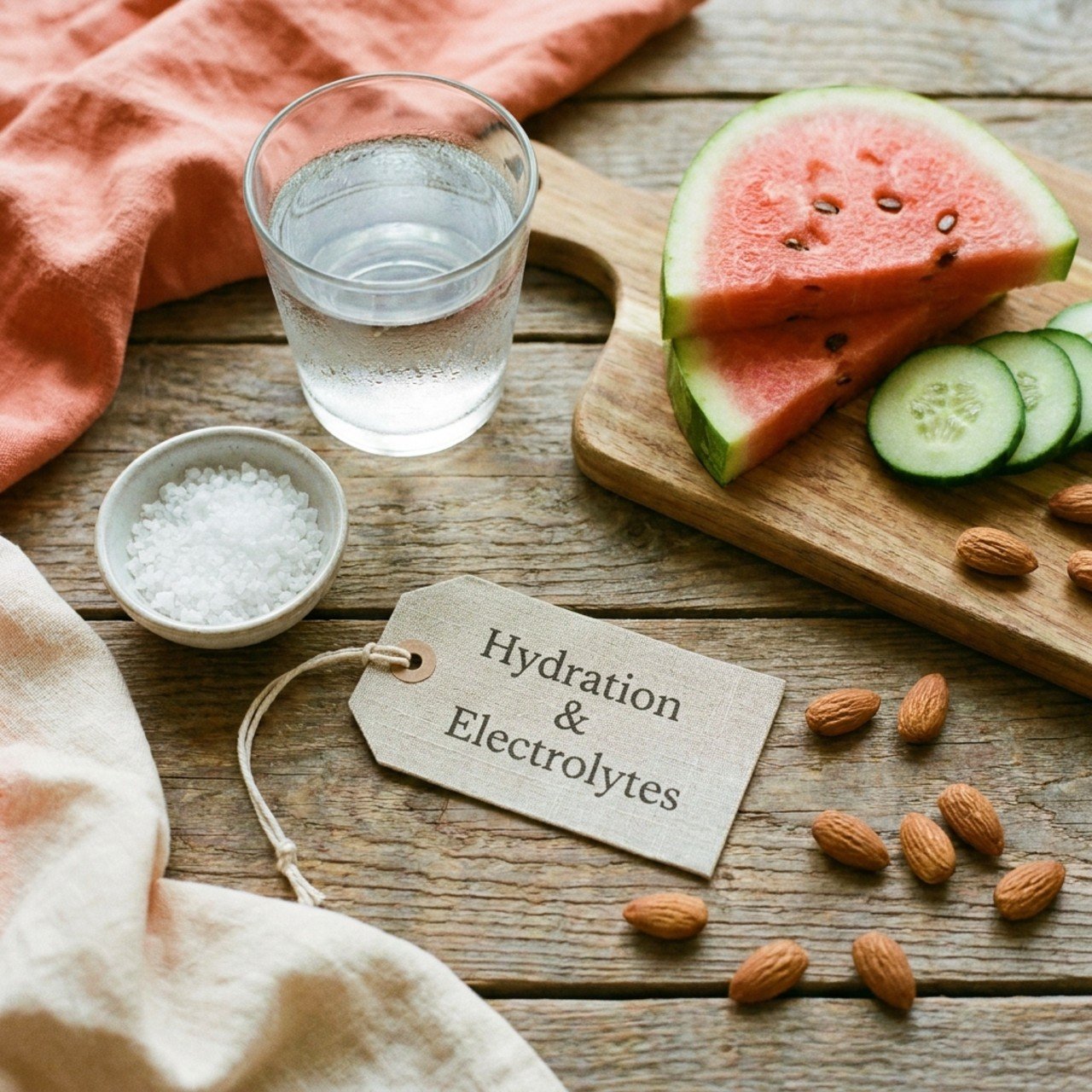
- Step 2, Electrolytes: Do not drink water in isolation. Pair it with sodium and potassium from real food (broths, salted foods in moderation, fruit, leafy greens) so the water you drink actually gets held where your body needs it, rather than passing straight through.
- Step 3, Timing: Front-load fluid and sodium earlier in the day if evening swelling is your specific pattern, and check with your doctor before adding any sodium if you have high blood pressure, kidney disease, or heart failure, since the calculus changes for those conditions.
Electrolyte-Rich Foods Worth Adding
- Coconut water: naturally rich in potassium, sodium, and magnesium.
- Broths and clear soups: an easy way to pair fluid with sodium at the same time.
- Bananas and leafy greens: useful potassium sources to balance sodium intake.
- Plain yogurt and milk: water-rich (close to 90% water) with electrolytes and protein included.
- Watermelon, cucumber, and celery: among the most water-dense whole foods available, and an easy way to boost total water intake through food rather than beverages alone.
This same estrogen-driven pattern is part of why so many women find weight loss feels fundamentally different in perimenopause than it did a decade earlier, and it often overlaps with the same stress-hormone pathway behind cortisol-driven belly fat and water retention.
If you are already looking at magnesium or other supplements for this stage of life, our guide to what actually works in perimenopause supplements covers where electrolyte support fits in.
| Signal | Likely Well-Hydrated | Possible Under-Hydration | Possible Water Retention |
|---|---|---|---|
| Urine colour | Pale yellow | Dark yellow or amber | Not a reliable indicator on its own |
| Thirst | Present and accurate | May be blunted after 40; do not rely on it alone | Not a reliable indicator on its own |
| Bloating or puffiness | Absent | Can occur alongside fatigue and headache | Can occur despite adequate water if sodium and potassium are out of balance |
| Energy and mood | Stable | Fatigue, irritability, or brain fog can appear at just a 2% fluid deficit | Generally unaffected unless severe |
For a fuller checklist, including when dehydration warrants a call to your doctor, the Mayo Clinic’s dehydration overview flags older adults as higher-risk, since thirst becomes a less reliable early warning sign.
Water And Weight Loss: What The Research Actually Shows
Water is not a weight-loss shortcut, but research on pre-meal water among midlife and older adults is genuinely interesting and happens to align with WLBF’s exact audience.
The Study Worth Knowing About
A randomised controlled trial published in Obesity assigned adults aged 55 to 75 to either a reduced-calorie diet alone, or the same diet plus 500 millilitres (about 17 oz) of water before each main meal. Over 12 weeks, the water group lost about 2 kilograms more than the diet-only group, a 44% greater decline in weight over the study period.
The likely mechanism: drinking water before a meal modestly reduces how much food you eat at that meal, an effect the researchers measured directly using test meals. Pair it with the basics the NHS outlines for a healthy weight; water alone will not offset an unbalanced diet.
What This Does And Does Not Mean
This is one 12-week study in a specific age group, not a universal hack. The effect was meaningful but modest, and only alongside a reduced-calorie diet. It is genuinely useful as a low-effort addition to a sustainable fat loss approach, not another restrictive rule to white-knuckle through.
- Try it at your biggest meal of the day, where the appetite-reducing effect has the most room to matter.
- Give it 30 minutes before eating where practical, rather than sipping mid-bite.
- Pair it with the other basics, like the protein and fibre habits in our guide to eating for optimal health, rather than expecting water alone to move the number on the scale.
Water Myths That Confuse Everyone (And What The Evidence Says)
Is A Gallon Of Water A Day Too Much?
For most healthy women, a gallon (about 3.8 litres) is well above the baseline need and edges toward the range the National Academies flags for very active people or those in continuous heat, not a general daily target.
There is no official upper limit for water because the kidneys can usually excrete excess, but drinking large volumes rapidly, faster than the kidneys can process it, can dilute blood sodium to dangerous levels, a condition called hyponatremia.
The Harvard T.H. Chan School of Public Health notes women are more susceptible than men to this rare but serious complication, partly due to smaller average body size.
Does Coffee Really Dehydrate You?
No, not meaningfully. As covered above, the National Academies found no convincing evidence that typical caffeine intake causes cumulative fluid loss. Soda is a different story, mainly because of the sugar, not the caffeine.
Should You Drink Alkaline Water?
The Harvard T.H. Chan School of Public Health’s review of alkaline water concludes the evidence for special benefits is not conclusive, and that plain water delivers the same hydration outcome for most healthy people. If it encourages you to drink more, it is not harmful, but it is not a proven upgrade either.
Does Water Really “Flush Out Toxins”?
Partly true, oversold in the marketing. Your kidneys and liver handle detoxification regardless; adequate hydration simply supports that existing process, plus healthy digestion and a stable metabolic rate, rather than adding a separate cleansing effect. Skin health and energy levels rely on the same basic mechanism: a genuine fluid deficit shows up as dull skin before it shows up as anything dramatic.
Join Our Mailing List
Join thousands of women inside our community and receive our free guide, 10 Actions That Support Permanent Weight Loss — the exact behavioural shifts that make the difference between a two-week attempt and a lasting transformation.
No restriction plans. No guilt. Just what actually works — for real women with real lives.
Practical Tips For Actually Hitting Your Number
Knowing your target is one thing. Actually hitting it on a normal, busy day is the harder part, and this is where a little behavioural psychology helps more than another rule.
- Habit-stack, do not rely on memory. Attach water to something you already do daily (making coffee, taking a supplement, sitting down at your desk) so the cue is automatic rather than another thing to remember.
- Make the default easy, not effortful. A filled bottle on your desk gets finished; an empty one in the cupboard does not. Small friction changes the whole behaviour.
- Flavour it if plain water feels like a chore. Sliced citrus, cucumber, or fresh mint make water more appealing without added sugar, and taste genuinely does drive intake.
- Track hot flash days differently. On days with frequent flashes or a rough night of sweating, treat your baseline target as a floor, not a ceiling, per the table above.
- Reframe the goal. Instead of “I have to drink more water,” try “I am giving my body what it needs to hold onto the water I drink,” which shifts the target from a number to a system, and systems are what stick. This same principle runs through our workout planning guidance and our tips on fuelling before and after exercise.
If your goal is broader than hydration alone, our overview of what keeps women at a healthy weight long-term and our list of calorie-burning habits that hold up over time both fit naturally alongside the hydration habits above.
And if your current “healthy” drinks are working against you without your realising it, it is worth a look at which popular drinks are not as healthy as they seem.
Ready For The Habits That Actually Stick?
Hydration is one piece of a much bigger picture, and juggling ounce targets, electrolyte timing, and everything else on your plate can feel like one more thing to manage alone. You do not have to figure it out piece by piece.
Our free guide, 10 Actions That Support Permanent Weight Loss, pulls hydration, nutrition, and movement into one sustainable set of healthy habits built specifically for how active women’s bodies work after 40, not a generic fitness journey borrowed from someone half your age.
Get your free copy here and start building the habits that hold up, one small system at a time.
The Bottom Line
The real answer to “how much water should you drink” is not a single magic number, it is a target (about 9 cups a day for most women, adjusted up for activity, heat, and hot flashes) paired with a system that accounts for what actually happens to a 40-plus body: a quieter thirst signal, real fluid loss from vasomotor symptoms, and a sodium and hormone relationship that determines whether the water you drink helps.
Chase the system, not just the ounces, and the confusion around this topic mostly resolves itself.
Glossary Of Key Terms
- Aldosterone: A hormone that signals the kidneys to retain sodium and water; its effects are normally counterbalanced by progesterone.
- Electrolytes: Minerals such as sodium, potassium, and magnesium that help the body hold water in the tissues where it is needed most.
- Hyponatremia: A dangerous condition caused by drinking too much water too quickly, resulting in the dilution of sodium in the blood.
- Perimenopause: The transitional phase leading to menopause, characterized by fluctuating and declining levels of estrogen and progesterone.
- RAAS (Renin-Angiotensin-Aldosterone System): A hormone system that regulates blood pressure and fluid balance; it becomes more active and promotes fluid retention as estrogen declines.
- Thermoneutral Zone: The temperature range in which the body can maintain its core temperature without needing to sweat or shiver.
- Total Daily Water: The sum of all water consumed from beverages (roughly 80%) and moisture-rich foods (roughly 20%).
- Vasomotor Symptoms: Physiological responses such as hot flashes and night sweats that cause significant, often unmeasured, fluid loss through sweating.
- Habit-Stacking: A behavioral strategy of attaching a new habit (like drinking water) to an existing daily routine (like brewing coffee) to ensure consistency.
- Baseline Target: The foundational amount of fluid needed (approximately 9 cups for women) before adjusting for factors like exercise, heat, or hormonal symptoms.
FAQ
How Much Water Should I Actually Drink Each Day?
About 9 cups (72 oz, roughly 2.1 litres) of total water a day is the evidence-based baseline for women, per the National Academies of Sciences, Engineering, and Medicine, adjusted upward for activity level, heat exposure, and hot flash frequency.
Can Drinking Too Much Water Be Dangerous?
Yes, in rare cases. Drinking very large volumes rapidly can dilute blood sodium to dangerous levels (hyponatremia), a risk the Harvard T.H. Chan School of Public Health notes is higher in women and children due to smaller average body size. There is no official upper limit for water because the kidneys typically handle normal excess, but moderation and pacing matter.
Why Do I Still Feel Bloated Even Though I’m Drinking Enough Water?
This is usually a sodium and hormone issue, not a water issue. Declining estrogen and progesterone in perimenopause change how your kidneys handle sodium, per research published in Reproductive Sciences, which can cause fluid retention independent of how much water you drink.
Does Coffee Or Tea Count Toward My Daily Water Intake?
Yes. The National Academies found no convincing evidence that typical caffeine intake causes cumulative dehydration, so coffee and tea both count toward your total fluid intake.
How Much Water Should I Drink During A Workout?
General sports nutrition guidance suggests roughly 17 to 20 oz of water 2 to 3 hours before exercise, 8 to 10 oz shortly before starting, and 7 to 10 oz every 10 to 20 minutes during activity, adjusted for sweat rate and intensity. Staying ahead of fluid needs protects physical performance, since mild under-hydration measurably drags down output. This matters even more in hot conditions: Johns Hopkins Medicine notes that heat exhaustion specifically results from a combined loss of water and salt, which is another reason electrolytes belong alongside plain water during a hot or intense workout, not just water on its own.
Is A Gallon Of Water A Day Too Much?
For most healthy, moderately active women, a gallon is more than the baseline requires and sits closer to the range recommended for very active people in continuous heat. It is not inherently dangerous, but it is not a general target either.
Why Do I Feel Less Thirsty Than I Used To?
This is a documented physiological change, not something you are imagining. Research in the New England Journal of Medicine found that older adults report significantly less thirst after fluid loss than younger adults, even when their bodies need the water equally, which is why a habit-based approach beats waiting to feel thirsty after 40.