
The Real Role Of Exercise In Weight Management (It’s Not What You Think)

You measure the size of the accomplishment by the obstacles you have to overcome to reach your goals.
Booker T. Washington ‧ Educator & author
Summary (TL;DR)
Exercise burns far fewer net calories than most weight-loss advice assumes. Anthropologist Herman Pontzer’s constrained energy expenditure research found that when people increase aerobic exercise, total daily calorie burn rises by only a fraction of what simple “calories in, calories out” math predicts, because the body quietly compensates elsewhere.
That does not make exercise optional for weight management. It means exercise earns its place through different levers entirely: preserving the lean muscle mass that keeps your metabolic rate running, regulating the hormones that govern hunger and fat storage, shrinking visceral fat specifically rather than fat in general, and protecting you from the stress-driven eating that undoes progress at the dinner table.
This guide rebuilds the case for the role of exercise in weight management around what the evidence actually shows it does, including what changes during perimenopause and postpartum recovery, and a realistic weekly framework based on CDC and WHO guidance rather than gym-culture folklore.
If you have laced up your trainers for months, stayed consistent, and then stood on the scale wondering why so little moved, you are not broken, and you are not imagining it.
“I exercise, but the scale won’t budge” is one of the most common things women tell us, and for years the standard answer, burn more than you eat, made it sound like a maths problem you were failing to solve. The research below suggests you were solving the wrong equation.
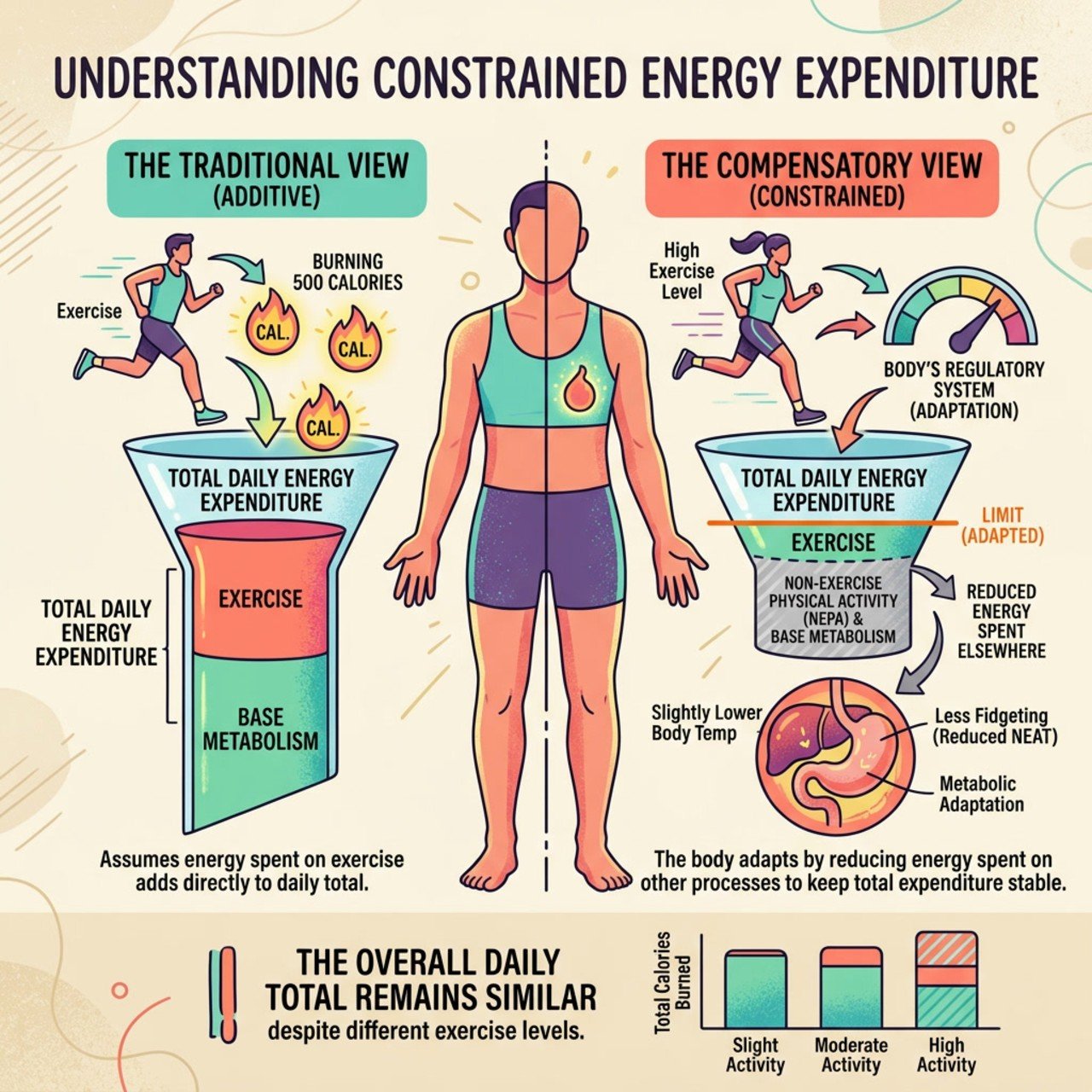
Here is the short version. Your body does not simply add the calories you burn in a workout onto your existing daily total and let the scale do the rest. It adapts. Push harder in the gym, and your body quietly pulls back elsewhere, on background fidgeting, on non-workout movement, sometimes on resting metabolism itself, clawing back a meaningful share of what you just burned.
That is not a reason to stop exercising. It is a reason to stop expecting exercise to work like a calorie-burning machine and start understanding what it is actually doing for your body underneath the scale.
That reframe matters even more once perimenopause enters the picture, when declining estrogen changes how your body stores fat and holds onto muscle, and again if you are rebuilding fitness after childbirth. Both get their own section below, because generic advice built for a 25-year-old male physiology does not transfer.
Whatever brought you here, whether it’s a stalled scale, intimidation about starting, or confusion about which advice to trust, this article answers the real question underneath all three: what is exercise actually doing for my body, and how much do I need?
Medical & Referral Disclaimer
This article is for informational and educational purposes only. It is not a substitute for professional medical advice, diagnosis, or treatment. Always consult your physician or a qualified healthcare provider before starting any new diet or exercise program, particularly if you are pregnant, postpartum, managing a chronic condition, or navigating perimenopause or menopause.
Key Takeaways
- Aerobic exercise raises total daily energy expenditure by roughly 28 to 46 percent of what basic “calories in, calories out” math predicts, because the body compensates elsewhere, per Pontzer’s constrained energy expenditure research.
- Muscle is metabolically active around the clock, so preserving lean muscle mass through resistance exercise protects resting metabolic rate in a way calorie-burning alone cannot.
- Exercise reduces visceral fat, the metabolically dangerous fat around your organs, in a dose-dependent way measurable independent of total weight change.
- Insulin resistance becomes markedly more common during the menopause transition, and muscle is the body’s primary site for clearing glucose from the blood.
- The CDC recommends 150+ minutes of moderate aerobic activity plus 2 days of muscle-strengthening work weekly, but meaningful protection begins at a fraction of that.
- Roughly 75 percent of eating is emotionally driven, per Cleveland Clinic psychologist Dr. Susan Albers, and exercise is one of the few reliable tools for lowering the cortisol that fuels it.
Why Exercise Alone Rarely Moves The Scale The Way You’d Expect
Exercise burns real calories in the moment, but your body compensates for a large share of that burn elsewhere in your day, through reduced background movement, small hormonal shifts, or a modestly lower resting metabolic rate.
Research on constrained total daily energy expenditure, led by Duke anthropologist Herman Pontzer, found that when people significantly increase their aerobic exercise, total daily calorie burn increases by only about 28 to 46 percent of the amount a simple additive model would predict, before any dietary changes are made.
From Mary: If you have exercised consistently for months and the scale barely moved, I want to say this clearly: that was almost certainly not a discipline problem. In over ten years of hearing from women about exactly this, “I’m doing everything right, and nothing is happening” is one of the most common messages we get, and it usually traces back to this physiology, not personal failure.
Your body was never going to let a workout simply stack on top of an unchanged daily calorie burn. It adapts, quietly, whether you know the research or not.
This finding was first demonstrated in a 2016 study in Current Biology on the Hadza, a hunter-gatherer community in Tanzania whose total daily energy expenditure barely differed from sedentary Western adults despite dramatically higher activity levels, the first clear evidence that the body constrains total burn rather than simply adding activity on top of it.
A synthesizing 2026 update in the same journal quantified the effect more precisely across aerobic exercise interventions: total energy expenditure compensation averaged around 97 kcal per day without dietary restriction, roughly 46 percent of the increase a simple additive model would predict, and compensation was somewhat lower for resistance training than for pure aerobic work.

| What You Might Expect | What The Research Actually Shows | Why It Happens |
|---|---|---|
| Burn 300 calories in a workout, lose 300 calories’ worth of fat | Roughly 28 to 46% of that 300 shows up as extra total daily burn | The body reduces background movement (NEAT) and makes small metabolic adjustments to compensate |
| More cardio always equals more fat loss | Aerobic exercise alone, without dietary change, produces modest average weight loss | Compensation is typically larger for pure aerobic work than resistance training |
| Exercise and diet should produce roughly additive results | Compensation is often amplified, not reduced, when exercise is paired with calorie restriction | The body treats simultaneous energy deficits as a signal to conserve, not just burn |
| If the scale isn’t moving, the workouts aren’t working | Body composition, metabolic health, and hormone regulation can all improve with no change on the scale | Weight is one output among several; scale weight does not capture muscle gain, water shifts, or visceral fat loss |
Note: these figures are population-level averages. Individual compensation varies by exercise type, starting body composition, and whether diet changes accompany the exercise programme.
None of this argues against exercise. It argues against expecting exercise to function as a calorie-burning machine and quietly concluding it “isn’t working” when the scale disagrees. The real reason exercise matters for weight management lives in the sections below, and none of it depends on the number a fitness tracker claims you torched.
What Exercise Actually Does For Weight Management
Exercise supports weight management primarily by preserving lean muscle mass, regulating appetite and metabolic hormones, reducing visceral fat, and lowering the stress hormones that drive emotional eating, not simply by burning calories in the moment. Each mechanism below works independently of whatever the scale says.

It Preserves And Builds Lean Muscle Mass, Which Runs Your Metabolism
In short: Muscle is metabolically active tissue that burns calories around the clock, even while you sleep, so losing it slows your metabolic rate; building or preserving it through resistance exercise protects the exact mechanism most weight-loss plans quietly undermine.
This matters more than most dieting advice admits. Any significant calorie deficit, whether from diet alone or diet plus cardio, causes the body to break down some muscle along with fat, unless resistance training signals the body to preserve it.
A 20-week controlled trial found resistance training altered body composition depending on menopausal status, with consistent lifters preserving significantly more lean mass than non-lifters over the same period.
A separate trial in postmenopausal women with metabolic syndrome found resistance training combined with intervals produced measurable reductions in weight, waist circumference, and fat mass, alongside better metabolic markers.
This is the piece a “just do more cardio” approach leaves out. Muscle you do not maintain, you lose, and every pound you keep is a pound working for you at rest. It is also what creates muscle tone, the firmer, more defined look most women mean by “toning up,” which comes from muscle underneath, not cardio alone.
Our full guide to strength training for women in perimenopause walks through how to build this in without a gym-intimidation spiral.
It Regulates Appetite Hormones, Though Not Always The Way You’d Guess
Exercise influences the hormones that signal hunger and fullness, including ghrelin and leptin, but the relationship is more complex than “exercise suppresses appetite.”
A 2024 review in Physiological Reports found exercise-induced appetite suppression is real and measurable in the hours right after a session, though longer-term, higher-intensity training can shift the picture, sometimes raising total ghrelin over weeks of sustained training.

The takeaway is not “exercise will make you less hungry, full stop.” It is that regular exercise sharpens your body’s hunger signalling over time, a different and more useful outcome than blunt appetite suppression.
Women who feel ravenous after a hard workout are not doing anything wrong; that response is individual. It is one more reason pairing movement with real healthy diet integration, rather than a licence to eat without attention, tends to work better than either alone.
It Improves Insulin Sensitivity And Hormone Balance
Regular exercise, particularly resistance training, improves insulin sensitivity, meaning your cells respond more efficiently to insulin’s signal to clear glucose from your bloodstream.
That matters enormously for weight management, because poor insulin sensitivity pushes your body toward storing more of what you eat as fat, especially around the abdomen.
This is not a minor detail for the women reading this. Insulin resistance becomes markedly more common as women move through the menopause transition, and muscle tissue is the body’s primary site for glucose disposal, so more muscle mass means better blood sugar handling.
The SHAPE trial found measurable insulin-sensitivity gains among healthy postmenopausal women following a structured exercise programme, and a separate eight-week aerobic study found similar gains in younger women, though four weeks was not enough. Consistency over time is what moves this marker.
Exercise interacts with sex hormones more broadly, too. A clinical trial on exercise and sex hormones in postmenopausal women and a review of adipocyte metabolism after menopause point to the same pattern: as estrogen declines, fat storage shifts toward the abdomen and fat cells become less metabolically responsive, and resistance training is one of the few interventions shown to partly counteract that shift.

It Targets Visceral Fat Specifically, Not Just “Fat” In General
Exercise reduces visceral fat, the fat stored deep around your abdominal organs and linked to cardiovascular and metabolic disease risk, in a measurable, dose-dependent way, even in people whose total body weight barely changes.
A well-cited dose-response analysis in the International Journal of Obesity found a clear relationship between aerobic exercise volume and visceral fat reduction, independent of overall weight loss.
That is genuinely important context if your scale weight has stalled: visceral fat can shrink, and the health risk with it can meaningfully drop, while total weight stays roughly flat, because muscle gained can offset fat lost even as your body composition improves.
It Reduces Stress And The Emotional Eating It Fuels
Exercise lowers circulating cortisol and provides a healthy outlet for stress, which matters directly for weight management because roughly 75 percent of eating is emotionally driven rather than hunger-driven, according to Cleveland Clinic psychologist Dr. Susan Albers, and cortisol specifically drives cravings for sugary, fatty, and salty foods.
“Cortisol makes us crave sugary, fatty, or salty foods,” Dr. Albers explains. “When you’re feeling stressed, you’re dealing with your ancient biology telling you, go get some food.” This is one of the most underrated links between exercise and weight management, since it works entirely outside the calories-burned framework.
A walk that lowers your cortisol after a hard day is not doing nothing just because a tracker logs a modest calorie count. It may be preventing the exact stress-eating episode that would have outweighed the workout several times over.

How Much Exercise Do You Actually Need?
The CDC recommends at least 150 minutes of moderate aerobic activity a week, such as 30 minutes a day, 5 days a week, plus strengthening work on 2 or more days. The research on minimum effective dose is even more encouraging for anyone starting from zero.
A landmark 2011 study in The Lancet, following over 416,000 adults in Taiwan for an average of eight years, found that just 92 minutes of moderate exercise a week, roughly 13 minutes a day, was associated with a 14 percent reduction in all-cause mortality and roughly three additional years of life expectancy versus inactive participants.
Each additional 15 minutes of daily exercise beyond that reduced mortality risk further, with diminishing returns at higher volumes. The curve is steepest at the bottom: zero to 15-to-20 minutes daily produces a bigger jump in benefit than going from 45 minutes to 60.
- Minimum effective dose: roughly 15 to 20 minutes of daily movement, enough to meaningfully reduce mortality risk and begin the benefits above.
- General health target: 150 minutes of moderate aerobic activity a week (or 75 vigorous), plus 2+ days of muscle-strengthening work, per CDC guidance.
- For weight management specifically: the CDC notes healthy-weight maintenance may need more than 150 minutes, and the exact amount varies by individual, which is why the mechanisms above, not a minute count, should drive your programme.
Swimming Can Aid In Fat Loss
Swimming laps is a vigorous exercise that can increase heart rate and breathing, which can help with weight loss. Swimming can also help tone muscles and burn calories.
| Goal | What The Evidence Supports | Weekly Starting Point |
|---|---|---|
| Reduce mortality risk from a sedentary baseline | Even small amounts of daily movement produce outsized benefit | 15 to 20 minutes daily brisk walking |
| Preserve lean muscle mass and resting metabolic rate | Resistance exercise 2 to 3x weekly, covering major muscle groups | 2 to 3 sessions, 30 to 45 minutes each |
| Reduce visceral fat specifically | Dose-response relationship with aerobic exercise volume | 150+ minutes moderate cardio, building over time |
| Improve insulin sensitivity | Consistency over 6 to 8+ weeks matters more than single-session intensity | Combination of resistance and aerobic work, most days |
| General CDC health guideline | Aerobic plus strength combination, sustained long-term | 150 min moderate cardio + 2 days strength training |
Exercise Habits For Different Life Stages
Perimenopause And Menopause Change The Rules
During perimenopause, declining estrogen accelerates muscle loss, shifts fat storage toward the abdomen, and increases insulin resistance, which is why the standard “eat less, move more” formula that worked at 30 often stops working the same way in your 40s and 50s, and why strength training becomes less optional and more foundational during this transition.
This isn’t a mysterious slowdown or a willpower problem. It’s a measurable hormonal shift, and it responds to a specific kind of exercise more than a generic one. Our complete guide to strength training for women in perimenopause covers the full programme, including how to build muscle safely and why more cardio alone tends to backfire once cortisol regulation is already under strain.

Postpartum Exercise: What The Research Actually Supports
Most women can begin gentle activity within days of an uncomplicated vaginal birth and are typically cleared for a fuller return to exercise at the 6-to-12-week postpartum check, per American College of Obstetricians and Gynecologists guidance, though recovery from a caesarean section requires additional time and individualised clearance.
Nearly three-quarters of women retain some gestational weight gain at six months postpartum, which makes the muscle-preservation and hormone-regulation mechanisms above especially relevant here, not just the calorie-burning frame most postpartum advice still leans on.
High-impact movement (running, jumping, heavy lifting) should generally wait until you pass a basic core and pelvic floor stability check, since postpartum hormones temporarily affect ligament laxity and raise the risk of pelvic organ prolapse or incontinence if you progress too fast.
Gentle walking, postpartum core work, and gradually reintroduced resistance training, guided by a postpartum-informed provider, is where the evidence points, not a race back to your pre-pregnancy routine.
- Check in with your provider if you notice: heaviness or bulging in the vaginal area, leaking urine during movement, or doming along your abdominal midline.
- Rebuild core and pelvic floor function first, before running or lifting.
- Expect the timeline to vary. A vaginal birth and a caesarean recovery are different starting points, and both are valid.
Building An Exercise Habit You’ll Actually Keep
Consistency, not intensity, drives the outcomes described throughout this article, and consistency is built through small, specific habits, not willpower: protecting a fixed weekly time, tracking progress beyond the scale, and treating a missed session as a detour, not a failure.
Join Our Mailing List
Join thousands of women inside our community and receive our free guide, 10 Actions That Support Permanent Weight Loss — the exact behavioural shifts that make the difference between a two-week attempt and a lasting transformation.
No restriction plans. No guilt. Just what actually works — for real women with real lives.
Intimidation, frustration, and confusion are not side issues here. They are often the real barrier between a woman and the benefits described above. If gym intimidation is what’s holding you back, our guide to why physical inactivity carries more risk than most people realise sets the starting line lower than the fitness industry usually implies, and our roundup of proven, effective weight loss exercises gives you a menu to choose from once you’re ready.
- Protect a fixed time slot before you rely on motivation. Habits that survive long-term are attached to a specific day and time, not a vague intention to “fit it in.”
- Track something other than the scale. A strength number, a session count, sleep quality, or energy on a simple 1-to-5 scale all reflect the real mechanisms above more accurately than body weight alone.
- Decide your flexibility rule in advance. “If I miss Monday, I move it to Tuesday, no penalty session” protects the self-belief that keeps you going far better than perfect attendance.
- Pair movement with something you actually enjoy. Swimming, dancing, cycling, or a class you look forward to produces the same benefits as a treadmill you resent, with none of the resentment working against your consistency.
Understanding why exercise works this way is one thing. Having the specific actions that put it into practice, structuring your week, protecting your muscle, no longer mistaking a stalled scale for a failed effort, is another.
Our free guide, 10 Actions That Support Permanent Weight Loss, is built around exactly the kind of process-based actions this article argues for: not a number to chase, but habits that compound over months, with weight change as the byproduct, not the point.
Get The Free Guide: 10 Actions That Support Permanent Weight Loss.
The Bottom Line
The role of exercise in weight management was never really about outrunning a bad diet or burning enough calories to force the scale down. Your body is too good at compensating for that framing to hold up under real research.
What exercise does, reliably and measurably, is preserve the muscle that keeps your metabolism running, regulate the hormones that govern hunger and fat storage, shrink visceral fat specifically, and protect you from stress-driven eating. None of that shows up as a satisfying number on the scale in week one, and all of it is real.
If the scale has felt like it was lying to you, it might simply have been measuring the wrong thing. Muscle gained can mask fat lost. Visceral fat can shrink while total weight holds steady.
Hormonal regulation has no unit on a scale at all. Keep showing up, track the markers that actually reflect what is changing, and give the process the months it genuinely requires.
Glossary Of Key Terms
- Body Composition: The ratio of fat to lean muscle mass in the body; it is often a more accurate marker of health and fitness than total body weight.
- Constrained Energy Expenditure: A metabolic theory suggesting the body limits total daily calorie burn by compensating for high activity levels with reductions in other energy-using processes.
- Cortisol: A stress hormone that, when elevated, can increase cravings for high-calorie foods and promote fat storage, particularly in the abdominal area.
- Ghrelin: A hormone often referred to as the "hunger hormone" because it signals the brain to increase appetite.
- Insulin Sensitivity: The efficiency with which the body’s cells respond to insulin to clear glucose from the blood; improved sensitivity aids in weight management and metabolic health.
- Lean Muscle Mass: The total weight of your body minus the fat; it is metabolically active tissue that significantly influences resting metabolic rate.
- Metabolic Rate: The rate at which the body uses energy to maintain basic life functions; it can be protected or increased through the preservation of muscle tissue.
- NEAT (Non-Exercise Activity Thermogenesis): The energy expended for everything we do that is not sleeping, eating, or sports-like exercise, such as fidgeting or walking to the car.
- Resistance Exercise: Physical activities designed to improve muscular strength and endurance, such as weightlifting, which are critical for preserving muscle during weight loss.
- Visceral Fat: Fat stored deep within the abdominal cavity around internal organs; it is linked to higher risks of cardiovascular and metabolic diseases.
FAQ
What Is The Real Role Of Exercise In Weight Management?
Exercise supports weight management mainly by preserving lean muscle mass, regulating appetite and metabolic hormones, reducing visceral fat, and lowering the stress hormones behind emotional eating, not by burning enough calories on its own. Constrained energy expenditure research shows the body compensates for much of that calorie burn elsewhere in the day.
Why Am I Exercising Consistently But Not Losing Weight?
This is common and rarely a discipline problem. The body adapts to more exercise by reducing background movement and other small metabolic adjustments, so a workout’s calorie burn rarely shows up directly on the scale. Muscle gained can also offset fat lost, even as body composition genuinely improves.
How Much Exercise Do I Need For Weight Management?
The CDC recommends at least 150 minutes of moderate aerobic activity a week plus 2 days of muscle-strengthening work, but meaningful benefits begin with as little as 15 to 20 minutes of daily movement, with the steepest gains at the lowest starting levels.
Does Strength Training Matter More Than Cardio For Weight Management?
Both matter, for different reasons. Resistance training preserves lean muscle mass and protects resting metabolic rate, with less compensation than pure aerobic exercise, while aerobic activity has a clear dose-response link to visceral fat reduction. A combination beats either alone.
How Does Exercise Change During Perimenopause?
Declining estrogen accelerates muscle loss, shifts fat storage toward the abdomen, and makes insulin resistance markedly more common, which is why resistance training becomes more central, and less optional, than it was in your 20s or 30s.
When Can I Safely Start Exercising After Giving Birth?
Most women can begin gentle activity within days of an uncomplicated vaginal birth and are typically cleared for fuller exercise at the 6-to-12-week postpartum check, per ACOG guidance, though caesarean recovery needs more time. High-impact movement should wait until you pass a basic core and pelvic floor stability check.
Can Exercise Help With Emotional Or Stress-Driven Eating?
Yes. Exercise lowers circulating cortisol, the hormone behind cravings for sugary, fatty, and salty foods under stress. Since roughly 75 percent of eating is emotionally rather than hunger-driven, per Cleveland Clinic research, regular exercise is one of the more reliable tools for reducing the stress that triggers it.