Bad Fats, Decoded: A Woman's Clear Guide To What To Cut, What To Cap, And What To Keep

The food you eat can either be the safest and most powerful form of medicine or the slowest form of poison.
Ann Wigmore ‧ Lithuanian-American holistic health practitioner
Summary (TL;DR)
Most of the fear around bad fats is aimed at the wrong target. The fat that genuinely earns the "bad" label is industrially produced trans fat — partially hydrogenated oil — which has no known health benefit and is now banned from the US food supply. Saturated fat (butter, fatty meat, coconut oil) isn't poison; it's a "cap it" fat, not a "cut it" fat. And the seed oils currently being demonised online are, by the evidence, on the good list. Below: a simple 3-Tier system — Cut, Cap, Keep — plus a swap table you can use on your next shop.
When it comes to dieting, most women have been taught to fear anything with the word "fat" on the label. But not all fat is the same, and treating it that way is exactly why so many of us feel confused in the supermarket aisle. Some vitamins literally need dietary fat to be absorbed at all — so "fat-free" was never the goal.
Here's where it gets frustrating. One year coconut oil is a superfood; the next it's clogging your arteries. Seed oils were the healthy choice your doctor recommended; now an influencer says they're toxic. Eggs, butter, avocado — every one of them has been on both lists. No wonder you feel intimidated before you've even picked up a basket.
So let's cut through it. This guide doesn't give you a longer list of forbidden foods. It gives you a system — and the science behind each call — so you can stop second-guessing every choice and start trusting yourself again.
Medical & Referral Disclaimer
This article is for informational and educational purposes only. It is not a substitute for professional medical advice, diagnosis, or treatment. Always consult your physician or a qualified health provider before starting any new diet or exercise programme.
Key Takeaways
- The real villain is industrial trans fat (partially hydrogenated oil), not fat in general. The WHO links it to more than 278,000 deaths a year and says it has no known health benefit.
- Saturated fat is a "cap," not a "cut." WHO advises keeping it under 10% of your daily calories — moderation, not elimination.
- Seed and vegetable oils are not the enemy. Major health bodies list sunflower, soybean, canola and corn oils as recommended replacements for bad fats.
- Coconut oil is a saturated fat — fine in moderation, not a free pass.
- Use the 3-Tier Fat Triage: Cut trans fat, Cap saturated fat, Keep unsaturated fat. One rule per tier, no memorising long lists.

What Are Bad Fats, Really?
The only fat with no redeeming quality is industrially produced trans fat — everything else is a question of how much, not whether. That single distinction clears up most of the confusion.
For years, "bad fats" was used as a catch-all term covering saturated fat and trans fat, lumping butter, beef, coconut oil and margarine into one scary pile. But the science treats them very differently. According to the World Health Organization, the quality of the fat matters far more than the word "fat" itself — and only one type is flagged for outright avoidance.
That's the reframe this whole article rests on. You don't have a willpower problem when you stand frozen in the oil aisle. You have an information problem — you've been handed a binary (good vs. bad) that the evidence doesn't actually support.
A Quick Reality Check From Our Community
When we surveyed women in the Women's Lean Body Formula community, 21% told us they avoid avocados because they think "fat = weight gain." Avocado is one of the healthiest fats you can eat.
That single data point captures the whole problem: decades of "all fat is bad" messaging have made women afraid of the very foods that support their hormones, their brain, and their satiety. The fear is real. The science behind it isn't.
The 3-Tier Fat Triage: Cut, Cap, Keep
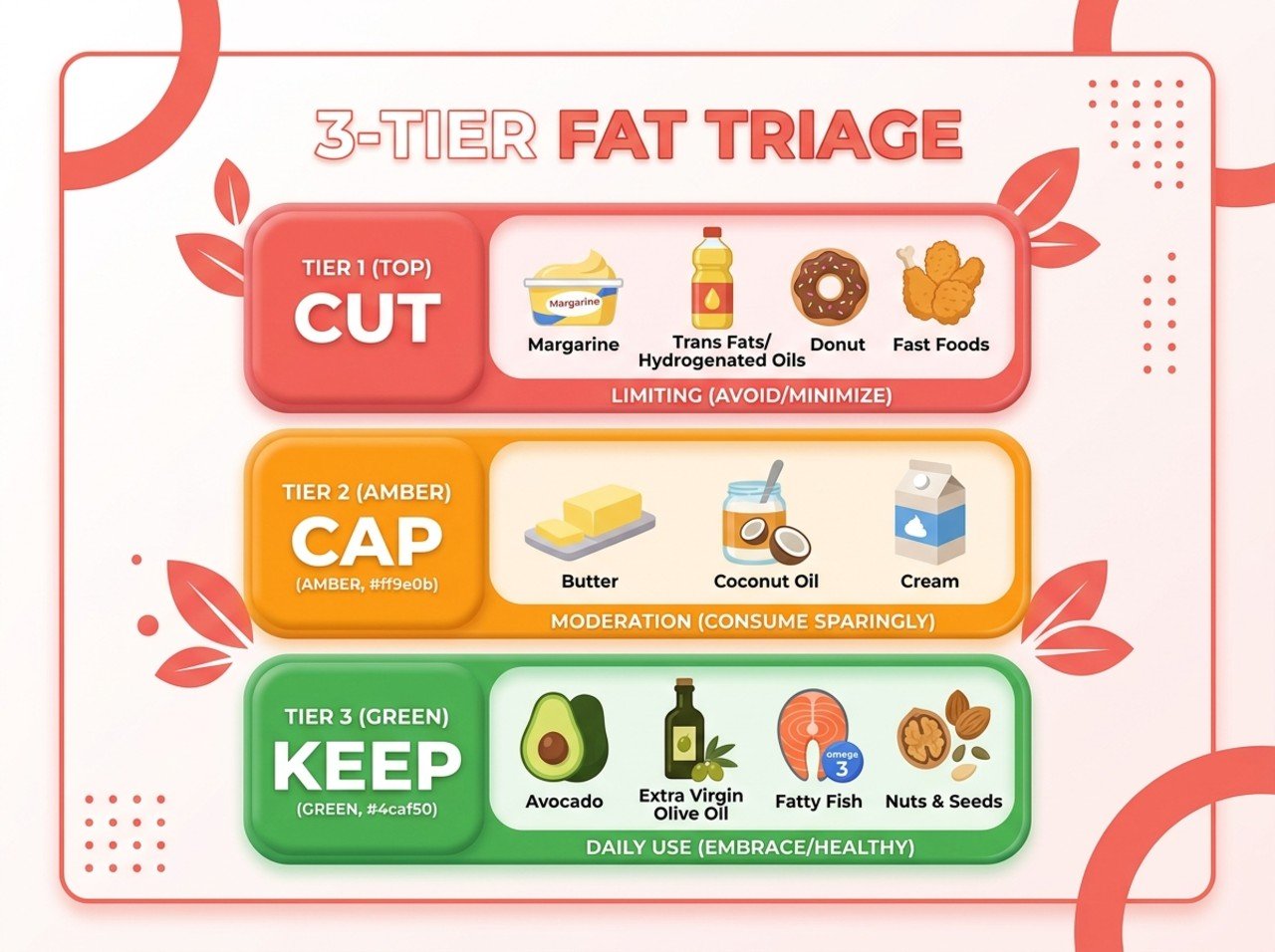
Forget the good-versus-bad list. Sort every fat into one of three tiers — Cut, Cap, or Keep — and you'll know what to do in two seconds flat. This is the framework we teach inside WLBF, and it maps directly onto what the world's leading health bodies actually recommend.
Here's the system at a glance.
| Tier | What it means | The fats it covers | Your one rule |
|---|---|---|---|
| CUT | No safe amount; avoid | Industrial trans fat / partially hydrogenated oils | Read the label; if you see "partially hydrogenated," put it back |
| CAP | Fine in moderation | Saturated fat — butter, fatty meat, cheese, coconut & palm oil | Keep under ~10% of daily calories |
| KEEP | Actively good for you | Unsaturated fat — olive & seed oils, nuts, avocado, oily fish | Make these your default cooking and snacking fats |
Notice what changed from the old advice: coconut oil moved out of "avoid forever" and into "cap." Vegetable and seed oils moved out of "bad" entirely and into "keep." Let's walk through each tier with the evidence.
Tier 1 — CUT: Industrial Trans Fat (The Only True "Bad Fat")
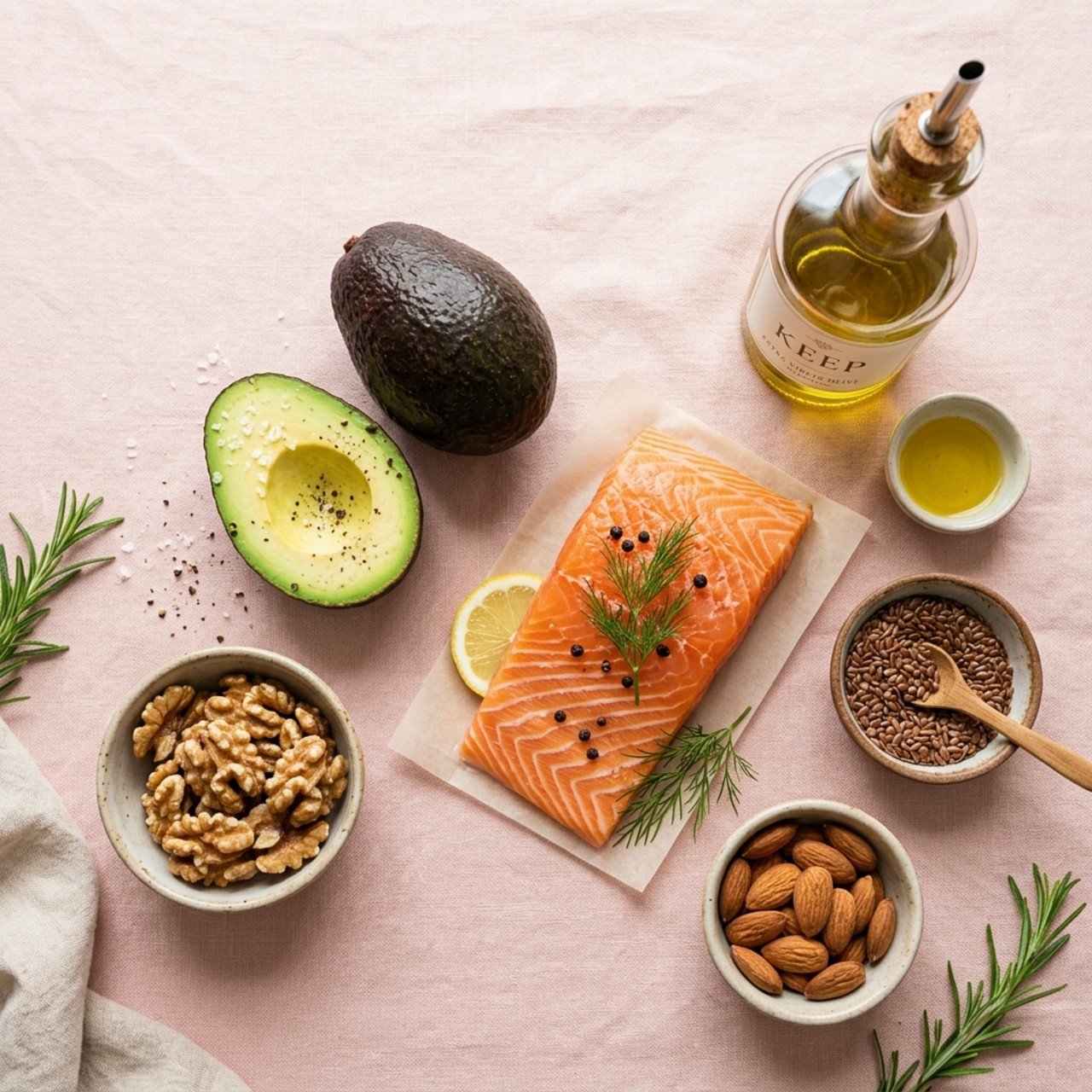
If there is one fat to treat as genuinely dangerous, it's industrially produced trans fat — and the good news is it's already disappearing from your shelves. This is the fat that earned the entire category its frightening reputation.
The WHO is blunt about it: industrial trans fat "clogs arteries," raises the risk of heart attacks, increases the risk of death from any cause by 34%, and has "no known health benefits." More than 278,000 deaths a year worldwide are attributed to it.
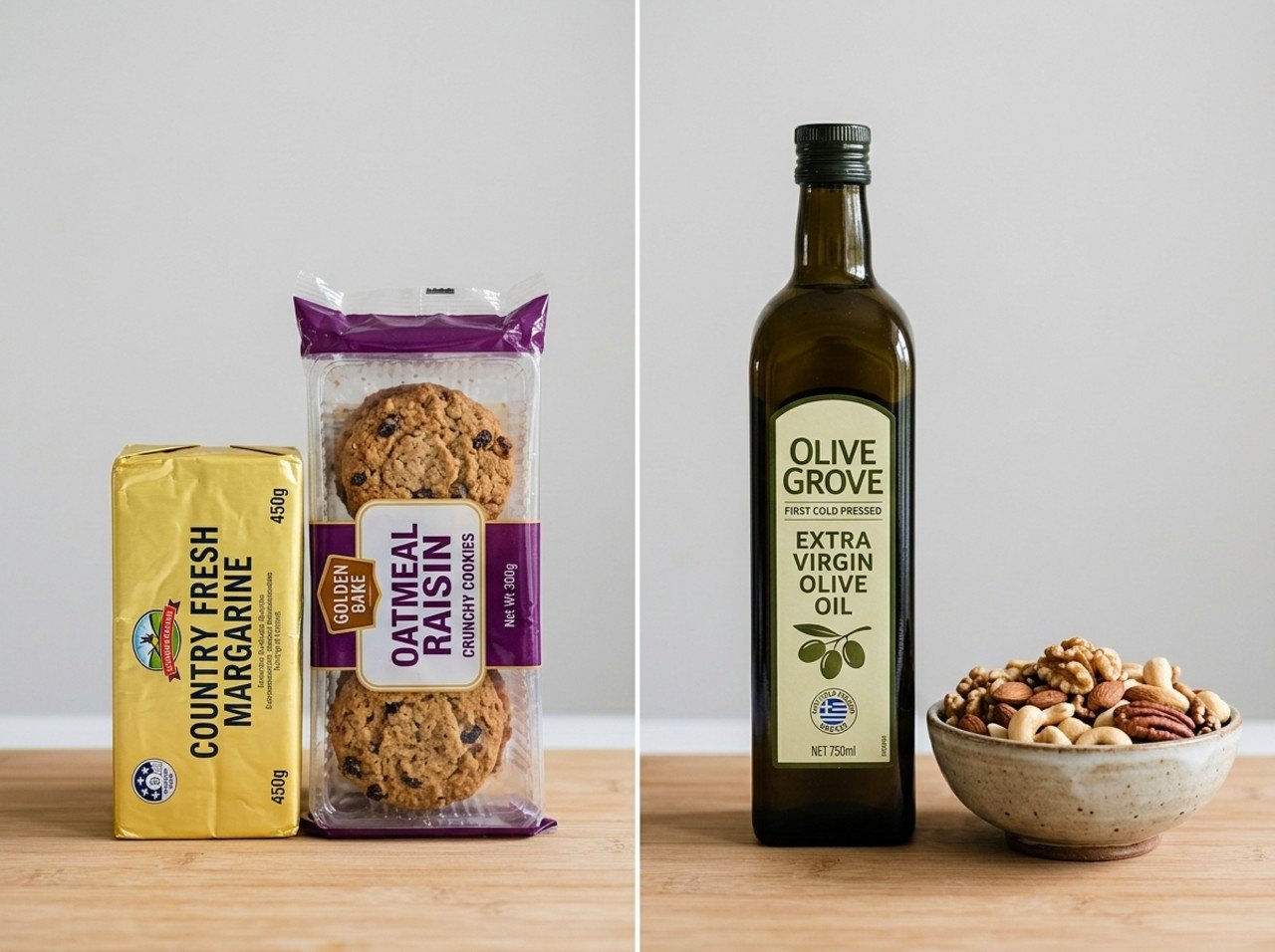
It's made by forcing hydrogen into liquid vegetable oil to make it solid and shelf-stable — a process called partial hydrogenation. The result, partially hydrogenated oil (PHO), was once everywhere: margarine, shortening, fried fast food, packaged cookies, cakes and pies.
Here's the part most women don't realise: in the US, this fight is largely won. The FDA determined in 2015 that PHOs are no longer "Generally Recognized as Safe," and manufacturers were barred from adding them to foods after June 2018.
So your job today isn't to hunt trans fat down in every product — it's simply to glance at the ingredients list of older-style imported or speciality packaged goods and avoid anything that still says "partially hydrogenated."
Where Trans Fat May Still Hide
- Older or imported margarines and vegetable shortening.
- Some commercial fried foods and baked goods (cookies, crackers, pies).
- A small amount occurs naturally in meat and dairy from cows, sheep and goats — the WHO notes this ruminant trans fat is chemically similar, so lean cuts and trimming visible fat still helps.
Tier 2 — CAP: Saturated Fat (Moderate, Don't Fear)
Saturated fat isn't a poison to eliminate — it's a fat to keep within sensible limits. This is the tier where the old article got it most wrong, and where the most stress lives for women trying to "eat clean."
The guidance is refreshingly specific. The WHO recommends that no more than 10% of your daily calories come from saturated fat — and that you replace some of it with unsaturated fat or whole-food carbohydrates like vegetables, fruit and whole grains. On a 2,000-calorie day, 10% works out to roughly 22 grams. That's a cap, not a ban.
And yes — coconut oil belongs here. It's a saturated fat, full stop. It isn't the artery-clogging villain some headlines claimed, but it also isn't the metabolic miracle others sold you. Use it for flavour when you want it, and count it toward your saturated-fat cap. (We dig into the nuance in our guide to the benefits of coconut oil.)
Saturated Fats To Keep An Eye On
- Butter, ghee, cream and full-fat cheese
- Fatty cuts of beef, pork and lamb; chicken skin
- Lard and tropical oils — palm, palm kernel and coconut
Why the "cap" rather than "cut"? Because the science on saturated fat has matured. The WHO still advises keeping it low, but the reason is specific: it raises LDL ("bad") cholesterol, and the bigger wins come from what you replace it with.
Swap saturated fat for unsaturated fat or whole-food carbohydrates, and you get a benefit; swap it for sugar and refined starch — which is exactly what the low-fat food industry did — and you don't. That nuance is why blanket "never eat saturated fat" advice quietly fell out of favour, and why a moderate, food-quality approach has taken its place.
The emotional reframe matters here: you don't have to feel guilty about butter on your toast or cheese in your omelette. You just have to keep the total in check across the day, and lean toward the unsaturated fats when you have the choice. That's a system, not a punishment.
Tier 3 — KEEP: Unsaturated Fats (Including The "Scary" Seed Oils)
Unsaturated fats are the ones to build your meals around — and that includes the very seed oils currently being demonised online. This is where a little courage with the evidence pays off.
Both the WHO and FDA name polyunsaturated and monounsaturated fats as the healthier replacements for bad fats. In fact, the WHO's official advice for swapping out trans fat is to use "oils rich in polyunsaturated fatty acids… include those from safflower, corn, sunflower, soybean… walnuts and seeds."
Those are the exact oils some influencers now tell you to throw out. The leading global health authority lists them as the solution, not the problem.
This is the contrarian-but-evidence-grounded heart of this guide: the seed-oil panic is not supported by the bodies that actually set dietary policy. The fat to fear was never sunflower oil — it was the partially hydrogenated version of it.
| Type | Good sources | Why it earns "Keep" status |
|---|---|---|
| Monounsaturated | Olive oil, avocado, almonds, peanuts, almond butter | Supports heart health; the backbone of Mediterranean-style eating |
| Polyunsaturated (Omega-3) | Salmon, sardines, mackerel, trout, flaxseed, walnuts | Anti-inflammatory; supports brain and hormonal health |
| Polyunsaturated (Omega-6) | Sunflower, soybean, corn, safflower oils | WHO-recommended replacement for trans and saturated fat |
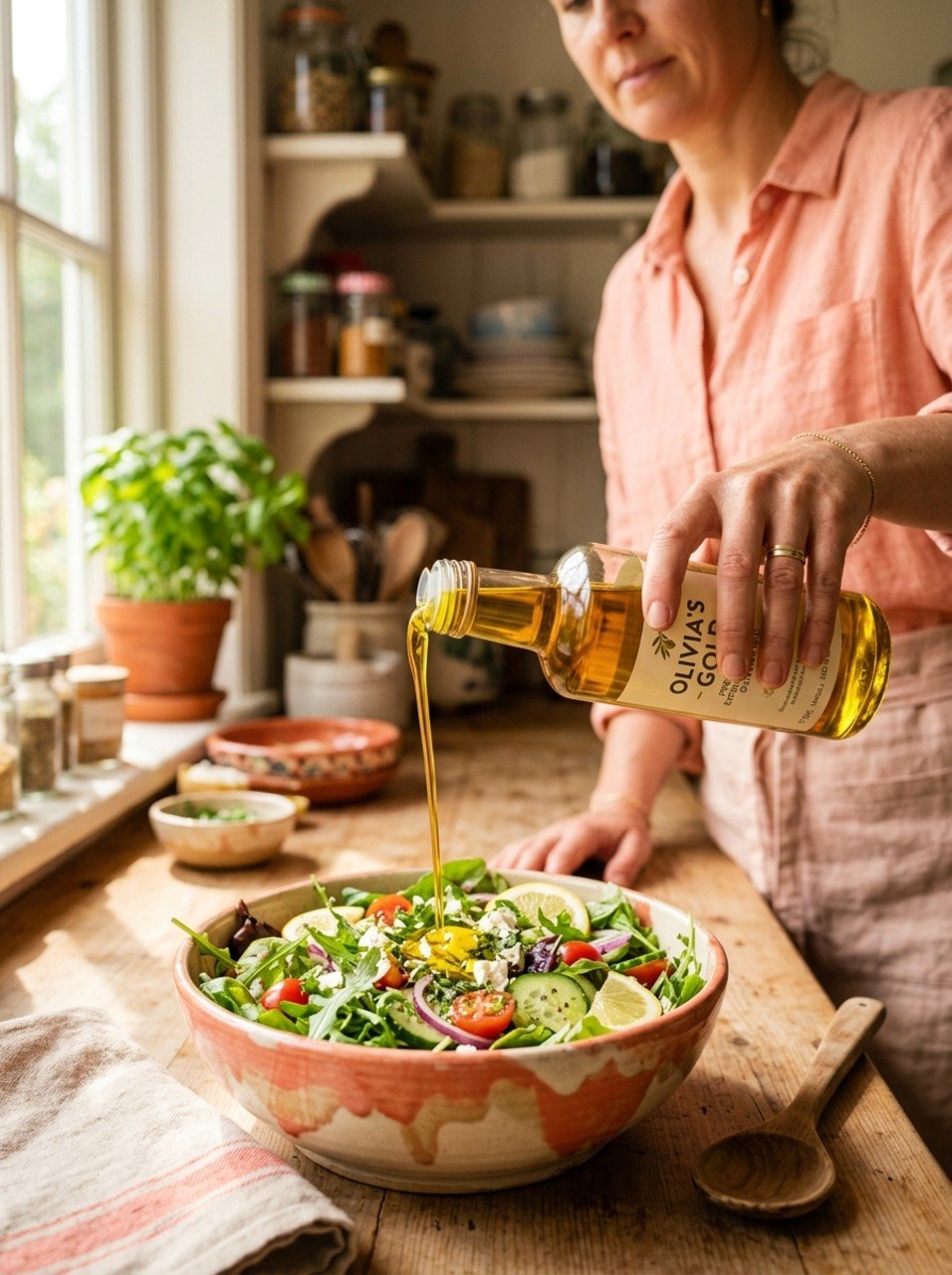
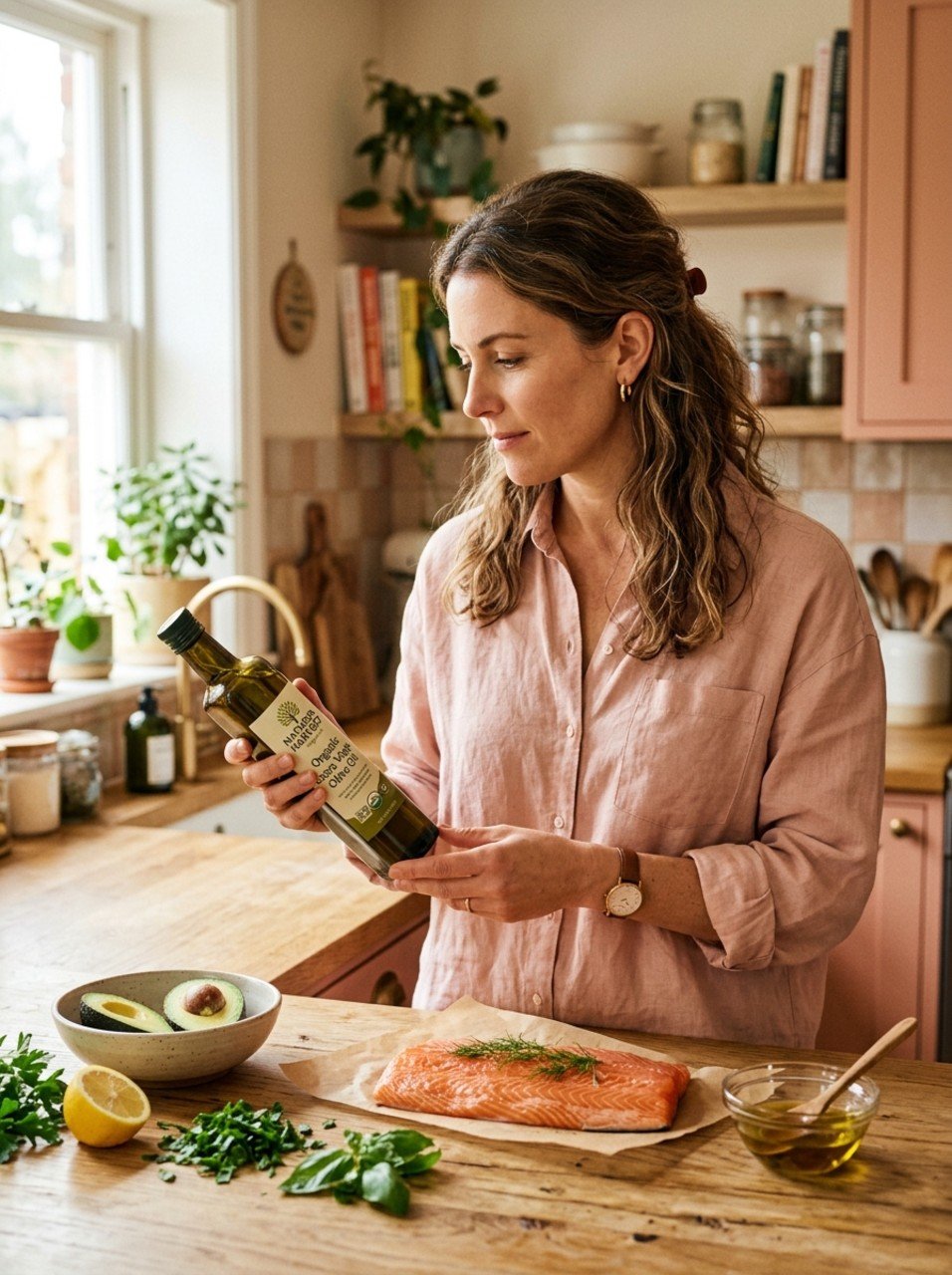
So the avocado that 21% of our community avoids? It's a Tier 3 "Keep." So is the olive oil you cook with and the salmon you were told was "fatty." These foods help with satiety, which is one of the most underrated tools in sustainable weight management.
Why "Fat-Free" Backfired For So Many Women
The low-fat era taught a generation of women to fear the wrong thing — and many of us are still carrying that fear. If you grew up reading "fat-free" on every yoghurt and cracker, this section is for you.
Here's what actually happened. When food makers stripped fat out of products to chase the "low-fat" trend, they replaced it with sugar and refined starch to keep things tasting good. The fat came out; the calories and the cravings stayed — or got worse.
Meanwhile, the fats that genuinely help you, the ones that keep you full and support your hormones, got swept into the same "avoid" bucket as the industrial junk.
That's the cruel twist behind the 21% figure from our community. Women aren't avoiding avocado because they're uninformed or undisciplined. They're avoiding it because they did exactly what the food industry trained them to do for thirty years.
The frustration is justified. The fix isn't more restriction — it's better information, which is the whole point of understanding the real role of healthy fats in weight loss.
When you stop fearing fat as a category and start sorting it with the 3-Tier system instead, two things happen. You eat more of the foods that actually keep you satisfied, and you quietly drop the ones doing real harm. That's not a diet. That's just clarity — and it's far easier to stick with for life than any rule built on fear.
Join Our Mailing List
Join thousands of women inside our community and receive our free guide, 10 Actions That Support Permanent Weight Loss — the exact behavioural shifts that make the difference between a two-week attempt and a lasting transformation.
No restriction plans. No guilt. Just what actually works — for real women with real lives.
The Practical Swap Table: Trade Up, Don't Cut Out
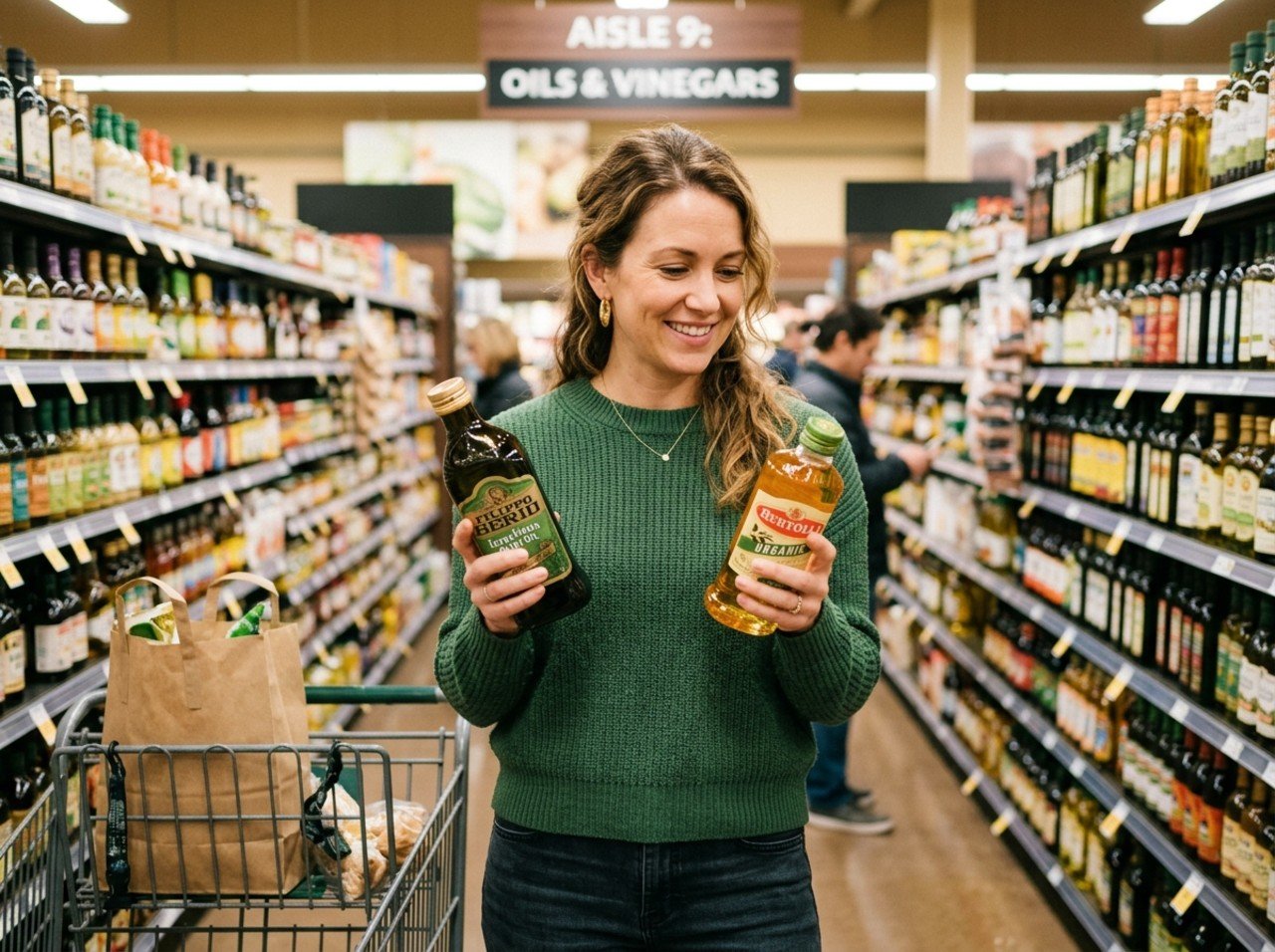
The fastest way to clean up your fats isn't deprivation — it's substitution. As the original version of this article rightly said, you can't cut everything overnight; you swap one habit at a time. Here's the cheat sheet.
| Instead of… | Reach for… | Why |
|---|---|---|
| Margarine / shortening | Olive oil or a soft spread with no PHO | Removes any lingering trans-fat risk |
| Butter for frying | Olive, canola or avocado oil | Swaps saturated for unsaturated |
| Fried fast food | Home-cooked, oven-baked or air-fried | Cuts hidden trans and saturated fat |
| Processed snacks | Nuts, seeds, or avocado on toast | Trades empty fat for satisfying, nutrient-dense fat |
| Fatty mince | Lean mince or trimmed cuts | Lowers saturated fat without losing protein |
One swap a week is enough. Steaming or baking instead of deep-frying, and choosing oils rich in unsaturated fat, are exactly the swaps the WHO recommends — and they make far more difference than chasing a "perfect" diet for three days and quitting.
Ready To Turn This Into Real Results?
You now understand fats better than 90% of the diet advice online. The next step is putting it into a routine that actually sticks.
Join thousands of women inside our community and grab our free guide: 10 Actions That Support Permanent Weight Loss — the practical, sustainable habits that translate everything you just read into real, lasting results. No fad diets. No fear-based food rules. Just what the research actually supports, written for real women.
The Bottom Line
The phrase "bad fats" did women a disservice. It turned a simple, three-part decision into a wall of fear and contradiction. The truth is calmer than the headlines: cut industrial trans fat, cap your saturated fat, and keep the unsaturated fats — yes, including the seed oils and the avocado you've been avoiding.
You don't need a stricter rulebook. You need permission to stop treating every fat as a threat, and a simple system to lean on when the next viral "this food is poison" post lands in your feed.
That's what the 3-Tier Triage gives you. Read your labels, make one swap at a time, and trust that real, lasting change is built from small, sustainable choices — not from fear.
Glossary Of Key Terms
- Partially Hydrogenated Oil (PHO): An industrial fat created by adding hydrogen to liquid vegetable oils to make them solid; the primary source of artificial trans fats.
- Trans Fat: A type of fat with no known health benefits that increases heart attack risk and is banned or heavily restricted by the FDA and WHO.
- Saturated Fat: Fats found in butter, meat, and tropical oils (like coconut) that are solid at room temperature and should be limited to 10% of daily calories.
- Unsaturated Fat: Healthy fats found in plants and fish (such as olive oil, nuts, and salmon) that support heart health and satiety.
- Monounsaturated Fat: A type of unsaturated fat found in olive oil and avocados that is a staple of Mediterranean-style eating.
- Polyunsaturated Fat: Healthy fats, including Omega-3s and Omega-6s, found in seeds, walnuts, and fatty fish that support brain and hormonal health.
- Satiety: The feeling of fullness and satisfaction after eating, which is significantly supported by the inclusion of healthy dietary fats.
- LDL (Low-Density Lipoprotein): Often referred to as "bad" cholesterol, which can be raised by excessive intake of saturated and trans fats.
- Ruminant Trans Fat: Naturally occurring trans fats found in small amounts in meat and dairy from animals like cows and sheep, which are chemically similar to industrial trans fats.
- 3-Tier Fat Triage: A simplified nutritional framework (Cut, Cap, Keep) designed to help individuals categorize and choose dietary fats based on scientific evidence.
FAQ
What Are Bad Fats And Why Should They Be Avoided?
The only fat truly worth avoiding is industrially produced trans fat (partially hydrogenated oil). The WHO links it to over 278,000 deaths a year and says it has no health benefit. The other fat often called "bad" — saturated fat — only needs to be limited, not eliminated.
Is Coconut Oil A Bad Fat?
Coconut oil is a saturated fat, so it belongs in the "cap it, don't cut it" tier. It's fine in moderation as part of your daily saturated-fat allowance, but it isn't a superfood that you can use without limit. Treat it like butter: a flavour choice, used sensibly.
Are Seed Oils And Vegetable Oils Bad For You?
According to the WHO and FDA, no. Seed and vegetable oils such as sunflower, soybean, canola and corn are unsaturated fats and are specifically recommended as healthier replacements for trans and saturated fats. The online "seed oil panic" isn't supported by the major health authorities.
How Much Saturated Fat Can I Eat In A Day?
The WHO recommends keeping saturated fat under 10% of your total daily calories — roughly 22 grams on a 2,000-calorie diet. Where possible, replace some of it with unsaturated fats or whole-food carbohydrates like vegetables and whole grains.
Why Shouldn't I Just Avoid All Fat To Lose Weight?
Because fat is essential. Your body needs dietary fat to absorb certain vitamins, support hormones, and keep you feeling full. Cutting all fat often backfires — you lose satiety and end up hungrier. The goal is choosing better fats, not eliminating them.
How Do I Spot Trans Fat On A Label?
Look in the ingredients list for the words "partially hydrogenated oil." In the US these are banned from new products, but they can still appear in older or imported packaged goods. The Nutrition Facts panel also lists trans fat in grams.
What's The Single Easiest Change I Can Make?
Swap one habit at a time. Start by cooking with olive, canola or avocado oil instead of butter or margarine, and choose oven-baked or air-fried over deep-fried. Small, repeated swaps beat short-lived perfect diets every time.