
Body Recomposition: A Realistic, Hormone-Smart Guide To Losing Fat And Building Muscle After 40
Mahatma Gandhi
Indian lawyer, politician, & writer
Strength does not come from the body. It comes from the will.
Summary (TL;DR)
Body recomposition means losing fat and building muscle at the same time, so your shape changes even when the scale won't. After 40, falling estrogen makes the process slower, but resistance training paired with enough protein makes recomp the smartest goal for women in perimenopause. This guide gives you the WLBF Recomp Reset, a realistic four-part plan you can actually live with.
Here's a moment that might sound familiar. You've been eating well. You've been moving your body. You step on the scale, and it hasn't budged in three weeks. So you decide nothing is working, and you quietly give up.
But what if that flat number is hiding something good? What if, underneath it, you're slowly trading fat for muscle, and your body is changing in ways the scale will never show you?
That trade has a name: body recomposition. And for women over 40, it isn't just possible. It's the goal that finally makes sense for your body, your hormones, and your life.
The frustration is real. So is the confusion. You've probably heard you "can't build muscle and lose fat at the same time," especially once perimenopause arrives. You've watched advice built for 25-year-old men fail you again and again.
This guide clears all of that up. You'll learn what recomposition actually means, why it works differently after 40, and how to start with a simple framework we built for women exactly like you.
Medical & Referral Disclaimer
This article is for educational and informational purposes only. It is not medical advice and should not replace guidance from a qualified healthcare professional. Every woman's body, hormones, and health history are different. Before starting a new exercise program, changing your nutrition strategy, or adjusting supplements, please consult your doctor or a registered dietitian, especially if you have an existing health condition.
Key Takeaways
- Body recomposition means losing fat and building muscle at the same time, which is why the scale often stays still while your body changes shape.
- Women lose roughly 5% to 10% of muscle per decade after 50, and falling estrogen speeds this up, so protecting muscle becomes urgent after 40.
- Recomposition is usually a better goal than weight loss for women over 40 because it targets visceral fat and protects your metabolism.
- Most women over 40 need about 1.6 grams of protein per kilogram of body weight each day to support muscle growth during training.
- Resistance training, not endless cardio, is the engine of recomposition and has been shown to reduce abdominal fat in postmenopausal women.
- A realistic pace is 0.5% to 1% of body weight in fat per week, so partial progress is still real progress.
- Our four-part WLBF Recomp Reset (Lift, Protein Floor, Strategic Fuel, Recovery) gives you a sustainable system instead of relying on willpower.

What Does Body Recomposition Actually Mean?
Body recomposition means changing your ratio of fat to muscle, so you lose body fat and build or keep muscle at the same time. Because muscle is denser than fat, your weight can stay flat while your body looks leaner, firmer, and smaller. The scale measures total weight, not what that weight is made of.
This is the part that trips up so many women. We were taught to chase one number. But that number can't tell the difference between a pound of fat and a pound of muscle.
Think of it like renovating a house without changing its footprint. The square footage stays the same. Inside, everything gets stronger and more functional. Body recomposition works the same way: you reshape what's already there.
This is why two women can weigh the same and look completely different. One carries more muscle and less fat. Same weight on the scale, a very different body in the mirror.
Here's the reframe worth holding onto. You don't have a weight problem. You have a body-composition opportunity. Once you stop asking the scale to define your progress, recomposition stops feeling impossible and starts feeling obvious.

Can Women Over 40 Still Build Muscle And Lose Fat?
Yes. Women over 40 can absolutely build muscle and lose fat at the same time. It happens more slowly than it did at 25 because estrogen decline slows muscle repair, but with resistance training and enough protein, recomposition remains fully achievable through perimenopause and beyond.
Let's be honest about what's working against you, because pretending it's easy helps no one.
After menopause, women lose muscle faster than men. On average, both men and women lose 3% to 8% of muscle per decade between 30 and 50. After 50, that climbs to 5% to 10% per decade. The drop in estrogen is a big reason why, because it affects how your muscles repair, recover, and rebuild.
The hormonal shift is measurable. Research shows lean mass drops by around 2.5% in perimenopause and 5.7% after menopause compared to premenopausal women. That isn't a willpower failure. It's biology, and biology responds to the right signals.
Here's the empowering part. The same research that documents the loss also points to the fix. Your muscles are still listening. When you challenge them with resistance training and feed them enough protein, they still adapt and grow. The window never closes. It just asks for more intention.
If you want to support your body through this transition, it's worth understanding perimenopause support as part of the bigger picture, not as a magic fix.

Why Recomposition Beats Weight Loss After 40
For decades, women were sold a single goal: get the number down. After 40, that goal quietly stops serving you, and sometimes it works against you.
When you chase weight loss alone, especially through aggressive dieting and hours of cardio, you often lose muscle along with fat. Less muscle means a slower metabolism, which makes the next round of weight loss even harder. It's a trap that gets tighter with every attempt.
Recomposition breaks the cycle. By building muscle while you lose fat, you protect the very tissue that keeps your metabolism humming. You also target the fat that matters most for your health.
That deep belly fat, called visceral fat, wraps around your organs and rises during the menopausal transition. The good news is that resistance training reduced abdominal fat in postmenopausal women in controlled research. Cardio alone rarely does that as well.
Here's a contrarian truth worth sitting with. For most women over 40, the scale is the worst tool in the house. It can't see the muscle you're building. It can't see the visceral fat you're losing. It punishes you for progress it can't measure.
This connects to something we talk about often, because stress hormones quietly shape where your body stores fat. Understanding stress and belly fat helps explain why grinding yourself down with extreme dieting can backfire.
| Old Goal: Weight Loss | New Goal: Recomposition |
|---|---|
| Measures total pounds | Measures fat-to-muscle ratio |
| Often loses muscle and fat together | Protects and builds muscle |
| Can slow metabolism over time | Protects and supports metabolism |
| Scale-focused, easy to feel defeated | Strength-focused, progress you can feel |
| Built on restriction | Built on nourishment and training |

The WLBF Recomp Reset: A Four-Part Framework
You don't need a perfect program. You need a system you can repeat on a normal, busy week. So we built one. The WLBF Recomp Reset rests on four pillars, and they work together. Pull one out and the whole thing wobbles.
| Pillar | What It Means | Why It Matters After 40 |
|---|---|---|
| 1. Lift Heavy | Resistance training 2 to 4 times a week, working close to effort | The signal that tells aging muscle to grow and protects it from loss |
| 2. Protein Floor | A daily protein minimum you hit every day | Gives muscle the raw material to repair; counters anabolic resistance |
| 3. Strategic Fuel | Eat at maintenance or a small deficit, not a crash diet | Allows fat loss without starving the muscle-building process |
| 4. Recovery | Sleep, stress care, and rest days you actually take | Where muscle is rebuilt and where fat-storing stress hormones calm down |
Pillar 1: Lift Heavy. This is the engine. Cardio is wonderful for your heart, but it won't reshape your body the way lifting does. Exercise training improves body composition in postmenopausal women, and resistance training leads the way. If you've ever worried about getting "bulky," that fear is largely a myth for women, and you can train smart and strong without bulking up.
Pillar 2: Protein Floor. As you age, your muscles become a little "deaf" to protein, a state called anabolic resistance. The fix is simple: eat more of it, consistently. We'll cover exact numbers in the next section.
Pillar 3: Strategic Fuel. You can recompose while eating at maintenance calories or a slight deficit. A small deficit of a few hundred calories lets fat loss happen without sabotaging muscle. This is where a smart nutrition plan for women over 40 earns its keep.
Pillar 4: Recovery. Muscle grows when you rest, not when you train. Poor sleep raises stress hormones and stalls progress, which is why sleep and weight loss are tied so tightly together. Recovery isn't the reward for the work. It's part of the work.
How Much Protein Do Women Over 40 Need For Recomposition?
Most women over 40 need around 1.6 grams of protein per kilogram of body weight per day to support muscle growth during resistance training. For a 150-pound (68 kg) woman, that's roughly 109 grams daily. Spreading it across meals, with 25 to 35 grams per meal, helps your body use it well.
This number isn't a guess. A landmark analysis of 49 studies found benefits to muscle growth levelled off around 1.6 grams per kilogram of body weight per day in people doing resistance training. Below that, you're likely leaving muscle on the table.
For women in midlife, protein does double duty. It also helps preserve muscle mass and fight age-related muscle loss, since protein is the most muscle-building nutrient and one that many women over 40 don't get enough of. So every meal becomes a chance to protect your future strength.
Many women are surprised by how much that really is. Most of us undereat protein, especially at breakfast. Building each meal around a protein source is the easiest habit to fix this, and keeping high-protein snacks on hand closes the gap on busy days.
| Your Weight | Daily Protein Target (about 1.6 g/kg) | Roughly Per Meal (3 meals) |
|---|---|---|
| 130 lb (59 kg) | ~94 g | ~31 g |
| 150 lb (68 kg) | ~109 g | ~36 g |
| 170 lb (77 kg) | ~123 g | ~41 g |
| 190 lb (86 kg) | ~138 g | ~46 g |
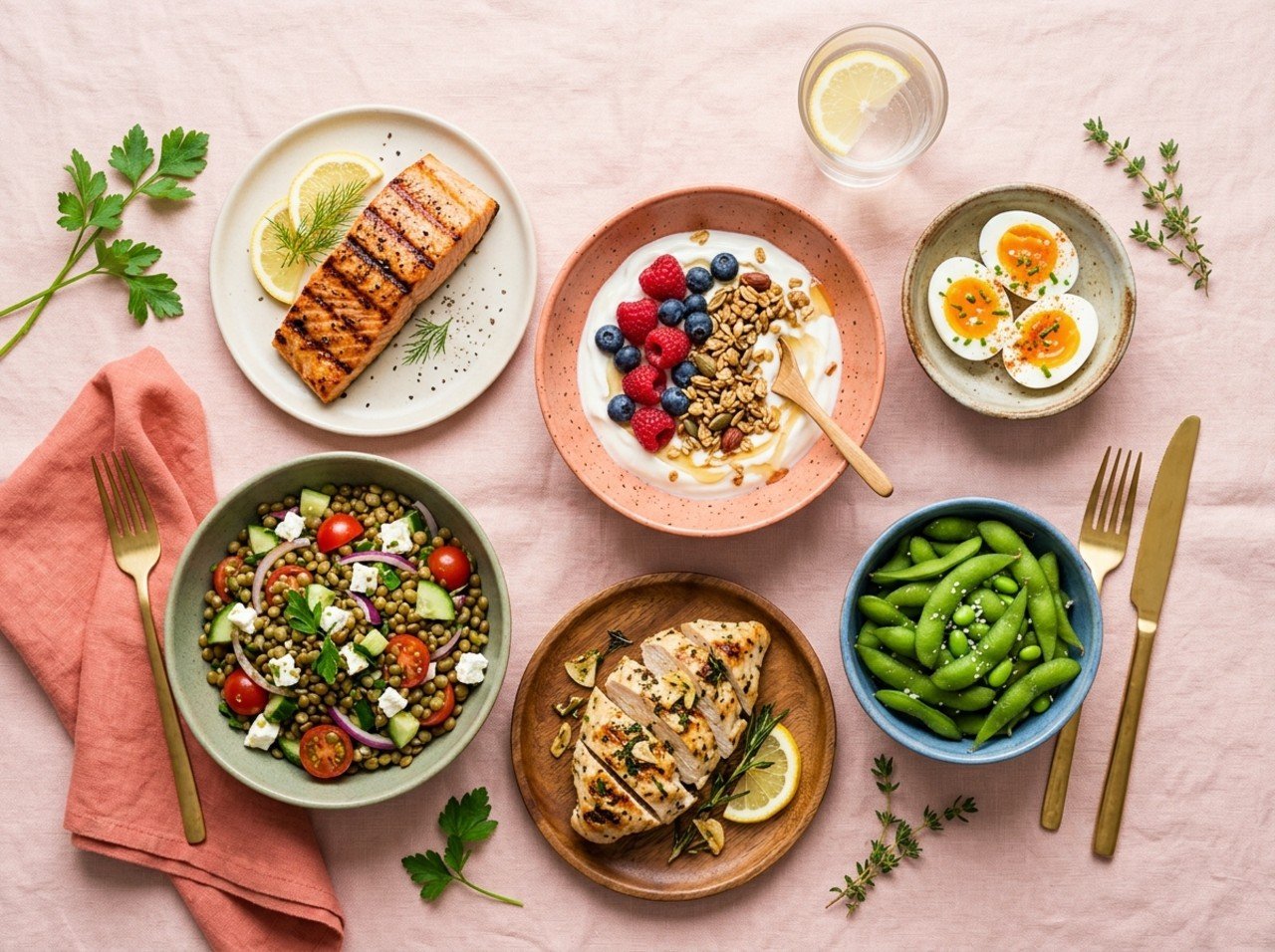
A quick note on what counts: 30 grams of protein looks like about a palm-sized chicken breast, a cup of Greek yogurt plus a scoop of protein, or roughly four large eggs. You don't need to be exact. You need to be consistent.

How Long Does Body Recomposition Take For Women Over 40?
Body recomposition is slow and steady, not fast. A realistic pace is losing about 0.5% to 1% of your body weight in fat per week while holding or gaining muscle. Visible changes usually take 8 to 12 weeks, with meaningful shifts over 4 to 6 months. After 40, patience is the strategy, not a setback.
We won't promise you a number by a date. That kind of promise sets you up to feel like a failure when your body follows its own timeline. And it will.
A healthy, sustainable rate of fat loss tends to land around 0.5% to 1% of body weight per week. Muscle builds even more slowly, which is exactly why the scale can sit still for weeks while real change is happening underneath.
This is where most women quit, right before the proof shows up. So change how you measure. Track how your clothes fit, the weights you can lift, your energy, and your sleep. These tell the true story long before the scale agrees.
And remember this: 70% consistency that you keep for a year beats 100% perfection that you abandon in March. Partial progress is still progress, and it compounds.
Join Our Mailing List
Join thousands of women inside our community and receive our free guide, 10 Actions That Support Permanent Weight Loss — the exact behavioural shifts that make the difference between a two-week attempt and a lasting transformation.
No restriction plans. No guilt. Just what actually works — for real women with real lives.
Common Recomposition Mistakes Women Over 40 Make
Even motivated women stall, and it's rarely about effort. It's usually a system problem, and systems are fixable.
The first mistake is too much cardio, too little lifting. Hours on the treadmill can burn calories, but they don't send the muscle-building signal. Without that signal, you can shrink without reshaping. Resistance training has to be the centerpiece.
The second is chronic under-eating. Slashing calories too hard tells your body to break down muscle for fuel, the opposite of what you want. It also spikes stress hormones. A small deficit of 250 to 500 calories with high protein protects your muscle while fat loss happens.
The third is scale obsession. Weighing daily and riding the emotional rollercoaster pulls focus away from what matters. The number can't measure your win.
The fourth is skipping recovery. Training hard while sleeping badly and living stressed keeps your body in a fat-storing, muscle-resisting state. Rest is not optional. It's where the results are made.
| The Mistake | The Recomp Reset Fix |
|---|---|
| Endless cardio, no lifting | Lift 2 to 4 times a week as your foundation |
| Crash dieting | Eat at maintenance or a small deficit with high protein |
| Daily scale weigh-ins | Track strength, clothes, energy, and photos |
| Pushing through poor sleep | Protect 7 to 9 hours and real rest days |
| Chasing "perfect" | Aim for repeatable, around 80% consistent |
Your stronger self is already on her way. Want a clear, women-first plan to meet her? Join the Women's Lean Body Formula newsletter for realistic, research-backed strategies made for your body and your stage of life. Grab your free guide and subscribe here. One small, consistent step starts today.
The Bottom Line
Body recomposition isn't a trend or a younger woman's game. It's the most honest, hormone-smart goal you can choose after 40. You're not trying to shrink yourself. You're rebuilding a stronger, more capable body, one that the scale will never fully measure.
Three things to carry with you. First, trade the scale for strength, photos, and how your clothes fit. Second, lift heavy and hit your protein floor, because those two pillars do most of the work. Third, give it time, because slow change is still change, and it lasts.
Glossary Of Key Terms
- Anabolic Resistance: A condition, often associated with aging, where muscles become less responsive to the protein consumed, requiring higher intake to stimulate muscle repair and growth.
- Body Recomposition: The process of simultaneously losing body fat and gaining or maintaining lean muscle mass to change the body's overall shape and health profile.
- Estrogen: A hormone that declines during perimenopause and menopause, affecting the body's ability to repair and build muscle tissue.
- Progressive Overload: The gradual increase of weight or difficulty in a resistance training program to ensure the muscles are continually challenged and prompted to grow.
- Protein Floor: A daily minimum protein target (typically 1.6g per kg of body weight) required to support muscle maintenance and growth during training.
- Recovery: The essential period of rest, sleep, and stress management during which the body repairs muscle tissue and regulates hormones.
- Resistance Training: Exercise that improves strength and muscle mass by requiring muscles to work against an external force; the primary driver of body recomposition.
- Strategic Fuel: A nutritional approach that involves eating at maintenance calories or a slight deficit to support fat loss without sacrificing muscle mass.
- Visceral Fat: Deep abdominal fat that wraps around internal organs; its levels often rise during menopause but can be mitigated through resistance training.
- WLBF Recomp Reset: A four-part framework (Lift, Protein Floor, Strategic Fuel, Recovery) designed to provide a sustainable system for body recomposition after age 40.
FAQ
Can You Really Build Muscle And Lose Fat At The Same Time After 40?
Yes, you can. It happens more slowly than it did in your twenties because estrogen decline slows muscle repair, but it remains fully possible. The key is resistance training combined with enough protein, usually around 1.6 grams per kilogram of body weight. Women who are newer to lifting often see especially clear recomposition results. Consistency over months, not perfection over weeks, is what makes it work.
Why Isn't The Scale Moving If Recomposition Is Working?
Because muscle and fat weigh the same, but take up different space. As you lose fat and gain muscle, your total weight can stay flat while your body gets leaner and firmer. The scale only measures total pounds, not what those pounds are made of. This is exactly why we recommend tracking your strength, your measurements, your progress photos, and how your clothes fit instead. A stuck scale is often a sign that recomposition is happening.
How Much Protein Do I Actually Need For Body Recomposition?
Most women over 40 do well aiming for about 1.6 grams of protein per kilogram of body weight each day. For a 150-pound woman, that's roughly 109 grams. Spreading it across meals, with 25 to 35 grams each, helps your body use it efficiently. Older muscles respond less readily to protein, so hitting this target consistently matters more with age. Building each meal around a protein source is the simplest way to get there.
Is Cardio Bad For Body Recomposition?
Not at all. Cardio is excellent for your heart, mood, and overall health, so keep some in your week. The issue is relying on cardio alone, because it doesn't send the strong muscle-building signal that lifting does. For recomposition, resistance training should be your foundation, with cardio as a supportive addition. Think of lifting as the main course and cardio as a helpful side.
How Long Before I See Results From Recomposition After 40?
Most women notice changes in 8 to 12 weeks, with more meaningful shifts over 4 to 6 months. Fat loss tends to be steady at about 0.5% to 1% of body weight per week, and muscle builds even more gradually. Because the process is slow, the scale may not reflect your progress for a while. Tracking strength gains and how your clothes fit will show results long before the scale does. Patience truly is part of the plan here.
Do I Need To Lift Heavy Weights, Or Are Light Weights Enough?
You want to train with enough resistance that the last few repetitions feel genuinely challenging. That's what tells your muscles to grow and protects them from age-related loss. Light weights can be a fine starting point, especially while you learn good form, but you'll want to progress over time by adding weight or difficulty. This gradual increase, called progressive overload, is what keeps results coming. Always prioritize safe technique over lifting heavier.
Will Strength Training Make Me Bulky?
This is one of the most common fears, and for the vast majority of women, it's a myth. Women generally have lower levels of the hormones needed to build very large muscles, so the typical result of lifting is a leaner, firmer, stronger look rather than a bulky one. Building noticeable muscle size takes years of dedicated, specific effort. What most women actually gain is definition, strength, and a metabolism that works in their favor.