Best Exercises for Flatter Abs: The Science-Backed Core Routine That Actually Works
The Complete Guide To The Best Exercises for Flatter Abs, Plus the Myth Nobody Told You About
Sara Blakely
Founder of Spanx & self-made billionaire entrepreneur
Don’t be intimidated by what you don’t know. That can be your greatest strength and ensure that you do things differently from everyone else.
Summary (TL;DR)
The best exercises for flatter abs aren’t just crunches — they’re a mix of targeted core-strengthening moves (bicycle crunch, reverse crunch, plank, dead bug, bird dog, Russian twist, leg raises) paired with a caloric deficit, because exercise alone can’t “spot reduce” belly fat. This guide walks you through the exact moves, in what order, and how to adapt every single one if you’re over 30, postpartum, or dealing with diastasis recti.
Let’s be honest: if you clicked on this looking for flatter abs, you’ve probably already done your time with crunches. Maybe hundreds of them. Maybe an app told you 30 days would do it. And maybe — like a lot of women we hear from — you’re standing in front of the mirror feeling frustrated, a little confused, and wondering if your body is just “different.”
It isn’t. What’s different is the information you’ve been given. Most “best ab exercises” lists hand you a stack of moves and stop there, as if doing them is the whole story. It isn’t, and pretending otherwise is exactly why so many women feel like they’re doing everything right and still not seeing anything change.
This guide is built differently. You’ll get the specific best exercises for flatter abs, ranked using real exercise-science data instead of guesswork — but you’ll also get the two pieces almost everyone leaves out: why targeted ab work can’t reveal your abs on its own, and how to protect your core (especially your pelvic floor) if you’re training after 30, after a baby, or after any kind of abdominal separation.
Medical & Referral Disclaimer
This article is for informational and educational purposes only. It is not a substitute for professional medical advice, diagnosis, or treatment. Always consult your physician, physical therapist, or qualified health provider before starting any new diet or exercise program — especially if you are pregnant, postpartum, or have a diagnosed condition such as diastasis recti.
Key Takeaways
- Crunches aren’t useless — they’re incomplete. Targeted ab exercises build and tone the muscle underneath; they don’t burn the fat covering it.
- Not all ab exercises are created equal. Research has measured the best move working the abs nearly 2.5× harder than a traditional crunch — and the worst-performing move tested up to 80% less effective than that.
- A caloric deficit is what reveals definition — you can’t out-crunch a nutrition plan that isn’t supporting fat loss.
- If you’re postpartum or over 30, some “classic” ab moves need modifying to protect your pelvic floor and avoid worsening abdominal separation.
- Consistency beats intensity. Two to three focused core sessions a week, done correctly, outperform daily crunches done on autopilot.
Why 100 Crunches a Day Won’t Give You Flatter Abs
Because ab exercises strengthen your abdominal muscles, but they don’t burn the fat sitting on top of them — that’s decided by your overall body composition, not which body part you’re training.
This idea, called “spot reduction,” has been tested directly. In a controlled study published in the Journal of Strength and Conditioning Research, 24 sedentary adults did seven abdominal exercises, five days a week, for six weeks straight.
Researchers found the training “was not sufficient to reduce abdominal subcutaneous fat,” with no significant change in body fat percentage, waist circumference, or abdominal skinfold thickness — even though the exercise group’s core endurance improved substantially (from an average of 32 curl-ups to 47).
We’ve covered why spot reduction doesn’t work in more depth in The Truth About Spot Reduction — the short version is that fat mobilizes systemically, across your whole body, based on genetics and hormones, not on which muscle you just worked.
That’s not bad news. It just means the best exercises for flatter abs are only one-third of the equation, and this guide covers all three.
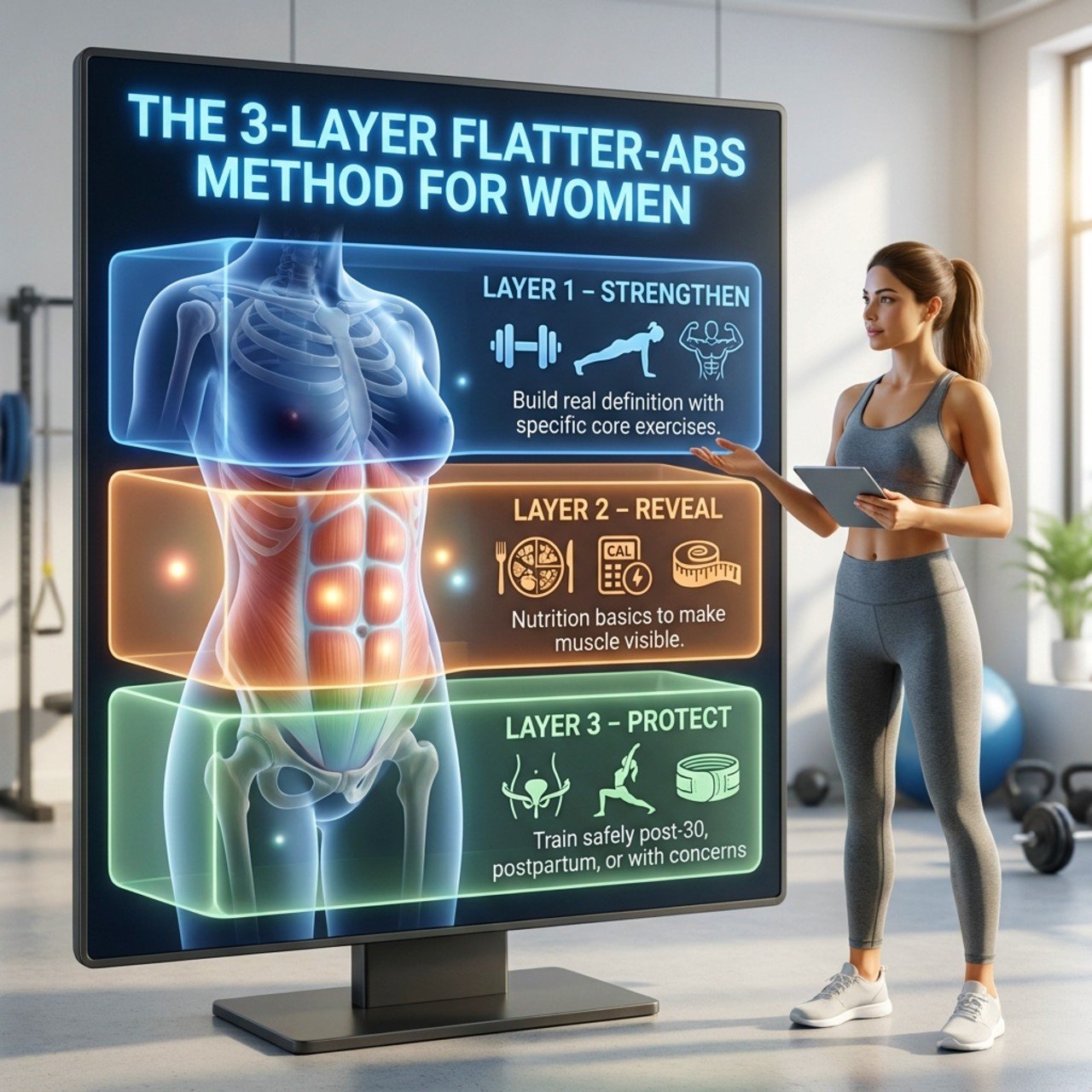
The 3-Layer Flatter-Abs Method
Flatter, more defined abs come from three things working together — strengthening the muscle, revealing it through nutrition, and protecting your core so you can keep training consistently.
We call it the 3-Layer Flatter-Abs Method, and it’s the framework the rest of this guide is built around:
- Layer 1 – Strengthen: The specific core exercises that build real definition, ranked by how hard they actually work your abs.
- Layer 2 – Reveal: The caloric-deficit basics that determine whether that muscle definition is visible at all.
- Layer 3 – Protect: How to train your core safely if you’re over 30, postpartum, or managing diastasis recti or pelvic floor concerns.
Layer 1 – Strengthen: The Best Ab Exercises, Ranked By Science
Not every ab exercise works your muscles equally — an ACE-sponsored study measuring muscle activation (EMG) across 13 popular ab exercises found the top move worked the rectus abdominis nearly 2.5 times as hard as a traditional crunch (248% of baseline activation), while the worst performed up to 80% worse.
The 30-person study tested everything from the bicycle maneuver to ab-toning gadgets like the Ab Rocker — and the plain crunch, long treated as the gold standard, landed just past the halfway mark: 11th out of 13.
Here are seven of the best exercises for flatter abs, chosen for correct-form effectiveness, variety across your upper abs, lower abs, and obliques, and how well they fit a real home ab workout with no equipment required.
| Exercise | Muscle Activation vs. Traditional Crunch | ACE Ranking (of 13) |
|---|---|---|
| Bicycle Maneuver | 248% (nearly 2.5× harder) | 1st |
| Traditional Crunch | 100% (baseline) | 11th |
| Ab Rocker (device) | Up to 80% less effective | 13th (last) |
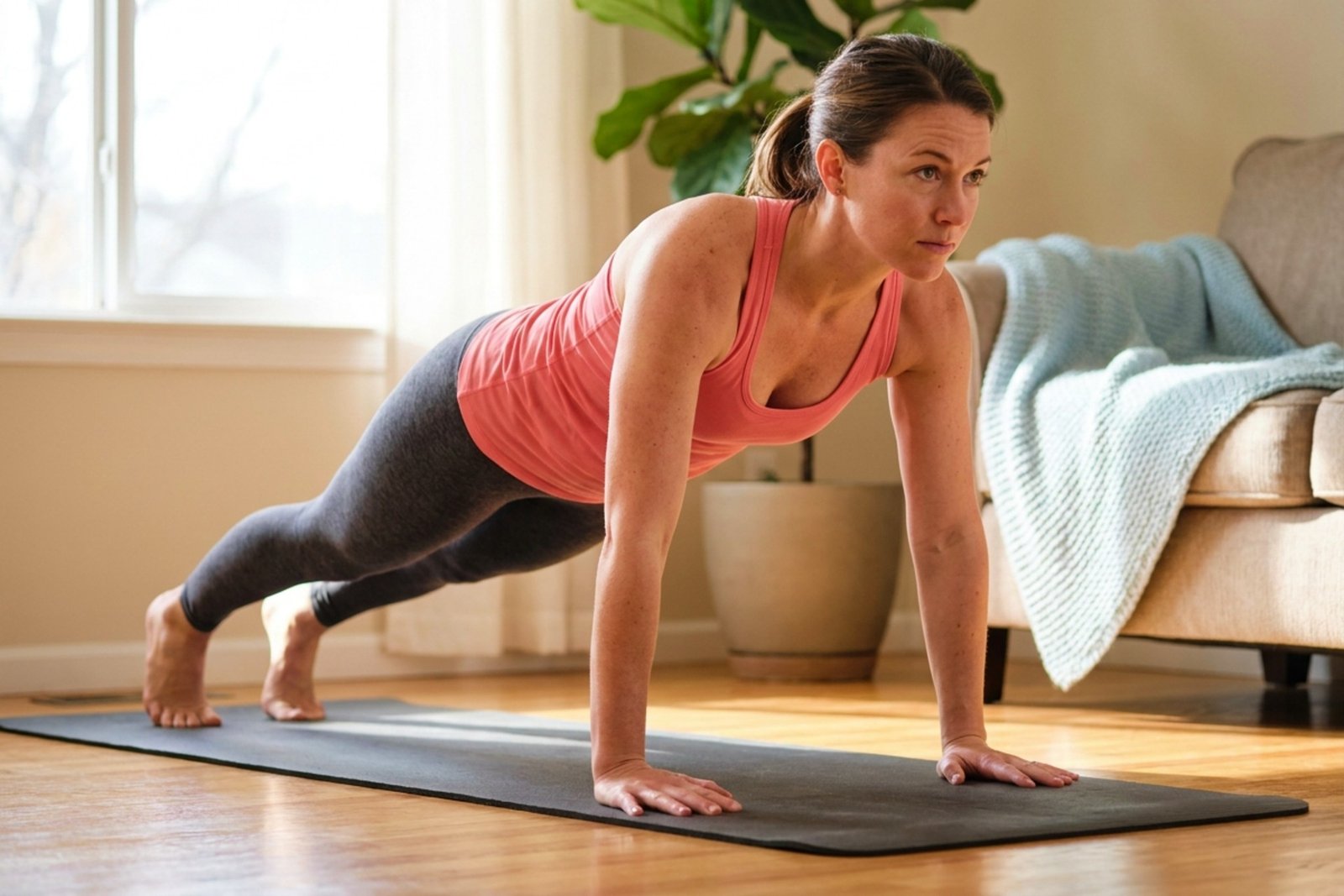
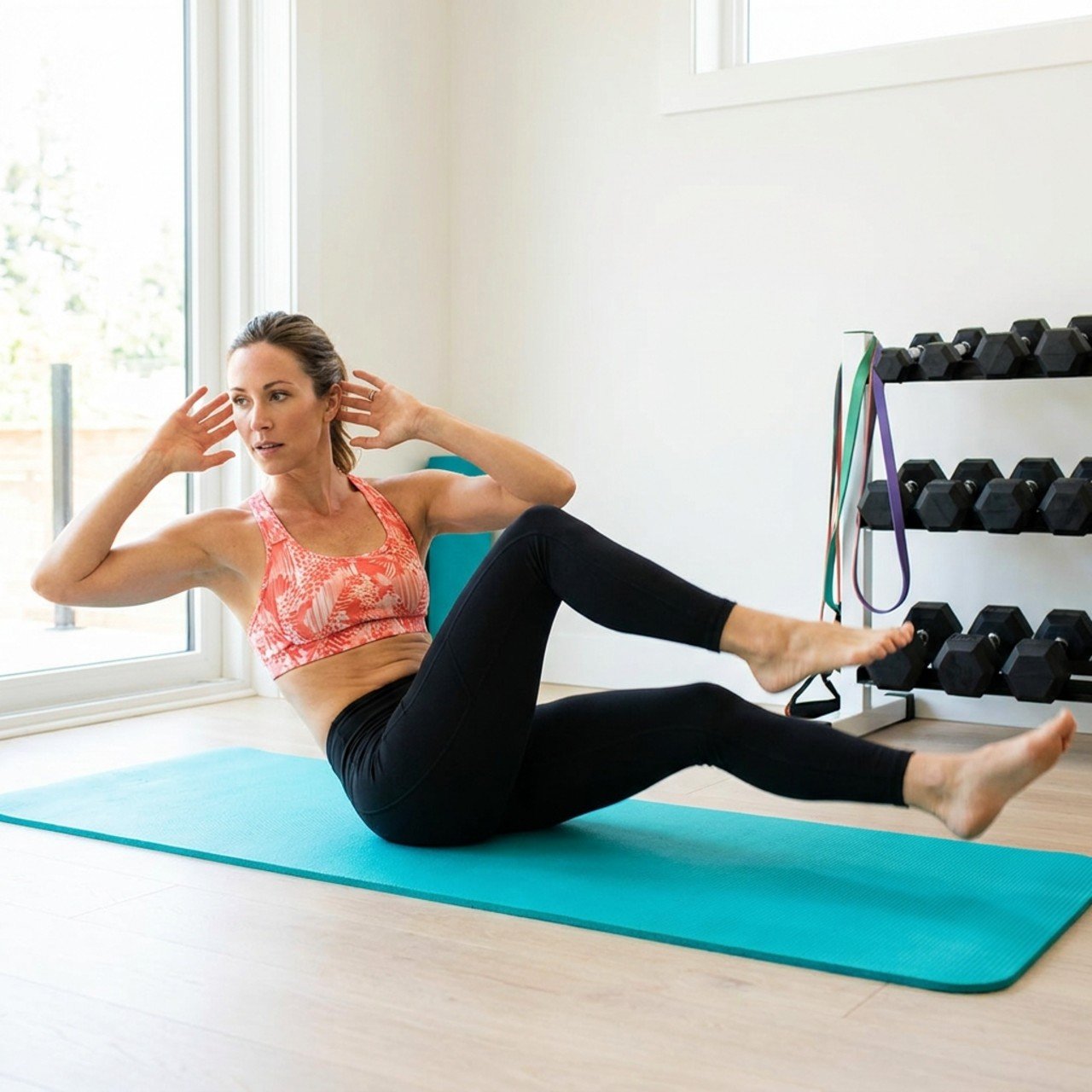
1. Bicycle Crunch (Upper Abs & Obliques)
Lie on your back, hands lightly behind your head, knees bent to 90 degrees. Bring your right elbow toward your left knee while extending your right leg, then switch sides in a smooth pedalling motion.
This move topped the ACE ranking for a reason: the twisting motion recruits both your rectus abdominis and your obliques at once. Keep the movement slow and controlled — speed doesn’t make this exercise more effective; form does.
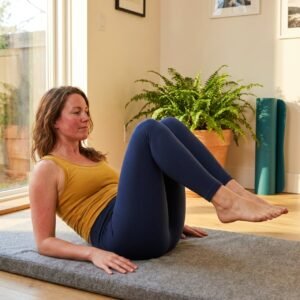
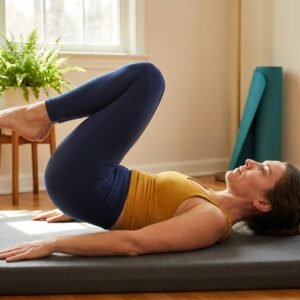
2. Reverse Crunch (Lower Abs)
Lie on your back with knees bent and lifted toward your chest, arms flat at your sides. Use your lower abs to curl your hips off the floor, then lower with control. This was one of the 13 exercises in the original ACE study, and it remains one of the few moves that genuinely isolates the lower abs — the region most women say is hardest to feel working with a standard crunch.
3. Forearm Plank (Total Core Stability)
Forearms on the floor, elbows under shoulders, body in a straight line from head to heels. According to Healthline’s medically reviewed overview of the transverse abdominis, this deep “corset” muscle — the one a plank trains best — helps stabilize your spine, improves posture, and has been shown to help decrease back pain and improve pelvic floor function.
Hold for 20–40 seconds, keeping your hips level; a sagging or piked hip position is the most common form mistake and it shifts the work away from your core entirely.
4. Dead Bug (Core Control & Lower-Back Safety)
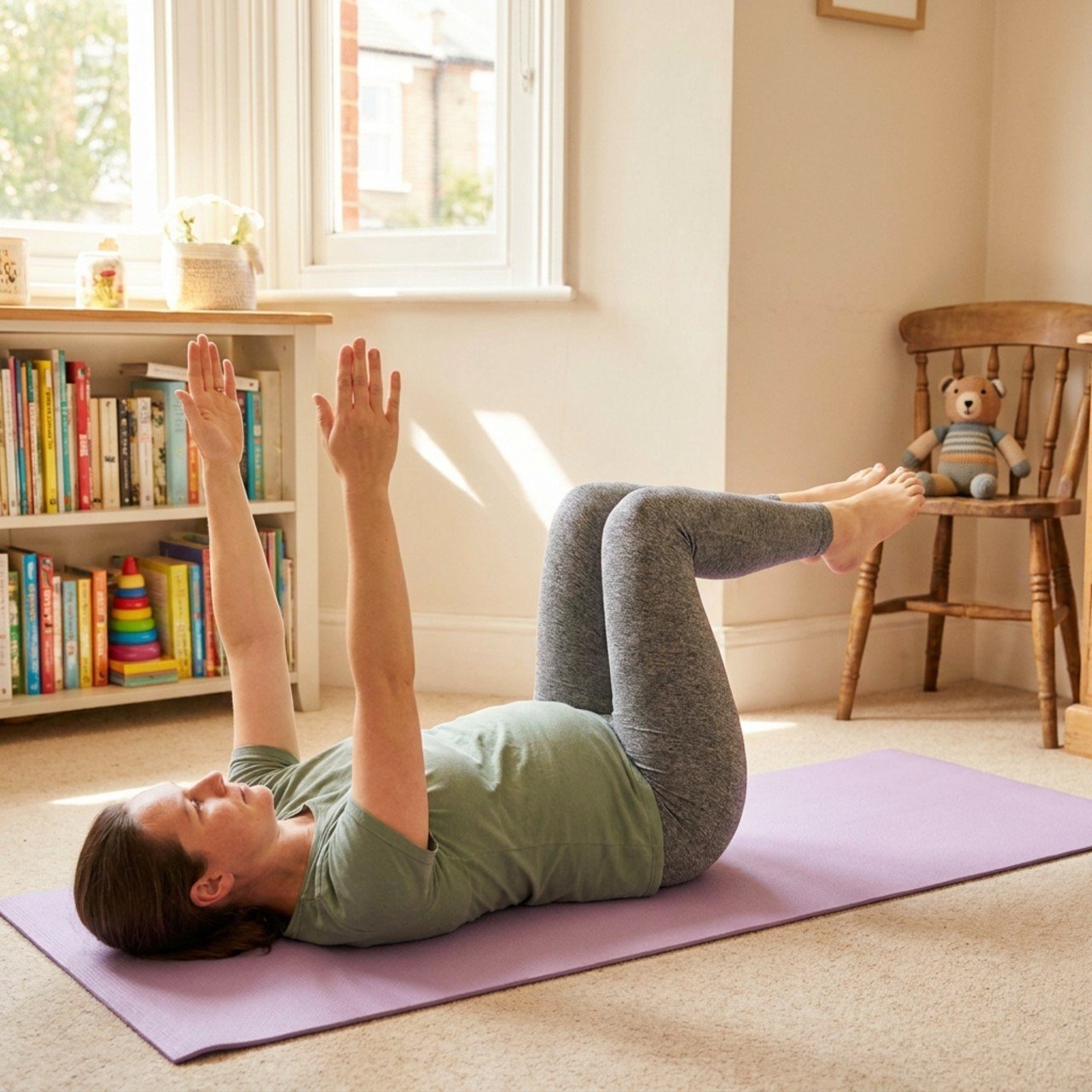
Lie on your back, arms reaching toward the ceiling, knees bent at 90 degrees above your hips. Slowly lower your right arm and left leg toward the floor while keeping your lower back pressed flat, then return and switch sides. This is a foundational move in physical therapy for a reason — it builds core control without any spinal flexion, which matters more than you’d think (more on that in Layer 3).
5. Bird Dog (Core Stability & Posture)
On all fours, extend your right arm and left leg simultaneously until they’re parallel to the floor, keeping your hips and shoulders square. Hold briefly, then switch. Like the dead bug, this move trains anti-rotation core strength — the ability to keep your spine stable while your limbs move — which carries directly into everyday posture and lifting mechanics.
6. Russian Twist (Obliques & Waist Slimming)
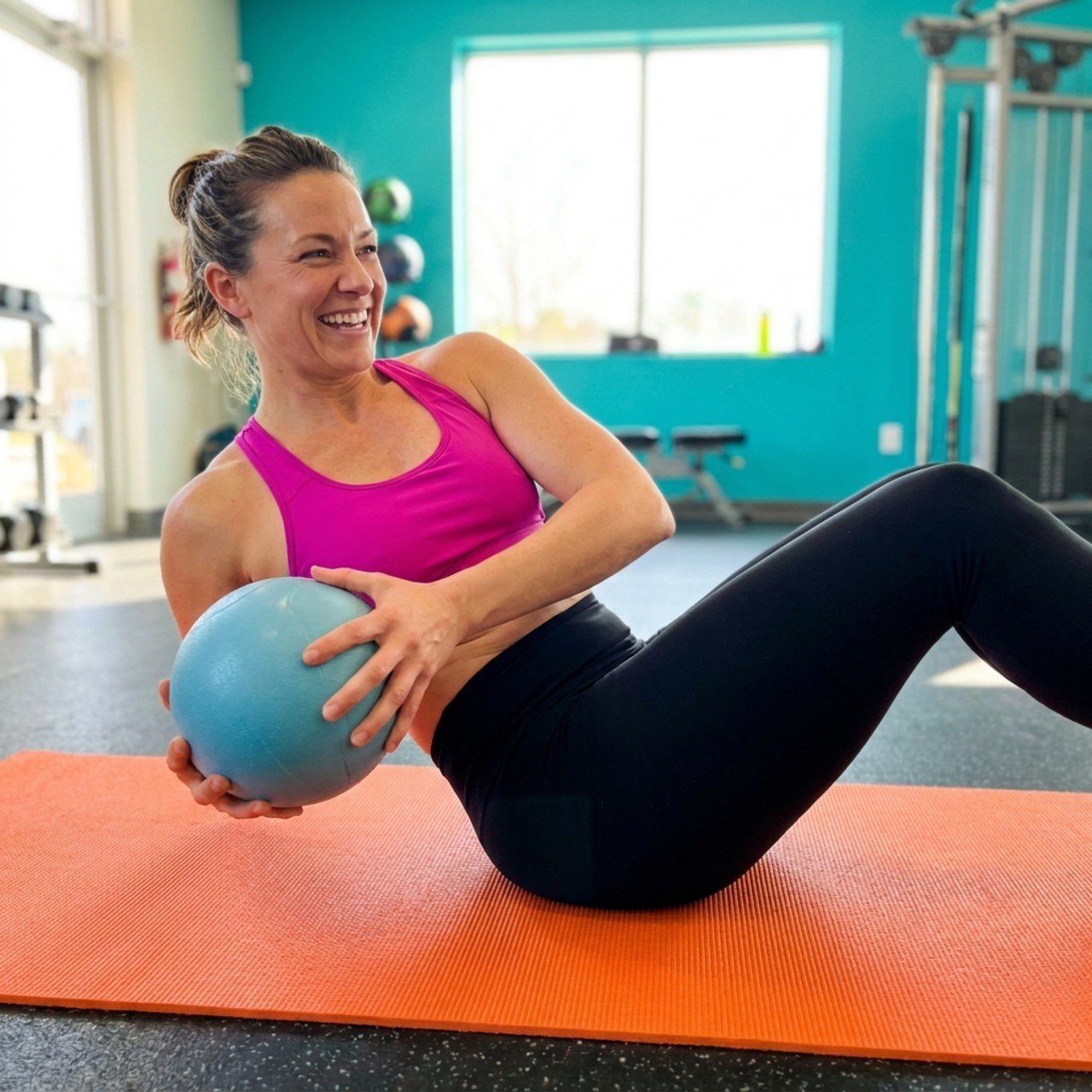
Sit with knees bent, lean back slightly to engage your core, and rotate your torso side to side, tapping the floor beside your hips (add a light weight or medicine ball once bodyweight feels easy). This is the move most associated with a slimmer-looking waist, since it directly targets the obliques that wrap around your sides.
7. Leg Raises (Lower Abs)
Lie flat, legs extended, hands under your lower back for support if needed. Lift both legs to vertical using your lower abs, not momentum, then lower slowly without letting your back arch off the floor.
If a full leg raise is too advanced, bend your knees slightly or raise one leg at a time — a smaller range of motion done correctly beats a full range done with your lower back doing the work.
If you belong to a gym, several of these translate directly to equipment: a cable crunch adds resistance to the bicycle-crunch pattern, and a weighted plank (a light plate across your upper back) intensifies the forearm plank once bodyweight stops being a challenge.
And if you’ve ever taken a Pilates class, you’ll recognize the emphasis on breath here too — exhaling fully as you contract, rather than holding your breath, is what lets you engage your deep core instead of just your hip flexors.
| Exercise | Primary Area | Diastasis-Recti-Safe? | Equipment |
|---|---|---|---|
| Bicycle Crunch | Upper Abs & Obliques | No – avoid during recovery | None |
| Reverse Crunch | Lower Abs | No – avoid during recovery | None |
| Forearm Plank | Total Core Stability | Yes, modified (on knees) | None |
| Dead Bug | Core Control | Yes | None |
| Bird Dog | Core Stability & Posture | Yes | None |
| Russian Twist | Obliques | No – avoid during recovery | Optional weight |
| Leg Raises | Lower Abs | Caution – check with a PT | None |

Layer 2 – Reveal: Why Your Diet Decides Whether Anyone Sees Your Abs
Your abdominal muscles can be strong and well-defined and still be invisible if there’s a layer of fat covering them — and the only thing that changes that layer is a sustained caloric deficit.
According to the American Council on Exercise, an average, non-athletic body fat percentage sits around 25–31% for women and 18–24% for men — and ACE flags anything below roughly 14% for women or 6% for men as dangerously low. Visible ab definition for most women tends to show up well below that average range, in ACE’s leaner “athlete” and “fitness” categories — though exactly where varies by genetics, how you personally carry fat, and how much underlying muscle you’ve built in Layer 1.
This is the part that trips women up most, and it’s where the frustration usually comes from: doing everything “right” on the exercise side while eating in a way that doesn’t support fat loss will never reveal the muscle you’re building.
A caloric deficit doesn’t mean starving yourself — it means consistently taking in somewhat fewer calories than you burn, built around a healthy diet with enough protein to protect the muscle you’re working so hard to build in Layer 1.
If your nutrition needs a starting point, our guide to eating healthy on a budget is a good place to begin, and these two effective weight-loss steps pair well with the routine in this guide.
The exercises in Layer 1 build and tone; total-body, calorie-torching movement is what accelerates the deficit that reveals them. For that whole-body half of the equation — think HIIT, mountain climbers, and full-body strength work — see our companion guide to the best exercises to melt belly fat.
Use that one for overall fat-burning volume and this one for the targeted strengthening and safety work underneath it.
Layer 3 – Protect: Core Training After 30, After Baby, Or With Diastasis Recti
If you’re over 30, postpartum, or have ever noticed a doming or bulge down the center of your stomach during a crunch, some of the exercises above need to wait — because moves that flex your spine forward can worsen abdominal separation before it’s healed.
That doming is often a sign of diastasis recti, a separation of the rectus abdominis muscles that’s extremely common during and after pregnancy, and, less commonly, in women who’ve never been pregnant at all.
According to GoodRx’s physical-therapist-reviewed guidance, exercises like sit-ups and crunches are specifically discouraged during diastasis recti recovery, in favor of moves that keep your trunk neutral instead of flexed: abdominal bracing, pelvic tilts, glute bridges, dead bugs, and bird dogs — two of which (dead bug and bird dog) are already part of Layer 1 above.
The guiding principle, in their words, is to “keep the trunk in a neutral (versus flexed) position, stabilize the core, and strengthen the pelvic floor muscles.”
And this isn’t only a pregnancy issue. If your core feels different in your 40s than it did a decade ago, that’s not in your head, either — the hormonal shifts of perimenopause and menopause affect the collagen and connective tissue that holds your midline together, on top of whatever pregnancy history you do or don’t have.
We hear from a lot of women in exactly this spot: not postpartum, just noticing their core doesn’t respond the way it used to, and tired of fitness advice that was clearly written for someone twenty years younger. The neutral-spine approach below works either way.
This is also where your pelvic floor comes in, and it’s a connection almost no “best abs” article mentions. Your deep core (the transverse abdominis) and your pelvic floor work as a team — when one is weak or overworked, the other compensates, which is part of why some women notice bladder leaks during high-impact ab work postpartum.
If any exercise causes leaking, doming, or pelvic pressure, that’s your body telling you to modify it or skip it, not push through it.
- Doming or a visible ridge down your midline during a crunch or sit-up motion.
- A bulging or coning sensation when you cough, sneeze, or strain.
- Leaking, pressure, or heaviness in your pelvic floor during or after core exercise.
- Lower-back pain that shows up specifically during ab work, which often means your back is compensating for a core that isn’t engaging correctly.
Core training stays firmly on the table here — it just starts with Layer 1’s neutral-spine moves (dead bug, bird dog, modified plank), giving yourself the six-to-eight-week recovery window physical therapists typically recommend before progressing, and getting a physical therapist’s clearance if you’re not sure where you stand.
If you’re earlier in your fitness journey generally, our beginner-friendly flat stomach routine is a gentler place to start.
Common Mistakes That Keep Your Abs From Showing
Most women who feel like their ab training “isn’t working” are actually making one of these five fixable mistakes. In years of hearing from women trying this exact thing, these are the five that come up again and again — usually in combination, not alone.
- Training abs in isolation. Skipping full-body strength and cardio work means missing the overall calorie burn and muscle-building that actually supports your fitness goals.
- Holding your breath. This spikes intra-abdominal pressure and shifts work away from your deep core — exhale on the effort, every rep.
- Chasing volume over form. A hundred sloppy crunches build less than twenty controlled ones. Quality recruits the muscle; quantity just recruits momentum.
- Ignoring nutrition entirely. As Layer 2 covers, this is the single most common reason strong abs stay invisible.
- Pushing through warning signs like doming or pelvic pressure instead of modifying, especially postpartum.
Join Our Mailing List
Join thousands of women inside our community and receive our free guide, 10 Actions That Support Permanent Weight Loss — the exact behavioural shifts that make the difference between a two-week attempt and a lasting transformation.
No restriction plans. No guilt. Just what actually works — for real women with real lives.
How Long Until You See Results?
Most women notice their core feels stronger and more stable within two to three weeks of consistent training, but visible definition depends far more on Layer 2’s caloric deficit and typically takes several months, not days.
That timeline is frustrating to hear when you want results now — but it’s the honest one, and it’s a lot more encouraging than the 30-day-transformation promises that got most of us here in the first place. Two to three focused sessions a week, rotating through the exercises in Layer 1, is enough; daily ab work isn’t required and can actually get in the way of recovery.
Want more from this training style? Our correct-form exercise library covers the rest of your body the same way this guide covers your core, and our best butt exercises guide rounds out your lower-body routine.
If you’d rather follow a structured week-by-week plan than mix and match exercises yourself, our flat stomach workout plan builds these same principles into a full routine, and our complete guide to achieving a flat stomach covers the lifestyle side in more depth.
Ready For The Rest Of Your Plan?
A stronger core is one piece of a much bigger picture — and trying to figure out the nutrition side alone is where most women get stuck. Our free guide, 10 Actions That Support Permanent Weight Loss, walks you through exactly the caloric-deficit basics from Layer 2, in plain language, with no crash diets and no gimmicks.
Grab your free copy here and get the piece this article can’t give you on its own: a plan for what to eat while you build the core you’re working for.
The Bottom Line
The best exercises for flatter abs aren’t a secret move nobody’s told you about — they’re bicycle crunches, reverse crunches, planks, dead bugs, bird dogs, Russian twists, and leg raises, done with real form instead of momentum.
What actually separates women who see results from women who don’t isn’t the exercise list. It’s understanding that strengthening (Layer 1), revealing (Layer 2), and protecting (Layer 3) all have to happen together — and adjusting that third layer without guilt if you’re over 30, postpartum, or still healing.
You don’t need to feel intimidated by any of this, and you don’t need to start from scratch tomorrow morning. Pick two or three moves from Layer 1, check them against the safety table if diastasis recti applies to you, and build from there. Staying at a healthy weight overall matters here too — if you want the bigger-picture “why,” 3 reasons to maintain a healthy body weight is worth a read.
Glossary Of Key Terms
- Anti-Rotation Strength: The ability of the core to keep the spine stable and square while the limbs are moving or resisting external force.
- Bicycle Maneuver: A core exercise involving a pedaling motion that recruits both the rectus abdominis and the obliques; ranked as the most effective ab move by ACE.
- Caloric Deficit: A state where an individual consumes fewer calories than they burn, which is the primary driver for body fat reduction.
- Diastasis Recti: A separation of the rectus abdominis muscles, often occurring postpartum, that requires specific "neutral spine" exercises for recovery.
- Doming (or Coning): A visible bulge or ridge that appears along the midline of the abdomen during exercise, signaling excessive intra-abdominal pressure or muscle separation.
- EMG (Electromyography): A research method used to measure the level of muscle activation during specific exercises.
- Pelvic Floor: A group of muscles that works in tandem with the deep core; weakness here can lead to leaking or pressure during high-impact abdominal work.
- Rectus Abdominis: The front-facing "six-pack" muscles responsible for flexing the spine.
- Spot Reduction: The debunked belief that performing exercises for a specific body part will preferentially burn fat in that area.
- Transverse Abdominis: The deepest layer of abdominal muscle that acts as a stabilizing "corset" for the internal organs and spine.
FAQ
What Are The Best Exercises For Flatter Abs?
The best exercises for flatter abs combine real muscle activation with correct form: bicycle crunches, reverse crunches, forearm planks, bird dogs, dead bugs, Russian twists, and leg raises. Pair them with the caloric-deficit and safety guidance in Layers 2 and 3 above for the full picture.
Can I Train My Abs Every Day?
You can, but you don’t need to — two to three focused sessions a week build more definition than daily sessions done on autopilot. Your core, like any muscle group, benefits from recovery time between sessions.
At What Body Fat Percentage Do Abs Become Visible?
There’s no single universal number, but the American Council on Exercise puts the average non-athletic range at 25–31% for women and 18–24% for men, with visible definition typically appearing below that. Genetics, where you personally carry fat, and how much muscle you’ve built all shift that number in either direction.
Is Running Good For Abs?
Running helps indirectly, by supporting the caloric deficit in Layer 2 and improving core stability through posture demands — but it doesn’t build targeted ab strength the way dedicated core exercises do. The two work best together, not as substitutes for each other.
Is It Safe To Do Ab Exercises With Diastasis Recti?
Some exercises are safe, and some aren’t: spine-flexing moves like crunches and sit-ups are generally discouraged during recovery, while neutral-spine moves like dead bugs, bird dogs, pelvic tilts, and modified planks are typically considered safer. Watch for doming, coning, or pelvic pressure, and check with a physical therapist if you’re unsure where you stand.
Do I Need Equipment For These Exercises?
No, every exercise in this guide is a bodyweight, home ab workout that needs nothing but floor space. If you train at a gym and want more resistance once bodyweight feels easy, a cable crunch or a lightly weighted plank are natural next steps.
Why Don’t I See Results Even Though I’m Doing Everything Right?
The most common reason is nutritional: strong, well-trained ab muscles stay invisible under fat that hasn’t been addressed through Layer 2’s caloric deficit. The second most common reason is inconsistent form — momentum-driven reps build far less than slow, controlled ones.