
How To Tell A Stress-Driven Belly From A Hormone-Driven One, And What To Do First
Hans Selye
Endocrinologist & pioneer of stress research
Adopting the right attitude can convert a negative stress into a positive one.
Summary (TL;DR)
Cortisol belly vs hormonal belly isn’t a pick-one choice. Cortisol is a hormone, so the labels overlap, and belly shape alone can’t tell you which is driving yours. This guide gives you a four-signal sort (sleep and stress, onset, rhythm, tests), shows which cortisol claims hold up, and explains when to see a doctor. Then it hands you one lever to pull first.
Cortisol belly, hormonal belly, estrogen dominance, adrenal fatigue. That’s four labels for one stubborn waistline, and none comes with a next step. So it’s fair to ask: cortisol belly vs hormonal belly, which one is yours?
Maybe you haven’t changed how you eat. Your workouts look the same. Yet your middle is different, and every article you open blames something new. It’s exhausting, and a little intimidating, to sort through this alone. That confusion is real, and it isn’t your fault.
Below you’ll find what the research shows, a four-signal method for sorting your own pattern, and the signs that mean a doctor’s visit is the smarter move. No hype, no diagnosis, no willpower lectures. You’re not broken. You’re just unsorted.
Medical & Referral Disclaimer
This article is for education only. It isn’t medical advice, and it can’t diagnose the cause of your belly fat. Hormone, thyroid, and metabolic conditions require a qualified clinician. If you notice easy bruising, purple stretch marks, new muscle weakness, missed periods, or sudden weight change, please see your doctor. Don’t start or stop any medication or supplement based on this article alone.
Key Takeaways
- Cortisol is a hormone, so a “cortisol belly” is one kind of hormonal belly, not a separate diagnosis.
- Across 34,342 people in 146 studies, higher long-term cortisol (measured in hair) tracked with BMI and waist size, but the links were small (0.10 to 0.18 on a scale where 1.0 is a perfect match).
- “Adrenal fatigue” found no support in a review of 58 studies. True cortisol excess (Cushing’s syndrome) affects roughly 40 to 70 people per million.
- In a 380-woman study, visceral fat began rising at the menopause transition (about 6% a year in the White reference group), then slowed.
- In midlife studies, cortisol tracked estrogen, follicle-stimulating hormone (FSH), and testosterone more closely than reported stress, so both patterns can show up together.
- A tape measure can miss deep belly fat, and no test is named for “cortisol belly.” Book a visit if you see red flags.
- Pick one lever first: sleep, strength training, regular meals, or stress recovery.

Cortisol Belly vs Hormonal Belly: What’s The Real Difference?
A cortisol belly is a popular label for belly fat linked to long-term stress. A hormonal belly is the broader label for fat gain tied to shifts in estrogen, insulin, androgens, or thyroid hormones. Because cortisol is itself a hormone, the two overlap, and belly shape alone can’t tell you which one is driving yours.
“Cortisol belly” is a wellness label, not a medical diagnosis. It describes extra fat around the middle that people link to chronic stress. “Hormonal belly” is even looser. It covers hormonal weight gain around your waist alongside changes in female hormones such as estrogen, or in insulin and thyroid function.
See the problem? Cortisol is a hormone. So a cortisol belly is really one flavor of hormonal belly, wearing its own name tag. The split exists because the suspected causes point to different first steps, not because your body sorts fat into two tidy boxes.
| Question | Cortisol Belly | Hormonal Belly |
|---|---|---|
| What it means | A popular label for belly fat tied to long-term stress | A broad label for belly fat tied to shifts in sex hormones, insulin, or thyroid function |
| Formal diagnosis? | No | No (but conditions behind it, like polycystic ovary syndrome (PCOS) or hypothyroidism, are) |
| Main suspected driver | Chronic stress, short sleep, high cortisol exposure | Estrogen changes, insulin resistance, androgens, thyroid function |
| Strength of the evidence | Real but modest links in large studies | Well documented for menopause and PCOS; exact mechanisms still debated |
| Who can test it | A doctor, mainly to rule out Cushing’s syndrome | A doctor, using labs chosen for your symptoms |
Is A Cortisol Belly Real, Or Just A Wellness Buzzword?
Partly. Research links higher long-term cortisol with more belly fat, but the link is small on average and runs in both directions. True cortisol excess, called Cushing’s syndrome, is rare and looks different from everyday stress. “Adrenal fatigue,” on the other hand, has no scientific backing.
What The Research Actually Shows
Start with a classic study. In 2000, researchers put 59 healthy premenopausal women through repeated lab stress tests. The 30 women with a higher waist-to-hip ratio (more fat around the middle) made significantly more cortisol in the first session than the 29 with a lower ratio.
Among lean women, the higher-ratio group kept making more cortisol on days two and three, so their stress response didn’t settle.
That fits the theory. But it was a snapshot, so it can’t say whether stress reactivity built the belly or the belly changed the stress response. Bigger data tell a quieter story. A 2022 meta-analysis pooled 146 study groups covering 34,342 people and measured long-term cortisol in scalp hair instead of a single moment.
Hair cortisol was positively linked to BMI, waist size, and waist-to-hip ratio. But the pooled correlation with BMI was about 0.10, and the strongest link, between hair cortisone (a close chemical relative of cortisol) and waist size, was 0.18. On a scale where 1.0 is a perfect match, those are small numbers.
A 2025 review calls the stress and obesity link “complex and multifaceted”, and notes that it can run both ways. So is cortisol belly real? The pattern is. A single, hormone-only explanation isn’t.
For the full stress-and-fat mechanism, see our guide to cortisol and belly fat.

What About Adrenal Fatigue?
You may have seen “adrenal fatigue” used to explain feeling wired, tired, and puffy. Researchers went looking for it. A 2016 systematic review screened 3,470 articles, kept 58 that met its criteria, and found no substantiation that adrenal fatigue is an actual medical condition.
The authors also note that no endocrinology society recognizes it. Your tiredness is real. The label just doesn’t hold up.
When High Cortisol Is Medical: Cushing’s Syndrome
Sustained cortisol excess does have a name. The National Institute of Diabetes and Digestive and Kidney Diseases puts Cushing’s syndrome at roughly 40 to 70 people per million, most often adults aged 30 to 50, and about three times more women than men. High cortisol symptoms of this kind look different from a stressful year:
- Thin arms and legs alongside weight gain in the middle.
- A rounder face and extra fat at the base of the neck or between the shoulders.
- Wide purple stretch marks, mainly on the abdomen, breasts, and hips
- Easy bruising.
- Weak muscles or irregular periods.
If several of these sound familiar, that’s a reason to book an appointment, not to buy a supplement.
| Claim | What The Evidence Shows | Verdict |
|---|---|---|
| “Chronic stress raises cortisol, which raises belly fat.” | Positive but small links in large datasets; the direction runs both ways | Partly holds up |
| “Women with more belly fat react more strongly to stress.” | One 59-woman lab study found it; a snapshot only | Suggestive |
| “Adrenal fatigue explains my exhaustion and weight.” | A 58-study review found no substantiation | Doesn’t hold up |
Cortisol Belly vs Hormonal Belly: The S.O.R.T. Method To Sort Yours
You can’t read your cause off your waistline, but you can gather clues. The S.O.R.T. method turns vague suspicion into four observations you can use to pick a first lever or bring to a doctor.
S: Sleep And Stress Load. Look at the last three months. Short, broken sleep, constant pressure, and no real downtime point toward stress. Ask yourself: has my sleep quality been poor most nights, and do I ever fully switch off?
O: Onset. When did your middle section change? A sudden shift after a hard year, a job change, or a loss points toward stress. A gradual shift across your 40s, or one that started as your periods changed, points toward the menopause transition.
R: Rhythm. Track your cycle, hot flashes, night sweats, and cravings. Cycle changes, hot flashes, and night sweats lean toward a hormone-driven pattern. Cravings that spike on your worst days lean toward stress. Irregular periods with acne or extra facial or body hair are worth raising with a doctor, because those are features of PCOS.
T: Tests And Thresholds. Measure your waist at navel level, relaxed, and write the number down. The National Heart, Lung, and Blood Institute says a waist measuring more than 35 inches in women may signal abdominal obesity, one condition of metabolic syndrome, though providers may use different cutoffs. Then ask your doctor which labs make sense, such as blood sugar or thyroid function.
| Signal | Leans Stress-Driven | Leans Hormone-Driven | See A Doctor If |
|---|---|---|---|
| Sleep And Stress | Short, broken sleep; high pressure; little recovery | Sleep and stress are manageable, yet your waist changed | Exhaustion is severe or new |
| Onset | Sudden, after a stressful stretch | Gradual across your 40s or alongside cycle changes | Change is rapid, with bruising or muscle weakness |
| Rhythm | Appetite and cravings spike on stressful days | Hot flashes, night sweats, cycle changes | Periods stop or turn very irregular, with acne or extra hair |
| Tests | No single number confirms it | Blood sugar or thyroid checks may point to insulin or thyroid issues | Waist over 35 inches, or purple stretch marks |
One honest note: S.O.R.T. is our own organizing tool, not a validated diagnostic instrument. Its job is to make your next conversation sharper. Look for the one or two signals that shout loudest. That’s your first lever.
Your One-Week Self-Sort
- Measure your waist at navel level and note the number.
- Write down the month your middle started to change, and what else happened that month.
- Rate your sleep and your stress from 1 to 5 each day for seven days.
- Note cycle changes, hot flashes, and night sweats as they happen. Also note whether your middle shifts across the month, since abdominal bloating and fat aren’t the same thing.
- Write two questions to bring to your doctor.
The Hormonal Side: Estrogen, Insulin, PCOS, And Thyroid
“Hormonal belly” covers several situations, so here’s what each one does and doesn’t explain. For the wider picture, our guide on hormones and weight loss maps how the key players interact.
Perimenopause And Menopause Fat Gain
This is the best-documented driver. In a study that followed 156 women for four years, only the women who became postmenopausal gained visceral fat significantly. Every woman gained fat under the skin, but visceral belly fat, the deep kind around your organs, rose only in the group whose estradiol fell. Energy use during sleep also dropped more in that group (7.9% versus 5.3%).
A larger follow-up tracked 380 women for a median of 11.8 years. Visceral fat began rising at the menopause transition, at about 6.24% a year, before slowing to about 1.47% a year afterward.
Those figures are for the study’s White reference group, and some trajectories differed in Black and Japanese women. The same paper found that waist and hip circumference were less sensitive than scan-based measures to these shifts, which is why a tape measure can miss what’s happening deeper.
What don’t we know? Why. A 2025 review says the precise mechanisms remain unclear, and researchers still debate how much comes from hormonal shifts versus regular aging, energy balance, and lifestyle. You’ll find the food-side detail in our guides to perimenopause belly fat foods and weight loss in perimenopause.

Insulin Resistance And PCOS Belly Fat
Insulin is your blood-sugar hormone. When your cells respond to it poorly, that’s insulin resistance. The World Health Organization says PCOS affects an estimated 10 to 13% of reproductive-age women, and lists weight gain, especially around the belly, among its symptoms, alongside a higher risk of insulin resistance.
WHO also estimates that up to 70% of women with PCOS worldwide don’t know they have it. So if your periods have always been irregular and you also have acne or extra facial hair, it’s worth a conversation.
Thyroid Imbalance And Weight
An underactive thyroid can raise your weight, but less than the internet suggests. The American Thyroid Association says about 5 to 10 pounds may be related to the thyroid for most patients, and that most of it is retained salt and water. It adds that if treatment improves your other symptoms but not your weight, the thyroid probably wasn’t the whole story.
A Word On “Estrogen Dominance”
Cleveland Clinic notes that some healthcare providers use it for high estrogen. But a British Menopause Society-registered GP writes that it isn’t a recognized medical diagnosis, and that perimenopausal symptoms come from estrogen fluctuating and eventually declining, not from excess. Treat the label as a conversation starter, not a conclusion. Hormonal balance isn’t one number you can check off.
Can You Have A Cortisol Belly And A Hormonal Belly At The Same Time?
Yes, and the two can overlap in midlife. In studies of women moving through the menopause transition, cortisol rose during the late stage and tracked estrogen metabolites, FSH, and testosterone more closely than reported stress. So a stress-driven pattern and a hormone-driven pattern can arrive together, though these studies measured cortisol, not belly fat.
This is where the either/or framing breaks down. It asks you to pick a team, but your biology doesn’t run on a single cause.

Here’s the evidence in brief. In a study of 169 women moving through the menopause transition, cortisol was higher after the late stage began than before it. The women whose cortisol rose didn’t differ from the others in reported stress, sleep, or mood, or in FSH and estrogen levels, so the picture isn’t tidy.
A follow-up of 132 women and up to 5,218 observations found that an estrogen metabolite, FSH, and testosterone were the best predictors of overnight cortisol. Stress hormones (epinephrine and norepinephrine) tracked it too, so stress still counts. It just isn’t the whole story.
Both are observational studies of urinary cortisol, not belly fat, so read them as clues about overlap, not proof of cause. Even so, they fit a simple idea: in midlife, a stress-driven belly and a hormone-driven belly can share one body, one year, even one hormone signal.
That’s one reason chronic stress alone may not explain the whole picture. Our guide to cortisol and weight gain in menopause walks through the comprehensive research.
The Contrarian Take: It’s Rarely Either/Or
Most content asks “which belly is yours?” as if you must choose. The better question is “which lever moves first for me?” Belly shape can’t answer either. Even lower abdominal fat, the soft kind that sits low, doesn’t reveal its cause.
So skip the type quiz. Gather clues, act on the loudest one, and reassess in a few weeks. You’re not choosing a diagnosis. You’re choosing a starting point.
Do You Need A Cortisol Level Test To Find Out?
Usually not. Cortisol belly isn’t a formal diagnosis, so no test is named for it. Doctors check cortisol mainly to look for Cushing’s syndrome, using timed tests such as 24-hour urine, late-night saliva, or a dexamethasone suppression test. If you have red flags, book a visit. If you don’t, a sorted log tells you more than one reading.
Cortisol rises and falls across the day, which is why the tests doctors use are timed. NIDDK lists three main ones: a 24-hour urinary free-cortisol test, a late-night salivary cortisol test, and a low-dose dexamethasone suppression test.
We couldn’t find a medical guideline that names a test for “cortisol belly.” The label describes a pattern, not a condition, so the missing test isn’t a gap in your health care. A one-week self-sort, taken to a doctor, is a stronger starting point than a single reading.

Book A Visit If You Notice
- Purple stretch marks, easy bruising, or new muscle weakness
- Thin arms and legs with a rapidly widening middle
- Periods that stop or become very irregular, especially with acne or extra facial hair
- A waist measuring more than 35 inches (a common metabolic checkpoint; cutoffs vary)
- Sudden or unexplained weight change
None of these means something is wrong. They mean a clinician should look, and that’s endocrine health done properly.
What Helps Whichever Belly You Have: The One-Lever-First Plan
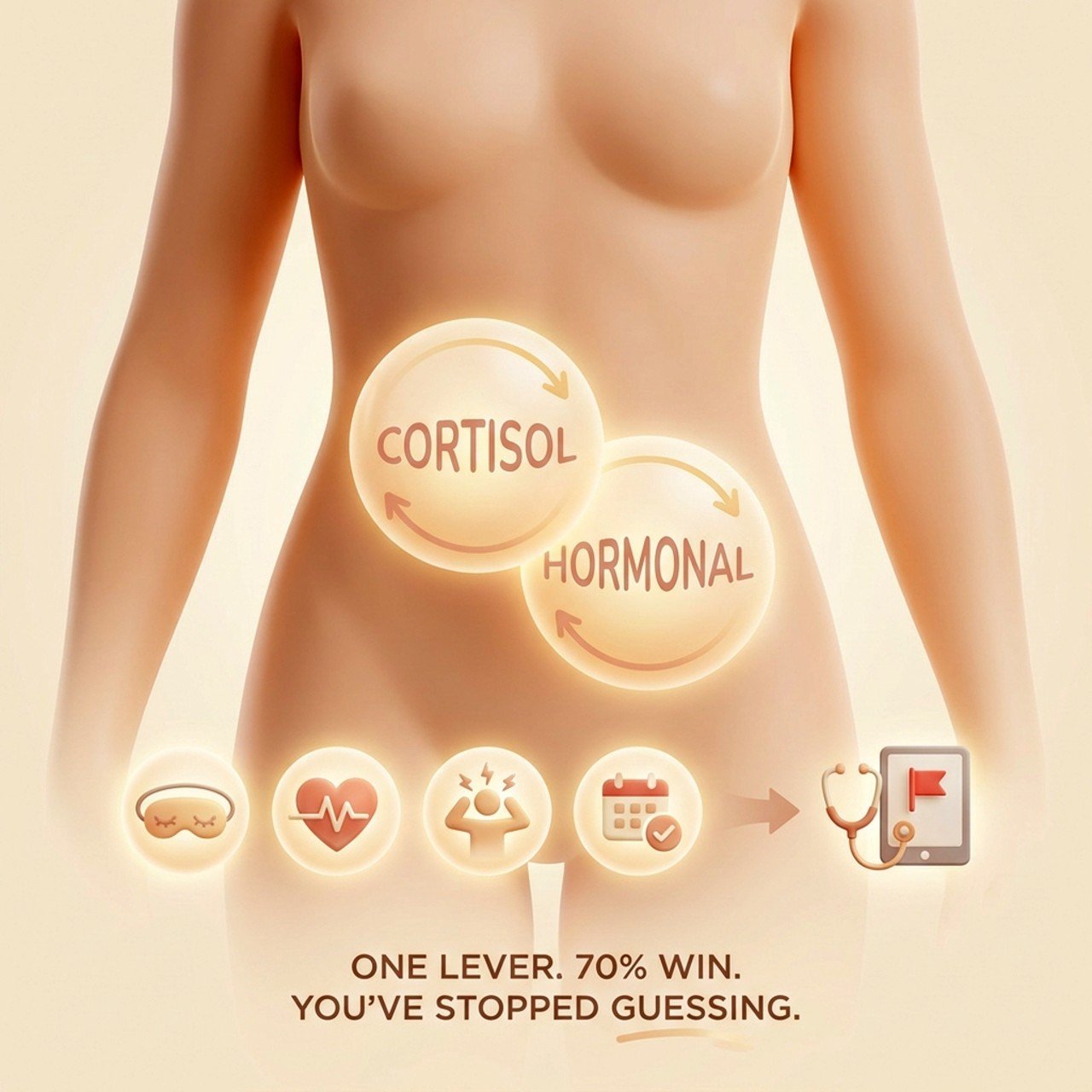
Here’s the good news about not being able to tell the two apart: the most useful moves overlap. Start with one lever and give it three weeks. Then add a second. As a coaching rule of thumb, not a study result, a plan you follow about 70% of the time beats a perfect plan you drop by Thursday.
Lever 1: Protect Your Sleep
In a controlled, 21-day inpatient study, 12 healthy adults (9 of them men) had either a 4-hour or a 9-hour nightly sleep opportunity for 14 days. During the short sleep, they ate more, gained more weight, and added more abdominal fat, including visceral fat.
The group was small, young, and mostly male, so treat it as a signal, not proof, for women in midlife. Start with our guide on sleep and weight loss.
Lever 2: Lift Something Heavy
In a 1,246-woman study, fat mass rose faster during the menopause transition (1.7% a year, versus 1.0% before) while lean mass slipped (about 0.2% a year). A 2025 review of menopause and body composition also considers regular exercise as a possible way to offset these changes.



Since lean mass slips in this window, protecting muscle looks like a smart priority in fitness for women over 40. Our guide to strength training in perimenopause shows how to start.
Lever 3: Eat Regular, Protein-Anchored Meals
This is the food lever both patterns share. No study cited here proves it for belly fat, so treat it as a practical starting point. Regular meals built around protein and fiber are a sensible way to smooth out blood sugar spikes. Our guide to cortisol-calming nutrition covers the details, with sources.
Lever 4: Build One Recovery Habit
The 2025 stress and obesity review calls for approaches tailored to the individual, including lifestyle changes, behavioral interventions, and psychosocial support. In short, stress management works best when it fits your real life. Pick one daily slot you protect: a 10-minute walk after lunch, a phone-free wind-down, or a weekly call with a friend who makes you laugh.
Match the lever to your loudest signal. Broken sleep? Start with Lever 1. Changes tied to your cycle? Start with Lever 2, then add Lever 3. Stress running hot? Start with Lever 4.
Ready to turn your signals into a plan? Grab the free guide, 10 Actions That Support Permanent Weight Loss and get ten actions to build on once your first lever is in place. Join the mailing list for evidence-checked tips built around how women’s bodies actually work. No restriction plans. No guilt.
The Bottom Line
Cortisol belly vs hormonal belly isn’t a fight you have to win. Cortisol is a hormone; the labels overlap, and the research shows a real but modest stress link alongside a well-documented menopause shift.
Your belly can’t tell you which is in charge, but four signals can point you to your first lever. If red flags appear, a doctor’s visit beats any guess online. Pick one lever this week, and count 70% as a win. You’ve already done the hardest part: you stopped guessing.
Glossary Of Key Terms
- Adrenal Fatigue: A popular wellness term used to describe exhaustion and weight gain; it is not recognized as a medical diagnosis by endocrinology societies and lacks scientific substantiation.
- Cortisol: A hormone linked to the body's stress response; while popular media links it to belly fat, scientific research shows only a modest correlation between long-term cortisol levels and waist size.
- Cushing’s Syndrome: A rare medical condition (affecting 40–70 people per million) caused by severe cortisol excess, characterized by specific physical markers like purple stretch marks and thin extremities.
- Estrogen Dominance: A non-medical term often used to describe high estrogen levels; clinical experts suggest perimenopausal symptoms result from fluctuating and declining estrogen rather than a simple excess.
- Insulin Resistance: A condition where cells respond poorly to insulin, leading to elevated blood sugar; it is frequently associated with weight gain around the middle and is a common feature of PCOS.
- PCOS (Polycystic Ovary Syndrome): A hormonal disorder affecting 10–13% of reproductive-age women, often characterized by irregular periods, acne, excess facial hair, and abdominal weight gain.
- S.O.R.T. Method: A self-assessment framework standing for Sleep and stress, Onset, Rhythm, and Tests/thresholds, used to identify patterns in abdominal weight gain.
- Visceral Fat: Deep fat stored around the internal organs; research indicates this specific type of fat increases significantly during the menopause transition as estradiol levels fall.
- Waist-to-Hip Ratio: A measurement used in research to assess fat distribution; higher ratios indicate more fat stored around the middle and have been linked to higher cortisol reactivity in some studies.
- Wellness Label: Non-clinical terms (like "cortisol belly") used to describe patterns of symptoms; they are useful for organizing thoughts but are not formal medical diagnoses.
FAQ
Is A Cortisol Belly A Real Medical Condition?
Not as a formal diagnosis. “Cortisol belly” is a wellness label for extra fat around the middle that people link to long-term stress. Large studies do find that higher hair cortisol goes with larger waists, but the link is small. True cortisol excess has a name, Cushing’s syndrome, and it affects roughly 40 to 70 people per million.
How Can I Tell If My Belly Fat Is From Cortisol Or Hormones?
You can’t tell from shape alone. In the 380-woman study, waist and hip measurements were less sensitive than scans to changes in fat distribution. What you can do is gather clues with the S.O.R.T. method: sleep and stress load, onset, rhythm, and tests. Then bring those notes to your doctor, who can choose the right labs.
Is Menopause Belly The Same As Cortisol Belly?
They overlap, but they aren’t the same. In one study, visceral fat began rising at the menopause transition. In other studies, cortisol rose during the late transition and tracked estrogen, FSH, and testosterone more closely than reported stress. So both patterns can show up in the same woman. The useful question is which lever to pull first, not which label wins.
Can PCOS Or A Thyroid Problem Cause Belly Fat?
Both can play a role. WHO lists weight gain, especially around the belly, among PCOS symptoms, along with irregular periods, acne, and extra hair growth. An underactive thyroid typically explains about 5 to 10 pounds, mostly salt and water. If your change is larger, or comes with other new symptoms, ask a clinician to look at the full picture.
Does Adrenal Fatigue Cause A Cortisol Belly?
There’s no good evidence that it does. A systematic review of 58 studies found no substantiation that adrenal fatigue is an actual medical condition. That doesn’t mean your exhaustion isn’t real. It means the cause deserves a proper investigation with a doctor, not a label.
Should I Buy An At-Home Cortisol Test?
We couldn’t find a medical guideline that uses at-home kits to explain belly fat. Doctors test cortisol mainly to check for Cushing’s, using timed tests such as 24-hour urine or late-night saliva. If you have red flags, book a visit instead of buying a kit. If you don’t, a one-week self-sort is more informative.
What Should I Change First If I Can’t Tell Which One I Have?
Start with the lever that matches your loudest signal. Broken sleep points to sleep first, since a controlled trial linked short sleep to more abdominal fat. Cycle-linked changes point to strength training first, then regular meals. High stress points to one daily recovery habit. Choose one, follow it about 70% of the time, and reassess in three weeks.