
Get Back Into Fitness The Smart Way: A 3-Phase Reconditioning Plan For Women Over 40
JACKIE JOYNER-KERSEE
Olympic track & field champion
Age is no barrier. It's a limitation you put on your mind.
Summary (TL;DR)
After years of inactivity, your body needs reconditioning before it can handle hard training. Start with gentle movement that wakes up underused muscles, build a walking base, then add progressive strength work. Begin easier than feels useful, and step up only when it feels too easy. Step-count benefits start to level off around 7,000 a day, and two short strength sessions a week protect your muscle.
You’ve told yourself you’ll start on Monday more times than you can count. Then Monday arrives, you feel tired, your knees ache just thinking about it, and you picture yourself as the least fit person in any room. So you wait for a better week.
If you want to get back into fitness after years of being sedentary, that pattern isn’t a character flaw. It’s what happens when the only plans on offer are built for people who never stopped.
Here’s the good news. Your body still responds to training at 40, 50 and beyond. It just needs a different on-ramp. Years of sitting change your muscles, joints and stamina, and perimenopause can add aches and fatigue on top. Jumping straight into bootcamp classes or long runs ignores all of that, which is why so many restarts end in pain or burnout.
This guide gives you a realistic path from sedentary to active. You’ll learn how to tell normal soreness from warning signs, how much movement actually counts, and a 12-week, three-phase plan that reconditions your body before it asks anything big of it.
Medical & Referral Disclaimer
This article is for informational and educational purposes only. It is not a substitute for professional medical advice, diagnosis or treatment. If you have chest pain, dizziness, a heart, metabolic or kidney condition, a recent injury, or any symptoms that worry you, talk to your doctor or a qualified healthcare professional before starting a new exercise program.
Key Takeaways
- Recondition before you train: Inactive adults lose about 3% to 8% of muscle mass per decade, so the first weeks are about waking muscles up, not pushing hard.
- Most women can start without clearance: If you have no symptoms or known heart, metabolic or kidney disease, light-to-moderate exercise is a safe place to begin.
- Walking counts: Going from 2,000 to 7,000 steps a day is linked to a 47% lower risk of early death.
- Tiny bursts help: About 3.4 minutes a day of vigorous everyday activity was linked to 45% fewer major cardiovascular events in women who didn’t exercise.
- Too-hard workouts backfire: Training above your comfort threshold lowers enjoyment, which may make you less likely to stick with it.
- Habits take time: Health habits took a median of 59 to 66 days to form, with a range of 4 to 335 days.
- Low-intensity exercise boosts energy: Gentle exercise cut fatigue by 65% in a six-week trial of sedentary adults.

Why Is It So Hard To Get Back Into Fitness After Years Of Inactivity?
It’s hard because years of sitting physically decondition your body. Muscles shrink and fire less efficiently, joints stiffen, and your heart and lungs lose stamina. In midlife, falling estrogen adds joint aches and muscle loss. Your body is out of practice, and it needs a gradual restart.
Let’s get the shame out of the way first. “Letting yourself go” usually means years of caregiving, demanding work, poor sleep or health stuff that took priority. You’re also far from alone.
A 2025 CDC report found that 47% of U.S. women aged 18 to 44 met neither the aerobic nor the muscle-strengthening guideline, and 55% did no muscle-strengthening at all.
What Years Of Sitting Actually Change
Deconditioning is the medical word for what happens when your body adapts to doing very little. It shows up in a few predictable ways:
- Muscle loss: Inactive adults lose 3% to 8% of their muscle mass per decade, along with a drop in resting metabolic rate.
- Sleepy muscles: Glutes, core and upper-back muscles that rarely work start to fire late, so other areas pick up the slack and complain.
- Stiff joints: Hips and ankles lose range when they spend most of the day bent in a chair.
- Lower stamina: Your cardiorespiratory health (heart and lung fitness) slips, so stairs and brisk walks leave you breathless sooner, which makes exercise feel harder than it really is.
The Perimenopause Factor
Midlife adds a layer most fitness advice ignores. A 2024 review in Climacteric found that more than 70% of women experience musculoskeletal symptoms across the menopause transition, and about 25% are disabled by them.
The authors named it the musculoskeletal syndrome of menopause: joint pain, muscle loss, bone loss and worsening arthritis, all tied to falling estrogen.
So if your knees ache before you’ve done a single squat, that’s real, and it’s another reason to start gently. (If you want a broader plan once you’re moving again, see my full get-in-shape guide.)

Is It Safe To Get Back Into Fitness After Years Of Being Sedentary?
For most women, yes. The American College of Sports Medicine says inactive adults with no symptoms and no known heart, metabolic or kidney disease can start light-to-moderate exercise without medical clearance. If you have symptoms or a diagnosed condition, check with your doctor first.
The ACSM’s screening model rests on three questions: How active are you now? Do you have signs, symptoms or known cardiovascular, metabolic or renal disease? And how hard do you plan to exercise?
The ACSM changed its rules in 2015 because older screening sent too many healthy people to doctors unnecessarily, which could become a barrier to starting at all. It also notes that exercise is safe for most people and that the cardiovascular risk of exercise drops as you get fitter.
Fear of pain is the bigger barrier for most women, though. This table helps you read what your body is telling you, based on ACSM warning signs and National Institute on Aging safety guidance.
| Signal | What It Feels Like | What To Do |
|---|---|---|
| Green (normal) | Mild muscle soreness 1 to 3 days later, heavier breathing that settles quickly, stiffness that eases as you warm up | Keep going at the same level |
| Amber (back off) | Joint ache lasting more than 48 hours, soreness that limits daily tasks, wiped-out fatigue the next day | Drop back one level for a week |
| Red (stop) | Chest pain or pressure, dizziness or fainting, unusual shortness of breath, sudden sharp pain or joint swelling | Stop and seek medical help |
If achy joints are already part of your daily life, my guide to perimenopause joint pain and exercise covers the low-impact workouts that are kindest to sore knees and hips.
The 3-Phase Systemic Reconditioning Method
The 3-Phase Systemic Reconditioning Method rebuilds your body in order: Phase 1 wakes up underused muscles, Phase 2 builds an aerobic and movement base, and Phase 3 adds progressive strength training. Each phase lasts about four weeks.
My view after years of writing about women’s fitness is this: returning after years of a sedentary lifestyle needs an approach designed for systemic reconditioning. Prolonged inactivity causes real physiological changes, so your body can’t handle high-intensity training straight away.
Skip the reconditioning, and you borrow against joints and tendons that aren’t ready yet. That’s where the “I hurt myself in week two” stories come from.
One rule runs through all three phases. Move up only after two straight weeks where the current level felt like you could have done more, with no lingering joint pain. That one rule is your best injury prevention tool.
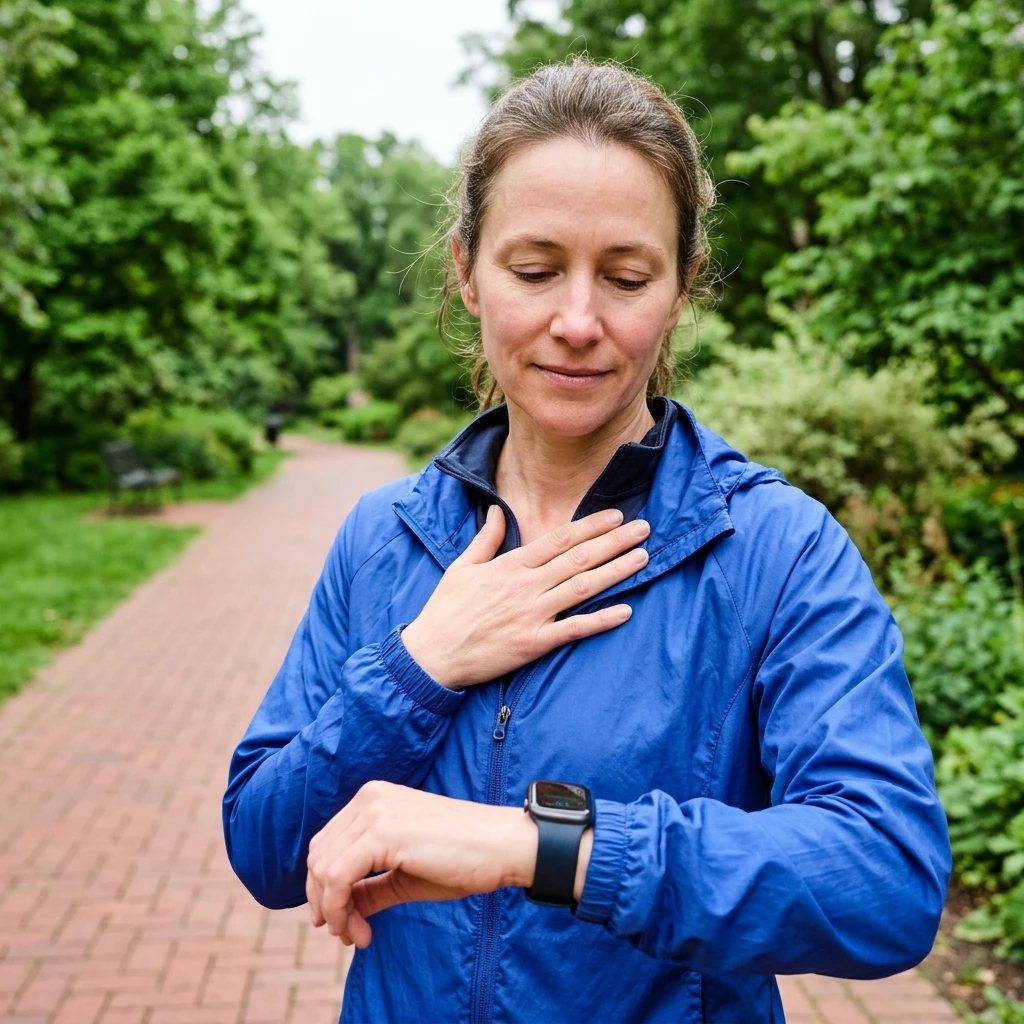
Phase 1: Neuromuscular Reawakening (Weeks 1 To 4)
The goal here is to re-teach your brain and muscles to work together. Think of it as muscle reactivation through a gentle exercise routine, more rehearsal than workout.
- Walk daily: Start with 10 minutes at a pace where you can chat, and add 2 to 3 minutes each week.
- Do mobility exercises for 5 to 10 minutes: Hip circles, cat-cow, ankle rolls and arm circles each morning.
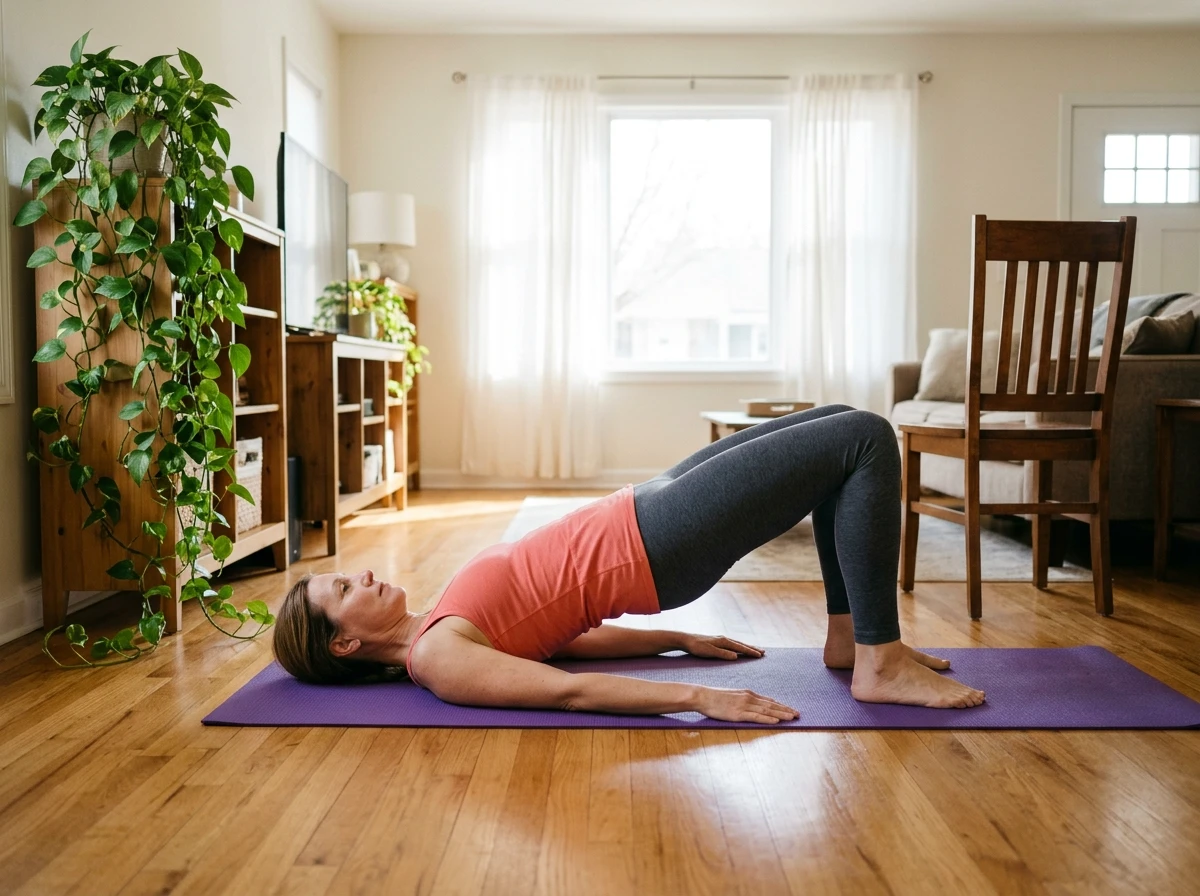
- Do wake-up moves 2 to 3 times a week: Chair sit-to-stands, wall push-ups, glute bridges, bird dogs, and calf raises, 1 to 2 sets of 8 to 10.
- Focus on posture: Stand tall, ribs stacked over hips, shoulders down and back.
Phase 2: Base Accumulation (Weeks 5 To 8)
Now you build volume, the base everything else sits on. You do a bit more, more often, still at a comfortable effort.
- Grow your walking routine: Aim for 20 to 30 minutes, 4 to 5 days a week, and raise your daily steps by about 500 to 1,000 every week or two.
- Strength twice a week: Same moves, now 2 sets, with slower lowering phases.
- Add short bursts: Take one or two flights of stairs or a short hill at a brisk pace during your day.
- Protect rest and recovery: Keep at least one full rest day and prioritize 7 or more hours of sleep.
Phase 3: Progressive Resistance (Weeks 9 To 12 And Beyond)
This is where beginner strength training starts to pay off. You add load, gradually, so muscles and bones have a reason to adapt. Ten weeks of resistance training can add about 1.4 kg of lean weight and raise resting metabolic rate by 7% in adults.
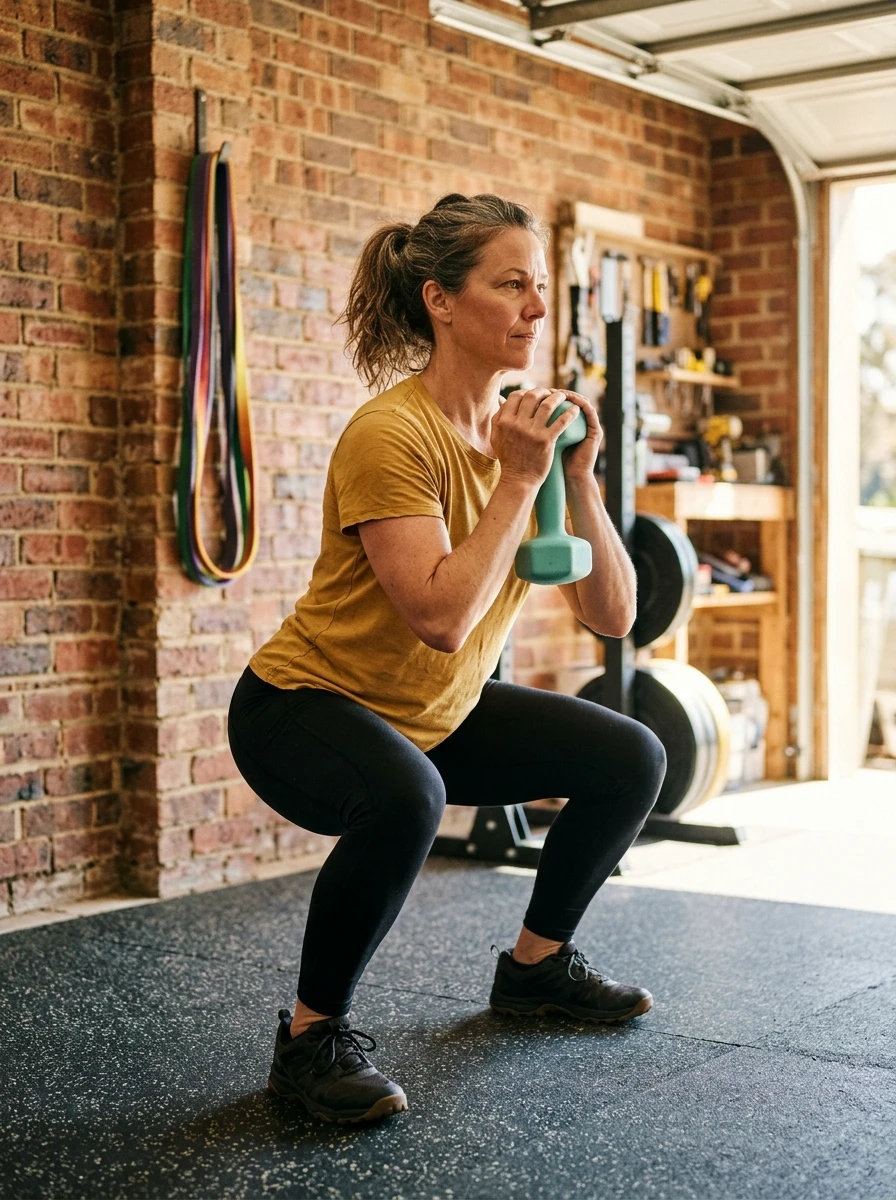
- Use light dumbbells or bands: Goblet squats, Romanian deadlifts, rows, overhead presses and step-ups.
- Work in the 8 to 12 rep range: 2 to 3 sets, stopping with 2 to 3 good reps left in the tank.
- Progress one thing at a time: Add a rep, a set or a little weight, never all three at once.
- Keep walking: Build toward 150 minutes a week of brisk walking.
For moves and form cues built for midlife, see my guide to strength training in perimenopause, or pick a ready-made plan from these beginner workout routines for women.
| Week | Phase | Walking | Strength | Effort (0 To 10) |
|---|---|---|---|---|
| 1 to 4 | Neuromuscular Reawakening | 10 to 20 min daily | Bodyweight, 1 to 2 sets, 2 to 3 times a week | 3 to 4 |
| 5 to 8 | Base Accumulation | 20 to 30 min, 4 to 5 days | Bodyweight, 2 sets, twice a week | 4 to 6 |
| 9 to 12+ | Progressive Resistance | Build to 150 min a week | Light weights or bands, 2 to 3 sets, 2 to 3 times a week | 5 to 7 |
How Long Does It Take To Get Back Into Shape?
Some women notice small wins, like easier stairs or a little more energy, within the first few weeks. Visible change in strength and shape usually takes two to three months of steady work. Progress isn’t linear, and a bad week doesn’t erase it. For a realistic week-by-week picture, read how long beginner results take.
How Much Exercise Do You Need To Get Back Into Fitness From Zero?
Less than you think to start. The official target is 150 minutes of moderate activity plus two strength days a week, but that’s the destination, not day one. Research shows big health gains from reaching about 7,000 daily steps and even a few minutes of brisk activity bursts.
The U.S. Physical Activity Guidelines recommend 150 to 300 minutes of moderate activity a week plus muscle-strengthening on two or more days. They also make a point beginners need to hear: some activity is better than none.
Walking is the easiest proof. A 2025 meta-analysis in The Lancet Public Health pooled 57 studies and found the benefits start to level off between 5,000 and 7,000 steps a day.
| Health Outcome | Risk Change At 7,000 vs. 2,000 Steps A Day |
|---|---|
| All-cause mortality | 47% lower |
| Dementia | 38% lower |
| Falls | 28% lower |
| Cardiovascular disease | 25% lower |
| Depressive symptoms | 22% lower |
| Type 2 diabetes | 14% lower |
Short, vigorous moments count too. In a 2024 University of Sydney study of more than 13,000 women who did no structured exercise, an average of 3.4 minutes a day of vigorous everyday activity was linked to a 45% lower risk of major cardiovascular events and a 67% lower risk of heart failure.
Think fast stair climbs or carrying heavy groceries. As little as 1.2 to 1.6 minutes a day was linked to 30% fewer events. It’s an observational study, so it shows a link rather than proof, but the message for beginners is encouraging: small bursts add up.
Why Starting Embarrassingly Easy Wins
Starting with workouts that feel almost too easy is one of the best-supported ways to make exercise feel manageable. Pushing past your comfort threshold makes exercise feel worse while you’re doing it, and feeling bad during exercise may make it harder to keep going.
This is the contrarian part, and it matters. Researcher Panteleimon Ekkekakis and colleagues had people exercise below, at and above their ventilatory threshold, the point where breathing suddenly gets harder.
In their 2008 study in Annals of Behavioral Medicine, going above that threshold caused consistent drops in pleasure among the 30 young adults tested. The authors warned this could hurt adherence. In plain terms, the “no pain, no gain” workout is the one you’re least likely to repeat.
Soreness isn’t the goal either. Feeling wrecked for three days means you overshot, not that it “worked.” Use the talk test to stay in the right zone:
| Effort (0 To 10) | Talk Test | Best Used For |
|---|---|---|
| 2 to 4 (easy) | You could sing or chat easily | Phase 1 walks, mobility, warm-ups |
| 5 to 6 (moderate) | You can talk in full sentences, but not sing | Late Phase 2 and most Phase 3 sessions |
| 7 to 8 (hard) | Only a few words at a time | Short bursts and final strength sets in Phase 3 |
| 9 to 10 (all-out) | You can’t talk | Not needed in the first 12 weeks |
How Do You Stay Consistent When You Have Zero Energy?
Don’t wait to feel motivated. Motivation tends to follow action, not come before it. Start with a tiny daily habit tied to something you already do, keep the intensity low, and let your energy build. Low-intensity exercise has been shown to reduce fatigue.
If you’re running on empty, a gentle workout sounds like one more drain. The research says otherwise. In a six-week randomized trial, sedentary adults with persistent fatigue raised their energy by about 20%. The University of Georgia team reported that the low-intensity group cut fatigue by 65%, more than the moderate group’s 49%.
The volunteers were young adults, but the lesson carries over: easy movement can give back more energy than it takes.
Patience matters when you’re building healthy habits. A 2024 systematic review in Healthcare found that healthy habits took a median of 59 to 66 days to form, ranging from 4 to 335 days. Habits practised in the morning tended to be stronger. So if week three feels like a grind, you’re right on schedule.

Daily Movement Hacks That Don’t Need A Workout
- Stack it: Do 5 sit-to-stands every time you boil the kettle.
- Walk your calls: Take phone calls on your feet or on a slow lap of the block.
- Use the stairs on purpose: Climb one flight briskly for a quick activity burst.
- Set a sitting alarm: Stand and stretch for a minute every 45 to 60 minutes.
- Lower the bar on bad days: On low-energy days, a 5-minute walk still counts. Keeping the habit alive beats a perfect session.
Getting started is one skill. Finishing sessions on hard days is another, and my guide on finishing workouts, not just starting them covers it.
How Do You Get Past Exercise Anxiety And The Fear Of Being Judged?
Start somewhere private, like your living room or a quiet walking route, until the basic moves feel familiar. Then step into shared spaces at off-peak times with a written plan. Confidence comes from competence, so practice first, and the gym becomes far less intimidating.
Feeling watched, not knowing how equipment works or fearing you’ll be the least fit person there are common reasons women put off exercise. Overcoming exercise anxiety takes a ladder, not a pep talk:
- Rung 1, home: Learn your Phase 1 moves where nobody is watching.
- Rung 2, outdoors: Walk in a park or neighborhood at a time that feels comfortable.
- Rung 3, a class or friend: Try a beginner-friendly or women-only class, or bring a friend.
- Rung 4, the gym: Go at quiet hours with your plan on your phone, and use one machine area until it feels routine.
Most people there are busy with their own workouts. For a step-by-step first visit, read starting at the gym without intimidation.
The Bottom Line
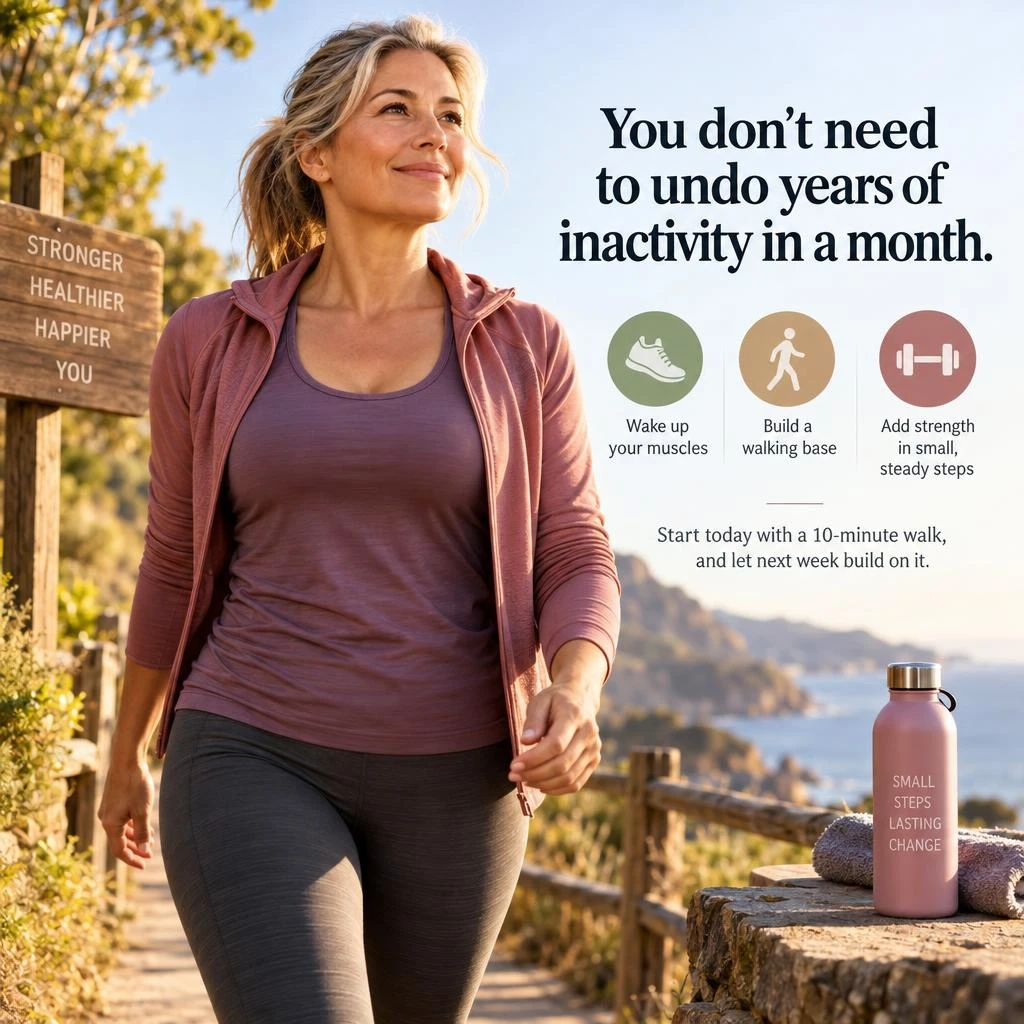
You don’t need to undo years of inactivity in a month. To get back into fitness, recondition first: wake up your muscles, build a walking base, then add strength in small, steady steps.
Keep the effort lower than your ego wants, read soreness as feedback rather than proof, and let consistency build sustainable fitness. So start today with a 10-minute walk, and let next week build on it.
Ready to make your restart stick? My free guide shares 10 research-backed habits that help women over 40 build strength, lose body fat and stay consistent, with no extreme plans and no guilt. Get My Free Restart Habits Guide.
Glossary Of Key Terms
- Deconditioning: The loss of strength, stamina and mobility that comes from long periods of inactivity.
- Neuromuscular Activation: How well your brain signals your muscles to switch on and work together.
- Sarcopenia: Age-related loss of muscle mass and strength.
- Musculoskeletal Syndrome Of Menopause: A cluster of symptoms, including joint pain and muscle and bone loss, linked to falling estrogen.
- Ventilatory Threshold: The effort level where your breathing suddenly speeds up and talking gets harder.
- RPE (Rating Of Perceived Exertion): A 0-to-10 scale for how hard exercise feels to you.
- VILPA (Vigorous Intermittent Lifestyle Physical Activity): Short bursts of vigorous effort during daily life, like fast stair climbing.
- DOMS (Delayed-Onset Muscle Soreness): Normal muscle soreness that peaks 1 to 3 days after new or harder exercise.
- Progressive Overload: Gradually increasing reps, sets or weight so your body keeps adapting.
FAQ
Is It Too Late To Get Back Into Fitness At 50 Or 60?
No. Muscles respond to training at any age, and research on resistance training shows gains in lean mass and metabolic rate in adults within about 10 weeks. You may need a longer reconditioning phase than a 30-year-old, but the direction of travel is the same.
Start with walking and bodyweight moves, then add light weights once those feel easy. Check with your doctor first if you have a heart, metabolic or kidney condition or any warning symptoms.
How Long Does It Take To Get Back Into Shape After Years Of Inactivity?
Some people notice more energy within a few weeks; in one trial of sedentary young adults, six weeks of gentle exercise cut fatigue by 65%. Visible strength and body-shape changes usually take 2 to 3 months of consistent training. Habits also take time: a 2024 review found a median of 59 to 66 days to form one. Treat the first 12 weeks as reconditioning, then keep building from there.
Do I Need To See A Doctor Before I Start Exercising?
Not always. Under ACSM screening guidance, inactive adults with no symptoms and no known heart, metabolic or kidney disease can usually begin light-to-moderate exercise without medical clearance. If you have chest pain, dizziness, unusual breathlessness or a diagnosed condition, get cleared first. When in doubt, a quick check-in with your doctor is worth it for peace of mind.
Is Walking Enough To Get Back Into Fitness?
Walking is an excellent start and brings big health benefits on its own. A 2025 Lancet Public Health meta-analysis linked 7,000 daily steps to a 47% lower risk of early death compared with 2,000 steps. Over time, add strength training at least twice a week to protect muscle and bone, especially after 40. Walking builds your base, and strength builds on it.
Why Do I Feel Sore And Achy In The First Week?
Mild soreness 1 to 3 days after new exercise is normal and called delayed-onset muscle soreness. It should ease as you move and fade within a few days. Joint pain that lasts more than 48 hours, swelling or sharp pain means you did too much, so drop back a level. Chest pain, dizziness or unusual breathlessness means stop and seek medical help.
Will I Lose Weight Just By Starting To Exercise?
Exercise supports weight loss, but the scale is a slow, noisy measure at first. The bigger early wins are energy, mood, strength and protecting muscle, which supports your metabolism. Pairing movement with a protein-rich nutrition strategy and good sleep works better for fat loss. Focus on how you feel and what you can do, not only the scale.
What Is The Best First Workout After Years Of Being Sedentary?
A 10-minute easy walk followed by a short set of chair sit-to-stands, wall push-ups and glute bridges is a strong first session. Keep the effort around 3 or 4 out of 10, where you could still chat. Repeat it 2 to 3 times in the first week. When it feels too easy for two weeks running, add a few minutes or a few reps.