
Why Insulin Resistance In Perimenopause Makes Blood Sugar Harder To Manage After 40, And The Habits That Help Most
Dr. Mary Claire Haver
Author of The New Menopause
Estrogen deprivation disrupts insulin signaling simultaneously in four major tissue types. The result is a systemic shift toward insulin resistance, increased blood glucose, and fat redistribution... Insulin resistance in menopause isn't a single point of failure. It's a systemic metabolic shift.
Summary (TL;DR)
Insulin resistance in perimenopause is common, and new research shows it climbs fastest in a four-year window around your final period. Falling estrogen, more visceral fat, less muscle and shorter sleep all push it up. It isn’t a willpower problem, and that fastest rise slows down after menopause. Eating protein and fiber first, walking after meals, lifting weights, protecting your sleep and asking for the right blood tests can all improve insulin sensitivity.
Same breakfast. Same workouts. Same jeans that fit last spring. If you suspect insulin resistance in perimenopause is behind what’s changing, you’re asking the right question.
Somewhere in your 40s, the waistband started digging in, and the 3 pm slump turned into a daily event. You eat lunch, and an hour later you’re foggy, tired and hunting for something sweet. Sound familiar?
For many women, it’s part of the story. Insulin resistance is a change in how your body handles blood sugar, and it often shows up quietly, years before any lab result looks “abnormal.” It also helps explain why weight loss feels harder right now, even when your habits haven’t changed.
Here’s the encouraging part. A long-running US study published in October 2026 found that insulin resistance speeds up during a specific window, then slows down again. That makes this stage a window to act in, not a life sentence. Let’s walk through what’s happening, how to check for it, and the habits with the strongest evidence behind them.
Medical & Referral Disclaimer
This article is for educational purposes only and isn’t medical advice. Insulin resistance, prediabetes, PCOS and menopause symptoms all need individual assessment. Please talk with your doctor or a registered dietitian before changing your medication, starting hormone replacement therapy, or making major changes to your nutrition or exercise routine, especially if you have diabetes or take blood-sugar-lowering drugs.
Key Takeaways
- A 2026 study of 1,315 women found insulin resistance rose about 4.3% per year in the four years around the final period, compared with roughly 1% per year before and after.
- That faster rise held up after accounting for weight changes, so it isn’t only about the number on the scale.
- Visceral (deep belly) fat grew by 5.8% to 8.2% per year starting about two years before menopause.
- Cutting sleep by 90 minutes a night for six weeks raised insulin resistance by more than 20% in postmenopausal women.
- Short, light walks after sitting lower blood sugar and insulin after meals better than standing breaks do.
- Eating vegetables and protein before carbohydrates lowered post-meal glucose by up to 37% in a small trial.
- Strength training improves insulin resistance markers independently, according to a 27-study meta-analysis.
- Hormone replacement therapy lowered the risk of new diabetes by 21% in a major trial, but it isn’t prescribed to prevent diabetes.

What Is Insulin Resistance In Perimenopause?
Insulin resistance in perimenopause is when your muscle, liver and fat cells respond less well to insulin during the years leading up to menopause. Your pancreas makes more insulin to keep blood sugar in range. Over time, that extra insulin can encourage belly fat storage, energy crashes and, eventually, higher fasting glucose.
Think of insulin as a key. After you eat, it unlocks your cells so glucose (sugar) can move out of your blood and into the places that use it. With insulin resistance, the locks get a little sticky. The key still works, but your body has to make more keys to get the same result.
In the early stages, this extra insulin keeps your blood sugar looking normal. That’s why so many women are told their labs are “fine.” The strain is real; it just hasn’t shown up in the standard tests yet.
This matters because the problem is widespread. The CDC reports that more than 2 in 5 American adults have prediabetes, and it often goes unnoticed until it becomes type 2 diabetes. Perimenopause is one of the stages when the risk quietly climbs.
Why Does Perimenopause Make Insulin Resistance More Likely?
Perimenopause makes insulin resistance more likely because several changes stack up at once: estrogen becomes erratic and then falls, fat shifts toward the abdomen, muscle mass starts to slip, and sleep gets disrupted. Each one makes your cells a little less responsive to insulin, and together they add up.
None of these changes means you did something wrong. This is women’s biology doing what it does in midlife. The good news is that most of these levers respond to what you do every day.
Estrogen Decline And Blood Sugar Balance
Estrogen helps your body use insulin well. As levels swing and then drop through perimenopause, that support fades. A 2025 presentation to diabetes educators described a rise in insulin resistance and a fall in insulin release across the transition.
Researchers still debate how much is menopause and how much is ageing, which is exactly why the new 2026 data matters (more on that below).

Visceral Fat And Midlife Weight Gain
Where fat sits matters more than how much you weigh. Visceral fat wraps around your organs and releases fatty acids and inflammatory signals that interfere with insulin.
In the SWAN Heart study (part of the long-running Study of Women’s Health Across the Nation), visceral fat increased by 5.8% to 8.2% per year, starting about two years before menopause. That’s the “my weight barely changed, but my waist did” experience so many women describe.
Muscle Loss And Your Glucose Sink
Muscle is your biggest blood sugar sponge. Under insulin-stimulated conditions, most glucose uptake happens in skeletal muscle. During the menopause transition, lean mass starts declining by about 0.2% per year while fat mass gains speed up to about 1.7% per year. Less muscle means fewer places for glucose to go.
Sleep, Night Sweats And Cortisol Levels
Poor sleep is one of the most underrated drivers. In a randomized trial, Columbia researchers had women cut their sleep by 90 minutes a night for six weeks. Insulin resistance rose by nearly 15% overall and by more than 20% in postmenopausal women.
Broken sleep and chronic stress also nudge cortisol up, and cortisol raises blood sugar. If stress is a big factor for you, our guide to cortisol belly vs hormonal belly can help you tell the patterns apart.
The 4-Year Window: When Insulin Resistance Speeds Up
For years, doctors couldn’t say whether midlife insulin resistance came from menopause or just from getting older. A study published on 6 October 2026 gives the clearest answer yet.
UCLA researchers followed 1,315 women in SWAN, measuring insulin resistance (as HOMA-IR, a score from fasting glucose and insulin) up to 12 times between 1996 and 2018.
The fastest rise happened over four years, from 1.5 years before to 2.5 years after the final menstrual period. It was slower in the years on either side, and the pattern held after adjusting for changes in body weight.
We call this the 4-Year Window. Your metabolism isn’t broken. It’s going through a period of faster change, and that period is when your daily habits carry the most weight.

| Marker | Before The Window | During The Window | After The Window |
|---|---|---|---|
| Insulin resistance (HOMA-IR), yearly rise | 1.2% | 4.3% | 0.9% |
| Fat mass, yearly change | About +1.0% | About +1.7% | Levels off |
| Lean (muscle) mass, yearly change | About +0.2% | About -0.2% | Levels off |
| Visceral fat, yearly change | No significant change | +5.8% to +8.2% | Not reported |
Sources: insulin resistance from Karlamangla et al., 2026; fat and lean mass from Greendale et al., 2019; visceral fat from SWAN Heart, 2021. Windows in the three studies differ slightly; figures are averages, not predictions for any one woman.
An earlier SWAN analysis found that insulin resistance rose in about 60% of women during the transition. So it’s common, but it isn’t universal. Your genes, activity, sleep and nutrition strategy all shape where you land.
A practical tip: you won’t know your exact final period until 12 months after it happens. If your cycles are getting irregular, assume you may already be in the window.
What Are The Signs Of Insulin Resistance In Perimenopause?
Common signs of insulin resistance in perimenopause include feeling wiped out after meals, strong carb or sugar cravings, brain fog, a growing waistline and skin tags. Many of these overlap with menopause symptoms, so a blood test is the only way to know for sure.
Harvard Health lists these warning signs, which often show up alongside extra belly fat:
- Post-meal crashes: sleepy or “flat” within an hour or two of eating.
- Increased hunger: feeling hungry again soon after a full meal.
- Brain fog: trouble concentrating, especially in the afternoon.
- Fatigue and mood swings: energy that rises and dips with your meals.
- Creeping lab numbers: blood pressure, cholesterol, or blood sugar rising, even within the normal range.
- Skin tags: small growths in the armpits or groin.
Many women describe the cravings as a personal failing. They aren’t. When insulin is running high, and glucose drops after a spike, your brain asks for quick fuel. That’s biology, not a lack of discipline.

Hot Flashes And Insulin: A Two-Way Street
Here’s a link most articles miss. In SWAN, women with frequent hot flashes had higher insulin resistance, even after accounting for body weight. And a 2026 analysis found that higher fasting insulin at age 47 predicted earlier and longer-lasting hot flashes. Researchers don’t yet know which comes first, but the two clearly travel together.
PCOS And Perimenopause
If you have polycystic ovary syndrome (PCOS), insulin resistance doesn’t simply retire with your cycle. A 2023 meta-analysis of women aged 45 and over found that those with PCOS had higher insulin resistance and about three times the odds of diabetes compared with women without PCOS.
The authors noted that extra body weight drove much of this risk and that the evidence quality was low. Still, if PCOS is part of your history, it’s worth getting checked earlier and more often.
How Do You Test For Insulin Resistance?
There’s no single routine test for insulin resistance. Doctors usually check fasting glucose and HbA1c, which catch prediabetes. Asking for fasting insulin lets your doctor calculate HOMA-IR, an earlier marker. A waist measurement and your triglyceride and HDL results add useful clues.
The American Diabetes Association recommends screening all adults 35 and older at least every three years. In the 4-Year Window, many women find it helpful to ask for a fuller picture.
| Test | What It Shows | Reference Points | How To Ask |
|---|---|---|---|
| Fasting glucose | Blood sugar after an overnight fast | Normal under 100 mg/dL (5.6 mmol/L); prediabetes 100–125; diabetes 126+ (ADA) | Usually part of routine bloods |
| HbA1c | Average blood sugar over 2–3 months | Normal under 5.7%; prediabetes 5.7–6.4%; diabetes 6.5%+ (ADA) | “Can we check my A1c, given my age and family history?” |
| Fasting insulin and HOMA-IR | How hard your pancreas works to keep glucose normal | No universal cut-off; labs and studies vary | “Could we add fasting insulin so we can calculate HOMA-IR?” |
| Triglycerides and HDL | Blood fats often affected by insulin resistance | High triglycerides with low HDL is a common pattern | Part of a standard lipid panel |
| Waist circumference | A rough proxy for visceral fat | Over 35 inches (88 cm) raises risk for women (NHLBI) | Measure at home, just above your hip bones |

Bring your results to your appointment and track them year to year. A trend tells you far more than a single number.
Your Window Plan: Order, Move, Lift, Sleep
You don’t need a perfect plan. You need a few high-impact habits you can repeat on a busy Tuesday. We built this plan around the four levers with the strongest evidence for managing blood sugar. Start with one. Add the next when it feels automatic. Doing 70% of this consistently beats doing 100% for two weeks.
The Window Plan in one line: eat your plate in the right order, move after you eat, lift heavy things at least twice a week, and treat sleep like an appointment.
Order: Change The Sequence, Not Just The Food
What you eat first shapes your blood sugar response. In a small Weill Cornell trial, people with type 2 diabetes ate the same meal in two orders.
When they ate vegetables and protein before the carbs, post-meal glucose was 29%, 37% and 17% lower at 30, 60 and 120 minutes. It was a group of just 11 people, so treat it as a promising, low-risk habit rather than proof.
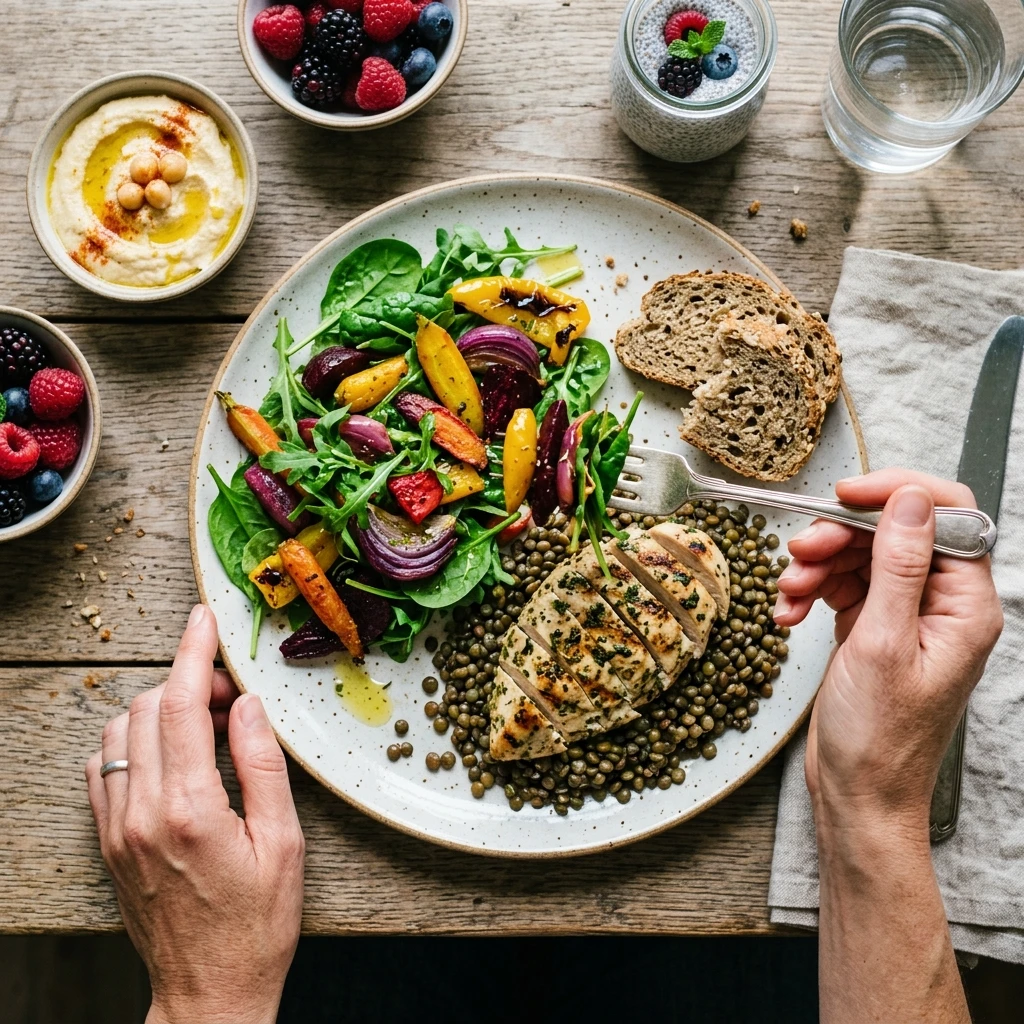
- Veg first: start lunch and dinner with salad, greens or roasted vegetables.
- Protein next: eggs, Greek yogurt, fish, chicken, tofu, lentils or beans.
- Carbs last: enjoy your bread, rice or fruit at the end of the meal.
- Pair, don’t go naked: add nuts or cheese to fruit rather than eating carbs alone.
Fiber-rich foods deserve a special mention. A Lancet series of meta-analyses found the biggest risk reductions, including for type 2 diabetes, when people ate 25 to 29 grams of fiber a day. Most of us fall short. Beans, oats, berries, chia, vegetables and whole grains close the gap.
Do You Need A Low Carb Diet?
Not necessarily. Lowering refined carbs (white bread, sweets, sugary drinks) helps most women. Cutting carbs to near zero is a bigger step that many find hard to keep up, and it isn’t required to improve blood sugar balance.
Think “lower and smarter,” not “none.” If you want a deeper look at which foods tend to drive midlife belly fat, read our guide to foods that drive belly fat.
How Much Protein Intake Do You Need?
Protein protects muscle, and muscle is your glucose sink. For adults over 65, an expert group recommends 1.0 to 1.2 grams per kilogram of body weight daily. No equivalent guideline exists for midlife women yet, so ask your dietitian what fits you.
Spreading it across meals is easier than cramming it into dinner. Our high-protein eating plan shows what that looks like on a real plate.
Move: Walk After You Eat
This is the easiest win on the list. A 2022 meta-analysis found that breaking up sitting with light walking significantly reduced post-meal glucose and insulin compared with sitting still. Walking beat standing breaks, too.
- The 10-minute rule: walk for 10 minutes within 30 minutes of your biggest meal.
- Desk breaks: stand up and walk for 2 to 3 minutes every 30 to 45 minutes.
- Stack it: take phone calls on your feet or walk to a farther bathroom.
Lift: Build Your Glucose Sink
Strength training directly targets the muscle loss that accelerates during this window. A meta-analysis of 27 studies found that resistance training significantly improved fasting insulin and HOMA-IR in adults with overweight or obesity, independent of other changes.
Harvard experts recommend at least 150 minutes of moderate exercise a week plus strength training two to three days a week. New to lifting, or worried about getting it wrong? Our guide to strength training in perimenopause walks you through a safe, progressive start.

Sleep: Protect Your Seven Hours
Remember that Columbia trial: just 90 fewer minutes a night pushed insulin resistance up within six weeks. Experts recommend a minimum of seven hours each night. When night sweats interrupt your sleep, that’s a reason to talk to your doctor, not something to push through.
- Keep it cool: a cooler bedroom and breathable bedding help with night sweats.
- Anchor your wake time: the same time daily, weekends included.
- Cut the late caffeine: stop by early afternoon.
For more practical fixes, see our guide on how sleep affects weight loss.
Where Hormone Replacement Therapy Fits
Hormone replacement therapy (HRT), also called menopausal hormone therapy, comes up in almost every conversation about midlife metabolism. The evidence is interesting, but it needs careful framing.
In the Women’s Health Initiative trial, women taking combined estrogen and progestin had a 21% lower risk of developing treated diabetes than those on placebo over the trial (a hazard ratio of 0.79).
In raw numbers, 3.5% of the HRT group and 4.2% of the placebo group were diagnosed. Insulin resistance also fell in the first year. In women who already have diabetes, a meta-analysis found HRT was linked to lower HbA1c and fasting glucose.
Here’s the honest caveat. Those trials weren’t designed to test diabetes prevention as a main goal, and HRT isn’t prescribed for that purpose. The Menopause Society’s 2022 position statement stresses that the benefits and risks depend on your age, time since menopause, health history and the type of hormone used.
Some women also ask about GLP-1 medicines or metformin; those are prescription decisions for you and your doctor. Use this checklist to make your next appointment count:
- Share your symptoms: cycle changes, hot flashes, sleep, cravings and energy dips.
- Bring your history: PCOS, gestational diabetes, or a parent or sibling with type 2 diabetes.
- Ask for the tests: fasting glucose, HbA1c, fasting insulin (for HOMA-IR) and a lipid panel.
- Ask the HRT question directly: “Am I a good candidate, and which type and route would you suggest for me?”
- Agree on a plan: when to retest, and which lifestyle steps to start with.

The Bottom Line
Insulin resistance in perimenopause is common, and it speeds up during a four-year window around your final period. That’s not a sign your body has failed. It’s a signal that this is the most valuable time to build a few steady habits.
Eat your plate in the right order. Walk after meals. Lift at least twice a week. Protect your sleep. Ask for the tests that show what’s really going on. You don’t need to do it all at once, and you don’t need to do it perfectly.
Ready to turn your window into a plan? Grab our free guide, 10 Actions That Support Permanent Weight Loss, and pick the first move you’ll make this week. Then put on your shoes and take a 10-minute walk after tonight’s dinner.
Glossary Of Key Terms
- Insulin: A hormone made by the pancreas that helps move glucose from your blood into your cells.
- Insulin Resistance: When cells respond less well to insulin, so the body needs more of it to keep blood sugar normal.
- Insulin Sensitivity: How well your cells respond to insulin. Higher sensitivity is better.
- HOMA-IR: A score calculated from fasting glucose and fasting insulin that estimates insulin resistance.
- HbA1c: A blood test showing your average blood sugar over the past two to three months.
- Fasting Glucose: Your blood sugar level after at least eight hours without food.
- Visceral Fat: Deep belly fat stored around your organs, closely linked to insulin resistance.
- Perimenopause: The years of hormonal change before menopause, often starting in your 40s.
- Final Menstrual Period (FMP): Your last period, confirmed after 12 months without one.
- Prediabetes: Blood sugar higher than normal but not yet in the diabetes range.
FAQ
Can You Reverse Insulin Resistance In Perimenopause?
Many women can improve insulin sensitivity significantly, especially when they act early. Strength training, regular walking, more fiber and protein, and better sleep all have research support. A meta-analysis found resistance training alone improved fasting insulin and HOMA-IR. The 2026 SWAN study also shows the steepest rise happens in a limited window, so your efforts during this stage matter. Work with your doctor to track your numbers over time.
Does Perimenopause Cause Low Blood Sugar Or Hypoglycemia?
Perimenopause itself isn’t an established cause of hypoglycemia. However, some women notice shaky, sweaty or anxious feelings a few hours after a carb-heavy meal. This can happen when a blood sugar spike is followed by a sharp drop. Hot flashes and anxiety can feel similar, which adds to the confusion. If these episodes are frequent, ask your doctor to check your blood sugar during or after an episode.
Is A Low Carb Diet Best For Insulin Resistance In Perimenopause?
Reducing refined carbohydrates helps most women manage blood sugar spikes. A strict low-carb diet isn’t required, and many women struggle to sustain it. Focusing on fiber-rich carbs, eating protein and vegetables first, and keeping portions steady works well for many. The best nutrition strategy is the one you can keep up for years. A registered dietitian can tailor it to your labs and lifestyle.
Does Intermittent Fasting Help With Insulin Resistance?
Some women find a regular overnight fast helpful. A Harvard-affiliated dietitian suggests 12 to 14 hours overnight without eating as a reasonable approach. Longer fasts aren’t necessary and may worsen sleep, stress or muscle loss if protein drops too low. If you take medication for blood sugar, talk with your doctor before fasting. Consistent meal timing matters more than extreme windows.
Can Insulin Resistance Cause Belly Fat During Perimenopause?
Insulin resistance and belly fat feed each other. High insulin levels encourage fat storage, and visceral fat releases substances that make insulin work less well. During the menopause transition, visceral fat increased by 5.8% to 8.2% per year in SWAN research. This is why many women notice a bigger waist even when their weight barely changes. Strength training, walking, fiber and sleep help break the cycle.
Does PCOS Get Worse In Perimenopause?
PCOS doesn’t simply disappear at menopause. A 2023 meta-analysis found women with PCOS aged 45 and over had higher insulin resistance and about three times the odds of diabetes. Much of this risk was linked to extra body weight, and the evidence quality was low. If you have PCOS, ask your doctor about regular blood sugar screening. The same lifestyle habits help, often with added medical support.
How Long Does It Take To Improve Insulin Sensitivity?
Some changes work fast. A short walk after a meal lowers that meal’s blood sugar response the same day. In the Columbia trial, shorter sleep worsened insulin resistance within six weeks; better sleep is expected to help, though that study didn’t test it. Strength training benefits usually build over two to three months. Retesting your HbA1c after about three months gives a fair picture of progress.