10 Habit-Stacking Tips For Real, Lasting Obesity Weight Loss

Because of the increasing rates of obesity, unhealthy eating habits and physical inactivity, we may see the first generation that will be less healthy and have a shorter life expectancy than their parents.
RICHARD CARMONA
Summary (TL;DR)
Obesity weight loss tips usually fail for one reason: they lean on willpower alone and ignore the biology working against you. 40.3% of U.S. adults now live with obesity, and the “just eat less, move more” advice most of us were handed doesn’t account for insulin resistance, appetite hormones, or a brain that actively resists losing weight too fast.
This guide uses habit stacking, attaching one small, specific action to a routine you already have, to turn 10 research-backed tips into changes that actually stick. You’ll also get an honest, judgment-free look at where GLP-1 medications fit, how to tell ordinary emotional eating from binge eating disorder, and exactly when to ask for help.
If you’ve tried to lose weight before and it didn’t stick, you’ve probably felt some mix of intimidation, frustration, and confusion, sometimes all three before breakfast. The diet industry doesn’t make it easier. One expert says cut carbs. Another says carbs are fine, just count calories. A third says forget both and focus on your gut microbiome. No wonder starting feels overwhelming.
Here’s what we want you to know before you read another word: struggling with obesity isn’t a character flaw, and it isn’t simply a matter of “more willpower.” Fatima Cody Stanford, MD, MPH, an obesity medicine physician at Massachusetts General Hospital and associate professor at Harvard Medical School, put it plainly in an interview with the American Medical Association: “I was part of that camp that believed that it was just about how much exercise you did, how you ate… without me understanding how complex the brain is in regulating our weight.”
If a Harvard obesity specialist had to unlearn the willpower myth, you’re allowed to let it go too. That’s where habit stacking comes in. Instead of overhauling your entire life on day one (the exact pattern that burns people out by week two), you attach one small, obesity-specific action to something you already do every day.
Below, you’ll get 10 tips built this way, plus a clear-eyed look at anti-obesity medications, when emotional eating crosses into something that needs professional support, and where the actual research points.
Medical & Referral Disclaimer
This article is for informational and educational purposes only. It is not a substitute for professional medical advice, diagnosis, or treatment, including for any medication, surgical option, or eating disorder discussed below. Always consult your physician, a registered dietitian, or a qualified mental health provider before starting any new diet, exercise, or medication plan, particularly if you have an underlying health condition.
Key Takeaways
- 40.3% of U.S. adults have obesity as of the most recent CDC data (2021–2023), including 9.7% with severe obesity, so if this feels like a solo struggle, it isn’t.
- “Eat less, move more” oversimplifies a process driven by brain chemistry, insulin resistance, and hormones, not just calories.
- Habit stacking, small actions attached to existing routines, builds change that survives a bad week, unlike all-or-nothing overhauls.
- GLP-1 medications (like semaglutide and tirzepatide) are one tool among several, meant to work alongside lifestyle changes, not replace them.
- Persistent binge eating is different from a rough week of stress-snacking, and it deserves real support, not more willpower.
- Sustainable obesity weight loss tips focus on 1–2 pounds a week, protecting muscle and metabolism instead of chasing a crash-diet number.
Understanding Obesity Today
Obesity is a chronic, complex disease, not a personal failing, defined clinically by a Body Mass Index (BMI) of 30 or above. According to the National Heart, Lung, and Blood Institute (NHLBI), BMI is a screening measure based on height and weight; it doesn’t account for muscle mass or body composition, so it’s one data point, not the full picture of your health.
The scale of this is bigger than most people realize. The CDC’s National Center for Health Statistics reported in February 2026 that 40.3% of U.S. adults ages 20 and older had obesity between August 2021 and August 2023, with 9.7% meeting the threshold for severe obesity and another 31.7% classified as overweight.
Prevalence is also highest among adults ages 40–59 (46.4%) compared with ages 20–39 and 60 and older, which is exactly the group Women’s Lean Body Formula was built for.
| BMI Category | Range | What It Means |
|---|---|---|
| Underweight | Below 18.5 | May indicate insufficient nutrition; talk to your provider. |
| Healthy Weight | 18.5 – 24.9 | Generally associated with lower chronic disease risk. |
| Overweight | 25.0 – 29.9 | Increased risk for insulin resistance and related conditions. |
| Obesity | 30.0 and above | Chronic disease classification; benefits from a structured plan. |
Source: NHLBI, NIH
Obesity is linked to a higher risk of type 2 diabetes, heart disease, stroke, and some cancers, largely through its effect on insulin resistance and visceral fat (the metabolically active fat stored around your organs, not just under your skin). Losing even a modest amount of weight measurably lowers that risk.
That’s the good news buried in the statistics: this is one of the most responsive chronic conditions there is, when the approach fits how your body actually works.

Why “Eat Less, Move More” Isn’t The Whole Story
Weight regulation happens in your brain, not just your willpower. Dr. Stanford explained to the AMA that two brain pathways drive appetite and fat storage: one that signals “eat less, store less,” and one, more active in people with obesity, that signals “eat more, store more.”
Your environment, stress, sleep, and hormones all influence which pathway dominates on any given day. That’s not an excuse; it’s biology, and understanding it is what lets you work with your body instead of white-knuckling against it.
Insulin resistance is a major piece of this picture. According to the National Institute of Diabetes and Digestive and Kidney Diseases (NIDDK), having overweight, obesity, or a large waist size increases your chances of developing insulin resistance, a condition where your cells stop responding well to insulin, driving up blood sugar and making fat, especially visceral fat, easier to store and harder to lose.
The reassuring part: NIDDK-funded research on the Diabetes Prevention Program found that losing just 5% to 7% of starting body weight measurably lowers the risk of insulin resistance progressing further. You don’t need a dramatic transformation to move the needle on your actual health.
The Habit-Stack Method: Small Changes That Actually Outlast Willpower
Habit stacking means attaching one new, specific action to a habit you already do automatically, a concept popularized by author James Clear in his research on behavior change.
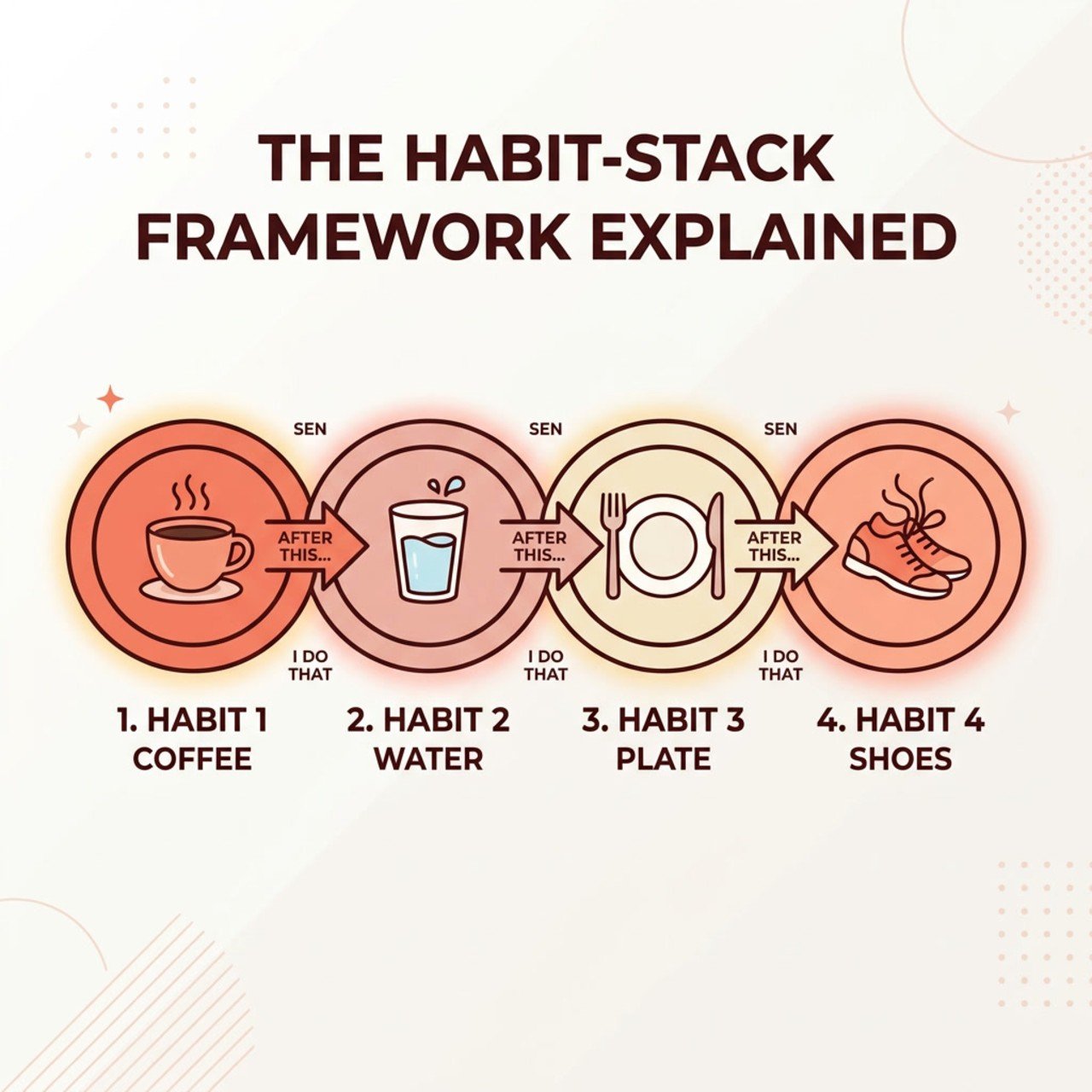
As Clear explains, the formula is simple: “After [current habit], I will [new habit].” Your existing routine becomes the reminder, so you’re not relying on memory or motivation at 6 a.m. to make the new behavior happen.
This matters enormously for obesity weight loss tips specifically, because the standard advice - overhaul your diet, start exercising daily, cut out sugar entirely - is exactly the kind of all-or-nothing plan that collapses the first time life gets in the way. If you’ve ever “fallen off” a plan after one bad meal and quietly given up for the week, you already know how that story ends.
Small, stacked habits don’t give you a single point of failure. Miss one day, and the stack is still there tomorrow. Here’s the basic formula applied to weight loss, so you can see how naturally it fits into a day you’re already living:
- After I pour my morning coffee, I will drink one full glass of water first.
- After I sit down for lunch, I will add one serving of vegetables to my plate before I eat anything else.
- After I brush my teeth at night, I will write down what I ate that day, no judgment, just data.
- After I finish a work call, I will stand up and walk for two minutes.
None of these feel intimidating on their own, and that’s the entire point. The 10 tips below are built to slot into this same structure.
10 Habit-Stacking Tips For Obesity Weight Loss
Tip #1: Stack One Small Change Onto A Habit You Already Have
Small, stacked changes beat dramatic overhauls because your body resists rapid change, not gradual change. Start by picking one simple dietary swap, like replacing an afternoon snack with a healthier option, and attach it to something you already do daily, like a 3 p.m. work break. Once it’s automatic (usually a few weeks), stack the next one on top.


Tip #2: Set Realistic, Process-Based Goals
A goal built around 1–2 pounds a week protects your metabolism and your motivation. Faster loss usually means muscle loss, not just fat loss, and it’s harder to sustain. Track a process goal (“I stacked my water habit 5 days this week”) alongside the scale.
If you notice yourself thinking “I already messed up today, so I’ll just start over Monday,” that’s the all-or-nothing trap; our piece on how black-and-white thinking sabotages weight loss walks through how to catch it before it derails a whole week.
Tip #3: Increase Your Protein Intake
Protein is the most satiating macronutrient, meaning it keeps you fuller on fewer calories than carbs or fat, according to WebMD’s macronutrient guide. Stack it simply: after I plate my meal, I will make sure a palm-sized portion of protein is on it first. This one habit does a lot of quiet work against mid-afternoon cravings.
Tip #4: Reduce Refined Carbs And Added Sugar
Refined carbohydrates spike blood sugar fast, which drives the exact insulin swings tied to fat storage around your midsection. You don’t need to eliminate carbs, just shift the source. Stack it: after I reach for a packaged snack, I will check whether a fruit or a handful of nuts would work instead. Small substitutions, repeated daily, add up to meaningfully less added sugar over a month.
Tip #5: Add More Fiber To Every Meal
Fiber slows digestion, blunts blood sugar spikes, and helps you feel full on fewer calories, making it one of the most underrated tools for both fat loss and insulin sensitivity. Stack it: after I start cooking dinner, I will add one high-fiber ingredient, beans, lentils, or an extra vegetable, to the pot.

Tip #6: Build A Water Habit, Not A Water Goal
Drinking water before meals can reduce how much you eat, since thirst is commonly mistaken for hunger. Rather than tracking ounces all day (which most people abandon within a week), stack it: after I sit down at the table, I will drink one full glass of water before I pick up my fork. This short video on everyday habits that help avoid obesity walks through this swap and several others in under two minutes.
Tip #7: Stay Active, Even Outside The Gym
Physical inactivity is a major, independent driver of obesity risk, separate from diet, and it’s often the easier lever to pull first. The CDC-backed research on our own site found that a sedentary lifestyle carries risks on par with obesity itself. You don’t need a gym membership to start. Stack movement into your day with any of these:
- After I finish a phone call, I will stand and pace for its remaining minutes.
- After I park the car, I will choose the farthest spot, not the closest.
- After dinner, I will take a 10-minute walk before sitting down for the evening.
Aim to build toward the CDC-recommended 150 minutes of moderate-intensity activity a week, but let daily step count and small movement snacks carry you there instead of one dreaded workout block.
Tip #8: Protect Your Sleep Like Part Of The Plan
Poor sleep disrupts the hormones that regulate hunger and fullness, leaving you hungrier the next day regardless of what you ate. Dr. Stanford noted to the AMA that disrupted circadian rhythm, common in shift workers, is directly linked to weight gain, and that restoring a regular sleep-wake pattern often shifts weight on its own. Stack it: after I put my phone on the charger, I will turn off screens for the night. Aim for 7–9 hours.
Tip #9: Seek Support Before You Think You Need It
Accountability measurably improves weight loss outcomes, whether that’s a friend, a dietitian, or a support group. Stack it: after my Sunday meal prep, I will send one friend a quick update on how the week went. If what you’re noticing feels bigger than ordinary stress-eating, the section below on emotional and binge eating explains what to watch for and where to turn.

Tip #10: Track Progress Beyond The Scale
The scale is one signal among several, and it’s often the noisiest one. Water retention, hormones, and muscle gain can all mask real fat loss for days or weeks at a time. Stack it: after I weigh in each week, I will also log one non-scale win: energy, sleep quality, a looser waistband, a habit you kept. Celebrating those keeps momentum alive between the scale’s good days.
Understanding Anti-Obesity Medications (GLP-1s)
GLP-1 receptor agonists, sold under brand names including Ozempic and Wegovy, are one evidence-based option for treating obesity, not a replacement for the habits above.
Dr. Stanford described their mechanism to the AMA in plain terms: they work on the same brain pathways discussed earlier, upregulating the “eat less, store less” signal and downregulating the “eat more, store more” one, which is why many patients report that food simply feels less compelling on the medication.
At its June 2026 Annual Meeting, the American Medical Association adopted new policy encouraging GLP-1 use “within comprehensive care plans that include behavioral and lifestyle interventions,” not instead of them, and directing physicians to screen for eating disorders and body-image concerns before prescribing.
The AMA also flagged a real, current problem: insurance coverage and cost put these medications out of reach for many of the people who could benefit most.
The honest picture is that GLP-1s aren’t right for everyone, aren’t guaranteed to be covered, and work best as part of, not instead of, the lifestyle foundation this article covers. That decision belongs to you and your prescribing physician.
| Approach | What It Is | Key Consideration |
|---|---|---|
| Lifestyle Changes | Nutrition, movement, sleep, and habit-stacking, as covered above. | The foundation for every other approach; free and always appropriate to start. |
| GLP-1 & Other Medications | Prescription drugs that act on brain appetite pathways. | Requires a physician; cost and insurance access vary widely. |
| Metabolic & Bariatric Surgery | Surgical procedures for severe obesity or obesity-related disease. | Reserved for specific clinical criteria; highest-impact option for eligible patients. |
Framework informed by Dr. Fatima Cody Stanford’s AMA interview and the AMA’s June 2026 policy update.
Join Our Mailing List
Join thousands of women inside our community and receive our free guide, 10 Actions That Support Permanent Weight Loss — the exact behavioural shifts that make the difference between a two-week attempt and a lasting transformation.
No restriction plans. No guilt. Just what actually works — for real women with real lives.

When It’s More Than A Habit: Emotional And Binge Eating
Occasional stress-eating is human; binge eating disorder (BED) is a diagnosable medical condition, and the difference matters. BED involves recurring episodes of eating a large amount of food while feeling a loss of control, often followed by shame, and it is not something you can simply out-willpower. Watch for these signs:
- Eating much faster than usual, or past the point of physical fullness, regularly.
- Eating alone specifically because of embarrassment about how much you’re eating.
- Strong feelings of disgust, guilt, or depression after overeating episodes.
- These episodes happening at least once a week for several months.
If any of this sounds familiar, please know it’s treatable, and you don’t have to figure it out alone. The National Alliance for Eating Disorders offers free referrals to specialized treatment and a helpline staffed by licensed therapists. Reaching out is a sign of strength, not a step backward on your weight loss journey.
This is exactly why Tip #9 matters as much as any tip about food or movement. A weight loss plan that ignores your emotional relationship with food isn’t complete; it’s a plan waiting to be undone by a hard week.
Start Stacking Today, With A Plan Built For You
Reading ten tips is easy. Turning even three of them into habits that survive a busy week, a bad night’s sleep, or a stressful Tuesday is the actual work, and you don’t have to design that plan alone.
Grab our free guide, 10 Actions That Support Permanent Weight Loss, and get the exact stacking sequence thousands of women have used to turn small, unintimidating changes into results that hold. No 5 a.m. workouts, no meal-prepping your entire Sunday, just the next small habit to stack.
Related Articles
The Bottom Line
Obesity weight loss tips work best when they respect how your body actually operates - brain chemistry, insulin resistance, hormones, and all - instead of demanding willpower alone.
Habit stacking gives you a way to build real change without the burnout of an all-or-nothing overhaul: one small action, attached to a routine you already have, repeated until it’s automatic, then stacked with the next one.
Whether your path includes lifestyle changes alone, a conversation with your doctor about GLP-1 medications, or support for your relationship with food, the goal is the same. Progress you can sustain beats perfection you can’t.
Glossary Of Key Terms
FAQ
Obesity is a chronic medical condition, defined as a BMI of 30 or above, that raises the risk of type 2 diabetes, heart disease, stroke, and certain cancers, largely through its effect on insulin resistance and visceral fat. It’s currently estimated to affect 40.3% of U.S. adults.
Obesity develops from a combination of genetics, brain chemistry, hormones, environment, and lifestyle factors, not a single cause or a lack of willpower. Research on brain pathways that regulate appetite and fat storage shows that some people are biologically more sensitive to environmental food cues than others.
Exercise supports a calorie deficit and builds muscle, which raises the calories you burn even at rest. Just as importantly, physical inactivity is an independent risk factor for obesity, so consistent daily movement, not only formal workouts, meaningfully lowers overall risk.
A safe, sustainable pace is roughly 1–2 pounds per week, achieved through gradual habit changes rather than crash diets, which tend to cost muscle mass and rebound. Consistency over months, not a fast timeline, is what predicts lasting results.
That’s a decision for you and your prescribing physician. GLP-1 medications are one evidence-based tool for obesity, intended to work alongside lifestyle changes rather than replace them, and current AMA policy specifically recommends screening for eating disorders and body-image concerns before prescribing. Access and cost also vary significantly by insurance.
Habit stacking attaches a new, small action to a routine you already do automatically, so the existing habit becomes the reminder instead of relying on memory or motivation. It works better than willpower-based overhauls because a missed day doesn’t collapse the whole plan, only that one link in the stack.
Occasional stress-eating is common and not a disorder. If you notice regular episodes of eating past fullness with a sense of loss of control, eating in secret out of shame, or intense guilt afterward happening at least weekly for months, that pattern may indicate binge eating disorder, and support from the National Alliance for Eating Disorders can help.
You Know Why. Now Learn Exactly How
Join thousands of women inside our community and receive our free guide: 10 Actions That Support Permanent Weight Loss — the practical, sustainable habits that translate everything you just read into real, lasting results.
No fad diets. No extreme plans. Just what the research actually supports — written for real women.