
Weight Loss Mindset: The Four Shifts That Actually Make Weight Loss Stick
James Clear
Author of Atomic Habits
Life is a series of seasons, and what works in one season may not work in the next. What season are you in right now? What habits does that season require?
Summary (TL;DR)
A weight loss mindset isn’t a feeling you wait for — it’s four learnable shifts: Clarity (goals tied to who you’re becoming, not just the scale), Compassion (breaking all-or-nothing thinking before it breaks you), Community (real support and accountability), and Consistency (expecting weeks, not days, and tracking more than weight). Research on habit formation, self-compassion, and stress all point in the same direction: the plan rarely fails first. The mindset around the plan does.
Most weight loss advice hands you a meal plan and a workout schedule and calls it a strategy. Then three weeks in, motivation dips, one bad day turns into a bad week, and the plan gets shelved — not because it didn’t work, but because nothing in it accounted for how your mind actually behaves under stress.
The real battle isn’t just on your plate or in the gym — it’s in your mind. A weight loss mindset means changing your thoughts, beliefs, and attitudes about your body, your goals, and the journey itself, so the inevitable off days don’t become the reason you quit.
This article breaks that mindset into four concrete, research-backed shifts — not vague positivity, but specific changes you can actually apply this week.
Medical & Referral Disclaimer
This article is for informational and educational purposes only. It is not a substitute for professional medical advice, diagnosis, or treatment. Always consult your physician or a qualified health provider before starting any new diet or exercise program, and before making changes related to stress or hormone health.
Key Takeaways
- A weight loss mindset is built from four specific shifts, not general positive thinking: Clarity, Compassion, Community, and Consistency.
- Chronic stress and cortisol make mindset work harder, not optional — especially in midlife, when your body is already managing more change than it was ten years ago.
- All-or-nothing thinking, not the occasional slip itself, is what derails most weight loss efforts.
- Real habit change takes roughly two months on average, not the “21 days” most people expect — and that mismatch is what makes people quit right before it would have worked.
- Tracking non-scale progress protects your motivation on the weeks the scale doesn’t move.

Why Your Mindset Decides Whether Weight Loss Sticks
Your mindset is not the soft part of weight loss — it’s the part that decides whether everything else holds up. It shapes your motivation, your relationship with food and exercise, and, most importantly, what happens the moment a plan meets a bad day.
Two women can follow the same plan. One treats a missed workout as proof she’s failed again and quits by Thursday. The other treats it as one data point in a much longer pattern and shows up again on Friday.
The difference between them rarely comes down to willpower. It comes down to mindset — and mindset, unlike willpower, can be deliberately built.
The Four C’s Of A Weight Loss Mindset
A weight loss mindset breaks down into four pillars: Clarity, Compassion, Community, and Consistency. Each one targets a specific place where mindset-driven weight loss efforts typically fail.
| Pillar | The Shift | Why It Works |
|---|---|---|
| Clarity | Set goals tied to who you’re becoming, not just the number on the scale | Identity-linked goals survive bad weeks that outcome-only goals don’t |
| Compassion | Replace all-or-nothing thinking with self-compassion after a slip | Research links self-compassion to healthier eating patterns and lower disordered-eating scores |
| Community | Build real support and accountability, not just good intentions | Most successful long-term maintainers used some form of external support or structure |
| Consistency | Expect weeks, not days, and track more than the scale | Automatic habits take roughly two months to form on average — quitting early is the actual failure point |
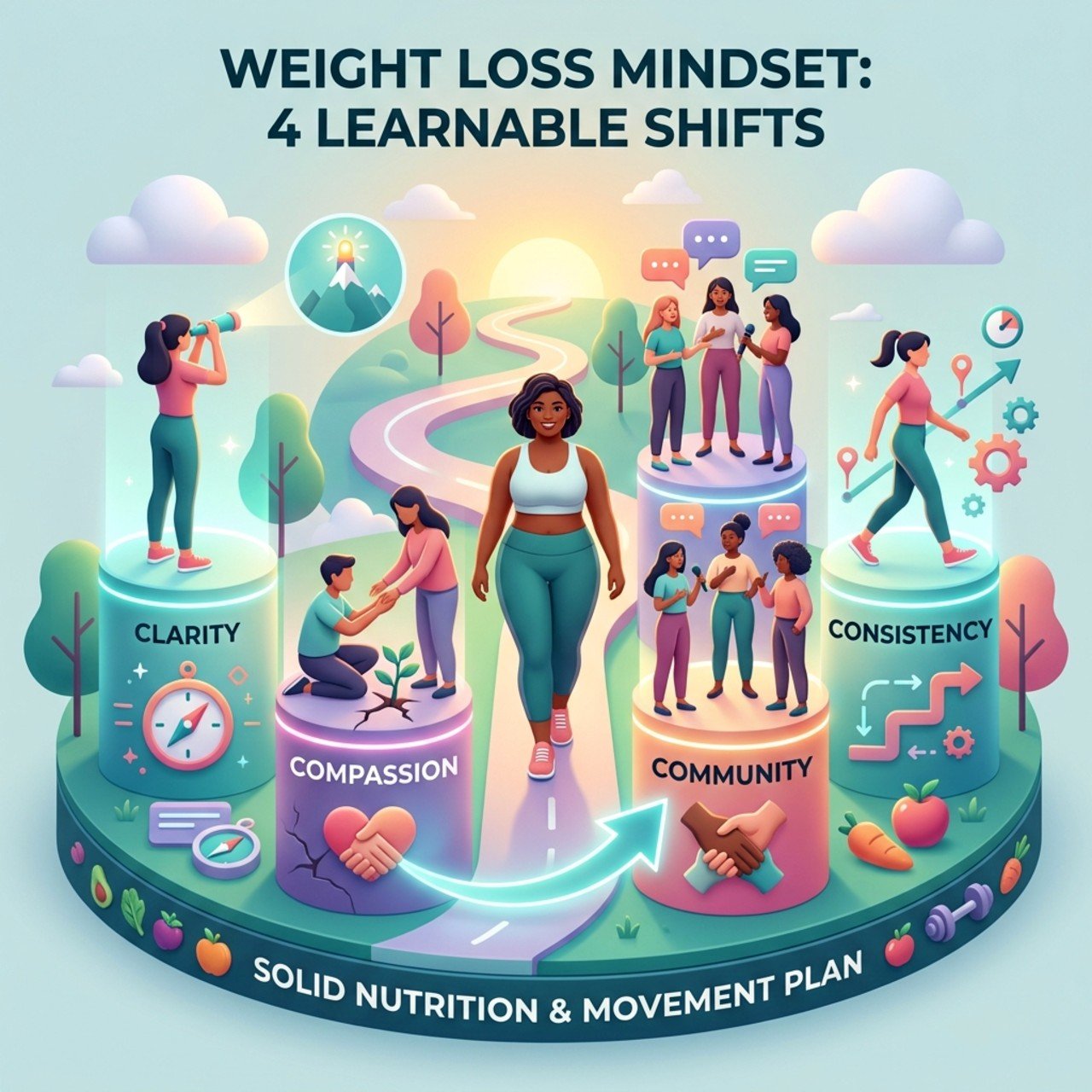
C1 — Clarity: Set Goals Tied To Who You’re Becoming, Not Just The Scale
Clarity means anchoring your weight loss goal to something bigger than a number, so a stalled scale doesn’t stall you. A goal like “lose 20 pounds” gives your brain nothing to hold onto between now and 20 pounds from now — no reason to show up on a hard day.
A goal like “become someone who moves her body most days” gives you an identity to act from today, immediately, regardless of what the scale says. Start by asking yourself three questions before you set your next weight loss goal:
- What will actually change in my day-to-day life if I reach this? More energy, better sleep, and being able to keep up on a hike are goals your brain can act on daily — a number on a scale is not.
- Is this goal something I control, or something I’m hoping happens to me? “I’ll walk four times this week” is fully in your control. “I’ll lose four pounds this week” is not, no matter how well you eat.
- Would I still call this week a win if the scale didn’t move? If the honest answer is no, the goal is doing more harm than good.
For a longer framework on setting goals that actually hold up under pressure, that guide walks through the process step by step.
C2 — Compassion: Replace All-Or-Nothing Thinking With Self-Compassion
Compassion means treating a slip as information instead of proof you’ve failed, because the second reaction is what actually derails a weight loss journey — not the slip itself.
One missed workout, or one difficult meal, is a blip. The all-or-nothing thought that follows it (“I’ve already ruined the week, might as well start Monday”) is what turns a blip into a lost month.

This isn’t just a comforting idea. A 2015 study on self-compassion and eating behavior found that people with higher self-compassion reported meaningfully more mindful eating and lower disordered-eating symptoms meaningfully — self-compassion explained roughly 11% of the variation in how mindfully people ate.
The researchers describe self-compassionate eaters as approaching food challenges with “nonjudgment, kindness, and patience” instead of rigid control — which is a fair description of the entire mindset shift this section is asking you to make.
Watch for these three mindset blocks — they’re the most common ones standing between you and a sustainable weight loss mindset:
- Negative self-talk: Constantly putting yourself down or doubting your ability to follow through erodes the same motivation you’re trying to protect.
- Perfectionism: Chasing a flawless week sets a bar that guarantees eventual failure and frustration — and frustration is what people quit on.
- All-or-nothing thinking: Believing that one off-plan meal ruins the whole week, or the whole effort, turns a minor setback into a reason to stop entirely.
Interestingly, the research here has a real nuance worth knowing: a 2024 study following bariatric surgery patients found that general all-or-nothing thinking about life didn’t predict worse weight outcomes — but all-or-nothing thinking specifically about food and eating did.
The takeaway isn’t to police every rigid thought you have. It’s to notice the specific ones aimed at your plate.
C3 — Community: Build Support And Accountability That Actually Holds
Community means having at least one person or structure that knows your goal and checks in on it — because intentions you keep to yourself are the easiest ones to quietly abandon. Seek out friends, family, or a support community who can offer encouragement and understanding, and say your goal out loud to at least one of them.
This matters more than it sounds. Long-running data from the National Weight Control Registry, which tracks people who’ve maintained significant weight loss for years, shows a majority didn’t do it entirely alone — roughly 55% used some form of structured program or outside support to get there in the first place.
Separately, newer research comparing people who maintained their weight loss against people who regained it found something worth sitting with: the group that regained weight was actually more interested in tracking apps and technology, but reported more guilt, discouragement, and anxiety while using them.
Support that adds shame isn’t support — it’s pressure with a friendlier name. The kind of community that helps is the kind that makes a hard week easier to talk about, not harder to admit to.
C4 — Consistency: Expect Weeks, Not Days, And Track More Than The Scale
Consistency means setting your timeline expectations to match reality, because the “21 days to build a habit” myth sets almost everyone up to quit right before a habit would have stuck.
A 2024 systematic review pooling 20 studies and over 2,600 participants found the real median time to reach automatic habit formation was 59 to 66 days — with some people taking anywhere from a few weeks to nearly a year. Two to three months, not three weeks, is the honest timeline.

One pattern I keep seeing when women talk about what actually got them through a plateau: it’s rarely a new diet trick. It’s that they stopped judging the week by the scale alone and started noticing everything else that had quietly changed — and that shift in what they were paying attention to is what kept them showing up long enough for the habit to become automatic.
Track these non-scale signs alongside your weight, especially in the weeks the scale won’t budge:
- Energy and sleep quality — often the first things to improve, well before the scale reflects anything.
- How your clothes fit — body composition can shift even when total weight holds steady.
- Consistency itself — how many of the last 14 days you showed up for your plan, regardless of outcome, is a better predictor of long-term success than any single week’s number.
Decision fatigue is worth planning around here too: a recent review of the research on food choices found that mental depletion pushes people toward automatic, low-effort decisions — which is exactly why the healthiest choice starts losing to convenience by 8 p.m.
Deciding your meals and your workout time in advance, while your willpower is fresh, removes the decision from the moment you’re least equipped to make it well.
Why Stress And Cortisol Make Mindset Even More Important At Midlife
Chronic stress doesn’t just make weight loss feel harder — for some people, it makes the body actively work against the effort, which is exactly why the mindset piece matters more, not less, as life gets busier.

A review of the research on stress and obesity susceptibility confirms cortisol, the body’s primary stress hormone, is linked to increased abdominal fat storage — with meaningful individual variation in how sensitive people’s bodies are to that effect.
This isn’t the same for every woman, and it isn’t a life sentence — researchers describe it as differences in glucocorticoid sensitivity between individuals, not a fixed rule that applies equally to everyone. For a deeper look at how this connects to hormones and weight loss specifically, that guide covers the full picture.
But for women juggling a demanding job, a household, and the ordinary stress load of midlife, it’s one more reason a rigid, high-pressure approach to weight loss tends to backfire. Stress-driven eating and a punishing mindset feed each other — the more pressure you put on yourself, the more your stress response works against the plan.
A calmer, more consistent approach isn’t just easier on your mood. It’s working with your physiology instead of against it.
What The Research Actually Shows
A lot of weight loss “mindset” advice is repeated so often it starts to sound like fact. Here’s what the actual research says, side by side with the common belief.
| Common Belief | What The Evidence Actually Shows |
|---|---|
| It takes 21 days to build a new habit | A 2024 meta-analysis of 20 studies found a median of 59–66 days, with wide individual variation |
| One off-plan meal “ruins” the week | Self-compassionate responses to a slip predict faster recovery; the harsh internal reaction, not the slip, drives the spiral |
| Rigid, all-or-nothing thinking is always the problem | Research on bariatric patients found only food-specific all-or-nothing thinking predicted worse outcomes — not general rigid thinking |
| Tracking everything always helps | People who regained weight were more drawn to tracking apps, yet reported more guilt and anxiety using them than those who maintained their loss |
| Willpower failures happen at random | Decision fatigue research shows self-control depletes over the day, making planned decisions more reliable than in-the-moment ones |

Join thousands of women in our community and get our free guide: 10 Actions That Support PERMANENT Weight Loss — practical, sustainable habits that turn everything you just read into real, lasting results.
No fad diets. No extreme plans. Just what the research actually supports — written for real women navigating real weeks.
Get My Free Guide: 10 Actions That Support PERMANENT Weight Loss.
The Bottom Line
A weight loss mindset isn’t something you either have or don’t — it’s four specific, learnable shifts. Clarity gives you a goal that survives a bad week. Compassion stops one slip from becoming a lost month.
Community gives you somewhere to say the hard part out loud. Consistency keeps you showing up long enough for a habit to become automatic, instead of quitting at week three because you expected week one results.
None of this replaces a solid nutrition and movement plan — it’s what makes that plan survivable past the first hard week. Willpower alone was never going to get you there; the four shifts above are what actually do.
Glossary Of Key Terms
- All-or-nothing thinking: A mindset block where a single mistake is perceived as a total failure, often leading to the abandonment of a goal.
- Clarity: The practice of anchoring goals to identity and daily actions (who you are becoming) rather than just numerical outcomes on a scale.
- Decision Fatigue: The depletion of self-control and mental energy over the course of a day, leading to impulsive or low-effort choices.
- Glucocorticoid Sensitivity: Individual variation in how the body's tissues respond to stress hormones like cortisol, which can influence abdominal fat storage.
- Mindfulness: The practice of bringing conscious awareness to eating habits, emotions, and triggers to make healthier, more intentional choices.
- Mindset Blocks: Negative thought patterns—such as perfectionism and negative self-talk—that hinder progress and erode motivation.
- Non-scale Progress: Indicators of health improvement other than weight, including better sleep, increased energy, and changes in body composition/clothing fit.
- Self-Compassion: Approaching setbacks with kindness and patience rather than judgment; a trait linked to more mindful eating patterns.
- Weight Loss Mindset: The collection of thoughts, beliefs, and attitudes that determine how an individual reacts to the inevitable challenges of a weight loss journey.
- 21-Day Myth: The common but scientifically unsupported belief that habits take only three weeks to form; research suggests a period closer to two months is required.
FAQ
What Is A Weight Loss Mindset, Exactly?
A weight loss mindset is the set of thoughts, beliefs, and habitual reactions — especially to setbacks — that determine whether you stay consistent with a plan long enough for it to work. It breaks down into four practical shifts: Clarity, Compassion, Community, and Consistency.
How Long Does It Actually Take To Build A Weight Loss Mindset?
Research on habit formation puts the median time to build an automatic habit at 59 to 66 days, not the commonly cited 21 days. Expect roughly two to three months of deliberate practice before the new mindset and the habits around it start to feel automatic.
Why Does One Bad Day Sometimes Turn Into Weeks Of Quitting?
Usually because of all-or-nothing thinking, not the bad day itself. The belief that one slip has “ruined” a plan removes any reason to continue it, turning a single off-plan meal or missed workout into a much longer break. Responding with self-compassion instead of self-criticism is linked to faster recovery from exactly this pattern.
Does Stress Actually Affect Weight Loss, Or Is That Overstated?
Chronic stress raises cortisol, which research links to increased abdominal fat storage — though the strength of that effect varies significantly between individuals based on their hormonal sensitivity. It’s a real contributing factor for many women, not a guarantee for every woman, which is exactly why a mindset that reduces pressure and rigidity matters.
Should I Track My Weight Every Day?
Daily weighing works for some people and backfires for others. Research comparing successful long-term maintainers to people who regained weight found that the regain group was more drawn to tracking tools but reported more guilt and anxiety about using them. If tracking your weight adds stress rather than clarity, track non-scale signs like energy, sleep, and workout consistency instead.
What’s The Difference Between Motivation And Mindset?
Motivation is a feeling that comes and goes, often within the same day. Mindset is the underlying set of beliefs and default reactions that keep you moving even when motivation is gone — which is why building mindset matters more than waiting to feel motivated.
Can I Build A Weight Loss Mindset Without Therapy Or A Coach?
Yes, for most people. The four shifts in this article — Clarity, Compassion, Community, and Consistency — are things you can start applying on your own this week. If all-or-nothing thinking is tied to a broader pattern of disordered eating or persistent anxiety around food, that’s worth bringing to a qualified therapist or your physician rather than working through alone.