
Dark Chocolate Benefits, Backed By Real Research, Not Just Cravings
Howard Sesso, PhD, MPH
Associate Professor of Medicine
COSMOS was not a trial to evaluate whether eating chocolate is good for you. It instead asks, ‘Is there something about the cocoa bean and the bioactive components in it that could be beneficial for health?
Summary (TL;DR)
Dark chocolate with at least 70% cocoa delivers real, research-backed dark chocolate benefits: it may modestly lower blood pressure, improve LDL cholesterol’s resistance to oxidation, support brain function under mental strain, and—in postmenopausal women specifically—reduce body fat percentage, raise resting calorie burn, and blunt the urge to overeat afterward.
The effects are real but small; the research is still developing for some claims (inflammation markers, sleep quality), and the benefits only hold at a controlled portion of high-cocoa chocolate, not a family-size candy bar. This guide breaks down what the evidence actually shows, what it doesn’t, and how much to eat to get the upside without the sugar and calorie downside.
Dark chocolate has earned a strange reputation: half health food, half guilty pleasure. Both halves are a little bit right. The flavanols and polyphenols concentrated in high-cocoa chocolate are genuinely bioactive compounds with measurable effects on blood vessels, fat cells, and appetite hormones—not just marketing language borrowed from a supplement label.
But “dark chocolate is good for you” is also the kind of claim that gets stretched past what the research actually supports. A 90% cocoa square eaten mindfully after dinner and a 250-calorie dark chocolate candy bar eaten standing at the pantry are not the same intervention, even though both technically qualify as “dark chocolate.”
This guide walks through what the research says about dark chocolate and heart health, inflammation, brain function, and—because most dark chocolate research quietly ignores the exact life stage where cravings, metabolism, and mood all shift at once—what a handful of studies specifically on perimenopausal and postmenopausal women have found.
Medical & Referral Disclaimer
This article is for informational and educational purposes only. It is not a substitute for professional medical advice, diagnosis, or treatment. Always consult your physician or qualified health provider before starting any new diet or exercise program.
Key Takeaways
- Cocoa flavanols may lower blood pressure by a small but measurable amount, with the strongest effect in people who already have elevated blood pressure.
- Dark chocolate’s antioxidant compounds can improve how resistant LDL cholesterol is to oxidation, a step in the process that contributes to artery plaque.
- In postmenopausal women specifically, a small daily amount of high-cocoa chocolate has been shown to reduce body fat percentage without changing body weight.
- Dark chocolate (80% cocoa) triggered less food intake meaningfully afterwards than milk or white chocolate in a controlled trial—a real craving-control mechanism, not just willpower.
- The benefits are dose- and percentage-dependent: research consistently uses 70–99% cocoa in small, controlled amounts, not standard candy-aisle chocolate.

What Makes Dark Chocolate Different From Milk Chocolate
The difference that actually matters for your health is cocoa percentage, not the word “dark” on the wrapper. Dark chocolate is made mostly from cocoa solids and cocoa butter, with little to no milk solids and less added sugar than milk chocolate.
The higher its cocoa percentage, the more flavanols—the same broad category of protective plant compounds behind most of the benefits below—it tends to retain, since flavanols degrade during the processing steps (alkalization, roasting, conching) that make chocolate taste smoother and less bitter.
That trade-off is worth knowing before you shop: the mildest-tasting, most palatable dark chocolate on the shelf is often the most processed, and processing is exactly what strips out the compounds you’re paying the calories for.
| Attribute | Dark Chocolate (70–85% Cocoa) | Milk Chocolate |
|---|---|---|
| Added Sugar | Lower | Higher |
| Cocoa Solids | Higher | Lower (often 10–20%) |
| Flavanol Content | Higher (varies by processing) | Minimal |
| Typical Calories Per 28g (1 oz) | ~170 | ~150–160 |
The Nutritional Value Of Dark Chocolate
A one-ounce (28g) square of 70–85% dark chocolate gives you real minerals alongside its calories—this isn’t empty-calorie candy.
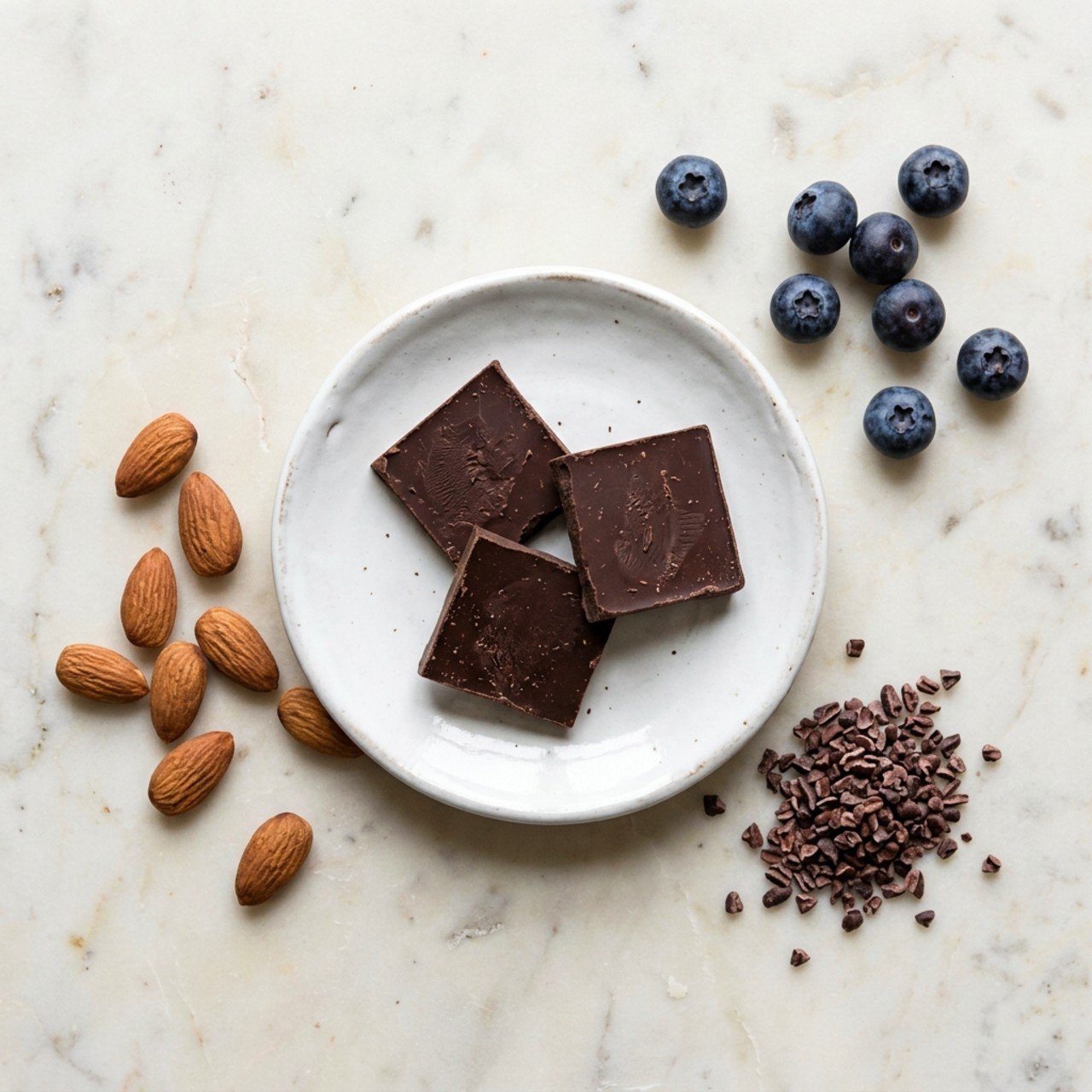
It’s a genuine source of iron, magnesium, copper, and zinc - minerals most women’s diets run short on, particularly magnesium, which is involved in over 300 enzymatic processes, including blood sugar regulation and muscle function—alongside other real food sources like almonds and broccoli.
| Nutrient | Amount Per 1 Oz (28g) Serving |
|---|---|
| Calories | 170 |
| Total Fat | 12 g |
| Protein | 2 g |
| Carbohydrates | 13 g |
| Fiber | 3 g |
| Sugar | 7 g |
| Iron | 3 mg (about 17% Daily Value) |
| Magnesium | 64 mg (about 15% Daily Value) |
| Zinc | 1 mg |
Those numbers shift with cocoa percentage—a 90% bar carries less sugar and slightly more fat than a 70% bar of the same size—so treat this as a representative snapshot, not a fixed number for every dark chocolate on the shelf.
Dark Chocolate And Heart Health
Blood Pressure
A Cochrane review of randomized trials found flavanol-rich cocoa products lower systolic blood pressure by about 2 mmHg on average—a small but real effect, not a dramatic one.
The reviewers rated this moderate-quality evidence and noted the effect was more pronounced in people who already had elevated blood pressure (roughly 4 mmHg), while the reduction in people with normal blood pressure wasn’t statistically significant. That distinction matters: dark chocolate is a modest complement to blood-pressure management, not a substitute for it.
The mechanism behind this is flavanols improving how well blood vessels dilate, which in turn supports healthy blood flow—the same vascular pathway researchers are studying for cognitive benefits later in this guide.

Cholesterol And Artery Health
Dark chocolate’s antioxidants may make LDL cholesterol more resistant to oxidation, a step that’s part of how arterial plaque forms in the first place.
In a controlled crossover study, adding cocoa powder and dark chocolate to a standard diet increased the time it took LDL particles to oxidize by about 8%, compared with the same diet without cocoa. Oxidized LDL is considered more damaging to artery walls than LDL alone, so slowing that process is a meaningful, if incremental, cardiovascular benefit.
Combined, the blood pressure and LDL-oxidation research is the closest thing dark chocolate has to a well-established heart-health case—modest, dose-dependent, and consistent across multiple independent studies.
Dark Chocolate And Inflammation
The inflammation story is more mixed than most dark chocolate articles let on, and the honest answer matters more than the flattering one.
A 2024 systematic review and meta-analysis of 33 controlled trials (1,379 participants) found dark chocolate and cocoa meaningfully reduced malondialdehyde, a marker of oxidative cell damage, and increased nitric oxide, which supports healthy blood vessel function.
But the same analysis found no significant overall effect on C-reactive protein, interleukin-6, or TNF-alpha—the inflammatory markers most closely tied to chronic disease risk.
The clearest anti-inflammatory effects showed up at higher flavanol doses (above 450 mg per day) over shorter periods, and in people who already had some degree of inflammation or metabolic dysfunction—not universally across healthy adults.
| Inflammatory Or Oxidative Marker | Effect Found In 2024 Meta-Analysis |
|---|---|
| Malondialdehyde (Oxidative Stress) | Significantly reduced |
| Nitric Oxide (Vascular Function) | Significantly increased |
| C-Reactive Protein | No significant change overall |
| Interleukin-6 & TNF-alpha | No significant change overall |
In plain terms: dark chocolate appears to help your body manage oxidative stress, which is a real and useful thing, but calling it an “anti-inflammatory food” in the way turmeric or fatty fish are discussed overstates the current evidence.

Dark Chocolate And Gut Health
Cocoa polyphenols appear to act as a prebiotic, feeding the gut bacteria linked to better digestive and metabolic health while crowding out some less helpful strains.
A review of human and animal research found that a four-week intervention using flavonol-enriched cocoa drinks significantly increased beneficial Bifidobacterium and Lactobacillus populations while reducing Clostridium histolyticum, a less favorable species linked to gut inflammation.
That prebiotic effect is one more thread connecting dark chocolate’s polyphenols to the broader inflammation and metabolic findings elsewhere in this guide—a healthier gut environment is part of how those compounds may be exerting their effects in the first place, rather than a separate, unrelated benefit.
Dark Chocolate And Brain Function
Higher-flavanol dark chocolate appears to help sustain mental performance during demanding tasks, more than it delivers a one-time brain boost.
In a small randomized crossover trial, adults who ate a higher-polyphenol chocolate (635 mg cacao polyphenols) maintained their accuracy on a demanding cognitive task across two consecutive sessions, while those who ate a lower-polyphenol version (212 mg) showed a measurable accuracy decline in the second session.
The sample was small—18 adults—so this is a promising early signal rather than settled science, but it lines up with the broader flavanol-and-blood-flow mechanism seen in the heart-health research above.
Natural Stimulant
Dark chocolate also contains theobromine, a mild natural stimulant related to caffeine but gentler and longer-acting. It won’t replace your coffee, but it may explain part of why a small square of dark chocolate in the afternoon can feel like it takes the edge off a slump.

Dark Chocolate, Weight Loss, And Cravings Control
The most useful weight-management finding isn’t about burning fat directly—it’s that dark chocolate can genuinely blunt how much you eat afterward.
In a controlled trial, postmenopausal women who ate 80% dark chocolate went on to eat significantly less at a subsequent meal than when they’d eaten milk chocolate or white chocolate—about 20% less than after milk chocolate, and 26% less than after white chocolate.
Researchers linked the effect partly to higher levels of a satiety hormone (pancreatic polypeptide) after the higher-cocoa chocolate, and partly to the smaller blood sugar and insulin spike that comes with less added sugar.
That’s a genuinely useful reframe: the goal isn’t to avoid the craving; it’s to satisfy it with something that turns the appetite signal down instead of back up.
- Choose 70% cocoa or higher. Below that, added sugar starts crowding out both the flavanol content and the satiety effect.
- Keep the portion to about one ounce (28g)—roughly one to two standard squares—rather than an open bag eaten while distracted.
- Eat it deliberately, away from screens, so you register the flavor and richness instead of the amount.
How It Compares To Other “Healthy” Snacks
It’s worth putting dark chocolate up against the other snacks that carry a health halo, since the comparison usually favors it more than people expect. A granola bar or a handful of dried fruit can carry as much or more added sugar than a 70% dark chocolate square, without the flavanol content to show for it.
- Granola bars often carry 8–12g of added sugar per serving—comparable to or higher than a one-ounce piece of dark chocolate—with none of the flavanol research behind it.
- Dried fruit concentrates natural sugars into a small volume, making it easy to eat several servings’ worth of sugar without noticing.
- Trail mix can look virtuous while quietly stacking calories from oil-roasted nuts, chocolate chips, and dried fruit into one handful.

None of this makes those foods off-limits—it just means “dark chocolate” doesn’t need to be the guilty option on that list.
Dark Chocolate During Perimenopause And Menopause
Most dark chocolate coverage is written as if every body is the same, but a handful of studies focused specifically on postmenopausal women found effects worth knowing if you’re in this stage of life.
Perimenopause and menopause bring a real shift in where fat is stored, how forgiving your metabolism feels, and how food cravings interact with mood—and dark chocolate research has quietly caught up to that fact in three specific ways.
First, a six-month randomized trial of 132 postmenopausal women found that adding just 10g of 99% cocoa chocolate to their daily diet reduced body fat mass and body fat percentage—without any significant change in body weight or BMI. The reduction showed up across the trunk, arms, and legs, which suggests a real shift in body composition rather than simple water-weight fluctuation.
Second, in a separate 30-day trial, 26 postmenopausal women who ate 20g of 72% dark chocolate daily saw their resting energy expenditure—the calories your body burns at rest—increase by about 3.2%, roughly 39 extra calories burned per day, with no comparable change in the group eating white chocolate.
That’s not a dramatic number on its own, but it adds up over weeks, and it runs counter to the assumption that any chocolate automatically works against a calorie deficit.
Third, an eight-week randomized trial of 60 menopausal women with mild-to-moderate depression found that a daily 12g portion of 78% dark chocolate significantly improved depression scores compared with milk chocolate—though the same study found no significant improvement in sleep quality or measurable change in weight, BMI, or waist circumference.
Worth being precise here: this is one trial in a specific population, not a green light to treat chocolate as a mood medication, but it’s a real, measured signal worth knowing given how closely mood and weight can be connected for women in this life stage.
| Study Focus | Population & Dose | Key Result |
|---|---|---|
| Body Composition | 132 postmenopausal women, 10g 99% cocoa/day, 6 months | Reduced body fat mass & % (weight unchanged) |
| Resting Energy Expenditure | 26 postmenopausal women, 20g 72% cocoa/day, 30 days | REE increased ~3.2% (~39 kcal/day) |
| Depression & Sleep | 60 menopausal women, 12g 78% cocoa/day, 8 weeks | Depression scores improved; sleep quality unchanged |
The 3 P’s Of Smarter Chocolate
Across all three of these studies, the same three variables kept determining whether dark chocolate helped or did nothing: Percentage (70% cocoa or higher, consistently), Portion (10–20g, roughly one small square to two), and Placement (eaten as a deliberate, single serving rather than grazed on throughout the day).
Get those three right, and you’re replicating the actual research conditions, not just eating chocolate and hoping.
How Much Dark Chocolate Should You Eat, And How To Choose It
Most of the research behind this guide used somewhere between 10g and 30g of dark chocolate daily—roughly one to two small squares, not a full bar.
That’s a genuinely small, sustainable amount to build into most days as part of a broader sustainable eating plan, which is part of why dark chocolate keeps showing up as a realistic swap rather than a restriction—the same logic behind smart swaps like avocado in place of less nutrient-dense fats.
- Check the cocoa percentage on the label first, not the marketing copy—look for 70% or higher.
- Scan the ingredient list for added fats and sugars, since some "dark" chocolate bars use palm oil and sugar to soften the bitterness that flavanols cause.
- Pick a brand you’d actually enjoy in a small amount, since satisfaction, not deprivation, is what makes a one-ounce portion feel like enough.
Join Our Mailing List
Join thousands of women inside our community and receive our free guide, 10 Actions That Support Permanent Weight Loss — the exact behavioural shifts that make the difference between a two-week attempt and a lasting transformation.
No restriction plans. No guilt. Just what actually works — for real women with real lives.
The Risks Of Overdoing It
Every benefit in this guide assumes a controlled portion—at higher amounts, dark chocolate’s calories and fat work against you the same way any dense food does.
A standard-size dark chocolate bar can run 500-plus calories, and its natural stimulants (caffeine and theobromine) can affect sleep or trigger jitteriness in people who are sensitive to them, particularly if eaten late in the day. People managing migraines, acid reflux, or a caffeine sensitivity may also want to keep an eye on how their body responds.
None of this cancels out the research above—it just means the dose really is the difference between a beneficial habit and an extra 500 calories a day that undercuts everything else you’re doing.
If you’re looking for more ways to work with your body’s changes instead of fighting them, our free guide walks through ten specific actions that support lasting weight loss without extreme restriction. Get your free copy of 10 Actions That Support PERMANENT Weight Loss here and start putting small, sustainable changes—like the one in this article—to work.
The Bottom Line
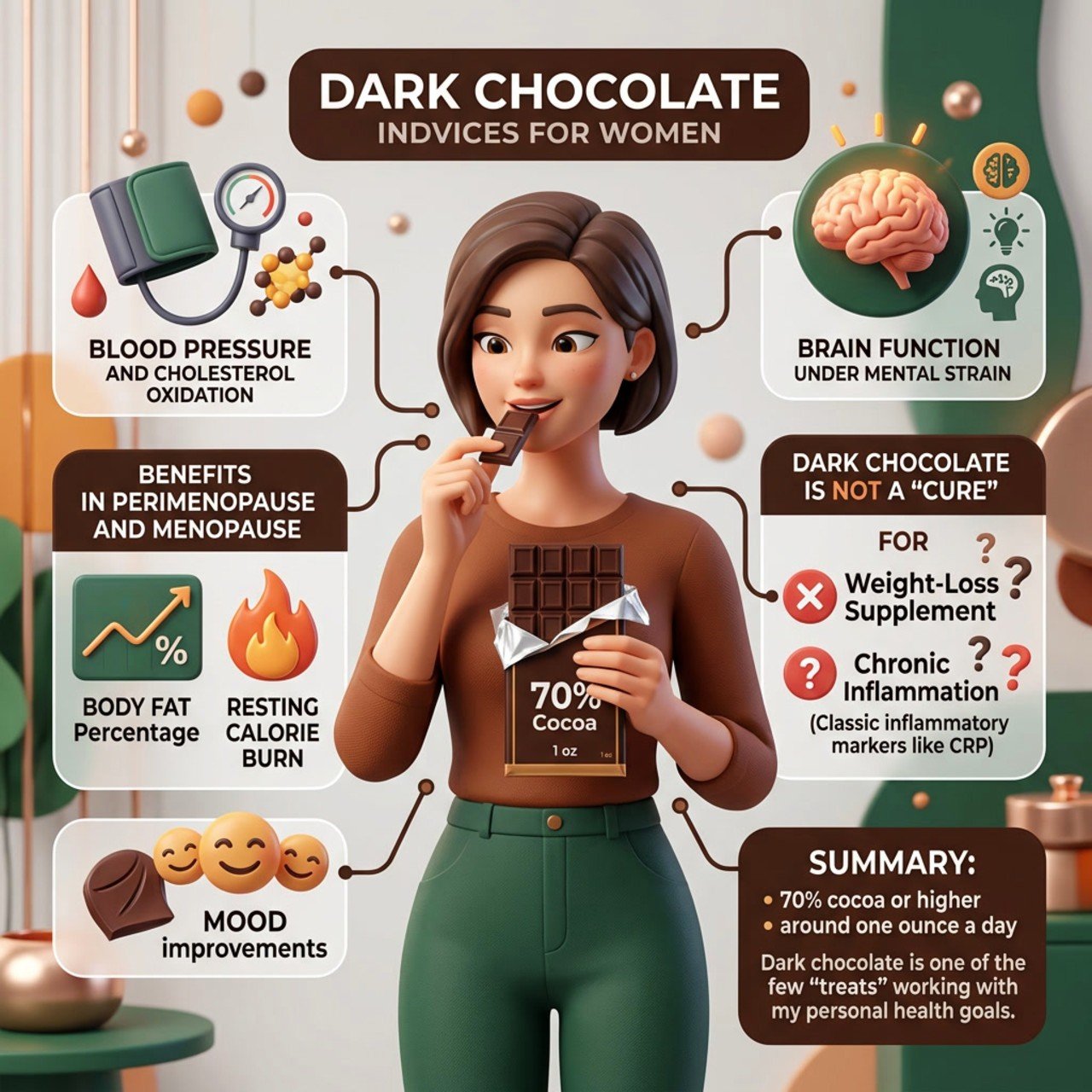
Dark chocolate, eaten in a small, high-cocoa portion, has real research behind modest benefits for blood pressure, cholesterol oxidation, brain function under mental strain, and—specifically for women in perimenopause and menopause—body fat percentage, resting calorie burn, and mood.
It is not a weight-loss supplement or a cure for inflammation, and the research is honest about where the evidence is still thin (sleep quality, classic inflammatory markers like CRP).
Used deliberately, at 70% cocoa or higher and around one ounce a day, it’s one of the few "treats" that’s genuinely working with your goals instead of against them.
Glossary Of Key Terms
- Antioxidants: Compounds that inhibit oxidation and neutralize free radicals to prevent damage to the body's cells.
- Cocoa Solids: The non-fat components of the cacao bean that contain the majority of beneficial compounds like flavanols and polyphenols.
- Endorphin Production: The release of natural chemicals by the body that lead to feelings of pleasure and well-being, often triggered by chocolate.
- Flavanols: A type of protective plant compound found in cocoa known for benefiting heart health, blood pressure, and vascular function.
- LDL Cholesterol: Often called "bad cholesterol," this substance can lead to plaque build-up in arteries; dark chocolate helps decrease its oxidation.
- Magnesium: An essential mineral found in dark chocolate that is vital for muscle function, blood sugar regulation, and over 300 enzymatic processes.
- Oxidative Stress: An imbalance between free radical production and the body's ability to counteract them, which dark chocolate helps manage.
- Polyphenols: Plant compounds with antioxidant and anti-inflammatory properties found in high concentrations in high-percentage dark chocolate.
- Prebiotic: A substance that induces the growth or activity of beneficial microorganisms (bacteria) in the gut.
- Theobromine: A mild, natural stimulant found in chocolate that is gentler and longer-acting than caffeine.
FAQ
Does Dark Chocolate Actually Help With Weight Loss?
Not directly by burning fat, but indirectly, yes: research in postmenopausal women found that a small daily portion reduced body fat percentage and slightly increased resting calorie burn, and separately, that it reduced how much food participants ate afterward compared with milk or white chocolate.
How Much Dark Chocolate Should I Eat Per Day?
Most of the studies behind these benefits used 10–30g daily—roughly one to two small squares of a 70% cocoa or higher bar, not a full-size bar.
What Cocoa Percentage Counts As Healthy Dark Chocolate?
Look for 70% cocoa or higher. Below that threshold, added sugar and fat increasingly crowd out both the flavanol content and the calorie-for-calorie value of the chocolate.
Can Dark Chocolate Lower Blood Pressure?
A Cochrane review of randomized trials found a small average reduction (about 2 mmHg systolic), with a stronger effect in people who already had elevated blood pressure and little measurable effect in people with normal blood pressure.
Is Dark Chocolate Good For Menopause Symptoms?
Research specifically on menopausal and postmenopausal women found improvements in body fat percentage, resting calorie burn, and depression scores, though not in sleep quality—so it may help with some menopause-related shifts but isn’t a fix for all of them.
Does Dark Chocolate Reduce Inflammation?
It’s mixed: a 2024 meta-analysis found real improvements in oxidative-stress markers, but no significant overall effect on classic inflammatory markers like C-reactive protein or interleukin-6.
What’s The Best Time To Eat Dark Chocolate For Cravings Control?
As a deliberate, standalone portion when a craving hits, rather than added on top of a meal or grazed on throughout the day—this mirrors how the craving-control research measured its effect.