
Health Benefits Of Avocado: Why This Fruit Is Non-Negotiable In Your 40s Diet
Discover The Real Benefits Of Avocado For Women In Perimenopause — Backed By Clinical Research
Dr. Mark Hyman, MD
Director of the Cleveland Clinic Center
Food is not just calories. It is information. It talks to your DNA and tells it what to do.
Summary (TL;DR)
The benefits of avocado go well beyond basic nutrition. For women in their 40s and beyond, this fruit targets the exact hormonal and metabolic shifts that make weight loss feel impossible — visceral fat, blood sugar swings, and relentless cravings. One avocado a day, used strategically as a swap for low-quality fats and refined carbs, is one of the simplest evidence-backed moves you can make.
If you've hit your 40s and started noticing that the weight loss strategies that worked in your 30s have quietly stopped working — welcome to perimenopause. The frustrating truth is that your body is not broken.
It's just operating under a completely different hormonal reality. Declining estrogen shifts fat storage from your hips and thighs to your abdomen. Your insulin sensitivity drops. Your appetite hormones get noisier. And suddenly, all that discipline you've been applying isn't giving you results the way it used to.
That's exactly where the benefits of avocado come in — and not in the superficial "eat clean" way you've probably already read about a dozen times. There's now a significant body of clinical research — randomised controlled trials, not just population surveys — showing that avocado works on the precise mechanisms that cause weight gain during perimenopause.
Here's what gets me about most avocado articles: they still trot out the same tired list of vitamins and call it a day. No explanation of why a fruit that's high in fat and calories is actually your ally during a hormonal shift. No connection to what your 40s body is actually going through. That's what this article is for.
Medical & Referral Disclaimer
This article is for informational and educational purposes only. It is not a substitute for professional medical advice, diagnosis, or treatment. Always consult your physician or qualified health provider before making changes to your diet, especially if you have existing health conditions or are managing hormone-related concerns.
Key Takeaways
- Avocado's monounsaturated fat (oleic acid) has been clinically shown to reduce visceral adipose tissue specifically in women — the dangerous belly fat that increases during perimenopause.
- A whole avocado at breakfast significantly elevates satiety hormones PYY and GLP-1, reducing the urge to snack for up to six hours.
- A 2023 meta-analysis of 10 RCTs found avocado intake significantly reduces LDL cholesterol and systolic blood pressure — two markers that worsen after 40.
- The "Avocado Swap Method" (replacing five common high-risk foods with avocado equivalents) is an easy, calorie-neutral strategy that improves dietary fat quality without complex tracking.
- Avocado's fiber content feeds the gut bacteria linked to better weight outcomes — a connection most women never hear about.
The Perimenopause Problem Nobody Tells You About
Here's the thing most diet advice conveniently ignores: weight gain after 40 in women isn't primarily a calorie problem. It's a fat redistribution problem driven by shifting hormones.
As oestrogen declines during the perimenopausal transition, visceral adipose tissue — the fat packed around your internal organs — increases significantly. This matters for two reasons.
Visceral fat is metabolically active in a way that subcutaneous fat is not. It drives inflammation, worsens insulin resistance, and makes losing weight feel like pushing a boulder uphill.
This isn't about willpower. It's biology. And it means the foods you choose need to work with your hormonal environment actively — not just be "low calorie." That's where avocado does something most foods can't.
What The Research Actually Says About Avocado And Visceral Fat
In the landmark Habitual Diet and Avocado Trial (HAT) — a multi-center randomised controlled trial of over 1,000 participants — women in the avocado group experienced a reduction of 33g of visceral adipose tissue, compared to an increase of 1.6g in the control group. The VAT-to-subcutaneous fat ratio was also significantly reduced, specifically in women.
Read that again: women eating one avocado a day lost visceral fat. The control group gained it.
That is not a small observational survey. That is a randomised controlled trial with a large, diverse sample — the gold standard of nutritional evidence.
The Benefits Of Avocado: A Framework That Actually Makes Sense
Rather than giving you a recycled list of vitamins, let me walk you through the benefits of avocado in a way that connects to your 40s body specifically.
#1. Oleic Acid Targets The Fat That Hurts Most
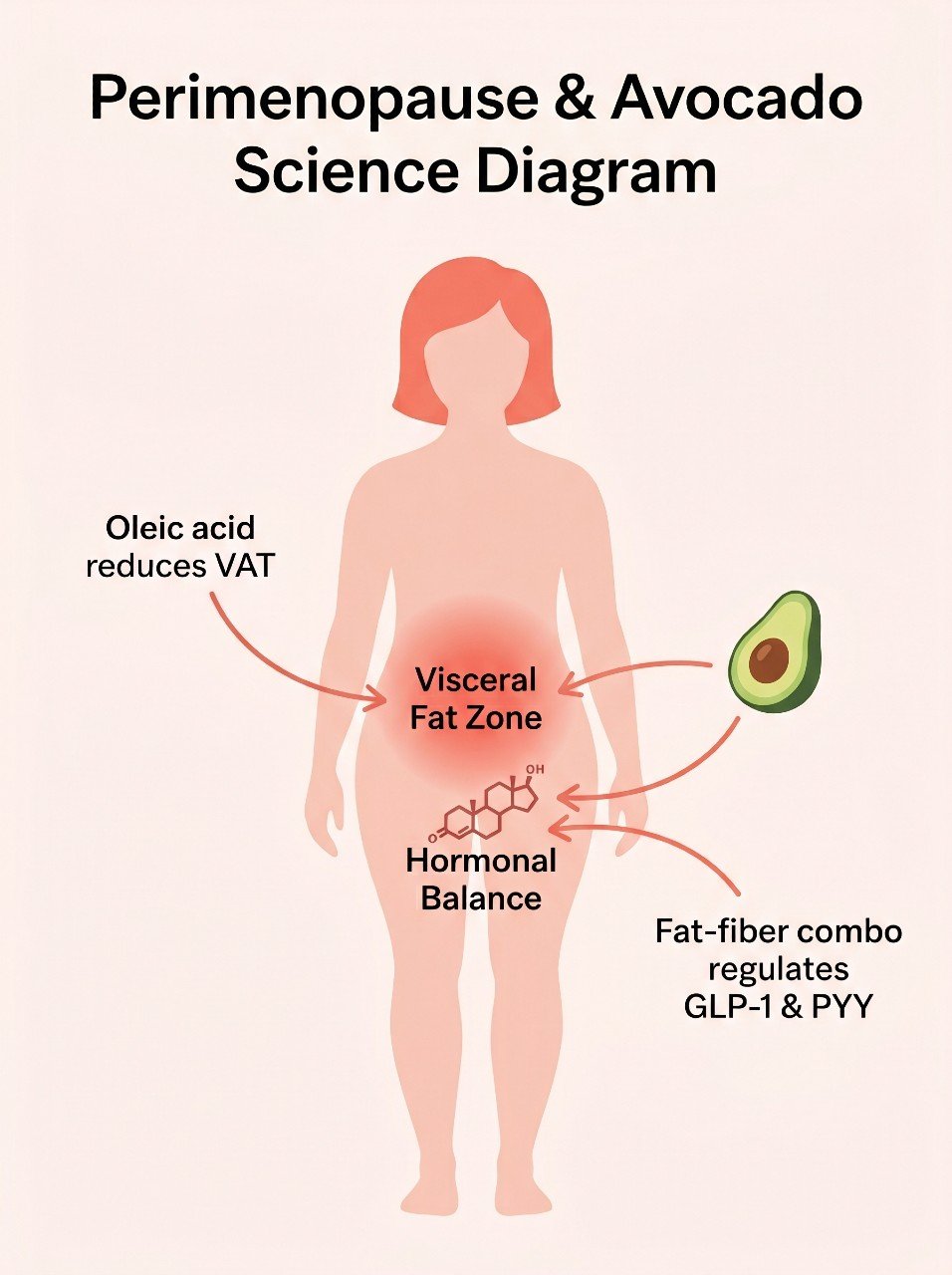
Avocados are approximately 70% monounsaturated fat, dominated by oleic acid — the same fatty acid that makes olive oil famous for heart health. Oleic acid does something specific and important: it activates fat oxidation pathways and has been associated with reduced visceral fat accumulation, which is precisely the fat that skyrockets during perimenopause.
This is not generic "healthy fat" messaging. Oleic acid has a documented mechanism that matters for women in hormonal transition. When declining oestrogen is already pushing fat to your abdomen, oleic acid acts as a counterweight.
#2. Avocado's Fat-Fibre Combination Silences Hunger Hormones
One whole avocado at breakfast does something remarkable to your appetite chemistry. In a randomised clinical trial specifically testing avocado's satiety effects, participants eating a whole avocado had significantly elevated PYY and GLP-1 levels — two hormones that tell your brain you are full — compared to a low-fat control meal. Insulin was also significantly lower after avocado versus the high-carb control.
What does this mean practically? You eat fewer calories for the rest of the day. Not because you're counting. Because your biology is regulated.
This is the key mechanism behind why avocado beats low-fat "diet foods" at keeping you satisfied. The fat-fibre combination — about 7g of fibre and 15g of monounsaturated fat per half avocado — is a hormonal satiety signal, not just a fullness sensation.

#3. It Rebalances Your Gut — And Your Gut Affects Your Weight
This is the benefit most avocado articles never mention. In a 12-week randomised trial, participants who added avocado to their weight-loss diet experienced not only greater weight loss but also meaningful shifts in gut microbiota — specifically an increase in bacteria involved in plant polysaccharide fermentation.
Why does this matter? Your gut microbiome influences how you extract calories from food, how you regulate blood sugar, and how well your hunger signals function. During perimenopause, gut diversity tends to decline. Avocado fibre is a targeted intervention for this — and one most women never think of.
#4. It Actively Lowers Bad Cholesterol
After 40, cardiovascular risk begins to creep up as oestrogen — which historically protected your heart — declines. Avocado addresses this directly. A 2023 meta-analysis of seven RCTs found that an avocado diet significantly reduced total cholesterol compared to habitual or low-fat diets.
A more recent GRADE-assessed meta-analysis of 10 RCTs (2024) found a significant reduction in LDL of 3.75 mg/dL and systolic blood pressure of 1.15 mmHg.
The mechanism: avocado's monounsaturated fats and plant sterols actively displace dietary saturated fat and block cholesterol absorption in the gut. This is real, measurable cardiovascular protection — not vague "heart healthy" labelling.
#5. Nearly Zero Sugar, High Nutrient Density
One whole avocado contains less than 1g of sugar. For context, a medium apple has around 19g. This matters enormously during perimenopause when insulin sensitivity is already compromised — even "natural" sugars from fruit can cause blood sugar spikes that trigger fat storage and afternoon energy crashes.
Avocado lets you eat something genuinely nutritious without that hormonal rollercoaster. And the nutritional profile is exceptional:
| Nutrient | Per Half Avocado (approx. 70g) | % Daily Value |
|---|---|---|
| Calories | 114 kcal | — |
| Total Fat | 10.5g | 13% |
| Monounsaturated Fat | 6.7g | — |
| Dietary Fibre | 4.6g | 16% |
| Potassium | 345mg | 7% |
| Folate | 59mcg | 15% |
| Vitamin K | 14mcg | 12% |
| Vitamin E | 1.3mg | 9% |
| Vitamin B6 | 0.2mg | 12% |
| Sugar | 0.2g | — |
Source: USDA FoodData Central
#6. Potassium Supports Blood Pressure And Reduces Bloating
Half an avocado contains more potassium than a medium banana — without the sugar spike. Potassium is an electrolyte that counteracts sodium's blood pressure-raising effects and helps your body flush excess water retention. For women in perimenopause who experience bloating and blood pressure fluctuations, this is a genuinely useful dietary tool.

The Contrarian Take: Yes, Avocado Is High In Calories — And That Is Not The Problem
Let's address the elephant in the room, because I know what's going through your head: "But avocados are high in fat and calories. Won't they make me gain weight?"
This is where a lot of women get tripped up — and understandably so. Decades of low-fat diet culture trained us to see "high fat = dangerous." It's genuinely confusing when something with 230 calories is being recommended for weight loss.
But here's the critical distinction the calorie-counting model completely misses: food quality and hormonal signalling determine your fat storage — not just energy intake in isolation.
A 230-calorie avocado:
- Elevates GLP-1 and PYY satiety hormones
- Lowers post-meal insulin
- Reduces visceral fat (confirmed in RCTs)
- Feeds beneficial gut bacteria
A 230-calorie low-fat muffin:
- Spikes blood sugar
- Triggers insulin release (which signals your body to store fat)
- Provides minimal satiety
- Feeds inflammatory gut bacteria
Same calories. Entirely different hormonal outcome. The avocado isn't making you fat. It's actively fighting the thing that is.
The National Health and Nutrition Examination Survey found that people who regularly ate avocados weighed an average of 7.5 pounds less and had a lower BMI than non-consumers, after controlling for overall diet quality and physical activity.
Join Our Mailing List
Join thousands of women inside our community and receive our free guide, 10 Actions That Support Permanent Weight Loss — the exact behavioural shifts that make the difference between a two-week attempt and a lasting transformation.
No restriction plans. No guilt. Just what actually works — for real women with real lives.
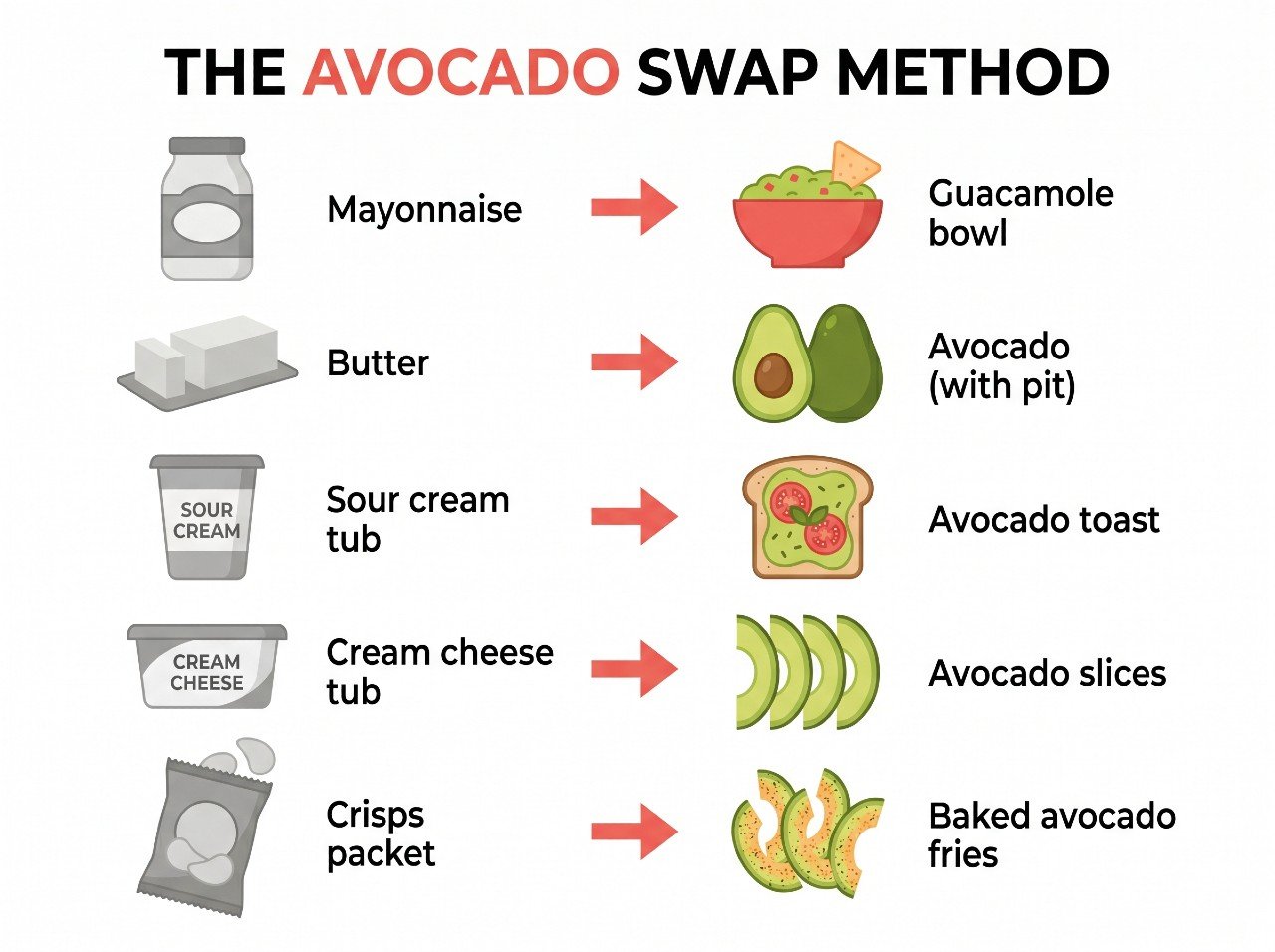
The Avocado Swap Method: Your 5-Food Framework
This is the practical framework I developed after watching women in their 40s struggle not with knowing avocado is healthy, but with actually replacing the less-helpful foods they're used to. The goal isn't to eat more — it's to eat differently.
The rule is simple: for each of these five foods, avocado is a drop-in replacement that cuts inflammatory fats, added sugars, or refined carbs while increasing satiety.
The Avocado Swap Table
| Swap Out | Swap In | Why It's Better |
|---|---|---|
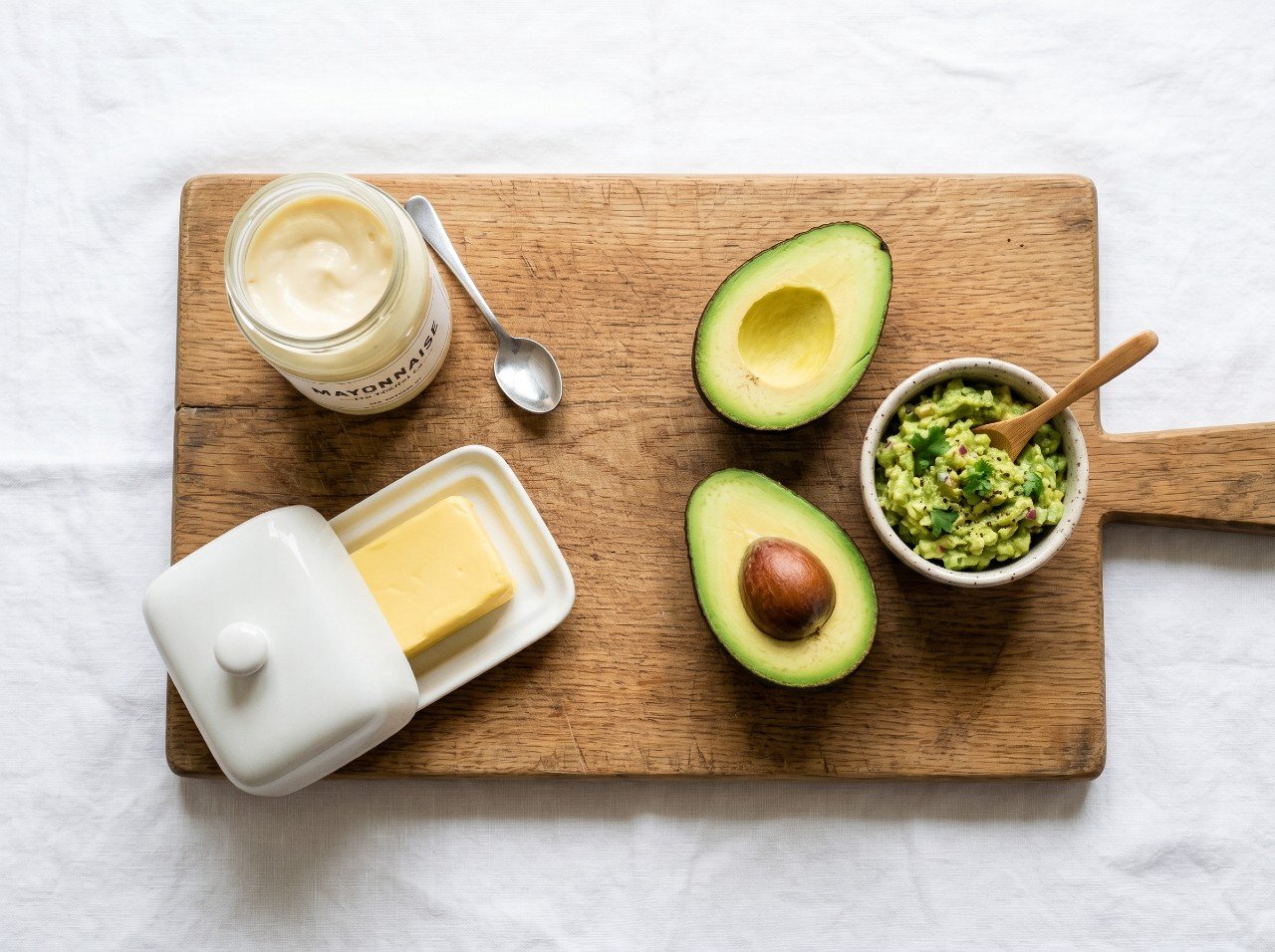
| 2 tbsp mayonnaise on a sandwich (188 kcal, 21g fat, 0 fibre) | 2 tbsp mashed avocado (50 kcal, 4.5g fat, 2g fibre) | Cuts calories by ~75%, replaces inflammatory omega-6 with oleic acid, adds fibre |
| 2 tbsp butter in baking (200 kcal, 23g saturated fat) | 2 tbsp avocado purée (60 kcal, 5.5g monounsaturated fat) | Eliminates saturated fat, keeps moisture, adds vitamin E |
| 1 cup sour cream dip (455 kcal, 44g fat) | 1 cup guacamole (235 kcal, 20g fat, 8g fibre) | Halves calories, adds fibre and folate, removes dairy saturated fat |
| Cream cheese on toast (100 kcal, 9g saturated fat) | ½ avocado on toast (114 kcal, 6.7g monounsaturated fat, 4.6g fibre) | Near-identical calories, dramatically better fat quality + adds 4.6g fibre |
| Afternoon bag of crisps (140 kcal, 8g fat, 0 fibre) | ¼ avocado with sea salt (58 kcal, 5g fat, 2.3g fibre) | Reduces insulin spike, provides actual satiety instead of a 30-minute fix |
The bottom line on swaps: you're not eating more. You're eating smarter. And because avocado suppresses appetite hormones for hours after eating, these swaps typically result in eating less overall — without hunger, restriction, or counting a single calorie.

How Many Avocados Should You Actually Eat?
Good news: the answer is simpler than most sources make it. Based on the clinical trial data:
- ½ to 1 avocado per day is the sweet spot consistently used in research showing weight and metabolic benefits.
- Spreading it across meals (½ at breakfast, ½ at lunch) maximises the satiety effect throughout the day.
- If you're using the swap method, you're likely replacing calories rather than adding them — so the calorie concern is largely moot.
Women managing their calorie intake: aim for ½ avocado per day as a starting point. If you're not counting calories and simply making quality swaps, up to 1 whole avocado daily is well-supported by the trial data.
Avocado And The Perimenopause Connection: Putting It All Together
Here's what that actually looks like in practice — how avocado maps directly onto the challenges your 40s body is dealing with:
| Perimenopausal Challenge | How Avocado Helps | Evidence Level |
|---|---|---|
| Visceral fat gain from oestrogen decline | Oleic acid reduces visceral adipose tissue in women | RCT (HAT Trial, n=1000+) |
| Insulin resistance / blood sugar swings | Low sugar + fat-fibre combo lowers post-meal insulin | RCT (satiety trial) |
| Cardiovascular risk increase | Reduces LDL by avg 3.75 mg/dL | Meta-analysis of 10 RCTs |
| Gut microbiome decline | Increases plant polysaccharide-fermenting bacteria | 12-week RCT |
| Relentless hunger and cravings | Elevates PYY + GLP-1 satiety hormones for hours | RCT |
| Bloating and water retention | Potassium counteracts sodium, reduces water retention | Nutritional physiology |
Ready to go deeper? Join the Women's Lean Body Formula newsletter for evidence-based strategies on strength, nutrition, and hormonal health — written specifically for women.
Want The Habits Behind Lasting Weight Loss? Get the free guide: 10 research-backed habits that help women lose body fat and keep it off, with no extreme diets. Send Me The Free Guide.
The Bottom Line
There is a reason avocado has survived every diet trend of the last decade — because the research keeps backing it up. For women in their 40s specifically, it's not just a "healthy food."
It targets the exact mechanisms that make weight loss harder after 40: visceral fat accumulation, declining insulin sensitivity, hormonal hunger dysregulation, and gut microbiome shifts.
You don't need to overhaul your diet. You need to make five strategic swaps, eat half an avocado consistently, and let the biology do the rest. That is the whole method.
Glossary Of Key Terms
- Visceral Adipose Tissue (VAT): Metabolically active fat stored deep within the abdominal cavity around internal organs; it is linked to increased inflammation and insulin resistance.
- Perimenopause: The transitional phase leading up to menopause, characterized by declining estrogen levels and shifts in metabolism and fat distribution.
- Oleic Acid: A monounsaturated fatty acid (the primary fat in avocados) known for activating fat oxidation pathways and supporting heart health.
- PYY and GLP-1: Satiety hormones released in the gut that signal the brain to feel full and satisfied, thereby regulating appetite.
- Monounsaturated Fats (MUFAs): Healthy fats found in avocados and olive oil that help lower LDL cholesterol and improve heart health markers.
- Insulin Sensitivity: The effectiveness with which the body uses insulin to reduce blood glucose; this sensitivity often declines during the perimenopausal transition.
- Plant Sterols: Natural compounds in plants that help block the absorption of cholesterol in the human gut.
- Gut Microbiota: The complex community of microorganisms living in the digestive tract; its diversity affects calorie extraction and blood sugar regulation.
- Potassium: An essential electrolyte that regulates blood pressure and fluid balance, helping to reduce water retention and bloating.
- Avocado Swap Method: A dietary strategy of replacing high-risk or low-nutrient foods (like mayo or butter) with avocado to improve fat quality and satiety.
FAQ
What Are The Main Benefits Of Avocado For Women Over 40?
The most clinically relevant benefits of avocado for women over 40 are visceral fat reduction, improved satiety hormone signalling (PYY and GLP-1), lower LDL cholesterol, better blood sugar regulation, and gut microbiome support. These target the exact physiological changes that make weight management harder during perimenopause. One clinical trial showed that women eating one avocado daily reduced visceral fat by 33g compared to a control group that gained 1.6g.
Will Eating Avocado Make Me Gain Weight?
This is one of the most common misconceptions about avocado. Despite being calorie-dense (around 230 kcal for a whole fruit), clinical trials consistently show that regular avocado consumption does not lead to weight gain — and in several studies, it supported weight loss. The fat-fibre combination suppresses appetite hormones for hours, reducing total calorie intake across the day. A National Health and Nutrition Examination Survey found that avocado consumers weighed an average of 7.5 lbs less than non-consumers.
How Does Avocado Help With Perimenopause Belly Fat?
The decline in oestrogen during perimenopause triggers a shift in fat storage towards the visceral (abdominal) area. Avocado's oleic acid — its primary monounsaturated fat — has been shown to specifically reduce visceral adipose tissue in women in the landmark HAT randomised controlled trial. It also lowers post-meal insulin, which is a key driver of abdominal fat storage when insulin sensitivity is declining.
How Much Avocado Should I Eat Per Day For Weight Loss Benefits?
Research consistently uses ½ to 1 whole avocado per day. Half an avocado per day is a good starting point — it provides 4.6g of fibre, 6.7g of monounsaturated fat, and meaningful satiety effects without adding excessive calories, especially if you're using the Avocado Swap Method to replace rather than add.
Can Avocado Really Lower Cholesterol?
Yes, and the evidence is strong. A 2024 GRADE-assessed meta-analysis of 10 randomised controlled trials found avocado consumption significantly reduced LDL cholesterol by an average of 3.75 mg/dL and systolic blood pressure by 1.15 mmHg. The mechanism: avocado's MUFAs and plant sterols displace saturated fat and block cholesterol absorption in the gut. This matters especially for women post-40, when cardiovascular risk increases as oestrogen declines.
Is Avocado Good For Blood Sugar?
Yes. Avocado has less than 1g of sugar per serving, and its fat-fibre combination blunts post-meal blood sugar spikes. Clinical trials show that including avocado in a meal results in lower post-meal insulin compared to higher-carbohydrate alternatives. For women in perimenopause managing declining insulin sensitivity, avocado is one of the smarter carbohydrate-displacement foods available.
What Is The Avocado Swap Method?
The Avocado Swap Method is a practical five-food framework developed for WLBF readers: replacing mayonnaise, butter, sour cream, cream cheese, and processed snacks with avocado equivalents. The goal is not to eat more avocado on top of your current diet, but to replace lower-quality fats and refined snacks with a food that actively improves your satiety hormones, gut health, and fat metabolism. See the full swap table above.