
Why Willpower Is The Wrong Tool: Science-Backed Secrets To Lose Weight Without Dieting Or Starving
James Clear
Atomic Habits
Stop trying to change your habits. Instead, change your environment.
Summary (TL;DR)
You don't need more willpower to lose weight — you need a smarter environment and a different strategy. This guide breaks down the behavioral science behind sustainable fat loss: mindful eating, environmental design, satiety-first nutrition, NEAT movement, and the hormonal levers most women never address. No calorie counting required.
I spent two years counting macros and hating every meal — and I still failed to hit my weight loss goals. Not because I wasn't trying hard enough. Because I was using the wrong tool entirely.
Willpower is a finite resource. Every "no" you say to a piece of cake, every hunger pang you white-knuckle through, drains it a little more. By the time the evening comes, it's gone — and that's when the fridge opens. If this sounds familiar, you're not weak. You've just been handed a broken strategy.
What the research actually shows is more interesting and more hopeful: dietary restraint itself elevates cortisol, the stress hormone linked to abdominal fat storage. In other words, the harder you try to diet through restriction, the more you may be working against your own biology. The fix isn't more discipline. It's a fundamentally different approach — one that works with your psychology, not against it.
That's what this guide is about. No deprivation, no counting, no all-or-nothing cycles. Just the seven behavioral science strategies that actually move the needle.
Medical & Referral Disclaimer
This article is for informational purposes only and is not a substitute for professional medical advice, diagnosis, or treatment. Always consult a qualified healthcare provider before making significant changes to your diet, exercise habits, or lifestyle. The strategies in this article are supported by the cited research — read it, and draw your own conclusions.
Key Takeaways
- Dietary restriction elevates cortisol — the very hormone that promotes abdominal fat storage. Willpower-based dieting is often physiologically counterproductive.
- Slowing your eating pace and eliminating distractions allows your brain's "fullness gap" to close, naturally reducing intake by up to 20% without any sense of deprivation.
- Switching from a 12-inch dinner plate to a 10-inch one reduces food intake by approximately 20% through the Delboeuf Illusion — a brain-perception trick, not a discipline trick.
- Protein reduces ghrelin (the hunger hormone) and raises GLP-1 and cholecystokinin — appetite-reducing hormones — leading to automatic calorie reduction.
- NEAT (Non-Exercise Activity Thermogenesis) can account for up to 2,000 calories per day difference between individuals, more than most structured exercise programs.
- Losing just 10% of your body weight produces measurable health outcomes, including a 50% reduction in joint pain and significantly improved mobility.
- Sleep loss triggers higher ghrelin and lower leptin simultaneously — a hormonal double-hit that makes cravings almost impossible to resist with willpower alone.
Video Overview
Why Everything You've Been Taught About Weight Loss Is Wrong
Most weight loss advice sets you up to fail before you've taken a single step. It's built on the assumption that the problem is you — your lack of discipline, your weak willpower, your poor choices. The research tells a different story.
Here's the contrarian truth: the conventional "eat less, move more, try harder" model doesn't account for the fact that dietary restraint has been shown to elevate cortisol — the stress hormone that specifically promotes fat storage around the abdomen. The more rigidly you try to restrict, the higher your cortisol climbs, and the harder your body fights to hold onto weight. It's a physiological trap, not a character flaw.
The long-term diet success numbers are sobering, too. While the often-cited "95% of diets fail" figure traces back to a 1959 study that's since been challenged, modern research from the American Psychologist found only about 20% of dieters successfully maintain a meaningful weight loss at one year — and the odds drop further beyond that. The problem isn't the people. It's the method.
Our modern environment is, in practice, designed for weight gain: ultra-processed foods engineered to override satiety signals, digital lifestyles that strip out incidental movement, and work-from-home schedules that erase even the marginal activity of commuting. The odds are structurally stacked against you.
The solution isn't to fight harder. It's to redesign the game.
The "Slow and Steady" philosophy — the framework this guide is built on — isn't a compromise or a consolation prize. It's an evidence-based system that respects your psychology, works with your hormones, and produces results that compound over months and years rather than collapsing after week three.

The Slow And Steady Framework
The Slow and Steady Framework is a 5-lever system for sustainable fat loss without restriction. Each lever targets a different mechanism — behavioral, environmental, nutritional, movement-based, or hormonal — so they compound rather than compete.
| Lever | What It Targets | Core Mechanic |
|---|---|---|
| 1. Mindful Eating | Behavioral — the "fullness gap" | Slow pace + remove distractions → brain catches up |
| 2. Environmental Design | Perceptual — visual portion cues | Smaller plate + contrast trick → 20% fewer calories |
| 3. Satiety-First Nutrition | Hormonal — ghrelin/GLP-1 | High protein + viscous fiber → automatic intake reduction |
| 4. NEAT Movement | Metabolic — daily calorie burn | Lifestyle movement > gym sessions for most women |
| 5. Internal Regulators | Hormonal — leptin/ghrelin/cortisol | Sleep + stress management → hunger switches balanced |
You don't need to activate all five levers on Day 1. Start with one. The compounding starts immediately.
The Science Of Mindful Eating
There is a 20-minute "fullness gap" between your stomach registering satiety and your brain receiving the signal. In a fast-paced meal, you can overshoot your actual hunger by hundreds of calories before the signal ever arrives. Mindful eating isn't a vague wellness concept — it's the practical technique for closing that gap.
Beyond pacing, practices like yoga develop a body awareness that carries directly into your relationship with food. Noticing when you're full — and actually stopping — is a skill, and it can be trained.
Mindful Eating Toolkit
- Chew thoroughly. Try counting 15–20 chews per bite. It slows the pace, physically aids digestion, and gives the brain time to register fullness before you've loaded another forkful.
- Use your non-dominant hand. If you're right-handed, try eating with your left. It breaks the "autopilot" eating mode and forces you to be present with every bite — sounds silly, works surprisingly well.
- Eliminate distractions. Phone face down, TV off. Research confirms that distracted eating impairs sensory feedback, delays fullness perception, and increases the likelihood of grazing within an hour of finishing a meal.
- Eat to 80%, not 100%. Before you reach for seconds, pause for five minutes. Most of the time, you'll find you're already done.
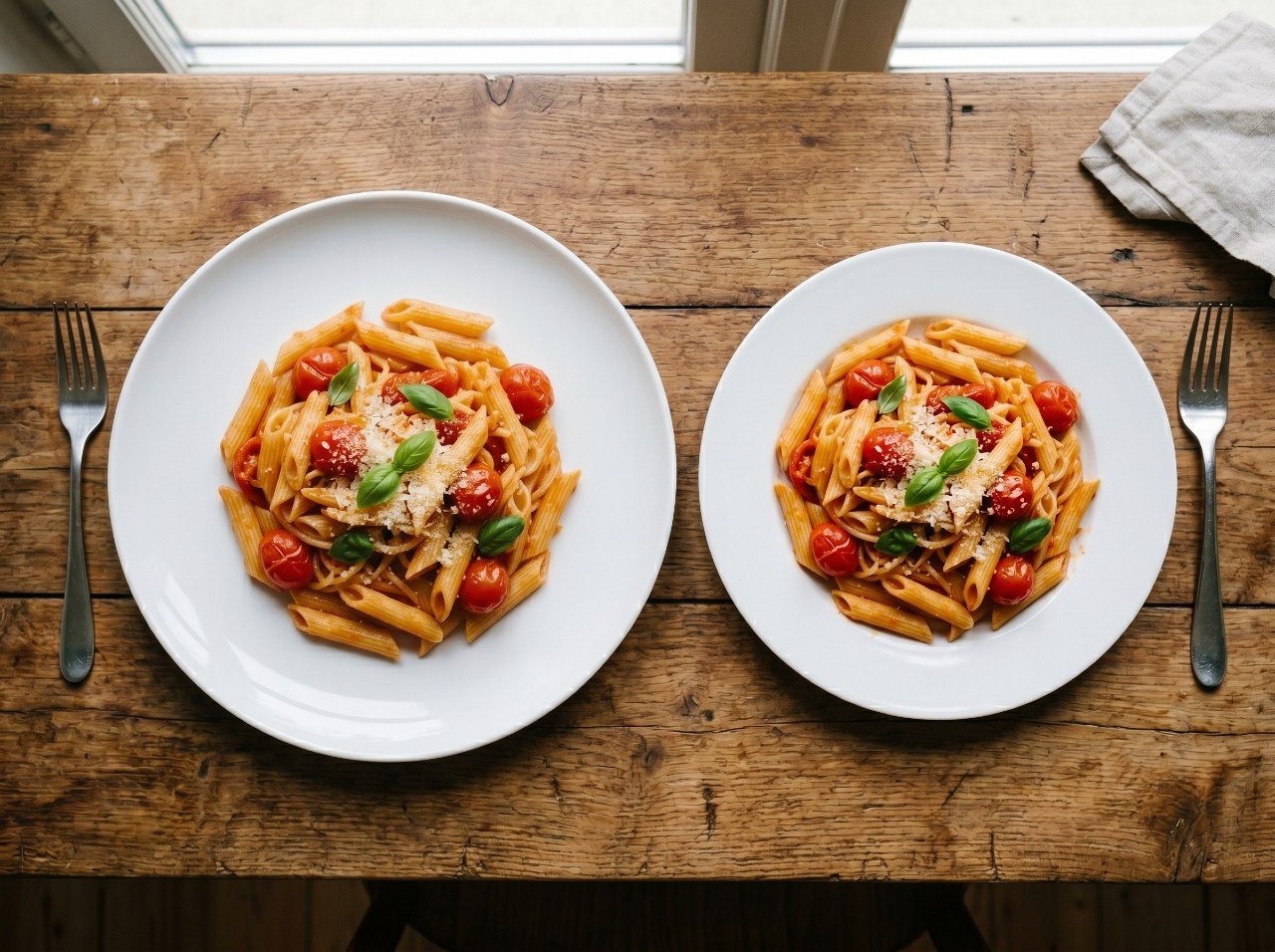
The "Smaller Plate" Optical Illusion: Trick Your Brain Into Fullness
Switching from a 12-inch dinner plate to a 10-inch one reduces food intake by approximately 20% — roughly 100–200 calories per meal — with zero sense of deprivation. This isn't portion control by willpower. It's the Delboeuf Illusion: the same portion of food looks larger on a smaller plate, and your brain uses visual cues — not stomach signals — to decide when you've had enough.
The same principle applies to drinks. Studies show that using a tall, thin glass instead of a short, wide one leads to consuming 25–30% less liquid — relevant if you're drinking juice, alcohol, or anything calorie-dense.
Environmental Hacks For Portion Control
| Environmental Cue | The Small Change | The Result |
|---|---|---|
| Plate size | Swap a 12-inch dinner plate for a 10-inch one | Reduces intake by ~20% (100–200 cal) without feeling deprived |
| Glass shape | Use a tall, thin glass instead of a short, wide one | Leads to consuming 25–30% less liquid calories |
| Visual contrast | Choose a plate color that contrasts with your food | Research shows you overserve when food matches the plate color |
| Food placement | Keep fruit and vegetables at eye level in the fridge | You eat what you see first — make the good choice the easy choice |
Tip: Doing something as simple as replacing one serving of soda a day with water or another low- or no-calorie drink can help you drop extra pounds — not through deprivation, but through a swap that barely registers.
Nutritional Foundations: Satiety Over Restriction
The goal isn't eating less. The goal is to eat foods that make you feel full on fewer calories. That's "energy density" — and shifting toward lower-density, higher-satiety foods is the most painless calorie reduction strategy available.
A practical anchor: aim for home-cooked meals at least five days a week. Use shortcuts — pre-cut vegetables, rotisserie chicken, batch-cooked grains — to keep it realistic.

The Satiety Secret: Why Protein Is Your Best Friend
Protein is the single most powerful dietary lever for managing hunger — and most women don't eat nearly enough of it. It works through multiple mechanisms simultaneously: it reduces ghrelin (the hunger hormone) and raises GLP-1 and cholecystokinin — both appetite-suppressing hormones — while also having a thermic effect of 20–30%, meaning your body burns roughly a quarter of the calories you consume in protein just digesting it.
Aim for 25–30 grams per meal. If breakfast is typically your weakest protein meal, Greek yogurt with berries is the easiest fix — 15–20 grams before 9 am sets you up for a fundamentally different appetite curve through the rest of the day.
Good protein sources: Greek yogurt, cottage cheese, eggs, lean meats, oily fish, lentils, chickpeas, quinoa, tofu.
The Viscous Fiber Factor
Not all fiber is created equal. Viscous fiber forms a thick gel in your gut that slows stomach emptying, delays nutrient absorption, and keeps you genuinely full for hours — not just "I technically ate" full, but "I'm not thinking about food" full.
Where to find it: Brussels sprouts, asparagus, oranges, flaxseeds, oats, and beans. Pairing viscous fiber with your protein at each meal creates a satiety effect that's difficult to replicate any other way.
Nourishing Whole Foods To Build Meals Around
- Lentils, beans, and chickpeas — exceptional combined protein and viscous fiber sources.
- Greek yogurt and cottage cheese — easy high-protein options that double as snacks.
- Quinoa and oats — complex carbohydrates with steady energy release.
- Asparagus, Brussels sprouts, and oranges — viscous fiber specifics.
- Lean proteins — chicken, fish, tofu for daily protein targets.
Beginner'S Guide To Natural Weight Loss
In a beginner's guide to natural weight loss, you will learn 10 healthy tips to help you achieve your weight loss goals in a kind, sane and sustainable way. Say goodbye to crazy diets — these simple, practical tips will help you transform your relationship with food, your body and your weight!
Precision Hydration
Your brain frequently misreads thirst as hunger. Drinking approximately 570ml (1 pint) of water 30 minutes before a meal has been clinically shown to increase meal-time satisfaction and reduce calorie intake. It's arguably the lowest-effort entry point in this entire guide.
If you're reaching for a snack and haven't had water in the last hour, drink a full glass first and wait five minutes. More often than not, the urge passes.
Smart Swaps: Eat This, Not That
| Instead of This | Try This | The Lean Body Benefit |
|---|---|---|
| Fruit juice or soda | Sparkling water with lemon | Saves 150+ calories, prevents insulin spikes |
| Flavored yogurt | Greek yogurt with berries | Doubles protein, cuts sugar by ~60% |
| White toast | Smashed avocado on sourdough | Healthy fats + fiber = fullness for 3+ hours |
| Potato chips | Air-popped popcorn or almonds | Same satisfying crunch, more volume, far more nutrients |
Movement As Lifestyle: The Power Of NEAT
The gym is optional. Movement isn't. And the distinction matters more than most fitness advice acknowledges.
Research by Dr. James Levine at the Mayo Clinic showed that NEAT — Non-Exercise Activity Thermogenesis, meaning all the calories you burn outside of structured exercise — can account for a difference of up to 2,000 calories per day between individuals. Lean people weren't doing more gym sessions. They were simply moving more throughout the day: standing, pacing, taking stairs, fidgeting.
Here's what makes this genuinely exciting: NEAT doesn't feel like exercise, and it doesn't require motivation. It just requires small decisions, made consistently.
Join Our Mailing List
Join thousands of women inside our community and receive our free guide, 10 Actions That Support Permanent Weight Loss — the exact behavioural shifts that make the difference between a two-week attempt and a lasting transformation.
No restriction plans. No guilt. Just what actually works — for real women with real lives.
10-Minute Movement Wins
- Brisk walking — one mile burns approximately 100 calories; a 20-minute post-meal walk also blunts the blood sugar spike from your last meal.
- The stair choice — every time, not just sometimes.
- Phone pacing — stand and walk during every call. No one knows, and the calories add up.
- Active chores — gardening, vacuuming, cleaning done at a pace count. Seriously.
- Desk breaks — set a timer for 45 minutes; stand up for 2–3 minutes. That's it.
The CDC and NHS recommend 150 minutes of moderate activity per week. That's 21 minutes a day. Break it into three 7-minute chunks, and you're there — without ever setting foot in a gym.
The Internal Regulators: Sleep, Stress, And Hormones
You can eat perfectly and move consistently and still struggle to lose weight if your internal hormones are working against you. Most diet advice ignores this entirely.
Here's the mechanism: Leptin signals fullness. Ghrelin triggers hunger. One night of poor sleep simultaneously lowers leptin and raises ghrelin — a double-hit that makes resisting cravings the next day genuinely physiologically difficult. It's not a willpower failure. It's hormonal arithmetic.
Research published in JAMA Internal Medicine found that sleeping just one extra hour per night was associated with losing up to 14 pounds in a year, without any other change. That's not a minor effect.
Cortisol, the stress hormone, adds a third layer: chronically elevated cortisol levels specifically promote abdominal fat storage, suppress metabolism, and — as noted earlier — are elevated by dietary restriction itself. Managing stress isn't a soft wellness add-on. It's a metabolic lever.
Sleep: Sleep Loss (<7 hours) = Higher Ghrelin + Lower Leptin = Increased Cravings. Target 7–9 hours.
Stress: Deep breathing, yoga, and brief mindfulness practice (even 5 minutes) measurably reduce cortisol. The mechanism is real, and the dose required is lower than most people assume.

Realistic Timelines And Success Strategies
Sustainable weight loss is 1–2 pounds per week. Not because you can't lose faster — you can — but because faster losses increasingly come from muscle and water rather than fat, and they collapse into rebound weight gain at a statistically predictable rate.
If you have a meaningful amount to lose, don't focus on the total. Focus on the first 10%. Losing just 10% of your starting body weight produces measurable health outcomes: a 50% reduction in joint pain, significantly improved mobility, better sleep, and improved metabolic markers. The first 10% is the highest-ROI target available.
| Quick Win | How |
|---|---|
| Pizza night | Swap meat toppings for extra vegetables — saves ~100 calories per slice |
| Snack urge | Sugarless mint gum redirects the oral fixation without calories |
| Coffee upgrade | Swap flavored syrups for cinnamon — saves 100–150 calories per cup |
| TV time | Stand or do light stretching rather than staying seated — free NEAT |
Your Success Checklist
- Consistency over perfection. One skipped workout, or one off-meal, doesn't change anything. Skipping the week after that is where progress erodes.
- The "Body Double" effect. Partnering with a friend or joining a support group increases the success rate by approximately 20%. Accountability is infrastructure, not motivation.
- One lever at a time. Don't overhaul everything in week one. Pick one swap — the 10-inch plate, the pre-meal water, the protein breakfast — and run it for two weeks before adding the next.
- Celebrate non-scale victories. Better sleep. Stable mood. More energy at 3 pm. These are the real markers of metabolic health, and they show up before the scale does.
Join thousands of women inside our community and receive our free guide: 10 Actions That Support Permanent Weight Loss — the practical, sustainable habits that translate everything you just read into real, lasting results.
No fad diets. No extreme plans. Just what the research actually supports — written for real women. Click here to join.
The Bottom Line
Willpower isn't the solution to weight loss — it's the symptom of a strategy that isn't working. When you stop fighting your biology and start designing around it — through environmental cues, satiety-first nutrition, lifestyle movement, and hormonal regulation — weight loss stops being a battle and starts being an outcome.
The Slow and Steady Framework isn't about restriction. It's about removing the friction between you and the behaviors that naturally produce a healthy weight. Small changes, compounded over months, produce results that a punishing six-week diet never will.
You don't have to change everything at once. Pick one lever. Run it for two weeks. Then add another. Which one starts today?
Glossary Of Key Terms
- Cortisol: A stress hormone that, when chronically elevated (often by dietary restriction), promotes abdominal fat storage and suppresses metabolism.
- Delboeuf Illusion: A visual perception phenomenon where the perceived size of a circle (or portion of food) changes based on the size of the area surrounding it.
- Energy Density: The number of calories in a specific weight of food; shifting toward lower-density, higher-satiety foods is a key strategy for painless calorie reduction.
- Ghrelin: Known as the "hunger hormone," it triggers the urge to eat and is often elevated by sleep deprivation.
- Leptin: The hormone responsible for signaling fullness to the brain; its levels can drop significantly following poor sleep.
- Mindful Eating: A behavioral technique involving slowing down and removing distractions during meals to better recognize internal satiety signals.
- NEAT (Non-Exercise Activity Thermogenesis): All the energy expended through daily movement that is not structured exercise, such as fidgeting, walking, and standing.
- Satiety: The state of feeling full and satisfied after eating, which prevents further food intake.
- Thermic Effect of Food: The amount of energy expenditure above the resting metabolic rate due to the cost of processing food for use and storage.
- Viscous Fiber: A type of soluble fiber that turns into a gel-like substance during digestion, slowing the emptying of the stomach.
FAQ
Is Losing Weight Without Dieting Really Possible?
Yes — and the research suggests it may be more effective long-term than traditional dieting. Restrictive diets elevate cortisol and deplete willpower; behavioral strategies that work with your biology produce results that compound over time rather than collapsing at the six-week mark.
How Can I Lose Weight Without Dieting And Still Feel Full And Satisfied?
Focus on the satiety trifecta: 25–30 grams of protein per meal, viscous fiber (beans, oats, leafy greens), and drinking water before meals. These three together reduce ghrelin, slow gastric emptying, and keep you genuinely full — not "technically fed" full.
Can I Still Exercise To Boost My Weight Loss Efforts?
Absolutely. But reframe the goal: formal exercise builds muscle and cardiovascular fitness; NEAT (everyday movement) is often the bigger fat-loss lever for most women. Aim for 150 minutes of moderate activity per week, broken into manageable daily chunks. The CDC and NHS guidelines both support this.
What Sleep Habits Help With Weight Loss?
Target 7–9 hours consistently. Even one hour less than your optimal sleep raises ghrelin and lowers leptin simultaneously — a hormonal setup for next-day cravings that's very difficult to override with willpower. A consistent sleep schedule (same wake time every day) is more impactful than occasional long sleep.
How Can I Manage Stress To Support My Weight Loss Goals?
Chronic stress elevates cortisol, which specifically promotes abdominal fat storage and is further worsened by dietary restriction. Even 5 minutes of deep breathing or mindfulness practice measurably lowers cortisol. Yoga combines the stress-management benefit with body-awareness that directly supports mindful eating.
What Mental Shifts Help Lose Weight Without Dieting?
The most important reframe: stop treating food decisions as a test of character. Every "failure" is information about your environment, not your willpower. Design your kitchen, your plate size, your food placement, and your meal timing to make the right choice, the automatic choice.
How Can I Lose Weight Without Following A Restrictive Diet?
The Slow and Steady Framework: (1) eat mindfully without distractions, (2) use smaller plates and tall glasses, (3) prioritize protein and viscous fiber, (4) add daily NEAT movement, and (5) protect your sleep. No calorie counting required. Start with one lever and add the next every two weeks.