

No Time To Cook? Here Is How To Lose Weight Without Spending Hours In The Kitchen
Practical Strategies For Losing Weight When You Have No Time To Cook

Healthy eating is a way of life, so it's important to establish routines that are simple, realistically, and ultimately liveable.
Arthur Agatston ‧ American cardiologist and celebrity doctor
Summary (TL;DR)
If you have no time to cook, you are not failing at weight loss. You are working inside a schedule that was never designed for elaborate meal prep. The research is clear: the women who lose the most weight are not the ones cooking the most.
They are the ones planning most consistently. This guide gives you a practical, evidence-backed system to build a lean-body nutrition strategy around your real life, including a 5-ingredient weekly fridge reset you can start this weekend.
The busy woman's playbook for eating well, dropping body fat, and reaching your lean body goals when life won't slow down
You open the fridge at 7 pm. You are exhausted. The kids are loud, the inbox is still full, and dinner needs to appear on the table in the next 15 minutes, or someone is ordering pizza. Again.
Sound familiar? If you are trying to lose weight but feel completely stuck on the cooking front, you are not alone, and you are not lazy. According to USDA Economic Research Service data, Americans average just 37 minutes per day on all food preparation and clean-up.
Factor in a job, a family, and a body navigating the hormonal shifts of perimenopause, and spending two hours cooking balanced meals every night sounds about as realistic as a mid-week spa day.
Here is what the fitness industry rarely tells you: the relationship between cooking time and weight loss is not what you think it is. The women who succeed at losing weight long-term are not the ones with elaborate Sunday meal prep marathons. They are the ones who have built a simple, repeatable system that works even on the hardest days of the week. This guide gives you exactly that.
Medical & Referral Disclaimer
This article is for informational and educational purposes only. It is not a substitute for personalized medical or nutritional advice. Always consult your healthcare provider or a registered dietitian before making significant changes to your nutrition approach, particularly during perimenopause or if you have any underlying health conditions.
Key Takeaways
- Women have spent an average of 71 minutes per day cooking consistently since 2003, yet a growing number still report feeling like they have no time to cook, pointing to a perception and scheduling gap rather than a time gap.
- A 2021 behavioral weight loss study found that greater meal planning frequency directly predicted greater weight loss outcomes, regardless of how much time participants spent cooking.
- No-cook "assembly meals" combining ready-made proteins, pre-washed greens, and fast carbs deliver the same nutritional value as cooked meals in under 5 minutes.
- Rotisserie chicken, canned salmon, cottage cheese, and pre-boiled eggs are the highest-leverage no-cook protein sources for busy women.
- A 20-minute weekly fridge reset (the 5-Ingredient Framework) eliminates decision fatigue and makes the healthy choice the easiest choice available.
- Time-restricted eating (12:12 or 14:10) is a research-backed strategy that reduces the number of meals you need to prepare without requiring calorie counting.
- Tiredness, stress, and low motivation to prepare food are recognized clinical barriers to balanced eating in perimenopause, not character flaws.
Video Overview
Why "No Time To Cook" Is A Real Barrier, Not A Moral Failing
Let's get one thing out of the way first.
Research on perimenopausal women identified tiredness, stress, and a lack of motivation to prepare nutritious meals as the top barriers to eating a balanced diet during this life stage. Not knowledge. Not willpower. Time pressure and depleted energy.
The standard fitness industry response to "I have no time to cook" is usually some version of "you just need to make it a priority" or "everyone has 30 minutes." That framing drops all the responsibility on you and none on the environment you are operating in. It also hands you a new reason to blame yourself every time life gets in the way, which it will, because that is what life does.
Your schedule is the constraint. A constraint, when you build a smart system around it, can actually make consistency easier, not harder.
Data from a 2023 analysis of the American Time Use Survey showed that women's average cooking time has stayed flat at approximately 71 minutes per day for two decades. We are not getting less efficient. We are just being asked to do more with the same amount of time.
Cooking more is not the answer. Designing a system that works with less cooking is.

Does More Cooking Time Actually Lead To Better Weight Loss?
Short answer: no. And the research behind this is more convincing than the meal prep influencers would like you to know.
A 2021 worksite-based behavioral weight loss study involving 139 participants (81.2% of them women, the majority living with overweight or obesity) found that greater average meal planning frequency was the strongest behavioral predictor of weight loss success. Not cooking complexity. Not time spent in the kitchen. Planning frequency.
The researchers' conclusion was direct: "Frequent meal planning should be emphasized as a continued, as opposed to intermittent, goal in behavioral weight loss programs to enhance weight loss."
A 2017 study of over 40,000 French adults reinforced this. People who planned their meals regularly were significantly more likely to meet nutritional guidelines and had meaningfully lower odds of being overweight or obese, regardless of how much time they spent cooking.
The contrarian take is that none of the meal prep accounts is selling you: spending 20 minutes planning what you will assemble this week is more valuable to your weight loss goals than spending 90 minutes cooking elaborate meals with no plan.
| Strategy | Weekly Time Investment | Weight Loss Impact |
|---|---|---|
| Elaborate cooking, no plan | 90+ minutes | Moderate (effort rarely sustainable) |
| Consistent meal planning, minimal cooking | 20-30 minutes | Strong (per Nicklas et al., 2021) |
| Assembly meals + simple protein anchor | 30-45 minutes | Strong (repeatable, low friction) |
| No plan, reactive eating every night | 0 minutes planning | Weak (drives poor default choices) |
Cooking is not the enemy. Cooking without a plan, when you are already stretched thin, usually is. For practical planning strategies that actually fit a busy schedule, explore our weight loss meal prep ideas for women.
The Assembly Method: Eating Well Without Actually Cooking
First, let's agree on a definition.
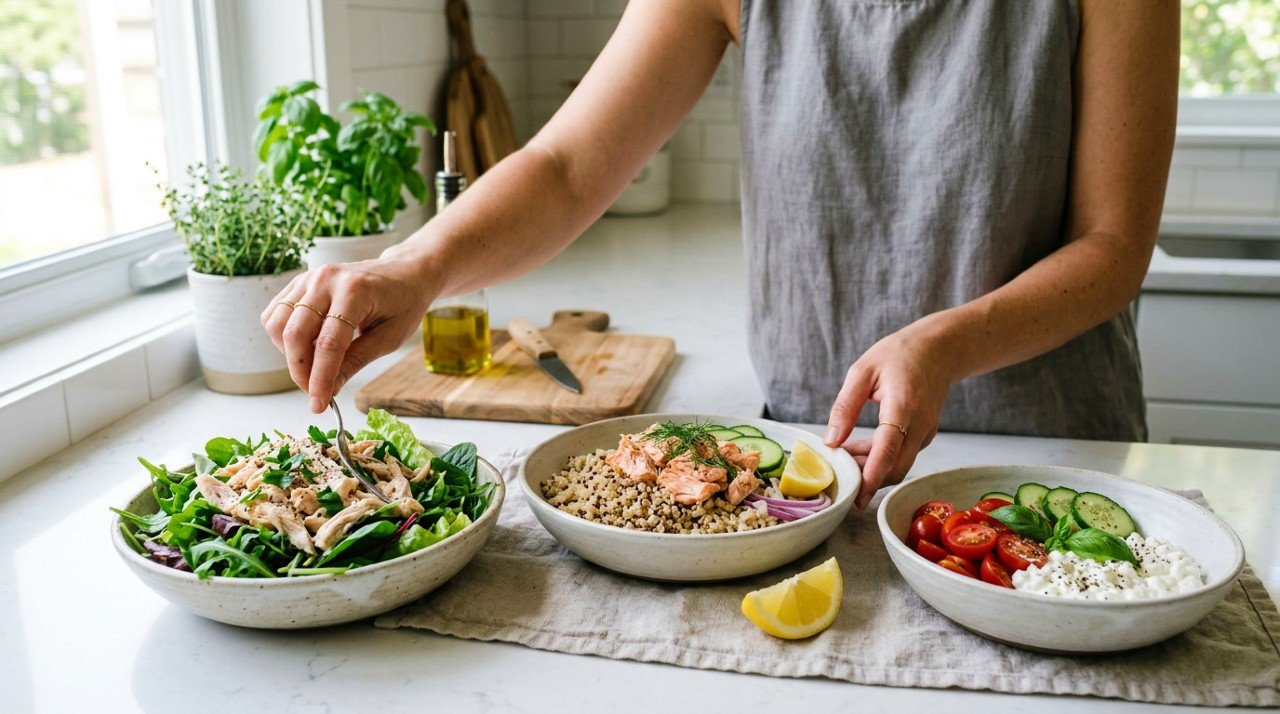
Cooking does not have to mean chopping, marinating, seasoning, and standing over a stove for 45 minutes. Assembly, combining ready-made, high-quality ingredients into a complete meal, produces the same nutritional outcome in a fraction of the time. And no, that is not cheating.
Think of it this way: a rotisserie chicken pulled apart over a bag of pre-washed mixed greens, topped with canned chickpeas and a drizzle of extra-virgin olive oil, is not a "lazy" meal. It is a lean-body meal that took four minutes to assemble.
A three-ounce serving of rotisserie chicken delivers approximately 24 grams of protein and just 2.5 grams of fat, which is the same nutritional profile you would get from a chicken breast you marinated, seasoned, and grilled yourself.
The assembly method runs on three pillars:
- Pillar 1: Ready Proteins. These are your no-cook anchors. Rotisserie chicken, canned salmon, canned tuna in olive oil, pre-boiled eggs (buy them ready-made or batch-boil six on Sunday), cottage cheese, and plain Greek yogurt. Each delivers 20 grams of protein or more with zero cooking.
- Pillar 2: Pre-Washed Greens and Vegetables. Bags of spinach, arugula, and mixed salad leaves; pre-cut stir-fry vegetable mixes; cherry tomatoes; and shredded coleslaw bags. Zero prep required. Into the bowl they go.
- Pillar 3: Fast Carbohydrates. Microwavable brown rice pouches (ready in 90 seconds), pre-cooked puy lentil packs, canned beans, and wholegrain wraps. Again, no cooking involved.
The result: a macronutrient-balanced meal in under five minutes. Our comprehensive healthy meal plans for busy lives can help you build out a full week of assembly meal options.

What Should You Eat When You Have No Time To Cook?
Prioritize high-protein, low-prep foods that you combine rather than cook. Aim for 25 to 35 grams of protein per meal using ready-made sources, then add a pre-washed green and a fast carb (microwave rice or canned beans). This three-part assembly covers your macronutrient bases in under five minutes and takes the guesswork out of the equation entirely.
Why does protein matter so much here? Research published in Nutrition & Metabolism confirms that higher protein intake preserves lean muscle mass and reduces the drop in satiety during a calorie deficit.
For women over 40 dealing with the metabolic changes of perimenopause, this is especially important. Muscle is a metabolically active tissue. Holding onto it while losing fat keeps your resting calorie burn higher over time.
Here is a practical "no time to cook" meal guide you can screenshot and take to the supermarket:
| Meal | Ready Protein | Pre-Washed Veg | Fast Carb | Protein Total | Assembly Time |
|---|---|---|---|---|---|
| Rotisserie Chicken Bowl | Shredded rotisserie chicken | Mixed greens + cherry tomatoes | Microwave brown rice pouch | ~34g | 4 minutes |
| Greek Tuna Wrap | Canned tuna in olive oil | Baby spinach + sliced cucumber | Wholegrain wrap | ~29g | 3 minutes |
| Cottage Cheese Power Bowl | Full-fat cottage cheese | Cherry tomatoes + sliced avocado | Rye crispbreads | ~26g | 3 minutes |
| Salmon and Lentil Salad | Canned wild salmon | Arugula + shredded coleslaw | Pre-cooked puy lentil pack | ~32g | 5 minutes |
| Egg and Bean Burrito | Pre-boiled eggs, sliced | Baby kale | Canned black beans + wrap | ~28g | 5 minutes |
For a deeper look at building a protein-centered approach that supports fat loss, read our high-protein diet plan for sustainable weight loss for women.
How Can Meal Timing Help When You Have No Time To Cook?
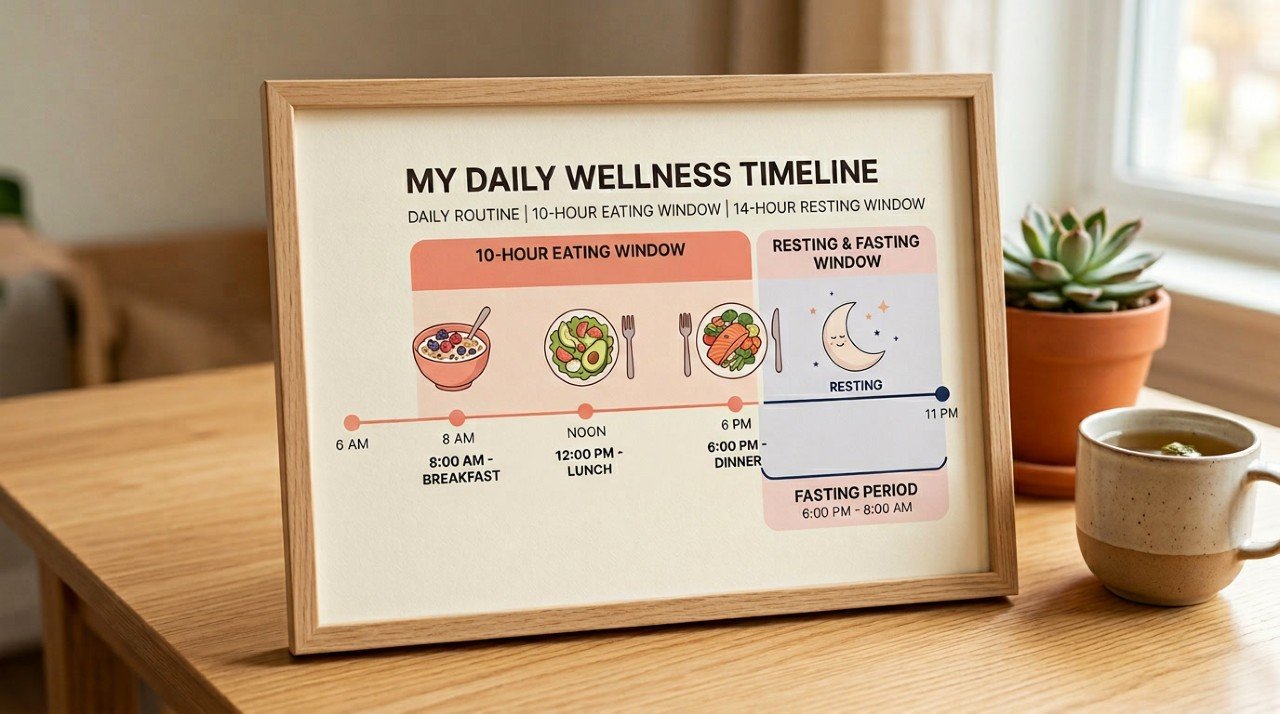
Time-restricted eating (TRE) is the most time-efficient strategy in this scenario. By limiting your eating to a consistent 10 to 14-hour window each day, such as 8 am to 6 pm or 8 am to 8 pm, you reduce the total number of meals you need to assemble from five to six per day down to two or three. No calorie counting required.
A 2025 systematic review on intermittent fasting and menopause confirmed that time-restricted eating is a promising strategy for weight management and hormonal balance in menopausal women. A separate study of perimenopausal and postmenopausal women found that both groups lost approximately 3.3% of body weight over eight weeks of time-restricted feeding, with participants adhering to their eating window on an average of 6.2 days per week, which is excellent real-world compliance.
The practical win for the time-pressed woman: fewer meals means fewer food decisions per day. If you are eating within a 10-hour window, you are planning two to three meals rather than five to six. That is a significant reduction in both kitchen time and cognitive load.
A note on perimenopause specifically: hormonal fluctuations during this stage can make aggressive fasting windows feel more stressful for some women. The gentlest starting point is a 12:12 window, which means finishing dinner by 8 pm and not eating breakfast until 8 am.
Most women are already doing something close to this without realizing it. Do not use time-restricted eating as a form of restriction or a test of willpower. Use it as a structural frame that reduces the number of decisions you need to make.
For more perimenopause-specific nutrition guidance, read our article on how to lose weight during perimenopause without starving yourself.
The 5-Ingredient Fridge Reset: Your 20-Minute Weekly Framework
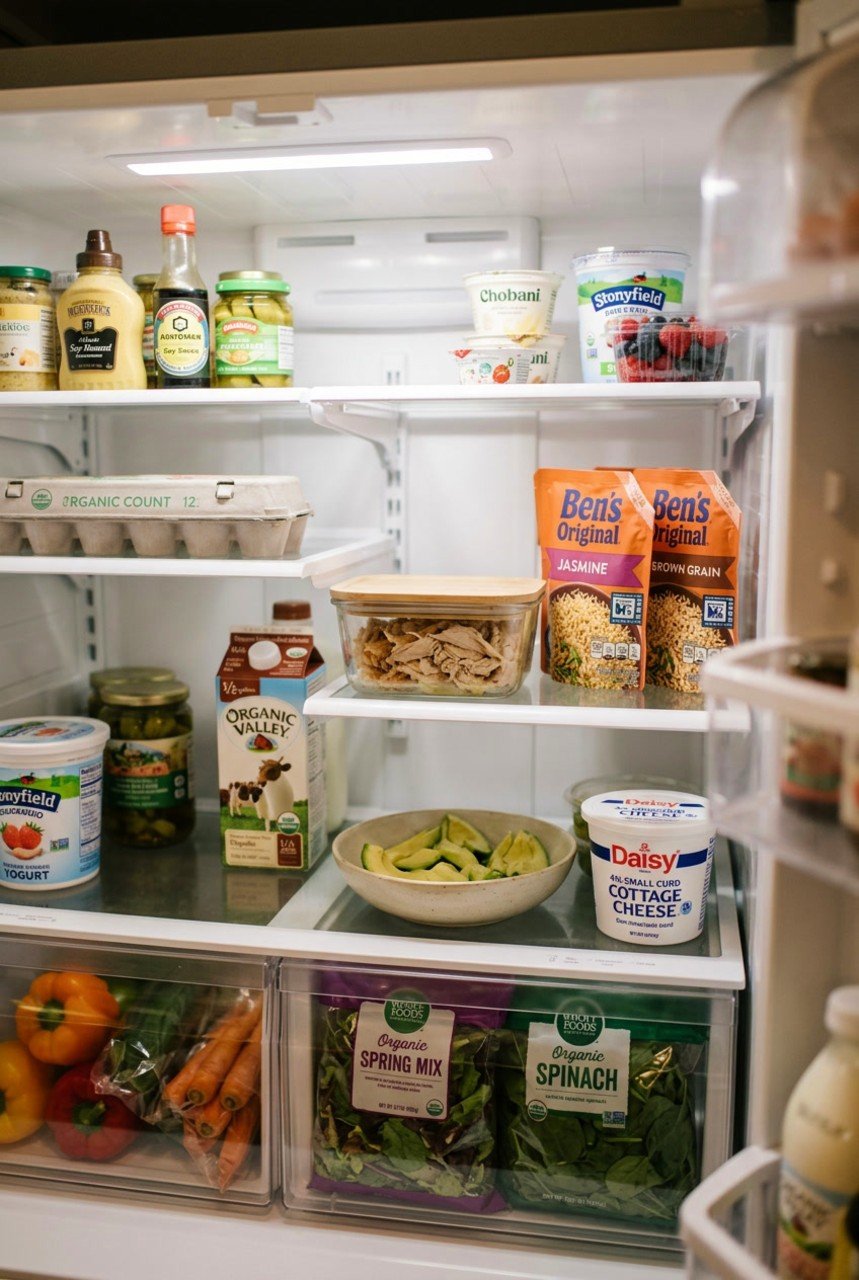
Everything else in this guide depends on this. Not a meal prep routine. Not a recipe collection. Just a weekly kitchen reset that takes 20 minutes and means you never have to stare blankly at a fridge again, wondering what to eat.
Spend 20 minutes on Sunday (or whichever day is quietest) stocking five pairs of ingredients. That is it. Five pairs. Here is how it works:
- Step 1: Stock 2 Ready Proteins. Rotisserie chicken (from any supermarket deli section) plus one other: a can of salmon, a tub of cottage cheese, or a batch of pre-boiled eggs. These are your week's protein anchors.
- Step 2: Stock 2 Pre-Washed Greens or Veg Bags. Mixed salad leaves plus one other option: pre-cut stir-fry vegetables, baby spinach, or a shredded coleslaw bag. No washing, no chopping.
- Step 3: Stock 2 Fast Carbs. Microwave brown rice pouches plus wholegrain wraps, or canned chickpeas plus rye crispbreads. Again, zero cooking involved.
- Step 4: Add 2 Healthy Fats. A ripe avocado, a bottle of extra virgin olive oil, or a small jar of hummus. These provide satiety and prevent meals from feeling sparse.
- Step 5: Set Up 1 Snack Station. A bowl of fruit on the counter (visible equals accessible), a container of mixed nuts in the cupboard, or portioned plain Greek yogurt in the fridge. Make the smart snack the easiest thing to grab.
Five pairs of items, 20 minutes of shopping and organizing, and you have a full week of balanced, lean-body meals on demand. No recipe. No stove. No willpower required. For more ideas to fill your snack station, explore our guide to healthy snacks for weight management.
How Do You Stay Consistent When You Have No Time To Cook?
Consistency doesn't come from having more willpower at 7 pm. It comes from removing friction before you even need willpower.
The women who eat well long-term have one thing in common: their environment makes the good choice easier than the bad one. A stocked fridge and a reliable backup plan beat a complicated meal plan you can follow for three days out of seven, every single time.
A longitudinal study tracking healthy eating over 36 months found that participants who used a structured food planning system maintained significantly better dietary adherence and weight loss outcomes than those without one. The system did not have to be elaborate. It just had to exist.
Three things that actually work:
- The Default Dinner Rule. Choose one "default dinner" that you can always fall back on. An assembly meal that takes under five minutes and whose ingredients are always in your fridge. When you are exhausted and your decision-making capacity is depleted by 7 pm, you do not have to think. You execute the default. A rotisserie chicken bowl with mixed greens and microwave rice is a strong default. So is Greek yogurt with fruit and a handful of nuts. Simple, repeatable, done.
- The Weekend Breakfast Anchor. Spend 15 minutes once a week preparing four portions of overnight oats or chia seed pudding in small jars. Your breakfasts are handled until Thursday with zero additional weekday effort. For hormone-supportive breakfast strategies that complement this, read our guide on what women should eat in the morning for hormone balance and fat loss.
- The Healthy Takeout Pivot. There will be nights when even a five-minute assembly feels impossible. That is not a failure state. That is Tuesday. Have a "healthy takeout list" ready: three or four local restaurants that offer grilled protein, salads, or grain-based options. Ordering well is a practical skill that belongs in your toolkit right alongside the 5-Ingredient Fridge Reset.
Want practical strategies like this in your inbox every week? Join our newsletter for evidence-based tips designed around real women's real schedules.
Want The Habits Behind Lasting Weight Loss? Get the free guide: 10 research-backed habits that help women lose body fat and keep it off, with no extreme diets. Send Me The Free Guide.
The Bottom Line
Having no time to cook is not a weight loss sentence. It's a constraint. And you're allowed to build your nutrition strategy around the life you actually have, not the one where you have two spare hours on a Tuesday evening.
The women who lose weight and keep it off are not the ones with elaborate kitchen routines. They are the ones who stopped waiting for the perfect conditions and built something that works on the hard days too.
Your lean body doesn't need a chef's kitchen. It needs a stocked fridge, two or three go-to assembly meals, and the willingness to treat a 70% week as a win, because it is one.
Start with the 5-Ingredient Fridge Reset this weekend. Twenty minutes. That's all. Stop waiting for things to slow down, because they will not, and you deserve to feel good right now.
Glossary Of Key Terms
- Assembly Method: A nutrition strategy focused on combining ready-made, high-quality ingredients into complete meals to achieve the same nutritional outcomes as cooked meals in a fraction of the time.
- Decision Fatigue: The decline in the quality of decisions made by an individual after a long period of decision-making, which often leads to poor dietary choices in the evening.
- Default Dinner Rule: A consistency strategy involving a pre-selected, five-minute meal that requires no decision-making, used as a fallback for high-stress or low-energy nights.
- Fast Carbohydrates: Pre-prepared or quick-cooking energy sources, such as microwavable grain pouches, canned beans, or wholegrain wraps, used to complete a balanced meal quickly.
- Five-Ingredient Fridge Reset: A 20-minute weekly organizational framework for stocking a kitchen with pairs of protein, vegetables, carbohydrates, fats, and snacks.
- Perimenopause: A life stage characterized by hormonal shifts that can increase stress, tiredness, and metabolic changes, making muscle preservation and satiety critical for weight management.
- Ready Proteins: High-protein, no-cook food sources such as rotisserie chicken, canned fish, pre-boiled eggs, or Greek yogurt that serve as the anchor for assembly meals.
- Satiety: The feeling of fullness and satisfaction after eating, which can be preserved during weight loss by maintaining high protein intake.
- Time-Restricted Eating (TRE): A meal-timing strategy that limits food consumption to a consistent daily window (e.g., 10 to 14 hours) to reduce the number of required food decisions.
- USDA Economic Research Service Data: Statistical information cited to show that Americans average only 37 minutes per day on total food preparation and clean-up, highlighting the need for efficient nutrition systems.
FAQ
Is It Actually Possible To Lose Weight Without Cooking?
Yes. Weight loss depends on consistent nutrition quality and a sustainable calorie deficit, not on whether your meals are cooked or assembled. Research confirms that meal planning frequency, not time spent cooking, is the strongest behavioral predictor of weight loss success. By assembling high-protein, nutrient-dense meals from ready-made ingredients (rotisserie chicken, canned fish, pre-washed greens, and fast carbs like microwave rice), you can achieve the same nutritional outcome as a cooked meal in under five minutes. Many women find that removing the pressure to cook actually improves their consistency, because the barrier to eating well is genuinely lower.
What Are The Best High-Protein Foods That Need No Cooking?
The most effective no-cook protein options for fat loss include rotisserie chicken (approximately 24g of protein per 3oz serving), canned wild salmon (around 23g per serving), canned tuna in water or olive oil (20 to 25g per serving), pre-boiled eggs (6g per egg), full-fat cottage cheese (14g per half cup), and plain Greek yogurt (15 to 17g per cup). These are all fridge-ready or shelf-stable and require zero preparation time. Combining two in one meal (such as eggs with cottage cheese) easily delivers the 25 to 35g of protein per meal that research links to better satiety and lean mass preservation during a calorie deficit.
How Can I Plan Meals Without Spending Hours Every Week?
The most efficient approach is the 5-Ingredient Fridge Reset. Once per week, spend 20 minutes stocking two ready proteins, two pre-washed vegetable bags, and two fast carbs (microwave pouches or canned options). This sets you up for five to seven days of balanced, no-cook assembly meals without any further daily planning. A 2021 behavioral weight loss study found that even simple, consistent meal planning significantly predicts better weight loss outcomes compared to more elaborate but less consistent approaches. The goal is not a detailed weekly menu. It is a stocked kitchen that makes good choices automatic.
Does Time-Restricted Eating Help Women Over 40 Lose Weight?
Evidence suggests yes, particularly when using a gentle 12:12 or 14:10 eating window. A 2025 review of intermittent fasting research in menopausal women found that time-restricted eating is a promising strategy for both weight management and hormonal balance. A separate clinical study found that perimenopausal and postmenopausal women both lost approximately 3.3% of body weight over eight weeks of time-restricted feeding, with excellent real-world compliance. The practical advantage for busy women is structural: fewer meals means fewer food decisions per day, which reduces both kitchen time and decision fatigue. Start with a 12:12 window (finish dinner by 8 pm, eat breakfast at 8 am) and monitor how your body and energy levels respond.
Why Do I Always Reach For Junk Food By Evening, Even When I Know Better?
This is a decision fatigue and cognitive load issue, not a willpower failure. By the end of a demanding workday, your brain has processed hundreds of decisions and its capacity for effortful choosing is genuinely depleted. Research on behavioral weight loss consistently shows that default behaviors take over when cognitive resources are low, which is exactly why people reach for whatever is easiest and most immediately rewarding by 7 pm. The solution is environmental design. Stock your fridge with ready-to-eat proteins and pre-washed greens. Move ultra-processed snacks out of easy reach. Prepare your default dinner ingredients in advance. When the path of least resistance leads to a protein bowl rather than a bag of crisps, you do not need willpower at all.
Are Store-Bought Convenience Foods Acceptable For Weight Loss?
Yes, with a couple of considerations. Rotisserie chicken, canned fish, microwavable grain pouches, pre-washed salad bags, and tinned legumes are all minimally processed whole foods that fit comfortably into a lean-body nutrition strategy. The two things worth checking on labels are sodium content (rotisserie chickens and some canned goods can be high; look for low-sodium canned options where possible) and added sugars (watch for these in pre-made dressings, flavored yogurts, and packaged sauces). Beyond those two checks, there is no meaningful nutritional difference between a meal you cooked from scratch and one assembled from high-quality ready-made components.
How Much Should I Eat Per Day If I Am Not Cooking Big Meals?
There is no single number that applies to every woman, because energy needs depend on height, current weight, activity level, and hormonal status. A practical starting framework for women over 40 supporting fat loss is three balanced meals per day, each containing 25 to 35g of protein, one to two cups of non-starchy vegetables, and a moderate portion of smart carbs (roughly half a cup of cooked grain or one serving of legumes). This structure covers your nutritional needs without requiring precise calorie tracking. For personalized guidance, a registered dietitian who specializes in women's health and perimenopause is the most effective resource. For a general framework to start from, our healthy meal plans for busy lives are a strong starting point.