Unlocking The Psychology Of Weight Loss: A Framework Built On Matching The Method To The Woman

Psychology is much bigger than just medicine or fixing unhealthy things. It’s about education, work, marriage – it’s even about sports. What I want to do is see psychologists working to help people build strengths in all these domains.
Martin Seligman ‧ Founder of Positive Psychology
Summary (TL;DR)
The psychology of weight loss isn’t one thing — it’s four different eating patterns, each needing a different fix. Stress eaters need emotion-regulation tools, not meal plans. All-or-nothing dieters need to interrupt perfectionism, not try harder. Habit-driven eaters need environment redesign. Restrained, diet-culture-worn eaters often need to eat more intuitively, not less. Generic “eat less, move more” advice fails because it applies one tool to all four patterns. Find your pattern below, and use the tools built for it.
If you’ve read every weight loss psychology tip on the internet and still find yourself stuck, frustrated, or quietly convinced something is wrong with your willpower — you’re not broken, and you’re not alone.
Wherever you are in your weight loss journey, you’ve likely tried numerous diets and exercise programmes already, done everything “right,” and still ended up back at square one, wondering what everyone else seems to know that you don’t.
Here’s what the last few years of behavioural research have made clear: the missing piece usually isn’t more discipline. It’s that most weight loss advice is written for a single, imaginary “average” eater — and almost none of us actually eat that way.
New 2026 research on phenotype-matched interventions, reviewed below, backs this up directly: women who get a psychological approach matched to their actual eating pattern do measurably better than women handed the same generic advice everyone else gets.
That’s the real psychology of weight loss — not a single mindset trick, but a matching problem. This guide walks through the four eating psychology patterns behind most stalled weight loss, the research-backed tool built for each one, and where the emotional side — the intimidation, the frustration, the confusion — actually comes from.
Medical & Referral Disclaimer
This article is for informational and educational purposes only. It is not a substitute for professional medical or psychological advice, diagnosis, or treatment. Always consult your physician or a qualified mental health provider before starting any new diet, exercise, or therapeutic program, and reach out to a licensed therapist if disordered eating patterns are affecting your health.
Key Takeaways
- Weight loss psychology research increasingly points to matched, not generic, interventions — a 2026 quasi-experimental trial found emotion-focused therapy roughly halved emotional eating scores, while standard support left them essentially unchanged.
- Most stalled weight loss traces to one of four eating psychology patterns: emotional/stress eating, all-or-nothing dieting, habit-driven eating, or diet-culture restraint-and-rebound.
- Willpower isn’t the missing ingredient. A 2020 stress-hormone study found people carrying excess weight eat significantly more under stress than leaner peers — a physiological difference, not a character flaw.
- Cognitive Behavioural Therapy (CBT) and goal-setting techniques show the strongest evidence overall, per a 2025 meta-analysis of 47 studies and 6,729 participants.
- New habits take a median of 59–66 days to become automatic, not 21 — so the “why isn’t this easier yet” feeling most women hit around week three is expected, not a sign of failure.
- Self-sabotage runs in two directions: University of Surrey research documents external “collusion” from friends and family, while newer research points to an internal identity mismatch — especially right as progress becomes real.

Why Willpower Isn’t The Problem, And Generic Advice Keeps Failing You
Willpower isn’t the problem — it’s a real, finite resource, not a personality trait you either have or don’t. If “just try harder” actually worked, it wouldn’t be the most-repeated weight loss advice in existence and also the least effective.
Most of what gets labelled a lack of discipline is actually one of a few specific mental blocks to losing weight — a stress response, an all-or-nothing thought pattern, an environment working against you — and each one has a different fix.
Part of the reason generic advice fails is physiological, not motivational. A study published in Translational Psychiatry put 36 women with obesity and 36 healthy-weight women through a standardised lab stress test, then measured how much they ate afterward.
Women with obesity who reacted strongly to stress (measured by cortisol response) ate significantly more after the stress test than women with obesity who reacted mildly — while healthy-weight women showed no significant difference in eating either way.
In plain terms: stress-driven overeating disproportionately affects women who are already carrying more weight, and it’s a measurable hormonal response, not a discipline gap. Telling a high cortisol-reactivity woman to “just resist the cravings” ignores the actual mechanism at play.
The other reason generic advice fails is more social than biological. Research from the University of Surrey, led by health psychologist Professor Jane Ogden, identified three distinct ways people around you can undermine weight loss without ever meaning to: sabotage (discouraging healthy choices), feeding behaviour (offering food when you’re not hungry or are trying to cut back), and collusion (going along with old habits under the guise of kindness).
If your environment is quietly working against your goals, no amount of internal willpower fixes that on its own — the fix has to include the environment, not just the mindset.
Mental & Physical Health Are Closely Linked
There’s a second kind of sabotage worth naming: the kind you do to yourself, often right as progress becomes real. A 2025 review of 47 studies and 6,729 participants found resolving these “incompatible beliefs” — the mismatch between your self-image and the identity your progress demands — among the strongest predictors of lasting change. More in the FAQ below.
This is why one-size-fits-all psychology advice keeps failing smart, capable women, and why willpower alone so often fails: it’s solving the wrong problem for a lot of readers. The real starting point isn’t “try harder.” It’s figuring out which pattern is actually driving your stuck points — the same shift that weight loss mindset work starts with.
- You’re not imagining the difficulty. Stress-driven overeating has a measurable hormonal component for many women, confirmed in controlled lab conditions, not just self-report.
- Your environment counts as much as your mindset. Sabotage and collusion from people close to you are documented, common barriers — not a sign you’re not trying hard enough.
- Generic advice was never built for your specific pattern. The fix isn’t more of the same tool, applied harder — it’s the right tool for what’s actually driving your eating.
The Four Eating Psychology Patterns: Find Yours First
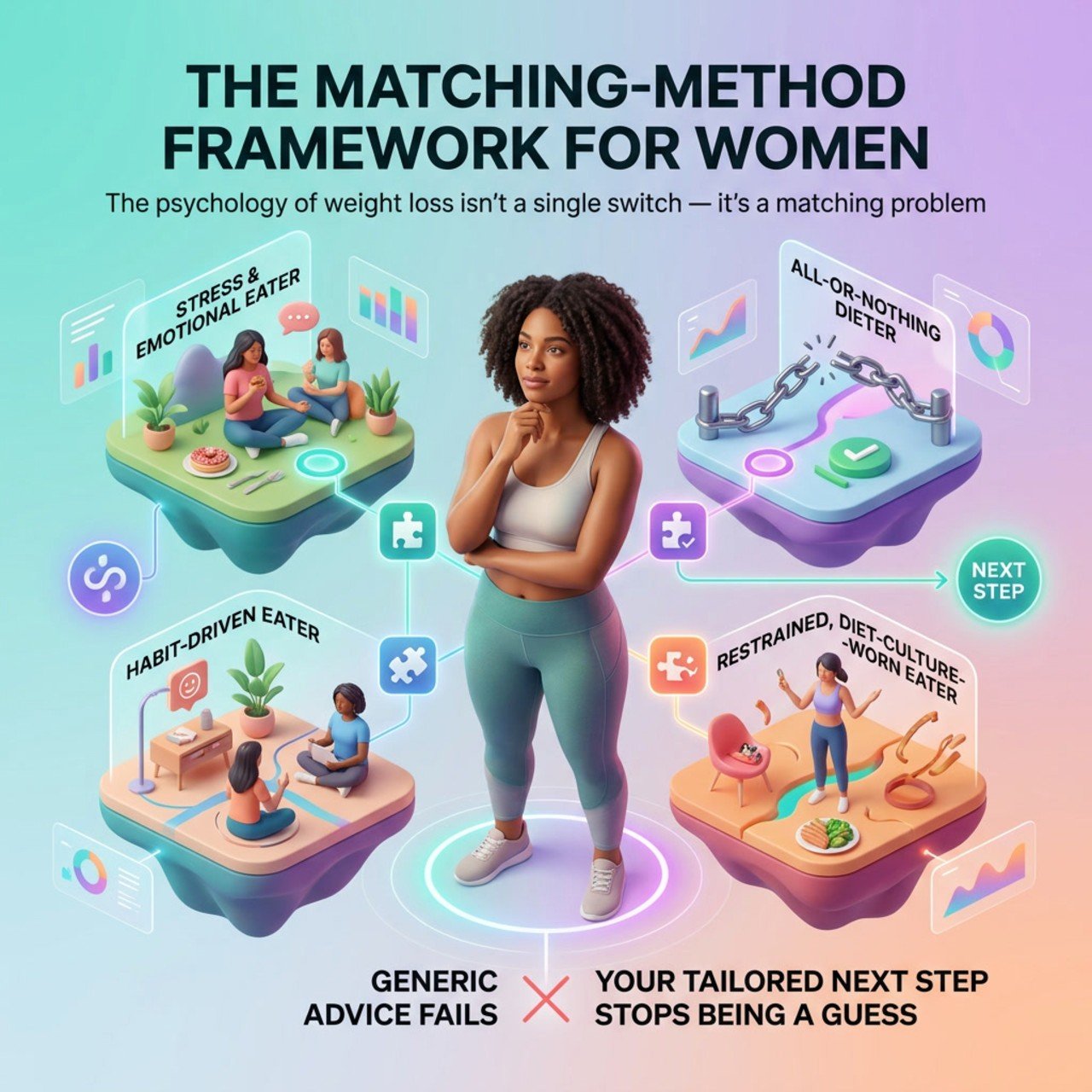
The four eating psychology patterns behind most stalled weight loss are stress-and-emotional eating, all-or-nothing dieting, habit-driven eating, and diet-culture restraint-and-rebound.
Most women recognise themselves in one or two more than the others — none of them is a diagnosis. They’re a starting point for matching your effort to the right tool.
#1. The Stress-And-Emotional Eater
Food becomes the fastest available way to soothe a hard feeling — stress, loneliness, boredom, overwhelm. A 2026 qualitative study of women with obesity in Iran described this as a self-perpetuating “emotional eating cycle.” Eating functions as self-soothing and a sense of control in the moment.
That can tip into loss-of-control or secretive eating, reinforced by an environment where food is constantly available — which then produces guilt and lower self-efficacy, feeding the next round of emotional eating. It loops rather than resolves on its own.
#2. The All-Or-Nothing Dieter
One “bad” meal turns into a written-off day, which turns into a written-off week. This pattern is less about food and more about rigid, black-and-white thinking — a single lapse gets treated as total failure instead of a normal blip, which makes minor setbacks feel like reasons to quit entirely.
#3. The Habit-Driven, Environment-Led Eater
Eating happens on autopilot — the 9 pm kitchen visit, the drive-through on the commute home, the office candy dish — triggered by a cue in the environment rather than genuine hunger or a strong emotion. This pattern responds best to redesigning the cue, not fighting the craving in the moment.
#4. The Restrained, Diet-Culture-Worn Eater
Years of restriction, rules, and diet-hopping have disconnected this pattern from its own hunger and fullness cues, often producing a restrict-then-rebound cycle. This is frequently the pattern behind “I know exactly what to eat, I just can’t stick to it” — because the rules themselves, not a lack of knowledge, are the problem.
| Eating Psychology Pattern | What It Looks Like | Best-Matched Tool |
|---|---|---|
| Stress-and-emotional eater | Eating to soothe a feeling, not hunger | Emotion-regulation skills (DBT-informed), stress-response awareness |
| All-or-nothing dieter | One lapse triggers total quitting | Cognitive Behavioural Therapy (CBT) – reframing all-or-nothing thoughts |
| Habit-driven, environment-led eater | Autopilot eating triggered by cues | Cue-routine-reward redesign, habit-formation pacing |
| Restrained, diet-culture-worn eater | Restrict-then-rebound, disconnected from hunger cues | Intuitive eating practices, rebuilding hunger/fullness awareness |
A 2026 study out of Saudi Arabia put this matching principle to a direct test. Sixty-eight overweight women were split into a group that received a Dialectical Behaviour Therapy (DBT)-based program — built specifically around emotion regulation, distress tolerance, mindfulness, and interpersonal effectiveness — versus a standard-support control group.
After the program, the DBT group’s emotional eating scores dropped from an average of 63.89 to 31.22, roughly halved, while the control group’s post-program score sat at 68.63 — essentially unchanged, with the gap between groups statistically significant. That’s the emotional eating pattern getting an emotion-focused tool instead of a meal plan, not just a slightly better version of the same generic support.

The Real Roots: Emotional Eating, Stress, And Your Body’s Chemistry
Emotional eating deserves its own deeper conversation than one section can hold — if this is your primary pattern, our full breakdown of the role of emotions in weight loss and this guide to breaking the emotional eating cycle with mindfulness go much further into practical, day-to-day tools.
What’s worth adding here is the scale of the evidence: a 2025 review of 47 studies and 6,729 participants (Journal of Human Nutrition and Dietetics) found a large reduction in emotional eating (SMD –0.99) and 4.09kg of average weight loss — driven mostly by techniques centred on identity and self-regulation, including the “incompatible beliefs” pattern above.
A separate 2026 randomised trial pushed this further by testing a fully matched approach: 77 women with Class II obesity were split into a “TARGETED” group (enhanced physical activity plus self-regulation training aimed at their specific psychosocial patterns) versus a standard weight-management education group.
Over six months, the TARGETED group showed a 54% greater reduction in emotional eating than the standard group, alongside significantly better improvements in body satisfaction — and those gains held up at the 12- and 24-month follow-ups. Matched psychology work doesn’t just work better short-term; it holds up.
If stress is a bigger driver for you than emotion generally, that’s worth naming specifically — and if you’re managing this alongside perimenopause or menopause, this piece on diet, stress hormones, and weight gain covers the gut-brain and cortisol mechanisms in more depth than fits here.
Cognitive Behavioural Therapy And The Habit Loop: Tools That Actually Change Behaviour
Cognitive Behavioural Therapy (CBT) works from a simple premise: your thoughts, feelings, and behaviours are all connected, so changing one of the distorted thoughts (“I’ve already ruined today, might as well keep going”) can interrupt the whole cycle before it reaches the behaviour.
It’s the closest thing weight loss psychology has to a general-purpose tool — which is exactly why the 2025 meta-analysis of 47 studies and 6,729 participants cited above singled out CBT-aligned and goal-setting techniques as the strongest performers across different eating patterns, not just one.

Underneath CBT’s reframing work sits a second mechanism worth understanding on its own: the cue-routine-reward loop. Every automatic eating habit runs on this same three-part structure — a cue triggers it (the couch, the clock hitting 9 pm, the smell of the office kitchen), a routine follows (the snack, the scroll-and-graze), and a reward reinforces it (comfort, distraction, a dopamine hit).
You don’t break a habit loop by white-knuckling through the routine step. You break it by either changing the cue itself, or swapping in a different routine that still delivers a similar reward — in other words, building healthy coping mechanisms that meet the same need the old habit was meeting, without the guilt that usually follows it.
| CBT / Behavioural Technique | What It Actually Does |
|---|---|
| Cognitive reframing | Catches distorted thoughts (“I ruined today”) and replaces them with realistic ones before they drive a behaviour |
| Cue identification | Names the specific trigger (time, place, emotion, person) behind an automatic eating habit |
| Routine substitution | Swaps the automatic response for a different action that meets the same underlying need |
| Reward mapping | Identifies what the habit is actually rewarding — comfort, distraction, control — so the replacement routine can deliver something similar |
| Realistic goal-setting | Sets a specific, achievable target instead of a vague one, reducing the all-or-nothing collapse when progress is slow |
Cognitive Behavioural Therapy is typically delivered by a trained therapist for anything beyond self-guided reframing, particularly if all-or-nothing thinking is tangled up with anxiety or depression — both of which the World Health Organization notes can independently affect appetite, motivation, and eating patterns, which is exactly why the “just try harder” framing so often misses what’s actually going on underneath.
Diet Culture, Body Image, And Why “Eat Less, Move More” Backfires
Diet culture sells the idea that thinner always equals healthier, that restriction is virtuous, and that your worth is tied to the number on the scale.
For the restrained, diet-culture-worn eater specifically, this messaging doesn’t just fail to help — it actively drives the restrict-then-rebound cycle that makes lasting change harder, by keeping the relationship with food adversarial instead of workable.

The evidence for the alternative is stronger than most women expect. A systematic review pooling nine intuitive eating intervention studies (six suitable for formal meta-analysis) found a large effect size — 1.50 — for improvements on intuitive eating measures, with the gains showing up not just in eating behaviour but in quality of life and body image too, and holding for at least six months after the intervention ended.
This isn’t “stop caring about your health” permission — it’s rebuilding a working relationship with your own hunger and fullness signals instead of overriding them with external rules — this breakdown of what mindful eating actually means goes deeper into the difference from intuitive eating.
- Notice the language you use with yourself. “I was so bad today” keeps the all-or-nothing loop running; describing what you ate without a moral label breaks it.
- Reintroduce foods you’ve labelled “off-limits.” Forbidden foods generate the exact cravings that trigger a binge-then-guilt cycle; removing the forbidden label often reduces the pull.
- Separate body image work from the number on the scale. Positive body image and weight change can move independently — you don’t have to wait to hit a goal weight to stop treating your body as the enemy.
Setting Goals Your Brain Will Actually Follow Through On
Vague goals (“eat healthier,” “move more”) give your brain nothing concrete to act on, which is exactly why they’re so easy to quietly abandon.
The psychological research on goal-setting for weight loss specifically is deep enough to deserve its own full treatment — our dedicated guide to weight loss goal-setting walks through exactly how specific your goals need to be and why, with the research behind it.
What matters most for this framework is pairing the goal-setting approach to your pattern: an all-or-nothing dieter needs goals flexible enough to survive a bad day without collapsing entirely, while a habit-driven eater does better with a goal tied to a specific cue-and-routine change than a general outcome target.
Join Our Mailing List
Join thousands of women inside our community and receive our free guide, 10 Actions That Support Permanent Weight Loss — the exact behavioural shifts that make the difference between a two-week attempt and a lasting transformation.
No restriction plans. No guilt. Just what actually works — for real women with real lives.
What This Looks Like For Women In Perimenopause And Menopause
If you’re noticing that approaches which used to work suddenly don’t, you’re not imagining it. Hormonal shifts during perimenopause and menopause affect mood regulation, sleep, and stress reactivity all at once — and all three feed directly back into the eating psychology patterns above.
Poor sleep lowers the threshold for emotional eating. Increased stress reactivity can amplify the exact cortisol-driven eating response described earlier. A habit-driven pattern that was manageable at 35 can feel unmanageable at 48 simply because the cues around it (energy dips, mood swings, disrupted routines) have multiplied.
This is precisely why generic, one-size-fits-all psychology advice — written with a hypothetical 25-year-old in mind — tends to land so badly for women in this stage of life. It’s not that the advice is wrong for everyone; it’s that it was never built for your actual hormonal and psychological context in the first place.
Building The Habit: A Realistic Timeline (Not 21 Days)
New habits take a median of 59 to 66 days to become automatic — not the widely repeated 21. That “21 days” figure isn’t backed by the research it’s usually attributed to. A 2024 systematic review and meta-analysis of 20 studies and 2,601 participants found real automaticity — the point where a behaviour stops requiring conscious effort — ranged from 4 to 335 days depending on the behaviour and the person.
That gap between the myth and the research matters emotionally, not just factually. If you expected a new habit to feel effortless by day 21 and it still feels like work at day 30, the honest research-backed answer is that you’re roughly on schedule, not falling behind.
- Weeks 1–2: Expect the new behaviour to require real, conscious effort every single time — this is normal, not a sign it isn’t working.
- Weeks 3–6: Effort typically starts easing, though this is also where the “why isn’t this automatic yet” frustration tends to peak — expected, per the 59–66 day median.
- Weeks 8–10 and beyond: Most people cross into genuine automaticity around here, though the real range runs much wider — some behaviours and some people take considerably longer, and that’s still within normal.

When To Get Outside Support: Counselling, Therapy, And When This Isn’t Just About Food
Self-guided tools go a long way, but they have a ceiling. If food feels tangled up with anxiety, depression, a history of disordered eating, or emotions that feel bigger than any single meal, that’s a sign to bring in a licensed therapist or counsellor rather than trying to psychology-tip your way through it alone.
There’s no failure in that decision — the same research showing CBT and DBT-based approaches outperform generic advice is research conducted by trained clinicians delivering structured, professional support, not a self-help framework applied solo.
You Know Your Pattern. Now Get The Plan That Actually Fits It
Understanding your eating psychology pattern is the diagnosis — the next step is the specific, practical actions that move it forward. Join the women inside our community and grab our free guide: 10 Actions That Support PERMANENT Weight Loss — the sustainable habits that turn what you just learned about your own psychology into steps you can actually take this week.
No generic plans built for someone else’s pattern. Just what the research says actually works — matched to how you actually eat.
The Bottom Line
The psychology of weight loss isn’t a single mindset switch you either have or don’t — it’s a matching problem. Generic advice fails because it assumes everyone eats for the same reasons and responds to the same tools.
Once you know whether you’re primarily a stress-and-emotional eater, an all-or-nothing dieter, a habit-driven eater, or a restrained, diet-culture-worn eater, the right next step stops being a guess — and stalled progress stops feeling like proof that something is wrong with you.
Glossary Of Key Terms
- All-or-nothing Thinking: A cognitive distortion where a single lapse is perceived as a total failure, leading to the abandonment of goals.
- Automaticity: The point at which a behavior or habit no longer requires conscious effort to perform.
- Cognitive Behavioural Therapy (CBT): A therapeutic approach that focuses on how thoughts, feelings, and behaviors are connected, used to replace distorted thoughts with realistic ones.
- Collusion: A social dynamic where friends or family members support an individual's old, unhealthy habits under the guise of being kind or supportive.
- Cortisol: A stress hormone that, in some individuals, triggers a physiological increase in appetite and eating behavior.
- Dialectical Behaviour Therapy (DBT): A program built around emotion regulation and distress tolerance, specifically effective for those who use food to soothe emotional pain.
- Habit Loop: A neurological pattern consisting of a cue, a routine, and a reward that governs automatic behaviors.
- Identity Mismatch: An internal conflict that occurs when a person's physical progress or new behaviors do not align with their established self-image.
- Intuitive Eating: A practice focused on rebuilding a working relationship with internal hunger and fullness signals rather than following external dietary rules.
- Phenotype-matched Intervention: A weight loss approach where the psychological strategy is specifically chosen to match the individual’s unique eating pattern or behavioral triggers.
FAQ
What Is The Psychology Of Weight Loss?
The psychology of weight loss is the study of the mental, emotional, and behavioural factors that determine whether weight loss efforts stick — including your relationship with food, your response to stress, how you set and pursue goals, and the specific eating pattern (emotional, all-or-nothing, habit-driven, or restrained) driving your day-to-day choices.
Why Do I Keep Losing And Regaining The Same Weight?
Regain is common: a 2026 review found one-third to two-thirds of lost weight typically returns within a year, nearly all within five — and, reassuringly, it isn’t predicted by baseline willpower but by whether behavioural change is sustained over time. That points back to the patterns above: strict rules work short-term, then a lapse triggers either total abandonment or a rebound period of eating everything the diet restricted, and the cycle repeats. Overcoming diet relapse usually comes down to how you respond to that first lapse: matching your approach to CBT-based reframing or intuitive eating tends to break the cycle more effectively than a stricter version of the same plan.
Is Emotional Eating The Same As Binge Eating?
No. Emotional eating — using food to soothe a feeling — is common and doesn’t automatically qualify as a clinical condition. Binge eating disorder is a diagnosable condition involving recurrent episodes of eating unusually large amounts of food with a genuine loss of control, and it warrants professional evaluation rather than a self-help approach.
Why Does Stress Make Me Eat More?
For some people, stress triggers a cortisol response that increases appetite; research shows this effect is significantly stronger in people already carrying excess weight than in leaner individuals under the same stress. It’s a measurable physiological pattern, not a discipline failure.
How Long Does It Actually Take To Build A New Habit?
Research puts the median at 59–66 days to reach true automaticity, not the commonly repeated 21 days — with a wide individual range depending on the behaviour and the person. Expecting effort to disappear by week three sets an unrealistic bar that has nothing to do with how habit formation actually works.
Can Cognitive Behavioural Therapy (CBT) Really Help With Weight Loss?
Evidence supports it: a 2025 review of 47 studies and 6,729 participants found significant improvements in both emotional eating (SMD –0.99) and weight (4.09kg average reduction), with CBT-aligned, identity-based techniques showing the strongest results — by targeting the distorted thoughts and beliefs that drive eating behaviour, not the food itself.
Why Do I Keep Sabotaging My Own Weight Loss?
Two ways: externally, University of Surrey research documents sabotage, unwanted feeding behaviour, and collusion from people close to you — naming it to them usually works better than out-willpowering it alone. Internally, the identity mismatch covered earlier surfaces right as progress becomes real. Our guide on breaking the cycle of weight loss fear goes further into rebuilding it with self-compassion.