

7 Weight Loss Tips That Last (Not Just The First Two Weeks)
The Science-Backed, Systems-First Approach To Weight Loss That Actually Sticks
James Clear
Author of Atomic Habits
You do not rise to the level of your goals. You fall to the level of your systems.
Summary (TL;DR)
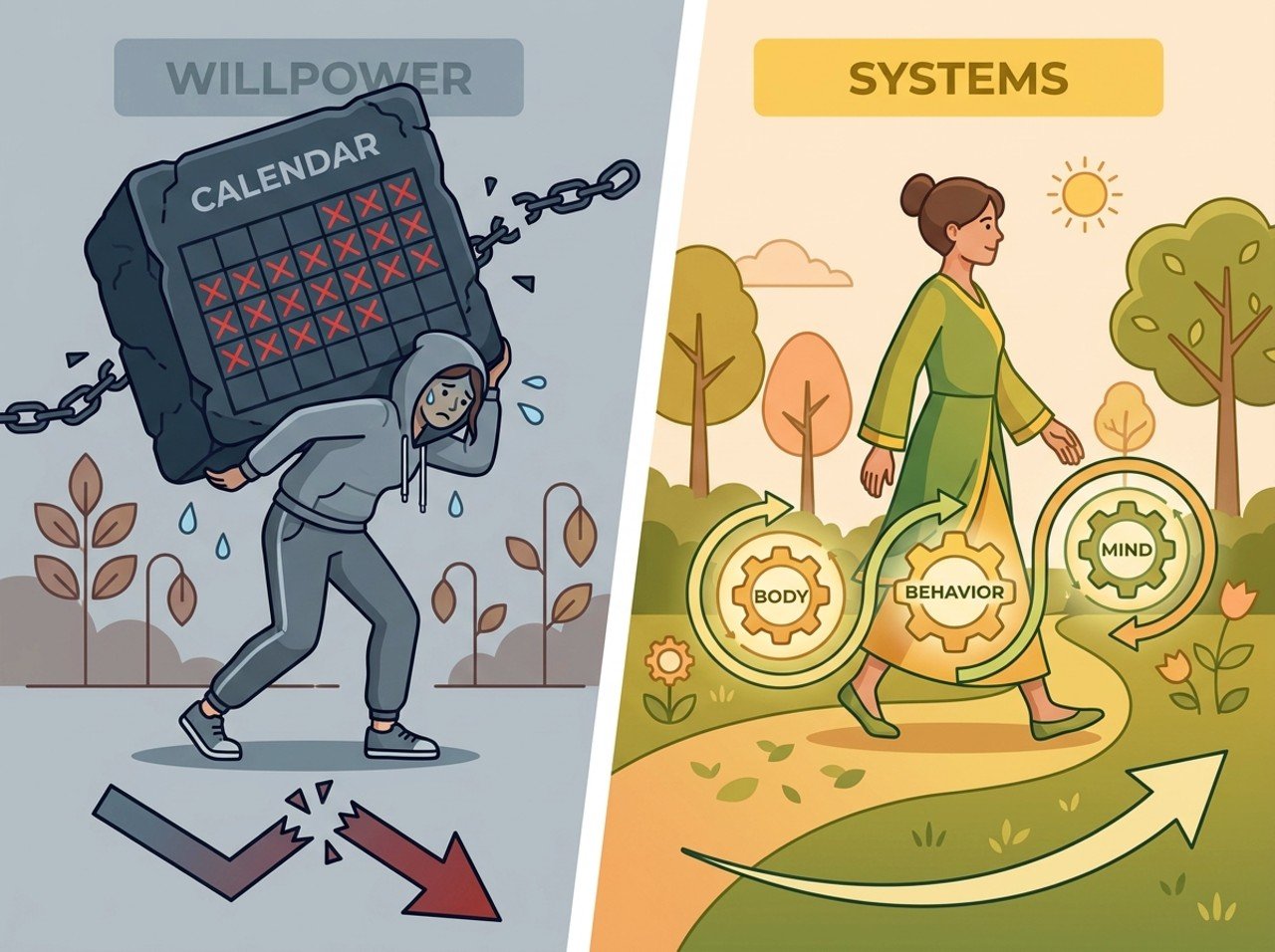
Weight loss tips that last aren’t about willpower. They’re about which systems you build around your body, your daily behavior, and your mindset.
Most “tips” fail within weeks because they target motivation instead of the three things research shows actually determine whether a habit sticks: sleep and stress (your body system), portion and hydration habits (your behavior system), and identity-level motivation (your mind system).
Below are 7 tips organized into that framework, each backed by a specific study rather than a slogan, plus two data tables, a glossary, and an honest answer to why the first attempt at “lasting” weight loss so often doesn’t.
If you’ve lost weight before and watched it come back, you already know the frustrating part: it’s rarely because you stopped trying. Weight loss tips that last require something most short lists of tips skip: addressing why your body, your daily habits, and your mindset all quietly work against each other once the initial motivation fades.
Sleep loss alone can raise hunger-driving ghrelin by nearly 15% and drop appetite-suppressing leptin by a similar margin, according to a Wisconsin Sleep Cohort Study of over 1,000 adults published in PLOS Medicine. That means you can eat a textbook-perfect diet and still fight your own biology every night you’re short on sleep.
That’s the real reason so much weight-loss advice has a short shelf life. It treats maintenance as a single willpower problem, when it’s actually three separate systems that all have to hold at once.
Below, we break lasting weight loss into the Body System (the physiology working in the background), the Behavior System (the daily mechanics), and the Mind System (the psychology that decides whether you keep going), with the real research behind each one, not just the popular version of it.
And if you’ve felt intimidated by conflicting advice, or confused about why a plan that worked for someone else didn’t work for you, that’s not a personal failure. It’s usually a sign that one of these three systems was left unaddressed. Let’s fix that.
Medical & Referral Disclaimer
This article is for general educational and informational purposes only and is not a substitute for professional medical advice, diagnosis, or treatment. Always talk to a qualified healthcare provider before starting a new diet, exercise, or supplement routine, especially if you have an existing health condition.
Key Takeaways
- Weight loss tips that last work on three systems at once: body, behavior, and mind, not motivation alone.
- Members of the National Weight Control Registry who kept off an average of 70 pounds for 5.5+ years shared common habits: near-daily breakfast, about 60 minutes of daily activity, and weekly self-weighing.
- Short sleep measurably raises ghrelin (hunger hormone) and lowers leptin (fullness hormone), a physiological reason diets stall that has nothing to do with discipline.
- More protein alone didn’t outperform standard protein intake for appetite control in a controlled 8-week trial. Cutting carbohydrate content was the variable that actually suppressed hunger.
- Chronic stress and elevated cortisol are linked to abdominal fat storage even in lean women, independent of overall calorie intake.
- Resistance training builds real strength and body composition changes, but a controlled trial found it didn’t significantly raise total daily energy expenditure on its own. It works best paired with the other systems below, not as a metabolism shortcut.

What Actually Makes Weight Loss Tips Last?
Weight loss tips last when they change a system, not just a single behavior. A one-off diet change competes with your biology, your daily environment, and your identity all at once, and usually loses within a few months.
The fix is to work on all three levels together: your Body System (sleep, hormones, and how your metabolism actually responds to exercise), your Behavior System (the small daily mechanics like portions and hydration), and your Mind System (emotional eating, support, and the deeper reason you started).
We call this the Body–Behavior–Mind Framework, and every tip below maps to one of the three.
| Willpower-Only Approach | Body–Behavior–Mind Approach |
|---|---|
| Relies on daily motivation, which naturally fades | Relies on systems and environment that work even on low-motivation days |
| Treats sleep and stress as separate from “the diet” | Treats sleep and cortisol as part of the weight equation |
| One generic plan for everyone | Layers habits across body, behavior, and mind so a weak day in one area doesn’t collapse the whole plan |
| Views a regain as personal failure | Views a regain as a signal that one specific system needs attention |
The Body System: What Your Physiology Is Doing While You’re Not Looking
Two women can eat the identical meal plan and get different results, because their bodies are running different background processes. Sleep quality, stress hormones, and how their muscle responds to training all shift the equation before willpower even enters the picture.

Tip 1: Protect Your Sleep Before You Touch Your Diet
Poor sleep changes your appetite hormones, not just your energy levels. In a study of over 1,000 adults from the Wisconsin Sleep Cohort, dropping from 8 hours to 5 hours of nightly sleep was linked to roughly 15.5% lower leptin (the hormone that signals fullness) and about 14.9% higher ghrelin (the hormone that drives hunger), and average BMI in the study rose alongside shorter sleep.
If your weight loss tips aren’t working despite a solid diet, your sleep window is one of the first places to look, before you touch another meal.
- Aim for a consistent sleep and wake time, even on weekends.
- Keep your bedroom cool, dark, and screen-free in the final 30 minutes before bed.
- Treat a bad night as a data point, not a diet failure. Adjust the next day’s expectations instead of punishing yourself with restriction.
Tip 2: Manage Cortisol Instead Of Ignoring It
Chronic stress and abdominal fat are more connected than most weight loss tips admit. A Yale study led by Dr. Elissa Epel found that lean, pre-menopausal women who were more reactive to stress secreted more cortisol under pressure, and cortisol directs the body to store fat specifically around the abdomen.
As Dr. Epel put it in the Yale research summary, “their cortisol exposure may have led them to accumulate greater abdominal fat,” even in women who weren’t overweight. In practice, this means stress management is a legitimate weight-loss lever in its own right, not just a nice-to-have alongside food and exercise, especially around the midsection.





Tip 3: Use Strength Training For What It Actually Does Best
Here’s a contrarian correction worth making. Strength training is often sold as a metabolism hack that makes your body “burn more calories all day.”
A controlled six-month trial published in The Journal of Clinical Endocrinology & Metabolism found that resistance training in young women increased fat-free mass and resting metabolic rate, but did not significantly change total daily energy expenditure on its own.
The calorie-burning benefit came mostly from the workout itself, not a lasting metabolic boost afterward. That doesn’t make strength training less valuable. It makes the honest case for it: muscle, strength, bone density, and long-term body composition, instead of an oversold metabolism myth that sets you up for disappointment.
The Behavior System: What People Who Keep Weight Off For Years Actually Do
The National Weight Control Registry, which has tracked thousands of adults who lost significant weight and kept it off, offers one of the few large, long-term looks at what actually separates lasting results from a rebound. Its members lost an average of about 70 pounds and maintained that loss for 5.5 years at the time they joined the registry.
Roughly 94% reported increasing their physical activity, most commonly around 60 minutes of moderate activity a day, alongside near-daily breakfast and weekly self-weighing. None of that is a single dramatic tip. It’s a set of small, repeated behaviors.

Tip 4: Build A Portion-Control Habit, Not A Restriction Rule
Portion tools change behavior more reliably than sheer willpower does. A trial covered in Nature Reviews Endocrinology found that a simple portion-control plate produced significantly greater weight loss than standard dietary advice alone in a group managing their weight and blood sugar.
The tool did the remembering, so participants didn’t have to rely on willpower at every meal. You don’t need a specialized plate to use the principle: fill half your plate with vegetables, a quarter with protein, and a quarter with whole-food carbohydrates, and let the visual cue do the work instead of counting every bite.
Tip 5: Drink Water Before Meals, Not Instead Of Them
Hydration is a small habit with a measurable effect. In a 12-week University of Birmingham trial covered by ScienceDaily, participants who drank about 500ml of water 30 minutes before each of their three main meals lost an average of 4.3kg, compared with just 0.8kg among those who rarely preloaded with water.
That’s roughly five times the result, from one simple timing habit layered on top of general healthy eating advice.
Tip 6: Cut Carbohydrate Load Before You Chase More Protein
This is the other contrarian correction worth knowing. “Eat more protein for fullness” isn’t the whole story. An 8-week controlled trial in 121 women with obesity, published via PMC, found that a higher-protein diet did not improve satiety or weight loss compared with a normal-protein diet.
Lower carbohydrate content, however, did significantly reduce hunger and increase fullness after meals. If portion control alone isn’t curbing your appetite, the fix may be trimming refined carbohydrates and adding fiber-rich vegetables, rather than simply stacking more protein onto the same plate.

| Habit | What The Research Found | Where It Shows Up Above |
|---|---|---|
| Daily activity (~60 min) | Reported by ~94% of long-term maintainers in the National Weight Control Registry | Behavior System |
| Water before meals | 4.3kg lost vs 0.8 kg over 12 weeks (consistent preloaders vs. rare) | Tip 5 |
| Lower carbohydrate load | Significantly reduced hunger vs. higher protein alone | Tip 6 |
| Portion-control plate | Significantly greater weight loss vs. standard advice | Tip 4 |
| 7–8 hours of sleep | ~15% swing in leptin/ghrelin between 8 and 5 hours | Tip 1 |
The Mind System: Why This Is Where Most Weight Loss Advice Quietly Fails
You can get the food and the exercise right and still lose the thread here, and if that’s happened to you before, it doesn’t mean you did it wrong. It usually means the emotional and identity side of the plan was never built out to begin with. This is also the part that’s hardest to talk about, because it involves admitting that a cookie at 9 pm was never really about the cookie.
Tip 7: Separate Emotional Eating From Physical Hunger
Emotional eating is one of the most common reasons weight comes back after it’s lost, and it’s rarely about lacking discipline. It’s about an unmet need looking for the nearest available comfort.
Keeping a simple food-and-mood log for a week or two is often enough to spot the pattern: are you eating because of genuine physical hunger, or because of boredom, stress, fatigue, or sadness? Once the pattern is visible, you can swap in an alternative that addresses the actual need.
- Call or text a friend instead of opening the pantry.
- Write for five minutes in a journal about what you’re actually feeling.
- Go for a short walk or run to burn off the stress response directly.
- Pick up a book you’re genuinely absorbed in.
- If it’s fatigue, allow yourself an actual nap instead of a snack that won’t fix the tiredness.

Build A Support System That Asks For Help On Purpose
Accountability isn’t a nice-to-have. It’s one of the most consistent predictors of behavior change across addiction recovery, habit research, and weight management alike.
Tell the people around you specifically what you’re working on and what kind of support actually helps (a walking partner, a check-in text, someone to call before a hard moment), rather than hoping they’ll guess. Vague encouragement rarely holds up. A specific, requested role usually does.
Reconnect With A Reason Bigger Than The Mirror
Appearance-based goals are notoriously fragile because they’re never fully satisfied. There’s always a smaller size or a flatter angle to chase.
Reasons tied to identity and future capability tend to hold up better under pressure: wanting the energy to keep up with your kids, wanting to be around for milestones decades from now, wanting to trust your own follow-through again.
As James Clear puts it, systems win because they’re tied to who you’re becoming, not just what you’re trying to achieve once. Write your real reason down somewhere you’ll actually see it, not just somewhere you filed it once and forgot.
The 7 Weight Loss Tips That Last, At A Glance
- Body System: Protect your sleep, manage cortisol, use strength training for strength and composition, not a metabolism shortcut.
- Behavior System: Build a portion-control habit, drink water before meals, cut carbohydrate load before stacking more protein.
- Mind System: Separate emotional eating from physical hunger, build a support system, reconnect with your deeper reason.
Get The Habits, Not Just The List
Reading seven tips is easy. Building the systems behind them on your own, at 9 pm, when the pantry is calling, and no one’s watching, is the actual work, and you don’t have to figure out the order of operations by yourself.
Our free guide breaks down into a simple starting sequence so you know exactly which system to shore up first, based on where your own weight loss has stalled before. Grab it here and start with the one system that’s actually holding you back, not all seven at once.
The Bottom Line
Weight loss tips that last aren’t the ones that ask for the most willpower. They’re the ones that ask the least of it, because the systems around you are doing more of the work. Sleep and stress management handle the physiology.
Portion habits, hydration, and a realistic look at protein and carbohydrates handle the daily mechanics. Separating emotional hunger from physical hunger, asking for the right kind of support, and anchoring to a reason bigger than the mirror handle the mindset.
None of these seven tips is a silver bullet on its own. Together, they’re the difference between a result that lasts two weeks and one that lasts.
Glossary Of Key Terms
- Body–Behavior–Mind Framework: A holistic approach to weight loss that addresses physiology (hormones/sleep), daily mechanics (habits/hydration), and psychology (identity/emotions).
- Ghrelin: A hormone that drives hunger; its levels increase significantly when the body is deprived of sleep.
- Leptin: A hormone that signals fullness and suppresses appetite; its levels drop when sleep is insufficient.
- Cortisol: A stress hormone that, when chronically elevated, is linked to the storage of abdominal fat, regardless of overall calorie intake.
- National Weight Control Registry: A research database tracking thousands of individuals who have successfully maintained significant weight loss for an average of 5.5 years.
- Resting Metabolic Rate (RMR): The rate at which the body burns energy while at rest; it can be increased by building fat-free mass through resistance training.
- Satiety: The state of feeling full or satisfied after eating, which research suggests is more influenced by carbohydrate load than protein intake alone.
- Emotional Eating: Consuming food in response to feelings like boredom, stress, or sadness rather than physical hunger.
- Portion-Control Plate: A visual tool used to manage food intake by dividing a plate into specific sections for vegetables, protein, and carbohydrates.
- Total Daily Energy Expenditure (TDEE): The total number of calories a person burns in a day; research indicates strength training does not significantly raise this on its own outside of the workout itself.
FAQ
Why Do I Keep Losing And Regaining The Same 10 Pounds?
This usually means one of the three systems - body, behavior, or mind - was never addressed, so the plan worked until that specific weak point resurfaced. Sleep debt, an unmanaged stress response, or unaddressed emotional eating are the three most common culprits behind a repeating cycle.
How Long Does It Actually Take For A Weight Loss Habit To Stick?
There’s no single universal number, but most habit-formation research points to roughly two to three months of consistent repetition before a behavior starts to feel automatic rather than effortful. Expect the first few weeks to feel like conscious work. That’s normal, not a sign it isn’t working.
Is Intermittent Fasting A Good Weight-Loss-Maintenance Strategy?
It can be, for some women, a scheduling tool that helps create a calorie deficit without constant food tracking. It isn’t inherently more effective than any other approach that achieves the same deficit, so choose it based on what fits your life and hunger patterns, not because it’s trending.
Do I Need To Count Calories Forever For Weight Loss Tips To Last?
No. Tools like counting calories or using a portion-control plate are most useful early on, while you’re building awareness of true portion sizes. Many long-term maintainers shift to intuitive, habit-based eating once portion awareness becomes automatic.
Can Stress Alone Stall Weight Loss Even With A Good Diet?
Yes. Chronically elevated cortisol is linked to abdominal fat storage independent of overall calorie intake, so a technically perfect diet can still underperform if stress and sleep are left unmanaged.
What If I Regain A Little Weight? Does That Mean I Failed?
No. A small regain is common and treated as information rather than failure; it’s a useful signal pointing to exactly which system needs attention, not a reason to abandon the other two that are still working.
I’m Approaching Perimenopause. Do These Tips Still Apply?
The Body–Behavior–Mind framework still applies, though hormonal shifts during perimenopause can change how your body responds to each system. For a deeper look at that specific stage, see our guide on losing weight during perimenopause without starving yourself.