
What a Certified Personal Trainer Actually Does, and Why It Changes Everything for Women Who've Tried Going It Alone
Amy Poehler
Your Circle Changes Everything
Find a group of people who challenge and inspire you, spend a lot of time with them, and it will change your life.
The Executive Summary
For women seeking effective weight loss, a personal trainer offers key advantages beyond solo gym efforts. They provide customized workout and nutrition plans, addressing individual needs and hormonal cycles, unlike generic fitness advice. Trainers offer crucial emotional support, combatting inconsistency and self-sabotage.
They also cut through nutrition confusion with goal-specific guidance, integrating diet and exercise for better results. This structured accountability ensures a sustainable path, making a trainer a strategic investment for lasting lifestyle change and faster results. A trainer's expert support helps maintain motivation.
You've done everything right. You showed up at the gym. You watched what you ate. You pushed through three weeks of early mornings and sore muscles. And then — nothing. The scale barely moved. The mirror told the same story. And somewhere between week four and the decision to quit, you wondered what everyone else knows that you don't.
Here's what they know: doing it alone is the hardest way.
Not because you lack discipline. Not because your goals are unrealistic. But because the female body is complex, fitness information is overwhelming, and motivation — however fierce at the start — was never designed to carry you all the way.
A personal trainer isn't a luxury for elite athletes. For women who are serious about results, a certified fitness coach is a strategic investment in the fastest, safest, and most sustainable path to the body and life they want.
In this guide, I'm breaking down the 4 most powerful benefits of working with a personal trainer — and why they matter more for women than most fitness content will ever acknowledge.
Medical & Referral Disclaimer
This article is for informational and educational purposes only. It is not a substitute for professional medical advice, diagnosis, or treatment. Always consult your physician before beginning any new exercise or nutrition programme.
Key Takeaways
- A personal trainer provides customised programming, injury prevention, and nutritional guidance — not just rep-counting.
- Emotional and psychological support from a trainer addresses the root causes of inconsistency that derail most solo fitness journeys.
- Structured accountability (regular check-ins, scheduled sessions) applies behavioural science to fitness adherence — and it works.
- Women specifically benefit from trainers who understand hormonal cycles, body composition goals, and female-specific exercise mechanics.
- Even experienced gym-goers plateau — a trainer introduces periodisation and progressive overload strategies to restart progress.
- The cost of a personal trainer is an investment in faster results, fewer injuries, and a system that outlasts motivation.
What Does a Personal Trainer Actually Do?
A personal trainer designs customised workout and nutrition plans, coaches correct exercise technique, monitors progress, and provides the accountability and emotional support that make the difference between short-term effort and lasting lifestyle change. Their value extends far beyond the gym floor.
The misconception most women carry into their first trainer conversation is that a personal trainer is essentially an expensive rep-counter — someone to stand beside you and count to twelve. That undersells the role dramatically.
A certified personal trainer is a programme architect, form coach, nutritional guide, accountability partner, and behavioural strategist — all in one. And for women navigating the particular complexity of female physiology, hormonal fluctuations, and the psychological weight of years of failed diets, that combination is genuinely transformative.
Benefit #1: You Get Expert Support That Goes Far Beyond The Gym
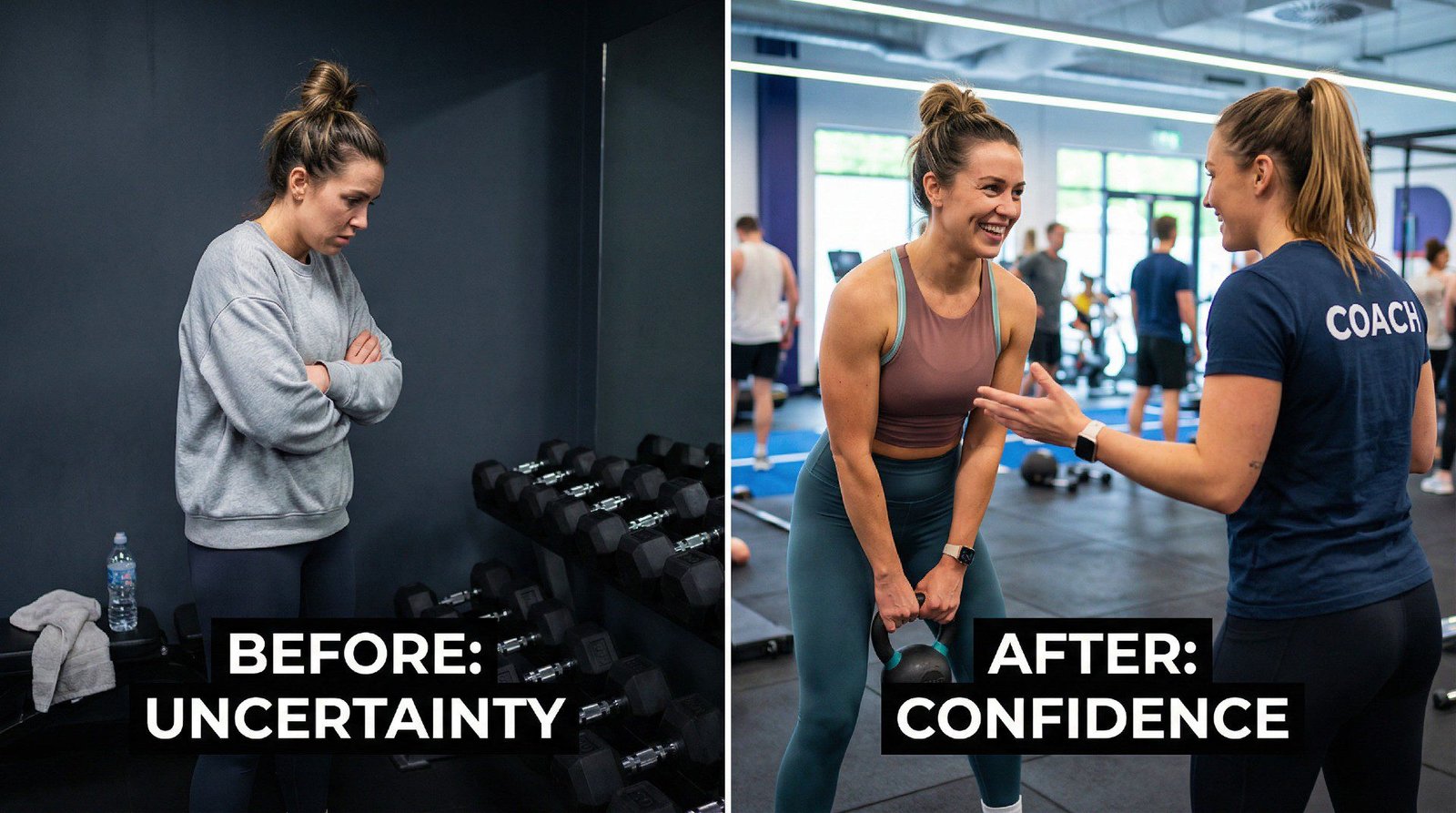
A personal trainer provides both physical coaching and the psychological support needed to push through the moments when you want to quit — which is where most solo fitness journeys actually end. This dual role makes a trainer the most effective tool for long-term consistency.
How Does Emotional Support Help Women Lose Weight With a Trainer?
The fitness industry loves to frame consistency as a willpower problem. It isn't. It's a support structure problem.
When you're going it alone, a stressful day at work leads to a skipped session. An emotional afternoon leads to a binge that unravels a week of progress. There's no one to call. No one who has seen this pattern before and knows exactly what to say.
A personal trainer changes that equation. Research found that participants who trained with a coach were significantly more likely to maintain their programme over 12 weeks compared to those who trained without support — and reported measurably higher motivation scores throughout.
The support your trainer provides includes:
- Perspective during plateaus — when you can't see your own progress, they can.
- Accountability without shame — the difference between a check-in and a weigh-in with a friend who knows your history.
- Identification of self-sabotage patterns before they become full derailments.
- Goal recalibration — adjusting targets based on real life, not the ideal version of it.
- Celebration of non-scale victories — energy, sleep, strength, confidence — the progress numbers miss.
You don't have a willpower problem. You have a support structure problem. A personal trainer is that structure.

What Does a Customised Workout Plan Look Like for Women?
No two women's bodies are identical. Your workout should reflect your goals, your current fitness level, your hormonal stage of life, any injury history, and the time you realistically have available.
A certified personal trainer builds your programme around these realities — not around a generic template pulled from a magazine.
A customised workout plan for a woman focused on fat loss and strength might include:
- 2–3 strength sessions per week targeting compound movements (squats, deadlifts, rows, hip hinges).
- 1–2 cardiovascular sessions chosen based on recovery capacity and training phase.
- Mobility and recovery work are integrated to reduce injury risk and improve performance.
- Hormonal cycle awareness — adjusting intensity and volume based on menstrual phase (higher intensity in follicular phase, lower in luteal phase).
- Progressive overload planning — so every four to six weeks, you are measurably stronger and fitter than the previous cycle.
For more on building a results-driven workout routine: Fat-Burning Workouts That Melt Stubborn Fat →
Benefit #2: A Personal Trainer Cuts Through Nutrition Confusion
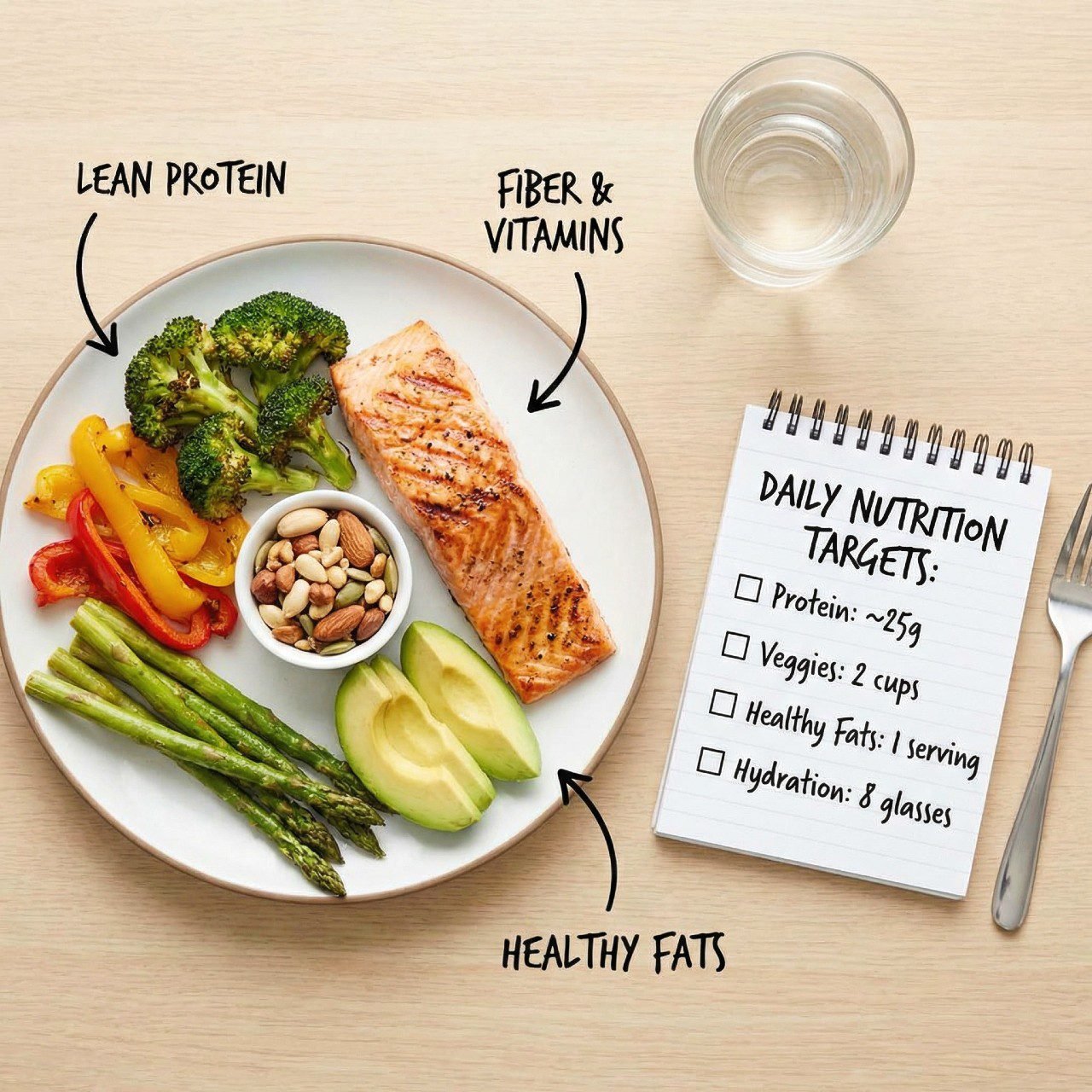
A personal trainer eliminates the paralysis caused by conflicting dietary information by providing clear, goal-specific nutrition guidance aligned with your training programme. This integrated approach to food and exercise produces significantly better results than either strategy alone.
Why Is Nutrition Guidance From a Trainer More Effective Than Dieting Alone?
The internet contains approximately seventeen different answers to every nutrition question. High carb. Low carb. Intermittent fasting. Eat every three hours. Avoid fat. Fat is fine. No wonder so many women feel paralysed before they even open the fridge.
A personal trainer cuts through the noise with one simple filter: what does your body need, at this stage, to support your specific goal?
They don't prescribe one-size-fits-all solutions. They assess your current intake, your training demands, your lifestyle, and your hormonal health — and build a nutrition framework that works in the real world.
According to the American College of Sports Medicine (ACSM), certified personal trainers with nutrition competencies are equipped to provide general nutritional guidance aligned with evidence-based healthy eating guidelines — and when exercise and nutrition are integrated, fat loss outcomes improve substantially compared to exercise alone.
What Should Women Eat When Working With a Personal Trainer?
Here is the nutrition framework a trainer will typically build for a woman focused on fat loss and lean body composition:
| Nutrient | Daily Target | Key Sources | Why It Matters |
|---|---|---|---|
| Protein | 1.6–2.0g per kg of bodyweight | Chicken, fish, eggs, Greek yoghurt, legumes | Builds lean muscle, manages hunger hormones, supports metabolism |
| Fibre | 25–35g | Vegetables, berries, oats, beans | Regulates blood sugar, reduces cravings, feeds gut health |
| Healthy Fats | 30–35% of calories | Avocado, olive oil, nuts, oily fish | Supports hormone production and sustained energy |
| Iron | 18mg (pre-menopause) | Red meat, leafy greens, lentils, fortified cereals | Prevents fatigue that kills training consistency |
| Calcium + Vitamin D | 1,000mg / 600–800 IU | Dairy, fortified foods, sunlight | Bone health and fat metabolism in women |
| Water | 2–2.5 litres daily | Water, herbal tea, water-rich foods | Reduces hunger confusion; supports every metabolic function |
What a trainer helps you move away from:
- Extreme calorie restriction that lowers metabolic rate and breaks down muscle.
- "All or nothing" eating mentality that turns one bad meal into a bad week.
- Decision fatigue — a trainer often removes daily food decisions by providing structure.
- Nutrient gaps common in women: iron, calcium, and omega-3s that directly affect energy and performance.
Build your weekly nutrition plan: Weight Loss Meal Prep Ideas for Women →
Certified Personal Trainer Can Guide You
Benefit #3: How Does a Personal Trainer Build Accountability That Actually Sticks?
A personal trainer engineers unavoidable accountability through scheduled appointments, progress tracking, and the social contract of showing up for someone who expects you — converting vague intentions into committed action backed by behavioural science.
Why Does Scheduled Accountability Work Better Than Self-Motivation?
Setting a goal for yourself is one thing. Sticking to it at 6:30 am on a cold Tuesday when nobody is watching — that's where solo fitness journeys quietly collapse. Motivation is a feeling. It comes and goes. Accountability is a system. And systems outlast feelings every time.
Here's what the behavioural science actually shows: a study found that people who reported their progress to someone else were 65% more likely to achieve their goals than those who kept their goals to themselves. Add a specific commitment appointment, and that number climbs to 95%.
A personal trainer is, at the most fundamental level, a commitment device. Cancelling feels different when someone is waiting. Showing up half-heartedly feels different when someone notices. Progress feels different when someone else tracks it alongside you.
What Accountability Tools Do Personal Trainers Use?
Structured accountability mechanisms your trainer will use:
- Scheduled sessions — a standing appointment removes the daily "should I go?" negotiation.
- Regular progress check-ins — body measurements, fitness assessments, or performance benchmarks every 4–6 weeks.
- Food and training logs — not to police choices, but to surface patterns that are invisible without data.
- Goal anchoring — connecting your daily decisions to your bigger "why" during sessions.
- Positive reinforcement — trainers are trained to celebrate incremental wins that keep momentum building.
This is why consistency wins: How to Motivate Yourself to Finish Workouts — Not Just Start Them →
Benefit #4: A Personal Trainer Breaks Through The Plateaus That Defeat Solo Training
A personal trainer identifies the hidden causes of fitness plateaus — poor technique, insufficient progressive overload, inadequate recovery, or nutritional gaps — and deploys advanced programming strategies like periodisation to restart measurable progress, regardless of your current experience level.
What Causes Fitness Plateaus In Women?
Plateaus are not a sign that you've done something wrong. They are a sign that your body has adapted to what you're doing. Adaptation is the goal of training — but it's also the mechanism that creates a plateau.
The most common plateau causes the trainers to see in women:
- Repetitive training stimulus — doing the same workouts at the same weight week after week.
- Insufficient protein intake — especially common in women, preventing muscle development that drives metabolic change.
- Chronic undereating — leading to metabolic adaptation and muscle breakdown.
- Poor sleep and elevated cortisol — suppressing the hormonal environment needed for fat loss.
- Technique inefficiency — performing exercises in ways that reduce mechanical load on the target muscles.
What Techniques Do Personal Trainers Use to Break Plateaus?
This is where a trainer's expertise pays dividends that are almost impossible to replicate alone.
Advanced plateau-breaking strategies your trainer will deploy:
- Periodisation — structuring training in phases (e.g., a hypertrophy phase for 4–6 weeks, followed by a strength phase, then a deload week) so your body never fully adapts.
- Progressive overload — systematically increasing load, volume, or intensity every session or week to ensure your muscles are always working harder than they're used to.
- Exercise variation — introducing new movements that challenge the same muscle groups through different ranges of motion.
- Deload weeks — planned periods of reduced intensity that allow full hormonal and nervous system recovery, which often precede significant breakthroughs.
- Nutrition periodisation — adjusting caloric intake and macros based on training phase and menstrual cycle.
Join Our Mailing List
Join thousands of women inside our community and receive our free guide, 10 Actions That Support Permanent Weight Loss — the exact behavioural shifts that make the difference between a two-week attempt and a lasting transformation.
No restriction plans. No guilt. Just what actually works — for real women with real lives.
Personal Trainer vs Training Alone: The Real Comparison
| Factor | With a Personal Trainer | Training Alone |
|---|---|---|
| Programme design | Evidence-based, customised, periodised | Self-designed, often repetitive |
| Technique | Corrected in real time; injury risk minimised | Self-monitored; form errors accumulate |
| Nutrition guidance | Integrated with the training plan | Generic online advice |
| Accountability | Scheduled, structured, with social contract | Willpower-dependent |
| Plateau management | Proactively prevented and resolved | Often leads to quitting |
| Progress tracking | Objective assessments every 4–6 weeks | Scale-dependent, emotionally volatile |
| Injury prevention | Continuous technique monitoring | Reactive (post-injury) |
| Results timeline | Significantly accelerated | Slower, less consistent |
Is a Personal Trainer Worth the Cost for Women?
For women with specific fat loss, strength, or body composition goals, the investment in a personal trainer typically accelerates results by 3–6 months compared to solo training — reducing the total time and money spent on approaches that don't work.
This is the question most women are really asking when they consider hiring a trainer, and it deserves a direct answer.
Here is how to think about the value:
- The cost of not knowing — years of ineffective programmes, injury setbacks, wasted gym memberships, and supplements that don't work.
- The cost of your time — if you're going to invest 4–5 hours per week in the gym, the difference between a productive and an unproductive hour is enormous.
- The health dividend — research from the CDC shows that regular, progressive physical activity reduces the risk of heart disease, type 2 diabetes, and several cancers — benefits that compound for decades.
Practical ways to make personal training financially accessible:
- Start with 2 sessions per month for programming and progress reviews; train the rest of the time independently using your trainer's plan.
- Consider small group personal training (2–4 people), which significantly reduces per-session cost while maintaining accountability.
- Invest in 3–6 months intensively to build a programme and the skills to maintain it independently.
- Look for certified trainers (look for NASM, ACE, or ACSM certification) who specialise in women's fitness and fat loss.
Understand your body's fat-loss fundamentals first: 3 Tips For Helping Women Lose Weight →

How to Choose the Right Personal Trainer for Women
Not all trainers are created equal — and for women, the right fit matters enormously. Here's what to look for:
Must-haves:
- Recognised certification: NASM, ACE, CSCS, or ACSM.
- Experience working with women, specifically with fat loss or body composition goals.
- Willingness to discuss the menstrual cycle, perimenopause, or hormonal factors if relevant to you.
- A coaching style that empowers rather than shames — you should feel supported, not judged.
Green flags in a first consultation:
- They ask about your health history, lifestyle, and what has and hasn't worked before.
- They explain the why behind programme decisions, not just the what.
- They set realistic expectations and avoid promises of rapid transformation.
Red flags to walk away from:
- Guarantees of specific weight loss numbers in specific timeframes.
- Pressure to buy supplements or proprietary products.
- A one-size-fits-all programme given to every client, regardless of history.
- Any trainer who uses shame or comparison as a motivational tool.
For women navigating hormonal fat loss: How Hormones Affect Weight Loss in Women →

A New Perspective on Getting Coached
The women who see the fastest, most lasting transformation share one thing: they stopped trying to figure it out alone.
Not because they weren't capable of figuring it out alone. They absolutely were. But because partnering with someone who has already solved the problem — who knows the shortcuts, the pitfalls, the adjustments your specific body needs — compresses years into months.
A personal trainer doesn't make the hard work easier. They make sure the hard work is pointed in exactly the right direction.
And for women who have already given years to approaches that didn't account for their biology, their schedule, or the psychological complexity of building new habits? That is worth everything.
Related Articles
The Bottom Line
A personal trainer is not just a gym companion. Done right, they are the difference between spinning your wheels alone and building real, lasting, measurable results.
The four benefits are clear:
- Expert, personalised support — emotional and physical, from someone who understands the female body.
- Nutrition clarity — a practical food strategy integrated with your training.
- Built-in accountability — the system that makes showing up non-negotiable.
- Plateau-breaking expertise — the advanced programming that restarts progress when everything else has stopped working.
If you're serious about your goals and tired of starting over, partnering with a qualified personal trainer is one of the most direct investments you can make in yourself.
Found this helpful?
Share it with a woman in your life who deserves a smarter approach.
Glossary Of Key Terms
FAQ
A personal trainer provides customised programming, real-time technique coaching, nutritional guidance, and structured accountability — the four elements most consistently linked to long-term fitness success. For women, a trainer also addresses hormonal and psychological factors that generic fitness programmes ignore entirely.
By correcting form in real time, a trainer eliminates the technique errors that reduce results and cause injury. They also design progressive programmes that ensure your body is always working at the right intensity — challenging enough to adapt, controlled enough to recover. Research from the ACSM confirms that supervised training produces significantly better strength and body composition outcomes than unsupervised training.
For women with specific goals — fat loss, strength building, or body recomposition — working with a certified trainer typically accelerates results by 3–6 months compared to unguided training. When measured against the cumulative cost of ineffective programmes, unnecessary supplements, and wasted gym memberships, a quality personal trainer almost always delivers superior value.
Through scheduled sessions, regular progress check-ins, food and training logs, and the social contract of showing up for someone who expects you. Research in the American Journal of Preventive Medicine found that people with a committed accountability partner were up to 95% more likely to achieve their goals than those who relied on self-motivation alone.
Absolutely. Plateaus are caused by adaptation — your body has simply mastered what you've been asking of it. A trainer introduces periodisation (structured training phases), progressive overload protocols, and technique refinements that create new stimulus. Even elite athletes work with coaches for this precise reason.
Prioritise certified professionals (NASM, ACE, CSCS, or ACSM) with demonstrable experience working with women on fat loss and body composition goals. In your first consultation, they should ask about your health history, hormonal considerations, and what has and hasn't worked before. A great trainer empowers and educates — they never shame, pressure, or promise unrealistic results.
You Know Why. Now Learn Exactly How
Want to deepen what you've just learned? Download the free Lean Body Formula Special Report — 10 evidence-based strategies for permanent fat loss, designed specifically for the female body.
Thank you so much for these! I have been wanting to get a personal trainer since I have no idea what workouts I’m doing and what workouts are really good for me, and if I’m even doing it correctly. Especially that I’m on the ketogenic diet.
Dear Yang,
Thank you for your comment. I hope it helps. Good day!