

Getting Your Weight Loss Journey Started: A Real First-Step Guide For Women
How To Start Your Weight Loss Journey When Starting Feels Impossible
James Clear
Author of Atomic Habits
All big things come from small beginnings. The seed of every habit is a single, tiny decision.
Summary (TL;DR)
Starting a weight loss journey is harder than any meal plan makes it look – not because you lack willpower, but because starting anything new fights against how your brain is wired to run on habit. This guide skips the overwhelming keto-versus-fasting debate and focuses on the part nobody talks about: the fear, the false starts, and the exact first week that gets you moving without needing to have it all figured out first. You’ll get a real 7-day starter framework, the honest science on what changes hormonally after 40, and a myth-busting section that cuts through the noise.
If you’ve opened a dozen weight loss articles, saved a few, and closed your laptop without doing anything different, you’re not alone – and you’re not the problem.
Nearly 42% of American adults live with obesity, according to CDC data. The “starting line” you’re standing at right now is one that millions of women are standing at too.
What usually gets in the way isn’t a missing meal plan. It’s the intimidation of not knowing where to start, the frustration of having tried before and stalled out, and the quiet confusion of conflicting advice – keto versus intermittent fasting versus clean eating versus calorie tracking, all shouted at once.
This guide isn’t another voice adding to that noise with a rigid new set of rules. It’s built around the actual moment you’re in right now, and the weight loss mindset that gets you through it: before the habits exist, before the routine feels natural, when starting still feels like the hardest part.
Here’s the honest version of how this works. You don’t need a perfect plan on day one. You need one small, doable action, a little patience with yourself, and a real understanding of what changes for your body at this stage of life – especially if you’re over 40 and tired of advice written for someone half your age. That’s exactly what the rest of this guide walks through.
Medical & Referral Disclaimer
This article is for general educational and informational purposes only and is not a substitute for individualised medical, nutritional, or fitness advice. Always talk to a qualified healthcare provider before making lifestyle changes to your eating or exercise routine, especially if you have an existing health condition. Some links on this site are affiliate links, meaning Women’s Lean Body Formula may earn a small commission at no extra cost to you if you make a purchase – we only recommend what we’d suggest to our own friends and family.
Key Takeaways
- The barrier is rarely willpower. Roughly 40% of what you do every day runs on habit, not conscious decision – which is why “just try harder” rarely works as a starting strategy.
- Your first week should be embarrassingly small. One walk. One water bottle. One earlier bedtime. Momentum beats intensity every time you’re starting from zero.
- If you’re over 40, your biology is a real factor – not an excuse. Muscle loss and hormonal shifts change the math, but they don’t make weight loss impossible.
- Support matters more than instructions. Research on weight-loss maintenance found that encouragement, not advice-giving, is what actually helps people stick with it.
- Plateaus are physiology, not failure. Your metabolism adjusts as you lose weight – that’s a predictable, explainable pattern, not a sign you’re doing something wrong.

Why Starting Feels So Hard (It Is Not About Willpower)
The moment you decide to start a weight loss journey is rarely the moment you actually start – there’s usually a gap of days, weeks, or years in between, and that gap isn’t laziness.
Research from psychologist Wendy Wood, covered by the American Psychological Association’s Monitor, found that about 40% of what people do every day happens on near-autopilot, in the same situations, without active decision-making.
That’s the real obstacle: you’re not fighting a lack of motivation, you’re fighting a wall of existing habits that don’t know a new plan exists yet.
The Overwhelm Trap: Too Many Rules, Not Enough Clarity
Most weight loss content throws a dozen changes at you on day one – cut sugar, count calories, meal prep, join a gym, track macros, drink a gallon of water – and that pile of rules is exactly what makes people quit before day three.
The CDC’s own guidance on losing weight starts with one question, not a checklist: understand your “why,” whether that’s a family health history or simply wanting more energy for your kids. Clarity on your reason comes before any rule about food.

What The Research Actually Says About Motivation
Motivation is not a resource you either have or don’t – it’s a byproduct of momentum. Small, specific, achievable goals build the kind of early wins that generate more motivation, which is why the CDC frames a strong starting goal as something like “I will walk 15 minutes, three days this week” rather than “I will get healthy.” Specific beats ambitious every time you’re at the very beginning.
Understanding Your Starting Point As A Woman Over 40
If you’re starting your weight loss journey in your 40s, 50s, or beyond, your body genuinely isn’t operating on the same rules it was at 25 – and pretending otherwise is exactly why so much generic advice quietly fails women.
Hormonal shifts through perimenopause and menopause change where fat is stored and how much muscle you naturally retain, which changes the math on both food and exercise.
What Perimenopause And Menopause Actually Change (And What They Don’t)
Hormonal changes make weight more likely to settle around your belly rather than your hips. Mayo Clinic research notes women may need roughly 200 fewer daily calories in their 50s than they did in their 30s and 40s just to maintain their current weight.
The main reason is muscle mass, which burns more calories at rest than fat and naturally declines with age. But the same research is clear on one point worth repeating: hormonal changes alone don’t necessarily cause weight gain.
Diet, activity levels, sleep, and stress are still doing most of the work, which means this stage of life changes your strategy, not your odds.

| Factor | What Actually Changes After 40 | What Stays In Your Control |
|---|---|---|
| Metabolism | Gradual slowdown, largely tied to muscle loss rather than age itself | Strength training can directly offset this |
| Fat Storage | Shifts toward the belly due to hormonal changes | Overall calorie balance and activity still drive fat loss |
| Muscle Mass | Declines steadily after 30–35, faster after 65 | Resistance exercise slows and can partly reverse this |
| Recovery Time | Often takes longer between hard workouts | Adjusting intensity and rest days, not stopping |
If supplement noise is part of what’s overwhelming you right now, we’ve already done the evidence-tier breakdown of what’s actually worth your money in our guide to perimenopause supplements.
Your First 7 Days: A Real Starter Framework
Your first week should have exactly one job: proving to yourself that you can follow through, not transforming your entire life overnight. Trying to overhaul food, exercise, sleep, and stress simultaneously is the single most common reason a weight loss journey stalls before it starts.
| Day | Focus | What You’ll Actually Do |
|---|---|---|
| 1–2 | Awareness | Write down what you eat and how you move – no changes yet, just honest data |
| 3 | Movement | One 15–20 minute walk, at whatever pace feels doable |
| 4 | Nutrition | Add one serving of protein or vegetables to a meal you already eat |
| 5 | Support | Tell one person your goal, or find one online accountability community |
| 6 | Rest | Protect your sleep – go to bed 20–30 minutes earlier |
| 7 | Review | Look back at the week and pick one thing to repeat, not ten new things to add |

Nutrition Basics For Your First Week
You do not need a meal plan to start eating better – you need three or four small, repeatable shifts. Start here:
- Add before you subtract. Add a serving of protein, vegetables, or fibre to meals you already eat, rather than banning foods on day one.
- Use portion control as your entry point. Smaller plates and slower eating do more for a first-week reset than any specific diet label.
- Batch one thing. Healthy meal prep doesn’t mean cooking for seven days – prepping two lunches from a whole foods diet in advance is enough to build the habit.
- Practise mindful eating at one meal a day. Put your fork down between bites and notice when you’re actually full, rather than when your plate is empty.
- Keep healthy snacking within reach. Cut vegetables, nuts, or fruit in the fridge at eye level; beat willpower alone at 3 pm.
Movement Basics For Your First Week
The CDC’s physical activity guidelines recommend 150 minutes of moderate activity a week plus two days of strength training – but that’s a destination, not a starting line. In week one:
- Pick daily walking goals you’ll actually hit. Ten minutes you complete beats forty-five minutes you skip.
- Add two short strength sessions. Bodyweight squats, wall push-ups, and resistance bands count – you don’t need a gym to start a beginner workout routine.
- Set fitness goals small enough to hit every week. A goal you actually complete builds more momentum than an ambitious one you abandon.
- Treat rest days as part of the plan, not a failure of it. Recovery is where the adaptation actually happens.
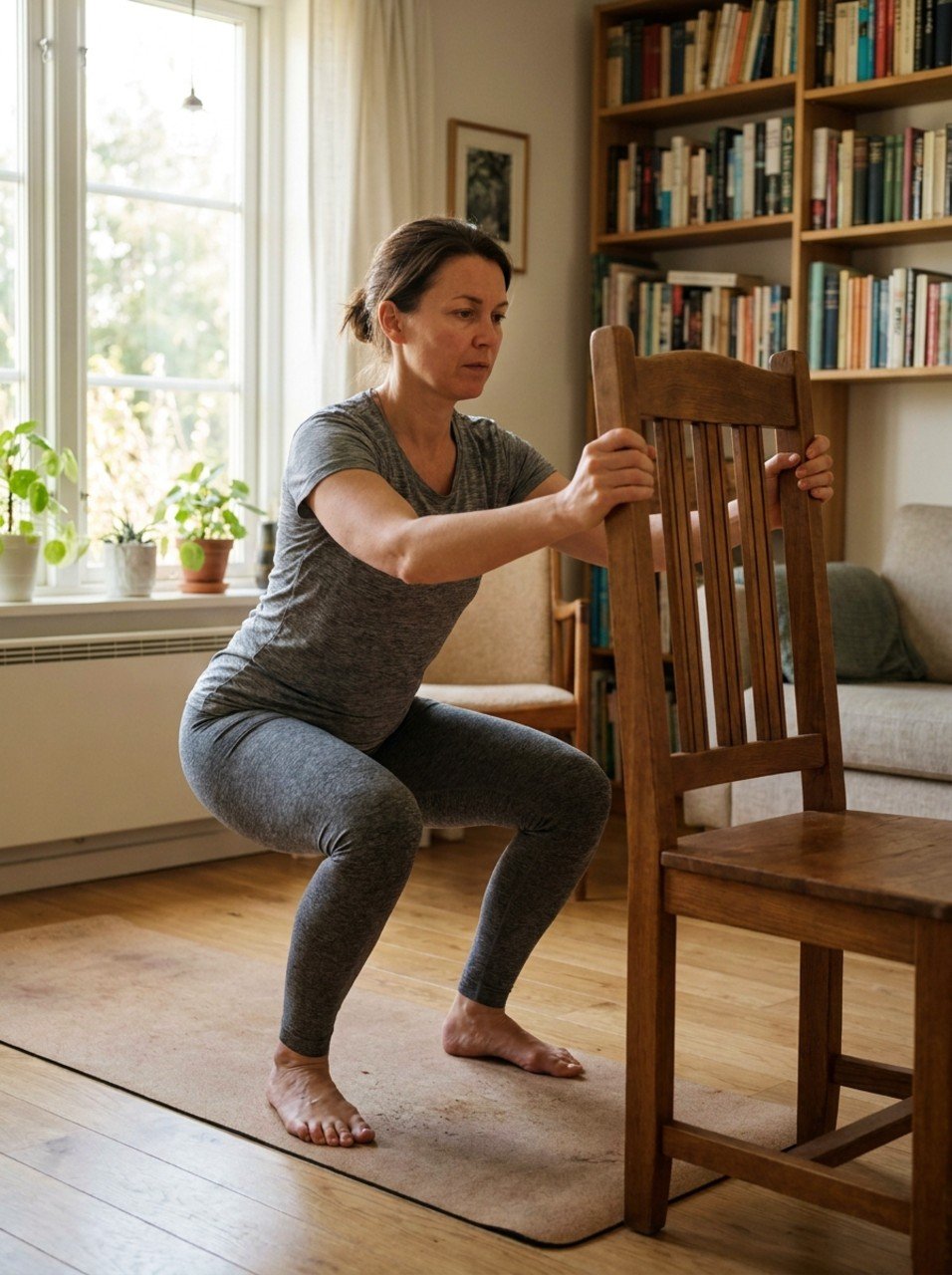
Strength training matters even more once you’re past your mid-thirties: the National Institute on Aging notes that muscle mass and strength peak around age 30 to 35 and decline gradually after that, but that resistance exercise can substantially slow that decline.
If anything counts as a real metabolism booster, it’s this, not a supplement. If you want a complete, paced program built specifically for this stage of life, our strength training guide for women in perimenopause walks through exactly that.
Building Habits That Actually Stick
A habit sticks when it’s attached to something you already do automatically – not when you rely on remembering it. This is the actual mechanism behind lasting change, and it’s far more useful than any motivational quote.
Habit Stacking: The Simplest Way To Start
Habit stacking means attaching a new, tiny habit to an existing one you never forget to do – brushing your teeth, making coffee, sitting down at your desk. Try pairing:
- “After I pour my morning coffee, I’ll drink one glass of water.”
- “After I brush my teeth at night, I’ll lay out tomorrow’s walking shoes.”
- “After I sit down for lunch, I’ll add one vegetable to my plate.”
None of these requires motivation once they’re attached to an existing routine – that’s the entire point.

Why An Accountability Partner Changes The Odds
Not all support helps equally. A study on weight-loss maintenance found that people who kept weight off tended to receive encouragement and active participation from the people around them, while those who regained weight more often received unsolicited advice and instructions instead.
If you’re choosing an accountability partner, pick someone who’ll cheer your walk, not someone who’ll critique your plate.
The Emotional Side Of Starting (Nobody Talks About This Enough)
Intimidation, frustration, and confusion are not signs you’re unprepared for a weight loss journey – they’re a completely normal response to starting something that matters to you.
If you’ve stood in front of the fridge feeling like you don’t even know where to begin, that’s not a personal failing, and it doesn’t mean the rest of this is going to feel that way too.
Emotional Eating And Stress: What The Research Shows
Stress-driven eating is real, but it’s more specific than “stress makes people eat.” A 2024 study published in Appetite found that women with high lifetime stress exposure were more likely to reach for comfort food during acute stress, but mainly when they also held strong beliefs that eating helps regulate difficult emotions.
In other words, the belief that food will fix the feeling is often doing as much work as the stress itself – which means noticing that belief, gently, is worth as much as any food swap.
Weight Loss Journey Myths We’re Correcting (With Evidence)
A lot of “starter tips” and fat loss strategies get repeated so often they start to sound like proven fact. A few of the most common ones deserve a second look.
Myth: The internet’s favourite hydration tip – a glass of water before every meal – reliably melts away extra calories. The evidence is thinner than the internet suggests. Harvard Health reviewed the research and found the studies showing a benefit were mostly small or short-term, with only modest effects – useful as one small hydration habit among many, not a standalone strategy.
Myth: More protein always means more fullness and faster fat loss. A controlled low-energy-diet study found that a higher-protein intake did not significantly improve satiety or weight loss compared to a standard amount, once calories were already controlled – it was the carbohydrate content that moved the needle more. Protein still matters for muscle maintenance, but it isn’t the single lever some meal plans make it out to be.
Myth: If the scale hasn’t moved in two weeks, whatever you’re doing has stopped working. That’s usually a plateau, not a failure – and it has a physiological explanation, covered next.
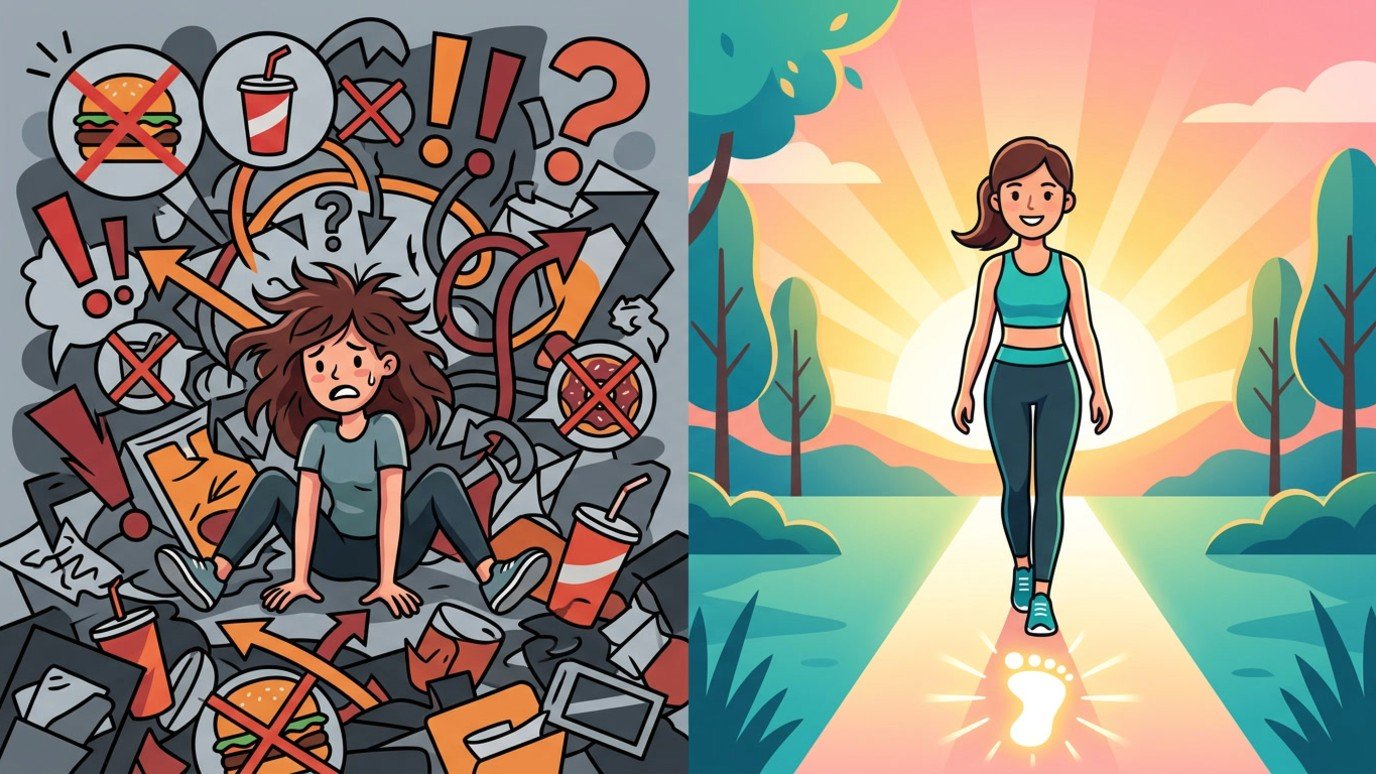
When Progress Stalls: Understanding Weight Loss Plateaus
A plateau happens because your body adapts as you lose weight, not because your plan quietly stopped working.
As Mayo Clinic explains, some weight loss along the way comes from muscle as well as fat, and muscle is what keeps your resting metabolism higher – so as you lose weight, you naturally start burning somewhat fewer calories than you did at your heavier starting weight.
Their guidance for pushing through: review your habits honestly for creeping portions, add more daily movement outside of formal workouts, and resist the urge to cut calories drastically. Dropping below roughly 1,200 calories a day tends to backfire.
Ready for more? A deeper breakdown of your metabolism and hormones is the natural next step once your first week is behind you.
Starting is the hard part – and you’ve just done the hardest part of starting, which is reading this far. If you want the next step handed to you instead of having to hunt for it, our free guide, 10 Actions That Support Permanent Weight Loss, breaks down exactly what over 14,000 women have already downloaded and used to build their own first week.
No credit card, no catch, just the report in your inbox in under a minute. Get your free copy here, and let today be the small decision that starts it all.
The Bottom Line
You don’t need a perfect plan, a clean slate, or the “right” motivation levels to start your weight loss journey – you need one small, repeatable action and a little patience with the version of yourself that’s just getting started.
The women who make it past week one aren’t the ones with the most willpower; they’re the ones who started small enough that quitting never felt necessary.
Long-term fitness success is built from that first small week, not from a single dramatic overhaul. Understand your why, protect one habit at a time, and let the rest build from there.
Glossary Of Key Terms
- Habit Stacking: A behavioral strategy where a new, small habit is anchored to an existing, automatic routine to ensure consistency without relying on memory or willpower.
- Perimenopause/Menopause: Biological stages in women that trigger hormonal shifts, often resulting in fat storage shifting toward the abdomen and a natural decline in muscle mass.
- Muscle Mass: Tissue that peaks in humans around age 30–35 and burns more calories at rest than fat; its maintenance is a primary driver of metabolic health.
- Weight Loss Plateau: A period during which weight loss stalls because the body has adapted to a lower weight and is burning fewer calories than at its starting point.
- Mindful Eating: The practice of noticing internal fullness cues and eating slowly, often used as an entry point for portion control.
- Whole Foods Diet: A nutritional approach focused on minimally processed foods; the guide suggests prepping small amounts of these as a starting habit.
- Accountability Partner: An individual who provides encouragement and support for goals; research suggests their role should be focused on participation rather than giving unsolicited advice.
- Metabolism: The process by which the body burns energy; the document emphasizes that it is influenced more by muscle mass and activity levels than by age alone.
- Overwhelm Trap: A state of paralysis or quitting caused by attempting to follow too many complex rules (like tracking macros, keto, and gym routines) simultaneously on day one.
- Momentum: The psychological and practical force generated by achieving small, specific wins, which eventually creates the motivation to continue more difficult tasks.
FAQ
How Do I Start A Weight Loss Journey When I Feel Overwhelmed?
Pick one small, specific action – a 15-minute walk or one added vegetable at dinner – and repeat it for a week before adding anything else. Overwhelm usually comes from trying to change everything at once, not from the goal itself.
How Long Does It Take To See Results When Starting A Weight Loss Journey?
Most people notice energy and habit changes within two to three weeks, while visible physical changes typically take six to eight weeks of consistency. The CDC notes that people who lose weight at a steady one to two pounds a week are more likely to keep it off than people who lose it faster.
What Is The Best First Step For A Weight Loss Journey After 40?
Start with two short strength-training sessions a week alongside your first walking habit, since muscle mass – not just calories – drives metabolism at this stage of life.
Do I Need To Exercise Every Day To Start Losing Weight?
No. The CDC’s guidelines target 150 minutes of moderate activity spread across a week, which leaves room for rest days – and rest days are when your body actually adapts.
How Do I Stay Motivated On A Weight Loss Journey?
Rely on small, visible wins and supportive people rather than waiting to feel motivated first – weight loss motivation tends to follow momentum, not the other way around.
What Should I Eat First When Starting A Weight Loss Journey?
Add a serving of protein or vegetables to a meal you already eat, rather than overhauling your entire diet on day one. Small additions are easier to sustain than sudden restriction.
Is It Normal To Feel Scared Or Intimidated Starting A Weight Loss Journey?
Yes, intimidation and confusion at the start are common, not a sign you’re unprepared. Naming that feeling honestly, rather than pushing through it silently, tends to make the first week easier, not harder.