Toning vs. Building Muscle For Women Over 40: What Science Actually Says
Jim Rohn
Author & personal development speaker
Take care of your body. It’s the only place you have to live.
Summary (TL;DR)
If you've been doing high-rep, light-weight workouts for months without results, the problem isn't effort. It's the method.
If you've spent time in any gym, you've heard it: "I don't want to bulk up. I just want to tone." It's a reasonable goal. The catch is that your muscles don't receive a separate "tone signal." They grow, shrink or stay about the same, and the toned look comes from the balance of muscle and fat.
After 40, there's a second layer: weight loss and toning can pull in different directions. This guide explains what toning really means, how it differs from building muscle and from weight loss, why the scale misleads in midlife, and how to train and eat for a lean, defined look.
Medical & Referral Disclaimer
This article is for educational purposes only and does not constitute medical or professional fitness advice. Individual results vary based on health status, training history, diet, hormonal factors, age, and individual biology. Consult a certified personal trainer or qualified healthcare provider before starting a new resistance training program, particularly if you have underlying health conditions, are pregnant, or are postmenopausal.
Key Takeaways
- "Toning" and "muscle building" aren't opposites. Both rely on progressive resistance training and enough protein.
- The practical differences are calorie intake (a modest deficit for toning, maintenance or a small surplus for building) and how heavy you lift.
- Weight loss and toning are different goals: one targets the scale, the other targets body composition.
- In the SWAN study, fat gain doubled and lean mass declined at the start of the menopause transition, without a jump in weight.
- Women rarely bulk up by accident. Building a lot of muscle takes years of focused training and eating.
- High-rep, very light workouts give too little stimulus for either goal.
- Track your waist, photos and strength, not just the scale.
What Does "Toning" Actually Mean?
Toning means reducing body fat until existing muscle becomes visible, while maintaining enough muscle mass to create shape and definition under the skin. There is no dedicated scientific definition because the term doesn't appear in peer-reviewed literature as a physiological process.
Why "Toning" Isn't A Physiological Term
Your muscles grow, atrophy, or stay roughly the same size. There is no third state called "toning" where they become firmer without size change. What creates the visual appearance of being toned is the ratio of muscle to subcutaneous fat on a given part of your body.
A 2025 review in the Journal of Education, Health and Sport found that the strategies producing the toned look are identical to those studied for body recomposition: progressive resistance training combined with a protein-adequate diet.
The Real Term: Body Recomposition
Body recomposition is the scientific term for what most women mean when they say toning. It describes changing the ratio of fat to muscle in your body, not necessarily losing weight on the scale, but changing how that weight is distributed.
Two women can weigh exactly the same and look completely different based on their muscle-to-fat ratio. This is why the scale is such a poor measure of whether "toning" is working. For a closer look at why the scale tells an incomplete story, read weight loss vs fat loss.
Weight Loss vs. Toning: The Real Difference
Weight loss is a drop in total body weight from any source, including fat, muscle, water, and stored carbohydrate. Body toning is a change in body composition: less fat and the same or more muscle, which is what makes you look firmer and more defined.
They overlap, but they aren’t the same thing. You can lose weight and look softer if much of what you lose is muscle. You can also tone up and barely change your weight at all, because you’ve swapped some fat for muscle.
| Factor | Weight Loss | Body Toning (Body Recomposition) |
|---|---|---|
| Main goal | Lower number on the scale | Less body fat, more visible muscle |
| What changes | Fat, muscle, water, glycogen | Mostly fat down, lean muscle mass up or kept |
| Main tool | Caloric deficit | Resistance training plus enough protein, with a modest deficit if needed |
| Best progress measure | Scale weight | Waist measurement, photos, strength, how clothes fit |
| Typical risk after 40 | Losing muscle along with fat | Slower-looking scale progress that feels discouraging |
| How you look at the end | Smaller, but possibly softer | Firmer and more shapely, sometimes at a similar weight |

What Is Muscle Building For Women?
Muscle building, technically called hypertrophy, is the process of increasing the cross-sectional size of muscle fibers through progressive resistance training. When you lift weights, microscopic tears form in muscle tissue. Your body repairs them slightly thicker and stronger. Over months, muscles grow in size and density.
How Hypertrophy Works In The Female Body
The core mechanism of muscle growth is identical in men and women. Differences exist in scale, not process.
A 2020 review in Frontiers in Physiology confirmed that testosterone, estrogen, growth hormone, and IGF-1 all contribute to muscle adaptation in both sexes, and that relative strength and hypertrophy gains are far more similar between men and women than traditionally assumed.
When researchers compare proportional gains from baseline (not raw numbers), women and men achieve nearly identical results from equivalent training programs. A systematic review in PLOS One found women tend to show greater strength gains in lower-body muscles than upper body, relevant for anyone focused on leg and glute definition.
The Hormone Reality: Why Women Don't "Accidentally" Bulk Up
Women are physiologically less likely to build large amounts of muscle. Not because women are weaker, but because they have 15 to 20x less testosterone than men.
Female bodybuilders who achieve significant mass train with years of specialized programming, aggressive caloric surpluses, and, in competitive cases, often performance-enhancing substances. That outcome doesn't happen because someone picked up heavier dumbbells twice a week.
A 2023 review in MDPI on hormonal influences on skeletal muscle adds something important: estrogen, the dominant hormone in women, promotes type I (slow-twitch, fatigue-resistant) muscle fibers and reduces post-exercise muscle protein breakdown.
This means women naturally lean toward endurance-type muscle adaptations rather than bulk. The hormonal environment works against rapid mass gain by default.
The cost of the "bulk" fear is real. A 2024 study in the Journal of the American College of Cardiology found that women who did muscle-strengthening activity had a 19% lower risk of death from any cause and a 30% lower risk of cardiovascular death than women who didn't.

It's observational, so it shows an association, but the gap was larger in women than in men. For more on building lean muscle without bulk, see our guide to strength training for women in perimenopause and over 40.
Why The Scale Lies After 40
During the menopause transition, fat gain speeds up, and muscle mass starts falling at the same time, so your weight can stay steady while your body changes underneath. That's why the toning question matters so much in your 40s and 50s.
The Study of Women’s Health Across the Nation (SWAN) tracked women with DEXA scans (detailed X-ray body-composition scans) for years.
It found that at the start of the menopause transition, the rate of fat gain doubled and lean mass declined, and these changes continued until about two years after the final period. Weight, meanwhile, showed no noticeable jump at the start of the transition.
Read that again, because it explains so much frustration. The number on your scale may look “fine” while your body is quietly swapping muscle for fat. Chasing that number with harder and harder dieting doesn’t fix the problem, and it can make it worse.
The Muscle You Lose Without Noticing
Inactive adults lose muscle every decade, and that loss slows your resting metabolism and makes fat gain easier. A review in Current Sports Medicine Reports puts it at a 3% to 8% loss of muscle mass per decade in inactive adults, along with a drop in resting metabolic rate.
Here’s what that looks like in everyday life after 40:
- Your clothes fit differently: tighter around the waist even though the scale hasn’t changed much.
- Everyday tasks feel harder: carrying shopping, climbing stairs, getting up off the floor.
- Your arms and legs feel softer: less firmness even without any weight gain.
- Old diet tricks stop working: the calorie cuts that worked at 30 now leave you tired and stuck.
If this sounds familiar, you’ll find more about how hormones shape midlife fat storage in our guide to cortisol belly vs hormonal belly.

What Happens When You Diet Without Lifting
Cutting calories without strength training tends to strip away muscle along with fat; adding resistance training protects most of that muscle. This is a big reason "just eat less" backfires for women over 40.
A meta-analysis of randomized trials in older adults with obesity found that adding resistance training offset about 93.5% of the lean mass loss caused by calorie restriction, while fat loss was about the same as dieting alone. In other words, the lifting groups lost similar fat but kept most of their muscle.
What Actually Separates Toning From Muscle Building?
Both goals require progressive resistance training. Both require adequate protein. Both respond to the same exercises: squats, deadlifts, rows, and presses. The meaningful differences come down to two variables: how many calories you eat while training, and how heavy you lift.
Toning vs. Building Muscle: How Training Compares
| Training Variable | Toning (Body Recomposition) | Muscle Building |
|---|---|---|
| Primary goal | Reduce fat + reveal muscle definition | Increase muscle size and strength |
| Calorie intake | Moderate deficit (200 to 400 cal/day) | Maintenance or slight surplus |
| Protein intake | 0.7 to 1.0g per lb body weight | 0.8 to 1.2g per lb body weight |
| Rep range per set | 10 to 20 reps | 6 to 12 reps (hypertrophy focus) |
| Weight load | Moderate (60 to 70% of 1-rep max) | Heavy (70 to 85% of 1-rep max) |
| Weekly training sessions | 3 to 4x resistance training | 3 to 5x resistance training |
| Cardio volume | Higher (supports calorie deficit) | Lower (preserves recovery) |
| Expected visible change | 8 to 16 weeks | 6 to 12+ months for significant size gain |
The Two Variables That Actually Matter
Caloric environment and training intensity are the real levers separating the two goals. A slight calorie deficit plus progressive resistance training burns fat while preserving (or slightly building) muscle, the toning outcome.
Maintenance calories or a small surplus plus progressive resistance prioritizes muscle growth. The exercises are the same either way.
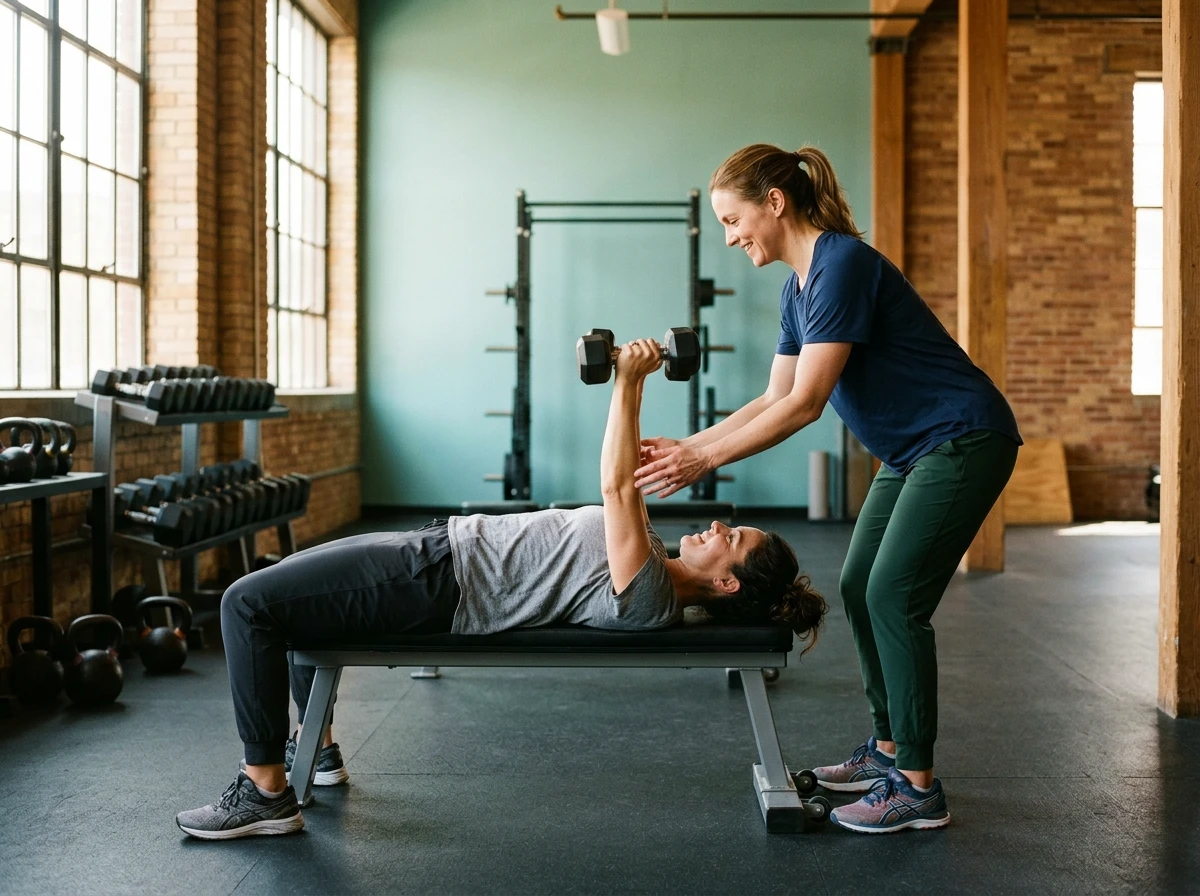
What doesn't separate the goals: high-rep, light-weight workouts. Those provide insufficient resistance for muscle adaptation and insufficient intensity for meaningful fat burning. They're not "toning exercises"; they're just insufficient stimulus for either goal.
This is also why one-size-fits-all plans often disappoint. See why one-size-fits-all workout programs miss the mark for women.
Can Women Lose Fat And Build Muscle At The Same Time?
Yes, and for most women new to training or returning after time off, this happens naturally. Body recomposition doesn't require advanced programming. It requires consistent resistance training, adequate protein, and patience.
Body Recomposition: The Science Behind Doing Both
A 2025 review analyzing five years of research on simultaneous fat loss and muscle gain found:
- Higher-load resistance training consistently outperformed lower-load training for body recomposition outcomes.
- Protein intake at or above 0.8 to 1g per pound of body weight was the most important dietary variable.
- In a 24-week study on postmenopausal women, higher-resistance groups achieved significantly greater body recomposition; all groups lost visceral fat, but heavier training produced the most definition change.
The PMC research on hormones and hypertrophy supports the same conclusion: training stimulus and protein intake matter more than hormone levels in determining body composition outcomes.
Who Gets The Best Results From Body Recomposition
Three groups see the fastest results:
- Beginners in their first 6 to 12 months of consistent training
- Women returning after a break (muscle memory accelerates rebuilding)
- Women carrying excess body fat (larger stored energy reserve to draw on)
Experienced, already-lean athletes may eventually need to choose between a dedicated muscle-building phase and a fat-loss phase. But that applies to very few recreational gym-goers. Most women training for a lean, defined look will see body recomposition results long before reaching that decision point.

Should You Cut, Recomp Or Build First?
Before you choose a plan, decide your first focus: fat loss (a cut), body recomposition (a recomp) or muscle building (a build). Five quick checks help, and they feed straight into the L.E.A.N. Framework below:
- Check your waist. Measure at the belly button and compare it with your height. The UK's National Institute for Health and Care Excellence (NICE) advises women to keep the size of your waist to less than half of your height, so a higher ratio points toward prioritizing fat loss.
- Check your training history. If you're new to lifting, you have the most room to build muscle while you lose fat.
- Check your hormone stage. In perimenopause, menopause or beyond, protecting muscle should come first.
- Check your intake. If you've been eating very little for months without results, you may need to eat more, not less.
- Check your evidence. Let your tape measure, photos and strength over the last month, not the scale, show you what's changing.
| Your Answers | Best First Focus | What It Looks Like |
|---|---|---|
| Waist over half your height, eating normally, any training level | Cut (fat loss) | Modest caloric deficit, strength training 2 to 3 times a week, high protein |
| New to lifting, waist near or under half your height | Recomp | Eat around maintenance, lift with progressive overload, prioritize protein |
| Peri- or postmenopausal, weight “fine” but feeling softer | Recomp | Strength training first, protein at every meal, track waist and strength |
| Long-term low-calorie dieting with little change | Recomp or build | Gradually raise calories toward maintenance while lifting |
| Lean already, wants more shape and definition | Build | Small calorie surplus or maintenance, heavier progressive training |
For most women over 40, the answer lands on recomp. That's good news, because it means you don't have to starve yourself to look better. For more on what that involves, read what body recomposition really means for women over 40.
The Emotional Reality: Fear, Confusion, And The Bulky Myth
The fear of "getting bulky" is one of the most consequential myths in women's fitness. It's not a minor confusion; it has real, measurable effects on how women train and what results they get.
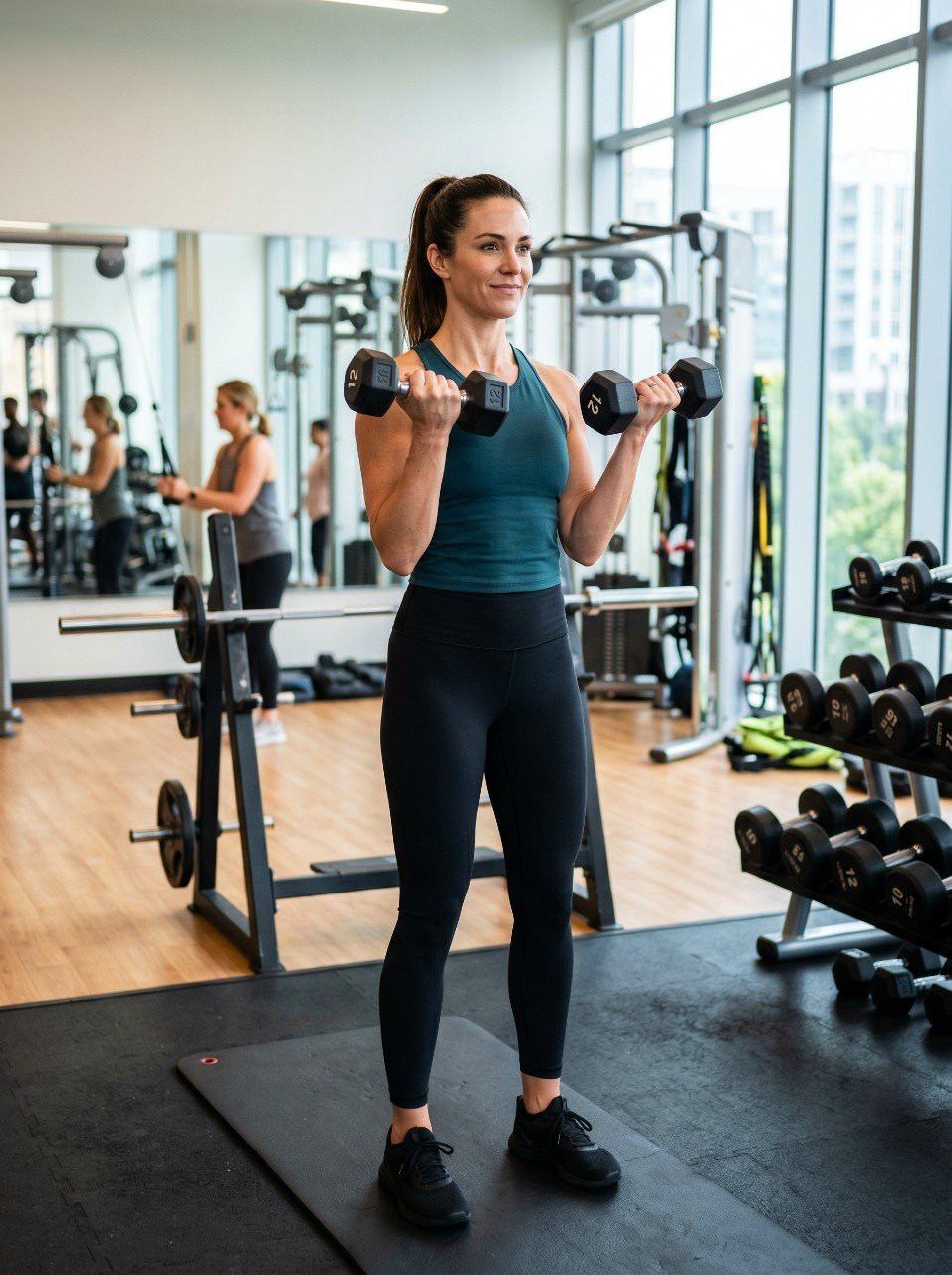
Fear of looking too muscular is one of the reasons many women stay away from the weights, and it keeps them from training in the way that produces the results they want.
Where The Bulky Myth Came From
Two sources created and reinforced it. First: images of competitive female bodybuilders, who represent a fraction of women who train and whose physiques require years of extreme effort, disciplined eating, and often pharmaceutical assistance. Second: the fitness industry's financial incentive.
Keeping women afraid of heavy weights sells light resistance classes, specialized "toning" equipment, and gym memberships that never threaten to change a woman's size visibly.
A 2025 review of the history of resistance training in women documents how women's strength training went from being actively discouraged in the early 20th century, when doctors genuinely warned women against lifting, to where we are now, still constrained by myths that decades of research have dismantled.
What Gym Intimidation Actually Costs Women
Feeling out of place in the weight room isn't a personality flaw. It's the predictable result of being told for years that that space isn't for you. And it has consequences: women who feel intimidated train differently - lighter weights, less progressive overload, fewer challenging sessions - which directly limits results.
The confusion about appropriate training isn't a failure of effort. It's the result of receiving contradictory and often incorrect information about how female physiology actually works.
For practical strategies on navigating this: How to Get Started at the Gym Without Feeling Intimidated as a Woman and How to Build Fitness Confidence When You Hate the Gym.
The L.E.A.N. Framework: How To Train For Your Actual Goal
Most training advice for "toning" is either too vague to act on or designed for a different goal. The L.E.A.N. Framework covers the four variables that decide whether you're moving toward a lean, defined look or spinning in place.
L, Lift heavy enough to stimulate change. If you can complete 20 reps without genuine effort, the weight is not challenging your muscles to adapt. Progressive overload, gradually increasing resistance, is required for any meaningful body composition change. "Toning weights" don't produce toning.
E, Eat for your specific goal. A calorie deficit promotes fat loss. Maintenance or a small surplus promotes muscle gain. These are different settings on the same dial. Neither requires extreme restriction or aggressive eating.
A, Allow recovery. Muscle is built during rest, not during training. Most women need 48 hours between training the same muscle group. Overtraining produces fatigue, not faster results.
N, Never skip protein. Protein is the raw material for muscle repair and growth. Without sufficient protein, neither toning nor muscle building works, regardless of how consistent the training is.
How To Structure Training For A Lean, Defined Look
A practical starting point for body recomposition:
- 3 to 4 resistance training sessions per week, targeting all major muscle groups.
- Progressive overload every 2 to 3 weeks (more weight, more reps, or shorter rest periods).
- 2 to 3 moderate cardio sessions per week for cardiovascular health and calorie management.
- Protein at 0.8 to 1g per pound of body weight daily, distributed across meals.
For a complete nutritional framework to support this: High-Protein Diet Plan for Sustainable Weight Loss for Women.
Goal-Based Body Composition Strategy
| Strategy | Calorie Approach | Protein Target | Training Focus | Best For | Realistic Timeline |
|---|---|---|---|---|---|
| Body recomposition (toning) | Maintenance or 200 to 300 cal deficit | 0.8 to 1g/lb | Full-body resistance + moderate cardio | Beginners, returning women | 3 to 6 months for visible change |
| Dedicated fat loss | 400 to 600 cal deficit | 0.8 to 1g/lb (to protect muscle) | Resistance training + higher cardio | Women with significant fat to lose | 8 to 20 weeks |
| Dedicated muscle building | 150 to 300 cal surplus | 1 to 1.2g/lb | Heavy progressive resistance, less cardio | Experienced, already-lean women | 6 to 18 months for significant size gain |
The Role Of Cardio In Both Goals
Cardio doesn't destroy muscle, but excessive cardio without sufficient protein can cause muscle loss. For toning, 2 to 3 moderate sessions per week support the calorie deficit without compromising muscle recovery. For muscle building, 1 to 2 weekly sessions maintain cardiovascular health without interfering with muscle repair.
The idea that cardio "burns muscle" applies mainly to extreme endurance athletes, or to women doing high volumes of cardio in a significant calorie deficit without adequate protein. For most recreational gym-goers, a balanced program has no muscle-wasting effect.
Spot Toning: Why Crunches Won't Flatten Your Belly
You can't choose where you lose fat. In one controlled study, six weeks of abdominal exercises didn't reduce abdominal fat, waist size or body fat percentage, although muscular endurance improved. Core work still strengthens your trunk; it just won't burn off the fat on top. More on the truth about spot reduction.
What Women Should Eat For Toning vs. Building Muscle
The training side of this equation gets most of the attention. Nutrition is where most women fall short, and where the fastest improvements usually come from.
Protein: The Non-Negotiable Variable
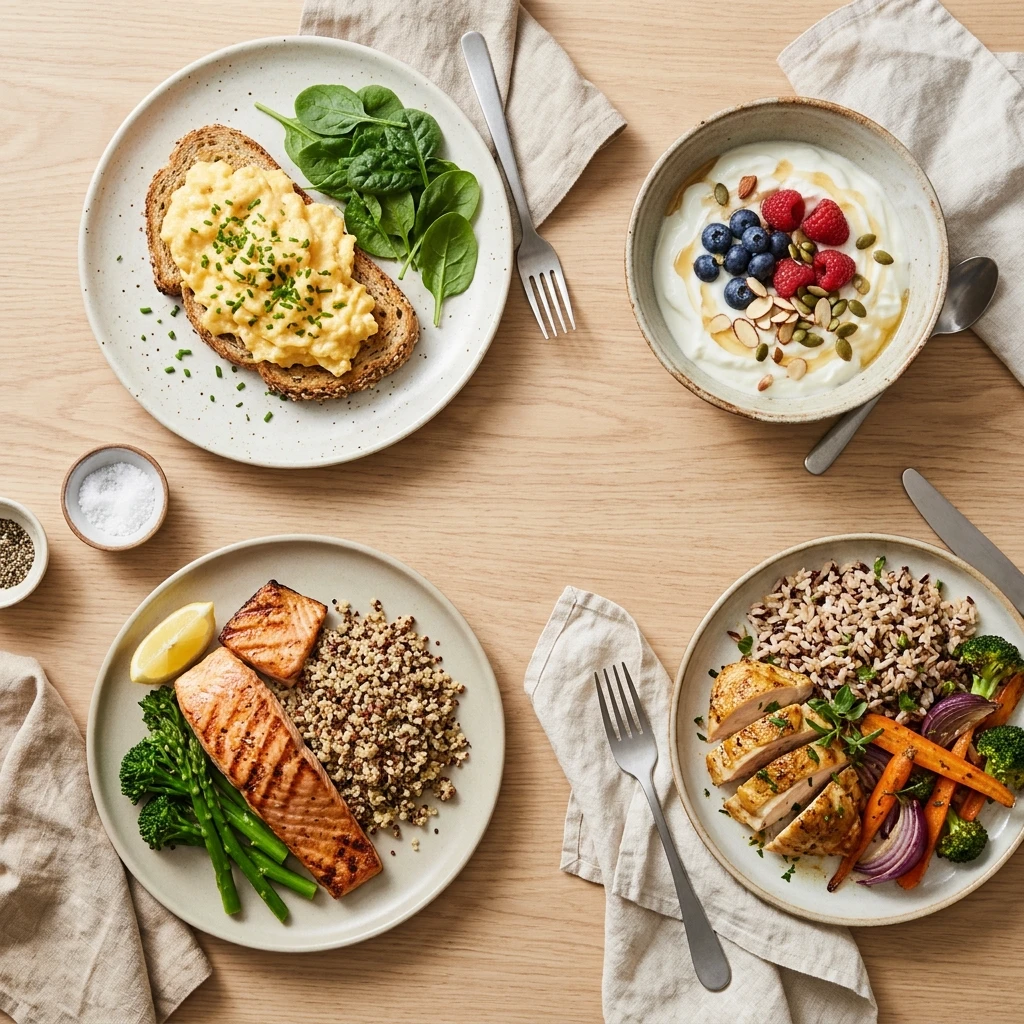
Both toning and muscle building stall without enough protein. A meta-analysis of 49 trials found that during resistance training, gains in fat-free mass levelled off at about 1.6 g of protein per kg of body weight per day (about 0.7 g per pound), and that protein's effect got smaller with age - one more reason to get it right after 40.
Protein is also filling, which makes a calorie deficit easier to hold. Protein timing matters too. Distributing intake across 3 to 4 meals rather than back-loading it at dinner supports muscle protein synthesis more effectively than the same daily total consumed in two sittings.
Calorie Strategies For Each Goal
The calorie target is the primary variable separating toning from muscle building:
- For toning: A 200 to 400 calorie daily deficit with high protein (0.8 to 1g/lb) preserves or slightly builds muscle while reducing body fat.
- For muscle building: Eating at maintenance or a 150 to 300 calorie surplus provides the energy required for muscle repair and growth without significant fat gain.
Neither approach requires dramatic restriction. Women who see the best long-term results make sustainable adjustments, not cycling through crash diets that cause muscle loss and reset progress repeatedly.
Hormones affect calorie strategy more than most programs account for. If stress or perimenopause is part of the picture, read about cortisol and belly fat and why it's so hard to lose weight in perimenopause.
How Long Does It Take To See Results?
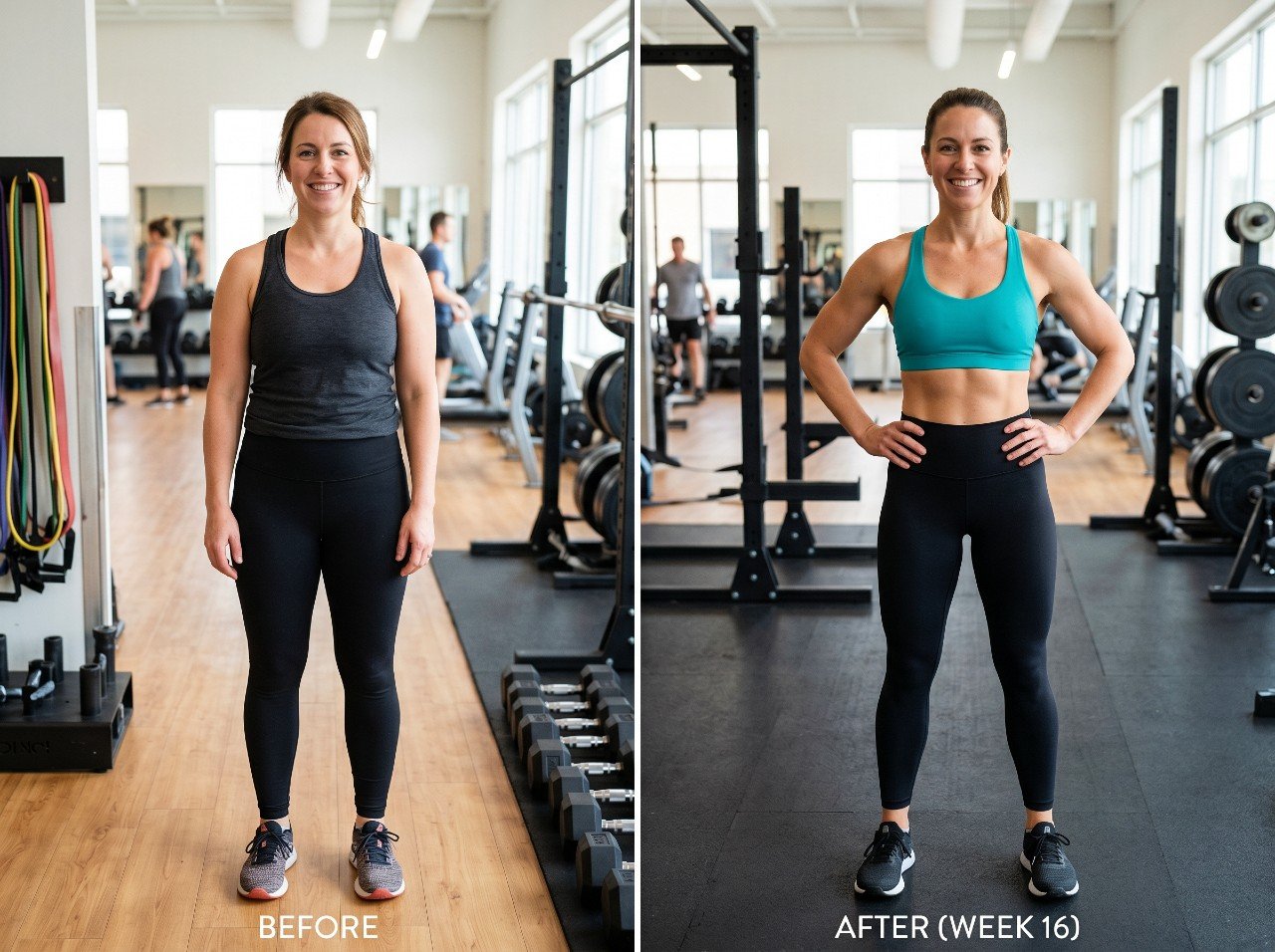
Timelines depend on training consistency, starting body composition, nutrition, sleep and stress. These are typical ranges, not promises.
Weeks 1 to 4: Neurological adaptations. You'll feel stronger before looking different. The nervous system is learning to recruit existing muscle fibers more efficiently. The scale may not move. That's normal.
Weeks 8 to 12: Visible body composition changes with consistent training and sufficient protein. Women with more body fat to lose typically see faster visible results.
3 to 6 months: Meaningful muscle definition becomes apparent with consistent work. This is when most women first see the results they set out to achieve.
6 to 12+ months: Significant muscle size increases for women in a deliberate muscle-building phase. This timeline assumes progressive overload is applied consistently.
The scale is an unreliable marker during body recomposition. You can lose inches and gain definition while the number barely moves.
See also: How Long Does It Take to See Results from Working Out as a Beginner Woman
How To Track Toning Progress When The Scale Won't Move
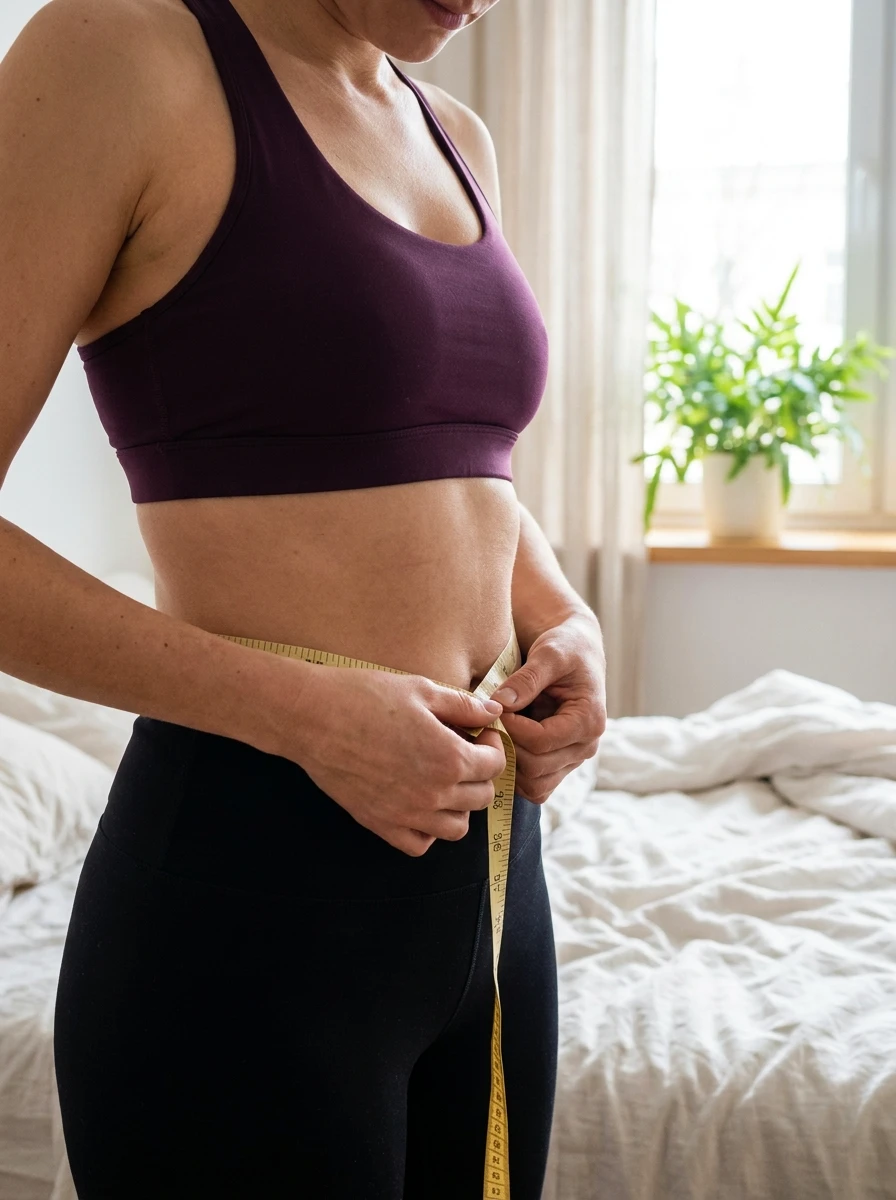
Track your waist, progress photos, and strength numbers instead of relying on weight alone, because those show fat loss and muscle gain that the scale hides. This is especially important after 40, when your weight can stay flat while your body composition changes.
| Measure | What It Tells You | How Often |
|---|---|---|
| Scale weight | Total mass only; can’t separate fat from muscle | Weekly average, if at all |
| Waist measurement | A practical sign of fat loss around the middle | Every 2 weeks |
| Progress photos | Visible shape and definition changes | Every 4 weeks, same light and pose |
| Strength log | Whether you’re building or keeping muscle | Every workout |
| How clothes fit | Real-world body composition change | Ongoing |
For a full walkthrough of these methods, see how to track your weight loss progress.

Expert Commentary: What The Research Actually Shows
Researchers have been chipping away at the toning myth for years. A 2020 review in Frontiers in Physiology concluded that relative strength and muscle gains are far more similar between men and women than traditionally assumed.
A 2025 review of body recomposition research found that higher-load training outperformed lower-load training and that protein intake was the most important dietary factor.
Exercise physiologist Dr. Stacy Sims, author of ROAR, has long argued that women need to lift heavy and that strength training is essential for limiting muscle and bone loss as estrogen declines.
For midlife women specifically, the SWAN analysis shows why the scale misleads: fat gain doubled, and lean mass declined at the start of the menopause transition, with no jump in weight. Put together, the message is consistent: challenging resistance training plus enough protein is what produces the "toned" look, at any age.
The Contrarian Take: You Might Not Need To Lose Weight At All
Most women who want to "tone up" assume they need to lose weight first. For many women over 40, that's backwards. If your waist is already under half your height, chasing a lower number with harder dieting can cost you the very muscle that creates shape.
A better goal for many women is to weigh the same, or even a little more, with a smaller waist and stronger lifts. That isn't failure on the scale. It's body recomposition working exactly as it should.
Want The Habits Behind Lasting Weight Loss? Get the free guide: 10 research-backed habits that help women lose body fat and keep it off, with no extreme diets. Send Me The Free Guide.

The Bottom Line
The difference between toning and building muscle for women is smaller than the fitness industry wants you to believe. Both goals require you to lift weights that challenge you, increase the challenge over time, and eat enough protein to support recovery. Toning adds a calorie deficit. Muscle building removes it.
The vocabulary separating these two goals makes them sound more different than they are. At their foundation, they're one process: progressive resistance, enough protein and time. After 40, add one rule: judge your progress by your waist, photos and strength, not the scale.
Pick up something heavy. Eat enough protein. Stay consistent for months. The results of the industry called "toning" will follow.
Glossary Of Key Terms
- 1-Rep Max (1RM): The maximum amount of weight an individual can lift for a single repetition of a given exercise, used to determine training intensity.
- Body Composition: The proportion of fat and non-fat mass (muscle, bone, water) in the body; a more accurate health indicator than total weight.
- Body Recomposition: The process of simultaneously losing body fat and gaining or maintaining muscle mass to change the body's fat-to-muscle ratio.
- Calorie Deficit: A state where an individual consumes fewer calories than their body burns, which is necessary for fat loss.
- Estrogen: The dominant hormone in women that promotes fatigue-resistant muscle fibers and reduces muscle protein breakdown.
- Hypertrophy: The physiological process of increasing the cross-sectional size of muscle fibers through resistance training and repair.
- Lean Muscle Mass: The total weight of the body's muscle tissue excluding fat; it is the primary driver of metabolic rate and physical "firmness."
- Metabolic Rate: The speed at which the body burns calories at rest; this rate increases as an individual gains more lean muscle mass.
- Muscle Atrophy: The medical term for the wasting away or decrease in size of muscle tissue, often due to lack of use or insufficient nutrition.
- Progressive Overload: The gradual increase of stress placed upon the body during exercise, achieved by adding more weight, more repetitions, or reducing rest periods.
FAQ
Can You Tone Without Building Any Muscle?
The defined, firm look people call toned needs visible muscle beneath a thinner layer of body fat. Losing fat without enough muscle usually leaves you smaller but not more defined. Some muscle building or maintenance through resistance training is needed for a toned result, which is why crash diets alone rarely produce the look people want.
How Many Reps Should Women Do To Tone Up?
The effective rep range for body recomposition is typically 10 to 20 reps per set, with weights that make the last 2 to 3 reps genuinely challenging. Workouts using very light weights for 30+ reps provide insufficient stimulus for muscle adaptation. They don't meet the toning goal and don't meet the muscle-building goal either. If the weight feels easy throughout, it's not doing much.
Will Lifting Heavy Weights Make Women Look Bulky?
No. Women lack the testosterone levels required to build the kind of muscle mass associated with a bulky appearance from standard resistance training. Lifting heavier weights with normal calorie intake produces a leaner, more defined physique over time, not a larger one. The "heavy weights = bulky women" connection exists in marketing, not in physiology.
What's The Best Diet For Toning Up?
A moderate calorie deficit (200 to 400 cal/day below maintenance) combined with high protein intake (0.8 to 1g per lb of body weight) and enough carbohydrates to fuel training sessions. Extreme caloric restriction accelerates scale-weight loss in the short term but causes significant muscle loss, which directly undermines the toning goal. Sustainable adjustments outperform aggressive restrictions every time.
Should I Lose Weight Or Tone First?
It depends on your starting point. If your waist is more than half your height, start with fat loss plus strength training. If you’re new to lifting, in perimenopause or menopause, or already a healthy size but feel soft, start with body recomposition.
Why Am I Not Losing Weight But Losing Inches?
You’re probably losing fat while gaining or maintaining muscle. The scale stays steady, but your body takes up less space. That’s body recomposition, and it’s a good sign.
Why Is It Harder To Tone Up After 40?
During the menopause transition, fat gain speeds up and lean mass declines, even when weight stays steady. Strength training and enough protein help counter this.