
The Perimenopause-Smart Approach To Weight Loss Goal Setting
Ralph Waldo Emerson
Essayist, philosopher & poet
The only person you are destined to become is the person you decide to be.
Summary (TL;DR)
Weight loss goal setting works, but only when the goal accounts for what your body is actually doing. Research shows higher, health-motivated goals outperform vague or appearance-driven ones, and after 40, hormonal shifts change the math entirely. This guide shows you how to set weight loss goals that fit your real body, track progress beyond the scale, and stay motivated using research-backed habit and mindset strategies, not willpower alone.
Losing weight can feel daunting, especially when the goals you’re setting don’t seem to match what your body is doing. If you’ve ever set a target, followed the plan, and watched the scale barely move, you’re not imagining it. You’re probably working from an outdated goal.
By mastering weight loss goal setting, you can transform your body, protect your health, and build the kind of confidence that comes from finally working with your body instead of against it.
That’s especially true if you’re 40 or older: this guide walks through what the research says about setting goals that actually fit a changing body, how to track progress that doesn’t show up on a scale, and how to stay motivated when the number moves slower than you’d like.
Whether you’re just starting out or you’ve been stuck at the same number for months, the tips below will give you a framework for setting weight loss goals that’s realistic, evidence-based, and built around how women’s bodies actually change, not generic advice written for a 25-year-old metabolism.
Medical & Referral Disclaimer
This article is for informational and educational purposes only. It is not a substitute for professional medical advice, diagnosis, or treatment. Always consult your physician or a qualified health provider before starting any new diet, exercise, or weight loss program, particularly if you are navigating perimenopause or menopause, when individual hormonal and metabolic factors vary widely.
Key Takeaways
- Higher, health-motivated goals outperform vague ones. A study of over 36,000 dieters found people who set goals above 10% body weight loss lost significantly more and were far less likely to quit than those with modest, appearance-driven targets.
- Your 40s and 50s change the math. Hormonal shifts during perimenopause accelerate fat gain and muscle loss at the same time, so a goal calibrated to your 20s or 30s body can set you up to feel like you’re failing when you’re not.
- The scale can lie to you. Weight can hold steady while body composition is genuinely improving, because fat and muscle are shifting in opposite directions underneath it.
- Self-monitoring is the single strongest predictor of success. Researchers call it the “cornerstone” of weight management, more so than any specific diet.
- “If-then” planning beats willpower. Attaching a new habit to an existing routine has a well-documented, medium-to-large effect on whether people actually follow through.
- Self-compassion is strategic, not soft. Research links it to better recovery from dietary lapses and more consistent long-term behavior change.

Why Most Weight Loss Goals Fail Before They Start
Most weight loss goals fail for a reason that has nothing to do with discipline: they’re outcome-only, vague, and disconnected from what actually changes behavior day to day.
A 2023 study published in the Journal of Medical Internet Research tracked more than 36,000 people in a 24-week digital weight loss program, and the size and type of goal people set was strongly associated with their results.
Participants who set a goal of losing more than 10% of their body weight lost an average of 5.21 kg more than those who set a modest 5–10% goal, and were far less likely to drop out (odds ratio 0.40). Motivation was linked to outcomes too: people driven by health or fitness lost significantly more weight than those motivated purely by appearance.
Health-motivated dieters lost 1.40 kg more on average than appearance-motivated ones. This is observational data from people who chose their own goals, so it shows a strong association rather than proof that a bigger goal alone causes better results, but the pattern is consistent and worth taking seriously.
That’s the opposite of what most of us are told. “Start small so you don’t get discouraged” is well-meaning advice, but the data suggests the discouragement usually comes from a different source: a vague goal, disconnected from a real reason, and impossible to act on today.
Recognize This Pattern?
Here’s a pattern that shows up constantly in weight loss forums, client intake calls, and comment sections: a woman sets a goal like “lose weight before summer,” doesn’t define how much or by when, ties it loosely to how she’ll look rather than how she’ll feel, and has no specific daily action attached to it.
Six weeks later, nothing’s changed, and it feels like a personal failure rather than what it actually is: a goal that was never specific enough to act on. If that sounds familiar, the fix isn’t more willpower. It’s a better-built goal, which is exactly what the rest of this guide covers.
The Perimenopause Factor Nobody Talks About In Weight Loss Goal Setting
If you’re over 40 and your weight loss goals aren’t landing like they used to, your body isn’t betraying you. It’s running on different hormonal math than a decade ago, math most weight loss advice ignores.
What Actually Changes In Your Body After 40
The Study of Women’s Health Across the Nation (SWAN), a landmark NIH-funded study that has tracked thousands of women through midlife for over two decades, found something most goal-setting advice ignores completely.
About two years before your final period, the rate of fat gain roughly doubles and lean muscle mass starts declining at the same time, not one after the other.
We’ve covered the full hormonal breakdown elsewhere, including exactly why it’s so hard to lose weight in perimenopause and what body recomposition really means after 40. What matters for goal setting specifically is simpler: if fat and muscle are moving in opposite directions at once, any goal measured purely in pounds is only seeing half the story.

Why Your Old Weight Loss Goals Need New Math
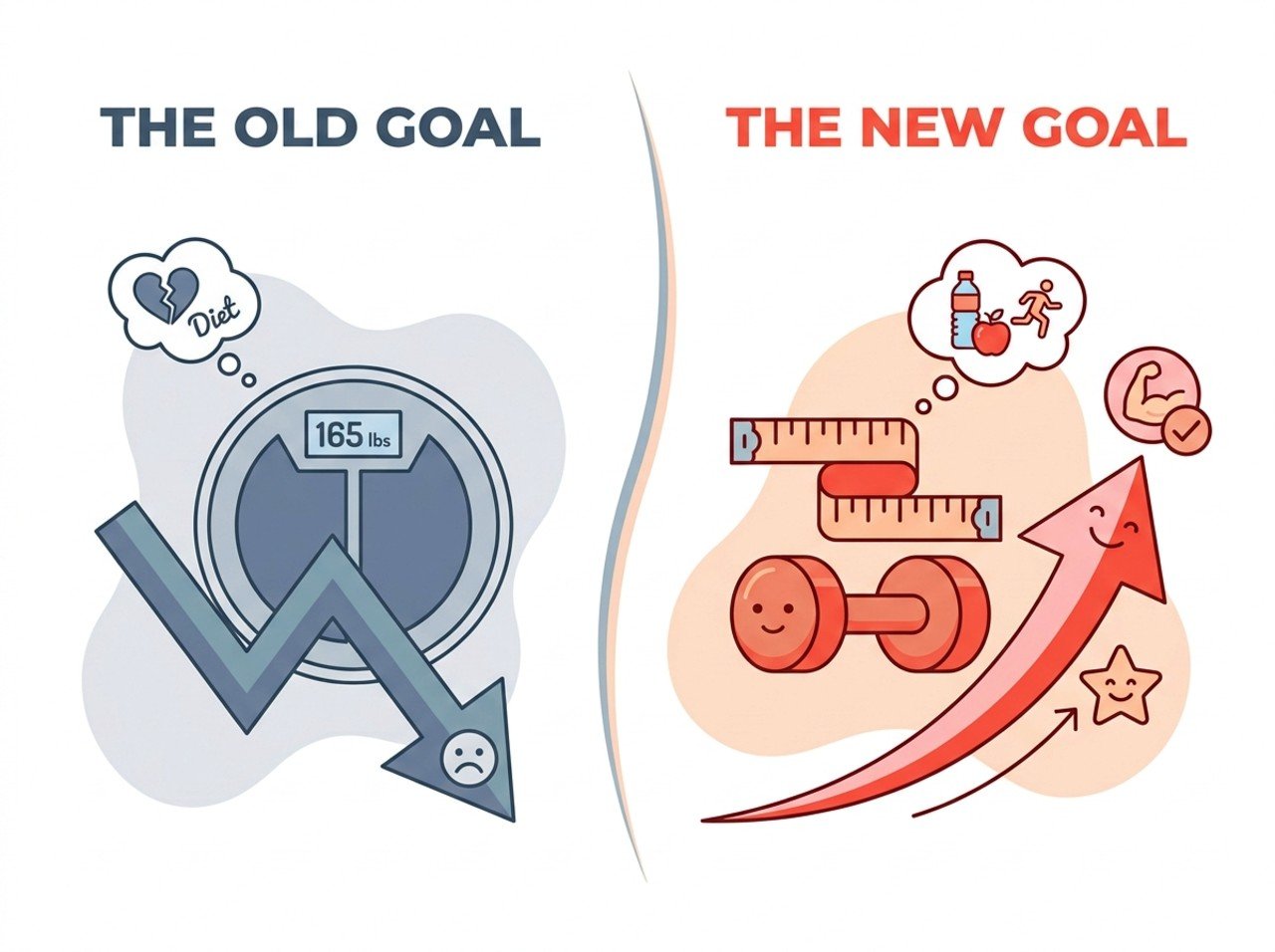
Because fat mass is climbing while muscle mass is dropping at the same time, your total body weight can stay almost perfectly flat even while your body composition is changing in ways that matter.
That’s the SWAN researchers’ own conclusion: gains in fat and losses in lean tissue “balance each other out” on the scale, which means the number you’re staring at every morning may not reflect the work you’re actually doing.
A weight loss goal built around how fast you lost weight at 28 isn’t just optimistic at 45. It’s measuring the wrong thing. Understanding what body recomposition actually looks like after 40 reframes the whole goal. The table below shows how the goal-setting approach needs to shift.
| Goal-Setting Factor | Your 20s & 30s | Perimenopause & Beyond |
|---|---|---|
| Primary success metric | Scale weight | Waist measurement, how clothes fit, strength gains |
| Expected monthly pace | Often 4–8 lbs with aggressive dieting | 1–2 lbs is genuinely a strong, sustainable result |
| Muscle vs. fat priority | Fat loss alone often “works” | Muscle preservation is part of the goal, not optional |
| Why plateaus happen | Often diet adherence | Can be genuine hormonal recalibration, not failure |
| What a “stalled scale” can mean | Usually a real plateau | Can mean fat loss plus muscle or water shifts happening simultaneously |

The Expert-Observed Mistake Behind Most Failed Weight Loss Goals
The single biggest mistake I see women over 40 make with weight loss goal setting: they set the number using their own past body as the benchmark, without adjusting for the fact that their body is no longer working from the same hormonal starting line.
I hear a version of this constantly: “I lost 15 pounds in six weeks when I did this in my 30s. Why isn’t it working now?” It’s not a discipline problem.
Per the research above, you’re very possibly losing muscle at the same time your body is more inclined to store fat centrally, two forces working against each other at the same time you’re trying to lose weight. Comparing this decade to your 30s isn’t just discouraging. It’s comparing two different physiological realities as if they were the same test.
The fix isn’t lowering your ambition. The Journal of Medical Internet Research data above is clear that bigger, more specific goals actually outperform timid ones. The fix is changing what you’re measuring: build your goal around strength, waist circumference, energy, and how your clothes fit, not a number on the scale that’s being pulled in two directions by biology you can’t out-discipline your way past.
How To Set Weight Loss Goals That Actually Stick
The most effective weight loss goals combine an ambitious outcome goal for motivation with small, specific daily actions, called process goals, that you actually control.
Setting Smart, Realistic Weight Loss Goals
Precision beats vagueness. A 2022 study in Frontiers in Psychology tested whether oddly specific goals (“lose 2.923 kg”) outperformed round ones (“lose 3 kg”), and found that both types of numeric, specific goals led to more weight loss than having no clear number at all.
Practical ways to make your goal specific and achievable:
- Set a real number and a real date. “Lose weight” isn’t a goal. “Lose 12 pounds by March 1” is.
- Anchor it to health or fitness, not appearance. The research above found health- and fitness-motivated goals outperformed appearance-driven ones by a meaningful margin.
- Break it into monthly and weekly checkpoints. A 12-pound goal becomes far less intimidating as four checkpoints of 3 pounds each.
- Account for your current life stage. A busy schedule, perimenopausal symptoms, or a physical limitation aren’t excuses. They’re inputs your goal should be built around, not obstacles to push through.
The distinction between an outcome goal and a process goal matters more than most weight loss advice admits. The table below shows how to pair them.
| Outcome Goal (The “What”) | Supporting Process Goal (The “How”) |
|---|---|
| Lose 12 lbs in 12 weeks | Log meals daily and hit a protein target at each meal |
| Fit into a specific clothing size | Strength-train twice a week, non-negotiable |
| Reduce waist circumference by 2 inches | Walk 20 minutes after dinner, five nights a week |
| Improve energy and sleep quality | Consistent bedtime, no late-evening heavy meals |





Turning Goals Into Automatic Habits
A goal only works if it turns into something you actually do on a Tuesday afternoon when you’re tired. This is where most weight loss plans quietly fall apart, not from lack of motivation but from never deciding exactly when and where the behavior happens.
The research on this is some of the most robust in behavioral psychology. A meta-analysis of 94 studies and over 8,000 participants by psychologists Peter Gollwitzer and Paschal Sheeran found that forming a specific “if-then” plan, attaching a new behavior to an existing routine or cue, had a medium-to-large effect on whether people actually followed through (d = .65), including a d = .61 effect specifically on overcoming the “I’ll start tomorrow” problem.
In practice, this means stacking your new habit onto something you already do without thinking. “After I pour my morning coffee, I’ll log breakfast” is far more durable than a general intention to “eat better.”
Tracking Progress Without Becoming A Slave To The Scale
Tracking is the single most reliable predictor of long-term weight loss success, but the scale is only one of several ways to do it, and often not the most useful one for women over 40.
A study following 220 women in a behavioral weight management program found that dietary self-monitoring was the “cornerstone” of successful long-term weight management.

Examples Of Tracking Methods That Work
Scale weight is only one input. These four methods, used together, give a far more accurate picture of real progress.
- Food journal or tracking app. Captures portions and patterns most people underestimate by habit, not dishonesty.
- Waist circumference, measured monthly. Given the visceral fat shift covered above, this can move even when the scale doesn’t.
- Strength benchmarks. Strength training progress, what you can lift or how many reps you can do, captures muscle retention: the thing scale weight actively hides.
- Progress photos, same lighting and pose monthly. Body composition changes often show up visually before they show up numerically.
Regular physical activity supports every one of these tracking methods, and the World Health Organization recommends at least 150–300 minutes of moderate aerobic activity per week for adults, alongside muscle-strengthening activity twice a week. That strength component matters more after 40, not less, given the muscle loss covered earlier in this guide.
Celebrating Milestones The Right Way
Celebrating a milestone reinforces the behavior that got you there, which is why skipping this step quietly undermines your own progress.
Without celebrating small wins, it’s easy to lose sight of how far you’ve actually come, especially on a journey where the scale might be lagging behind the real progress you’re making, as covered above.
- Non-food rewards tied to the goal. New workout gear, a massage, or a piece of clothing in your current size - something that reinforces the identity shift, not just the number.
- Non-scale victories, tracked deliberately. A looser waistband, an extra rep, better sleep, or more energy by 3 pm all count and deserve to be written down, not dismissed.
- Sharing wins with your support system. Telling a friend, a partner, or an online community makes the milestone feel real and adds a layer of accountability for the next one.
Join Our Mailing List
Join thousands of women inside our community and receive our free guide, 10 Actions That Support Permanent Weight Loss — the exact behavioural shifts that make the difference between a two-week attempt and a lasting transformation.
No restriction plans. No guilt. Just what actually works — for real women with real lives.

Staying Motivated When Progress Feels Slow
Motivation dips are normal, not a sign you’re doing something wrong. The strategies that work best replace reliance on willpower with structure: accountability, a specific plan for setbacks, and tracking that captures progress the scale misses.
Common motivation killers include a lack of accountability, hitting a plateau without understanding why, and comparing your current pace to a younger version of yourself using the wrong benchmark, the exact mistake covered earlier in this guide.
Finding a workout partner, joining a support community, or drawing on outside motivation strategies all provide the external accountability that research consistently links to better follow-through.
The Mindset Shifts That Make Weight Loss Goals Sustainable
Sustainable weight loss depends less on willpower than on three specific mindset shifts: measuring progress instead of perfection, treating setbacks with self-compassion instead of punishment, and optimizing for years instead of weeks.
Progress, Not Perfection
Celebrate the pound you lost instead of fixating on the nine you haven’t. Perfectionism is one of the most common reasons people abandon otherwise-working plans after a single off-track day.

Self-Compassion Backed By Research
Self-compassion after a dietary lapse is a documented predictor of getting back on track faster, not indulgence.
A research review in Frontiers in Psychology found self-compassion supports weight regulation through several mechanisms, including helping people recover from dietary lapses without spiralling into the all-or-nothing thinking that often derails an entire week. Self-kindness, rather than self-judgment, was consistently linked to better long-term health behavior outcomes.
Long-Term Thinking Over Quick Fixes
Shifting from “lose weight for an event” to “build a lifestyle I can sustain” changes which goals feel worth setting in the first place. It’s the mindset most consistently associated with keeping weight off rather than losing it repeatedly.
Ready To Put This Into Practice?
You now know why most weight loss goals stall: vague targets, the wrong benchmark, and a scale that hides real progress. Knowing it isn’t the same as having the day-to-day plan for it.
Our free guide, 10 Actions That Support Permanent Weight Loss, turns everything above into a simple daily framework: specific actions, not vague advice, built for how real women’s bodies actually change over time. No crash diets, no scale obsession. Just what the research says works.
The Bottom Line
Weight loss goal setting isn’t about picking a number and gritting your teeth. It’s about picking the right number for your actual body, and building the tracking and habits that turn it into something you do automatically.
If you’re over 40, that means measuring more than the scale, expecting a genuinely different pace than you had at 25, and treating muscle preservation as part of the goal, not an afterthought.
Set a specific, health-motivated goal. Attach it to a real if-then plan. Track more than your weight. Celebrate the wins the scale can’t show you. That combination, backed by the research throughout this guide, is what actually moves the needle, even when the needle itself is telling only half the story.
Glossary Of Key Terms
- Perimenopause: The transitional phase leading up to menopause, characterized by hormonal shifts that increase fat gain and accelerate muscle loss.
- Body Recomposition: The process of simultaneously losing body fat and gaining or preserving lean muscle mass, which may result in no net change on the scale.
- Outcome Goal: A specific, measurable target defining a desired end result, such as a specific weight or clothing size.
- Process Goal: A controllable daily or weekly action, such as hitting a protein target, that serves as the "how" behind achieving an outcome goal.
- If-Then Planning: A behavioral strategy (also called implementation intentions) that links a situational cue to a specific action to automate new habits.
- Self-Monitoring: The practice of tracking dietary intake, exercise, or physical measurements; it is considered the strongest predictor of weight management success.
- Visceral Fat: Fat stored centrally around the abdominal organs, which often increases during midlife and is best tracked via waist circumference.
- Non-Scale Victories (NSVs): Markers of progress that do not involve body weight, including increased energy, improved sleep quality, and better-fitting clothes.
- SWAN Study: The Study of Women's Health Across the Nation, a multi-decade research project that identified how fat and muscle mass change during the menopause transition.
- SMART Goals: A framework for setting objectives that are Specific, Measurable, Attainable, Relevant, and Time-bound.
FAQ
What Are The Benefits Of Setting SMART Weight Loss Goals?
SMART goals (Specific, Measurable, Attainable, Relevant, and Time-bound) are more likely to be achieved than vague ones because they give you something concrete to act on and track. Research on over 36,000 dieters found that more specific, ambitious goals outperformed modest or vague ones in both weight loss and long-term adherence.
What Is A Good Monthly Weight Loss Goal?
For most adults, 1–2 pounds per month is a safe, sustainable pace that’s more likely to stay off. Faster loss is possible but carries a higher risk of muscle loss and rebound weight regain, which matters even more after 40.
How Do Weight Loss Goals Need To Change During Perimenopause?
Because fat gain accelerates while muscle mass declines during the menopause transition, goals should shift from scale weight alone to waist measurement, strength, and how clothes fit. Expect a genuinely slower pace than in your 20s or 30s: that’s physiology, not failure.
How Do I Set Realistic Weight Loss Goals?
Start by talking to your doctor or a registered dietitian, then set a specific number and date based on your current body, lifestyle, and life stage, not your body from a decade ago. Break the goal into monthly checkpoints and track multiple metrics.
What Are Common Mistakes Women Make When Setting Weight Loss Goals?
The most common mistake is benchmarking the goal against a younger version of yourself instead of your current hormonal and metabolic reality. Other frequent mistakes include vague targets, appearance-only motivation, no tracking system, and no specific if-then plan for daily actions.
How Can I Stay Motivated To Reach My Weight Loss Goals?
Build accountability through a support system, attach your goal to specific if-then habits rather than willpower, and track non-scale progress like strength and measurements so you can see wins the scale might be hiding. Celebrate milestones deliberately instead of waiting for the final number.
What If The Scale Isn’t Moving Even Though I’m Following My Plan?
A stalled scale doesn’t always mean stalled progress. Research shows fat gain and muscle loss can happen simultaneously during midlife, effectively cancelling each other out on the scale while your body composition is genuinely changing. Track waist measurement and strength alongside weight to see the fuller picture.