
Generic Plans Build The Habit. Individualised Training Builds The Results After 40
CHRISTIAN D. LARSON
New Thought leader, teacher & author
Believe in yourself and all that you are. Know that there is something inside you that is greater than any obstacle.
Summary (TL;DR)
One-size-fits-all workout programs miss the mark for women over 40 because they’re written for an average body that isn’t yours: usually younger, often male, and rarely going through perimenopause.
A generic plan is a fine way to build the habit. Long-term progress needs a plan adjusted to your life stage, training history, recovery and schedule.
The core rules (lift progressively heavier, eat enough protein, recover well) work just as well for women. You personalise the dials with the F.I.T.S. Method below, rather than chasing every new “female-specific” rule online.
Have you ever followed a workout program to the letter, every session ticked off, only to feel exhausted, frustrated and no closer to your goals? You’re not alone, and it’s likely not your fault. The uncomfortable truth is that most mainstream fitness advice was never tested on women like you.
A startling analysis of 5,261 sport and exercise science publications found that women made up just 34% of participants, and only 6% of studies looked at women alone.
Women in midlife and beyond are, as the same researchers put it in a British Journal of Sports Medicine call to action, even more invisible. So the “standard” program you downloaded was built on someone else’s data.
Our view at Women’s Lean Body Formula is simple. A generic workout program can help a beginner build the right habit, and that has real value. But long-term progress for women over 40 requires a highly individualised approach.
This article shows you why the template stops working, what actually needs changing, and how to tailor any plan without hiring a coach or getting lost in influencer rules.
Medical & Referral Disclaimer
This article is for informational and educational purposes only. It is not a substitute for professional medical advice, diagnosis or treatment. Always consult your physician or a qualified health provider before starting any new diet or exercise program, especially if you have osteoporosis, joint problems, heart conditions or significant perimenopause symptoms.
Key Takeaways
- The template isn’t the enemy: A generic plan is a good starting point for building consistency. It just can’t take you all the way after 40.
- Your life stage changes the plan: The menopause transition speeds up fat gain and muscle loss, so lifting matters more, not less.
- The rules are shared, the dials are personal: Progressive overload works for everyone. What you personalise is the load, volume, recovery and schedule.
- Skip the phase calendar: A 2026 randomised trial found no extra strength or muscle gains from training around menstrual cycle phases.
- Women get more from less: Women reached the same survival benefit at about 140 minutes of weekly activity that men needed 300 minutes to get.
- Use F.I.T.S.: Find your stage, Individualise your load, Track your recovery, Scale progressively.

Why Do One-Size-Fits-All Workout Programs Fail Women Over 40?
One-size-fits-all workout programs fail women over 40 because they assume a body, schedule and recovery capacity you don’t have. They rarely account for perimenopause, your training history, past injuries or the 20 other jobs you’re juggling, so the same plan that works for a 25-year-old stalls for you.
It isn’t that the exercises are wrong. Squats, rows and brisk walks are as good for you as for anyone. The problem is the settings: how heavy, how often, how much rest, and what happens when life gets in the way. Here are the biggest mismatches.
The Research Behind Most Plans Was Built On Men
Most popular training advice comes from studies where women were the minority and midlife women were barely present. When only 6% of sport science studies focus on women alone, “proven” often means proven on young men.
That doesn’t make the advice useless. It means you’re allowed to question rest periods, volumes, and rep schemes never checked on a body like yours.
Generic Plans Assume A 25-Year-Old’s Body
Generic plans assume a stable body, but the menopause transition changes it fast. The Study of Women’s Health Across the Nation (SWAN) found that at the start of the transition, the rate of fat gain doubled and lean mass began to decline, until about two years after the final period.
That’s exactly why so many women tell us they “did everything right” and still gained weight around the middle. The program didn’t change, but the body running it did.
A plan that ignores this shift will keep prescribing endless cardio when what your muscles need is a stronger signal to stay. You can read more about this in our guide to strength training in perimenopause.
The Same Template Ignores Your Starting Point
A one-size template treats a woman who has never lifted the same as one with ten years of training, a bad knee or a shoulder that clicks. Your training age, injury history and equipment decide where you start, and starting in the wrong place is the fastest route to quitting.

This is where gym intimidation creeps in. If the first session is too hard, too confusing or too painful, it’s easy to decide “lifting isn’t for me”. It is. The plan just wasn’t built for you.
Are Women Really Just “Small Men” In The Gym?
No, but the differences are smaller than influencers suggest. Men have over 15 times more circulating testosterone, yet in training studies women build muscle at a similar relative rate. The same training principles work. The settings are what need tailoring.
Here’s our contrarian take. The differences that matter most aren’t between women and men. They’re between you and the “average” woman the plan was written for.
The National Strength and Conditioning Association’s position statement on female athletes says the same: sex-specific physiology can shape how fast you adapt, but progressive overload, specificity and periodisation apply to everyone.
Women also tend to be less fatigable than men at similar intensities in many tasks, although the effect depends on the exercise. In practice, that means you may be ready for your next set sooner than your gym partner’s program suggests. Time your rest by how ready you feel, not by a stopwatch copied from someone else.
Rate Your Program: Is It Actually Built For You?
Your program is probably a one-size-fits-all plan if it gives everyone the same weights, never changes, and has no way to adjust on bad days. Run through this quick check. Two or more “yes” answers mean it’s time to personalise.
- Fixed weights for everyone: It tells you to lift “5 kg dumbbells” instead of a load that feels challenging for you.
- No progression: Week 8 looks exactly like week 1.
- Cardio-first: Most sessions are long cardio, with strength as an afterthought or missing entirely.
- No plan B: There’s nothing to do on a night of poor sleep, a flare of joint pain or a brutal work week.
- No life-stage thinking: It never mentions perimenopause, menopause or bone health.
- All-or-nothing scheduling: Missing one session leaves you feeling like you’ve “failed” the week.
If that list felt uncomfortably familiar, good. That’s the problem, named. Now let’s fix it.

The F.I.T.S. Method: How To Personalise Any Workout Program
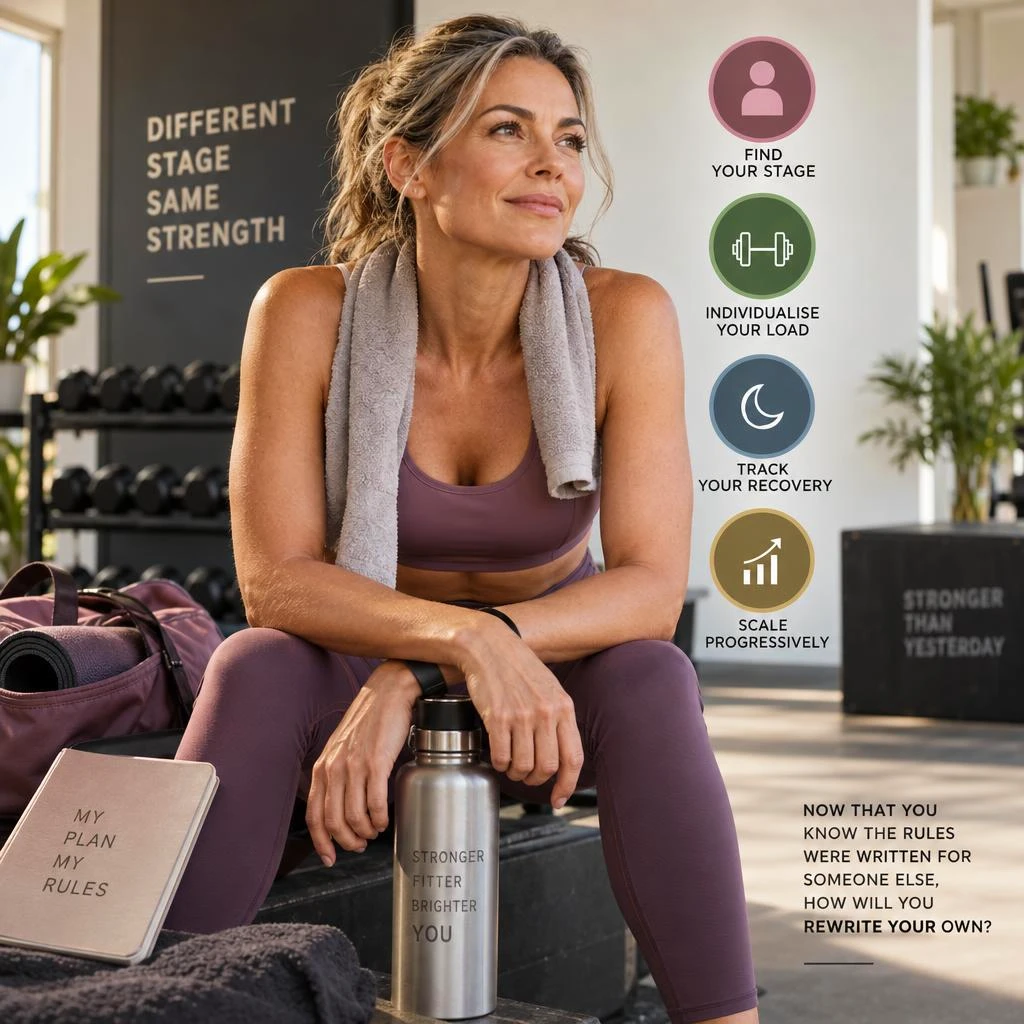
The F.I.T.S. Method is a four-step way to turn any generic plan into a custom workout plan: Find your stage, Individualise your load, Track your recovery, and Scale progressively. You keep the proven structure and change the settings to fit your body and your life.
You don’t need to throw away the program you have. Think of it as a good off-the-rack dress that needs taking in at the waist.
| Step | What You Do | What It Fixes |
|---|---|---|
| F: Find Your Stage | Identify your life stage, training age and limits | Plans written for a different body |
| I: Individualise Your Load | Choose weights by effort, not by numbers on a page | Too light to change anything, or too heavy to sustain |
| T: Track Your Recovery | Log sleep, energy, soreness and symptoms | Pushing through on bad days, coasting on good ones |
| S: Scale Progressively | Add a little weight, reps or sets over time | Plateaus and boredom |
F: Find Your Stage
Finding your stage means matching your plan to where your body is now: still cycling, in perimenopause, or postmenopause. Each stage shifts priorities, but none of them changes the core rule that muscle needs a challenge to grow or stay.
| Life Stage | What Changes | What To Adjust | What Stays The Same |
|---|---|---|---|
| Still Cycling (Regular Periods) | Energy and symptoms may vary across the month | Adjust by how you feel on the day, not by a phase calendar | 2-3 strength sessions a week with progressive overload |
| Perimenopause | Faster fat gain, lean mass starts to drop, sleep and cycles get unpredictable | Prioritise strength over long cardio, plan “flex” sessions for rough weeks | Compound lifts, enough protein, steady progression |
| Postmenopause | Lower oestrogen, higher risk of bone loss and muscle loss | Build towards heavier loads and impact work, ideally with supervision at first | Consistency beats intensity; every week counts |
Then add your personal layer: How long have you been training? Any injuries? Home or gym? How many realistic sessions a week? Write the answers down. They are your program’s real brief. If you’re brand new, start with our beginner workout routines for women and come back to F.I.T.S. after six to eight weeks.
I: Individualise Your Load
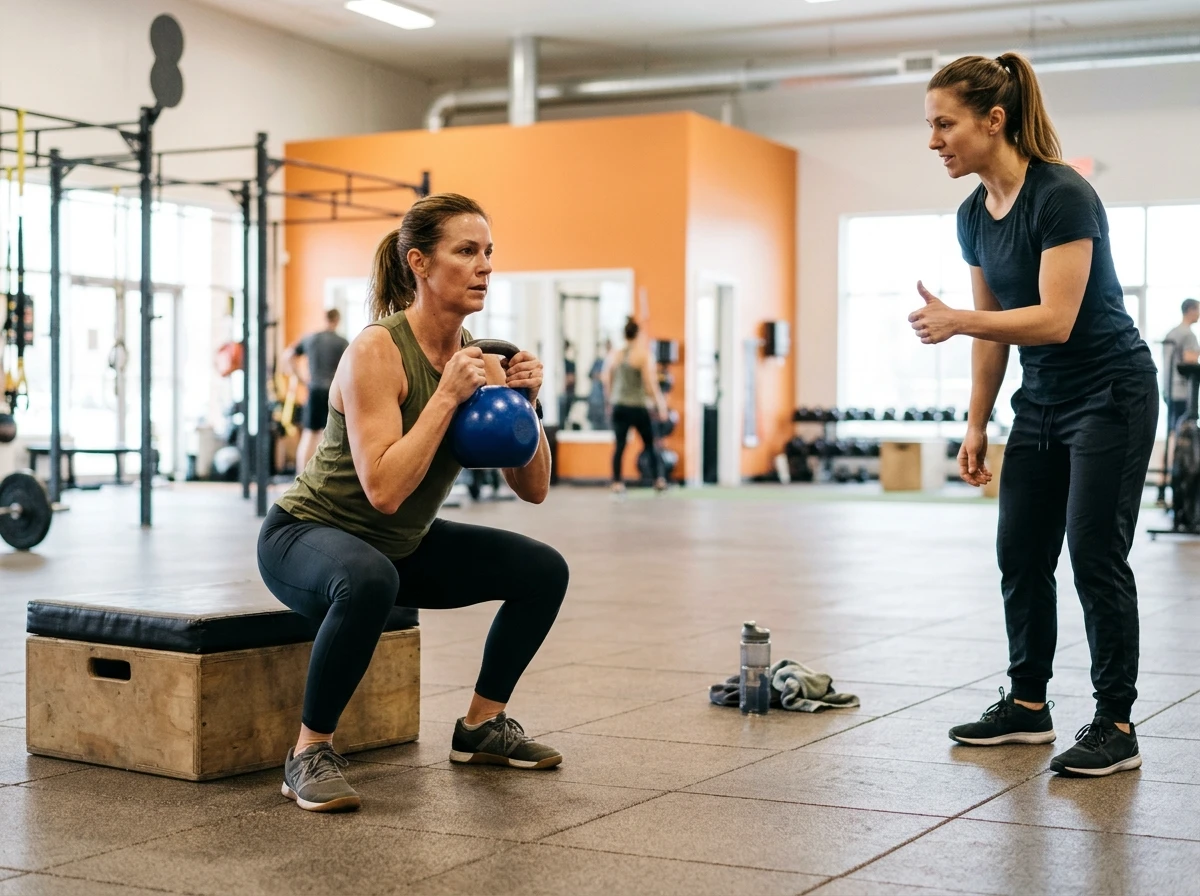
Individualising your load means picking weights by how hard a set feels, not by what the plan prints. A good working set ends with roughly one to three reps left in the tank. If you could do ten more, it’s too light to change your body.
Coaches call this “reps in reserve”, and researchers have built a rating scale around it for resistance training. It’s the simplest way to make the same program fit a beginner and an experienced lifter.
- For muscle: A meta-analysis of low- versus high-load training found muscle growth was similar across a wide range of loads when sets were taken close to failure. So lighter weights can work if you push the effort.
- For strength: The same analysis found maximal strength gains came from heavy loads. If you want to carry the shopping and lift the suitcase with ease, some heavy work belongs in your week.
- For bone: In the LIFTMOR trial, postmenopausal women with low bone mass did supervised 5 × 5 lifts above 85% of their maximum twice a week for eight months. Their lumbar spine bone density rose 2.9% while the low-intensity group’s fell 1.2%, with one minor adverse event reported.
- For joints: Swap, don’t skip. A goblet squat to a box, a trap-bar deadlift or a machine press often feels better than the barbell version the template insists on.
Worried that heavier weights will make you bulky? That fear deserves its own article, and we wrote one: toning vs building muscle for women.
T: Track Your Recovery
Tracking your recovery means noting sleep, energy, soreness and symptoms before you train, then adjusting the session to match. On a strong day, push. On a rough day, keep the session but trim the volume. Either way, you still show up.
Most generic plans leave this step out, and it matters even more in perimenopause, when sleep and energy swing week to week. Score each marker 1-5 in your phone. After a month, patterns appear that no template could predict.
- Green (mostly 4-5): Run the session as written, or add a set.
- Amber (mostly 3): Keep the weights, cut one set from each exercise.
- Red (mostly 1-2): Do a 20-minute version: two big lifts, then a walk.
This is also the honest, evidence-based way to use your cycle if you still have one. Notice how you feel and adjust on the day. You don’t need to plan your whole month around phases (more on that below).

S: Scale Progressively
Scaling progressively means making your workouts slightly harder over time by adding weight, reps or a set once a session feels easier. This progressive overload is the one rule every program shares, and it’s what turns effort into visible change.
Try “double progression”. Pick a rep range, say 8-12. When you can do 12 good reps on every set, add the smallest weight jump available and start again at 8. Small, steady jumps beat big leaps that leave you sore and discouraged.
What Should A Personalised Workout Week Look Like After 40?
A personalised week after 40 usually means two to three strength sessions plus regular walking or other cardio, adjusted to your recovery. The CDC recommends at least 150 minutes of moderate activity a week plus two days of muscle strengthening for adults.
Here’s something encouraging. A large study with almost 5 million person-years of follow-up found that women reached the same survival benefit at about 140 minutes of weekly activity that men needed 300 minutes to get. You don’t need to live in the gym. You need a week you can repeat.
| Day | Busy Week (About 2.5 Hours) | Standard Week (About 4 Hours) |
|---|---|---|
| Monday | Full-body strength, 35 min | Lower-body strength, 45 min |
| Tuesday | Brisk walk, 25 min | Brisk walk or cycle, 30 min |
| Wednesday | Rest or mobility, 10 min | Upper-body strength, 45 min |
| Thursday | Full-body strength, 35 min | Intervals, 20 min |
| Friday | Brisk walk, 25 min | Full-body strength, 45 min |
| Weekend | Something you enjoy, 30 min | Long walk, hike or class, 45 min |
Treat the table as a starting shape, not a prescription. Run it through F.I.T.S., and it becomes yours. For the nutrition side, our guide to body recomposition after 40 shows how food and training work together.
Influencer Rules vs. What The Research Actually Shows
Most viral “female-specific” training rules, such as cycle-syncing every workout, never training fasted, or racing to drink a shake within 30 minutes, are stronger online than in the research.
Personalising your plan means following fewer, better rules. If your feed has left you confused, here’s each rule, the truth, and your new game plan.

The Myth: You Must Train Around Your Cycle Phases
The truth for women: a 2026 randomised controlled trial of 24 women over three cycles found phase-based training gave no extra muscle or strength gains. Total training volume, not cycle phase, drove results.
That matches an earlier review concluding that current evidence shows no influence of cycle phase on strength performance or adaptations. A 2026 BBC report also noted that cycle-tracking apps tend to assume regular 21-35-day cycles, which is a poor fit once perimenopause makes your cycle unpredictable.
Your new game plan: Use the T in F.I.T.S. Adjust to how you feel on the day. If you enjoy cycle syncing and it keeps you consistent, our cycle syncing guide shows how to do it sensibly.
The Myth: Fasted Workouts Burn More Fat
The truth for women: when young women did the same cardio fasted or fed alongside a calorie deficit, both groups lost fat, with no meaningful difference between them. Eating first doesn’t cancel your workout, and skipping food doesn’t supercharge it.
Your new game plan: Choose what lets you train well. If you feel shaky or weak on an empty stomach, a small snack helps you lift heavier. Our article on what to eat before and after a workout has easy options.
The Myth: You Have Only 30 Minutes To Eat Protein After Training
The truth for women: the “anabolic window” is far less strict than gym folklore claims. Your total daily protein matters more. A large meta-analysis found muscle gains levelled off at about 1.6 g of protein per kg of body weight a day.
That same analysis found protein’s effect weakened with age, which is one more reason women over 40 shouldn’t leave it to chance. Spread it across your meals.
Your new game plan: Aim for a palm-sized portion of protein at every meal, and eat within a few hours of training rather than a few minutes. Our high-protein plan for women makes it easy.
| Influencer Rule | What The Research Shows | F.I.T.S. Fix |
|---|---|---|
| Sync every workout to your cycle phase | No extra strength or muscle gains from phase-based training | Track recovery, adjust on the day |
| Never eat before you train | Fat loss is similar whether fasted or fed | Eat if it helps you train harder |
| Protein within 30 minutes or it’s wasted | Total daily protein matters more than timing | Protein at every meal, about 1.6 g/kg a day |
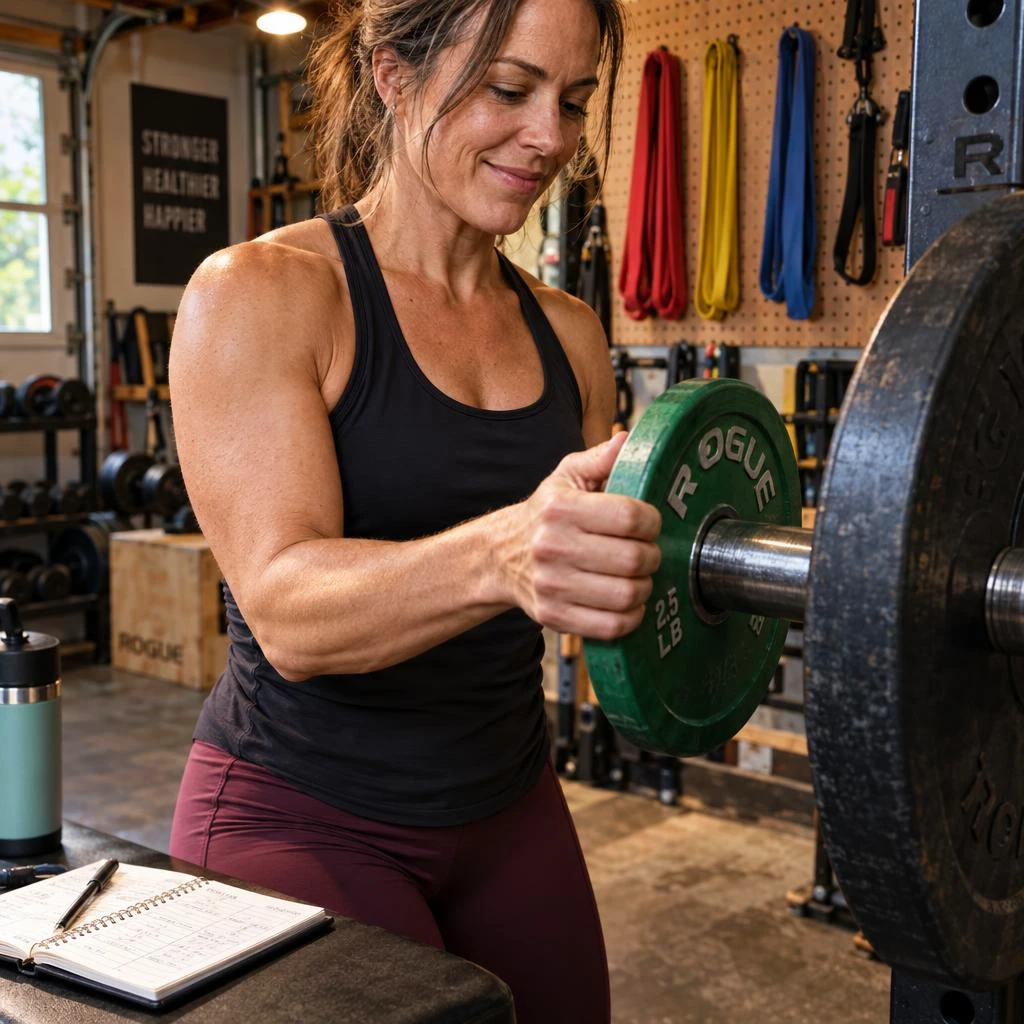
| Light weights only, or you’ll bulk up | Heavy loads build the most strength, and women gain muscle at a similar relative rate to men, not “bulk” | Individualise load by effort |
Want the full list of myths, rated by the research? See our guide to common fitness myths about women.
Plateau Busting: What To Do When Your Custom Plan Stalls
When a personalised plan stalls for three or more weeks, the fix is usually one variable, not a whole new program. Check your progression, recovery and food first. Program-hopping resets the clock and hides what’s actually holding you back.
- Check the logbook: Have you added weight or reps in the last month? If not, the plan isn’t progressing, even if it feels hard.
- Check recovery scores: A run of amber and red days means you need a lighter week, not more effort.
- Check protein and sleep: These two quietly undo good training more often than the exercises do.
- Change one thing: Swap one exercise per muscle group, or move to a new rep range, for four to six weeks.
- Take a deload: Many coaches build in a lighter week at about half the usual volume every couple of months, so you can recover before pushing on.
If the scale is your main concern, our tips to overcome a weight loss plateau cover the nutrition side.
When Is A Generic Workout Program Actually Fine?
A generic workout program is fine when you’re a true beginner, and your goal is to build the habit. In your first six to eight weeks, showing up matters more than perfect settings. Once the habit sticks, personalisation is what keeps the results coming.
Most “one size doesn’t fit all” articles skip this part. If a simple plan gets you moving three times a week, it’s doing its job. The mistake isn’t starting with a template. It’s staying on it for a year and blaming yourself when it stops working.
Ready to make your plan yours? Our free guide gives you 10 research-backed habits that help women lose body fat and keep it off, without extreme diets or a program that ignores your life stage. It’s the perfect companion to the F.I.T.S. Method. Send Me The Free Guide.
The Bottom Line
One-size-fits-all workout programs miss the mark for women over 40 because they were written for someone else’s body, data and life. You don’t need a completely different set of rules. You need the proven ones, set to fit you.
Find your stage, individualise your load, track your recovery and scale progressively. Do that, and the plan stops fighting you. Now that you know the rules were written for someone else, how will you rewrite your own?
Glossary Of Key Terms
- Deload: A planned lighter week, at about half your usual volume, to recover and break plateaus.
- Double Progression: Adding reps within a range first, then adding weight once you reach the top.
- F.I.T.S. Method: Our four-step framework for personalising any program: Find, Individualise, Track, Scale.
- Hypertrophy: The scientific term for muscle growth.
- Lean Mass: Everything in your body that isn’t fat, including muscle, bone and organs.
- Menopause Transition: The years of changing hormones before and around your final period, also called perimenopause.
- Periodisation: Planning training in phases so that load and volume change over weeks or months.
- Progressive Overload: Gradually increasing the challenge of your training so your body keeps adapting.
- Reps In Reserve (RIR): The number of extra reps you could have done at the end of a set. Used to choose the right weight.
- Training Age: How long you’ve been training consistently, which is different from your actual age.
FAQ
Why Do One-Size-Fits-All Workout Programs Stop Working For Women Over 40?
They stop working because they don’t adjust to you. Most generic plans never progress, ignore perimenopause and menopause, and have no plan for bad weeks. The menopause transition speeds up fat gain and muscle loss, so a static, cardio-heavy plan falls further behind your body’s needs.
Do Women Need Completely Different Workouts From Men?
No. Women build muscle at a similar relative rate to men, and the same principles, like progressive overload, apply to both. What differs is the individual settings: load, volume, rest, recovery and life stage. Personalise those rather than following a separate set of “female-only” rules.
How Do I Create A Custom Workout Plan For Myself?
Start with a proven beginner template, then apply the F.I.T.S. Method. Find your life stage and limits, choose weights that leave one to three reps in reserve, track sleep, energy, soreness and symptoms, and add a little weight or reps when sessions feel easier.
Should I Change My Workouts Based On My Menstrual Cycle?
You don’t need to. A 2026 randomised trial found no extra strength or muscle gains from phase-based training. If your energy dips on certain days, adjust that session by feel. If you’re in perimenopause with irregular cycles, adjusting by daily recovery is far more practical than a phase calendar.
Is Lifting Heavy Safe For Women After Menopause?
For many women, yes, with good coaching and a gradual build-up. In the LIFTMOR trial, postmenopausal women with low bone mass did supervised heavy lifting twice weekly for eight months and improved spine bone density, with one minor adverse event. Check with your doctor first if you have osteoporosis.
How Many Days A Week Should A Woman Over 40 Strength Train?
Two to three days a week suits most women over 40. The CDC recommends at least two days of muscle-strengthening activity plus 150 minutes of moderate activity weekly. Two full-body sessions work well on busy weeks, and three sessions give you more room to progress.
How Long Should I Follow A Generic Program Before Personalising It?
About six to eight weeks is a sensible window if you’re a beginner. That’s long enough to learn the movements and build the habit. After that, or sooner if you stall, feel run down or have pain, start adjusting load, recovery and progression to fit you.