The 4 Best Fat-Burning Exercises For Women To Lose Weight — Plus The Science-Backed Strategies That Amplify Every Rep
IDO PORTAL
Movement coach, teacher & practitioner
The body will become better at whatever you do, or don't do. If you don't move, your body will make you better at not moving.
Summary (TL;DR)
The four compound exercises that deliver the most weight loss bang for your buck are squats, deadlifts, push-ups, and shoulder press. But exercise alone won't move the needle if your sleep, hormones, and daily movement are fighting against you. This guide covers both the exercises to prioritise and the four strategies that make them actually work.
We've all been there — staring at a scale that won't budge despite our best efforts, feeling a mixture of exhaustion and frustration. In the world of women's fitness, we're often taught to obsess over a single number. But I'm here to tell you: the scale is a liars' club.
True, sustainable transformation requires shifting focus from simple weight loss — which includes shedding water, bone density, and muscle — to mastering body composition. By prioritising fat loss while protecting lean tissue, you're not just "shrinking." You're upgrading your metabolic engine.
Traditional dieting often fails because it treats the body like a simple calculator rather than the complex biological system it is. Total body mass is a fluctuating figure influenced by hydration, glycogen stores, and muscle mass.
True body composition focuses on the ratio of lean muscle to fat. By building that ratio in your favour, you protect your hormonal health and build a resilient, functional physique — one that burns more energy even at rest.
Remember: Weight is just one indicator of health. Focus on progress, not perfection.
Medical & Referral Disclaimer
The information in this article is for educational purposes only and does not constitute medical advice. Always consult a qualified healthcare professional before starting a new exercise or nutrition programme, especially if you have a pre-existing health condition.
Key Takeaways
- Squats, deadlifts, push-ups, and shoulder press are the four compound exercises that recruit the most muscle and burn the most energy — start here.
- Strength training builds "metabolic machinery": muscle tissue is more metabolically active than fat, raising your resting calorie burn even while you sleep.
- Getting fewer than 7 hours of sleep disrupts leptin and ghrelin — the hormones that control hunger — making fat loss significantly harder.
- HIIT generates far greater excess post-exercise oxygen consumption (EPOC) than steady-state cardio, meaning your body keeps burning fat long after the session ends.
- NEAT — the energy you burn through daily non-exercise movement — can rival a formal workout in its contribution to daily calorie expenditure.
- Healthy fats from avocados, olive oil, and nuts stabilise blood sugar and reduce cravings; the Mediterranean dietary pattern is not associated with weight gain even at high fat intake.
The 4 Best Exercises For Women To Lose Weight
These aren't random picks. Each of these compound movements recruits multiple muscle groups simultaneously, demands a high energy cost, and builds the lean muscle that raises your resting metabolic rate over time. They are, in the simplest terms, the best bang for your workout buck.
1. Squats
Squats are the single best lower-body exercise for women who want to lose weight and build functional strength. They recruit the glutes, quads, hamstrings, and core all at once — a massive energy demand that few other exercises can match.
How to do them:
- Stand feet shoulder-width apart, toes slightly turned out.
- Drive your hips back and bend your knees until your thighs are parallel to the floor (or as low as comfortable).
- Keep your chest tall and your knees tracking over your toes.
- Drive through your heels to stand back up.
Start with bodyweight, then add a dumbbell or barbell as you build confidence. Even 2–3 sets of 10–12 reps, twice a week, is enough to start shifting your body composition.
2. Deadlifts
The deadlift is the ultimate full-body metabolic stimulator. It targets the entire posterior chain — glutes, hamstrings, lower and upper back — and demands serious core stability. It also teaches your body to move powerfully from the hips, which translates directly into everyday strength.
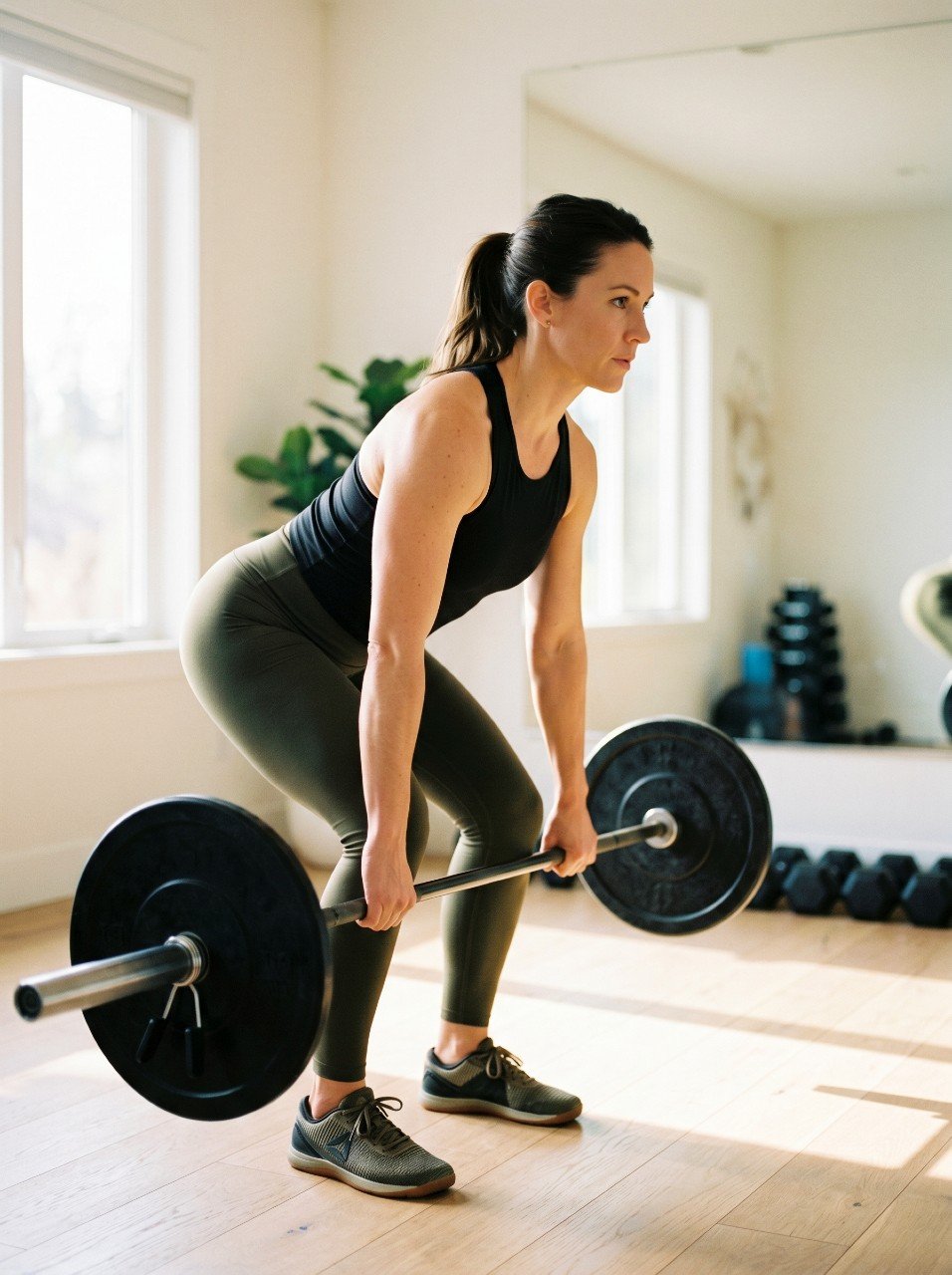
How to do them:
- Stand with feet hip-width apart, a weight (dumbbell or barbell) on the floor in front of you.
- Hinge at the hips, keeping your back flat and chest up, and grip the weight.
- Drive through your heels and squeeze your glutes to stand tall.
- Lower the weight with control — this is where a lot of the muscle-building happens.
Don't skip this one out of fear. With light weights and good form, deadlifts are accessible for beginners and brutally effective at any level.
3. Push-Ups
Push-ups are a bodyweight powerhouse for the upper body and core — no gym required. They target the chest, shoulders, and triceps, while demanding trunk stability throughout. They're also infinitely scalable: wall push-ups for beginners, elevated feet for advanced.
How to do them:
- Place hands slightly wider than shoulder-width on the floor (or a bench to reduce difficulty).
- Keep your body in a straight line from head to heels — don't let your hips sag or pike up.
- Lower your chest toward the floor until your elbows hit roughly 90 degrees.
- Press back to the start position.
The goal isn't perfect form on day one. The goal is progression — one more rep each session, week after week.
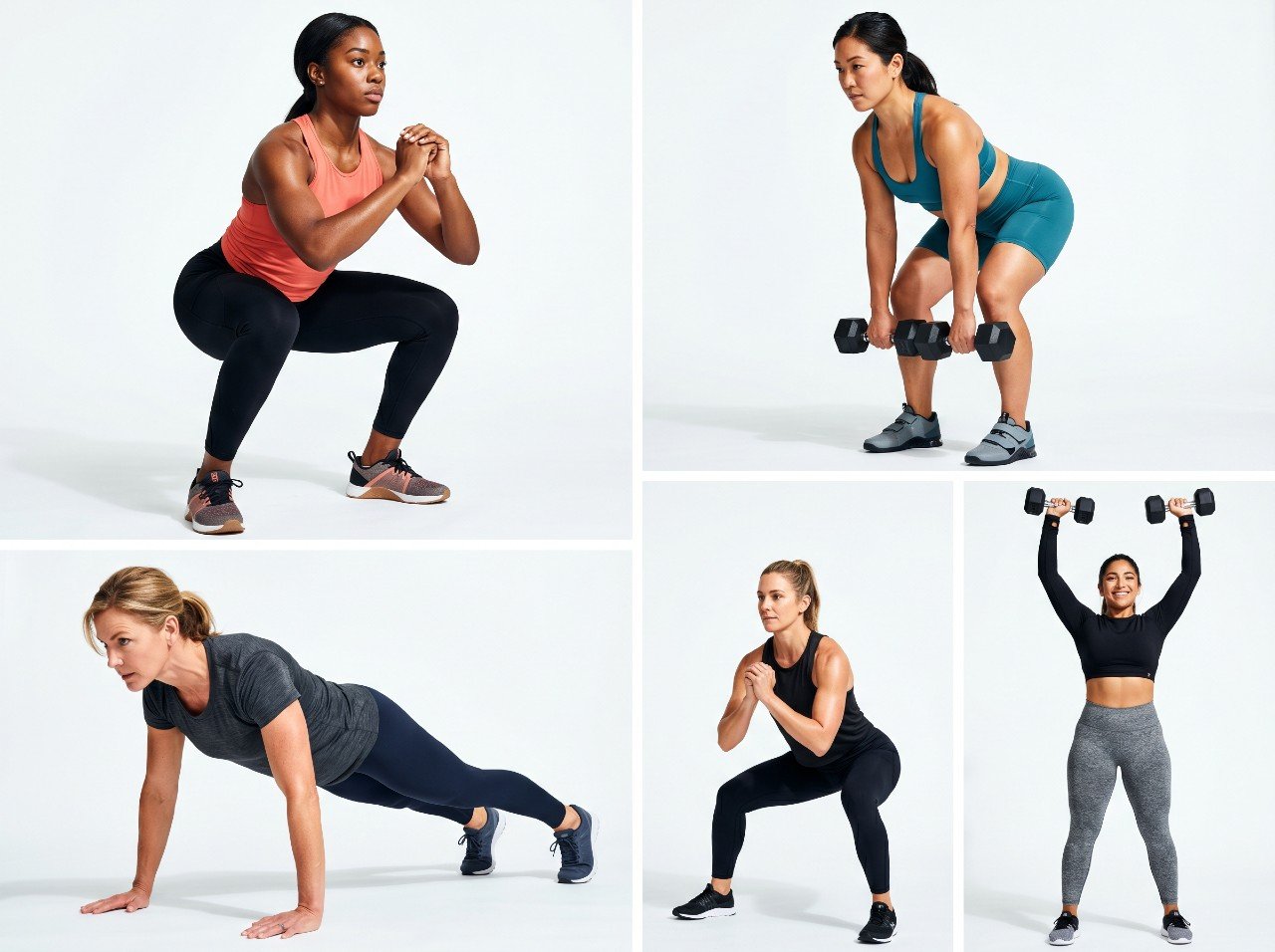
4. Shoulder Press
The shoulder press builds the upper-body definition that creates a leaner silhouette. By developing the shoulders and upper back, it creates a visual "V-taper" that makes the waist appear narrower — a common goal for women who want to look and feel more toned.
How to do them:
- Hold a dumbbell in each hand at shoulder height, palms facing forward.
- Press the weights overhead until your arms are fully extended.
- Lower with control back to shoulder height.
This can be done seated or standing. Standing adds a core stability challenge that burns slightly more energy.
| Exercise | Primary Muscles | Why It Works For Weight Loss |
|---|---|---|
| Squats | Glutes, quads, hamstrings, core | Highest energy demand of any lower-body movement |
| Deadlifts | Posterior chain, back, core | Full-body recruitment; builds metabolic muscle fast |
| Push-Ups | Chest, shoulders, triceps, core | Scalable compound upper-body movement |
| Shoulder Press | Shoulders, upper back, arms | Builds shape and boosts upper-body metabolic activity |
The 4 Strategies That Make Every Exercise Work Harder
The exercises above are your engine. These four strategies are the fuel, the tune-up, and the road conditions. Skip them, and you're driving with the handbrake on.
1. The Strength Training Paradox: Why Lifting Heavy Is A Woman's Best Friend
The most persistent myth in fitness is that lifting weights makes women "bulky." Biologically, this just isn't how it works — women lack the testosterone levels required for significant hypertrophy. What strength training does is build the long, lean muscle that creates a toned look.
Muscle is your metabolic machinery. It is significantly more active than fat tissue at rest, which means it demands more energy around the clock — even while you sleep. This elevates your resting metabolic rate and creates a powerful "afterburn" effect, where your body continues to oxidise fat for hours post-workout.
According to one review, 10 weeks of resistance training can increase resting calorie burn by 7% and reduce body fat by nearly 2 kg. That's muscle doing what fat simply cannot.
| Myth | Reality |
|---|---|
| "Lifting makes women bulky" | Women lack the testosterone for mass hypertrophy; lifting builds lean, defined muscle |
| "Cardio burns more fat than weights" | Strength training raises your resting metabolism; cardio does not |
| "Light weights, high reps are safer for women" | Compound movements with progressive load build more muscle and burn more fat |
2. The Sleep-Weight Connection: Harmonising Your Hunger Hormones
I view rest as a metabolic necessity, not a luxury. Sleep is the conductor of your hormonal symphony — and when it's disrupted, your fat-loss efforts fall apart fast.
Research involving 245 women found that those who consistently slept 7+ hours per night increased their success rate in losing weight by 33%.
When you're sleep-deprived, leptin — the hormone that signals fullness — plummets. Meanwhile, ghrelin — the "hunger hormone" — spikes. You're not weak-willed when you reach for junk food at midnight. You're fighting a hormonal storm that sleep deprivation created.
A 16-year study of 68,183 women confirmed this: those sleeping 5 hours or less were significantly more likely to gain weight than those getting 7+ hours. Rest is as productive as a workout. Sometimes more.
3. HIIT vs Traditional Cardio: The Efficiency Winner
Steady-state cardio — a long walk, a light cycle — is genuinely great for heart health and longevity. But if you're time-pressed and want maximum fat-burning per minute, High-Intensity Interval Training (HIIT) wins.
HIIT alternates short bursts of maximum effort with recovery periods. The key metabolic advantage isn't what happens during the session — it's what happens after.
Research published in the journal Sports found that HIIT produced nearly double the excess post-exercise oxygen consumption (EPOC) compared to moderate-intensity continuous training, with significantly greater fat oxidation persisting for 60 minutes post-workout. Your body keeps burning fat long after you've left the gym.
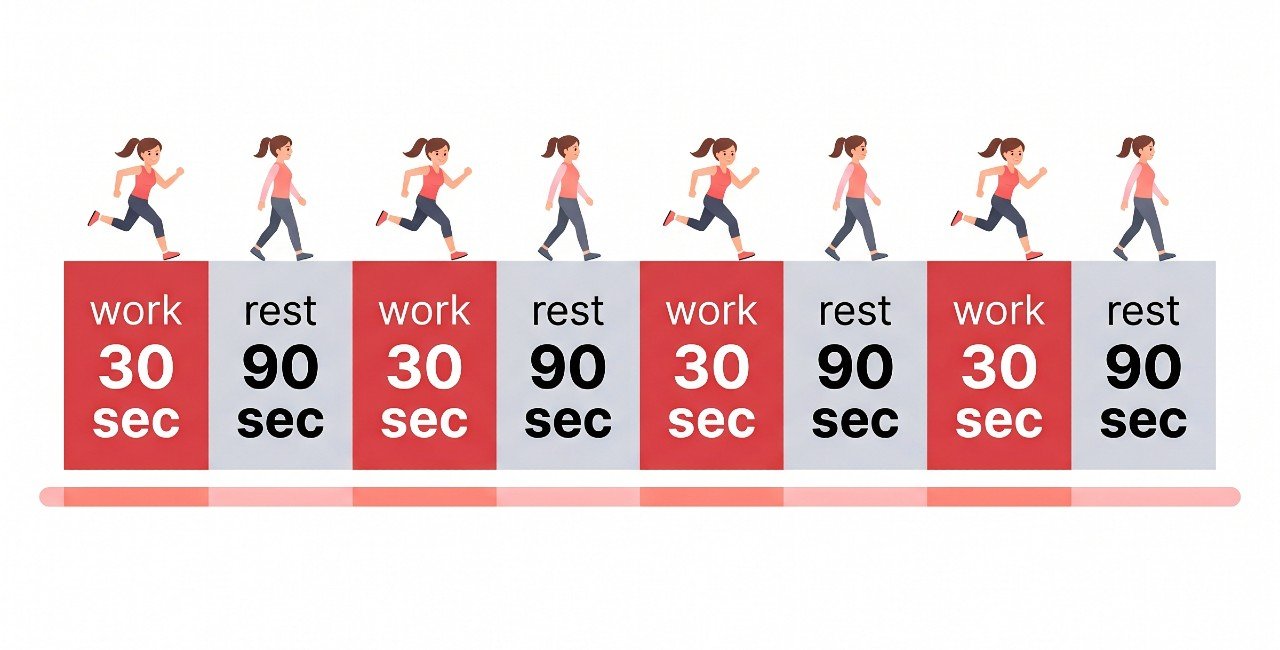
A simple HIIT protocol you can do at home:
- The work interval: 30 seconds of high-intensity movement (sprinting on the spot, jumping jacks, burpees)
- The recovery interval: 90 seconds of slow walking or rest
- The session: Repeat for 10–20 minutes
That's it. Three to four sessions a week are enough to see meaningful results.

4. The Power Of NEAT: Every Step Counts
Your fat-burning shouldn't be confined to a 30-minute gym window. NEAT (Non-Exercise Activity Thermogenesis) is the energy you burn through everyday tasks — cleaning, standing during calls, taking the stairs, fidgeting.
NEAT can account for a significant portion of your daily energy expenditure, and it's the easiest lever to pull. You don't need a gym. You don't need a programme. You just need to move more throughout the day.
5 easy NEAT habits that add up:
- Take the stairs instead of the lift every time
- Stand during phone calls or video meetings
- Walk to a colleague's desk instead of messaging them
- Park at the far end of the car park
- Do 10 minutes of light movement after each meal
Small? Yes. Cumulative over weeks and months? Significant.
The Healthy Fat Counter-Intuition
It feels backwards to eat fat when your goal is fat loss. But this is one of those areas where the science contradicts the instinct. Whole-food fats — avocados, olive oil, nuts — slow stomach emptying, signal satiety to the brain, and prevent the blood sugar spikes and crashes that drive cravings.
A large-scale randomised controlled trial found that a high-fat Mediterranean dietary pattern — even with no calorie restriction — was not associated with weight gain and was linked to significantly less central adiposity compared to a low-fat control diet. The fat you eat is not the fat you store, provided it comes from whole-food sources.
Swapping trans fats and processed sugars for whole-food fats is one of the most powerful dietary shifts you can make — and it makes the whole process feel less like a battle of willpower.

Metabolic Micro-Wins: Probiotics, Iron, And Vinegar
Success is often built from small, cumulative details. Three science-backed dietary interventions worth knowing about:
- Targeted Probiotics. The gut-weight connection is real. Randomised controlled trials on Lactobacillus amylovorus CP1563 have shown significant reductions in body fat percentage, total body fat, and visceral fat in participants with overweight (BMI 25–30) over 12 weeks. Probiotic strains vary widely in effect — check that any supplement you choose has clinical evidence behind the specific strain, not just the genus.
- The Iron Factor. Iron is critical for thyroid function, and your thyroid is the master controller of your metabolism. Women are at higher risk of deficiency due to the menstrual cycle. Low iron leads to hypothyroid-adjacent symptoms: fatigue, sluggishness, and weight that won't shift. Iron-rich foods (leafy greens, legumes, lean red meat) or a supplement (with your doctor's guidance) can let your metabolic engine run at full capacity.
- The Vinegar Approach. Research suggests that vinegar consumption before meals suppresses appetite in the short term by slowing gastric emptying and increasing satiety signalling. A systematic review of vinegar's effects on appetite found that vinegar containing at least 24.6 mmol of acetic acid consistently reduced food intake in the hours following consumption — though long-term appetite suppression wasn't confirmed. One to two tablespoons in water before a meal is a low-risk, evidence-adjacent habit worth testing.
The Hidden Heroes: Sleep, Stress, And Recovery
Rest is a physiological requirement for change. If you're constantly stressed or chronically tired, your body may actively hold onto fat — cortisol signals fat storage, especially around the belly.
Join Our Mailing List
Join thousands of women inside our community and receive our free guide, 10 Actions That Support Permanent Weight Loss — the exact behavioural shifts that make the difference between a two-week attempt and a lasting transformation.
No restriction plans. No guilt. Just what actually works — for real women with real lives.

Why Sleep Matters For Weight Loss
- Hormone regulation: Sleep balances ghrelin (hunger) and leptin (fullness).
- Cravings control: Sleep deprivation disrupts the brain's prefrontal cortex, increasing cravings for high-calorie foods.
- Recovery: Sleep is when muscle tissue repairs itself — no sleep, no adaptation, no progress from your workouts.
Understanding Active Recovery
Rest doesn't mean staying completely still. Active recovery — a light walk, 10 minutes of stretching, a gentle yoga flow on "off" days — promotes blood flow and helps repair the micro-tears created during training. You come back to your next session stronger, not just rested.
Your First 30 Days: A Realistic Action Plan
Consistency beats intensity. Aim for a safe loss of 1–2 lbs (0.5–1 kg) per week — this is the range that protects muscle while losing fat. To get there, focus on action-based goals rather than result-based ones.
- Result-based goal: "I want to lose 5 lbs this month." (You can't always control this.)
- Action-based goal: "I will do 2 strength sessions and 2 HIIT sessions each week." (You have total control over this.)
Weekly Habit Tracker (30-Day Challenge)
| Habit | Target | Why It Matters |
|---|---|---|
| Compound strength training | 2 sessions/week | Builds metabolic muscle |
| HIIT cardio | 2 sessions/week | Maximises EPOC and fat oxidation |
| Daily steps/NEAT | 8,000+ steps/day | Keeps fat-burning active all day |
| Sleep | 7+ hours/night | Regulates hunger hormones |
| Hydration | Swap 1 sugary drink for water daily | Reduces empty calories |
Final word: Consistency over perfection. If you miss a day, don't spiral — just start again at the next meal or the next session.
Now that you know the best exercises for weight loss and how to make them actually work, are you ready to take the next step? Grab your free guide here for a done-for-you workout plan that incorporates these exercises, plus a detailed nutrition strategy to amplify your results.
The Bottom Line
You now have both the exercises and the strategies. The four compound movements — squats, deadlifts, push-ups, and shoulder press — are your foundation.
Stack on strength training's metabolic effects, quality sleep, HIIT's afterburn, and NEAT's daily movement, and you have a system that works with your biology rather than against it.
Fitness isn't about a number on a scale. It's about building a body that lets you live your life with energy and confidence. The tools are here. The rest is consistency.
Glossary Of Key Terms
- Active Recovery: Light physical activity, such as stretching or gentle yoga, performed on "off" days to promote blood flow and repair muscle micro-tears.
- Body Composition: The ratio of lean muscle to fat tissue in the body, prioritized over total body mass as an indicator of health.
- Compound Exercises: Movements like squats and deadlifts that recruit multiple muscle groups simultaneously to maximize energy expenditure.
- EPOC: Excess Post-Exercise Oxygen Consumption; the metabolic state where the body continues to burn calories at an elevated rate after intense exercise.
- Ghrelin: The "hunger hormone" that signals the brain to eat; levels typically spike when an individual is sleep-deprived.
- HIIT: High-Intensity Interval Training; a workout strategy involving short bursts of maximum effort followed by recovery periods.
- Leptin: The "fullness hormone" that signals satiety to the brain; levels often drop significantly due to lack of sleep.
- Metabolic Machinery: A term used to describe muscle tissue, which is more metabolically active than fat and increases energy demands at rest.
- NEAT: Non-Exercise Activity Thermogenesis; energy expended for everything we do that is not sleeping, eating, or sports-like exercise.
- Posterior Chain: The group of muscles on the backside of the body, including the glutes, hamstrings, and back, primarily targeted by deadlifts.
FAQ
What Are The 4 Best Exercises For Women To Lose Weight?
The four most effective exercises for women who want to lose weight and improve body composition are squats, deadlifts, push-ups, and shoulder press. These are all compound movements — they recruit multiple muscle groups at once, creating a high energy demand and building the lean muscle that raises your resting metabolic rate. They work at home with dumbbells or in a gym, and they scale from beginner to advanced.
How Often Should Women Do Strength Training To Lose Weight?
Two to three sessions per week is the sweet spot for most women starting out. That frequency is enough to build lean muscle and elevate your resting metabolic rate, while leaving recovery time between sessions. Pair strength training with two HIIT sessions per week, and you have a comprehensive fat-loss programme in four days.
Is HIIT Or Steady-State Cardio Better For Fat Loss?
Both have a place, but HIIT wins on efficiency. HIIT produces significantly greater excess post-exercise oxygen consumption (EPOC), meaning your body burns more fat in the hours after the session than it does after steady-state cardio. If you're time-pressed, 20 minutes of HIIT will outperform 45 minutes on a treadmill for fat-burning purposes. That said, steady-state cardio has real benefits for heart health, recovery, and mental well-being — it doesn't need to be either/or.
Can Women Lose Weight With Home Workouts?
Absolutely. All four exercises in this guide can be done at home with a pair of dumbbells. For squats and deadlifts, even bodyweight is enough to begin building lean muscle. Add HIIT work (no equipment needed), strong sleep and movement habits, and a home programme is as effective as any gym membership.
What Role Does Diet Play Alongside Exercise?
Exercise is the engine; diet is the fuel quality. You can't out-train a poor diet, but you also don't need to be perfect. The most effective dietary approach for women trying to lose fat while maintaining energy is one that creates a modest calorie deficit, prioritises protein (to protect muscle), includes whole-food fats, and limits ultra-processed foods. The Mediterranean dietary pattern has the strongest body of evidence behind it for long-term weight management.
How Much Weight Can Women Realistically Expect To Lose Per Week?
Health experts recommend 1–2 lbs (0.5–1 kg) per week as the safe, sustainable range. Faster loss usually involves muscle loss, which works against your long-term metabolic health. Some weeks you'll lose more; some weeks nothing moves on the scale. Progress in the gym, better sleep, and how your clothes fit are all more reliable signals than weekly weigh-ins.
How Does Sleep Affect Weight Loss?
Significantly. Even a few nights of poor sleep disrupts leptin (the fullness hormone) and spikes ghrelin (the hunger hormone), making you eat more without realising it. A study of 245 women found that those consistently sleeping 7+ hours per night were 33% more successful at losing weight than those sleeping less. Sleep isn't a reward you earn after making progress — it's a prerequisite for making progress at all.