


Weight Loss Motivation: Why You've Lost It And How To Get It Back For Good
The Science-Backed Truth About Why Motivation Expires (And The Reset That Actually Works)
Octavia Butler
Author
First, forget inspiration. Habit is more dependable. Habit will sustain you whether you're inspired or not.
Summary (TL;DR)
Feeling zero motivation to lose weight isn't a character flaw. It's a predictable result of chasing external goals that your brain can't sustain long-term. Research shows intrinsic motivation, the kind driven by values and identity rather than the scale, is the only type that predicts lasting weight loss success. This post introduces the M.O.V.E. Reset: a four-part framework to rebuild your drive from the inside out, so you stop starting over and start moving forward.
I used to set my alarm for 6 am on a Monday, plan my meals, fill my water bottle, and still be ordering takeaway by Wednesday evening. Not once. Not twice. More times than I care to count.
And every single time, I told myself the same thing: "I just don't have what it takes. Other women can do this. I can't." Sound familiar? Here's what I know now that I didn't know then: that feeling wasn't weakness. It was a signal that my entire approach to motivation was built on a foundation that was designed to collapse.
The weight loss industry profits from selling you a very specific version of motivation. It's loud, it's visual, it's built around before-and-after photos, January challenges, and 30-day resets. And it works brilliantly for about three weeks. Then your brain catches up. And it stops.
This article is about what happens after that. Why motivation keeps running out, what the science actually says about how to rebuild it, and the M.O.V.E. Reset framework that shifts you from chasing drive to growing it from the inside.
Medical & Referral Disclaimer
This article is for educational and informational purposes only. It is not intended as medical advice, diagnosis, or treatment. The strategies discussed are based on published research and general wellness principles. Always consult a qualified healthcare professional before beginning any weight loss programme, especially if you have existing health conditions, are navigating perimenopause or menopause, or have a history of disordered eating.
Key Takeaways
- Lack of motivation is the number one internal barrier to physical activity for women trying to lose weight.
- A 2024 study found that on days when women gained even a small amount of weight, motivation dropped measurably and shame/guilt rose, creating a direct cycle of worse eating behaviour.
- Extrinsic motivation (tied to appearance, events, or the scale) creates a dependency cycle and predicts weight regain.
- Autonomous (intrinsic) motivation predicts successful weight loss maintenance over three years.
- The shame cycle is real: weight-related guilt actively increases unhealthy eating in women, not the other way around.
- Motivation follows action. Waiting to feel ready keeps you stuck. The brain generates drive after you begin, not before.
- The M.O.V.E. Reset (Mindset, Obstacles, Values, Environment) rebuilds motivation from the inside out without relying on willpower.
Video Overview
Is It Normal To Lose Motivation For Weight Loss?
Yes, completely. The research confirms it happens to most women, most of the time. Studies consistently show that motivation naturally fluctuates throughout a weight loss journey and is especially vulnerable to setbacks. A 2024 study published in the Journal of Behavioral Medicine found that on days when women gained even small amounts of weight, their motivation dropped measurably, their guilt and shame rose, and their confidence in their own ability to control their weight fell. This is biology responding to perceived failure. It is not a character flaw.
Research confirms that lack of motivation is the number one internal barrier to physical activity for women working on weight loss. It ranks above time constraints, cost, and physical limitations. So if you're reading this thinking "everyone else manages to stay motivated and I just can't," the data disagrees with you firmly. You are not the exception. You are the majority.
The shame layer makes it considerably worse. Research on emotional eating consistently shows that weight-related shame doesn't push women to try harder. It does the opposite. Shame actively increases unhealthy eating patterns. And a 2024 study from NC State found that the experience of weight regain worsened women's self-image more than if they had never tried to diet at all. The cycle is real, and it's brutal. And understanding how stress sabotages weight loss biochemically helps explain why this shame spiral isn't just emotional; it's metabolic.
For women in perimenopause, there's an additional biological layer. Declining estrogen reduces the brain's natural hunger-suppressing signals, lowers metabolic rate, and directly affects mood and motivation pathways. Losing drive isn't laziness in this context. It's a hormonal reality that demands a different approach.

Why Your Weight Loss Motivation Keeps Running Out
Because most weight loss motivation is extrinsic (tied to the scale, an outfit size, an event, or someone else's approval), and research confirms that extrinsic motivation is hardwired to expire. It works fast and burns out faster. The women who stay consistent long-term aren't more disciplined. They're drawing from a fundamentally different fuel source.
Self-determination theory, one of the most robust frameworks in motivational psychology, distinguishes between two types of motivation. Extrinsic motivation comes from outside you: the number on the scale, fitting into a dress, receiving compliments. Intrinsic (or autonomous) motivation comes from within: feeling strong, having energy for the people you love, and sleeping better.
The difference in long-term outcomes is dramatic. Research published in the International Journal of Behavioral Nutrition and Physical Activity found that autonomous motivation predicted successful weight loss maintenance over three years in overweight women, while extrinsic motivation predicted the familiar pattern of short-term loss followed by regain. A separate programme study found that participants in a self-determination-theory-based intervention lost significantly more weight at 12 months than those in standard programmes.
Neuroscience adds another dimension. Dopamine, the brain's primary motivation chemical, is a reward-prediction signal: it fires hardest when you're moving toward a goal, not after you've achieved it. When you set a weight loss goal, and the scale stops moving, dopamine drops. Your brain interprets the plateau as "this effort isn't working", and motivation evaporates. It's not a weakness. It's neuroscience.
Understanding the psychology behind lasting weight loss is the essential first step, because you can't fix a system you don't understand.

The Motivation Myth: Why Waiting To Feel Ready Keeps You Stuck
Here's the contrarian truth that the weight loss industry actively avoids telling you: motivation doesn't create action. Action creates motivation.
The brain generates drive as a response to movement, not as a precondition for it. When you take a small action, your brain releases a modest dopamine signal. That signal generates a little more energy to take the next action. That generates a little more dopamine. And gradually, the internal drive you were waiting for at the starting line starts to appear three steps in, not at the beginning.
I used to wait for the right Monday. The right level of readiness. The right amount of inspiration. Then I had to accept something uncomfortable: there is no right Monday. The Monday feeling is the reward the brain hands you after you've already started, not the ticket you need to get in.
This is what common weight loss mistakes almost always have in common: people wait for conditions to be perfect before beginning. They wait to feel motivated before they act. But the research, and the lived experience of every woman who has built a lasting healthy habit, points in exactly the opposite direction.
The smallest possible action is the legitimate starting point. Not a 30-day plan. Not a full pantry clear-out. Not a gym membership. One action. One walk around the block. One glass of water before breakfast. The brain doesn't distinguish between a small win and a large one when it comes to the reward signal. It just registers: "I said I would do something, and I did it." That registration is the beginning of motivation, not the end.
Research on barriers and motivators to weight loss consistently shows that women who connect their first actions to small, achievable moments of competence are far more likely to build lasting change than those who begin with ambitious overhaul plans.
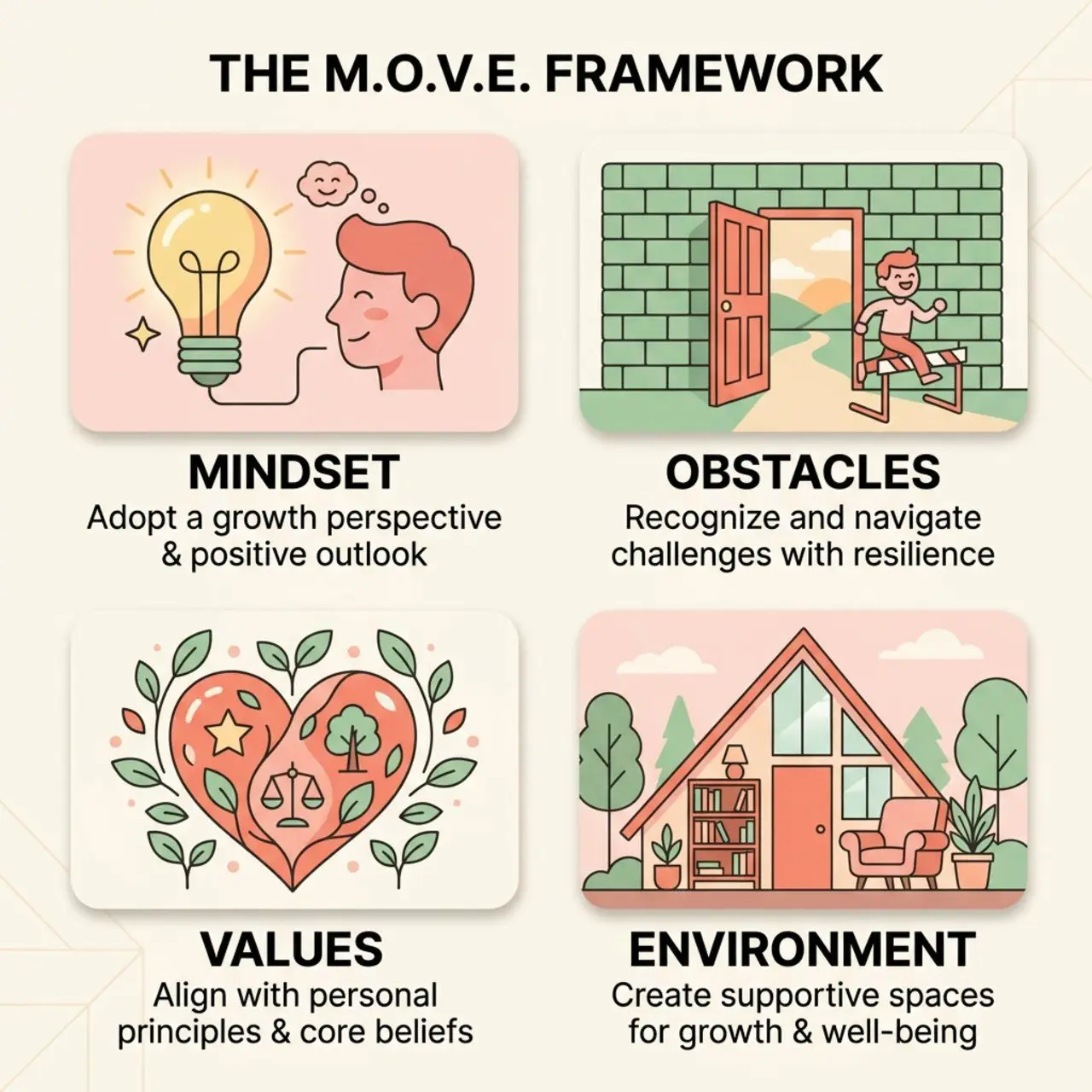
The M.O.V.E. Reset: A Framework To Rebuild Your Drive From The Inside Out
When you've genuinely lost your motivation to lose weight, what you need isn't another nutrition strategy. You need to rebuild the architecture that makes sustained effort possible. The M.O.V.E. Reset is a four-part framework designed specifically for women who feel stuck and are done pretending that "trying harder" is the answer.
M: Mindset
The first shift is moving from outcome identity to process identity. "I want to lose weight" is an outcome statement. It ties your worth and your motivation to a result you can't fully control. "I am a woman who takes care of her body" is an identity statement. It describes who you already are, right now, before the scale moves.
Research consistently shows that identity-based motivation is one of the strongest drivers of long-term behavioral change because acting in alignment with your identity feels natural rather than forced. One small reframe: instead of "I need to start exercising," try "I am someone who moves her body." That single shift changes the emotional relationship you have with every subsequent action. A deeper exploration of this sustainable weight loss mindset is worth reading alongside this framework.
O: Obstacles
Most weight loss advice tells you to push through obstacles. The M.O.V.E. Reset asks you to name them instead. What is actually killing your motivation right now? Is it a biological barrier (perimenopause, poor sleep, chronic stress)? An emotional one (past failures, shame, fear of trying again)?

An environmental one (no time, no support at home, a partner who doesn't eat the same way)? Qualitative research on emotional barriers to weight loss found that women who named and acknowledged their specific obstacles made far more progress than those who tried to override them with willpower. You can't remove a barrier you haven't identified.
V: Values
This is the most important step, and the most skipped. Your "why" must have nothing to do with the scale. Not "I want to lose weight." Something deeper: "I want the energy to keep up with my children." "I want to be strong enough to travel in my 60s." "I want to sleep through the night without waking up sweating."
Psychology Today research on permanent weight loss motivation identifies three prerequisites for lasting intrinsic motivation: confidence that you can succeed, a sense of autonomous choice over your actions, and a feeling of belonging with people who support your goals. Values give you all three. Write down one sentence that captures your real why. Keep it somewhere visible.
E: Environment
This is where the internal work becomes external. Once you have your mindset, your obstacles named, and your values clear, you redesign your immediate environment to make the right action the path of least resistance. Trainers by the door. Meal prep ingredients visible at the front of the fridge.
A workout playlist is already loaded. A friend who expects a check-in text on Tuesday mornings. The science of how to unlock lasting weight loss consistently points to environmental design as the single most underused lever in any woman's weight loss journey.
| Motivation That Expires | Motivation That Compounds |
|---|---|
| Based on scale results | Based on identity and values |
| Depends on visible progress | Grows from consistent action |
| Collapses after one bad week | Survives bad weeks intact |
| Tied to how you look | Tied to how you feel and function |
| Requires willpower to maintain | Becomes automatic over time |
| Peaks at the start | Builds gradually from the inside |
Does The Scale Kill Motivation?
Yes, it can. The research is clear on why. A 2024 study found that on days when women in a weight loss programme registered even small weight gains, their negative mood increased, guilt and shame rose, and their motivation to continue dropped measurably. The women who had been least satisfied with their progress were hit hardest. The scale, used as a primary motivation tool, becomes a psychological liability.
The problem is what the scale actually measures. On any given morning, your weight reflects water retention, glycogen stores, hormonal fluctuations across your cycle, bowel content, sodium intake, and inflammation. For women, especially those in perimenopause, the hormonal changes that affect metabolism mean the scale can swing by two to four pounds across a single week with no change in fat whatsoever. Using it daily as a measure of progress is a reliable way to feel like you've failed when you haven't.
Alternative progress markers do a better job of sustaining the motivation that compounds. Here's what to track instead:
| What The Scale Doesn't Tell You | What Actually Sustains Motivation |
|---|---|
| How much lean muscle you're building | Energy levels throughout the day |
| How is your cardiovascular fitness improving | Quality and duration of sleep |
| How your hormones are shifting | Clothes fit and body measurements |
| What your blood pressure and glucose are doing | Mood stability across the week |
| Whether you're building habits that will last | How many days you showed up |
| How has your sleep quality changed | Strength and stamina improvements |
How Do You Get Back On Track When You've Lost All Drive?
Start with the smallest possible action today, not the biggest plan. Research on habit formation shows the brain's reward system responds more to completing an action than to the eventual outcome that action produces. A two-minute walk counts. Ten minutes of food prep counts.
Drinking one extra glass of water counts. Not because these things transform your body overnight, but because each completion registers as a win in the brain's reward circuitry, and those small wins stack into the forward momentum you've been waiting to feel.

Here are six practical re-entry points, organised by how low your energy is right now:
| Energy Level | Re-Entry Action | Why It Works |
|---|---|---|
| Very low | Write your M.O.V.E. Reset "Values" statement | Reconnects to your real why without requiring physical effort |
| Very low | Go to bed 30 minutes earlier tonight | Sleep deprivation directly reduces motivation hormones |
| Low | Walk for 10 minutes, no destination needed | Movement triggers dopamine, which generates more motivation |
| Low | Prep one healthy meal component (boil eggs, wash vegetables) | Small competence win builds confidence |
| Medium | Reach out to one person who supports your health goals | Relatedness is a core driver of autonomous motivation |
| Medium | Schedule your next three workouts in your calendar right now | Environmental cue that reduces decision fatigue |
Don't restart from zero. That's the trap. If you've been doing nothing for six weeks, you haven't "lost" your progress from before: your habits are just dormant, not deleted. One action reactivates them. If emotional eating is part of what's pulling you back, learning to break the emotional eating cycle is worth addressing alongside your motivation reset, because the two are more connected than most fitness advice acknowledges.
If you're navigating perimenopause, the path back is the same, but the timeline is longer. Losing weight during perimenopause requires understanding that your hormonal environment genuinely changes what your body responds to. Going easier on yourself isn't giving up. It's working with your biology instead of against it.
Research on the role of emotions in long-term weight loss found that women who maintained a positive emotional relationship with their health journey, rather than one built on guilt and obligation, achieved notably better long-term outcomes. Momentum is emotional before it's physical.
Ready to put the M.O.V.E. Reset into action and get your weight loss motivation back for good? Grab your free guide here for a step-by-step walkthrough to help you reignite your intrinsic drive and create lasting change.
Related Articles
The Bottom Line
You are not uniquely broken. You are not lacking something other women have. You have been using a type of motivation that the research says doesn't work for anyone long-term: external, scale-focused, shame-fuelled, and dependent on perfect conditions that never arrive.
The M.O.V.E. Reset gives you a different foundation. Start with V. Write down one reason to feel stronger that has nothing to do with how you look. Then do one small thing today. That's not giving up on weight loss. That's building the internal architecture that makes sustainable change possible for the first time.
Want weekly mindset strategies, practical movement tools, and evidence-based weight loss guidance designed specifically for women 40+? Join the Women's Lean Body Formula newsletter and get them delivered straight to your inbox every week.
Glossary Of Key Terms
FAQ
Because most weight loss programmes are built around extrinsic motivation, the kind tied to scale results, appearance, or a deadline, and the brain is not wired to sustain that type of drive indefinitely. Dopamine (the brain's motivation chemical) fires strongest when you're working toward a new goal.
Once the novelty wears off, or the scale stops moving, the dopamine signal drops and motivation follows. Research on self-determination and weight control shows that only intrinsic motivation, the kind tied to personal values and identity, predicts success beyond the initial weeks. The fix isn't to try harder. It's to change your fuel source from external validation to internal drive.
Yes, and for many women, it's the most productive thing they can do. Forcing effort during periods of high stress, hormonal disruption, or emotional overwhelm tends to generate shame cycles rather than progress. A deliberate pause, where you focus on maintaining rather than losing, gives your nervous system space to recover and reduces the risk of the all-or-nothing thinking that leads to complete abandonment.
The research on emotional regulation and weight management suggests that women who maintain a positive relationship with their health journey, including recognising when to rest, achieve notably better long-term outcomes than those who push through at all costs. Rest is a strategy, not surrender.
Start by reframing what "failed" means. Every attempt taught your body and brain something about what works and what doesn't. The NC State research on dieting and self-image found that the shame associated with past attempts does far more damage than the attempts themselves.
The most effective starting point is not a new plan but a new question: "Who do I want to be?" rather than "What do I want to weigh?" When you build your identity first and your habits second, the motivation question shifts completely. Try one single small action today, not a programme, and celebrate completing it. That completion signal is how motivation rebuilds.
Yes, and this is biology, not a personal failing. According to the Mayo Clinic, declining estrogen during perimenopause reduces the brain's hunger-suppressing signals, lowers resting metabolic rate, and directly affects mood regulation. When your body feels harder to manage, your motivation to manage it drops.
This is a predictable biological response, not evidence that you're not trying hard enough. The solution is working with your hormonal environment rather than against it, which means adjusting expectations, prioritising sleep and stress management, and recognising that losing weight during perimenopause requires a different strategy than at 30.
Autonomous intrinsic motivation: drive that comes from your own values, identity, and genuine enjoyment of the process, rather than from external pressure, appearance goals, or fear. A long-term study published in the International Journal of Behavioral Nutrition and Physical Activity found that only autonomous motivation predicted maintained weight loss over three years in women, while extrinsic motivation (appearance, compliments, target weight) predicted the familiar cycle of short-term loss and long-term regain. The best motivation for lasting change is the kind rooted in how you feel, how you function, and who you are, not in how you look or what the scale says.
The first step is recognising that emotional eating and motivation loss are connected, not separate. Research on the shame cycle shows that guilt and shame around food increase unhealthy eating rather than reduce it. Punishing yourself for emotional eating makes it worse. A more effective approach starts with curiosity: what emotion or need is driving the eating?
Stress, loneliness, boredom, and fatigue are all signals your body is sending that deserve a response other than restriction and shame. Building the skill to break the emotional eating cycle through mindfulness-based tools is evidence-backed and directly addresses the root rather than the symptom.
Research shows health-related habits take anywhere from two to five months to become automatic, depending on the complexity of the behaviour and how consistently it is practised. The well-known "21 days" figure has no scientific basis. What the research does support is that the first few weeks are the hardest, the first month is critical, and consistency of repetition matters far more than perfection of execution.
Missing one day does not reset your progress. A core principle of lasting behavioral change is that habits reinforce identity, and identity reinforces habits, creating a self-sustaining loop that grows stronger the longer it continues. Start small. Repeat often. The automaticity comes.