
How To Stay In Shape Without Exercise Equipment For Women: Your Essential Home Workout Guide
MARY JAMES
Women's Lean Body Formula
I stopped waiting for the perfect gym, the perfect schedule, and the perfect motivation. I started in my living room with nothing but my own bodyweight — and that was enough.
The Executive Summary
Discover how to stay in shape without gym equipment using bodyweight exercises. This guide emphasizes that you can achieve a balanced fitness routine at home, incorporating dynamic warm-ups, strength training, cardio, and recovery.
Focus on compound moves like squats and prioritize quality over frequency, aiming for 150 minutes of weekly activity. Master proper form in beginner exercises such as chair squats and knee pushups, then progress to more advanced moves. Consistency and mastering bodyweight movement mechanics are key to building functional strength.
You do not need a gym membership to get in shape and stay in shape. You do not need a rack of dumbbells, a treadmill, or a boutique fitness class that costs more than your weekly groceries. What the fitness industry does not want you to know is this: your body weight, used correctly, is one of the most effective training tools that exists.
The idea that results require equipment is one of the most expensive myths in wellness — and it has kept millions of women on the sidelines, waiting until they can afford the gym, waiting until the kids are older, waiting until life slows down. That wait ends here.
This guide gives you everything: a science-backed framework, a 30-move progressive exercise library, a 30-day movement calendar, and the exact mindset shift that turns a 20-minute living room session into a lasting fitness habit — no equipment required, no excuses accepted.
Whether you are a complete beginner or returning to fitness after a break, this is your starting point. The only thing you need to bring is yourself.
Key Takeaways
- Consistency Over Perfection: Aim for 150 minutes of moderate activity per week. Five 30-minute sessions are superior to one long, exhausting workout.
- The 15–30 Minute Post-Meal Window: Moving for 15–30 minutes after a meal helps your muscles utilize glucose for energy, effectively blunting post-meal glucose spikes.
- Compound Moves are King: Prioritize exercises like burpees and squats that engage multiple muscle groups to maximize metabolic output.
- Quality Over Frequency: One well-executed session with perfect form (navel to spine, exhaling on exertion) is better than daily sessions with poor mechanics.
- Master the "Waistline Lift": In all plank movements, focus on pulling your waistline away from the floor to protect your spine and engage the deep core.
Can You Really Build Functional Strength With Only Your Body Weight?
The quick answer: Yes. Bodyweight training, or calisthenics, uses gravity as resistance to improve muscular strength, endurance, and flexibility. This practice leverages compound movements to engage multiple muscle groups simultaneously, effectively improving body composition and functional fitness without the need for traditional gym machines.
Mastering proper form is your foundational step for long-term injury prevention. For beginners, moves like the Chair Squat (using a seat to master hip hinges) or the Knee Pushup allow for the gradual development of the upper body and posterior chain. As your strength grows, you can utilize progressive overload by moving toward intermediate and advanced variations.
What Are The Essential Components Of A Fitness Routine?
The quick answer: A balanced fitness routine consists of four pillars: a dynamic warm-up to prepare joints, strength training for muscle development, cardio for heart health, and recovery to allow tissue repair. This structure ensures you build functional power while avoiding injury and metabolic burnout.
Component | Primary Purpose | Key Benefit for Beginners |
Warm-Up | Activates the core and "posterior chain." | Prepares muscles for exertion and reduces injury risk. |
Strength Training | Uses body weight to create resistance. | Increases lean muscle mass and metabolic rate. |
Cardio/HIIT | Elevates heart rate and oxygen use. | Enhances cardiovascular health and aids sleep quality. |
Recovery | Facilitates muscle repair and growth. | Prevents burnout and reduces symptoms of anxiety. |
The "So What?": A balanced routine is superior to doing random exercises because it ensures you train all major muscle groups—upper body, lower body, and core—without overstressing one area. This systematic approach is the only way to ensure your body adapts and grows stronger. Every effective session begins with a proper warm-up.
20 Min Full Body Workout For Total Beginners (No Equipment)
A 20-minute, full-body, fat-burning workout that you can do at home without any equipment! Designed for total beginners! Whether you're just getting into fitness or getting back into it, this one's for you!
Why Are Dynamic Warm-Ups Better Than Static Stretching?
The quick answer: Dynamic warm-ups utilize active movements to increase blood flow and muscle temperature. Unlike static stretching, which can temporarily weaken muscles before a workout, dynamic moves like the Bridge or Plank to Downward Dog activate the nervous system and prime the body for high-intensity work.
To prepare for your routine, utilize specific dynamic moves from the source context to wake up your body.
How To Perform The Bridge (Proper Form)
- Step 1: Lie on your back with your knees bent and feet flat on the floor, arms at your sides.
- Step 2: Draw your navel toward your spine to engage your core.
- Step 3: Pushing through your heels, raise your bottom off the ground until your hips are fully extended.
- Step 4: Squeeze your glutes at the top and exhale on the exertion as you lift.
- Step 5: Slowly return to the starting position.
This movement "wakes up" your backside, transitioning your body into a "work" phase ready for the challenges of strength training.
Join Our Mailing List
See how easily you can get fitter. Sign up to get your free PDF report on 10 Actions That Support Weight Loss sent to your inbox!
Rep-Based Sets vs. Circuit Training: Which Strategy Should You Choose?
The quick answer: Rep-based training involves completing specific sets of a single move with rest intervals to master form and build foundational skills. Circuit training moves through a sequence of different exercises with minimal rest, prioritizing metabolic conditioning and cardiovascular intensity for efficient fat loss.
Your choice of strategy should align with your experience level:
- The Rep-Based Model (Beginner): Complete 2 sets of 10–15 repetitions of one move, resting for 30–60 seconds before the next. This builds the calisthenics skills needed for safe progression.
- The Circuit Model (Advanced): Move through 8–10 exercises back-to-back with only 20 seconds of rest between them. This approach often utilizes timed rounds (e.g., 1 minute per move) to maximize caloric burn.
Regardless of the structure, the secret to progress is mastering the specific mechanics of bodyweight movement.

Mastering Bodyweight Exercises: Progressions For Every Level
Bodyweight exercises utilize gravity to build functional strength and are easily scaled from beginner to advanced levels. By adjusting your body’s leverage or adding explosive elements, you can continue to challenge your muscles and increase tone without needing external weights.
Beginner Level (Mastering Form)
- Chair Squats: Sit back into a chair to master hip-hinge mechanics.
- Knee Pushups: Keep a straight line from head to knees; exhale as you push up.
- Tricep Dips: Perform on the floor with fingers facing toward your body; bend elbows to lower your butt.
- Side-lying Hip Abduction: Lie on your side and lift the top leg, keeping hips pointed forward to strengthen the outer hip.
Intermediate Level (Increasing Resistance)
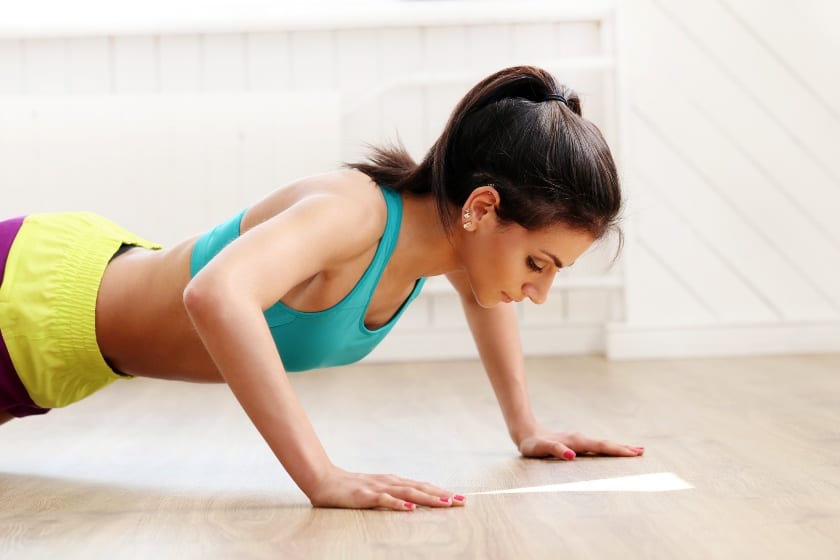
- Standard Pushups: High plank position; maintain a neutral spine by drawing your navel to your spine.
- Dolphin Pushups: Start in a forearm plank, pike your hips up while keeping legs straight, then lower back down to work the shoulders uniquely.
- Walking Lunges: Enhances stability and balance by traveling forward through the movement.
- Kneeling Side Plank: Hold your body up with your knee and arm; pull your waistline up away from the ground to engage the obliques.
Advanced Level (Maximum Effort)
- Frog Squats: Start in a deep goblet squat position; raise your hips until they are in line with your knees, then lower back down.
- Jumping Lunges: A plyometric move that requires exploding upward and switching legs in mid-air.
- One-legged Pushups: Lifting one leg increases the weight and stability demand on the other three limbs.
- Hollow Hold to Jackknife: Continuous abdominal contraction; bring arms and legs together to touch at the top.
Why Is Recovery The Secret To Weight Loss And Muscle Tone?
The quick answer: Muscles do not grow during the workout; they repair and strengthen during rest. Strategic recovery prevents burnout and injury, ensuring you reach the 8-week mark where noticeable changes occur. Neglecting rest is the fastest way to stall your progress.
To ensure long-term success, follow these physiological rules:
- The 24-Hour Rule: Larger muscle groups (upper and lower body) need at least one day off between intense sessions to repair tissue.
- Hydration: Water is essential for nutrient transport to recovering muscles and maintaining energy.
- The 30-Day Winter Wellness Challenge: On rest days, engage in low-impact movement like yoga or gentle stretching to keep joints mobile. This "wellness challenge" approach keeps you active without causing central nervous system fatigue.
See How Easily You Can Get Fitter
Sign up to get your free PDF report on 10 Actions That Support Weight Loss sent to your inbox!
BETSY MORRISON
Getting in shape is not about punishing your body for what it looks like. It is about training it for what it can do.
How To Use The 30-Day Movement Calendar To Stay In Shape
The quick answer: A 30-day movement calendar rotates focus between upper body, lower body, and core to meet the health guideline of training each major group twice a week. This structured rotation ensures full-body progress and prevents overtraining any single muscle group.
A Typical Week In The 30-Day Plan
- Day 1: Upper Body (Pushups, Dips)
- Day 2: Lower Body (Squats, Lunges)
- Day 3: Core Focus (Planks, Sit-ups)
- Day 4: Cardio / HIIT (High Knees, Burpees)
- Day 5: Upper & Lower Body Combo
- Day 6: Cardio & Core Combo
- Day 7: Rest or Gentle Yoga
Progressive Overload: According to the 30-day plan guidelines, aim for 30 repetitions of each exercise per session (e.g., 3 sets of 10). To progress, aim for 1–2 more reps each week or move to a more difficult variation from the progression guide.

The Master List: 30 Equipment-Free Moves For Every Level
To help you start your journey, here is a comprehensive list of 30 bodyweight moves categorized by difficulty. Choose the level that fits your current ability and progress as you get stronger.
Beginner Routine (Foundations)
- Bridge: Activates the core and posterior chain.
- Chair Squat: Perfects squat form using a chair for safety.
- Knee Pushup: Builds chest and arm strength.
- Stationary Lunge: Targets quads, hamstrings, and glutes.
- Plank to Downward Dog: Tests shoulder stability and flexibility.
- Straight-leg Donkey Kick: Isolates the glute muscles.
- Bird Dog: Improves balance and core stability.
- Forearm Plank: Builds full-body isometric strength.
- Side-lying Hip Abduction: Strengthens the outer hips.
- Bicycle Crunch: Targets the rectus abdominis.
Intermediate Routine (Progression)
- Bridged March: Challenges stability by using one leg.
- Standard Squat: Master the hinge without a chair.
- Full Pushup: Standard plank-position chest press.
- Forward and Backward Lunge: Enhances mobility and balance.
- Pike Pushup: Directs resistance toward the shoulders.
- Kneeling Squat: Increases time under tension for the glutes.
- Superman: Strengthens the lower back and spinal stabilizers.
- Plank with Alternating Leg Lift: Forces the core into overdrive.
- Kneeling Side Plank with Hip Abduction: Dual core and hip work.
- Dead Bug: Activates deep core muscles.
Advanced Routine (Mastery)
- Single Leg Bridge (Extended): Maximum glute and hamstring load.
- Overhead Squat: Challenges upper-body mobility and core.
- One-legged Pushup: Increases weight on the upper body.
- Jumping Lunges: A plyometric move for explosive power.
- Elevated Pike Pushup: Advanced shoulder-strength builder.
- Kneeling Squat with Jump: Requires high power and coordination.
- Advanced Bird Dog: Performed from a full high plank.
- One-leg Forearm Plank Hold: Extreme core stability test.
- Side Plank with Hip Abduction: Full-body lateral challenge.
- 30. Hollow Hold to Jackknife: Sustained abdominal contraction.
Turn This Workout Guide Into A Real, Lasting Habit
You now have the exercises. You have the progressions. You have the 30-day framework. The next step is making it stick — and that is exactly what this free guide was built for. Inside, you will get the 10 daily actions that transform a workout routine into a permanent part of your life:
- How to build the consistency habit even on your lowest-energy days
- The nutrition basics that support home training without complicated meal plans
- What to do when motivation disappears (and it will) so you never lose your progress again
No gym required. No equipment required. Just what actually works — written for real women.
What Are The Mental Health Rewards Of Strength Training?
The quick answer: Resistance training is scientifically associated with significant reductions in symptoms of anxiety and depression among adults. Regular movement improves cognition and sleep quality by regulating the body's stress response and promoting empowerment through physical milestones.
The psychological benefits are particularly measurable for adults with diagnosed depression, who often experience improved mood and self-esteem through consistent strength work. Beyond the physical aesthetics, the mental clarity and emotional resilience gained from a home routine provide a vital foundation for wellness.
Related Articles
The Bottom Line
You want to get fit and stay in shape. But you don't want to join a gym. It's too expensive, there isn't a gym that's convenient for you, or maybe you're just the independent type. Or, maybe, you're already a gym member, but your schedule is too manic to get away.
Starting your fitness journey is a commitment to yourself, not to a gym membership. By using the tools of functional strength and respecting your body's need for recovery, you are taking control of your health in a way that is sustainable, affordable, and effective.
Don't wait for the "perfect" Monday to begin. Choose the beginner routine and complete your first set of chair squats today. Remember the Master Instructor's secret: navel to spine, exhale on the effort, and focus on the 8-week horizon. Your transformation starts with the next rep.
Embrace Inspiration
Like What You Read? Be Sociable, Comment, And Share It! Thanks.
Glossary Of Key Terms
• Bodyweight Exercises (Calisthenics): A form of training that uses an individual's own weight against gravity to provide resistance, improving strength, endurance, and flexibility.
• Compound Moves: Exercises that engage multiple muscle groups simultaneously, such as burpees or squats, to maximize metabolic output.
• Dynamic Warm-Up: Active movements designed to increase blood flow, raise muscle temperature, and prime the nervous system for high-intensity work.
• Functional Strength: Physical power developed through movements that mimic real-world activities, focusing on the body's ability to perform everyday tasks efficiently.
• Progressive Overload: The gradual increase of stress placed upon the body during exercise by adding repetitions or moving to more difficult exercise variations to continue building muscle and tone.
• Rep-Based Training: A workout structure involving a specific number of repetitions and sets of a single exercise followed by a rest interval, used to master form and foundational skills.
• Sustainable Fitness: A state of well-being achieved through manageable, consistent habits integrated into daily life, rather than extreme, short-term lifestyle overhauls.
• Viscous Fibre: A specific type of dietary fiber mentioned as being particularly effective in evidence-based strategies for reducing belly fat.
• Waistline Lift: A specific mechanical cue used in plank movements to pull the waistline away from the floor, protecting the spine and engaging deep core muscles.
• 150-Minute Rule: The health guideline recommending at least 150 minutes of moderate activity per week, prioritized through consistent sessions rather than single, exhaustive efforts.
FAQ
You can stay in shape effectively using just your body weight. Bodyweight training, also known as calisthenics, uses gravity as resistance to improve your strength, endurance, and flexibility. Focus on compound movements like squats and burpees that engage multiple muscle groups simultaneously.
Consistency is key; aim for 150 minutes of moderate activity per week, broken into manageable sessions. A balanced routine should include a dynamic warm-up, strength training, cardio, and recovery. Remember, the fitness industry often overlooks the effectiveness of bodyweight exercises, so embrace the simplicity and accessibility of training with what you already have.
A well-rounded fitness routine includes four key elements: a dynamic warm-up, strength training, cardio, and recovery. Dynamic warm-ups prepare your joints and muscles for exercise, reducing the risk of injury. Strength training, using your body weight for resistance, helps build lean muscle mass and boost your metabolic rate. Cardio elevates your heart rate and improves cardiovascular health.
Finally, recovery allows your muscles to repair and grow, preventing burnout and reducing anxiety. A balanced routine is superior to random exercises because it ensures you train all major muscle groups without overstressing any single area, promoting consistent adaptation and strength gains.
Yes, dynamic warm-ups are generally more effective than static stretching before a workout. Dynamic warm-ups involve active movements that increase blood flow and muscle temperature, preparing your body for exercise.
Unlike static stretching, which can temporarily weaken muscles before activity, dynamic movements activate your nervous system and prime your body for higher-intensity work.
Examples of dynamic warm-up exercises include the Bridge or Plank to Downward Dog, which can wake up your body and prepare it for the challenges of strength training, making your workout safer and more effective from the start.
To perform the Bridge exercise correctly, start by lying on your back with your knees bent and feet flat on the floor, arms at your sides. Engage your core by drawing your navel toward your spine. Then, push through your heels to lift your bottom off the ground until your hips are fully extended, squeezing your glutes at the top of the movement.
Exhale as you lift. Finally, slowly return to the starting position. This exercise effectively activates your posterior chain, preparing your body for the demands of strength training. Focus on maintaining proper form throughout the movement to maximize its benefits.
The choice between rep-based sets and circuit training depends on your experience level. If you're a beginner, rep-based training is recommended. This involves completing 2 sets of 10–15 repetitions of a single exercise, with 30–60 seconds of rest between sets, to master form and build a solid foundation. For more advanced individuals, circuit training is a good option.
This involves moving through a sequence of 8–10 exercises with minimal rest (around 20 seconds) between them, prioritizing metabolic conditioning and cardiovascular intensity for efficient fat loss. Regardless of the method, mastering proper form is crucial for safe progression and effective results.
Less than you think. The majority of the exercises in this guide require nothing more than a clear floor space roughly the size of a yoga mat — approximately 6 feet by 2 feet. That is enough room for planks, lunges, squats, push-up variations, and every core move in the 30-exercise library above. Here is how to set yourself up for success in any sized space:
- Clear a consistent spot — using the same space each time creates a psychological trigger that tells your brain it is time to train
- Use a non-slip surface — a yoga mat or even a folded towel protects your wrists and knees during floor work
- Keep your space visible — rolling up your mat and hiding it in a cupboard increases the friction between you and your next session; leave it out where you can see it
- Use a wall — wall sits, incline push-ups, and standing stretches all use vertical space when floor space is tight
- Use a sturdy chair — tricep dips, elevated push-ups, step-ups, and seated core work can all be performed with a single piece of furniture you already own
No equipment purchases required. The most effective home gym you will ever build is one you can set up in 30 seconds and break down in 10 — because that is the one you will actually use consistently.
No. Bodyweight exercises use gravity for resistance. By increasing your "time under tension" (moving slower), decreasing rest intervals, or choosing harder variations (like one-legged pushups), you can build significant strength and muscle mass at home.
You Know Why. Now Learn Exactly How
Join thousands of women inside our community and receive our free guide: 10 Actions That Support Permanent Weight Loss — the practical, sustainable habits that translate everything you just read into real, lasting results.
No fad diets. No extreme plans. Just what the research actually supports — written for real women.