
What 10 Minutes Of Daily Meditation Does To Your Brain, Your Body, And Your Stress Levels — Explained By Neuroscience

Meditation will not carry you to another world, but it will reveal the most profound and awesome dimensions of the world in which you already live. Calmly contemplating these dimensions and bringing them into the service of compassion and kindness is the right way to make rapid gains in meditation as well as in life.
Hsing Yun ‧ Chinese Buddhist monk and Zen master
The Executive Summary
Discover the science-backed benefits of daily meditation for women, including increased happiness and emotional wellbeing through non-reactive awareness. Meditation reduces cortisol, the primary stress hormone, and improves sleep quality.
Research indicates that consistent practice lowers rates of anxiety and depression while enhancing cognitive functions. Even 5-10 minutes a day can create measurable changes by training attention and awareness to cultivate a calmer mental state, offering significant advantages for managing stress and promoting overall health.
You already know you should meditate. You have read the articles, downloaded the apps, and told yourself you would start "when things calm down."
Here is the irony: things never calm down. The mental load does not shrink. The inbox does not empty. The responsibilities do not pause.
You do not have a stress problem. You have a stillness deficiency. And the most evidence-backed solution available costs nothing, requires no equipment, and takes less time than scrolling Instagram.
This article gives you the five most compelling, research-supported reasons to start a daily meditation practice — and a simple, beginner-friendly system for making it stick.
Medical & Referral Disclaimer
This article is for informational and educational purposes only. It is not a substitute for professional mental health or medical advice. If you are experiencing severe anxiety, depression, or other mental health conditions, please consult a qualified healthcare provider.
Key Takeaways
- Just 10 minutes of daily meditation produces measurable changes in brain structure and function within 8 weeks.
- Meditation reduces cortisol — the primary stress hormone — with effects detectable in blood and saliva markers.
- Regular meditators show measurably lower rates of anxiety, depression, and insomnia than non-meditating controls.
- Daily meditation improves working memory, attention span, and cognitive flexibility — all of which deteriorate under chronic stress.
- Sleep quality improves significantly in consistent meditators, including reduced time to fall asleep and fewer night wakings.
- For women, meditation specifically addresses the cortisol-driven hormonal disruption that undermines weight management and energy levels.
- Starting with 5-10 minutes per day is sufficient to begin experiencing benefits — you do not need an hour or a retreat.
What Is Daily Meditation, And Why Should Women Prioritise It?
Daily meditation is the intentional practice of training attention and awareness — typically through focused breathing, body scanning, or mindful observation of thought — to cultivate a calmer, more present mental state. For women navigating the intersection of professional, familial, and personal demands, it is one of the most efficient and evidence-based investments in mental and physical health available.
The science is not subtle. A landmark meta-analysis published in JAMA Internal Medicine, reviewing 47 randomised controlled trials with 3,515 participants, found that mindfulness meditation programmes produced moderate evidence of improvement in anxiety, depression, and pain effects comparable to antidepressant treatment in some studies.
For women specifically, the case is even stronger. Women report higher rates of stress, anxiety, and depression than men across all age groups, and carry disproportionate emotional and cognitive labour. Meditation does not solve the systemic causes of that disparity. But it measurably changes how your brain and body respond to the remaining demands.
Benefit 1: How Does Daily Meditation Increase Happiness And Emotional Wellbeing?
Daily meditation increases happiness by training the brain to observe negative thoughts and emotions without being controlled by them. This practice — called non-reactive awareness in mindfulness research — reduces rumination (the mental habit of replaying negative experiences) and gradually shifts the brain's default emotional baseline toward more positive affect. Studies show measurable increases in self-reported wellbeing within 8 weeks of consistent practice.
The mechanism is neurological. Meditation strengthens the prefrontal cortex — the brain's regulation centre — while reducing reactivity in the amygdala, the region responsible for threat response and negative emotional reactions. The result is not forced positivity. It is greater emotional intelligence: the ability to experience difficult feelings without being overwhelmed by them.

Letting Go As A Neurological Practice
One of the most transformative aspects of meditation for women is its approach to past experiences and negative thought patterns. Rather than suppression (pushing thoughts away) or rumination (replaying them endlessly), meditation teaches a third option: observation without attachment.
You notice the thought: "I should have handled that better." You acknowledge it. You breathe. And you let it pass — the way clouds pass through the sky without changing the sky itself.
Over time, this practice reduces the psychological weight of self-criticism, guilt, and anxiety about the future. Research from the Greater Good Science Center at UC Berkeley confirms that mindfulness practice is consistently associated with increased self-compassion, which is, in turn, one of the strongest predictors of long-term mental wellbeing.
Breathwork As An Emotional Tool
Focused breathing during meditation gives the nervous system a direct physiological reset. Slow, diaphragmatic breathing activates the parasympathetic nervous system — shifting the body from sympathetic (fight-or-flight) to rest-and-digest mode. This shift is measurable in heart rate variability, cortisol levels, and subjective wellbeing within a single 10-minute session.
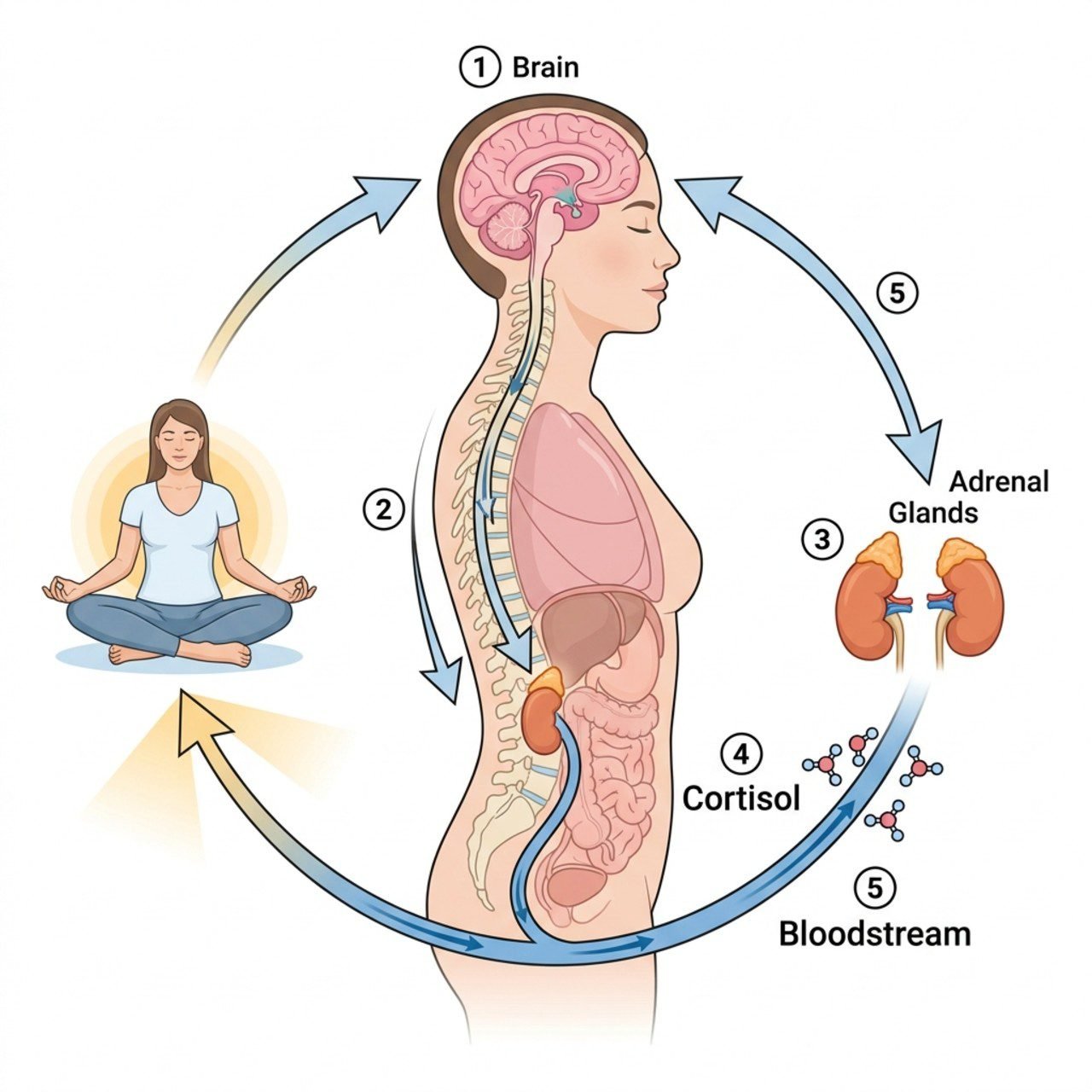
Benefit 2: How Does Meditation Reduce Stress And Lower Cortisol?
Meditation reduces stress and lowers cortisol — the body's primary stress hormone — through both immediate parasympathetic activation and longer-term changes in the hypothalamic-pituitary-adrenal (HPA) axis, which governs the stress response. Research shows that 8 weeks of mindfulness practice produces measurable reductions in salivary cortisol, inflammatory markers, and self-reported perceived stress.
For women, cortisol dysregulation has consequences that extend far beyond feeling stressed. Chronic elevated cortisol:
- Promotes fat storage, particularly in the abdominal region.
- Disrupts sleep architecture (reducing deep sleep stages).
- Suppresses reproductive hormones, affecting menstrual regularity and perimenopausal symptoms.
- Impairs thyroid function, which governs metabolism.
- Accelerates cellular ageing via telomere shortening.
This means that managing the hormonal cascade driven by chronic stress is not just a mental health priority for women — it is a metabolic and longevity priority. Meditation addresses it at the source.
Anxiety Relief Through Meditation: What The Research Shows
A 2014 meta-analysis in JAMA Internal Medicine found mindfulness meditation programmes reduced anxiety symptoms by a level comparable to antidepressant medication — without the side effects. The most robust evidence exists for Mindfulness-Based Stress Reduction (MBSR), an 8-week programme developed by Jon Kabat-Zinn at the University of Massachusetts Medical School.
For women experiencing stress-related anxiety — work pressure, caregiving demands, health concerns — even non-clinical mindfulness practice produces meaningful symptom relief.
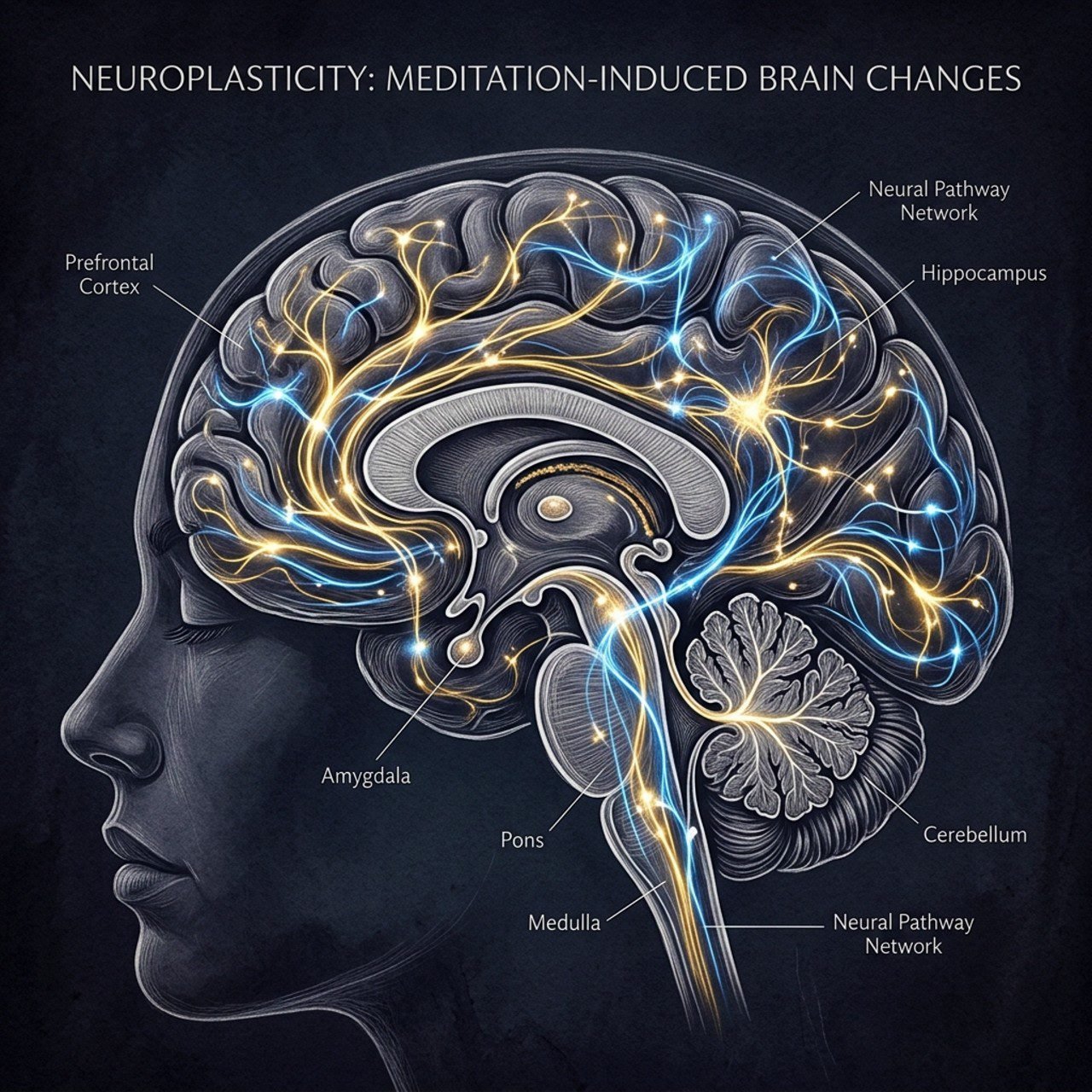
Benefit 3: How Does Daily Meditation Sharpen Focus, Concentration, And Mental Clarity?
Daily meditation improves focus and concentration by strengthening the brain's attentional networks — the neural pathways responsible for directing, sustaining, and refocusing attention. Research from Harvard Medical School shows that long-term meditators have measurably more grey matter density in the prefrontal cortex, the brain region governing attention, working memory, and executive function.
In practical terms, meditation trains the exact cognitive skills that chronic stress degrades. Stress fragments attention. Meditation restores it.
How Neuroplasticity Makes Meditation A Brain-Changing Practice
Neuroplasticity — the brain's ability to physically reorganise itself in response to experience — is the mechanism through which meditation creates lasting cognitive change.
A landmark study from Harvard University researchers found that 8 weeks of MBSR practice produced measurable increases in grey matter density in the hippocampus (learning and memory), posterior cingulate cortex (mind-wandering regulation), and cerebellum — alongside reduced grey matter density in the amygdala (threat response).
These are structural brain changes — visible on MRI — produced by a daily 10-minute practice.
Focus Benefits For Women At Work And In Daily Life
Women's cognitive load — managing multiple competing responsibilities simultaneously — is associated with a phenomenon researchers call "attention fragmentation." Meditation directly counteracts this by training the skill of returning focus to a single point of attention, repeatedly and without self-judgment.
Research from the University of Waterloo found that just 10 minutes of mindfulness meditation per day was sufficient to improve concentration and reduce mind-wandering in previously non-meditating adults. This is particularly relevant for women in professional roles, caregiving roles, or any context requiring sustained attention under pressure.

FACT: Sleep and meditation have a mutually reinforcing relationship: better sleep improves next-day stress resilience and emotional regulation, making meditation easier and more effective.
Benefit 4: How Does Daily Meditation Improve Sleep Quality?
Daily meditation improves sleep quality by calming the mental activity — racing thoughts, replayed conversations, anticipatory worry — that most commonly prevents sleep onset and causes night wakings. Mindfulness-based interventions consistently produce significant improvements in insomnia severity, time to sleep onset, total sleep time, and daytime fatigue in women with self-reported sleep difficulties.
Sleep and meditation have a mutually reinforcing relationship: better sleep improves next-day stress resilience and emotional regulation, making meditation easier and more effective. Worse, sleep impairs all cognitive and emotional functions, increasing the urgency of the stress-reduction meditation provides.
What Happens In The Brain During Meditation That Helps Sleep
When you meditate before bed — or develop a general daily meditation habit — several sleep-supporting changes occur:
- Cortisol levels drop, allowing the natural evening rise of melatonin to proceed without hormonal interference.
- Heart rate variability improves, signalling the nervous system's transition from sympathetic to parasympathetic dominance.
- Theta brainwave activity increases — the same brainwave state associated with the hypnagogic (pre-sleep) phase.
- Rumination decreases — the cognitive loop of worry and replay that keeps so many women awake is interrupted.
A study published in JAMA Internal Medicine found that mindfulness meditation training produced significant improvement in sleep quality in adults with moderate sleep disturbance — with effects maintained at 6-month follow-up.
Evening vs. Morning Meditation For Sleep Benefits
Both morning and evening meditation support better sleep — but through different mechanisms:
- Morning meditation reduces the cumulative cortisol load that builds through the day, preventing the elevated evening cortisol that disrupts sleep onset
- Evening meditation (20-30 minutes before bed) directly reduces physiological arousal and cognitive activity at the time when sleep initiation is needed
For beginners, morning meditation is generally easier to make consistent, but any time that allows daily practice is the right time.

Benefit 5: How Does Meditation Support Personal Growth And Self-Awareness?
Daily meditation cultivates self-awareness — the capacity to observe your own thoughts, emotions, and behavioural patterns with clarity and without automatic reactivity — which is the foundation of all meaningful personal growth. Meditators show measurable improvements in emotional intelligence, self-compassion, perspective-taking, and values-based decision-making, which accumulate and compound over months and years of practice.
Personal growth through meditation is not a mystical claim. It is the natural consequence of spending time in honest, non-judgmental observation of your own inner life. You begin to notice your habitual responses before they become actions. You notice the stories you tell yourself. You notice what you actually value versus what you have been pursuing out of habit or fear.
The Compassion Dividend
One of the less-discussed benefits of consistent meditation practice is the outward expansion of compassion — toward others and, critically, toward yourself. Loving-kindness meditation (metta) specifically trains the neural networks associated with empathy and social connection, producing measurable increases in positive affect toward both familiar people and strangers.
For women, who often extend more compassion to others than to themselves, the self-compassion dimension of meditation practice is transformative. Research from Dr. Kristin Neff at the University of Texas — the leading researcher on self-compassion — finds that self-compassion is more reliably associated with wellbeing than self-esteem, and that it is directly trainable through meditation practice.
Spiritual Growth Without Dogma
While meditation has deep roots in Buddhist and contemplative traditions, the evidence-based mindfulness practices now studied extensively in Western medicine and psychology are entirely secular. You do not need a spiritual framework to benefit from meditation — though many practitioners find that consistent practice naturally deepens their sense of meaning, presence, and connection to something larger than daily concerns.
For women navigating the process of ageing, health, and long-term vitality, meditation's capacity to cultivate presence — the ability to fully inhabit the current moment rather than living primarily in anxious anticipation of the future — may be its most quietly profound benefit.
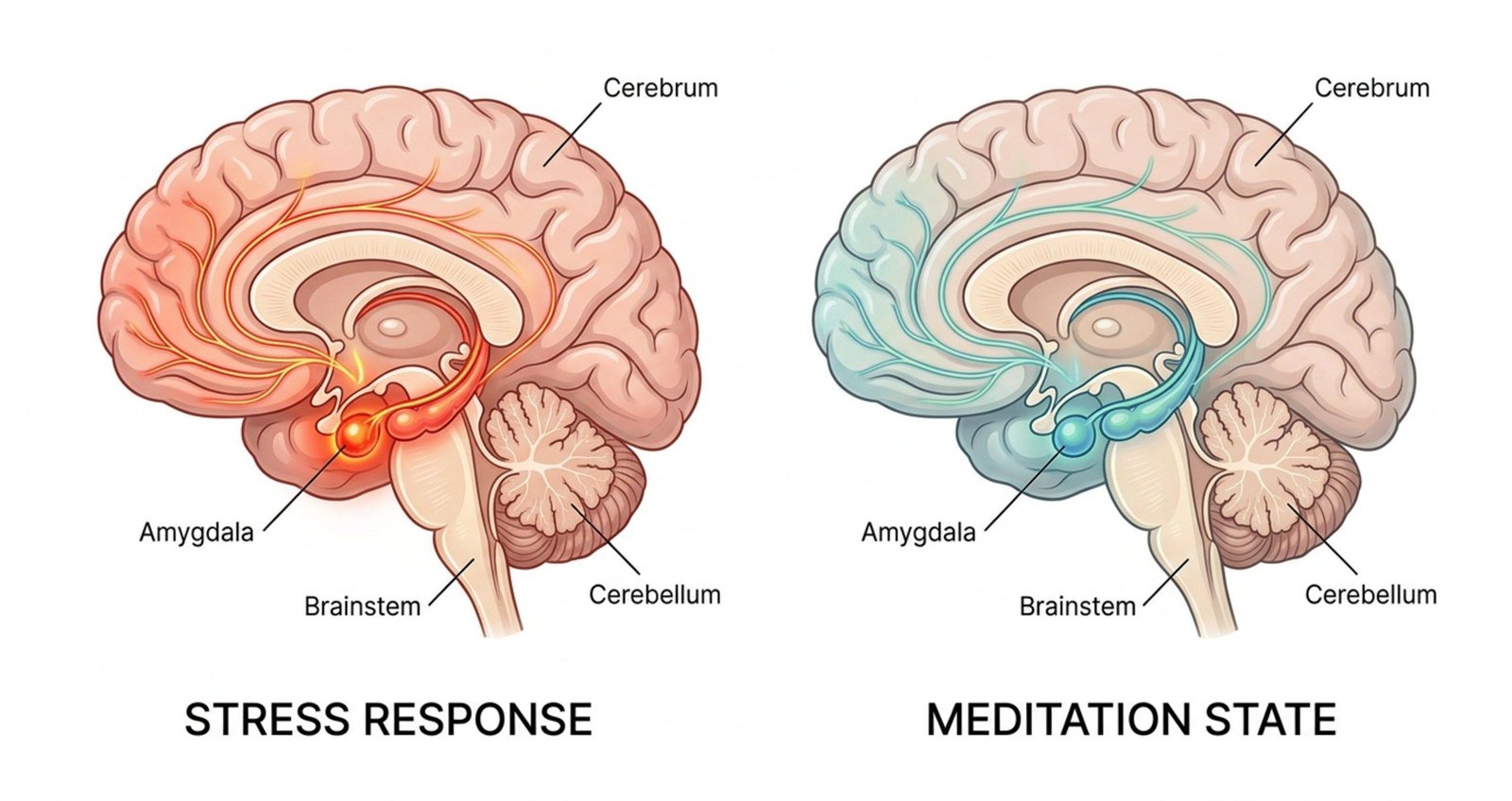
What Does Meditation Actually Do To Your Brain? (The Neuroscience)
Meditation produces measurable structural and functional changes in the brain — including increased grey matter density in attention and memory regions, reduced amygdala reactivity, strengthened prefrontal-amygdala connectivity (improving emotional regulation), and longer telomeres (a marker of cellular age). These changes are detectable with neuroimaging after as little as 8 weeks of consistent practice.
Summary Of Key Brain Research Findings
| Brain Region | Change with Meditation | Associated Benefit | Source |
|---|---|---|---|
| Prefrontal Cortex | Increased grey matter density | Better focus, decision-making, emotional regulation | Harvard Medical School, 2011 |
| Hippocampus | Increased volume | Improved learning, memory, and stress resilience | Hölzel et al., Psychiatry Research, 2011 |
| Amygdala | Reduced size and reactivity | Less anxiety, fear response, and emotional reactivity | Hölzel et al., Social Cognitive Neuroscience, 2010 |
| Anterior Cingulate Cortex | Strengthened connectivity | Better attention, impulse control, error awareness | Tang et al., PNAS, 2007 |
| Default Mode Network | Reduced activity during rest | Less mind-wandering and rumination | Brewer et al., PNAS, 2011 |
| Telomere Length | Preserved/increased | Slower cellular ageing, longevity markers | Epel et al., Psychoneuroendocrinology, 2009 |
These findings place meditation alongside exercise and nutrition as one of the three most evidence-supported lifestyle interventions for long-term brain health — not a supplement to be added eventually, but a foundational practice.

How Do You Build A Daily Meditation Habit From Scratch?
Building a daily meditation habit requires starting smaller than you think is necessary, anchoring the practice to an existing habit, and prioritising consistency over session length. Research in habit formation consistently shows that beginning with 5 minutes done daily produces more durable long-term practice than 30 minutes done occasionally.
The single biggest mistake beginners make is starting too ambitiously — aiming for 20-30 minutes before the habit is established — then abandoning the practice when life makes that duration difficult.
A 4-Week Beginner Meditation Progression
| Week | Daily Session Length | Focus | Technique |
|---|---|---|---|
| Week 1 | 5 minutes | Breath awareness only | Count 10 breaths; repeat when mind wanders |
| Week 2 | 7-8 minutes | Breath + body scan | Breath awareness, then scan attention down through the body |
| Week 3 | 10 minutes | Breath + open awareness | Notice thoughts without following them; return to breath |
| Week 4 | 10-15 minutes | Loving-kindness or guided | Use a guided meditation app or loving-kindness phrases |
| Month 2+ | 15-20 minutes | Your chosen focus | Establish preferred style; experiment with different forms |
Your Starter Toolkit: How To Meditate In 5 Steps
1. Choose a time and anchor it
The most consistent meditators attach their practice to an existing habit — immediately after waking, after morning coffee, or directly before bed. This reduces the need for daily decision-making about when to meditate.
2. Create a minimal environment
A quiet corner, a cushion, and the expectation of 5 uninterrupted minutes is sufficient. You do not need candles, altars, or special music. You need to sit down and begin.
3. Set a timer
This removes the temptation to check the time — which fragments concentration — and provides a psychological boundary that makes beginning easier.
4. Focus on your breath
Breathe naturally. Notice the sensation of air entering and leaving your nostrils, or the rise and fall of your chest. When your attention wanders (it will, constantly — this is normal), gently return it to the breath. That return is the practice.
5. End intentionally
Before opening your eyes, take 3 slow breaths. Notice how you feel compared to when you sat down. This brief reflection reinforces the habit loop and builds awareness of meditation's immediate effects.
Guided Meditation For Beginners
If sitting in silence feels daunting, guided meditation is an evidence-supported alternative that removes the uncertainty of "am I doing this right?" Apps such as Headspace, Calm, and Insight Timer offer free beginner tracks from 3-10 minutes — enough to establish the habit without committing to a paid programme.
Pairing daily meditation with holistic wellness practices that support your mood and movement creates a comprehensive self-care system that addresses both mind and body simultaneously.
For women whose relationship with stress has contributed to weight management challenges, understanding how chronic stress and cortisol affect body weight completes the picture — meditation is not separate from your fitness goals. It is one of the most powerful tools for achieving them.
Join Our Mailing List
See how easily you can get fitter.
Sign up to get your free PDF report on 10 Actions That Support Weight Loss sent to your inbox!
Benefits Of Meditation
TIP: Proper breathing techniques in meditation will help you focus your mind and energy on one spot.
Your Next Step: Start The Habit That Changes Every Other Habit
You now have the science, the benefits, and the starter system. Five minutes. Today. That is all that is required to begin.
The Lean Body Formula Special Report builds on this foundation: combining the stress-management and mindset insights from this article with the nutrition and movement strategies that support permanent transformation — designed specifically for women's bodies, women's hormones, and women's real lives.
Join thousands of women in our free community and claim your copy — completely free.
Related Articles
The Bottom Line: Ten Minutes That Change Everything
The case for daily meditation is not aspirational. It is neurological, hormonal, psychological, and — for women navigating complex lives — profoundly practical.
In 8 weeks of 10 minutes per day, you can measurably:
- Reduce cortisol and anxiety.
- Improve sleep quality and time to sleep onset.
- Strengthen attention and working memory.
- Shift your brain's default emotional baseline toward greater wellbeing.
- Build the self-awareness that makes every other positive change more sustainable.
You do not need to find peace. You need to practice it — 5 minutes at a time, one breath at a time, beginning today.
For a complete foundation that combines movement, nutrition, and the mindset tools that support lasting transformation, pairing a meditation practice with evidence-based weight loss strategies designed for women creates the whole-person approach that short-term programmes never deliver.
Embrace Inspiration
Like What You Read? Be Sociable, Comment, And Share It! Thanks.
Glossary Of Key Terms
FAQ
Research from the University of Waterloo found significant improvements in concentration and focus after just 10 minutes of daily meditation. For deeper benefits — measurable changes in cortisol levels, sleep quality, and anxiety symptoms — the evidence consistently points to 8 weeks of consistent practice as the threshold for substantial change. Many practitioners report subjective improvements in mood and stress response within the first 2-3 weeks, before structural brain changes are measurable.
The evidence is robust: a 2014 meta-analysis in JAMA Internal Medicine reviewing 47 randomised controlled trials found moderate evidence that mindfulness meditation reduces anxiety, depression, and pain — with effect sizes comparable to antidepressant treatment in some analyses. Mindfulness-Based Cognitive Therapy (MBCT) is now recommended by the UK's National Institute for Health and Care Excellence (NICE) as a clinical intervention for preventing recurrent depression.
Begin with 5 minutes daily. This is not a compromise — it is the evidence-based starting point for habit formation. Consistent 5-minute sessions produce more durable long-term practice than sporadic 30-minute sessions. Once sitting still and focusing for 5 minutes feels effortless, progress to 7, then 10 minutes. Most practitioners find 10-20 minutes daily to be the sweet spot for sustainable long-term practice.
Morning is generally recommended because it anchors the practice before the day's demands create scheduling conflicts, and reduces the cortisol load that builds through the day. However, research shows that meditation at any time produces benefit — the optimal time is whichever time you will actually do it consistently. For sleep benefits specifically, an evening practice 20-30 minutes before bed is particularly effective.
Yes — through several mechanisms. Cortisol reduction from regular meditation directly reduces cortisol-driven fat storage, particularly in the abdominal area. Improved sleep quality from meditation practice supports leptin and ghrelin regulation — the appetite hormones that govern hunger and satiety. Enhanced emotional regulation reduces stress eating. And the self-awareness meditation cultivates makes mindful eating more natural, reducing unconscious overconsumption. Meditation does not replace nutrition and exercise — but it addresses the psychological drivers that undermine them.
Mindfulness meditation (the most studied form in Western research) focuses on present-moment awareness — typically breath, body sensations, or thoughts — without judgment. Other forms include loving-kindness meditation (directed compassion toward self and others), transcendental meditation (mantra-based), body scan meditation (systematic attention through the physical body), and movement-based meditation (mindful walking, tai chi, yoga). All share the common element of intentional, focused attention — and all produce overlapping benefits. Beginners are recommended to start with breath-focused mindfulness before exploring other styles.
Join Our Mailing List
Join thousands of women inside our community and receive our free guide, 10 Actions That Support Permanent Weight Loss — the exact behavioural shifts that make the difference between a two-week attempt and a lasting transformation.
No restriction plans. No guilt. Just what actually works — for real women with real lives.