
Your Daily Protein Floor By Body Weight, Plus A Simple Way To Hit It Without Tracking Every Gram
FRANÇOIS DE LA ROCHEFOUCAULD
French author & moralist
To eat is a necessity, but to eat intelligently is an art.
Summary (TL;DR)
Protein for perimenopause works best at 1.2 to 1.6 grams per kilogram of body weight a day, well above the 0.8 g/kg Recommended Dietary Allowance (RDA), which only prevents deficiency. Your body can’t bank extra protein for later, so spread it out: three anchor meals of about 0.4 g/kg each (roughly 25 to 35 grams) meet your daily floor. Protein helps protect muscle, supports fullness and is good for bones. It won’t fix hot flashes or sleep.
You’re still walking. You’re still eating well. So why do you feel more tired, softer around the middle, and weaker on the stairs than you did two years ago? If that sounds familiar, protein for perimenopause is one of the first things worth checking, and one of the easiest to fix.
In one busy discussion among women over 40, someone asked why doctors never mention protein needs. The top reply was simply, “They barely tell you about perimenopause to begin with.” That’s not a failure on your part. Research on midlife women’s nutrition is still catching up.
This guide gives you a clear number, the reason behind it, and a no-math way to hit it at real meals. You’ll also learn what protein can’t do, because more isn’t always better and no single nutrient fixes perimenopause. The short version: aim above the official minimum, and spread it out.
Medical & Referral Disclaimer
This article is for general education only and isn’t medical advice. It doesn’t diagnose or treat perimenopause or any other condition. Protein needs vary with your health, medications and activity level. If you have kidney disease, diabetes, a history of disordered eating, or any ongoing medical condition, talk with your doctor or a registered dietitian before changing how much protein you eat.
Key Takeaways
- 1.2 to 1.6 g/kg a day is our recommended daily protein intake in perimenopause. The 0.8 g/kg RDA was set to prevent deficiency, not to protect midlife muscle.
- That works out to roughly 80 to 110 grams a day for a 150-pound woman.
- Lean mass starts to fall at the start of the menopause transition, while the rate of fat gain doubles, according to the long-running Study of Women’s Health Across the Nation (SWAN).
- Spacing matters: eating about 30 grams at each meal produced 25% more 24-hour muscle protein synthesis than saving most of it for dinner.
- Floor + 3 Anchors: three meals at about 0.4 g/kg each add up to your daily floor, and snacks top you up.
- Protein works best with strength training. In a large meta-analysis, extra muscle gains leveled off at about 1.6 g/kg a day.
- Food first, and both whey and plant protein are valid. If you eat mostly plants, mix your sources and aim higher.
- Protein won’t balance your hormones or cure hot flashes. The best-supported benefits are muscle, fullness and bone.

How Much Protein Do You Need In Perimenopause?
Most women in perimenopause do best with 1.2 to 1.6 grams of protein per kilogram of body weight a day. Treat 1.2 g/kg as your daily floor, and move toward 1.6 if you lift weights or are trying to lose fat. For a 150-pound (68 kg) woman, that’s about 80 to 110 grams a day.
An honest note: we found no clinical trial that sets a protein target just for perimenopause. Our range borrows from research on aging muscle and on strength training.
On the aging side, the international PROT-AGE study group recommends at least 1.0 to 1.2 g/kg a day for adults over 65, and 1.2 g/kg or more for people who exercise. Mayo Clinic Press suggests 1.0 to 1.2 g/kg for women after menopause.
We start at the top of that range on purpose. Perimenopause is when lean mass starts to decline, so it makes sense to act early rather than wait until you’re 65.
Want to do the math yourself? Divide your weight in pounds by 2.2 to get kilograms. Then multiply by 1.2 for your floor and by 1.6 for your upper target. Or skip the math entirely and use the table below.
Your Protein Floor By Body Weight
| Body Weight | Daily Floor (1.2 g/kg) | Upper Target (1.6 g/kg) | Per Anchor Meal (0.4 g/kg) |
|---|---|---|---|
| 120 lb (54 kg) | 65 g | 87 g | 22 g |
| 140 lb (64 kg) | 76 g | 102 g | 25 g |
| 160 lb (73 kg) | 87 g | 116 g | 29 g |
| 180 lb (82 kg) | 98 g | 131 g | 33 g |
| 200 lb (91 kg) | 109 g | 145 g | 36 g |
| 220 lb (100 kg) | 120 g | 160 g | 40 g |
If your current weight is well above where you feel healthy, run the numbers on a realistic goal weight instead. It keeps the target achievable without short-changing your muscle. And if you’re working on body recomposition after 40, the upper target column is your zone.
Why Does Protein Matter More In Perimenopause?
Falling estrogen seems to make muscle harder to hold on to. In the long-running SWAN study, lean mass began to decline at the start of the menopause transition while the rate of fat gain doubled. More protein, paired with strength training, gives your muscles the raw material to push back.
SWAN has followed women through midlife for decades. Its body-scan analysis found that fat gain rose from about 1.0% a year before the transition to 1.7% a year during it, while lean mass slipped by about 0.2% a year. These shifts continued until roughly two years after the final period, then leveled off.
A 0.2% yearly drop sounds tiny, but it lands just as fat gain speeds up. That’s the “softer, even though nothing changed” feeling so many women describe.

Estrogen Loss Effects On Muscle
Estrogen seems to help your muscles respond to the signals that build them. A review in the Proceedings of the Nutrition Society explains that a lack of estrogen after menopause may make muscle less sensitive to strength training and protein, which can speed up muscle loss. Researchers call this anabolic resistance.
Aging adds a second layer. The PROT-AGE group notes that older muscle shows declining anabolic responses to the protein you eat. Put simply, the same small breakfast does less for your muscles at 48 than it did at 28.
It’s Not Only About Muscle
Muscle is one of the main places your body stores and uses blood sugar. So muscle loss and insulin resistance in perimenopause often travel together. Muscle also supports your joints, balance and daily strength.
If your doctor never brought any of this up, you’re in good company. You’re not doing it wrong. You just weren’t given the full picture.
The RDA Is A Floor, Not A Goal
The Recommended Dietary Allowance for protein is a modest 0.8 grams per kilogram of body weight, or 0.36 grams per pound. For a 140-pound woman, that’s only about 50 grams a day.
The RDA was designed to cover basic needs and prevent deficiency in healthy adults. It was never meant to protect muscle through a hormonal transition. Think of it like a minimum wage: technically enough, but nobody plans a strong midlife around it.
That’s why expert groups focused on aging set higher targets. The PROT-AGE group states plainly that older adults need more dietary protein than younger adults to maintain function. Here’s how the main protein recommendations compare.
| Recommendation | Daily Target | Who It Was Built For | What It Means For You |
|---|---|---|---|
| RDA (U.S.) | 0.8 g/kg | Healthy adults, preventing deficiency | The absolute minimum, not a midlife goal |
| PROT-AGE (2013) | 1.0 to 1.2 g/kg | Adults over 65 | Baseline support for aging muscle |
| PROT-AGE, Active Adults | 1.2 g/kg or more | Older adults who exercise | Matches our perimenopause floor |
| Morton Meta-Analysis (2018) | About 1.6 g/kg | Adults doing strength training | Where extra muscle gains leveled off |
| Schoenfeld & Aragon (2018) | 1.6 up to 2.2 g/kg | People trying to maximize muscle growth | Upper bound, not needed by most women |
The Morton meta-analysis pooled 49 trials and found that protein intakes beyond about 1.62 g/kg a day added no extra muscle from strength training, on average. The uncertainty around that number is wide, so we treat 1.6 as a sensible ceiling for most women, not a hard limit.
The Floor + 3 Anchors Method
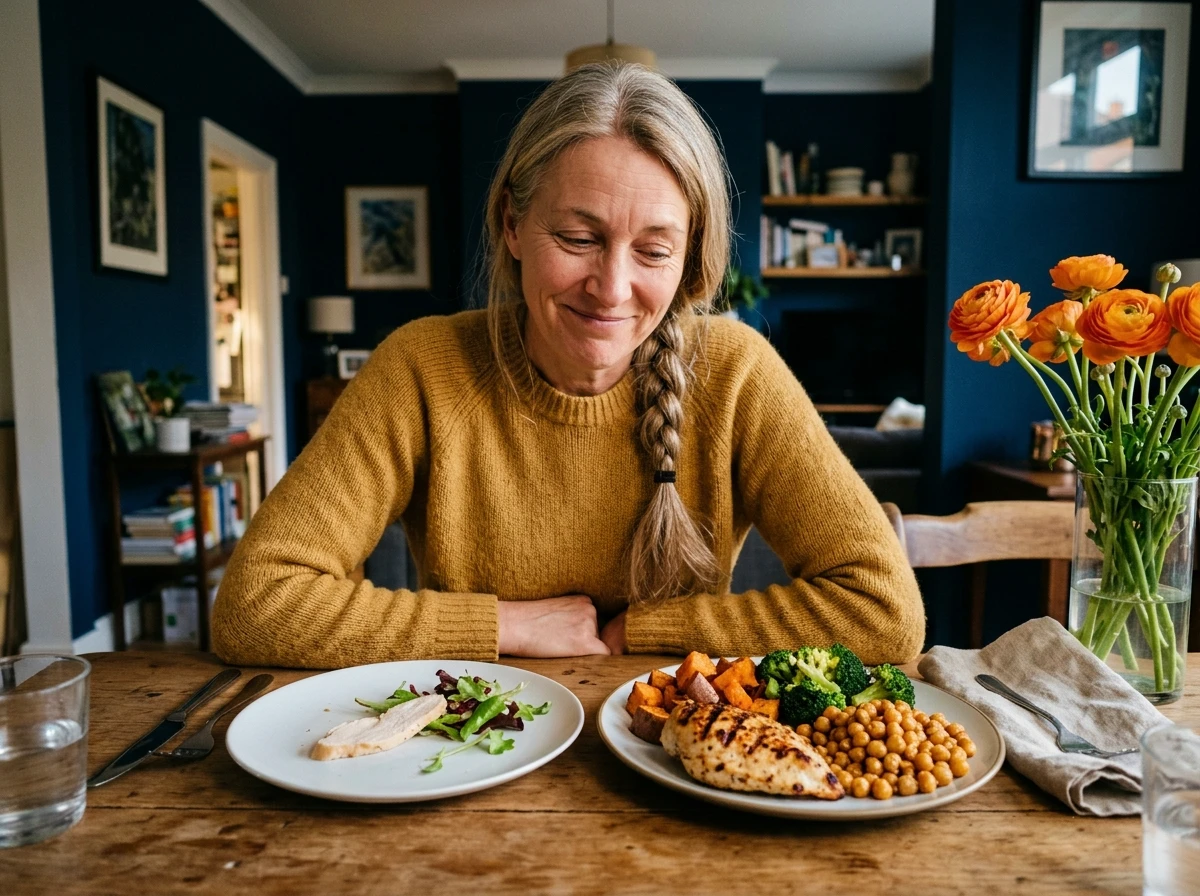
Here’s the principle this whole method rests on: your body can’t store extra protein for later. It keeps carbohydrates as glycogen and extra energy as body fat, but it has no protein pantry to draw from tomorrow.
So protein needs to come in steadily, spaced through the day, to keep switching on muscle protein synthesis, the process your body uses to repair and build muscle.
Most of us do the opposite. A coffee and toast breakfast, a light lunch, then a big protein-heavy dinner. A small study in the Journal of Nutrition tested exactly this pattern. When adults ate 30 grams of protein at each meal instead of 10, 15 and 65 grams, their 24-hour muscle protein synthesis was 25% higher, with the same total protein.
A review in the Journal of the International Society of Sports Nutrition suggests about 0.4 g/kg per meal as a practical target. That review built its plan around four or more meals for maximum muscle growth.
Our method borrows the per-meal number and does the math differently: three meals at 0.4 g/kg equal 1.2 g/kg. That’s your daily floor, built from meals you already eat.
Step-By-Step
- Find your floor: look up your weight in the table above and note the daily floor and per-meal number.
- Set three anchors: breakfast, lunch and dinner each carry about 0.4 g/kg. For most women, that’s 25 to 35 grams.
- Fix breakfast first: it’s often the lightest meal, and the easiest one to upgrade.
- Top up with one or two snacks: 10 to 20 grams each moves you toward 1.6 g/kg if you lift weights or are losing fat.
- Pair every anchor with fiber: vegetables, beans, berries or whole grains keep you fuller and support digestion.
- Do a one-time check: log three typical days, see where you land, adjust, then stop counting.
The No-Math Version
If grams per kilogram feels like homework, use your hand. A palm-sized portion of cooked chicken, fish or lean meat is roughly 3 to 4 ounces, which lands around 20 to 35 grams of protein (chicken at the top, fish a little lower).
Aim for one palm of protein at each meal, and add a small protein side such as yogurt, cottage cheese or beans if your hands are small or you lift. Macro tracking is optional, not a moral test. Our meal prep ideas make the anchors even easier on busy weeks.

What Are The Best Sources Of Protein For Perimenopause?
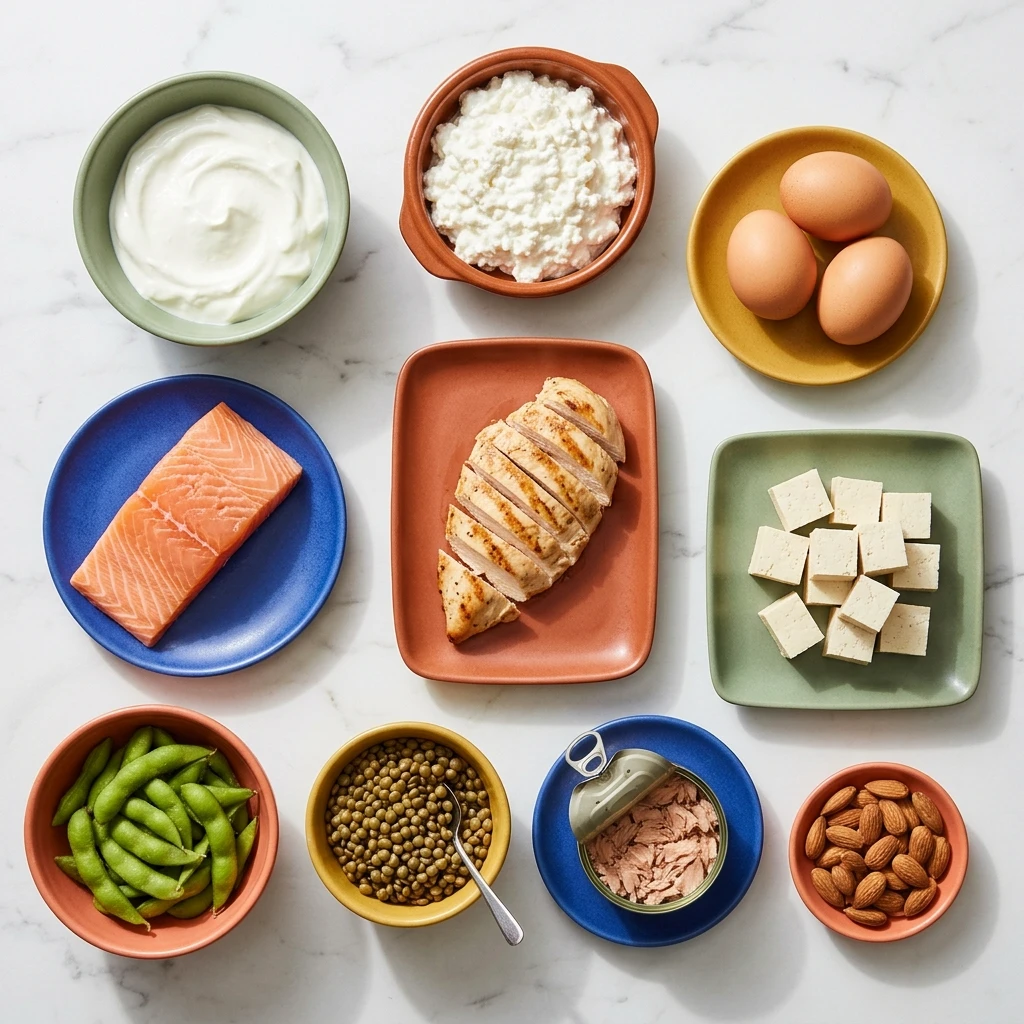
Start with whole foods: eggs, Greek yogurt, cottage cheese, fish, poultry, lean meat, tofu, edamame and lentils. Protein powders, whey or plant-based, are useful tools for busy mornings or a low appetite. If you eat mostly plants, mix your sources and aim toward the higher end of your range.
For more ideas, see our list of protein-rich foods. The values below are approximate, based on USDA FoodData Central, so always check your labels.
| Food | Serving | Protein (Approx.) | Bonus Nutrient Density |
|---|---|---|---|
| Chicken breast, cooked | 3 oz (85 g) | 26 g | Lean and versatile |
| Salmon, cooked | 3 oz (85 g) | 22 g | Omega-3 fats |
| Canned tuna in water | 3 oz (85 g) | 20 g | Shelf-stable backup |
| Plain nonfat Greek yogurt | 3/4 cup (170 g) | 17 g | Calcium |
| Low-fat cottage cheese | 1/2 cup (113 g) | 13 g | Calcium |
| Eggs, large | 2 eggs | 12 g | Choline |
| Firm tofu | 3 oz (85 g) | 8 to 14 g (varies by brand) | Calcium if calcium-set |
| Edamame, shelled | 1/2 cup | 9 g | Fiber |
| Lentils, cooked | 1/2 cup | 9 g | Fiber and iron |
| Whey protein powder | 1 scoop | 20 to 25 g (check label) | Fast and convenient |
| Pea or soy protein powder | 1 scoop | 15 to 25 g (check label) | Dairy-free |
Whey Protein Powder vs. Plant-Based Protein
Both can work. Animal proteins like whey tend to give a stronger muscle-building signal per gram. A review in the Journal of Nutrition explains that most plant proteins are lower in leucine, the amino acid that helps switch on muscle building, and are a little less digestible.
The fix is simple: blend sources (such as pea plus rice, or soy with grains) and eat a bit more.
Plant protein has its own case, too. In the Nurses’ Health Study, which followed 48,762 women from midlife, each small increase in the share of calories from plant protein was linked to 38% higher odds of healthy aging.
That’s an observational finding, so it shows a link, not proof. Our take: food first; both are valid, and the best protein is the one you’ll eat consistently.
If you use powder, look for a brand with third-party testing. Our guide to perimenopause supplements that work covers how to judge labels.

Hitting Your Number Without Living On Shakes
- Upgrade breakfast: two eggs plus half a cup of cottage cheese gets you to about 25 grams.
- Swap, don’t add: trade regular yogurt for Greek yogurt and you can double the protein in the same bowl.
- Batch-cook one protein: roast chicken, lentils or tofu on Sunday so lunch anchors are ready to go.
- Keep shelf-stable backups: tuna pouches, roasted edamame and nut butter cover the days you didn’t plan.
- Add a protein side: stir lentils into soup or put edamame next to a salad.
- Use powder when appetite is low: stir a scoop into oats or a smoothie instead of forcing a big meal.
Protein For Perimenopause: What It Can And Can’t Do
Protein has become a wellness buzzword, and some women are tired of the hype. In one menopause community discussion, the most upvoted reply called the sleep and cortisol claims “wellness industry grifting.” On the hormone claims, they have a point.
What The Evidence Supports
Muscle, especially with lifting. Protein is the raw material and strength training in perimenopause is the signal. In the Morton meta-analysis, protein boosted training gains in muscle and strength, up to the 1.6 g/kg plateau.
Fullness and healthy weight loss. A review in the American Journal of Clinical Nutrition found a modest satiety effect from higher-protein meals. In shorter, tightly controlled studies, higher-protein weight-loss diets led to more fat loss and better preservation of lean mass. Longer-term results were more mixed, so think “helpful,” not “magic.”
Bone density health. An old worry said protein harms bone. A National Osteoporosis Foundation meta-analysis found moderate evidence that higher protein may protect bone density at the lower spine, with no effect at the hip. In other words, higher protein didn’t harm bone in the pooled data, with a possible benefit at the spine.
Staying strong later. In the Women’s Health Initiative, among 24,417 women aged 65 to 79, a 20% higher protein intake (measured with biomarker calibration) was linked to a 32% lower risk of frailty over three years. That’s observational, but it points the same way as the muscle research.
What Protein Won’t Do
We couldn’t find good evidence that eating more protein does any of the following:
- Stop hot flashes or night sweats: these are driven by hormone changes, not protein intake.
- “Balance” estrogen or progesterone: food can support your body, but it doesn’t reset your hormones.
- Fix sleep or lower cortisol on its own: some women feel better with steadier meals, but that’s not the same as a treatment.
- Burn belly fat directly: no food targets fat in one spot.
- Replace medical care: if symptoms are disrupting your life, hormone therapy and other options are a conversation for your doctor.
Don’t Forget Fiber
Another reply in that same thread said, “It’s FIBER.” They’re not wrong. Protein and fiber work as a team for fullness, steady energy and digestion. That’s why every anchor in our method comes with a plant on the plate.
Is A High-Protein Diet Safe, And What Are The Signs You’re Not Getting Enough?
For women with healthy kidneys, 1.2 to 1.6 g/kg a day overlaps what experts recommend for active older adults (1.2 g/kg or more) and what strength-training research supports (about 1.6).
The main exception is kidney disease. The PROT-AGE group and the National Kidney Foundation both advise lower, individualized intakes in that case, so get medical guidance first.
PROT-AGE carves out people with severe kidney disease who aren’t on dialysis as the group who should limit protein. The National Kidney Foundation adds that too little protein also causes problems at any stage, which is why a kidney dietitian should set your number.
What about eggs? Two large eggs give you about 12 grams of protein. For a 140-pound woman, that’s roughly 16% of her daily floor. So no, two eggs a day isn’t too much protein. For most women, it’s not enough on its own for breakfast.

Signs You May Be Falling Short
None of these proves low protein on their own, and several have other causes, such as thyroid or iron problems. But if a few sound familiar, it’s worth looking at your plate.
- Losing strength: stairs, groceries or getting up from the floor feel harder, even though you’re still active.
- Hungry soon after meals: especially after carb-heavy breakfasts and lunches.
- Slow recovery: you stay sore for days after workouts you used to bounce back from.
- Mostly fruit-and-veg meals: healthy plates that are light on eggs, dairy, fish, meat, tofu or beans.
- Muscle going with the weight: you’re losing weight, but you feel weaker and softer, not leaner.
If any of these come with unexplained weight loss, ongoing fatigue or other new symptoms, see your doctor before changing your eating.
Ready to turn your protein floor into a full midlife plan? Grab our free guide, 10 Actions That Support Permanent Weight Loss, and get practical, science-backed strategies built for women in perimenopause. Pair it with your three anchors this week, while your new breakfast habit is still fresh.
The Bottom Line
Protein for perimenopause isn’t about chasing the biggest number online. Use 1.2 g/kg as your floor, build it from three high-protein anchor meals of about 0.4 g/kg each, and move toward 1.6 if you lift or are losing fat.
Pair protein with strength training and fiber. Then judge your progress by strength and energy over weeks, not by a single day’s log. Start tomorrow with one change: an anchor breakfast of 25 to 30 grams. For many of us, it’s the lightest meal of the day.
Glossary Of Key Terms
- Amino Acids: the building blocks of protein. Your body uses them to repair muscle, make enzymes and much more.
- Anabolic Resistance: when muscle responds less strongly to protein and exercise, common with aging and lower estrogen.
- Grams Per Kilogram (g/kg): grams of protein per kilogram of body weight. Divide your weight in pounds by 2.2 to get kilograms.
- Lean Mass: the non-fat soft tissue in your body, mostly muscle, organs and water.
- Leucine: an amino acid that acts as a key trigger for muscle building. Whey, dairy, meat and eggs are rich in it.
- Menopause Transition: the years around your final period when hormones swing and then fall. It overlaps with perimenopause.
- Muscle Protein Synthesis: the process your body uses to repair and build muscle tissue.
- Recommended Dietary Allowance (RDA): the intake that meets basic needs for nearly all healthy adults. For protein, it’s 0.8 g/kg.
- Sarcopenia: age-related loss of muscle and strength. Sarcopenia prevention starts with muscle mass retention in midlife.
- Satiety: the feeling of fullness and satisfaction after eating that keeps cravings in check.
FAQ
How Much Protein Does A 40-Year-Old Woman Need?
The RDA says 0.8 grams per kilogram of body weight, but that’s a minimum to prevent deficiency. Once perimenopause starts, or if you’re active, 1.2 to 1.6 g/kg is a better target. For a 150-pound woman, that’s about 80 to 110 grams a day. If you have kidney disease, ask your doctor first.
How Much Protein Should I Eat Per Meal In Perimenopause?
Aim for about 0.4 grams per kilogram of body weight at each main meal, which is 25 to 35 grams for most women. One study found that eating 30 grams at each meal led to 25% more muscle protein synthesis over 24 hours than eating most protein at dinner. Larger amounts at one meal aren’t harmful, but spreading protein out works better.
Is 2 Eggs A Day Too Much Protein?
No. Two large eggs give you about 12 grams of protein. For a 140-pound woman, that’s roughly 16% of a 76-gram daily floor. On its own, it’s usually not enough for a full breakfast anchor. Add Greek yogurt, cottage cheese or whole-grain toast with a protein topping to reach 25 to 30 grams.
Does Protein Affect Hormones In Perimenopause?
Not in the way social media often claims. There’s no good evidence that protein balances estrogen or progesterone or stops hot flashes. Higher-protein meals do raise fullness hormones modestly, which can help with cravings. The real reason protein matters in perimenopause is muscle: falling estrogen seems to make muscle harder to keep, and protein gives it the raw material it needs.
Can More Protein Help With Perimenopause Weight Loss?
It can help, but it isn’t a magic switch. In short-term controlled studies, higher-protein weight-loss diets led to more fat loss and better muscle preservation than lower-protein ones.
Protein also helps you feel full, which makes eating a little easier. Long-term results are more mixed, so pair protein with strength training, sleep and steady habits. Our guide on how to lose weight in perimenopause covers the full picture.
Should I Use Protein Powder During Perimenopause?
You don’t need it, but it can be a useful tool. Powder helps on busy mornings, when your appetite is low, or when you eat mostly plants. Whey gives a strong muscle-building signal, and pea or soy blends work well if you avoid dairy.
Choose a product with third-party testing and check the label for added sugar. Use it to fill gaps, not to replace real meals.
Do Protein Needs Change After Menopause?
Your needs don’t drop after menopause. In the SWAN study, the fast changes in muscle and fat leveled off about two years after the final period. But aging keeps making muscle less responsive to protein, so experts recommend at least 1.0 to 1.2 g/kg for adults over 65, and more if you’re active. Keep 1.2 g/kg as your floor, and ask your doctor if illness or recovery raises your needs.