

The Real Benefits Of Regular Cycling After 40 — And The One Thing It Won’t Do

When the spirits are low, when the day appears dark, when work becomes monotonous, when hope hardly seems worth having, just mount a bicycle and go out for a spin on the road, without thought on anything but the ride you are taking.
Arthur Conan Doyle
Summary (TL;DR)
The benefits of regular cycling for women over 40 go well beyond calorie burn: stronger heart, lower cardiovascular and cancer risk, better joint mobility, sharper mood, and real support for weight management — all without the pounding that running or high-impact classes put on aging joints.
But cycling has one honest limitation: because it’s non-weight-bearing, it does little for bone density, which matters more once estrogen starts declining. Here’s what the research actually shows, what a physical therapist and two professional cycling coaches say about it, and exactly what to pair it with.
If you haven’t been on a bike since your kids were small — or since before perimenopause started rearranging your joints, your sleep, and your motivation — the hesitation you feel about getting back on one is normal. Balance feels uncertain.
Traffic feels louder than it used to. And there’s a quieter worry too: will this actually do anything for me at this stage of life?
The short answer is yes, and the research behind it is more specific than most “cycling is good for you” articles let on. The benefits of regular cycling for women over 40 include measurable drops in cardiovascular and cancer risk, meaningful calorie burn, and joint-friendly conditioning that high-impact workouts simply can’t offer once your joints start telling you what they will and won’t tolerate.
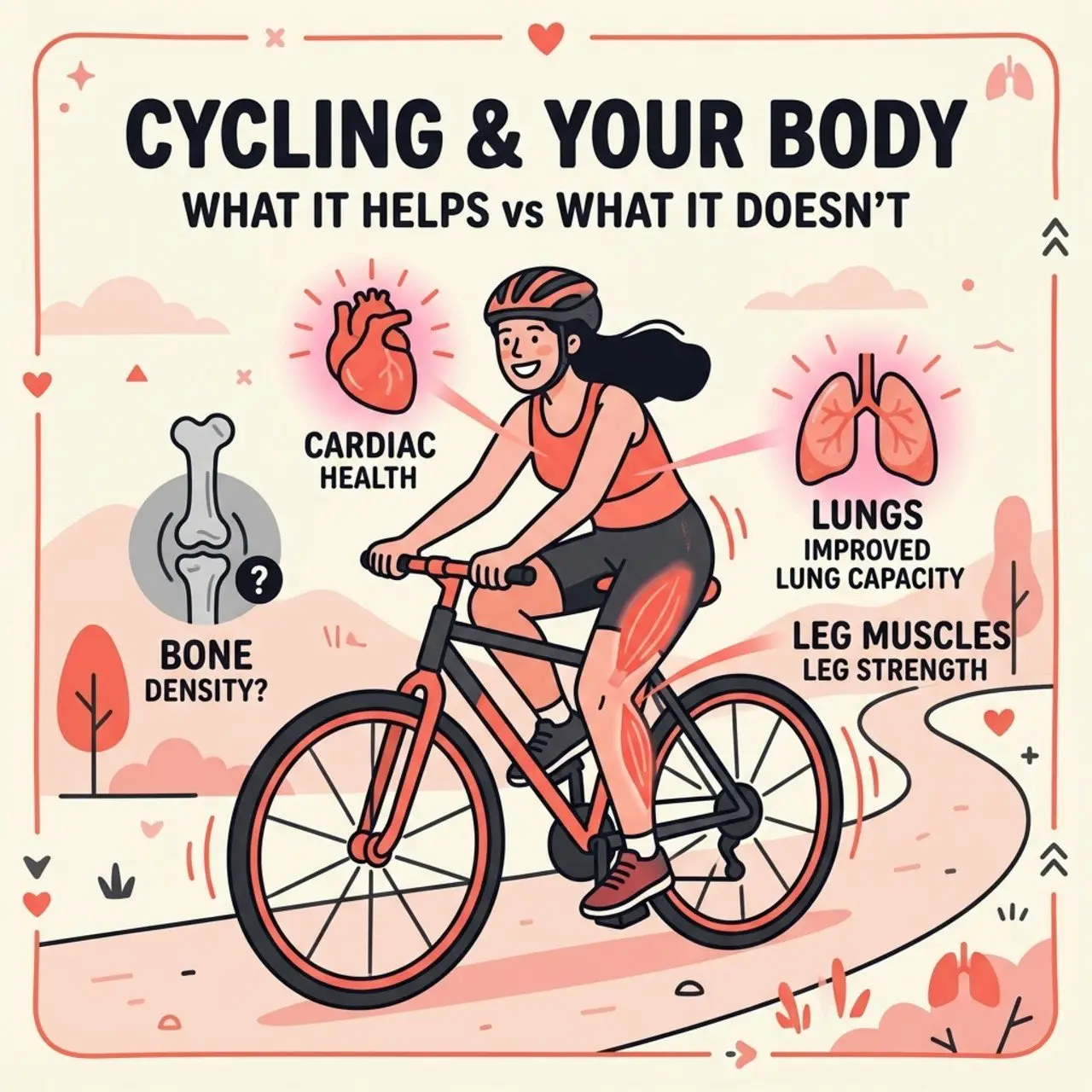
What most cycling articles skip is the honest caveat: cycling is a non-weight-bearing exercise, which means it does very little to protect the bone density that estrogen decline puts at risk.
That’s not a reason to skip it — it’s a reason to pair it correctly. We’ll show you exactly how, with input from a physical therapist and two professional cycling coaches, further down.
Medical & Referral Disclaimer
This article is for informational and educational purposes only. It is not a substitute for professional medical advice, diagnosis, or treatment. Always consult your physician or a qualified healthcare provider before starting any new exercise program, especially if you have joint, bone density, or cardiovascular concerns.
Key Takeaways
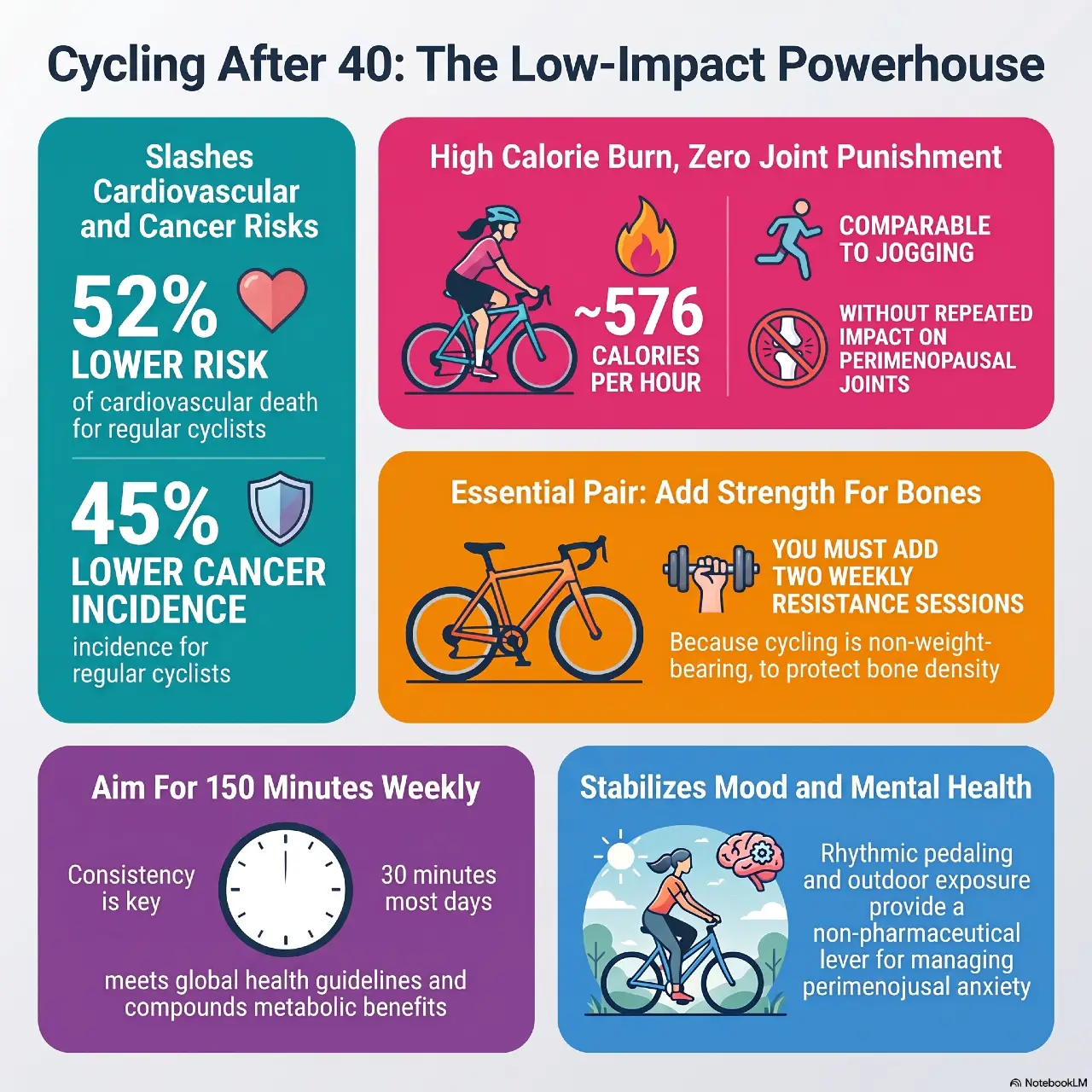
- Cardiovascular payoff is real and measured: cycle commuters showed a 52% lower risk of cardiovascular death in a large UK cohort study.
- Cancer risk reduction is one of cycling’s most underreported benefits — 45% lower incidence, 40% lower mortality in the same study.
- Calorie burn is genuinely competitive with running at a fraction of the joint stress.
- Cycling won’t build bone density — pair it with two weekly strength sessions for a complete plan.
- Intimidation, not fitness, is the real barrier for most women restarting in their 40s and 50s — and it has a specific, practical fix.
- 150 minutes a week of moderate cycling meets the standard aerobic activity guideline used by most major health bodies.

The 9 Benefits Of Regular Cycling For Women Over 40
These are the benefits of regular cycling that hold up under research — not just the ones that sound good in a listicle.
1. It Trains Your Heart Without Punishing Your Joints
Cycling raises your heart rate and works your cardiovascular system just as effectively as running, without the repeated impact that running, jump-based classes, or stair workouts put through your knees and hips.
That trade-off matters more after 40, when cartilage recovers more slowly, and joint pain becomes a more common perimenopausal symptom. Low-impact cardio, such as cycling, walking, and swimming, is especially recommended for women managing joint discomfort during this transition.
2. It Builds Real Leg, Hip, And Core Strength
Pedalling isn’t just a leg workout. Every rotation recruits your quads, hamstrings, glutes, hip flexors, and core to stabilize your position on the bike, which is why regular riders see strength gains beyond their calves and thighs.
This carries over directly into the kind of functional strength that makes everyday movement — stairs, carrying groceries, getting up off the floor — noticeably easier.
3. It Tones Muscle Gradually, Without Joint Strain
Because cycling is low-impact, you can ride often enough for visible muscle tone to develop in your calves, thighs, hamstrings, and glutes without the recovery penalty of high-impact strength circuits. Consistency, not intensity, is what drives the change here.


4. It Lowers Your Cardiovascular Disease Risk
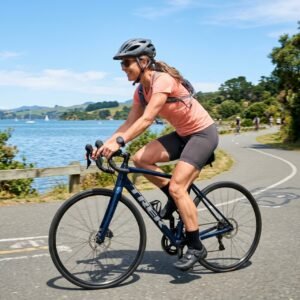
In a UK Biobank study published in The BMJ that tracked 263,450 adults, people who commuted by cycling had a 46% lower risk of developing cardiovascular disease and a 52% lower risk of dying from it, compared to people who commuted by car or public transport.
That’s one of the largest and most rigorous datasets on this question to date, and the association held even after adjusting for other health and lifestyle factors.
5. It Improves Circulation And Aerobic Capacity
Your legs contain some of the largest muscle groups in your body, and activating them repeatedly during a ride drives blood flow, boosts oxygen delivery to working tissue, and gradually raises your aerobic capacity — the measure of how efficiently your body uses oxygen during exercise.
A higher aerobic capacity translates into more everyday stamina, not just a better time on the bike.
6. It Sharpens Coordination And Balance
Staying upright, steering, braking, and scanning your surroundings all at once forces your upper and lower body — and your eyes — to communicate constantly.
That coordination demand is part of why cycling is often recommended as a fall-prevention tool for women managing the balance changes that can come with hormonal shifts in their 40s and 50s.
7. It Burns A Genuinely Competitive Number Of Calories
A 155-lb woman burns roughly 504–576 calories an hour cycling at a moderate outdoor pace — comparable to jogging, without the joint load. See the full breakdown by intensity in the table below. Combined with a balanced eating plan, that calorie burn adds up to meaningful, sustainable fat loss over weeks and months rather than a crash-diet spike.
8. It Protects Your Mental Health During Hormonal Change
Rhythmic, sustained exercise like cycling triggers an endorphin release that measurably improves mood, and outdoor riding adds the additional benefit of daylight exposure and green space, both linked to lower stress and better sleep.
For women navigating the anxiety and mood swings that often accompany perimenopause, that combination is a real, non-pharmaceutical lever worth using.
9. It’s Linked To Meaningfully Lower Cancer And Diabetes Risk
In the same UK Biobank cohort, cycle commuters had a 45% lower incidence of cancer and a 40% lower cancer mortality rate than non-active commuters.
A separate population-based cohort of more than 22,000 adults aged 40–79 found that cycling at least 60 minutes a week was independently associated with a 9% reduction in all-cause mortality.
A Danish cohort study of more than 52,000 men and women aged 50–65 found that consistent cyclists had up to a 20–30% lower risk of developing type 2 diabetes than non-cyclists. Three different large studies, three different populations, the same directional finding.
How Many Calories Does Regular Cycling Actually Burn?
A 155-lb (70 kg) woman burns between roughly 500 and 860 calories an hour cycling, according to Harvard Health Publishing’s calorie-burn data, with moderate outdoor pace sitting around 576 calories per hour.
Speed and terrain matter more than most people expect — the difference between a leisurely ride and a brisk one can nearly double your calorie burn for the same hour spent on the bike.
| Cycling Intensity | Approx. Speed | Calories Burned Per Hour (155 lb / 70 kg) |
|---|---|---|
| Stationary bike, moderate effort | — | ~504 |
| Outdoor, moderate pace | 12–13.9 mph | ~576 |
| Outdoor, brisk pace | 14–15.9 mph | ~720 |
| Off-road / varied terrain | Variable | ~612 |
| Outdoor, vigorous pace | 16–19 mph | ~864 |
Source: Harvard Health Publishing, calories burned by activity and body weight.
You don’t need to chase the top of that table. A consistent 30–45 minutes at a moderate pace, a few times a week, is enough to meet the 150-minutes-a-week aerobic activity guideline most health bodies recommend — and consistency burns more total calories over a month than sporadic hard efforts.
If you want to see how that fits into a broader plan, our weight management calculators can help you map calorie burn against your goals.
Cycling vs. Other Low-Impact Cardio: How Does It Compare?
Cycling burns more calories per hour than walking and holds up well against swimming and rowing, but it’s the only one of the four that pairs almost no bone-loading benefit with almost no joint impact — a trade-off worth knowing before you build a routine around it alone.
| Activity | Calories/Hour (155 lb) | Joint Impact | Builds Bone Density? |
|---|---|---|---|
| Cycling (moderate, 12–13.9 mph) | ~576 | Very low | No — non-weight-bearing |
| Brisk walking (3.5 mph) | ~266 | Low | Yes — weight-bearing |
| Swimming (general) | ~432 | Very low | No — non-weight-bearing |
| Rowing (stationary, moderate) | ~504 | Low | No — seated, non-weight-bearing |
| Elliptical trainer | ~648 | Low | Partial — semi-weight-bearing |
Calorie data: Harvard Health Publishing. Bone-loading classification: see sourcing in the next section.
None of this makes cycling a worse choice — it makes it an incomplete one, the same way any single form of cardio is incomplete on its own. The fix isn’t switching activities. It’s adding one.
The One Thing Cycling Won’t Do For Your Bones, And What To Pair It With
Cycling is non-weight-bearing, meaning your body weight is supported by the saddle rather than your skeleton, so it does little to stimulate the bone-building response that weight-bearing and resistance exercise provide.
That matters specifically for women over 40, because declining estrogen during perimenopause already accelerates bone density loss on its own. This isn’t a reason to stop riding — it’s a reason to stop treating cycling as your entire fitness plan.
Systematic review evidence on postmenopausal women consistently finds that high-impact and resistance-based exercise is what actually preserves bone mineral density, while purely non-weight-bearing cardio like cycling and swimming shows little to no protective effect on its own — a finding echoed in broader research on exercise and osteoporosis risk after menopause.
FACT: When you ride a bicycle, muscle groups from the upper and lower body are working together to move forward. This improves the coordination of your arms to legs and your eyes to your body.
“Regular exercise, especially weight-bearing activities like walking or strength training, plays a key role in maintaining bone density and muscle mass, which are critical for joint health,” notes Alexis Fletcher, PT, DPT, a certified pelvic health physical therapist at Mathis Physical Therapy.
Her guidance on menopause-related joint pain is consistent with the broader research: low-impact cardio like cycling protects the joints, but it needs a weight-bearing or resistance partner to protect the bones.
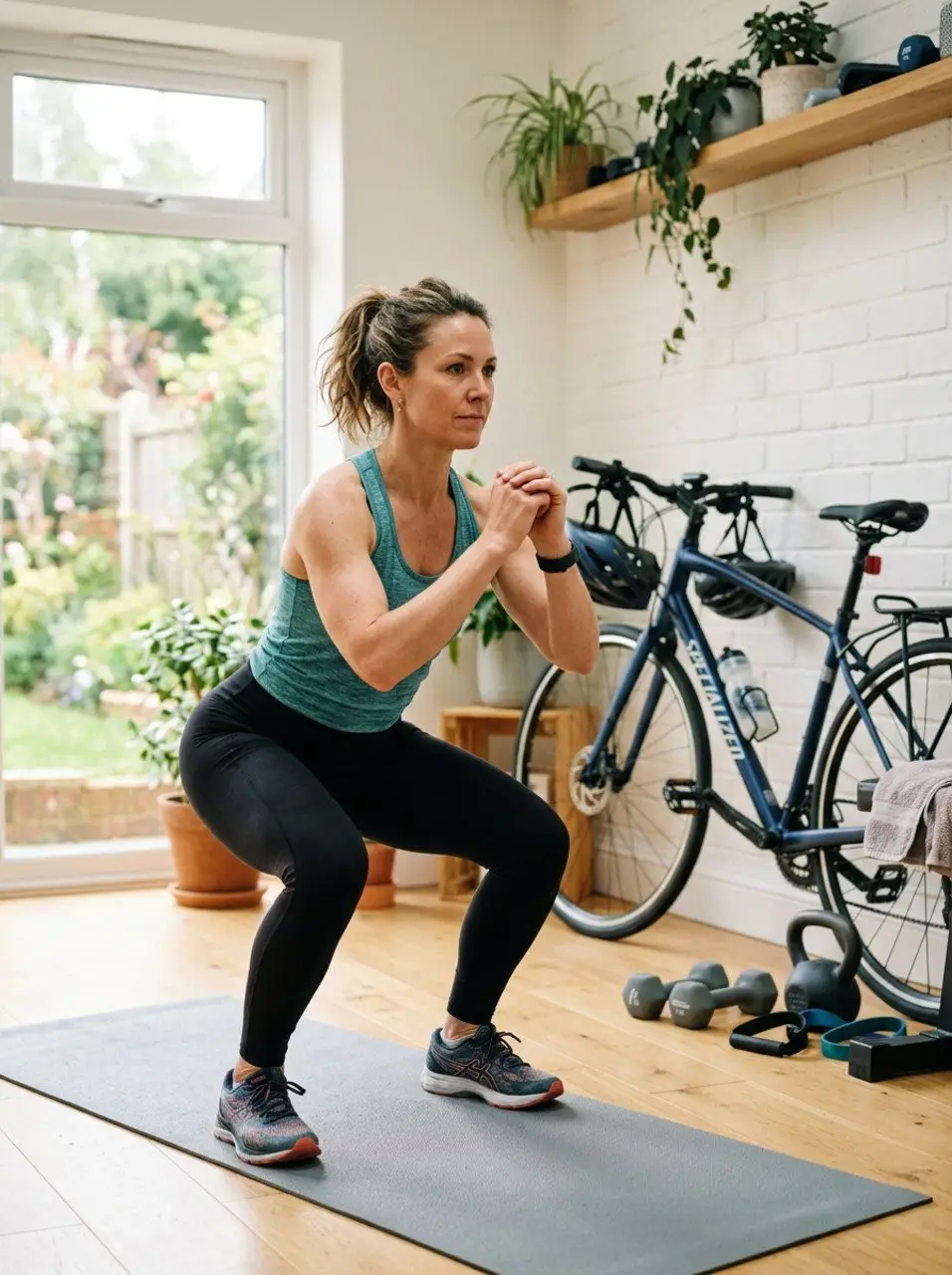
The practical fix is simple: keep cycling for your heart, your joints, and your mood, and add two sessions a week of resistance or weight-bearing work — bodyweight strength training, resistance bands, or brisk walking — to cover what cycling structurally can’t.
If you’re not sure where to start, our guide to strength training for women in perimenopause walks through exactly that pairing.
Why Getting Back On A Bike Feels So Intimidating, And How To Get Past It
The intimidation most women feel about returning to cycling in their 40s or 50s is rarely about fitness — it’s about self-consciousness, and two professional cycling coaches say the fix is deliberately lowering the bar to entry, not raising your fitness first.
Former Olympic Program cycling coach Lee Povey calls this the “party effect”: “You’re worried about what you look like or what others are going to think, but the reality is that we’re all thinking the same thing,” he says.
His practical advice for building the habit back: “Lower the bar to resistance. Put out your kit the night before, have your bike shoes and helmet by the door. Do whatever it takes to make getting on your bike as easy as possible.”

Former professional cyclist and cycling performance coach Dr Sally Bigham makes a related point about comparing your current fitness to your past self — a trap that’s common for women who used to ride, or used to be fitter in general, before life, kids, or hormonal changes got in the way: “If you focus on having fun then everything else will click into place, and the watts look after themselves.”
She adds a specific caution for time-crunched women: get creative with shorter, imaginative sessions rather than measuring every ride against an old standard, since obsessive tracking “can create performance anxiety, even in short training sessions.”
If the idea of riding with a group specifically worries you, that’s common enough to have a name. The fix both coaches point to isn’t forcing yourself into a fast group ride — it’s starting solo, on a familiar route, at a pace that has nothing to do with anyone else’s.
For more on rebuilding exercise confidence generally, see our gym motivation tips for women, most of which apply directly to getting back on a bike.
How To Start Cycling Safely After 40
Get Your Bike Fit Checked First
A poorly fitted bike is one of the most common causes of knee, hip, and lower back pain in returning riders — and it’s also one of the easiest problems to fix. Most local bike shops offer a basic fit check, and it’s worth doing before your first ride, not after your third uncomfortable one.
Start With Shorter, Flatter Routes
Fifteen to twenty minutes on flat, familiar ground beats an hour on unfamiliar terrain for building both fitness and confidence back at the same time. You can extend distance and difficulty gradually once the basic mechanics — balance, braking, gear shifting — feel automatic again.
Join Our Mailing List
Join thousands of women inside our community and receive our free guide, 10 Actions That Support Permanent Weight Loss — the exact behavioural shifts that make the difference between a two-week attempt and a lasting transformation.
No restriction plans. No guilt. Just what actually works — for real women with real lives.

Protect Your Joints And Your Safety
A properly fitted helmet is non-negotiable, and if you have existing knee, hip, or back concerns, keeping your seat height correct prevents the kind of joint strain that undermines cycling’s whole low-impact advantage.
If you’re also managing a cardiovascular condition, the same precautions that apply to preventing heart strain during exercise apply here: warm up, know your limits, and check with your doctor before increasing intensity.
Build The Habit Before You Build The Distance
Two or three short, consistent rides a week for a month will do more for your long-term fitness than one ambitious ride that leaves you too sore to try again for two weeks. Consistency is the entire game here — the calorie burn, cardiovascular benefit, and mood lift all compound with regularity, not intensity.
Ready To Put This Into A Full Plan?
Knowing the benefits of regular cycling is one thing. Turning it into a routine that actually fits your week, your joints, and your goals is another.
Join thousands of women inside our community and get our free guide, 10 Actions That Support Permanent Weight Loss — the practical, sustainable habits that turn everything you just read into real, lasting results. No fad diets. No extreme plans. Just what the research actually supports, written for real women.
Related Articles
The Bottom Line
The benefits of regular cycling for women over 40 are well-documented: a stronger heart, meaningfully lower cardiovascular and cancer risk, real calorie burn, better coordination, and a mood lift that doesn’t come with the joint punishment of higher-impact workouts.
What most articles on this topic won’t tell you is that cycling alone won’t protect your bone density — and at this stage of life, that gap is worth closing rather than ignoring. Ride for your heart. Lift, walk, or resistance-train for your bones. Do both, and you’ve covered what neither one does alone.
Glossary Of Key Terms
FAQ
The top benefits of regular cycling are a stronger cardiovascular system, meaningfully lower cancer and heart disease risk, effective calorie burn, improved coordination, and a mood boost from rhythmic aerobic activity — all achieved with far less joint impact than running or high-impact classes.
Cycling alone isn’t enough for complete musculoskeletal health because it’s non-weight-bearing and does little to build bone density. Pairing two weekly cycling sessions with two weekly resistance or weight-bearing sessions covers what cycling alone cannot structurally provide.
Most health bodies recommend at least 150 minutes of moderate-intensity aerobic activity a week, which cycling for 30 minutes most days comfortably meets. Splitting that across three to five shorter rides is easier to sustain than one long weekly ride.
Yes. A 155-lb woman can burn 500–600 calories an hour at a moderate pace, and sustained over weeks, that calorie deficit supports genuine fat loss when combined with a balanced diet rather than restrictive dieting.
Cycling triggers an endorphin release that measurably lifts mood, and outdoor rides add daylight exposure and time in green space, both linked to reduced stress and better sleep — benefits that matter especially during the mood shifts common in perimenopause.
Cycling is generally considered joint-friendly for women with knee or back issues because the smooth, circular pedalling motion puts minimal stress on these joints compared to running. Always confirm with your healthcare provider before starting, and get your bike fit checked to avoid strain from poor positioning.
Start with a bike fit check, a short flat route, and zero comparison to how you used to ride. Professional cycling coaches specifically recommend lowering the barrier to getting out the door — kit ready the night before, realistic first distances — rather than trying to match old fitness levels on day one.
You Know Why. Now Learn Exactly How
Join thousands of women inside our community and receive our free guide: 10 Actions That Support Permanent Weight Loss — the practical, sustainable habits that translate everything you just read into real, lasting results.
No fad diets. No extreme plans. Just what the research actually supports — written for real women.