
Swimming: The Science-Backed, Joint-Friendly Full Body Workout That Builds Strength, Burns Fat, And Transforms Your Fitness
Aleksandr Popov
4× Olympic Swimming Champion
The water is your friend. You don't have to fight with water; just share the same spirit as the water, and it will help you move.
The Executive Summary
Discover why swimming is a top exercise, especially for women. This full-body workout builds strength, burns 400-700 calories per hour, and is easy on the joints. Water resistance engages all muscles, including deep stabilizers, offering functional strength.
It's ideal for those with joint pain, in postpartum recovery, or seeking low-impact fitness. Swimming improves cardiovascular health and reduces stress, making it a comprehensive physical and mental wellness tool that enhances weight loss and lung capacity.
Think about every workout you've ever pushed through — the treadmill miles, the burpees, the gym sessions that left your knees aching and your joints protesting. Now picture all of that happening in an environment where your body is weightless, where the resistance works with you, and where every single muscle is engaged at once.
That's what the pool offers. And for women specifically — women navigating hormonal shifts, joint sensitivities, fitness plateaus, and the desire for a workout that genuinely transforms the body without destroying it — swimming may be the most underestimated exercise available.
This guide covers everything you need to know: the real science behind swimming's benefits, how it compares to other forms of exercise, what it does specifically for the female body, and how to start — even if the last time you swam a length was years ago.
Medical & Referral Disclaimer
This article is for informational and educational purposes only. Always consult your physician before beginning any new exercise programme, particularly if you have existing joint conditions, cardiovascular issues, or are pregnant.
Key Takeaways
- Swimming is a complete full-body exercise — water resistance engages all major muscle groups simultaneously, including deep stabilisers that most gym equipment misses.
- One hour of swimming laps burns between 400–700 calories, depending on stroke intensity, comparable to running, with a fraction of the joint impact.
- Swimming is the gold-standard low-impact exercise for women with arthritis, joint pain, pregnancy, postpartum recovery, or perimenopause.
- Intermittent breathing during swimming specifically trains lung capacity and cardiovascular efficiency beyond what land-based cardio achieves.
- Swimming reduces cortisol (the stress hormone) measurably more than most forms of exercise, making it a dual physical-mental wellness tool.
- The core — not just the abs — works constantly to maintain position in water, making swimming one of the most effective exercises for core definition.
- Beginners see meaningful fitness improvements within 4–6 weeks of 3× weekly swimming sessions.
Is Swimming Really A Full-Body Workout?
Yes — swimming engages every major muscle group simultaneously because water provides 12–14% greater resistance than air in all directions. Unlike land-based exercises that isolate specific muscle groups, swimming requires the upper body, lower body, and core to work in coordinated, continuous motion throughout every length.
Which Muscles Does Swimming Actually Work?
The reason swimming transforms the body so comprehensively is that every stroke activates a different combination of muscles — and unlike gym machines that move in a single plane, water resistance challenges muscles from multiple angles simultaneously.
Muscle activation by swimming stroke:
| Stroke | Primary Muscles | Secondary Muscles | Key Benefit for Women |
|---|---|---|---|
| Freestyle (Front Crawl) | Latissimus dorsi, deltoids, triceps | Core, glutes, hip flexors | Full upper body + cardiovascular endurance |
| Breaststroke | Pectorals, quads, inner thighs | Core, shoulders, calves | Hip and groin flexibility; gentlest on the shoulders |
| Backstroke | Trapezius, rhomboids, biceps | Core, glutes, hamstrings | Posture correction; shoulder relief from desk work |
| Butterfly | All upper body muscles, core | Quads, hamstrings | Highest calorie burn; advanced core strength |
| Water Aerobics | Lower body, core | Cardiovascular | Joint-friendly strength for beginners and seniors |
The muscles that swimming activates most distinctively are the deep stabiliser muscles — the multifidus, transverse abdominis, and rotator cuff muscles — that most gym programmes never reach. These hidden muscles are the foundation of postural strength, injury prevention, and functional movement.
Why Does Water Resistance Build Strength Differently Than Weights?
When you lift a dumbbell, you work one muscle group against gravity in one direction. When you swim, water pushes back from every direction — which means every movement recruits stabilising muscles to counteract resistance at multiple angles.
The result is what exercise scientists call functional strength — the kind that makes you better at everything you do outside the gym. This is why competitive swimmers are consistently ranked among the most athletically complete athletes across all sports.
Build your broader exercise foundation: Fat-Burning Workouts That Build Lasting Strength →

How Does Swimming Burn Calories and Support Weight Loss?
Swimming burns 400–700 calories per hour, depending on stroke, intensity, and body weight — comparable to running and higher than most gym classes — while simultaneously building lean muscle that raises resting metabolic rate. This combination makes swimming one of the most efficient tools for sustainable weight loss available.
How Many Calories Does Swimming Burn Per Hour?
The calorie burn from swimming varies significantly by stroke and intensity. The American College of Sports Medicine provides these estimates for a 155-pound (70kg) woman:
| Activity | Calories Per Hour | Impact Level | Muscle Groups |
|---|---|---|---|
| Butterfly swimming | 650–700 | Zero impact | Full body |
| Freestyle (vigorous) | 590–630 | Zero impact | Full body |
| Breaststroke | 520–560 | Zero impact | Full body |
| Backstroke | 460–500 | Zero impact | Full body |
| Running (6mph) | 590–650 | High impact | Lower body |
| Cycling (vigorous) | 500–560 | Low impact | Lower body |
| HIIT class | 400–600 | Moderate-high | Mixed |
| Strength training | 300–400 | Moderate | Targeted groups |
| Water aerobics | 300–400 | Zero impact | Full body |
The critical advantage swimming holds over running and cycling for calorie burn is that it achieves comparable energy expenditure with zero joint impact — meaning you can train more frequently, recover faster, and sustain the programme long-term without the overuse injuries that force many women off land-based exercise routines.
Why Is Swimming Particularly Effective for Fat Loss in Women?
Swimming engages large muscle groups continuously, which means the afterburn effect (EPOC: excess post-exercise oxygen consumption) is significant. Your body continues burning calories for up to 14 hours after an intense swimming session as it repairs muscle tissue and restores oxygen balance.
Additionally, the cold water temperature of most pools triggers mild thermogenesis — your body burns extra calories simply maintaining its core temperature. This passive caloric expenditure adds a meaningful margin over time.
Understand how your body burns fat: 3 Evidence-Based Tips for Women to Lose Weight →
Why Is Swimming Ideal for Women With Joint Pain or Injuries?
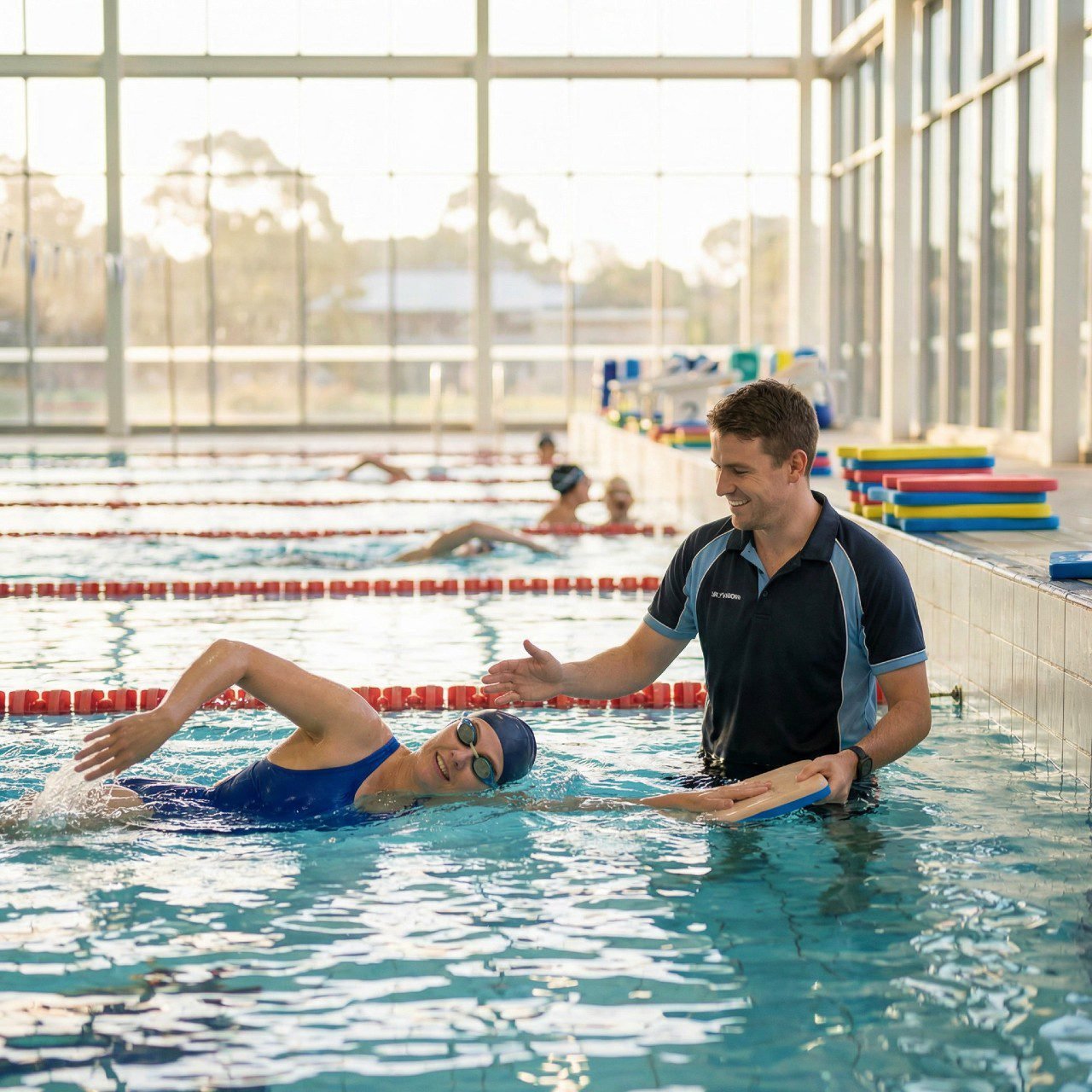
Swimming is the premier low-impact exercise because water buoyancy reduces effective body weight by up to 90%, removing virtually all compressive force from joints while still delivering cardiovascular and muscular training benefits. This makes it accessible — and highly effective — for women who cannot safely perform high-impact land-based exercise.
What Makes Swimming Genuinely Low-Impact?
In water, buoyancy counteracts gravity. When you're submerged to chest height, your effective body weight is approximately 10% of your actual weight. This means:
- Zero ground reaction force — the compressive impact that wears down knee cartilage, stresses the spine, and causes shin splints simply doesn't occur in water.
- Joint decompression — rather than compressing joints, movement in water creates a gentle traction effect that many people with arthritis find actively therapeutic.
- Full range of motion without pain — water supports the limbs through ranges of movement that would be painful or impossible on land.
This is why swimming is routinely prescribed in aquatic therapy and physiotherapy settings for injury rehabilitation. The therapeutic benefits are not a byproduct — they are a primary mechanism.
Who Gets the Most From Swimming as Their Primary Workout?
Swimming delivers disproportionate value for:
- Women with osteoarthritis, rheumatoid arthritis, or chronic joint pain.
- Women in perimenopause or menopause, where joint sensitivity increases and hormonal changes affect bone density.
- Women in postpartum recovery, where impact-based exercise may be contraindicated.
- Women recovering from lower body injuries (knee, hip, ankle).
- Women over 50 seeking sustainable, long-term fitness that protects bone and joint health as they age.
- Women on the heavier end of the weight spectrum for whom land-based impact exercise causes pain or discomfort.
For women navigating hormonal changes: How Hormones Affect Your Fitness and Fat Loss →
How Does Swimming Improve Cardiovascular Health and Lung Capacity?
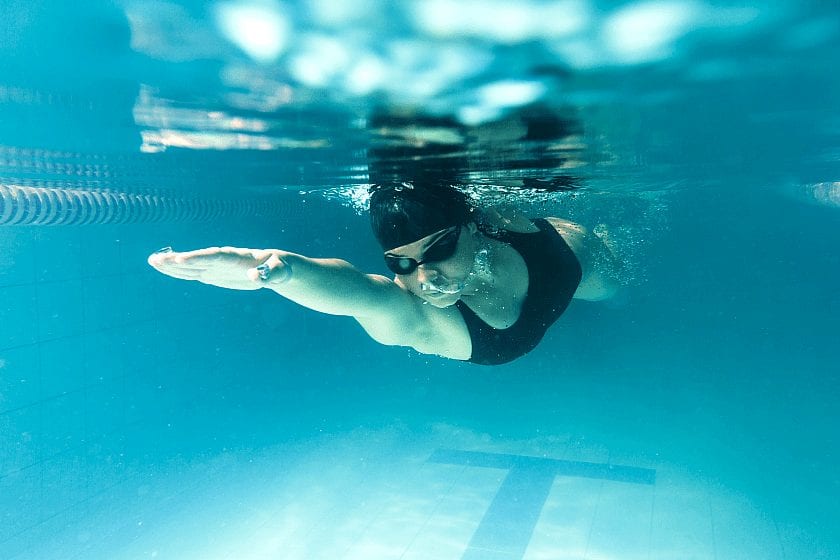
Swimming uniquely trains both the heart and the respiratory system by requiring controlled intermittent breathing — taking in oxygen only at specific intervals against water resistance. This disciplines the lungs to extract oxygen more efficiently, strengthens the respiratory muscles, and produces cardiovascular adaptations beyond those achieved through most land-based cardio.
What Is Intermittent Breathing and Why Does It Matter?
When you run, you breathe freely — as much as you need, whenever you need it. When you swim face-down, you can only breathe at deliberate intervals, on a specific side, at a precise moment in your stroke cycle.
This constraint creates a training stimulus that ordinary cardio cannot replicate:
- Respiratory muscle strengthening — the diaphragm and intercostal muscles work harder against water resistance on each breath.
- Oxygen efficiency — the body adapts to extract more oxygen from each breath taken, improving VO2max (the gold standard measure of aerobic fitness).
- Carbon dioxide tolerance — controlled breathing builds resilience to the discomfort of elevated CO2, which improves performance in all aerobic activities.
- Reduced resting breathing rate — regular swimmers typically breathe 10–12 times per minute at rest vs. 16–20 for the average person.
When you first swim and find yourself breathless after two lengths, that is not a failure of fitness — it is your respiratory system encountering a training demand it hasn't experienced before. This is precisely where the cardiovascular adaptation happens.
According to research published by Harvard Medical School, regular swimming is associated with lower blood pressure, reduced resting heart rate, improved cholesterol profiles, and meaningfully reduced cardiovascular disease risk — comparable to the cardiovascular benefits of running.

What Are the Mental Wellness Benefits of Swimming?
Swimming consistently reduces cortisol (the primary stress hormone), raises endorphin levels, and produces a meditative focus state that researchers call "blue mind" — a calm, connected cognitive state triggered by immersion in or proximity to water. These effects make swimming one of the most powerful natural interventions for stress, anxiety, and mood available.
How Does Swimming Reduce Stress and Anxiety?
Multiple mechanisms explain swimming's powerful mental health effects:
- Cortisol reduction — the rhythmic, repetitive motion of swimming activates the parasympathetic nervous system (rest-and-digest), suppressing cortisol production. A 2016 study in the International Journal of Stress Management found that regular swimmers had significantly lower baseline cortisol levels than age-matched non-swimmers.
- Endorphin release — sustained aquatic exercise produces the same endorphin cascade as running, creating genuine post-swim euphoria.
- Sensory reduction — immersion in water removes most external sensory stimulation, naturally quieting the mind and interrupting the anxious thought loops that drive modern stress.
- Breath control as mindfulness — the focus required to time breathing precisely anchors attention to the present moment, functioning as active meditation.
For women managing chronic stress — which, as we know, directly drives cortisol-related belly fat and hormonal disruption — swimming offers a dual intervention: burning the fat that stress creates while simultaneously reducing the stress that causes it.
On the connection between stress and weight: How Cortisol and Stress Drive Weight Gain in Women →
What Makes Open Water Swimming Different for Mental Health?
Open water swimming — lakes, the sea, rivers — amplifies the mental wellness benefits of pool swimming through additional mechanisms:
- Cold water immersion triggers a sharp endorphin and noradrenaline release that produces a pronounced mood elevation lasting hours.
- Nature immersion compounds the cortisol-reducing effect of water alone.
- Research from the British Medical Journal has documented cases of open water swimming treating treatment-resistant depression in women.
If a pool is your starting point, open water is a compelling destination to work toward.
How Does Swimming Build Core Strength and Muscle Tone?
Swimming develops core strength through constant, involuntary activation — your abdominals, obliques, and deep spinal muscles work continuously to maintain a horizontal, streamlined position against water resistance. This sustained engagement produces functional core strength and definition that targeted floor exercises like crunches cannot replicate.
Is Swimming Effective for Achieving a Visible Core?
Yes — and more effectively than most women realise. The reason swimming produces visible core definition is not the number of times the abs contract, but the sustained, low-load engagement throughout every length.
When you hold a streamlined position in the water:
- The transverse abdominis (the deepest abdominal layer) is in continuous contraction to maintain spinal alignment.
- The obliques rotate the torso through each stroke cycle.
- The lower back muscles stabilise the spine against water resistance from every angle.
This produces the compact, functional core definition associated with swimmers — the result of sustained endurance work rather than isolated, high-intensity abdominal exercises.
The belly fat piece: How to Get Rid of Belly Fat Naturally — The Women's Guide →
Which Swimming Strokes Are Best for Core Strength?
- Butterfly — the undulating body wave requires the most powerful continuous core activation of all strokes. The most challenging but most effective for core development.
- Freestyle — hip rotation through each stroke cycle provides strong oblique engagement throughout.
- Backstroke — the flutter kick in a face-up position uniquely activates the lower abdominals.
- Breaststroke — the glide phase requires the core to hold a rigid, streamlined position isometrically.
Pool workout for core focus:
| Set | Exercise | Duration/Distance | Core Focus |
|---|---|---|---|
| Warm-up | Easy freestyle | 200m | General activation |
| Main set | Butterfly kick with kickboard | 4 × 25m | Lower abs and deep core |
| Main set | Freestyle with hip rotation focus | 4 × 50m | Obliques |
| Main set | Backstroke | 4 × 50m | Lower abdominals |
| Cool-down | Easy breaststroke | 100m | Full body recovery |
Pool Workout For Abs
TIP: Adding in a few swimming sessions each week will help you become a more well-rounded athlete and build up a more stable form of strength that you can rely on for other activities as well.
How Should Beginners Start Swimming for Fitness?
Beginners should start with three 30-minute sessions per week, focusing on stroke technique before distance or speed. Consistency over the first 4–6 weeks builds the breathing adaptation and stroke efficiency that transforms swimming from exhausting to enjoyable — and unlocks the full fitness and fat-loss benefits.
What Does a 4-Week Beginner Swimming Programme Look Like?
| Week | Sessions/Week | Duration | Distance Target | Focus |
|---|---|---|---|---|
| Week 1 | 3 | 20–25 min | 400–600m | Breathing rhythm, basic freestyle |
| Week 2 | 3 | 25–30 min | 600–800m | Stroke efficiency, adding backstroke |
| Week 3 | 3 | 30–35 min | 800–1000m | Building continuous lengths without stopping |
| Week 4 | 3–4 | 35–40 min | 1000–1200m | Introducing breaststroke, increasing speed |
Beginner swimming tips that make the critical difference:
- Get your technique assessed early — one session with a qualified swimming coach will improve your efficiency more than 10 sessions of self-teaching. Proper form means less effort, more benefit.
- Rest between lengths initially — 15–30 seconds' rest per length is completely appropriate for beginners. It is not a weakness; it is building the breathing adaptation systematically.
- Hydrate before and after — you sweat in the pool even though you cannot feel it. Dehydration is a common reason swimmers fatigue prematurely.
- Use equipment strategically — a kickboard isolates the legs; a pull buoy isolates the arms. Both help you focus on one skill area at a time.
- Aim for 3 sessions per week consistently — the breathing and cardiovascular adaptations from swimming require repetition. Three sessions per week allow adaptation without over-fatigue.
Join Our Mailing List
Ready to dive deeper into the topic and discover how it can transform your fitness journey? Swimming offers a unique, low-impact way to build strength and burn fat, all while being gentle on your joints.
For a complete guide to maximizing your workouts and achieving your fitness goals, grab your free guide here and start making waves today!

Is Swimming Good for Women Over 40 and During Menopause?
Swimming is particularly valuable for women over 40 because it simultaneously addresses the key fitness challenges of this life stage: joint sensitivity, cortisol-driven belly fat, cardiovascular risk, sleep disruption, and mood volatility — with zero impact on bones and joints that may already be under hormonal stress.
During perimenopause and menopause, when estrogen decline increases joint inflammation and redistributes fat to the abdominal region, swimming provides:
- Joint-safe cardio — preserving the ability to exercise consistently even as joint sensitivity increases.
- Cortisol management — reducing the primary hormonal driver of menopausal belly fat.
- Bone support — water resistance training builds muscle around joints, reducing fracture risk even without the bone-loading effect of impact exercise (complementary to — not a replacement for — weight-bearing exercise for bone density).
- Mood stabilisation — the serotonin and endorphin effects of regular swimming help manage the mood fluctuations common during hormonal transitions.
- Sleep quality improvement — regular aerobic exercise, including swimming, has been shown to improve sleep quality in perimenopausal women, specifically, according to research.
For the full hormonal picture during this life stage: How Hormones Affect Weight Loss in Women →
A New Perspective on the Pool
Here's a shift that might change how you think about swimming forever: it is not just an exercise. It is an environment.
The water is a place where the joint that hurts on the track doesn't hurt. Where the anxiety that follows you into the gym dissipates after the first length. Where the plateau that's frustrated you for months dissolves because your body encounters a stimulus it has never experienced.
Swimming doesn't just work your body differently from land-based exercise. It works your mind differently. The focused rhythm of breath, stroke, and turn creates a meditative state that no spin class or weight room replicates.
The women who discover swimming often describe the same experience: they start because someone recommended it for their knees, or because they wanted to try something new, and within a month, they wonder how they ever trained without it.
Related Articles
The Bottom Line
Swimming is one of the best exercises available to women for a simple reason: it delivers cardiovascular fitness, full-body strength, core definition, mental wellness, and calorie burn — simultaneously, without impact, and in a way that is genuinely sustainable for life.
The five reasons to make it a cornerstone of your fitness:
- Full body conditioning — every muscle group, every length
- High calorie burn with zero joint impact — the efficiency equation that land-based cardio can't match
- Cardiovascular and respiratory training — intermittent breathing builds lung capacity and heart health
- Profound stress reduction — cortisol management through blue mind and endorphin release
- Core strength and muscle tone — sustained, functional, visible
Whether you are just starting your fitness journey, recovering from injury, navigating menopause, or looking to break through a plateau — the pool is waiting.
Embrace Inspiration:
Did this inspire you to try the pool? Share it with a friend who might be looking for a workout that finally feels right.
Glossary Of Key Terms
FAQ
Yes — swimming burns 400–700 calories per hour, depending on stroke and intensity, comparable to running, while simultaneously building lean muscle that elevates resting metabolic rate. The combination of high calorie expenditure and muscle development makes swimming an effective weight loss tool. Three to four sessions per week, combined with appropriate nutrition, produce meaningful fat loss within 6–8 weeks.
For general fitness and weight loss, three sessions per week of 30–45 minutes is the evidence-based starting point. This frequency allows the cardiovascular and breathing adaptations swimming requires to develop without over-fatigue. Women training for specific performance goals may swim 4–5 times weekly, but three consistent sessions deliver the majority of the health and body composition benefits.
Butterfly burns the most calories (650–700 per hour), but it is technically demanding. For most women, vigorous freestyle is the most practical high-calorie-burning stroke, combining accessibility with efficiency. Breaststroke burns slightly fewer calories but is easier to sustain for longer sessions — making total calorie burn comparable for many swimmers.
Most women notice improved cardiovascular endurance (less breathlessness) within 2–3 weeks of regular swimming. Body composition changes — improved muscle tone, visible waist reduction — typically become measurable at 6–8 weeks. The breathing adaptation that makes swimming feel sustainable (rather than exhausting) develops within the first 4 weeks with consistent practice.
Swimming is one of the most strongly recommended exercises for women with joint conditions. Because water buoyancy removes up to 90% of bodyweight loading, swimming delivers full cardiovascular and muscular training benefits with virtually zero compressive force on knee, hip, or ankle joints. Many physiotherapists specifically prescribe aquatic exercise as the first step in joint rehabilitation.
Yes — significantly. The rhythmic, meditative nature of swimming, combined with breath control and sensory reduction from water immersion, reliably reduces cortisol and raises endorphin levels. Research published in the International Journal of Stress Management found regular swimmers had substantially lower baseline cortisol levels than non-swimmers. For women where chronic stress is driving hormonal weight gain, swimming addresses both the physiological and psychological roots simultaneously.
You Know Why. Now Learn Exactly How
Ready to build your complete fitness foundation? Download the free Lean Body Formula Special Report — 10 evidence-based strategies for permanent fat loss, designed specifically for women's bodies.