
The 3-Job Plate For Perimenopause Nutrition, Plus An Honest Keep, Swap Or Skip Food List
ROBERT URICH
American film & television actor
A healthy outside starts from the inside.
Summary (TL;DR)
A perimenopause diet isn’t a hormone-balancing cleanse. It’s a way of eating that protects muscle, steadies blood sugar and keeps your energy up while your body changes. Build every meal around three jobs: protein to build, fiber-rich carbs to fuel, and whole foods plus healthy fats to keep things steady. Eat more protein and fiber, not less food. Limit alcohol and ultra-processed snacks, and don’t starve yourself.
If you’re eating the way you always have and your jeans still feel tighter every month, you’re not imagining it, and you’re not lacking willpower. A perimenopause diet matters because the rules quietly changed.
In the large SWAN study (Study of Women’s Health Across the Nation), the rate of fat gain doubled and lean mass started to fall as women entered the menopause transition.
Here’s how we see it at WLBF. As estrogen declines and the transition gets going, fat gain speeds up, shifts toward your belly, and muscle starts to slip. That combination calls for more protein and more fiber every day, not severe calorie cuts. Eating less is the reflex most of us reach for, and it’s exactly the move that backfires.
Keto, vegan, fasting, “hormone-balancing” smoothies: every feed swears by something different. We went to the research instead. Below you’ll find what’s changing in your body, a simple 3-Job Plate, an honest keep, swap or skip list, and a sample day for tired days.
Medical & Referral Disclaimer
This article is for educational purposes only. It isn’t medical advice and doesn’t replace a conversation with your doctor, a registered dietitian or a menopause specialist. Perimenopause symptoms can overlap with thyroid issues, anemia and other conditions. Talk to a healthcare professional before making big changes to your diet, especially if you have kidney disease, diabetes, or take regular medication.
Key Takeaways
- Fat gain speeds up: In SWAN, fat mass rose about 1.0% a year before the transition and 1.7% a year during it, while lean mass started to decline.
- Your metabolism didn’t crash: A study of 6,400+ people found energy use (adjusted for body size) stays stable from age 20 to 60. What changes is body composition.
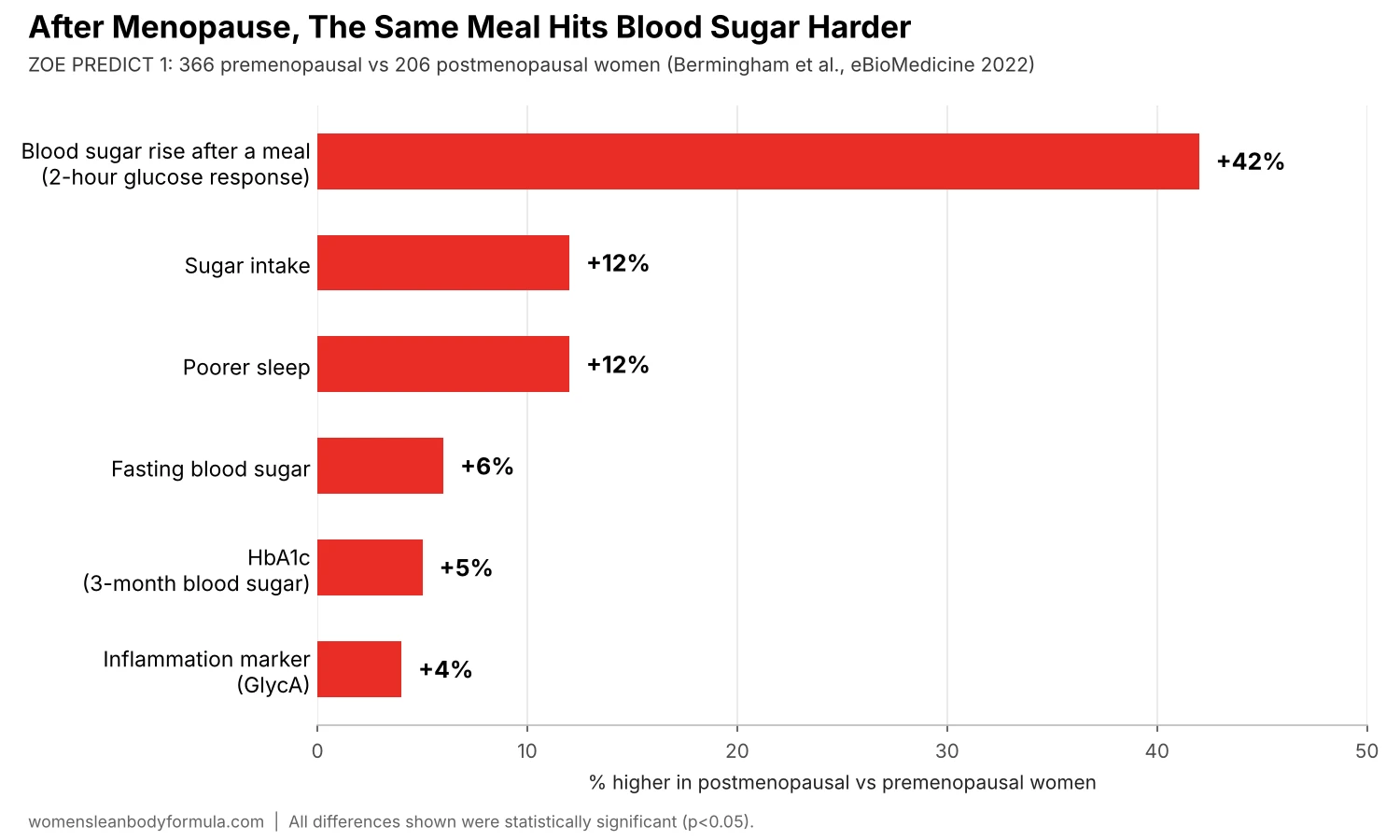
- Blood sugar reacts harder: After menopause, women in the ZOE PREDICT study had a 42% bigger blood sugar rise after the same test meal.
- Protein is the priority: Aim for roughly 1.2 to 1.6 g per kg of body weight a day, spread across meals.
- No food “balances” hormones: Food can ease symptoms and protect your health, but it can’t smooth out fluctuating estrogen.
- Heavy periods drain energy: Women with three or more heavy-bleeding episodes in six months had 62% higher odds of feeling tired, so iron matters.

What Is A Perimenopause Diet, Really?
A perimenopause diet is a way of eating that supports your body through the years before your final period.
It focuses on enough protein to protect muscle, plenty of fiber for steady blood sugar and gut health, and nutrient-dense foods that keep your energy up. It’s a pattern, not a strict plan, and it doesn’t require cutting out food groups.
Perimenopause usually starts in your 40s and can last several years. Your hormones don’t simply drop in a straight line. As one review in the Journal of Women’s Health explains, perimenopause isn’t just a gradual loss of estrogen. Levels can swing high and low from cycle to cycle.
So the goal isn’t to “fix” those swings with food. It’s to give your body what it needs while they happen, with three targets:
- Energy: fewer afternoon crashes and less of that “running on empty” feeling.
- Muscle: holding on to the lean tissue that keeps you strong and your metabolism working.
- A steadier waistline: slowing the shift of fat toward your midsection.
Think of it as a nutrition strategy, not a diet in the old “eat less” sense. You’ll still eat bread, potatoes and dessert. You’ll just build meals differently.
Why Does Eating The Same Stop Working In Perimenopause?
Eating the same stops working because your body composition changes, not because your metabolism suddenly breaks. During the menopause transition, fat gain speeds up, more of it settles around your belly, and muscle starts to decline.
Research also suggests blood sugar reacts more strongly to the same meals after menopause, making energy dips and cravings more likely.
That’s why so many women feel they’re “doing everything right.” In one busy perimenopause discussion, a woman described trying Whole30, keto and cutting out sugar and flour, and feeling no different at all. That isn’t failure. The target moved.

Your Metabolism Didn’t Crash At 40
A slowing metabolism over 40 is the myth we hear most, and the data doesn’t back it. A large 2021 study in Science measured daily energy use in more than 6,400 people. After adjusting for body size, energy expenditure stayed stable from age 20 to 60.
So what does change? Your mix of muscle and fat. SWAN found that fat mass rose about 1.0% a year before the transition and 1.7% a year during it, while lean mass dropped around 0.2% a year.
Visceral fat, the deeper belly fat around your organs, grew roughly 6% a year during the transition. Overall weight creeps up too, by roughly 1 to 1.5 pounds a year through midlife. Unlike a “broken metabolism,” muscle is something you can protect.
Why Do Blood Sugar Swings Feel Worse Now?
The ZOE PREDICT study compared hundreds of women before and after menopause. Postmenopausal women had a 42% higher blood sugar response after the same test meal, plus higher fasting blood sugar and poorer sleep.
Bigger spikes often mean bigger dips, and dips feel like fatigue, brain fog and “I need a cookie right now.”
| What Changes Through The Transition | What Doesn’t Change (Much) | What It Means For Your Plate |
|---|---|---|
| Fat gain speeds up and shifts toward the belly (perimenopause belly fat) | Your basic calorie burn for your size | Protect muscle instead of slashing calories |
| Lean mass starts to decline | Your ability to build muscle with training | Protein at every meal, plus strength work |
| Bigger blood sugar spikes after meals (seen after menopause) | How well fiber and protein slow digestion | Pair carbs with protein and fiber |
| Gut bacteria tend to become less diverse after menopause | Your gut’s response to plant variety | Aim for a wide range of plant foods |
| Sleep often gets lighter and more broken | Caffeine and alcohol still affect sleep | Time caffeine early and drink less alcohol |
Stress and poor sleep pile on top of this. If you’re running on five hours of rest, read our guide on cortisol and belly fat too.
The 3-Job Plate: A Simple Perimenopause Diet Framework
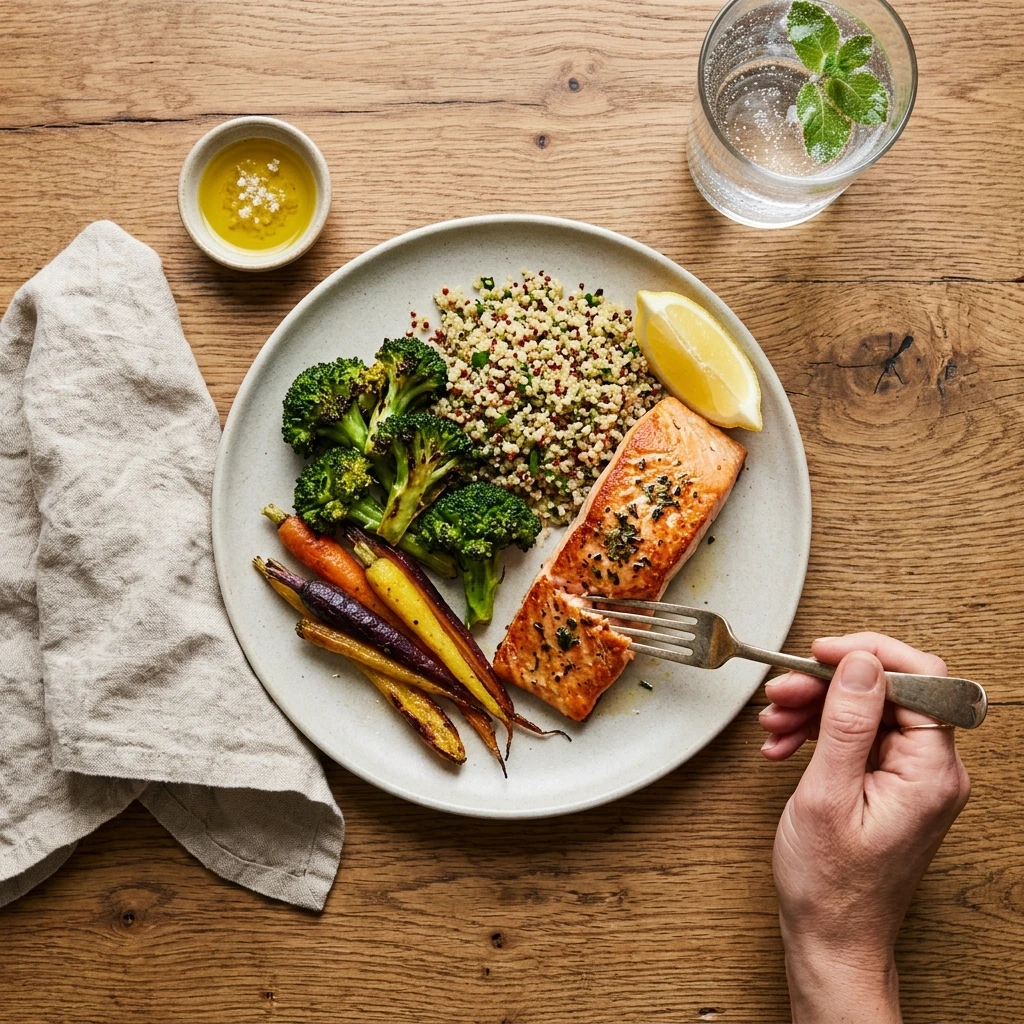
Most perimenopause advice hands you a list of “superfoods” and leaves you to figure out dinner. We’d rather give you one rule that works anywhere, at home or at a café. We call it the 3-Job Plate: build each meal around three jobs.
- Build (protein): a palm-to-hand-sized portion of protein. This protects muscle, keeps you full and blunts blood sugar spikes.
- Fuel (fiber-rich carbs): a cupped handful of beans, lentils, whole grains, potatoes or fruit. This is your steady energy, not the enemy.
- Steady (plants and healthy fats): half the plate in vegetables, plus a thumb of olive oil, nuts, seeds or avocado. This supports blood sugar balance and feeds your gut.
Why jobs instead of a calorie number? Because it answers the question you ask at 6 p.m.: “What goes on the plate?” It also protects food joy. As one woman put it, food is one of the few things she’s got left that still feels like her. The 3-Job Plate adds before it takes away.
| Meal | Build (Protein) | Fuel (Fiber-Rich Carbs) | Steady (Plants & Fats) |
|---|---|---|---|
| Breakfast | Greek yogurt, or eggs with cottage cheese (aim for 25 to 30 g) | Oats or berries | Chia, walnuts or spinach in the eggs |
| Lunch | Chicken, tuna, tofu or lentils | Quinoa, beans or a whole-grain wrap | Big salad with olive oil dressing |
| Dinner | Salmon, lean beef, tempeh or chickpeas | Roast potatoes, brown rice or barley | Two kinds of veg plus olive oil |
| Snack (optional) | Cottage cheese, edamame or a protein shake | An apple or pear | A small handful of almonds |
You don’t need all three jobs every time. If breakfast is coffee and a banana, make lunch do more of the protein work. Seventy percent consistency still wins.
What Should A Perimenopause Diet Include For Energy, Muscle And A Steadier Waistline?
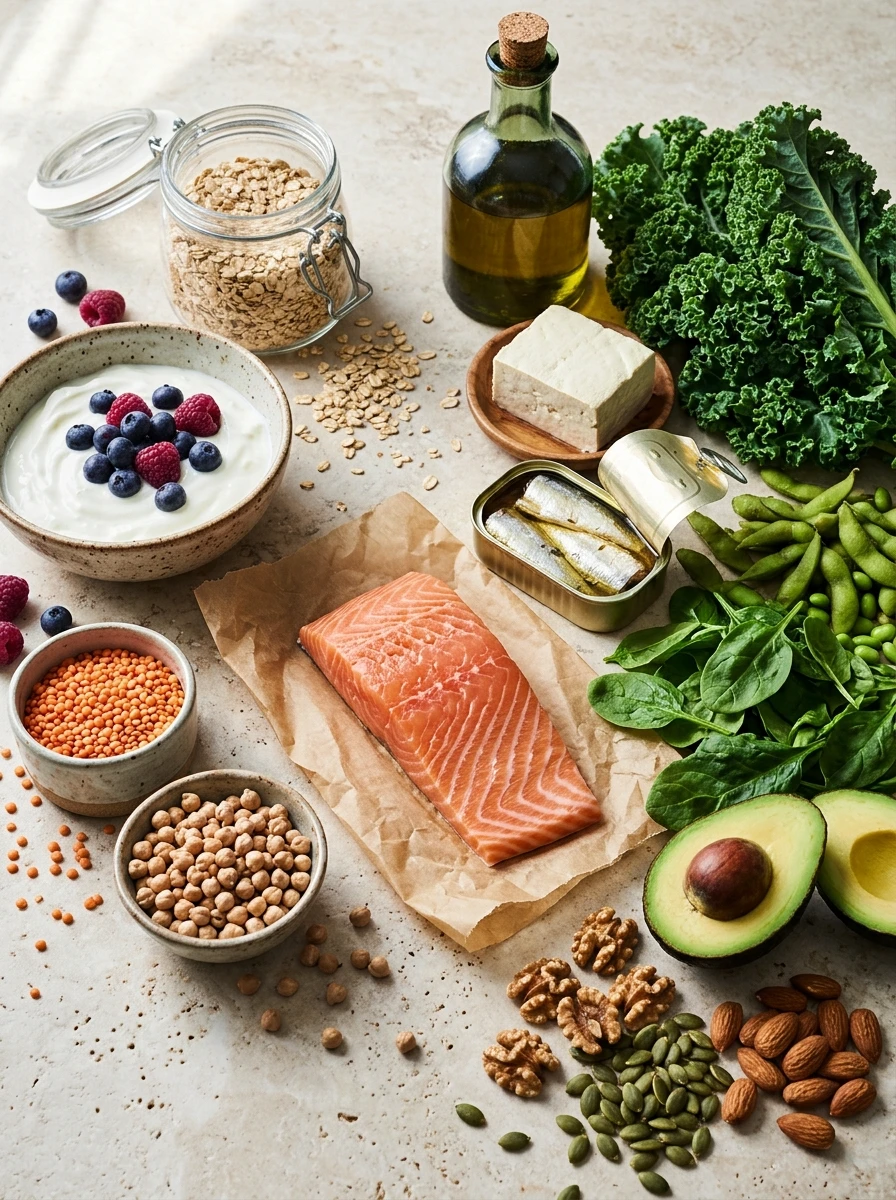
The best foods for perimenopause are protein-rich foods like fish, eggs, Greek yogurt, tofu and lean meat; fiber-rich foods like beans, lentils, oats, berries and vegetables; healthy fats like olive oil, nuts and oily fish; and iron- and calcium-rich foods.
Together, they protect muscle, steady blood sugar and support energy and bones.
Protein For Perimenopause: How Much Is Enough?
Our stance at WLBF is a range of 1.2 to 1.6 g of protein per kg of body weight a day, with the standard 0.8 g/kg treated as a floor, not a goal. Experts in the PROT-AGE study group recommend at least 1.0 to 1.2 g/kg a day for older adults, and needs rise when you train.
For a 70 kg (154 lb) woman, that’s about 84 to 112 g a day. Your body can’t bank protein for later, so spread it out. In one trial, eating 30 g of protein at each meal boosted muscle building by about 25% compared with a skewed pattern loaded at dinner.
Our full guide to protein for perimenopause breaks down the numbers by body weight.
Fiber-Rich Foods And Gut Health
Fiber keeps you full, slows blood sugar spikes and feeds your gut bacteria. A major Lancet review found that eating 25 to 29 g of fiber a day was linked to a 15 to 30% lower risk of early death, heart disease and type 2 diabetes compared with the lowest intakes.
Your gut needs this support more now. In a study of over 2,000 adults, postmenopausal women tended to have less diverse gut bacteria, closer to men’s profiles. Variety is your friend: aim for many different plant foods across the week.
- Easy fiber wins: beans or lentils at lunch, berries on oats, an extra vegetable at dinner.
- Go slow: add fiber gradually and drink more water, or you’ll swap one kind of bloating for another.
- Fermented extras: plain yogurt, kefir and sauerkraut, if you enjoy them.
Healthy Fats For Heart And Hormone Health
Healthy fats won’t “balance” your hormones, but they matter. Losing ovarian hormones raises heart and blood sugar risk, so olive oil, nuts, seeds, avocado and oily fish like salmon and sardines are smart staples. They also make meals more satisfying.
Iron, Calcium And Vitamin D For Energy And Bones
If perimenopause fatigue is wearing you down and your periods have turned heavy, don’t blame “just perimenopause” yet.
A 2025 SWAN analysis found women with three or more heavy-bleeding episodes in six months had 62% higher odds of feeling tired. Women under 51 need 18 mg of iron a day. Ask your doctor to check your iron before supplementing.
Bones need attention too. Women need 1,000 mg of calcium a day up to age 50 and 1,200 mg after. Dairy, fortified plant milks, calcium-set tofu, canned salmon and leafy greens all count.

Foods To Avoid In Perimenopause: What Should You Skip Or Swap?
The main foods to limit in perimenopause are alcohol, ultra-processed snacks, sugary drinks and refined carbs eaten on their own. Late-day caffeine can also disrupt sleep, and caffeine is linked to more bothersome hot flashes after menopause.
You don’t need to ban anything forever. Swapping these for whole-food options gives you most of the benefit.
| Food Or Drink | Keep, Swap Or Skip? | Why | Try Instead |
|---|---|---|---|
| Alcohol | Skip for 30 days, then limit | Can disrupt sleep, some women find it triggers hot flashes, and it’s linked to higher breast cancer risk | Sparkling water with lime, kombucha, alcohol-free spritz |
| Ultra-processed snacks | Swap | Easy to overeat; people ate about 500 extra calories a day on them in an NIH trial | Nuts, cheese and fruit, hummus with veg |
| Sugary drinks and juices | Swap | Fast sugar with no fiber or protein to slow it down | Whole fruit, unsweetened iced tea |
| Refined carbs on their own | Swap | Bigger blood sugar spikes after menopause | Pair them with protein, or choose whole-grain versions |
| Afternoon caffeine | Keep, but move earlier | Linked to more bothersome hot flashes after menopause; can disrupt sleep | Morning coffee, decaf or herbal tea after noon |
| Spicy food and hot drinks | Keep unless they trigger you | A common hot flash trigger for some women, not all | Notice your own triggers and adjust |
| Very low-calorie “detox” diets | Skip | Speed up muscle loss and drain energy | The 3-Job Plate at normal portions |
Should You Cut Out Alcohol During Perimenopause?
Alcohol is the swap women mention most. In the same perimenopause thread, several women said cutting alcohol helped their mood and symptoms a lot. There’s a long-term reason too: according to the National Cancer Institute, even one drink a day raises a woman’s breast cancer risk.
You don’t need a lifetime ban. Try a 30-day alcohol-free test and notice your sleep, night sweats and energy. Your own results will tell you more than any article.

Why Ultra-Processed Food Makes This Harder
In a tightly controlled NIH trial, adults ate about 500 more calories a day on an ultra-processed diet than on a minimally processed one, even though both were matched for sugar, fat and fiber.
When your blood sugar already reacts more strongly, those foods hit twice. For a deeper list, see our guide to what foods cause belly fat in perimenopause.
Does Caffeine Make Hot Flashes Worse?
Possibly, but it’s not all bad. A Mayo Clinic study of 1,806 women found that caffeine was linked to more bothersome hot flashes after menopause, yet linked to fewer mood and memory complaints in perimenopausal women. Keep your morning coffee if it helps you. Just move the last cup before lunch.
The Myth Of The Hormone-Balancing Diet
Search “perimenopause diet”, and you’ll be told to eat for “hormone balance” or follow an “estrogen dominance diet.” When your body feels out of control, that promise is hard to resist.
Here’s the honest version. “Estrogen dominance” isn’t a recognized medical diagnosis. What’s real is that estrogen and progesterone fluctuate unpredictably in perimenopause, sometimes running high, sometimes low.
No smoothie, seed cycle or supplement stack has been shown to even those swings out. If your symptoms are severe, that’s a conversation for your doctor, and hormone therapy is often part of it.
So what can food do?
- It can protect muscle and bone through protein, calcium and vitamin D.
- It can steady blood sugar through fiber, protein and fewer ultra-processed foods.
- It may ease hot flashes for some women. A review of lifestyle research found that Mediterranean and plant-forward eating may reduce hot flashes. In the Women’s Health Initiative, postmenopausal women who lost 10% or more of their weight on a healthier diet were more likely to see hot flashes disappear.
One honest note: The Menopause Society’s 2023 position statement doesn’t recommend soy foods or diet changes as a treatment for hot flashes. Soy is still a great protein food; just don’t expect it to work like medication.

A Perimenopause Meal Plan For Tired Days
The best perimenopause meal plan is the one you’ll follow when you’re exhausted. In one perimenopause fitness thread, a top comment admitted she’s lucky if she can cook dinner by the end of the day. So this sample day is built from low-effort meals.
| Meal | What To Eat | Approx. Protein | Effort |
|---|---|---|---|
| Breakfast | Greek yogurt, berries, oats and a spoon of chia | 25 to 30 g | 2 minutes |
| Lunch | Whole-grain wrap with canned tuna or chickpeas, salad leaves and avocado | 25 to 30 g | 5 minutes |
| Snack | Cottage cheese with an apple, or a handful of edamame | 12 to 15 g | 1 minute |
| Dinner | Sheet-pan salmon or tofu with potatoes, broccoli and olive oil | 25 to 35 g | 10 minutes prep |
| Total | Roughly 30 g of fiber from oats, berries, beans, veg and fruit | About 90 to 110 g | Under 20 minutes active |
Want more variety? Our menopause diet 5-day plan has recipes. Three shortcuts help on tired days:
- Batch one protein: roast chicken thighs or bake tofu on Sunday.
- Use “assembly” foods: canned beans, bagged salad, frozen veg, microwave grains.
- Keep a protein backup: eggs, yogurt or a shake for no-cook nights.
Why Eating Less Backfires In Perimenopause
When the scale climbs, the instinct is to cut hard. But if you’re already losing muscle, a deep deficit with low protein speeds that up, leaving you weaker and more tired.
That’s why our approach is more protein and more fiber, with a gentle deficit at most, not starvation. If blood sugar is a particular worry, our guide to insulin resistance in perimenopause goes deeper.
Is Intermittent Fasting OK During Perimenopause?
It’s optional, not required. A gentle 12-hour overnight gap (say 7 p.m. to 7 a.m.) is fine. Aggressive fasting or one meal a day makes it hard to hit your protein targets, which is the priority right now. If you’re curious, our intermittent fasting guide covers the safer ways to try it.


Strength Training And Nutrition Work As A Team
Protein gives your muscles the raw materials; lifting gives them a reason to use them. Start with our guide to strength training for women in perimenopause.
Want this in your pocket instead of your browser tabs? Grab our free guide and join the newsletter. You’ll get practical, research-checked tips for eating, training and feeling like yourself again through perimenopause, without the hype, the shame or the 22-year-old meal plans.
The Bottom Line
A perimenopause diet isn’t about fixing your hormones or eating as little as possible. Your metabolism didn’t break. Your body composition shifted, and your blood sugar got touchier. The answer is more of the right things: protein at every meal, plenty of fiber and lots of plants.
Use the 3-Job Plate to build meals without counting every calorie. Limit alcohol and ultra-processed snacks without banning joy. Lift a few times a week so that protein has a job to do. And on the days you’re running on empty, a yogurt bowl and a canned-bean wrap still count. Sustainability beats intensity every single time.
Glossary Of Key Terms
- Perimenopause: The years before your final period when hormone levels fluctuate and periods become irregular, often starting in your 40s.
- Menopause Transition: The research term for the stretch of perimenopause that leads up to your final period.
- Lean Mass: Everything in your body that isn’t fat, mainly muscle, bone and water.
- Visceral Fat: Deep belly fat around your organs, linked to heart and diabetes risk.
- Blood Sugar Response: How far and how fast blood sugar rises after eating.
- Muscle Protein Synthesis: How your body repairs and builds muscle after protein or training.
- Ultra-Processed Food: Factory-made foods with ingredients you wouldn’t cook with at home, like most packaged snacks.
- Gut Microbiome: The bacteria living in your gut, which affect digestion, weight and immunity.
- Vasomotor Symptoms: The medical term for hot flashes and night sweats.
- Estrogen Dominance: A popular term for estrogen being high relative to progesterone. It isn’t a recognized medical diagnosis.
FAQ
What Foods Should I Avoid During Perimenopause?
The main foods to limit are alcohol, ultra-processed snacks, sugary drinks and refined carbs eaten on their own. In an NIH trial, people ate about 500 extra calories a day on an ultra-processed diet.
Alcohol can disrupt sleep and is linked to higher breast cancer risk. Late-day caffeine and spicy foods may trigger hot flashes in some women. Swaps work better than lifelong bans.
What Is The Best Perimenopause Diet For Belly Fat?
There’s no single best diet, but a sensible, research-informed pattern combines high protein, high fiber and mostly whole foods, much like a Mediterranean diet. Protein protects muscle while fiber steadies blood sugar.
Strength training matters as much as food, and crash diets backfire because they speed up muscle loss. Expect results over months, not weeks.
How Much Protein Do I Need In Perimenopause?
We recommend about 1.2 to 1.6 g of protein per kg of body weight a day, which is higher than the standard 0.8 g/kg. For a 70 kg woman, that’s roughly 84 to 112 g daily.
Spread it across meals, aiming for around 25 to 30 g each time. Evenly spread protein supports muscle building better than one big dinner. If you have kidney disease, check with your doctor first.
Can Diet Help Perimenopause Hot Flashes?
Diet may help some women, but it’s not a proven treatment. Reviews suggest Mediterranean and plant-forward eating may reduce hot flashes, and in the Women’s Health Initiative, postmenopausal women who lost 10% or more of their weight on a healthier diet were more likely to see them disappear.
However, The Menopause Society doesn’t recommend diet changes or soy as a hot flash treatment on their own. For severe symptoms, talk to your doctor about hormone therapy.
Is Intermittent Fasting Safe During Perimenopause?
For most healthy women, a gentle overnight fast of about 12 hours is fine. Longer fasts or one meal a day make it harder to eat enough protein, which is the priority for protecting muscle. Fasting is a tool, not a requirement for a good perimenopause diet. If you have diabetes or a history of disordered eating, avoid fasting unless your doctor approves.
Does Soy Help Or Hurt In Perimenopause?
Soy foods like tofu, tempeh and edamame are a healthy source of protein and fiber in perimenopause. They contain plant compounds that weakly act like estrogen, which is why they’re often promoted for hot flashes.
The Menopause Society’s 2023 statement doesn’t recommend soy as a hot flash treatment. There’s no good reason to fear soy foods in normal amounts.
Is The Mediterranean Diet Good For Perimenopause?
Yes, it’s a well-studied eating pattern that suits this stage of life well. It’s rich in vegetables, beans, whole grains, fish, olive oil and nuts, which supports heart health, steady blood sugar and gut health.
Research links it to fewer hot flashes for some women. It’s flexible enough to stick with long-term. Just check that each meal still covers your protein needs, using the 3-Job Plate as a guide.