


Making Healthier Food Choices Feels Impossible Until You Try This 3-Step Reset
The 3-Swap Reset: A Smarter Approach To Making Healthier Food Choices After 40
Dr. Dariush Mozaffarian
Cardiologist & Jean Mayer Professor
Everybody should be focused on increasing the good — how do we get more fruit, nuts, fish, healthy oils, vegetables, and beans into our diet and onto our plates?
Summary (TL;DR)
Making healthier food choices doesn't require a full dietary overhaul. It requires three targeted swaps: replacing refined carbs with complex ones, trading ultra-processed snacks for whole food alternatives, and shifting from autopilot eating to deliberate awareness. These three changes work with the way women's bodies — and hormones — actually function, especially during perimenopause.
For so many of us, the word "diet" feels like a heavy backpack we never asked to carry. It's a world of restriction, cold calculations, and the constant, draining battle of willpower.
You already know you should eat more vegetables. You already know the granola bar isn't really healthy. What nobody tells you is why it's still so hard — even when you know all the rules.
Here's the part the wellness industry glosses over: after 40, the game genuinely changes. Oestrogen shifts directly affect how your body regulates hunger and cravings. Research published in Physiology & Behavior found that the estradiol-leptin axis — the interplay between oestrogen and the satiety hormone leptin — is directly linked to food cravings and habitual intake.
When oestrogen fluctuates in perimenopause, your body may crave carbohydrate-dense foods with an urgency that feels irrational. It isn't. It's biology. The good news — and this is the contrarian take I've arrived at after more than ten years of researching women's nutrition — is that the answer is not about cutting more.
Dr. Dariush Mozaffarian, Dean of the Friedman School of Nutrition Science and Policy at Tufts University, put it plainly to WBUR: "We should be eating more calories from healthy foods, and counting them to increase those calories, not decrease those calories." We are not looking for a quick fix. We are looking for three strategic swaps that work with your body, not against it.
Medical & Referral Disclaimer
This article is for informational and educational purposes only. It is not a substitute for professional medical advice, diagnosis, or treatment. Always consult your physician or qualified health provider before making significant changes to your diet, especially during perimenopause or if you have any underlying health conditions.
Key Takeaways
- Making healthier food choices is harder in perimenopause because oestrogen and leptin shifts directly affect cravings — this is physiology, not willpower.
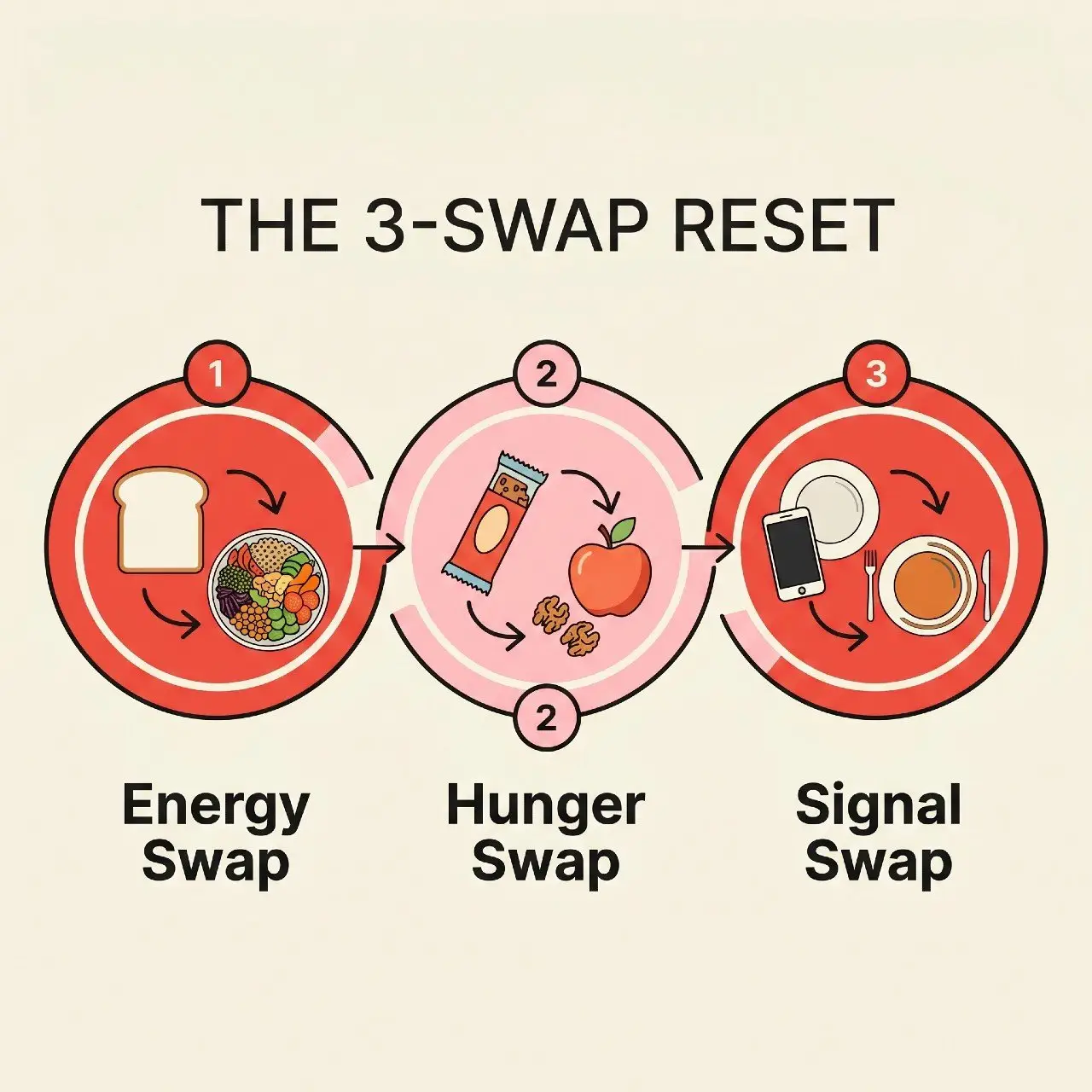
- The 3-Swap Reset provides three clear categories where targeted change makes the biggest impact: Energy Swap, Hunger Swap, and Signal Swap.
- Ultra-processed foods actively suppress satiety hormones, making you hungrier — they aren't just nutritionally empty, they're biologically disruptive.
- A randomised controlled trial specifically in women aged 40–59 found that mindful eating produced significantly greater weight loss and lower daily caloric intake compared to controls.
- Adding more whole foods is more effective than restriction — focus on increasing the good, not just eliminating the bad
- Small, consistent swaps consistently outperform dramatic dietary overhauls.
The Real Reason Making Healthier Food Choices Feels So Hard
Healthier food choices feel hard, not because you lack discipline, but because we make over 200 food decisions every day — most of them on autopilot, before conscious intention ever has a chance to intervene.
That number is worth sitting with. Two hundred decisions. Driven by hunger, habit, convenience, mood, stress, and the food environment around you — not by some calm, rational weighing-up of nutritional value. Trying to override 200 autopilot moments with willpower alone is not just exhausting. It's a strategy built to fail.
The confusion around healthy eating runs deep. Conflicting headlines, foods marketed as healthy that actively undermine your hunger signals, and advice designed for a generic "adult" body rather than a woman navigating perimenopause — it's no wonder so many women feel like they're doing everything right and still not getting anywhere.
Why "Eat Less, Cut More" Is The Wrong Framework
The standard dietary advice — restrict calories, eliminate food groups, track every bite — treats every food decision as a moral test. When it inevitably breaks down (because it always does), the message you internalise is that you broke down. That framing is both inaccurate and deeply unhelpful.
What a decade of writing in this space has shown me: the women who change their eating habits long-term are not the ones who muster the most discipline. They're the ones who stop fighting their hunger signals and start redesigning their food environment to make better choices easier and worse choices less automatic.
For women in perimenopause, this matters even more. UC Davis and USDA researchers found that the estradiol-leptin axis directly influences both craving intensity and habitual food intake.
As oestrogen declines, this axis shifts — and the carbohydrate cravings that follow are not a character flaw. They are a physiological response to a hormonal transition. The right strategy responds to that reality. The 3-Swap Reset is designed to do exactly that.

The 3-Swap Reset: A Framework For Healthier Food Choices
The 3-Swap Reset is a decision architecture, not a diet. Instead of telling you what to eliminate, it identifies three specific categories where strategic substitution produces the greatest change in hunger, energy, and long-term habit formation.
| Swap | Old Pattern | New Pattern | Core Benefit |
|---|---|---|---|
| Energy Swap | Refined carbs — white bread, pasta, crackers, most breakfast cereals | Complex carbs + healthy fats — oats, legumes, sweet potato, nuts, avocado | Stable blood sugar; fewer energy crashes and cravings |
| Hunger Swap | Ultra-processed snacks — including many "healthy" labelled products | Whole food alternatives — fruit, nuts, plain yoghurt, seeds, vegetables | Restored satiety signalling; naturally eat less |
| Signal Swap | Distracted, autopilot eating — screens, multitasking, eating on the go | Deliberate, awareness-based eating — present, unhurried, attentive | Fewer calories consumed; reconnection with hunger and fullness cues |
You do not need to implement all three simultaneously. Start with one. Stack the others over time.
Swap 1: The Energy Swap — From Refined To Complex
Refined carbohydrates create a blood-sugar spike-and-crash cycle that leaves you hungry within hours of eating. Complex carbohydrates and healthy fats slow digestion, stabilise blood glucose, and sustain satiety for significantly longer.
I spent years reaching for what I thought were sensible mid-morning snacks — a cereal bar, a piece of toast, a small bag of crackers from the office kitchen. And every single time, by 11 am, I was already thinking about lunch. Not vaguely peckish. Actually hungry.
Once I tracked this pattern, the connection was almost always the same: a refined carb breakfast or snack had set the hunger cycle spinning before I'd even sat down at my desk.
The swap that changed it for me was deceptively simple: overnight oats with walnuts, a tablespoon of chia seeds, and whatever berries I had. Higher in calories than the cereal bar. My mid-morning hunger — gone. That's the Energy Swap working as it should.
The Science Behind Refined Vs. Complex Carbs
Refined grains are stripped of the fibre that slows glucose absorption. Without it, blood sugar rises rapidly, triggering an insulin spike — followed by the crash the body registers as hunger. Complex carbohydrates — oats, brown rice, lentils, sweet potato, chickpeas — digest slowly, keeping blood glucose stable and extending fullness.
Pair them with healthy fats (olive oil, avocado, nuts) and the effect amplifies: fat delays gastric emptying, meaning the meal physically stays with you longer. This combination — complex carb + healthy fat — is the foundation of what researchers consistently identify as the most satiating eating pattern for women over 40.
Making The Energy Swap Work In Your Daily Routine
These substitutions require no special cooking skills, and most take no additional time:
- Breakfast: Overnight oats with chia seeds and berries instead of toast or boxed cereal.
- Snack: Apple + small handful of almonds instead of crackers, cereal bars, or rice cakes.
- Lunch: Lentil soup or a bean-based salad instead of a white-bread sandwich.
- Side dish: Roasted sweet potato or quinoa instead of white rice or white pasta.
- Grazing: Hummus with carrot and cucumber instead of crackers and dip.
Aim for directional change rather than perfection. One Energy Swap per day is a meaningful start.

Swap 2: The Hunger Swap — From Ultra-Processed To Whole Food
Ultra-processed foods — including many products actively marketed as healthy — disrupt the hormones that tell your body when it has had enough to eat.
This is not a moral stance against convenience food. It is a biological observation. A landmark randomised controlled trial published in Cell Metabolism found that participants on an ultra-processed diet consumed approximately 500 more calories per day than those on an unprocessed diet — even when both diets were matched for macronutrients and offered ad libitum.
The ultra-processed diet suppressed PYY (the satiety hormone that signals fullness) and elevated ghrelin (the hunger hormone). The food wasn't just nutritionally inferior. It was actively reconfiguring appetite signals.
This explains something many women find genuinely confusing: you can eat what feels like a healthy lunch and still be ravenously hungry two hours later. If that lunch included ultra-processed components, your hunger hormones likely never properly registered the meal.
Why "Healthy" Labels Are Not The Whole Story
Calling out the wellness industry here is worth it: a product can carry "high protein," "low sugar," "all natural," or "made with whole grains" on its front label and still contain the industrial additives that drive this satiety disruption. Emulsifiers, modified starches, flavour compounds, and sweeteners are all present in many products that sit in the health food aisle.
Reading the ingredient list is more useful than the front of the packet. A useful working principle: whole foods have one ingredient, or a short list you'd recognise in a home kitchen. The longer and more technical the ingredient list, the more processed the product.

The Hunger Swap In Practice
| Instead Of... | Try... | What Changes |
|---|---|---|
| Branded protein bar | Greek yoghurt (full fat, plain) + seeds and berries | Real protein and probiotics; no emulsifiers or sweeteners |
| "Low fat" fruit yoghurt | Full-fat plain yoghurt + a drizzle of honey | Fat delivers satiety; "low fat" versions compensate with sugar |
| Flavoured rice cakes | Oatcakes + a tablespoon of almond or nut butter | Fibre + fat; no blood-sugar spike |
| Processed granola | Homemade toasted oats + mixed nuts + seeds | You control the ingredients and the sugar content |
| Fruit juice (even fresh-pressed) | Whole fruit | Intact fibre slows glucose release; far more satiating |
| Bagged flavoured popcorn | Air-popped popcorn + olive oil + salt | Whole grain base; no additives |
The Hunger Swap is not about eating less. It is about eating foods that actually allow your body to recognise when it is full.
The Preparation Objection — And Why It Is Mostly A Myth
The most common pushback on whole food snacks is that they require more preparation time. They do not, or at least not meaningfully more. Washing an apple takes ten seconds. Slicing cheese takes twenty. Portioning a handful of walnuts takes thirty.
Batch preparation on a Sunday — boiling eggs, portioning nuts, washing and cutting vegetables — takes twenty minutes and removes preparation as a barrier for the entire week.
Swap 3: The Signal Swap — From Autopilot To Awareness
Mindful eating is not about meditating over your meals. It is about reinstating the body's natural hunger-and-fullness signals that are routinely bypassed during distracted eating.
One of the most directly relevant pieces of research I've encountered in over a decade writing about women's nutrition specifically examines women in the perimenopause age range.
A randomised controlled trial published in the Journal of Nutrition Education and Behavior focused on women aged 40 to 59 who ate out at least three times per week. Those in the mindful eating group lost significantly more weight (P = .03), consumed fewer daily calories (P = .002), reduced fat intake (P = .001), and reported greater confidence in their food choices than the control group.
Making Better Choices With The Eatwell Guide
The Eatwell Guide translates government advice on food, nutrients and health into simple messages to help us make informed choices about the foods, drinks and eating patterns that promote good health.
This wasn't a general population study. It was perimenopausal women, specifically.
The frustration I hear most from women in this community is not "I don't know what to eat." It is "I eat well most of the time and nothing changes." When I dig into the details, the eating is almost always happening quickly — in front of a screen, in the car, standing at the kitchen counter, while answering emails. The body is receiving food. It is not registering a meal.
How Distracted Eating Undermines Every Other Effort
When we eat while scrolling or multitasking, we bypass the cephalic phase digestive response — the body's anticipatory preparation triggered by seeing, smelling, and attending to food. This response primes enzyme production and initiates satiety signalling.
Skip it habitually, and you eat more than you need — not because your hunger is extreme, but because your system never properly registers the meal started.
For women navigating perimenopause, where oestrogen changes are already affecting appetite regulation, adding distracted eating on top is particularly counterproductive. The Signal Swap doesn't require a dramatic habit change. It requires three small adjustments to how you eat — not what you eat.
Three Signal Swap Habits To Start This Week
- Pause before the first bite. Look at your food. Take one deliberate breath. This is not a mindfulness exercise in the abstract sense — it initiates the cephalic phase response that prepares your body to actually register what it is receiving.
- Put your utensil down between bites. This forces a natural pace that your body can track. Most people eat fastest at the start of a meal, precisely when satiety signalling has not yet begun.
- Eat the first ten minutes of every meal without a screen. The bulk of your intake happens in the first ten minutes. Give those minutes your attention. You don't need to banish your phone from the table — just from the first part of the meal.
Join Our Mailing List
Join thousands of women inside our community and receive our free guide, 10 Actions That Support Permanent Weight Loss — the exact behavioural shifts that make the difference between a two-week attempt and a lasting transformation.
No restriction plans. No guilt. Just what actually works — for real women with real lives.

Smarter Grocery Shopping To Lock In The 3-Swap Reset
Your food environment decides your choices before hunger does. If the kitchen is stocked with ultra-processed options, that is what you will reach for when tired, stressed, or short on time. The shopping list is where food decisions are actually made.
A practical list organised around the three swaps removes decision fatigue from the equation entirely.
Building A Shopping List Around The 3 Swaps
- Energy Swap staples (complex carbs and healthy fats): rolled oats, sweet potatoes, brown rice, lentils, chickpeas, walnuts, almonds, avocados, extra virgin olive oil, eggs
- Hunger Swap staples (whole food snacks): apples, seasonal berries, full-fat plain Greek yoghurt, a good cheddar or feta, pumpkin and sunflower seeds, chia seeds, hummus, carrot and cucumber for crudités
- Signal Swap support: if portion size is a habit to address, smaller plates genuinely help — research consistently shows people serve themselves less and feel equally satisfied. A designated eating space, away from screens, supports the practice from the environmental side.
One practical rule: shop from the perimeter of the supermarket first. Produce, meat, fish, and dairy are where whole foods concentrate. The centre aisles are where ultra-processed products live.
Related Articles
The Bottom Line
Making healthier food choices is not about knowing more rules. Every woman reading this already knows the rules. What the 3-Swap Reset provides is something different: a framework that works with your biology, your schedule, and the honest reality that willpower is not a sustainable strategy — especially when hormonal changes in perimenopause are actively shifting the landscape.
Start with one swap. The Energy Swap is often the easiest entry point — replace one refined-carb meal with a complex-carb alternative and notice how you feel by mid-morning.
When that becomes automatic, add the Hunger Swap. Then the Signal Swap. The compounding effect of three small changes, made consistently, far outpaces any extreme diet ever attempted and abandoned.
Eating better is not a destination you arrive at. It is a practice you refine — and one that naturally evolves as your body changes through perimenopause and beyond. The 3-Swap Reset was designed for exactly that kind of evolution.
Glossary Of Key Terms
FAQ
Start with the Energy Swap: replace one refined-carb meal per day with a complex-carb and healthy-fat alternative. This single change typically reduces mid-morning and mid-afternoon hunger within one to two weeks, making every subsequent food decision easier.
If your meal included ultra-processed ingredients — even branded health products — it may have suppressed PYY (your fullness hormone) while keeping ghrelin (your hunger hormone) elevated. Switching to whole food versions of the same meal often resolves the post-meal hunger that feels puzzling and demoralising.
Declining oestrogen disrupts the estradiol-leptin axis, which governs food cravings and habitual intake. Women in perimenopause may experience intensified carbohydrate and sweet cravings that feel physiologically urgent — because they are. This makes hormone-aware strategies, like the 3-Swap Reset, more effective than generic calorie-counting for this life stage.
No. While organic produce reduces exposure to certain pesticides, the bigger driver of dietary quality is shifting from ultra-processed to minimally processed foods — and that shift doesn't require an organic budget. A conventional apple is vastly more nutritious than an organic cereal bar.
Yes. At a restaurant: apply the Energy Swap by choosing the grain or vegetable side over chips; apply the Hunger Swap by starting with a broth-based soup or salad to naturally reduce appetite before the main course; apply the Signal Swap by putting your phone face-down for the first ten minutes of the meal.
Most women notice reduced afternoon energy crashes and more stable hunger within one to two weeks of consistently applying the Energy Swap. The Hunger Swap's effect on post-meal satiety can often be felt within a few days. The Signal Swap builds cumulatively over several weeks as deliberate eating becomes more automatic.
No. It is a food quality restructuring. Many women find that after implementing the three swaps, they eat more food by volume than before — and still reduce overall intake — simply because whole foods are more satiating per calorie. The goal is not to count less. It is to eat in a way that lets your body do the counting for you.