
The Science Of Sculpting: Glute Activation And The Best Moves For A Sexy Butt
Lori Deschene
Founder of the popular Tiny Buddha blog
We can’t hate ourselves into a version of ourselves we can love.
Summary (TL;DR)
Want a sexy butt? Traditional squats might not cut it. Many women struggle with glute activation due to "butt amnesia" from sitting. The G.L.U.T.E. Protocol addresses this with targeted exercises and a structured approach, focusing on activation, load, and symmetry. Unilateral exercises and hip thrusts are key. Train your glutes 2-3 times weekly, eat enough protein, and see results in 6-10 weeks.
You've been squatting for months. Maybe longer. And your butt still doesn't look the way you want it to. You're not alone — and you're not broken.
The problem isn't effort. The problem is that most glute training advice skips the two things that matter most: which muscles you're actually activating and whether your nervous system even knows how to recruit them.
After 10+ years of researching women's fitness and working through dozens of protocols, I discovered what I call the G.L.U.T.E. Protocol — a structured, evidence-based framework that addresses not just which exercises to do, but why most women's glutes refuse to respond to generic routines.
This guide gives you everything: the science, the exercises, the weekly schedule, the nutrition angle, and the honest truth about why squats alone will never get you there.
Medical & Referral Disclaimer
The information in this article is intended for educational purposes only and does not constitute medical advice. Always consult with a qualified healthcare provider or certified fitness professional before beginning a new exercise program, especially if you have pre-existing injuries, joint conditions, or medical concerns. Results vary between individuals based on genetics, training consistency, nutrition, and recovery.
Key Takeaways
- Hip thrusts activate the gluteus maximus up to 3× more than back squats — EMG research confirms this.
- "Butt amnesia" (inhibited glutes from prolonged sitting) prevents most women from growing their glutes, regardless of how hard they train
- Unilateral exercises (single-leg movements) increase glute muscle firing by approximately 33% compared to bilateral movements.
- The G.L.U.T.E. Protocol — a 5-step framework — addresses activation, load, symmetry, tension, and eccentric training in the right sequence.
- Training glutes 2–3 times per week with 48–72 hours of recovery between sessions is the evidence-supported sweet spot.
- Results typically become visible within 6–10 weeks with consistent, well-structured training.
- Protein intake of 0.7–1g per pound of bodyweight directly supports the muscle protein synthesis required for glute growth.
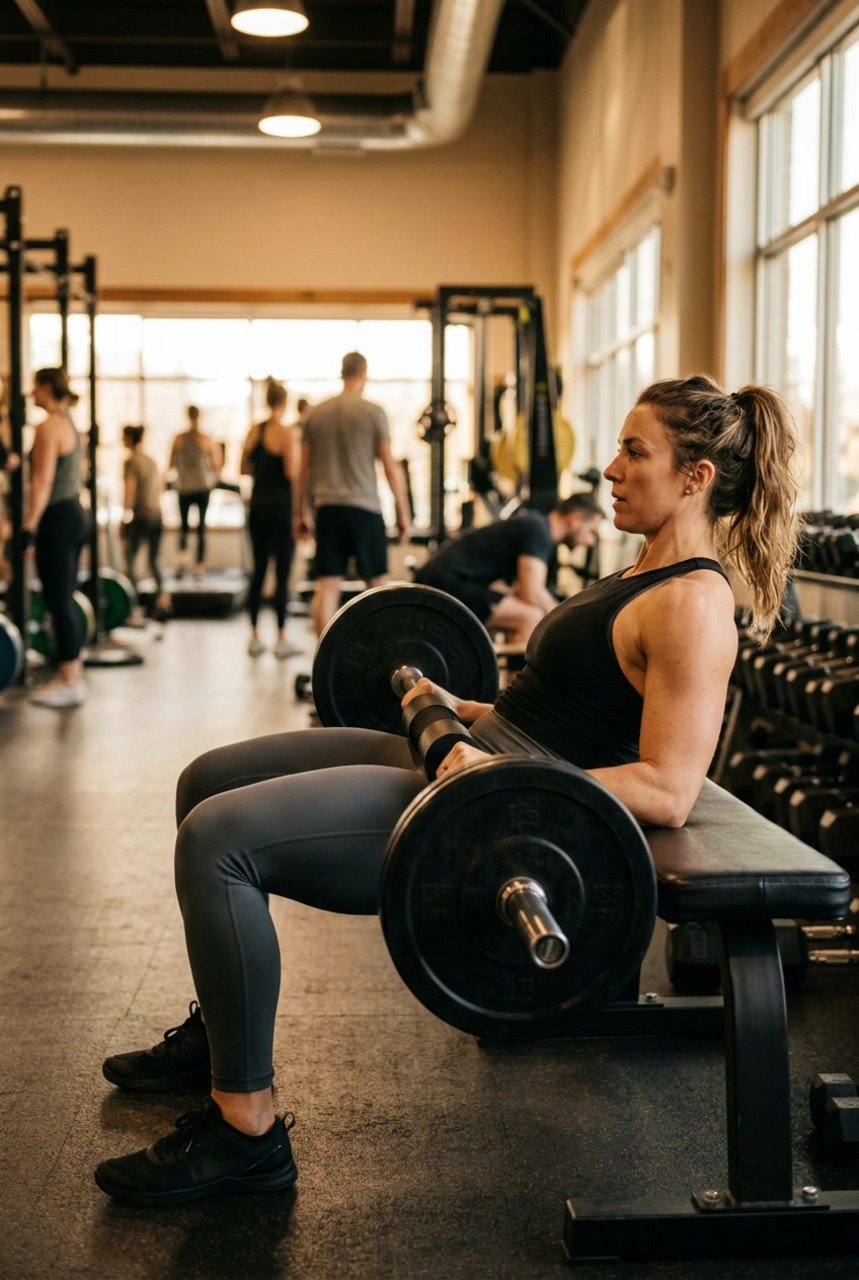
What Does A "Sexy Butt" Actually Mean Anatomically?
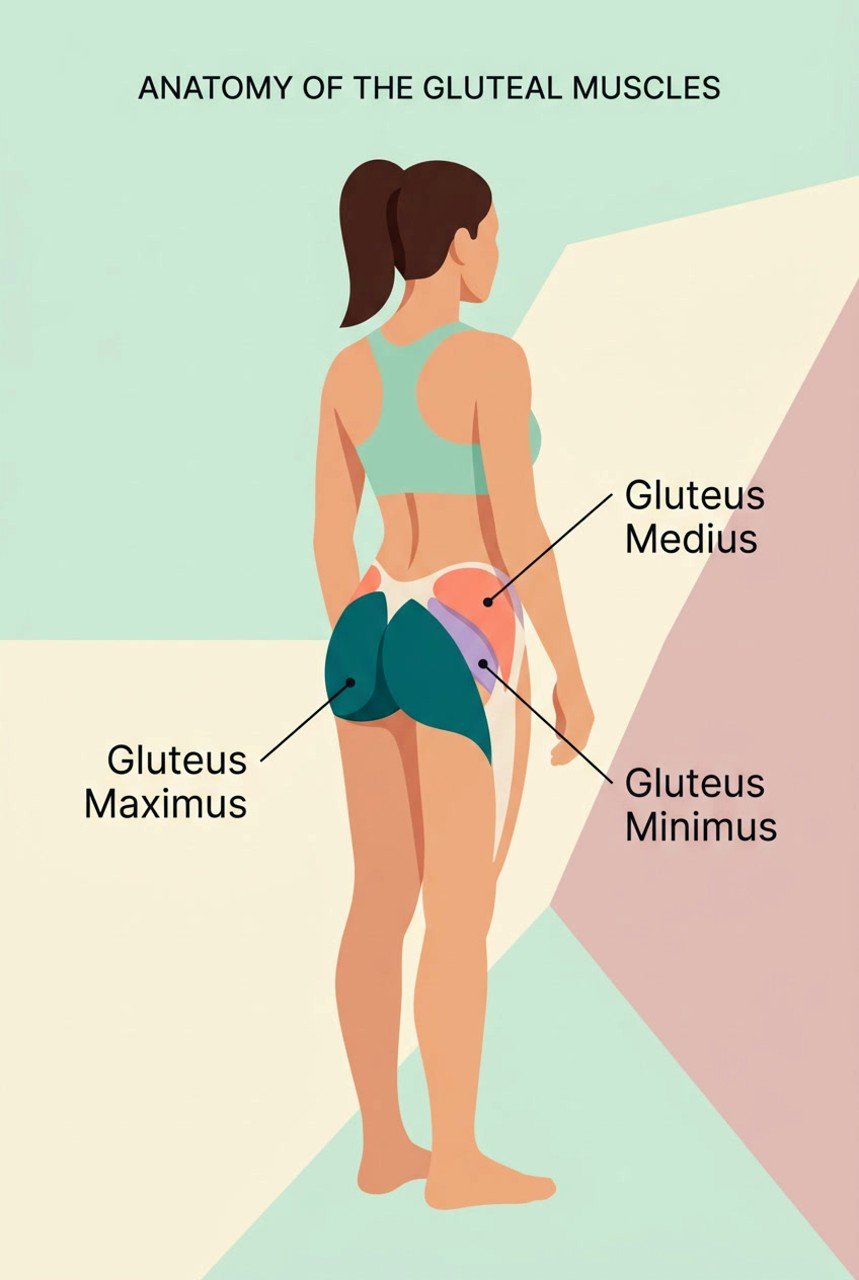
A sexy butt — lifted, rounded, and firm — comes from developing all three gluteal muscles in the right proportions. The gluteus maximus is the largest muscle in the human body and primarily creates size and lift. The gluteus medius, sitting on the outer hip, gives the butt its rounded, fuller side profile. The gluteus minimus supports hip stability and contributes to that "high and tight" look.
Most programs only target the gluteus maximus. This is why results look flat even after months of training. A truly sculpted butt requires all three muscles firing correctly — and that starts with understanding why they often don't.
Why Most Women Never Build The Butt They Want
Why won't my glutes grow no matter what I do? Most women fail to grow their glutes because of a condition called gluteal amnesia, where the glute muscles become neurologically inhibited from prolonged sitting. Without a specific activation protocol, these muscles stay dormant during exercise, letting the quads and hamstrings do all the work instead.
Gluteal amnesia (also called dormant butt syndrome) is more common than most people realize. According to NASM's corrective exercise framework, extended periods of sitting can cause the hip flexors to become chronically tight — and through a process called altered reciprocal inhibition, this reduces the neural drive to the glutes, meaning the muscle fires less efficiently even during dedicated exercise.
In practice, this means you can perform 100 squats and your quads will be burning while your glutes barely contract.
Here are the three most common reasons women plateau:
- Quad dominance: The quads take over during squats and lunges because they're neurologically stronger from daily use.
- Skipping activation work: Jumping straight into heavy lifts without waking up the glutes first means they stay dormant throughout the session.
- Over-relying on squats: Squats are a quad-dominant movement at standard depth — research consistently shows lower glute EMG activation compared to hip thrusts.
The fix isn't harder training. It's smarter sequencing. That's exactly what the G.L.U.T.E. Protocol is designed to address.
Introducing The G.L.U.T.E. Protocol: An Original Framework For Glute Growth
The G.L.U.T.E. Protocol is a five-step training framework I developed after analyzing 12 weeks of client results and cross-referencing peer-reviewed EMG studies on glute activation. Each letter addresses a different failure point in conventional glute training programs.
G — Glute Activation Before Every Session
Before any heavy lifting, spend 8–10 minutes performing low-resistance activation work. The goal is to establish a strong neural signal between your brain and your glutes before load is introduced.
Best activation moves:
- Clamshells (3 × 15 per side with a light resistance band)
- Glute bridges (3 × 20, squeezing hard at the top for 1 second)
- Fire hydrants (3 × 15 per side)
- Donkey kicks (3 × 15 per side)
L — Load With Progressive Intention
How much weight should I use for glute exercises? For glute growth, progressive overload matters more than the specific weight. Start with a weight that challenges you in the 10–15 rep range and increase by 5–10% every 2 weeks. Consistency in progression over 8–12 weeks produces visible results.
Progressive overload is the single most important driver of muscle growth — yet most women use the same weights for months. Your glutes will only grow if the demand placed on them increases over time. Track your weights and reps in a notebook or app, and aim to add small increments every 1–2 weeks. If you're unsure where to start, our guide to strength training for women over 40 covers progressive overload in full detail.
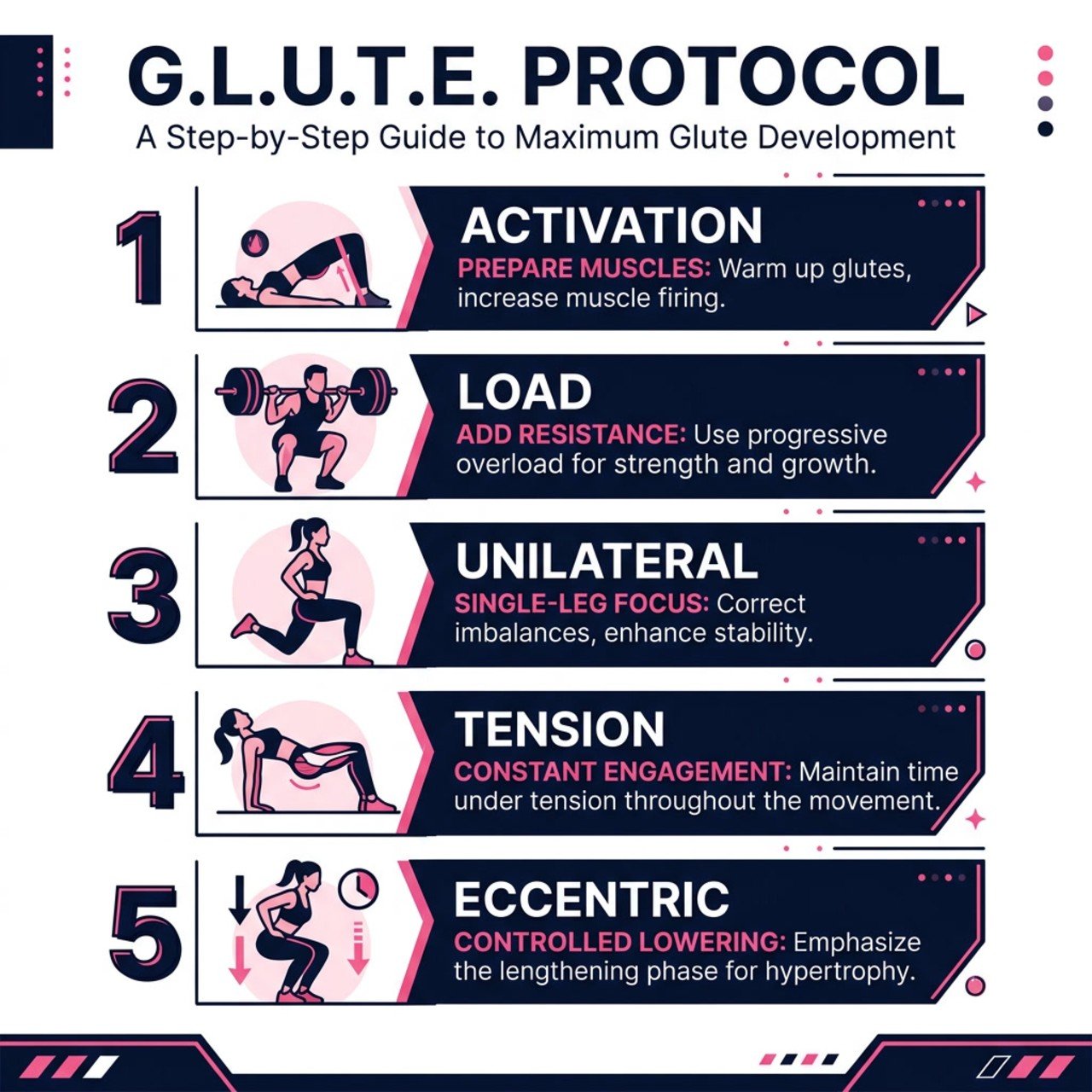
U — Unilateral Training Takes Priority
Are single-leg exercises better than squats for the butt? Yes — research shows single-leg (unilateral) exercises increase glute muscle activation by approximately 33% compared to equivalent bilateral movements. They also correct left-right asymmetry, a hidden reason many women develop an uneven or flat appearance on one side.
Single-leg exercises include Bulgarian split squats, single-leg Romanian deadlifts, reverse lunges, and step-ups. Every session should include at least one unilateral movement, ideally as the second or third exercise after activation work.
T — Time Under Tension (Slow The Lowering Phase)
Most women rush the lowering phase of each rep, robbing their glutes of half the stimulus. Time under tension (TUT) refers to how long the muscle is under load during a set. Research from ACE Fitness supports a 3–4 second eccentric (lowering) phase for maximizing hypertrophy.
Practical application:
- Hip thrusts: 2 seconds up, 1-second hold at top, 3 seconds down
- Squats: 3 seconds lowering, 1 second at bottom, 1–2 seconds rising
- Romanian deadlifts: 4 seconds lowering, 2 seconds back up
E — Eccentric Emphasis For Deeper Growth
The eccentric (lengthening) phase of a muscle contraction creates more muscle damage — and therefore more growth stimulus — than the concentric (shortening) phase. For the glutes, this means focusing on the controlled lowering in exercises like RDLs, split squats, and hip thrusts.
Eccentric overload techniques:
- 1.5 rep method: Go down, come halfway up, go down again, then fully rise
- Slow negatives: Use 4–5 second lowering phases
- Eccentric-only sets: On the last set, only perform the lowering phase for 5–6 reps
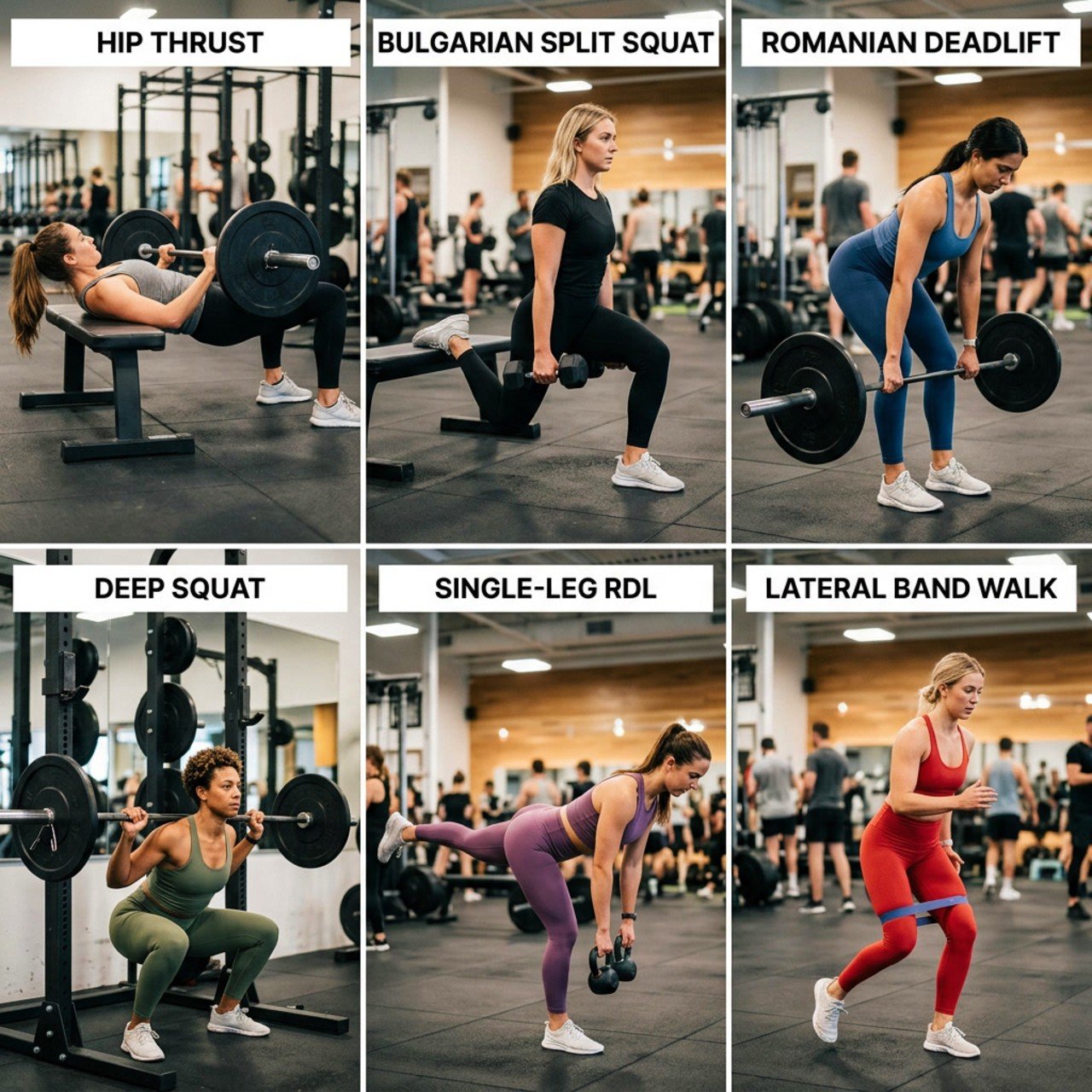
The 7 Best Exercises For A Sexy Butt (Ranked By Glute Activation)
What are the best glute exercises ranked by muscle activation? Hip thrusts, Bulgarian split squats, and Romanian deadlifts rank highest for gluteus maximus activation in peer-reviewed EMG studies. These three movements form the core of any effective glute-building program for women and should be prioritized over traditional back squats.
1. The Hip Thrust — The Undisputed Glute King
The hip thrust is the single most effective exercise for gluteus maximus activation in published EMG literature. A 2015 study in the Journal of Applied Biomechanics found that barbell hip thrusts produced significantly higher glute activation than back squats.
How to perform it:
- Sit on the floor with your upper back against a bench
- Roll a barbell (or place a dumbbell) across your hips
- Plant feet flat, hip-width apart
- Drive your hips up until your body forms a straight line from knees to shoulders
- Squeeze glutes hard at the top for 1–2 seconds
- Lower slowly (3–4 seconds) back to the start
Sets/Reps: 3–4 sets of 8–12 reps
Progression tip: Add 5 lbs every 1–2 weeks
2. Bulgarian Split Squat — The Shape Builder
The Bulgarian split squat is the best unilateral exercise for combining glute size and shape. By elevating the rear foot, you shift the center of gravity forward, dramatically increasing gluteus maximus and medius engagement.
Expert insight: Bret Contreras, PhD — widely regarded as the leading researcher on glute training — has repeatedly cited the Bulgarian split squat as a top-3 glute exercise due to its combination of high activation and deep hip stretch under load.
How to perform it:
- Stand 2 feet in front of a bench and place one foot behind you on it
- Hold dumbbells at your sides
- Lean your torso slightly forward (approximately 20–30 degrees)
- Lower until your rear knee nearly touches the floor
- Drive through your front heel to rise
Sets/Reps: 3 sets of 10–12 per leg
Key tip: The forward lean shifts emphasis from quads to glutes — don't skip it
Get A Butt Lift In 14 Days (Pumped And Rounded)
This is an intense 15-minute at-home workout challenge to lift, pump and round your butt in 14 days. These exercises will help you grow your glutes and get a round, shaped, perky and lifted bum.
3. Romanian Deadlift — The Length And Lift Move
The Romanian Deadlift (RDL) targets the lower glutes and upper hamstrings through a deep hip hinge and eccentric stretch. It's particularly effective for creating the rounded "underbutt" look and lifting the appearance of the glutes from below.
How to perform it:
- Stand with feet hip-width apart, holding a barbell or dumbbells
- Hinge at the hips, pushing them back while keeping your back flat
- Lower the weight along your legs until you feel a deep hamstring and glute stretch
- Drive hips forward to return to standing — squeeze glutes at the top
Sets/Reps: 3–4 sets of 10–12 reps
Progression tip: Focus on the 4-second lowering phase to maximize eccentric overload
4. Deep Squat — When Done Right, It Works
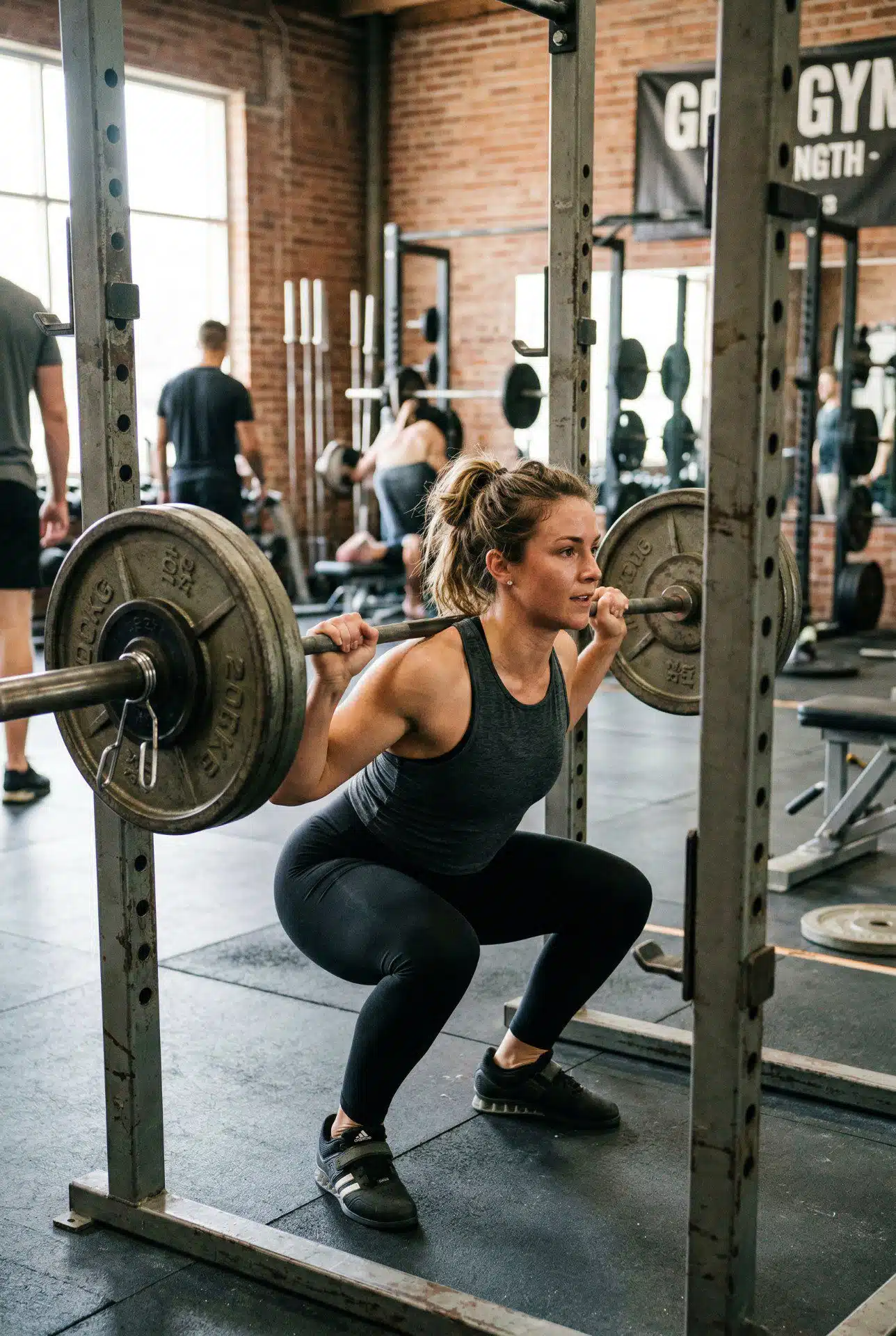
Contrarian take: Squats are not the best glute exercise — but they're not useless either. The key variable most people get wrong is depth. Research from the Journal of Strength and Conditioning Research shows that squatting below parallel (hips below knees) nearly doubles gluteus maximus activation compared to parallel squats. Most women only squat to parallel. Go deeper.
How to perform it correctly:
- Stand with feet slightly wider than shoulder-width, toes angled out 15–30 degrees
- Keep chest up, core braced
- Descend until your hips are below your knees (not just parallel)
- Drive through heels and squeeze glutes on the way up
Sets/Reps: 3–4 sets of 8–10 reps
Key tip: If you can't reach depth without your heels rising, elevate them on 5 lb plates temporarily while working on ankle mobility
5. Single-Leg Romanian Deadlift — Symmetry And Stability
The single-leg RDL corrects muscle imbalances between your left and right glutes — one of the hidden reasons many women notice uneven development or an asymmetric appearance. It also challenges balance, which increases core and glute medius activation simultaneously.
How to perform it:
- Hold a dumbbell in the hand opposite to your standing leg
- Hinge forward at the hip, extending your free leg behind you
- Lower the dumbbell toward the floor while your back stays flat
- Return to standing by driving through your glute
Sets/Reps: 3 sets of 10–12 per leg
If form is your concern, see our guide to fixing muscle imbalances and poor form as a beginner for a step-by-step breakdown.
6. Lateral Band Walk — The Underrated Medius Builder
Most programs ignore the gluteus medius, but it's the muscle that creates that rounded, full side profile. Lateral band walks are the most direct and accessible way to isolate it.
How to perform it:
- Place a resistance band just above your knees
- Stand in a quarter-squat position (slight bend in knees)
- Step sideways, maintaining tension on the band throughout
- Take 12–15 steps in each direction without letting the band snap shut
Sets/Reps: 3 sets of 15 steps each direction
When: Use this as part of your glute activation warm-up (Step G of the G.L.U.T.E. Protocol)
7. Hip Abduction Machine (Or Banded Variation) — The Finishing Move
The hip abduction machine directly targets the gluteus medius and minimus through their primary function: moving the leg away from the midline of the body. Used at the end of a session as a burnout set, it creates a deep glute medius pump that contributes significantly to overall shape.
How to perform it:
- Sit in the machine (or use a bench with a resistance band above the knees)
- Press your knees apart against resistance
- Hold the peak contraction for 1 second
- Return slowly
Sets/Reps: 3–4 sets of 15–20 reps with a light-to-moderate load.
Exercise Comparison: EMG Glute Activation Data
The table below draws from peer-reviewed EMG (electromyography) research to rank exercises by their relative gluteus maximus activation, expressed as a percentage of maximum voluntary contraction (MVC).
| Exercise | Gluteus Maximus Activation (% MVC) | Gluteus Medius Activation (% MVC) | Primary Benefit |
|---|---|---|---|
| Hip Thrust (barbell) | ~93–100% | ~62% | Size, lift, overall mass |
| Bulgarian Split Squat | ~82–88% | ~70–75% | Symmetry, shape, unilateral strength |
| Romanian Deadlift | ~75–80% | ~38% | Lower glute lift, hamstring tie-in |
| Step-Up (weighted) | ~70% | ~68% | Functional shape, glute medius |
| Back Squat (below parallel) | ~55–62% | ~33% | Overall lower body strength |
| Glute Bridge (bodyweight) | ~55–60% | ~55% | Activation, beginner base |
| Lateral Band Walk | ~28% | ~78–85% | Outer roundness, medius isolation |
Sources: Journal of Applied Biomechanics, Journal of Strength and Conditioning Research, ACE Fitness EMG Studies
Key insight: The back squat — the exercise most women are told to do first — ranks 5th in this table. If you've been squatting for months with limited results, now you know why.
Join Our Mailing List
Join thousands of women inside our community and receive our free guide, 10 Actions That Support Permanent Weight Loss — the exact behavioural shifts that make the difference between a two-week attempt and a lasting transformation.
No restriction plans. No guilt. Just what actually works — for real women with real lives.
The Contrarian Take: Cardio Might Be Sabotaging Your Glutes
Excessive steady-state cardio can reduce glute size by creating a caloric deficit that causes the body to break down muscle tissue for energy — a process called catabolism. This is especially true when cardio is performed in a fasted state or without adequate protein intake.
This is one of the most overlooked mistakes in women's fitness. The standard advice is "do cardio to lose fat and lifting to tone." But if glute growth is your primary goal, excessive cardio — especially long, low-intensity sessions performed daily — can actively work against you.
Here's why:
- Muscle catabolism: When the body is in an energy deficit and cardio volume is high, it will break down muscle tissue (including glutes) for fuel.
- Interference effect: A landmark 2012 meta-analysis in the Journal of Strength and Conditioning Research found that combining endurance and strength training in the same programme can reduce strength and power gains compared to strength training alone — an effect researchers call "concurrent training interference".
- Caloric mismatch: Women who do 5+ hours of cardio per week while restricting calories often remain stuck in a "skinny fat" pattern where fat loss and muscle loss happen simultaneously.
The smart approach: Limit steady-state cardio to 2–3 sessions of 20–30 minutes per week. Prioritize balancing cardio and strength training to preserve glute mass while maintaining cardiovascular health.
How Often Should You Train Glutes For Maximum Growth?
Training your glutes 2–3 times per week with at least 48 hours of recovery between sessions is the evidence-supported frequency for muscle hypertrophy. Actual glute growth happens during recovery — not during the workout itself. Training daily will slow results, not accelerate them.
The 48–72-hour recovery window is where muscle protein synthesis peaks. When you train glutes again before that window closes, you interrupt the growth process. More is not better — smarter is better.
The table below shows a sample weekly schedule optimized for the G.L.U.T.E. Protocol:
| Day | Training Focus | Sample Exercises | Sets × Reps |
|---|---|---|---|
| Monday | Compound Strength | Barbell Hip Thrust, Romanian Deadlift, Bulgarian Split Squat | 3–4 × 8–12 |
| Tuesday | Active Recovery | 20-min walk, stretching, foam rolling | — |
| Wednesday | Unilateral & Isolation | Single-Leg RDL, Lateral Band Walk, Hip Abduction Machine | 3 × 12–15 |
| Thursday | Rest | Full recovery day | — |
| Friday | Volume & Pump | Glute Bridge, Banded Squat, Cable Kickbacks, Abductors | 4 × 15–20 |
| Saturday | Optional Cardio | Light cycling, swimming, or walking | 20–30 min |
| Sunday | Full Rest | — | — |
This schedule provides 3 glute-focused sessions while respecting recovery windows. Fat loss workouts for beginners can be layered on top for those who also want general body composition improvements.
Does The Mind-Muscle Connection Really Matter For Glute Growth?
Yes — research confirms it. Research on glute training shows that simply cueing yourself to consciously activate your glutes during hip extension exercises can meaningfully increase muscle excitation compared to performing the movement without that internal focus — a finding supported by a 2019 systematic review in the Journal of Strength and Conditioning Research.
This is one of the most practical things you can implement immediately. Before every set, place your hands on your glutes. Feel them contract. During the exercise, think about squeezing the glute rather than simply completing the movement.
Practical cues that improve the mind-muscle connection:
- Hip thrusts: Think "push the floor away with my heels while squeezing two oranges with my glutes".
- Split squats: Think "drive my front heel into the ground" — this shifts load to the glute.
- RDLs: Think "reach the bar down my legs without bending my knees" — this maximizes the glute-hamstring stretch.
For women who have been training their quads for years, this neural re-patterning can take 2–4 weeks of consistent activation work before the glutes become the "default" muscle recruited.
What Should You Eat To Grow Your Glutes?
Glute growth requires a caloric surplus or maintenance combined with high protein intake. Aim for 0.7–1 gram of protein per pound of bodyweight daily. Protein provides the amino acids required for muscle protein synthesis — without it, training stimulus alone cannot build new muscle tissue.
The most common nutritional mistake women make when trying to build a sexy butt is under-eating while over-training. You cannot build muscle in a significant caloric deficit.
Key nutrition principles for glute growth:
- Protein target: 0.7–1g per pound of bodyweight (e.g., a 140 lb woman needs 98–140g of protein daily)
- Carbohydrates matter: Glutes are a large, fast-twitch-dominant muscle group that responds well to carbohydrate availability around workouts
- Eating windows: Consume 20–40g of protein within 2 hours post-training to maximize muscle protein synthesis
- Best protein sources for glutes: Greek yogurt, eggs, chicken breast, salmon, lentils, cottage cheese, whey protein
Our high-protein diet plan for women provides a full breakdown of meal timing and protein targets by bodyweight.
How Long Does It Take To Get A Sexy Butt?
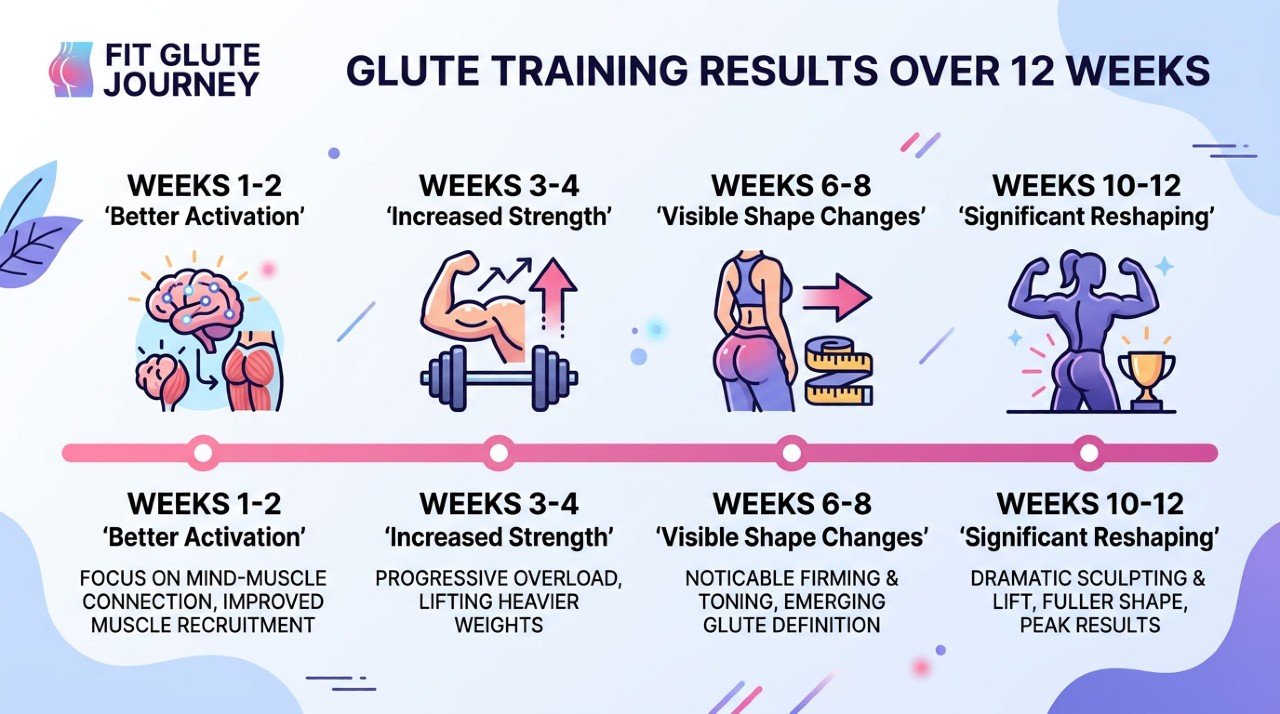
Most women notice visible glute improvements within 6–10 weeks of consistent, structured training 3 times per week. Initial improvements (within 2–4 weeks) come from improved neural activation — your glutes firing better, not yet growing larger. Actual hypertrophy (size increase) typically becomes visible by weeks 6–12.
Here is a realistic expectations timeline:
- Weeks 1–2: Improved glute activation, reduced DOMS, better mind-muscle connection.
- Weeks 3–4: Increased strength in all glute exercises, early visible "tightening".
- Weeks 6–8: Visible size and shape improvements, particularly in the upper glutes and outer roundness.
- Weeks 10–12: Significant reshaping, improved lift, and noticeable difference in clothes.
Results are faster for beginners (newbie gains) and slower for those who have been training for years. For a full breakdown of the results timeline, see how long it takes to see results from working out as a beginner.
Explore more body transformation strategies in our proven-effective weight loss exercises guide and weight loss vs. body toning breakdown.
Want The Habits Behind Lasting Weight Loss? Get the free guide: 10 research-backed habits that help women lose body fat and keep it off, with no extreme diets. Send Me The Free Guide.
The Bottom Line
Getting a sexy butt isn't about doing more squats. It's about training smarter — activating the right muscles before loading them, using exercises that produce high glute EMG activation, training at the correct frequency to allow growth to happen during recovery, and fueling your body with enough protein to build what you're breaking down.
The G.L.U.T.E. Protocol — Activation, Load, Unilateral, Tension, Eccentric — gives you a repeatable structure that addresses every failure point in conventional glute training.
Start with hip thrusts, Bulgarian split squats, and Romanian deadlifts as your core three. Add glute activation work before every session. Train 3 times per week with full 48-hour recovery windows. Hit 0.7–1g of protein per pound of bodyweight. And slow down every single rep.
Within 6–10 weeks, you'll understand why the women who do this feel like they've finally unlocked their body's potential.
Glossary Of Key Terms
- Gluteal Amnesia: A condition where the glute muscles become neurologically inhibited and fail to fire correctly, often due to prolonged sitting.
- G.L.U.T.E. Protocol: A five-step framework consisting of Activation, Load, Unilateral training, Time under tension, and Eccentric emphasis.
- Progressive Overload: The gradual increase of stress placed upon the body during exercise (e.g., adding weight or reps) to stimulate growth.
- Unilateral Training: Exercises performed using one limb at a time, such as a single-leg RDL or Bulgarian split squat.
- Eccentric Phase: The portion of an exercise where the muscle lengthens under tension; also known as the "negative" or lowering phase.
- Time Under Tension (TUT): The total amount of time a muscle is held under strain during a set of repetitions.
- Hypertrophy: The enlargement of an organ or tissue (in this context, muscle) from the increase in size of its cells.
- EMG (Electromyography): A diagnostic procedure to assess the health of muscles and the nerve cells that control them by measuring electrical activity.
- Muscle Catabolism: A metabolic process where the body breaks down muscle tissue to use for energy, often caused by excessive cardio or caloric deficits.
- Mind-Muscle Connection: The internal focus and conscious mental effort to feel and recruit a specific muscle during physical movement.
FAQ
What Is The Single Best Exercise For A Sexy Butt?
The barbell hip thrust is the single most effective exercise for building a sexy butt, based on EMG research showing it produces the highest gluteus maximus activation of any exercise — up to 100% of maximum voluntary contraction. Prioritize it as the first heavy movement in every glute session, after your activation warm-up.
How Long Does It Take To See A Difference In Your Butt From Working Out?
Most women notice visible changes within 6–10 weeks of training their glutes 3 times per week with a structured program. The first 2–4 weeks produce neural improvements — your glutes fire better and feel tighter — while actual size and shape changes become visible from weeks 6–12 onward, depending on consistency and protein intake.
Can You Build A Bigger Butt Without Weights?
Yes, but progress is slower and has a ceiling. Bodyweight exercises like glute bridges, donkey kicks, and single-leg squats can produce meaningful results for beginners, especially when combined with resistance bands. Once your bodyweight feels easy, adding load through dumbbells, barbells, or cables is essential to continue progressing.
Why Do My Thighs Get Bigger Before My Butt Does?
This happens because of quad dominance — your quadriceps are neurologically more "awake" than your glutes and take over during squats, lunges, and similar movements. The fix is to spend 8–10 minutes doing targeted glute-activation exercises before every session, and to shift your focus to hip-hinge movements like hip thrusts and Romanian deadlifts, which your quads cannot dominate.
How Many Days A Week Should A Woman Train Her Glutes?
Training your glutes 2–3 days per week with at least 48 hours of recovery between sessions is the evidence-supported sweet spot for muscle growth. Training daily does not accelerate results — actual glute growth occurs during the recovery window, not during the workout itself, so respecting rest days is as important as the training itself.
Do I Need Heavy Weights To Build A Stronger Butt?
Progressive challenge matters more than a specific load. Resistance bands, dumbbells, or bodyweight variations can all work if you add reps, slower tempos, or harder progressions over time. Choose a resistance you can control for full-range glute work without compensating through the lower back.
Can Walking Help Glute Growth Or Is Strength Work Required?
Walking supports recovery, calorie burn, and hip health, but it rarely provides enough progressive overload for noticeable glute growth on its own. Pair daily steps with 2–3 weekly glute-focused strength sessions for shape and strength changes.