
Overcoming The Time Crunch With Quick Workout Motivation For Working Moms
Zig Ziglar
Starting Is Winning
You don't have to be great to start, but you have to start to be great.
The Executive Summary
For working moms struggling with workout motivation, ditch the guilt and embrace short, sustainable strategies. Understand that decision fatigue and hormonal fluctuations impact motivation. Schedule workouts like meetings, leveraging the morning for consistency.
Even 10-minute sessions count, offering cardiovascular benefits. Shift your identity to someone who values health, and remember exercise improves patience and energy, making you a more present parent.
You set your alarm for 5:30 a.m. with every intention of getting a workout in before the household woke up. Then life happened: a sick toddler, a 10 p.m. work email that needed answering, or just the bone-deep exhaustion of doing everything for everyone, every day.
The alarm went off. You hit snooze. By the time you'd packed lunches, answered Slack messages, and dropped everyone at school, the workout felt like a distant dream from another life.
Sound familiar? Here's what you need to hear: you are not lazy. You are not undisciplined. You have a design problem — not a character flaw.
Workout motivation for working moms is one of the most misunderstood topics in women's fitness. Most advice assumes you have the same 24 hours as someone without a family to run, a career to show up for, and an internal guilt meter that quietly reminds you every minute spent on yourself is a minute away from your kids.
That's not your reality. This article is written for your reality. Below, you'll find practical, evidence-based strategies built specifically for the working mom lifestyle — from 20-minute HIIT sessions to dopamine-rewiring habits to dismantling the mom guilt that quietly kills long-term consistency.
Key Takeaways
- 10 minutes count. Short workouts are not a consolation prize — research shows three 10-minute sessions deliver comparable cardiovascular benefits to one 30-minute session, making daily movement achievable on even the busiest schedule.
- Identity beats willpower. Sustainable workout motivation comes from seeing yourself as someone who moves daily — not from forcing discipline. Shifting from "I'm trying to exercise" to "I'm a woman who prioritizes her health" changes behavior at the root.
- Schedule it like a meeting. Workouts that are blocked on the calendar — with a specific time, type, and location — are significantly more likely to happen than open-ended intentions.
- Mom guilt is a motivation killer. Exercise is not selfish. It directly improves patience, energy, and mood — which makes you a more present parent and partner.
- Your environment does the heavy lifting. Put your workout clothes on, keep a resistance band in your line of sight, or have a 20-minute playlist ready. This stops you from getting stuck in doubt.
- Track streaks, not perfection. Consistency over weeks matters far more than any single perfect session. Missing one workout is normal — missing two in a row is the pattern to prevent.
Why Is Workout Motivation So Hard for Working Moms?
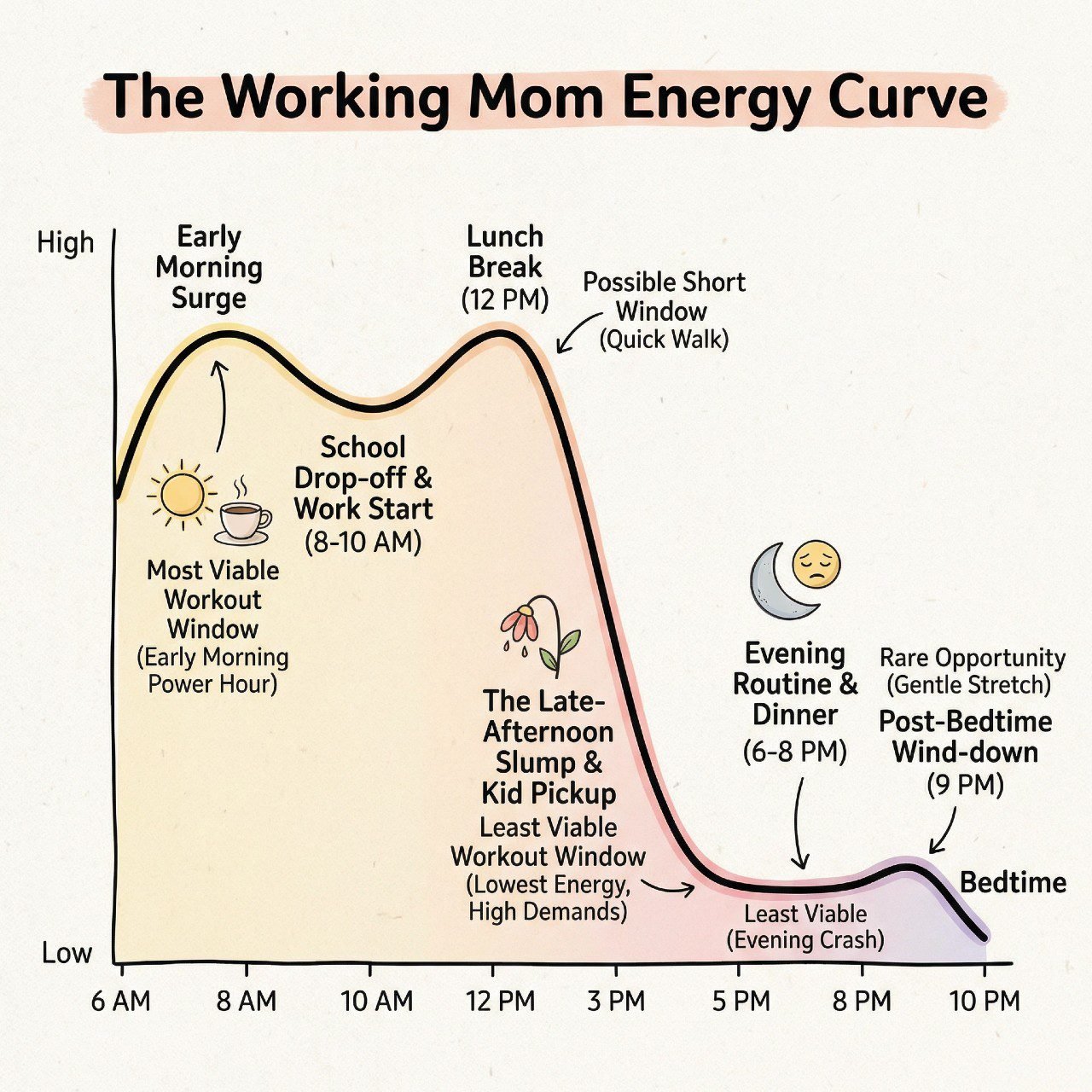
Working moms struggle with workout motivation primarily because of competing priorities, chronic decision fatigue, and a biology-driven drop in energy during the late afternoon — the very window most try to exercise. Understanding these root causes makes building a solution far easier.
This isn't about wanting it badly enough. Research published in the Journal of Health Psychology (2021) found that decision fatigue — the mental depletion caused by making hundreds of small choices throughout the day — significantly erodes self-regulation by evening, making it harder to choose a workout over the couch.
Add in the invisible load of motherhood: scheduling, emotional management, anticipating everyone else's needs before your own. By 6 p.m., your brain has genuinely used up the willpower it borrowed this morning.
This is not a weakness. This is neuroscience.
What Is Decision Fatigue and How Does It Kill Your Fitness Motivation?
Decision fatigue occurs when the mental resources required for self-regulation run low after a full day of choices. For working moms managing careers and families, this means that by the time the kids are in bed, the executive function required to override rest and choose movement is genuinely depleted — not because you are weak, but because you have already made hundreds of decisions.
The fix is not more willpower. There are fewer decisions. We'll cover how to build that system below.
How Mom Guilt and Exercise Are Secretly Connected
Mom guilt — the persistent, quiet feeling that time spent on yourself is time taken from your children — is one of the most powerful hidden barriers to working mom fitness. A 2022 survey by the American Psychological Association found that 41% of working mothers cited guilt as a significant barrier to personal health behaviors, including exercise.
Here is the reframe that changes everything: a mom who exercises regularly is modeling self-respect and physical health for her children. That is not selfish. That is parenting.
We will come back to this, because rewiring the guilt narrative is one of the highest-leverage moves you can make for long-term workout consistency.
What Does Science Say About Workout Motivation for Women?
Women's exercise motivation is significantly shaped by dopamine timing, hormonal fluctuations across the menstrual cycle, and social accountability structures. These biological and psychological factors explain why motivation feels inconsistent — and how to work with them instead of against them.
The Dopamine Problem Most Working Moms Don't Know About
Here is the framework that will change how you think about motivation forever: you don't have a motivation problem. You have a dopamine timing problem.
Motivation is not a personality trait. It is a neurochemical state. Dopamine, the brain's primary reward chemical, plays a central role in driving action and sustaining effort. The problem with most fitness advice? It asks you to delay the reward (results take weeks to appear) while the effort is immediate.
Working moms who stay consistent long-term have figured out how to generate the dopamine hit before and during the workout — not just as a distant outcome. This means:
- Choosing workouts you actually enjoy, not just "effective" ones.
- Building micro-celebrations into your routine ("I showed up — that's a win").
- Anchoring exercise to identity, not aesthetics ("I am a woman who moves her body").
This connects directly to what we cover at Women's Lean Body Formula: the real challenge of finishing workouts isn't starting — it's the motivational architecture underneath.
How Your Hormones Directly Affect Fitness Motivation
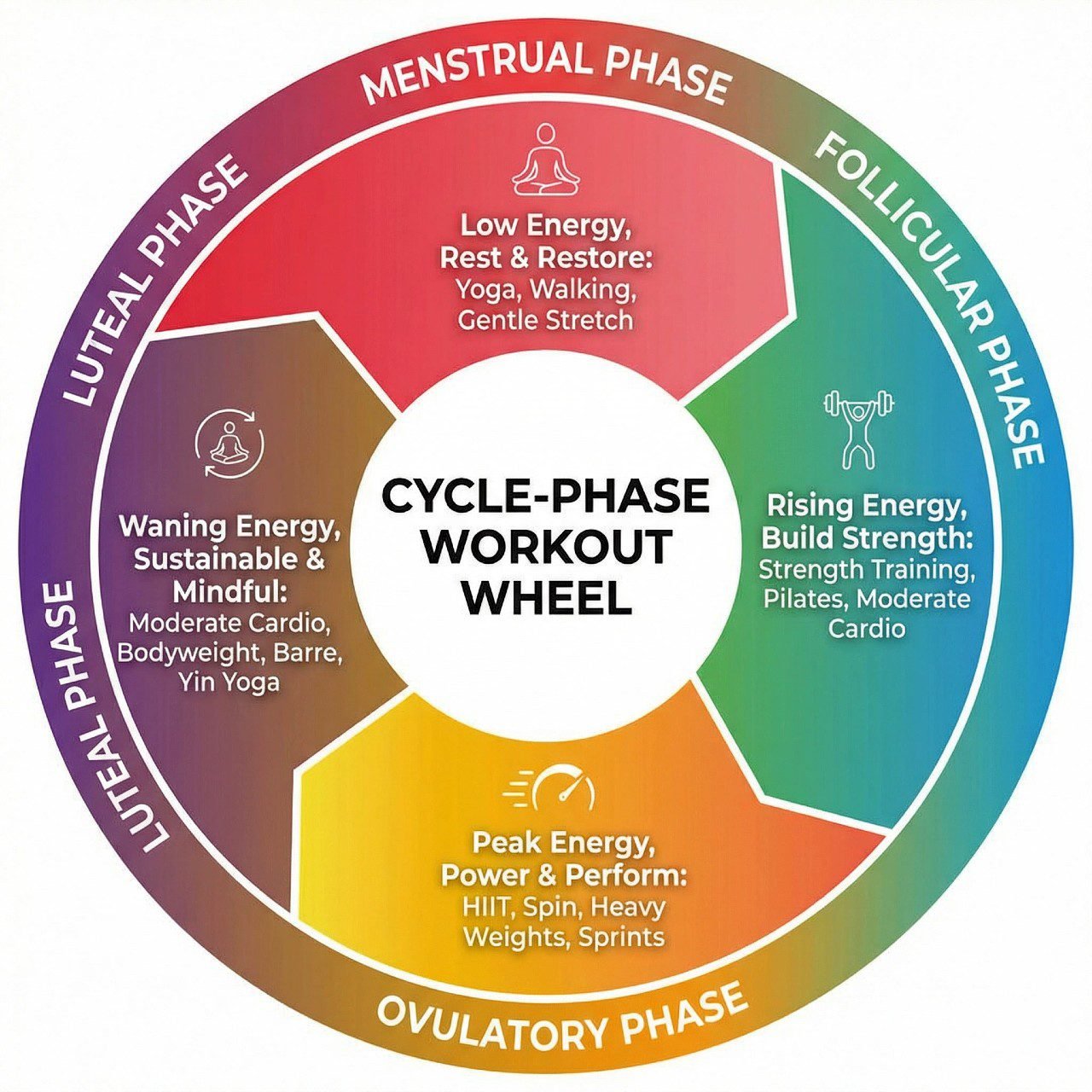
Your menstrual cycle has a measurable, direct impact on your energy levels, physical strength, and mental drive to exercise. Estrogen rises in the first half of your cycle, naturally lifting mood, energy, and gym motivation. Progesterone dominates the second half — and with it comes physical fatigue, lower mood, and a genuine physiological signal to recover.
This is not a weakness. This is biology.
Understanding where you are in your cycle lets you stop fighting your body and start working with it — scheduling high-intensity sessions when your hormones support them, and choosing restorative movement when they don't.
Table 1: Menstrual Cycle Phases and Optimal Workout Motivation Strategy
| Cycle Phase | Days (Approx.) | Dominant Hormone | Energy Level | Best Workout Type | Motivation Strategy |
|---|---|---|---|---|---|
| Menstrual | 1–5 | Low estrogen & progesterone | Low | Gentle yoga, walking, stretching | Rest without guilt; movement is optional |
| Follicular | 6–13 | Rising estrogen | High | Strength training, HIIT, new challenges | Push harder — try a new class, aim for PRs |
| Ovulatory | 14–16 | Peak estrogen | Peak | High-intensity cardio, group fitness | Schedule your hardest sessions here |
| Luteal | 17–28 | Rising then falling progesterone | Declining | Moderate cardio, Pilates, yoga | Prioritize consistency over intensity |
For a deeper look at the hormonal side of fat loss and energy, see how hormones affect weight loss in women.
How Do You Build a Realistic Morning Workout Routine as a Busy Mom?
The most effective morning workout routine for working moms takes 20–30 minutes, is fully prepared the night before, and uses a habit stack to eliminate decision-making. Research shows that morning exercisers are significantly more consistent over time than those who plan to work out in the evening.
A 2020 study in the British Journal of Health Psychology found that people who exercised in the morning were 2x more likely to maintain consistency over 12 weeks compared to evening exercisers. For a working mom, the logic is simple: morning is the one window the day hasn't claimed yet.
The 5-Minute Commitment Strategy
Do not commit to a 45-minute workout you will dread. Commit to five minutes. Put on your shoes. Hit play on your warm-up. That is the only contract with yourself.
What happens next is almost always the same: you keep going. The research calls this the "action precedes motivation" principle — you do not wait to feel like working out. You start, and the motivation arrives. The psychological barrier of a big ask disappears when you shrink the entry point to five minutes.
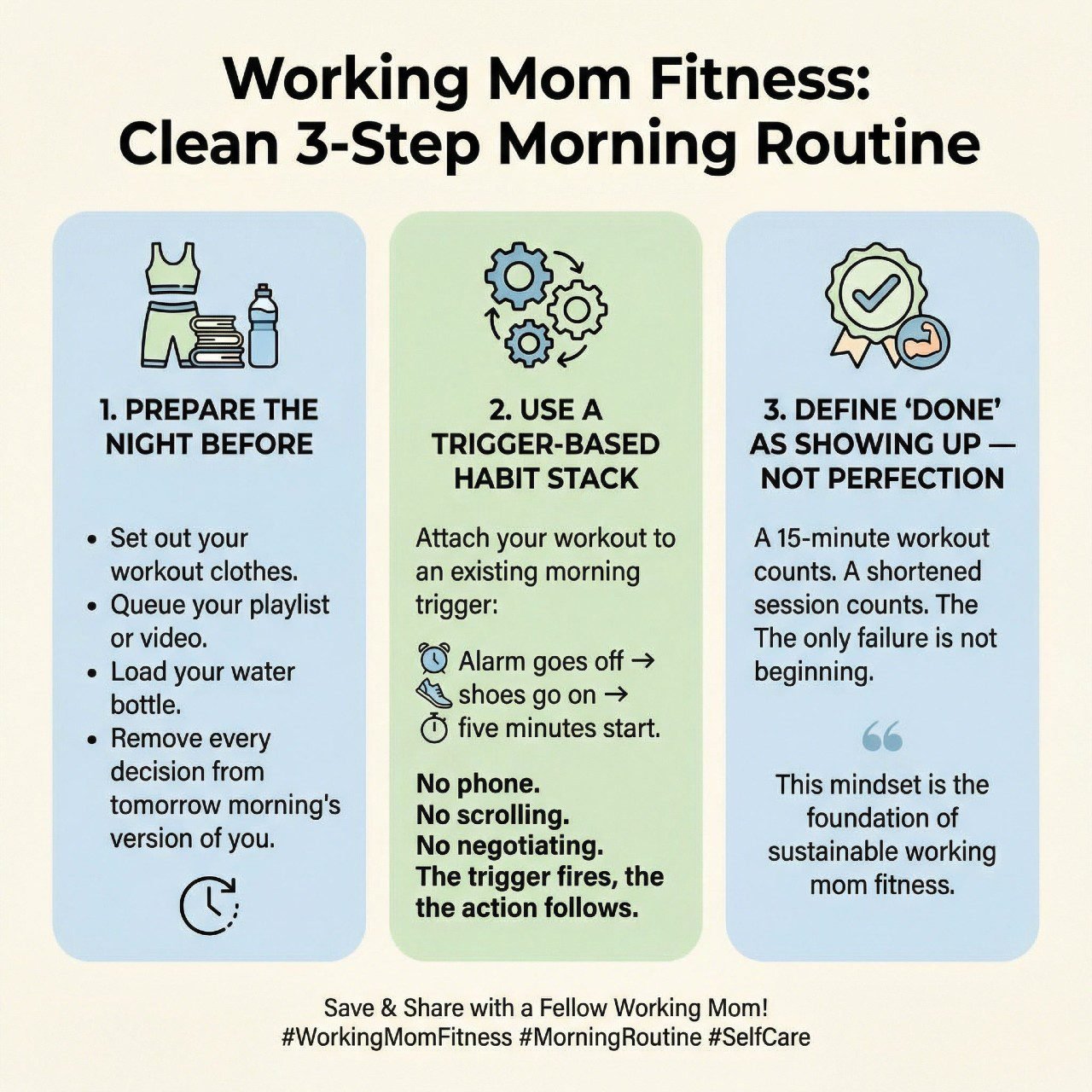
Building Your Morning Routine in 3 Steps
Step 1: Prepare the Night Before
Set out your workout clothes. Queue your playlist or video. Load your water bottle. Remove every decision from tomorrow morning's version of you.
Step 2: Use a Trigger-Based Habit Stack
Attach your workout to an existing morning trigger: Alarm goes off → shoes go on → five minutes start. No phone. No scrolling. No negotiating. The trigger fires, the action follows.
Step 3: Define "Done" as Showing Up — Not Perfection
A 15-minute workout counts. A shortened session counts. The only failure is not beginning. This mindset is the foundation of sustainable working mom fitness.
What Are the Most Effective Short Workouts for Busy Moms?
The most effective short workouts for busy moms are 20-minute HIIT sessions and bodyweight strength circuits, which deliver comparable metabolic and cardiovascular benefits to longer workouts when performed consistently 3–4 times per week. Short and frequent beats long and sporadic every time.
HIIT for Working Moms: Why 20 Minutes Is Enough
High Intensity Interval Training (HIIT) is the working mom's highest-ROI fitness investment. Research published in the Journal of Physiology (2016) found that 20-minute HIIT sessions produced cardiovascular and fat-burning adaptations similar to those of 45-minute steady-state cardio.
The reason: HIIT elevates your metabolic rate for hours after you stop — a phenomenon called Excess Post-Exercise Oxygen Consumption (EPOC), or the "afterburn effect." You are not just burning during the session. You are burning for hours afterwards.
For a complete beginner-friendly workout plan that works with a busy schedule, see fat loss workouts for beginners.
Strength Training at Home: The Underrated Priority
Strength training at home is one of the highest-return activities available to working moms. It builds lean muscle (which burns more calories at rest), improves posture, reduces injury risk, and produces mood-boosting endorphins within minutes of starting.
You do not need a gym or expensive equipment. Squats, push-ups, lunges, glute bridges, and planks cover all major muscle groups with zero equipment and zero travel time.
And unlike cardio, strength training delivers visible body composition changes that sustain motivation far better than a number on a scale.
The Minimum Effective Dose Framework
You do not need to work out every day. Research supports a minimum effective dose approach: three to four intentional sessions per week produce meaningful fitness improvements for previously sedentary women, without burning out.
Aim for:
- 2 strength sessions (20–30 minutes each).
- 1 HIIT session (15–20 minutes).
- Daily movement — walks, active play with kids, taking stairs — as your foundation.
Table 2: Quick At-Home Workout Options by Time Available
| Time Available | Workout Type | Example Session | Primary Benefit |
|---|---|---|---|
| 10 minutes | Metabolic circuit | 10 burpees, 20 squats, 10 push-ups × 2 rounds | Endorphin hit, metabolism activation |
| 15 minutes | HIIT intervals | 30 sec on / 30 sec rest × 15 rounds | Fat burning, cardiovascular fitness |
| 20 minutes | Bodyweight strength | Squats, lunges, push-ups, planks × 3 rounds | Muscle building, posture improvement |
| 30 minutes | Yoga or Pilates flow | Sun salutations, core work, hip openers | Flexibility, stress relief, recovery |
| 45+ minutes | Full strength + cardio | Dumbbell circuit + 10-minute walk cooldown | Comprehensive fitness gains |
How Can You Overcome Mom Guilt Around Exercise?
Mom guilt around exercise dissolves when you reframe fitness not as time away from your children, but as modeling self-respect and health for them. Research shows that a mother's physical activity level is the single strongest predictor of her children's activity level — making your workout a parenting investment.
Reframing Self-Care as an Act of Parenting
A 2017 study in the International Journal of Behavioral Nutrition and Physical Activity found that maternal physical activity was the strongest predictor of children's activity levels — stronger than school programs, community resources, or a father's activity level.
You are not taking time away from your kids by exercising. You are teaching them what it looks like to take care of a body. You are giving them a blueprint for self-respect that no classroom or conversation can provide.
That changes things, doesn't it?
The language matters too. Instead of "I'm going to work out" (which can feel exclusive), try: "Mom is doing her health time" — or better yet, invite them in.
How to Involve Your Kids in Your Fitness Routine (Active Parenting)
Active parenting — exercising with or alongside your children — solves the guilt problem and the time problem simultaneously. You do not have to choose between being present and being active.
Approaches that actually work:
- Stroller walks or runs — 30–40 minutes of cardio while your youngest gets fresh air.
- Backyard obstacle courses — disguised HIIT for you, pure fun for them.
- Family yoga evenings — stretching and breathwork, toddlers enthusiastically included.
- Living room dance parties — 10 minutes of chaos that counts as cardio.
- Bodyweight workouts during screen time — do your push-ups while they watch their show.
What Are the Best Time Management Strategies for Working Mom Fitness?
The most effective time management strategy for working mom fitness is habit stacking — anchoring workout time to an existing daily trigger so it runs on automatic, rather than willpower. Consistency follows structure, and structure always beats motivation over the long run.
The Habit Stack Technique for Busy Moms
Habit stacking, popularized by James Clear in Atomic Habits, connects a new behavior to an existing one using the formula: "After I do [CURRENT HABIT], I will do [NEW HABIT]."
For working moms, powerful stacks look like:
- "After I drop the kids at school, I will complete a 20-minute home workout before opening my laptop."
- "After I brew my morning coffee, I will put on my workout clothes."
- "After I put the kids to bed, I will do 10 minutes of yoga before watching television."
The key: the cue already exists. You are not creating a new window in an already packed schedule. You are borrowing the threshold of one that is already there.
Fitness Apps for Working Moms: What Actually Works
Not every fitness app is built for a working mom's schedule. The ones that deliver results for busy parents share common features:
- Short workouts under 30 minutes.
- No-equipment or minimal-equipment options.
- Flexible scheduling (not rigid day-by-day programs).
- Progress tracking that rewards consistency, not just calorie burn.
Top options worth exploring:
- Nike Training Club — free, extensive library of short workouts, beginner-friendly.
- Sweat (by Kayla Itsines) — women-specific programming with strong home workout options.
- Down Dog — customizable yoga at every level, excellent for recovery days.
- MyFitnessPal — pairs nutrition and movement tracking in one dashboard.
Pair any workout routine with meal planning strategies designed for busy schedules to multiply results without adding complexity.
Goal Setting for Moms: Making Fitness Non-Negotiable
Vague goals disappear. Specific goals survive. Instead of "I want to work out more," define it precisely:
- "I will complete three 20-minute workouts per week: Monday, Wednesday, and Friday, before 7 a.m."
- "I will track my workouts in my planner every Sunday evening."
- "I will sign up for a 5K four months from now."
Research shows that people who write down implementation intentions — the when, where, and how of a goal — are 2–3x more likely to follow through than those who set outcome goals alone.

How Do You Stay Motivated to Work Out Long-Term as a Working Mom?
Long-term workout motivation for working moms is sustained through identity-based habits, external accountability, and measuring progress through non-scale metrics. The goal is to become someone who moves her body — not to reach a destination and stop.
Identity-Level Habits vs Willpower: The Shift That Changes Everything
The women who stay consistent for years — not just weeks — share one fundamental mindset shift: they stopped doing fitness and started being fit. They built their self-concept around being someone who moves their body.
Instead of asking "How do I force myself to work out?" they ask: "What would a healthy, active woman do in this situation?"
Every time you show up — even for 10 minutes, even when it's hard — you cast a vote for the identity you are building. Enough votes, and the identity becomes self-reinforcing. This is what consistency actually looks like at the neurological level.
Building an Accountability System That Works
Solo motivation is the hardest kind to sustain. External accountability dramatically increases follow-through, especially when life gets demanding.
Approaches that work well for working moms:
- One workout buddy — a neighbor, colleague, or friend who commits to the same schedule.
- A virtual check-in group — even a 2-person text thread works.
- A fitness journal — a visible record of every session you complete creates momentum you will not want to break.
- App-based streaks — gamification triggers a powerful completion drive.
You do not need a whole tribe. You need one person who will notice if you go quiet.
Tracking Progress Without Obsessing Over The Scale
The scale measures weight — a number that fluctuates daily based on hydration, hormones, food timing, and inflammation. Relying on it as your primary motivation metric is a reliable path to discouragement.
More meaningful metrics for working moms:
- Workouts completed per week (consistency is the real win).
- Energy levels throughout the day — exercise is one of the most powerful antidotes to fatigue.
- Strength gains — can you do more push-ups than last month?
- Sleep quality — regular movement dramatically improves sleep depth and duration.
- How your clothes fit — body composition shifts that the scale misses entirely.
- Mood and mental clarity — often the fastest-noticed benefit of regular exercise.
Speaking of energy: if chronic fatigue is part of what keeps derailing your workouts, this guide to stopping the constant exhaustion cycle is worth a read.
What Should Working Moms Know About Postpartum Fitness and Motivation?
Postpartum workout motivation requires a gentler framework than standard fitness advice. The postpartum body undergoes significant hormonal, physical, and emotional changes for up to 12 months after birth. In this window, prioritizing recovery and pelvic floor rehabilitation over performance is not a setback — it is the foundation.
The fourth trimester — the first 12 weeks postpartum — is a recovery period, not a training window. Walking, gentle stretching, and pelvic floor exercises are appropriate and beneficial in this phase.
From weeks 6–12 onward (with medical clearance), low-impact movement such as yoga, Pilates, and light resistance training can begin gradually. High-impact exercise — running, HIIT — should wait until pelvic floor function has been assessed by a women's health physiotherapist.
The motivation challenges in this window are unique:
- Sleep deprivation directly reduces dopamine levels and drive.
- The sharp estrogen drop after birth can cause mood shifts that feel like a lack of motivation.
- Body image after pregnancy is a real and valid psychological challenge that standard fitness advice ignores.
Give yourself a 2–3 month runway before evaluating consistency. Progress in this phase is measured in days you moved at all — not miles covered. For the nutrition side of the postpartum equation, see mastering postpartum meal prep while managing newborn exhaustion.
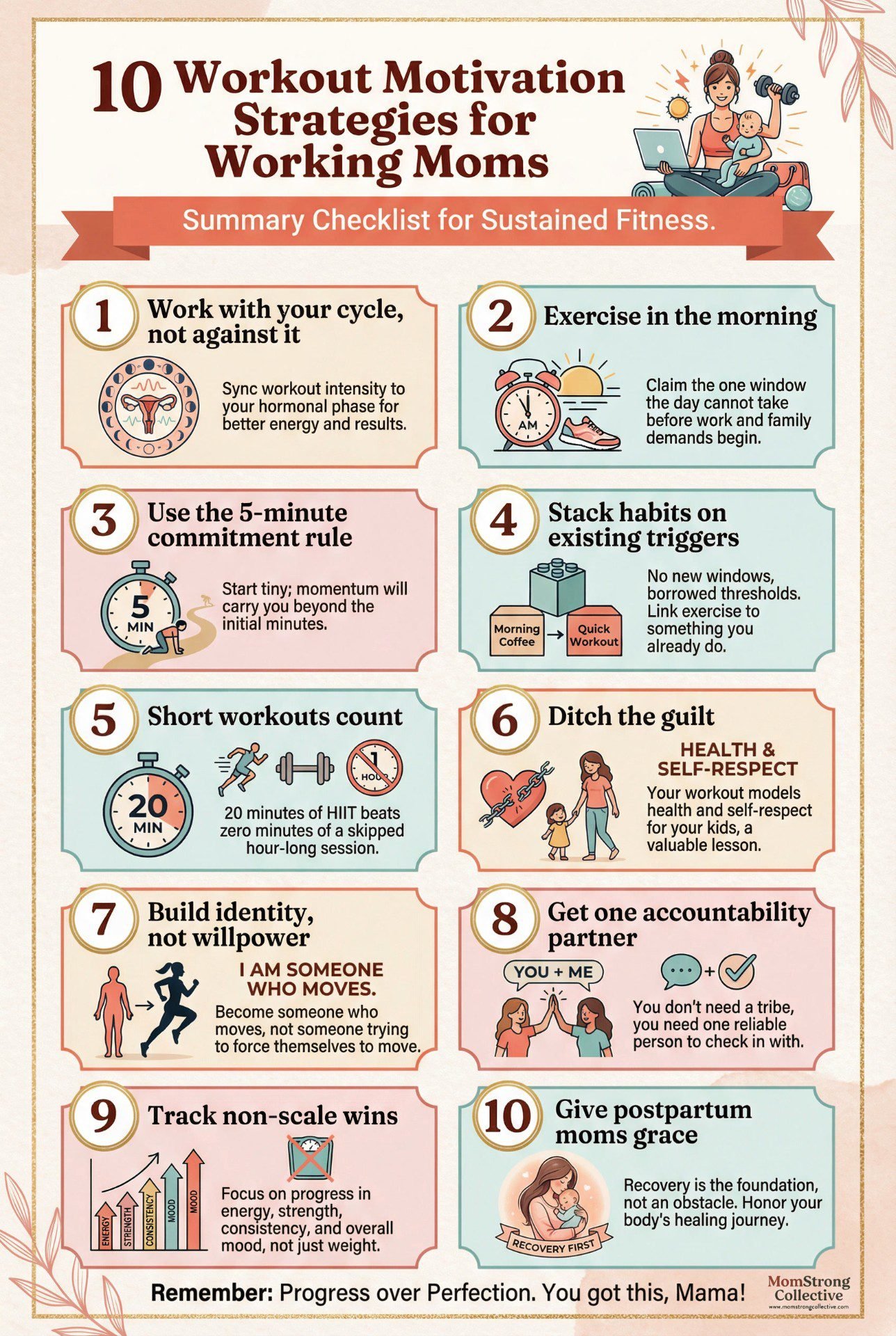
Workout Motivation Strategies: Quick Reference
1. Work with your cycle, not against it — sync workout intensity to your hormonal phase.
2. Exercise in the morning — claim the one window the day cannot take.
3. Use the 5-minute commitment rule — start tiny; momentum will carry you.
4. Stack habits on existing triggers — no new windows, borrowed thresholds.
5. Short workouts count — 20 minutes of HIIT beats zero minutes of a skipped hour-long session.
6. Ditch the guilt — your workout models health and self-respect for your kids.
7. Build identity, not willpower — become someone who moves, not someone trying to.
8. Get one accountability partner — you don't need a tribe, you need one person.
9. Track non-scale wins — energy, strength, consistency, mood.
10. Give postpartum moms grace — recovery is the foundation, not an obstacle.
Related Articles
- How Long Does It Take To See Results From Working Out As A Beginner Woman
- Will Working Out Change Breast Size For Women
- Why One Size Fits All Workout Programs Miss The Mark For Women
- Working According Current Mood
- Ultimate Guide To Sustainable Fat Loss
- Flat Stomach Workout Plan For Lean Core
- 4 Ways Avoid Common Workout Injuries
The Bottom Line
You now have a complete, science-backed toolkit for building sustainable workout motivation as a working mom — designed for your real schedule, your real biology, and your real life.
Your move is simple: pick one strategy from this article and implement it this week. Just one. The 5-minute morning commitment. A habit stack anchored to school drop-off. A cycle-synced workout schedule.
One change. One week. One vote for the woman you are becoming.
Embrace Inspiration:
Like What You Read? Be Sociable, Comment, And Share It! Thanks.
Glossary Of Key Terms
FAQ
The most reliable time to exercise as a working mom is the morning, before family and work responsibilities take over. Even 15–20 minutes before the house wakes up makes a real difference. Attach your workout to an existing morning trigger — your alarm, your coffee, the school drop-off — to eliminate the decision entirely.
Yes. Research supports that 20 minutes of HIIT or strength training, performed three to four times per week, produces significant improvements in cardiovascular health, body composition, and mood. Consistent short workouts outperform sporadic long ones every time.
Start with movement, not motivation. Put on your shoes and commit to five minutes. The act of starting almost always generates enough momentum to continue. Exercise also directly combats fatigue — even a 10-minute walk increases alertness and energy for hours afterward.
The most effective at-home workouts for working moms are HIIT circuits (burpees, jump squats, mountain climbers), bodyweight strength routines (squats, push-ups, lunges, planks), and yoga or Pilates flows. All require zero equipment, take 15–30 minutes, and can be done in a living room.
Reframe the guilt: you are not taking time away from your kids — you are showing them what it looks like to value your body and your health. Studies confirm that active mothers raise more active children. Your workout is one of the most impactful parenting investments you can make.
Yes. Combined with sustainable nutrition habits, three focused workout sessions per week is sufficient to support fat loss and meaningful body composition improvements. The key variable is consistency, not frequency. For the nutrition side, see how to create a healthy diet for weight loss.
You Know Why. Now Learn Exactly How
Join thousands of women inside our community and receive our free guide: 10 Actions That Support Permanent Weight Loss — the practical, sustainable habits that translate everything you just read into real, lasting results.
No fad diets. No extreme plans. Just what the research actually supports — written for real women.