

The Honest, Fact-Checked Guide To Using Apple Cider Vinegar For Weight Loss And Blood Sugar Support

Apple cider vinegar has been reportedly used as a healing potion dating back to 3300 B.C. for overall health, wound disinfection, strength and athletic performance, sore throat and cold remedies, among other uses.
Dr. Bubu Banini, M.D. ‧ Hepatologist & Obesity Medicine Physician, Yale Medicine
Summary (TL;DR)
Yes, apple cider vinegar can offer a small, real boost to weight loss, blood sugar, and cholesterol when you use it consistently and don't expect it to do the heavy lifting on its own. But here's what almost nothing you've read about it mentions: the most-cited viral study behind the "ACV melts fat" headlines was retracted in 2025 after statisticians couldn't replicate its results.
This guide separates what got retracted from what's still standing. We'll walk through the real 2025 meta-analyses on weight and blood sugar, correct a claim ("reverses diabetes") that never had evidence behind it in the first place, and give you a simple 3-question self-check, The ACV Reality Check, to decide if it's worth adding to your routine.
If you've felt confused, or a little burned, by conflicting apple cider vinegar claims, you're not imagining it. The science genuinely did get messier in the last two years. We're going to make sense of it.
Medical & Referral Disclaimer
This article is for informational and educational purposes only and does not constitute medical advice. Individual results vary based on physiology, health history, medications, and existing conditions. Always consult your physician or a registered dietitian before adding apple cider vinegar to your routine, particularly if you have diabetes, gastroparesis, acid reflux, or are pregnant or breastfeeding.
Key Takeaways
- The viral 2024 ACV weight-loss study was retracted in October 2025. BMJ pulled it after statisticians couldn't reproduce the results and found irregularities in the data.
- Real evidence still exists, just smaller than the headlines claimed. A 2025 meta-analysis of 10 trials (789 people) found modest reductions in weight, BMI, and waist size, especially at higher daily doses.
- "Reverses diabetes" was never accurate. The best current data shows apple cider vinegar can modestly lower fasting blood sugar and HbA1c (your 3-month blood sugar average). That's support, not reversal.
- Appetite suppression is genuinely mixed. Some short-term studies show it, longer studies mostly don't. We're not going to oversell this one.
- The people who benefit most already have elevated blood sugar or cholesterol. In healthy participants with normal levels, one major meta-analysis found little to no effect, and in some cases a slight uptick.
- "Detox" isn't a real mechanism. Your liver and kidneys already do that job. Apple cider vinegar's real benefits are elsewhere.

The Study Everyone Cites Got Retracted, Here's What Actually Happened
In October 2025, BMJ retracted the single most widely shared apple cider vinegar weight-loss study after independent statisticians couldn't reproduce its results.
If you've seen a headline promising dramatic, fast weight loss from a couple of tablespoons of apple cider vinegar a day, this is almost certainly the study it was talking about.
The trial, published in BMJ Nutrition, Prevention & Health in March 2024, followed Lebanese teens and young adults and reported dramatic weight loss from small daily doses of apple cider vinegar. It went viral. It's still being referenced in articles and social posts today, even though it no longer exists as valid science.
Here's why it was pulled. After critiques were published as letters in the journal, BMJ's content integrity team brought in independent statisticians to try to replicate the findings and check the authenticity of the underlying data.
They couldn't reproduce the results. They found patterns in the dataset that looked inconsistent with random assignment to treatment groups, and implausibly small p-values given how few participants the study had (BMJ Nutrition, Prevention & Health, retraction notice).
Separately, three independent researchers published a formal comment describing the same weight-loss data as containing "improbable data characteristics and extreme effects" (Malbouby, Trexler & Heathers, BMJ Nutrition, Prevention & Health). The study's authors called the errors honest mistakes and agreed to the retraction.
We're telling you this not to talk you out of apple cider vinegar, but because we think you deserve to know when the ground shifts under a claim you've read a dozen times.
A retraction doesn't mean apple cider vinegar does nothing. It means that specific, most-quoted study can no longer be used as evidence for anything. The good news: there's still real research standing on its own, and we're about to walk through exactly what it says.

Does Apple Cider Vinegar Actually Help You Lose Weight?
Yes, modestly, according to a 2025 meta-analysis that pooled 10 randomized controlled trials and 789 participants, apple cider vinegar intake was linked to small but statistically significant reductions in body weight, BMI, and waist circumference, with bigger effects at higher daily doses, around 30 mL (2 tablespoons) per day.
The researchers screened nearly 3,000 studies to land on these 10, all of them in adults with overweight, obesity, or type 2 diabetes (Castagna et al., Nutrients, 2025).
"Modest" is the operative word. This isn't a fat-burning hack. It's a small nudge, roughly in the range you'd get from cutting one sugary drink a day, not a replacement for the calorie deficit, protein intake, and movement that actually drive weight loss.
Acetic acid, the compound that gives vinegar its sour bite and makes up 5 to 6% of apple cider vinegar, is the presumed mechanism: animal research suggests it may modestly increase fat oxidation and reduce fat storage, though the human evidence for that specific pathway is thinner than the weight-loss data itself.
Here's how the claims you've probably seen stack up against what the evidence actually supports:
| Common Claim | Evidence Strength | What The Research Actually Shows |
|---|---|---|
| "Melts belly fat fast" | Weak / Overstated | The study behind most viral versions of this claim was retracted in 2025. |
| Modest weight, BMI, and waist reduction | Moderate | 10-trial, 789-person 2025 meta-analysis found small but real reductions, larger at ~30 mL/day. |
| Lowers fasting blood sugar and HbA1c | Moderate | Confirmed across two 2025 and 2021 meta-analyses, effect concentrated in people with elevated blood sugar. |
| "Reverses" type 2 diabetes | Not supported | No trial shows reversal. Modest support for blood sugar management, alongside medical care, is the accurate framing. |
| Suppresses appetite | Mixed / Inconsistent | Some short-term studies show it; results don't hold up in longer-term research. |
| "Detoxes" the body | Not a real mechanism | Your liver and kidneys handle detoxification; there's no evidence vinegar adds a separate detox pathway. |

How Apple Cider Vinegar Supports Blood Sugar Levels (Not "Reverses" Diabetes)
Apple cider vinegar has a genuinely well-supported, if modest, effect on blood sugar: a 2025 meta-analysis of seven controlled trials found it significantly lowered fasting blood sugar by roughly 22 mg/dL and HbA1c by about 1.5 percentage points in people with type 2 diabetes, but did not meaningfully improve insulin resistance itself (HOMA-IR), and the same analysis actually found circulating insulin levels ticked up slightly, not down.
That's an important, honest distinction: apple cider vinegar can help blunt how high your blood sugar climbs after a meal, without necessarily fixing the underlying insulin sensitivity problem behind it (Arjmandfard et al., Frontiers in Nutrition, 2025).
An earlier, independent 2021 meta-analysis of nine trials backs this up with similar numbers, fasting glucose down roughly 8 mg/dL and HbA1c down half a point on average, and adds an honest wrinkle worth sitting with: in participants who were already healthy, with normal blood sugar to start, apple cider vinegar didn't lower glucose further and in some subgroups nudged fasting glucose and HDL ("good") cholesterol slightly upward instead (BMC Complementary Medicine and Therapies, 2021).
Put simply: apple cider vinegar appears to help the people who need it most, those with elevated blood sugar, and does close to nothing measurable for people whose levels are already normal. That's not a weakness in the research. It's exactly the kind of nuance that "reverses diabetes" headlines flatten out, and exactly why we corrected that language in this piece.
This matters more, not less, once you're in your 40s. Insulin sensitivity and β-cell function measurably shift across the menopause transition, independent of weight, tracked in a 16-year, 1,224-woman community cohort study that found the odds of developing diabetes climbed in the years leading into menopause before leveling off afterward (Choi & Yu, Healthcare, 2025).

If your fasting glucose or HbA1c has crept up since your 40s started, without any real change to your diet, that's a hormonal shift, not a willpower problem, and it's exactly the population the apple cider vinegar research above shows the most benefit for.
If you're managing type 2 diabetes or perimenopause-related blood sugar changes, this is a supporting habit to discuss with your doctor, not a substitute for medication or monitoring.
What About Appetite, Bloating, And Digestion?
The evidence that apple cider vinegar suppresses appetite is genuinely mixed; some short-term studies show it, but the effect doesn't reliably hold up in longer trials, so we're not going to promise you it'll quiet your hunger.
The proposed mechanism is real: acetic acid appears to slow gastric emptying, meaning food leaves your stomach more slowly, which is part of why one small pilot study in people with type 1 diabetes and delayed digestion found vinegar further extended that delay (Hlebowicz et al., BMC Gastroenterology, 2007).
Slower gastric emptying can translate to feeling fuller for longer, which is the theory behind the appetite-suppressant claim. But "can" isn't "does, reliably," and that's exactly the gap between the theory and the proof.
This same slowed-digestion mechanism is also why some women report bloating relief after starting apple cider vinegar, and why others report the opposite, more bloating or an upset stomach, especially when they start with too strong a dose.
If apple cider vinegar makes your digestion feel worse rather than better, that's a real signal to dilute it further, take it with food, or stop, not something to push through.
Gut health specifically deserves a straight answer: the human research here is thin. Most of what you'll read about apple cider vinegar and your gut microbiome comes from mouse studies, not people.
That doesn't mean it's false; fermented foods generally have a reasonable case for supporting a diverse gut microbiome, but it does mean the specific claim "apple cider vinegar improves your gut health" is running well ahead of the human evidence. We'd rather tell you that plainly than repeat a claim we can't back up.

Does Apple Cider Vinegar Lower Cholesterol?
A 2021 meta-analysis of nine clinical trials found apple cider vinegar modestly lowered total cholesterol by about 6 mg/dL, alongside the blood sugar improvements above, but had no significant effect on LDL ("bad") or HDL ("good") cholesterol specifically.
The benefit was strongest in people who already had type 2 diabetes and in those who used a lower daily dose (15 mL or less) for more than eight weeks (BMC Complementary Medicine and Therapies, 2021).
That's a real, if modest, heart-health supporting habit, not a replacement for the diet and movement patterns (and, where needed, medication) that do the heavy lifting on cardiovascular health.
Acetic acid is thought to play a role here too, as a short-chain fatty acid your body naturally produces in small amounts and metabolizes as part of normal fat and carbohydrate metabolism (UK Health Security Agency).
How To Use Apple Cider Vinegar Safely For Weight Loss
Getting The Dose And Format Right
The dose used across most of the studies above is 15 to 30 mL (1 to 2 tablespoons) per day, always diluted in water, and started at a lower amount to see how your body handles it.
Undiluted vinegar is acidic enough to damage tooth enamel and irritate your throat and oesophagus over time, so "straight from the bottle" is not a shortcut worth taking.

| Step | What To Do | Why |
|---|---|---|
| Starting dose | 1 teaspoon (5 mL) in a full glass of water | Lets you assess tolerance before increasing |
| Target dose | 1-2 tbsp (15-30 mL) daily, split into 2-3 doses | Matches the dose range used in the clinical trials above |
| Format | Raw, unfiltered, with "the mother" | Retains the cloudy sediment of beneficial bacteria and enzymes; always dilute |
| Timing | Before or with meals | Matches how it was administered in most glycemic-response studies |
| Never | Undiluted, or in "shot" form | Risk of enamel erosion, throat and oesophagal irritation |
A few practical ways to actually make this a daily ACV habit instead of a bottle that sits in your pantry for six months:
- Whisk it into an olive oil vinaigrette; this is the easiest way to get a daily dose without "drinking" anything.
- Stir 1 tablespoon into a large glass of water with a squeeze of lemon and drink it before your largest meal.
- Add a splash to sparkling water for a low-calorie, tangy alternative to soda.
- Use it in a marinade or quick-pickled vegetables so it becomes part of a meal, not an extra task.
Who Should Check With A Doctor First
Skip it, or check with your doctor first, if any of the following apply to you:
- You have gastroparesis or type 1 diabetes with delayed stomach emptying; apple cider vinegar can slow digestion further.
- You take insulin or blood-sugar-lowering medication, since the combined effect could push glucose lower than intended.
- You have acid reflux, GERD, or a history of oesophageal irritation.
- You're prone to low potassium or take medications affected by it (diuretics, some heart medications); very high, long-term vinegar intake has rarely been linked to this.
Join Our Mailing List
Join thousands of women inside our community and receive our free guide, 10 Actions That Support Permanent Weight Loss — the exact behavioural shifts that make the difference between a two-week attempt and a lasting transformation.
No restriction plans. No guilt. Just what actually works — for real women with real lives.
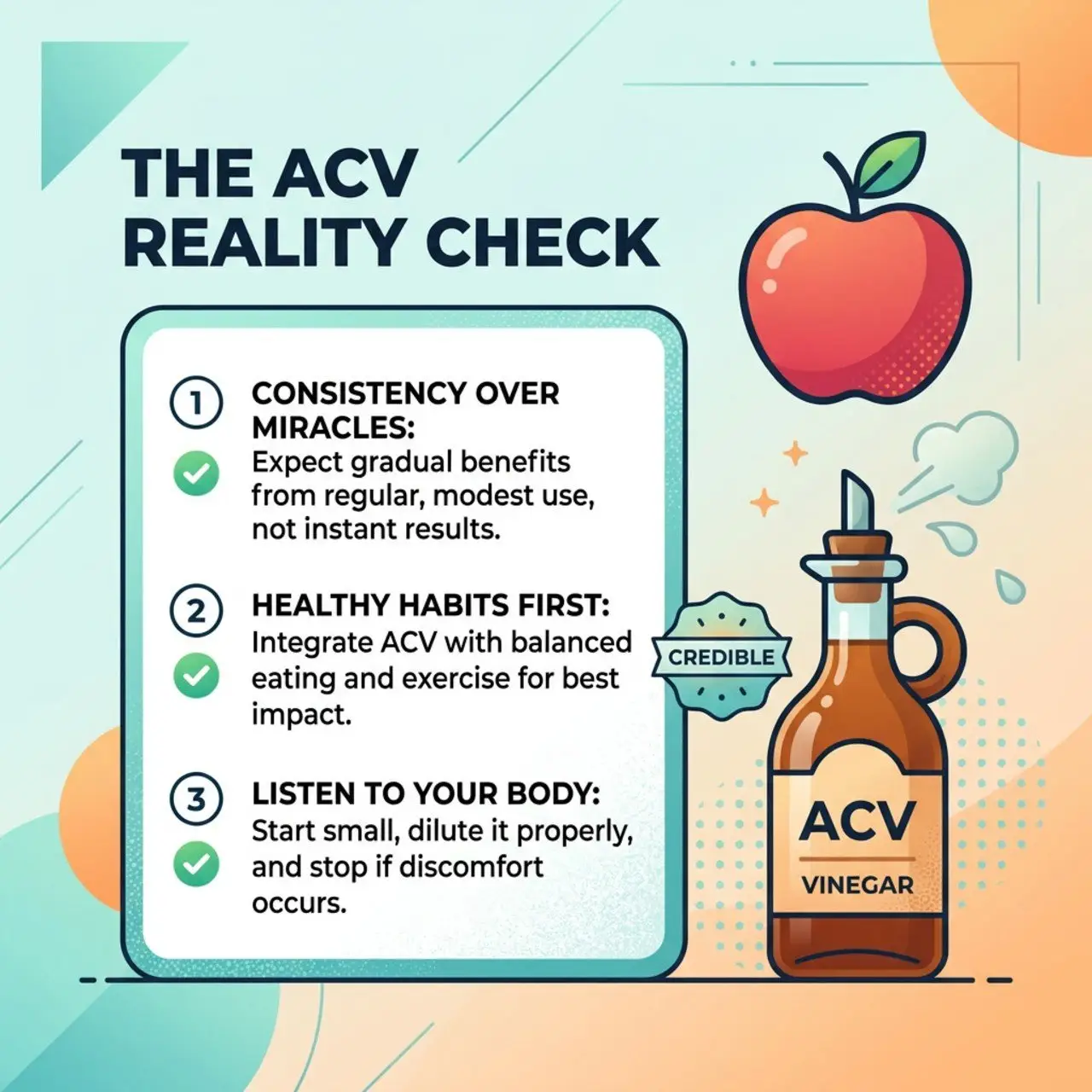
The ACV Reality Check: A 3-Question Self-Assessment
Before you add apple cider vinegar to your routine, ask yourself these three questions; they'll tell you in under a minute whether it's actually worth trying for your specific goal.
We built this because so much of the confusion and intimidation around apple cider vinegar doesn't come from the science itself; it comes from not knowing which version of the claim applies to you.
- Is my goal something the evidence actually supports? If you're hoping for a modest nudge alongside real changes to food and movement, yes. If you're hoping it replaces those changes, no, and no supplement or pantry staple will.
- Am I using a verified dose and format? 15-30 mL/day, diluted, raw and unfiltered. Gummies, capsules, and "detox" blends weren't what any of the studies above actually tested.
- Do I have a condition that changes the risk-benefit? Gastroparesis, active reflux, insulin use, or a history of disordered eating all shift this from "probably fine to try" to "talk to your doctor first."
If you answered yes to the first two and don't have a flag on the third, apple cider vinegar is a low-cost, low-risk habit worth a genuine 8-to-12-week trial, long enough to match the studies that actually found an effect. If you're not sure, that uncertainty is worth a five-minute conversation with your doctor or dietitian rather than a guess.
Ready to build the rest of your routine on the same kind of verified, no-nonsense guidance? Our free guide takes the same evidence-first approach to the bigger picture: 10 Actions That Support Permanent Weight Loss, the practical habits research actually backs, without a single "detox" or "melt fat overnight" claim in it. Get The Free Guide.
Related Articles
The Bottom Line
Apple cider vinegar isn't the weight-loss shortcut the retracted 2024 study made it look like, and it isn't the "diabetes reversal" or "natural detox" some corners of the internet still claim either.
What it is: a genuinely evidence-backed, low-cost habit that can modestly support weight, blood sugar, and cholesterol, especially if those numbers are already a little elevated, when you use a real dose, diluted, consistently, for two to three months.
That's a smaller promise than the viral version. It's also one you can actually trust, because every claim in this guide traces back to a study that's still standing after scrutiny, not one that had to be pulled.
Glossary Of Key Terms
FAQ
Modestly, yes. A 2025 meta-analysis of 10 randomized trials and 789 participants found small but statistically significant reductions in weight, BMI, and waist circumference, larger at doses around 30 mL/day. It's a supporting habit, not a replacement for a calorie deficit and movement.
Yes. BMJ retracted the March 2024 Lebanese weight-loss trial in October 2025 after independent statisticians couldn't replicate the results and found irregularities in the data. It's still frequently cited online despite no longer being valid evidence.
No. That claim isn't supported by any current research. What the evidence does show is a modest reduction in fasting blood sugar and HbA1c, most pronounced in people who already have elevated levels, alongside medical care, not a substitute for it.
Most of the clinical research uses 15 to 30 mL (1-2 tablespoons) per day, always diluted in water and typically split into 2-3 doses. Start with 1 teaspoon to check your tolerance before working up to that range.
The evidence is mixed. Some short-term studies show a modest effect, likely tied to slower gastric emptying, but longer studies don't consistently confirm it. We'd rather tell you it's inconsistent than promise something the research doesn't back.
For most healthy adults, yes, in diluted amounts within the studied range. Skip it or check with your doctor first if you have gastroparesis, take insulin or blood-sugar medication, have acid reflux, or are pregnant or breastfeeding.
No. Your liver and kidneys already handle detoxification; there's no evidence that apple cider vinegar adds a separate pathway. Its real, evidence-backed benefits - modest support for weight, blood sugar, and cholesterol - don't need a "detox" story to be worth using.
You Know Why. Now Learn Exactly How
Join thousands of women inside our community and receive our free guide: 10 Actions That Support Permanent Weight Loss — the practical, sustainable habits that translate everything you just read into real, lasting results.
No fad diets. No extreme plans. Just what the research actually supports — written for real women.