


Calorie Counting For Women: 4 Methods That Work (Even When Your Hormones Don't Cooperate)
Why The Rules Changed After 40 — And How To Count Calories In A Way That Actually Fits Your Life
ASTRID ALAUDA
Author & inspirational speaker
Your body is a temple, but only if you treat it as one.
Summary (TL;DR)
Calorie counting works — but the version most women are trying was designed for a 25-year-old's metabolism. After 40, your body burns 100–300 fewer calories per day than it used to, and research shows most women underestimate their intake by 37–42%. This article walks you through four practical methods that account for those realities, plus a 3-day no-pressure starting point that works even if apps feel overwhelming.
If you've tried counting calories before and felt like it wasn't working — or worse, like it was working against you — you're not imagining things.
Here's what nobody tells you upfront: the way most calorie-counting advice is written assumes a body that hasn't changed. But if you're in your 40s or 50s, your metabolism has quietly shifted. Hormonal changes during perimenopause reduce how many calories your body burns each day. Your hunger signals are different. And the standard "1,200 calories for women" advice? It was never written with you in mind.
That doesn't mean calorie counting is useless. It means the approach needs to fit where you actually are. What I've found — both in my own experience and in watching thousands of women work through this — is that tracking doesn't have to be obsessive or complicated to be effective.
In fact, something as simple as writing down what you eat for three days, with no calorie target at all, is often enough to shift awareness in a way that changes how you eat within a week.
The four methods below are practical, research-backed, and designed around real life — not a controlled lab setting.
Medical & Referral Disclaimer
This article is for informational and educational purposes only. It is not a substitute for professional medical advice, diagnosis, or treatment. Always consult your physician or qualified health provider before starting any new diet or exercise programme.
Key Takeaways
- A Kaiser Permanente study of 1,700 participants found that people who kept daily food records lost twice as much weight as those who kept none.
- Women in perimenopause experience a metabolic rate reduction of 100–300 calories per day — meaning the same eating habits that maintained your weight at 35 may create a surplus at 48.
- Research shows postmenopausal women underestimate their calorie intake by 37–42% — not because they're careless, but because portion estimation is genuinely difficult.
- The best calorie tracking method is the one you'll actually use consistently — not the most technically precise one.
- An accountability partner nearly doubles weight loss results in head-to-head studies; social support influences 69% of weight-loss behaviour.
- Start with observation, not restriction: three days of logging with zero calorie target builds awareness faster than jumping straight into a deficit.

Why Calorie Counting Gets Harder After 40 (And What To Do About It)
Most calorie-counting guides skip this part entirely, which is why so many women feel like they're doing everything right and still not getting results.
During perimenopause, declining oestrogen levels accelerate the loss of lean muscle mass, and muscle burns more calories at rest than fat does. Research published in Frontiers in Endocrinology found that menopausal women experience a basal metabolic rate reduction of approximately 100–300 calories per day compared to their pre-menopausal baseline.
A woman who maintained her weight eating 2,000 calories at 40 may need only 1,700–1,800 calories at 52 — even if she hasn't changed a single habit.
Here's the part that stings more: a PubMed study of postmenopausal women found they underestimated their total energy intake by 37% using a 7-day food record. That's not a personal failure — it's a measurement challenge. Portion sizes are hard to eyeball accurately, especially for calorie-dense foods like nuts, oils, and cheese.
What this means practically: if you're going to count calories, you need a baseline that accounts for your current metabolic reality — not a generic internet calculator built on population averages. The table below gives you a starting reference point.

Estimated Daily Calorie Needs For Women By Age And Activity Level
| Age | Sedentary | Moderately Active | Active |
|---|---|---|---|
| 40–44 | 1,800 | 2,000 | 2,200 |
| 45–49 | 1,700 | 1,900 | 2,100 |
| 50–54 | 1,650 | 1,850 | 2,050 |
| 55–59 | 1,600 | 1,800 | 2,000 |
| 60+ | 1,600 | 1,750 | 1,950 |
Source: Adapted from USDA Dietary Guidelines and NIDDK Body Weight Planner estimates. Individual needs vary — consult a registered dietitian for personalised targets.
#1. Keep A Food Journal To Count Calories
The most reliable thing you can do to understand your eating patterns is write them down. A landmark study by Kaiser Permanente's Center for Health Research, published in the American Journal of Preventive Medicine, followed nearly 1,700 participants over six months.
The single strongest predictor of weight loss wasn't the diet they followed or the exercise they did — it was how consistently they kept a food record. People who logged daily lost twice as much weight as those who didn't log at all.
You don't need a perfect system to get started. Here's the framework I recommend before you touch an app or count a single calorie:
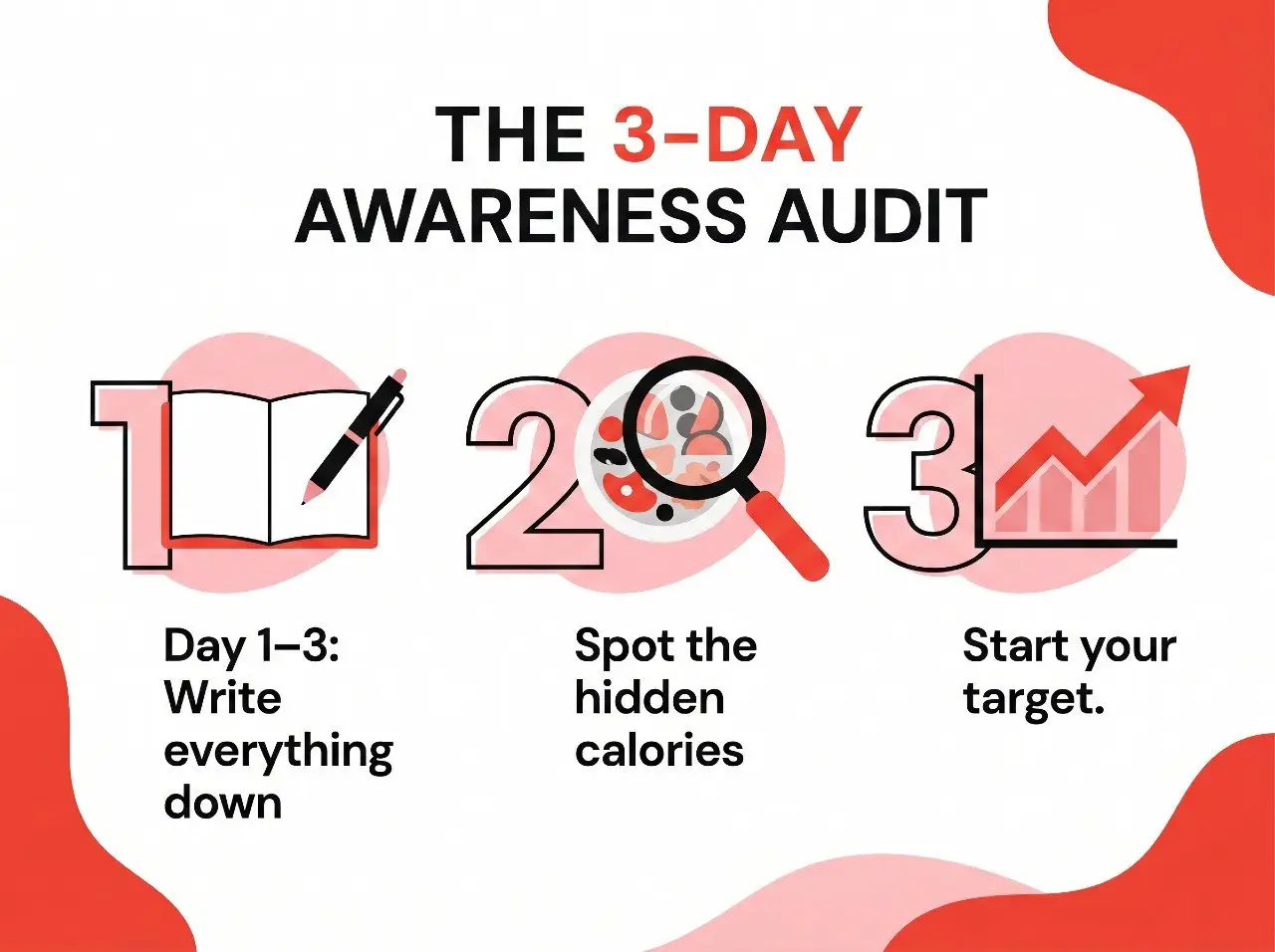
The 3-Day Awareness Audit (Start Here)
Before you set any calorie target, spend three days writing down everything you eat and drink — with no judgement and no numbers. Just observation.
This matters because of what I've noticed consistently: women who track for just three days without any calorie target become noticeably more conscious of their portions within a week.
The awareness alone shifts behaviour. You start to notice the handful of almonds you forget about, the cooking oil that doesn't make it into the mental tally, the second pour of wine. None of those things is "bad" — but you can't manage what you can't see.
After the 3-day audit, start adding calorie data.
Calorie Tracking Apps: What's Worth Using In 2026
The app landscape has changed. Here's an honest comparison of the current best options:
| App | Best For | Database Quality | Cost |
|---|---|---|---|
| MyFitnessPal | Beginners; largest food database | Very large (user-submitted, some errors) | Free / Premium |
| Cronometer | Nutrient-focused tracking; accuracy | Smaller but verified entries | Free / Gold |
| MacroFactor | Women wanting adaptive calorie targets | Excellent; algorithmically adjusts | Paid subscription |
| Lose It! | Simple interface; casual trackers | Good | Free / Premium |
Note: SparkPeople is no longer available (shut down in 2021). MacroFactor is particularly useful for women 40+ because it adjusts your calorie target based on your actual weekly weight trend — it accounts for metabolic adaptation rather than using a fixed calculator.

#2. Enlist An Accountability Partner
Having someone to check in with about your goals is one of the most underrated weight-loss tools available — and the research behind it is stronger than most people realise.
A study of more than 3,500 couples published in JAMA Internal Medicine found that both men and women had nearly double the weight-loss success when working toward the goal with a partner compared to going it alone.
Separate research found that social support influences 69% of weight-loss behaviours, and that regular accountability check-ins push goal completion rates dramatically higher than going solo.
Your accountability partner doesn't have to be on the same journey as you. They just need to be someone who will check in genuinely — not someone who'll say "oh you're fine" every time. A friend who asks "how did the logging go this week?" every Sunday is worth more than the most sophisticated app.
If you don't have someone in your life who fits that role right now, online communities (WLBF's community included) are a legitimate substitute. The mechanism that matters is consistent, non-judgmental check-ins.
#3. Eat Smarter, Not Just Less
Calorie counting works best when it's paired with food choices that make the deficit feel manageable. This isn't about clean eating or cutting out food groups — it's about understanding calorie density.
Join Our Mailing List
Join thousands of women inside our community and receive our free guide, 10 Actions That Support Permanent Weight Loss — the exact behavioural shifts that make the difference between a two-week attempt and a lasting transformation.
No restriction plans. No guilt. Just what actually works — for real women with real lives.
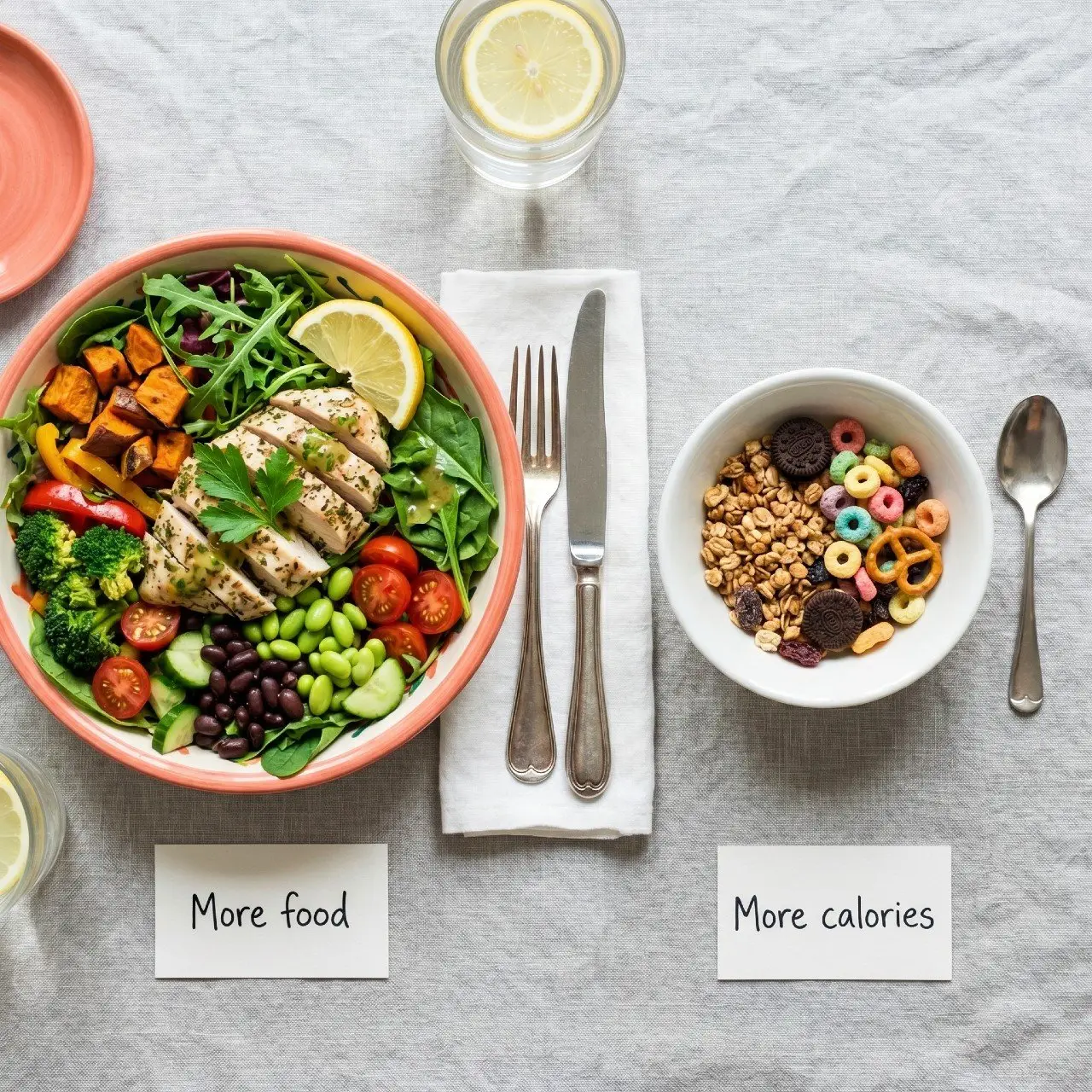
Fruits and vegetables are high in fibre and water, which means they take up more space in your stomach per calorie than processed foods do. Dietary fibre has been shown to reduce overall energy intake by slowing gastric emptying and increasing satiety hormones. In practical terms, a large bowl of roasted vegetables with chicken will leave you more satisfied than the same number of calories from crackers and cheese.
The common mistakes that undermine calorie counting aren't usually about main meals — they're about the edges:
- Cooking oils: A tablespoon of olive oil is 120 calories and takes two seconds to pour. Most people don't log it.
- Sauces and dressings: A generous pour of Caesar dressing can add 200–300 calories that never make it into a food diary.
- Liquid calories: A flavoured coffee drink, a glass of juice, or two glasses of wine can add 400–600 calories a day without ever registering as "food."
- The "healthy" trap: Foods marketed as healthy (granola, smoothies, protein bars) are often very calorie-dense. A 100g serving of granola averages 450 calories.
Calorie Density Comparison: Smart Swaps
| Instead of... | Try... | Calorie Saving |
|---|---|---|
| 100g granola (450 kcal) | 100g rolled oats, cooked (68 kcal) | ~382 kcal |
| Large Caesar salad with dressing (600 kcal) | Large green salad, olive oil + lemon (180 kcal) | ~420 kcal |
| Flavoured latte, medium (250 kcal) | Black coffee or Americano (5 kcal) | ~245 kcal |
| 30g mixed nuts (180 kcal) | 1 large apple + 1 tbsp almond butter (160 kcal) | ~20 kcal + more fibre |

#4. Be Mindful — Especially About The Sneaky Stuff
Mindful eating isn't a wellness buzzword — it's a practical strategy for the specific challenge most women face: eating in response to stress, boredom, or habit rather than hunger.
The key question to ask before eating anything outside of a planned meal: Am I actually hungry, or am I reacting to something? That one pause — just two seconds of checking in with yourself — is the difference between a conscious choice and a habit-driven one.
A few practical applications:
- Don't eat in front of a screen. Research consistently shows that distracted eating leads to higher calorie intake and lower meal satisfaction — meaning you eat more and enjoy it less.
- Use your food log as a pre-commitment device. Some people find it effective to log what they're planning to eat before they eat it. This creates a brief moment of reflection that can interrupt automatic eating.
- Give yourself a "no-log" option for one day a week. Rigid tracking can create an all-or-nothing mindset. One flexible day doesn't derail progress — it makes the other six days sustainable.
The goal isn't perfection. It's consistent, mostly-conscious eating that you can maintain for months rather than days.
Related Articles
The Bottom Line
Calories matter. The evidence on that point is clear, and a deficit, sustained over time, is the mechanism behind every successful fat loss approach, regardless of what the diet is called.
But the approach has to fit your body and your life. After 40, that means accounting for a metabolism that burns fewer calories than it used to, a tendency to underestimate portions (that affects nearly everyone, not just you), and a lifestyle that isn't compatible with weighing every gram of food forever.
Start with three days of awareness. Pick one tracking method you'll actually use. Find one person to check in with. Make smarter food choices at the edges. That's the full system — and it works.
Glossary Of Key Terms
FAQ
Declining oestrogen during perimenopause reduces lean muscle mass (which burns calories at rest) and lowers basal metabolic rate by approximately 100–300 calories per day. At the same time, research shows postmenopausal women tend to underestimate their calorie intake by 37–42% — meaning the gap between "what I think I'm eating" and "what I'm actually eating" often widens precisely when the margin for error gets smaller.
There's no single answer because calorie needs vary significantly by age, height, weight, and activity level. A general starting point is a deficit of 300–500 calories below your TDEE, with most women in the 40–55 age range finding their maintenance calories sit between 1,600–1,950, depending on activity. The NIDDK Body Weight Planner gives a personalised estimate based on your actual data.
The most accurate method is weighing food on a digital kitchen scale and logging it in a verified database like Cronometer (which uses USDA-verified entries). That said, accuracy matters less than consistency. A slightly imprecise log you keep every day produces better results than a perfectly accurate log you abandon after a week.
No. Most people use calorie tracking as a learning tool rather than a permanent practice. After 6–12 weeks of consistent logging, most women develop a reliable intuitive sense of portion sizes and calorie density that holds up without active tracking. Some return to logging briefly after holidays or when habits drift.
Yes — and it may be one of the most useful tools specifically because menopausal weight gain is often driven by a gradual, invisible calorie creep (eating the same amount while burning less). Tracking makes that invisible shift visible. Pairing calorie awareness with adequate protein intake (1.2–1.6g per kg of bodyweight) and strength training addresses all three drivers of menopausal weight gain simultaneously.
The most common errors are not logging cooking oils and sauces, underestimating restaurant portions (which average 2–3x larger than home portions), forgetting liquid calories (coffee drinks, juice, alcohol), and using packaged serving sizes that don't reflect how much is actually eaten. The 3-Day Awareness Audit described in this article is specifically designed to surface these hidden calories before you set any target.
Yes, and the framing matters enormously. Tracking is a data-collection exercise, not a moral scorecard. A useful mental shift: think of your food log the same way you think of a bank statement — it's just information about what happened, not a judgement of your character. If you notice tracking is increasing anxiety or preoccupation with food beyond what feels healthy, step back and speak with your doctor or a registered dietitian.