
Beyond The Squat: 7 Surprising Secrets To Sculpting Your Sexiest, Strongest Glutes Ever
Obstacles don't have to stop you. If you run into a wall, don't turn around and give up. Figure out how to climb it, go through it, or work around it.
Michael Jordan
Achieving superior glute hypertrophy requires a strategic combination of compound movements and targeted isolation exercises designed to maximize muscle fiber recruitment. For dedicated gym goers, mastering the mechanics of the barbell hip thrust, Romanian deadlift, and back squat is essential for building a powerful, aesthetic lower body.
This guide prioritizes evidence-based training techniques that emphasize progressive overload and proper biomechanical alignment, ensuring that every repetition contributes to significant gluteus maximus development while maintaining long-term joint health and functional strength.
Having a sexy butt is something that almost every woman dreams of, right? We are not all born with sexy butts, unfortunately, and to get the butt you desire, you must work for it.
Have you ever finished a grueling leg day with your quads on fire, yet your glutes feel frustratingly "soft" and unengaged? Many women pour hours into their booty workout only to find their progress plateauing.
The issue often isn't a lack of effort, but a physiological hurdle Bridie Wilkins and other experts call "butt amnesia." This occurs when your glutes fail to "switch on," forcing your lower back and knees to shoulder the load of your fitness routine.
To achieve a truly sexy butt, we must recalibrate your movement patterns to target the entire posterior chain: the Gluteus Maximus (the powerhouse for "pop"), the Gluteus Medius (the stabilizer for side-shaping), and the Gluteus Minimus (the deep muscle providing lift).
By integrating the latest biomechanical protocols from experts like Stephen Pasterino, Paul Stoicescu, and Bret Contreras, you can unlock the kinetic potential of your buttock muscles. Here are seven evidence-based secrets to transform your body sculpting journey.
Key Takeaways
- Combat "Butt Amnesia" with Activation: Prevent your lower back and knees from taking the strain by "waking up" your glutes before heavy training. Incorporating 3–4 bodyweight moves like clams, glute bridges, and fire hydrants ensures the muscles are primed to fire correctly.
- Prioritise Unilateral Training: Switching from double-leg movements to single-limb exercises, such as single-leg deadlifts or box step-ups, can increase muscle firing by 33%.
- Master Specific Biomechanical Angles: To shift the focus of lunges from the quads to the glutes, adopt the "Golden Angle" by tilting your torso forward to 45 degrees.
- Balance Your Routine with the 3:2 Ratio: Follow the Stoicescu Protocol by performing three compound exercises (for mass) for every two isolation moves (for lift and definition).
- Optimise Growth Through Rest: Real muscle growth occurs during the repair phase, not the workout itself. Limit glute-specific training to 2–3 times per week, allowing 48 to 72 hours for cellular repair and the synthesis of new muscle tissue.
- Focus on the "Maximum Squeeze": Quality of movement is superior to the amount of weight lifted; always prioritise a mindful contraction at the peak of every repetition.
Secret #1: The 33% Advantage Of Unilateral Training
To maximize the efficiency of your lower body training, you must embrace instability. According to research cited by fitness experts, switching from double-leg movements to unilateral (single-limb) exercises can increase muscle firing by a staggering 33%.
When you perform a single-leg deadlift or a box step-up, your glutes are forced to work exponentially harder to stabilize the pelvis. This is particularly true for lateral movements. Note that even the smallest movements can yield the most significant recruitment for the Gluteus Maximus and Medius.
Don't let the small range of leg lift motion fool you. Your buns are sure to be burning with this exercise. By prioritizing these single-leg variations, you aren't just working harder; you're working smarter, achieving more growth in less time by challenging the muscle's stabilizing capacity.
Get A Butt Lift In 14 Days (Pumped And Rounded)
This is an intense 15-minute at-home workout challenge to lift, pump and round your butt in 14 days. These exercises will help you grow your glutes and get a round, shaped, perky and lifted bum.
Secret #2: The "Golden Angle" For Lunge Activation
Lunges are a foundational pillar of glute exercises, but most practitioners miss the subtle shift that moves the burn from the quads to the glutes. Renowned specialist Bret Contreras recommends a specific "Golden Angle": tilting your torso forward to a 45-degree angle during the descent.
This postural adjustment shifts your center of gravity, forcing the Gluteus Maximus to take on the majority of the load. While a traditional upright lunge is quad-dominant, this 45-degree lean ensures that every repetition contributes directly to rear-end toning. It is the difference between simply moving weight and strategically sculpting your silhouette.
Join Our Mailing List
See how easily you can get fitter.
Sign up to get your free PDF report on 10 Actions That Support Weight Loss sent to your inbox!
Secret #3: Why "Deep Squats" Double Your Effort
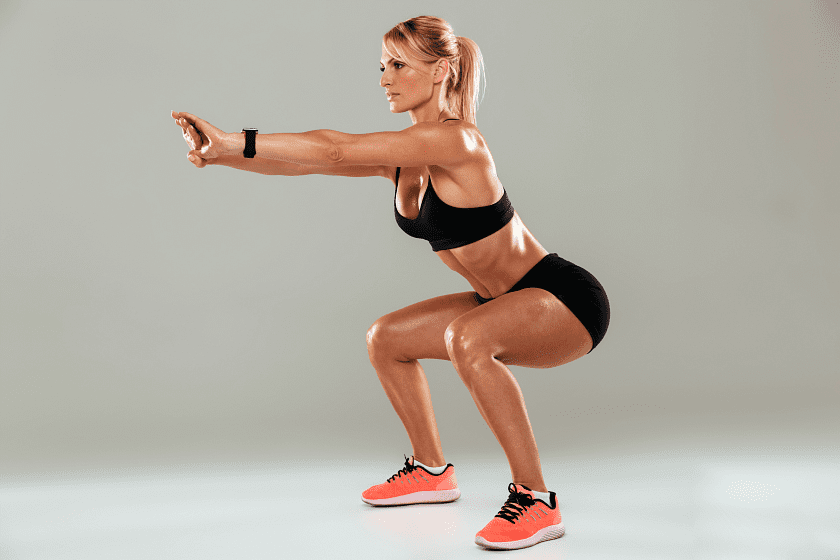
In the world of body sculpting, depth is the ultimate currency. While many avoid going low due to a fear of knee strain, the source data is clear: "deep squats"—where the hips dip below the level of the knees—can almost double the effort required from the glutes as you drive back to standing.
To protect the joints while maximizing the "peach" effect, always ensure your knees track in line with your toes and your weight stays firmly in your heels. Deep squats allow for a greater stretch-shortening cycle, which is essential for developing the power and shape of a firm butt.
Secret #4: Curing "Butt Amnesia" With Activation
As Bridie Wilkins explains, "butt amnesia" is a silent progress-killer. When these muscles stay sedentary, the surrounding joints—the lower back, hips, and knees—take the extra load, leading to pain and poor posture.
Stephen Pasterino, founder of P.volve, emphasizes that you must "wake up" the muscles before entering heavy resistance training. Incorporate 3–4 bodyweight activation moves at the start of every session:
- Clams: Essential for targeting the Medius and "opening" the hips
- Glute Bridges: To prime the posterior chain for lifting
- Fire Hydrants: For lateral shaping and hip stability
Beyond the aesthetic "lift," curing butt amnesia ensures your body functions as a cohesive, powerful unit, reducing chronic pain and enhancing athletic performance.
Secret #5: The 3:2 Ratio: The Stoicescu Protocol
For a structured approach to firm glutes, expert Paul Stoicescu recommends a specific exercise ratio to balance mass-building with fine-tuned sculpting. His protocol suggests a 3:2 ratio: three compound exercises for every two isolation moves.
Compound moves like deadlifts provide the "mass," while isolation moves like weighted kicks provide the "lift" and the "underbutt" definition. For optimal results, Stoicescu recommends performing 3-4 sets of 15 repetitions with strictly 1-minute breaks to keep the metabolic stress high.
The Stoicescu "Top 5" Routine
- Squats (Compound - Mass)
- Deadlifts (Compound - Mass)
- Hip Thrusts (Compound - Mass/Squeeze)
- Lunges (Unilateral - Balance)
- Weighted Kicks (Isolation - Lift/Sculpt)
Secret #6: The Counter-Intuitive Truth: Rest Is Where Growth Happens
One of the hardest mental hurdles in fitness is the "more is better" culture. However, the aesthetic "lift" you desire does not manifest during the workout itself. Heavy resistance training creates microscopic tears in the muscle fibers; the actual growth happens during the cellular repair phase.
Training your glutes every day is counterproductive. To see a sexy butt emerge, you should limit glute-specific training to 2–3 times per week. Giving your body 48 to 72 hours of recovery allows for the synthesis of new muscle tissue, turning your hard work into visible results.
Join Our Mailing List
Are you ready to get in shape? Join us and get the list of top 10 actions that support PERMANENT weight loss, make you look and feel better without being hungry in the process!
Secret #7: Mind-Muscle Connection And "Maximum Squeeze"
Mindless repetition is the enemy of a firm butt. To truly shape the glutes, you must cultivate a "Maximum Squeeze" at the peak of every movement. Fitness expert Lilly Sabri offers two essential technical cues for glute bridges and donkey kicks: flex your feet and tuck your tailbone under.
These cues prevent the lower back from arching and ensure the tension stays entirely on the gluteal muscles. Mindful contraction—clinching the muscle at 100% of its maximum at the top of a hip thrust—is far more effective for body sculpting than lifting heavy weights with poor form.
Related Articles
The Bottom Line
If you want a sexy butt in no time, try the exercises above. You will notice a huge difference in the way your bum looks, and you will continue to see improvement as you continue to work out.
Sculpting a strong, firm butt is a science, not a secret. By moving beyond the basic squat and incorporating unilateral movements, the "Golden Angle" for lunges, and the Stoicescu Protocol, you bypass the plateaus that stall most fitness routines.
The real question is: Are you willing to trade ego-lifting for the "Maximum Squeeze"? Challenge yourself to prioritize form, depth, and the 45-degree tilt in your next session. If you are willing to slow down and focus on the mindful contraction of the muscle, your sexy butt is only a few targeted workouts away.
Embrace Inspiration:
Like What You Read? Be Sociable, Comment, And Share It! Thanks.
Glossary Of Key Terms
• Butt Amnesia: A condition where the gluteal muscles remain inactive or "unengaged" during movement, leading to compensations by the lower back and knees.
• Compound Exercises: Movements that engage multiple muscle groups and joints simultaneously, such as squats and deadlifts, are primarily used for building muscle mass.
• Gluteus Maximus: The largest of the three gluteal muscles, responsible for providing the "power" and "pop" of the buttocks.
• Gluteus Medius: The muscle located on the side of the hip that acts as a stabilizer and is essential for lateral shaping.
• Gluteus Minimus: The deepest of the gluteal muscles, which provides structural lift to the buttocks.
• Hypertrophy: The process of muscle growth and an increase in cell size, triggered by resistance training and proper recovery.
• Isolation Moves: Exercises that target a specific muscle group to fine-tune definition and "lift," such as weighted kicks.
• Mind-Muscle Connection: The practice of using mindful, conscious contraction to ensure the target muscle is doing the work during an exercise.
• Posterior Chain: The group of muscles on the backside of the body, including the glutes, hamstrings, and lower back.
• Stoicescu Protocol: A specific training methodology suggesting a 3:2 ratio of compound to isolation exercises, performed in 3-4 sets of 15 repetitions.
• Unilateral Training: Exercises performed using a single limb, such as a single-leg deadlift, to increase muscle recruitment and pelvic stability.
• The Golden Angle: A specific 45-degree forward torso tilt used during lunges to maximize gluteal activation and minimize quadriceps dominance.
FAQ
To build a stronger, more toned backside, focus on compound movements targeting the gluteus maximus, medius, and minimus. The most effective exercises include squats, walking lunges, and glute bridges. These moves engage multiple muscle groups simultaneously, ensuring maximum calorie burn and muscle definition.
For optimal results, maintain proper form by keeping your back straight and engaging your core throughout each repetition. Incorporating resistance bands or dumbbells can further increase intensity as your strength improves.
By varying your foot placement, you can target different angles of the glute muscles for a fuller look. Consistently performing these specific movements two to three times a week is the key to sculpting a firmer, sexier butt over time.
When combined with a good diet and cardio exercise, you can see results within about three weeks. At around six to eight weeks, you'll see signs of muscle development in the glutes and hamstrings, with a supple, tighter butt.
Two to three times a week is enough! That's because the in-between recovery days are just as important for your glute strength. Pay attention to how you feel and any noticeable dips in strength from workout to workout.
The most effective exercises for toning and lifting the buttocks are squats, lunges, glute bridges, and deadlifts. Squats and lunges target the gluteus maximus, gluteus medius and gluteus minimus, providing a comprehensive workout for the entire area. Glute bridges and deadlifts are excellent for isolating and strengthening the glutes, resulting in a firmer and lifted appearance.
For best results, aim to train your glutes at least 2-3 times per week. This frequency allows for adequate muscle recovery between sessions, while maintaining a consistent stimulus for muscle growth and toning. Be sure to include a variety of exercises to target all areas of the glutes and avoid plateauing.
Yes, bodyweight exercises can be very effective for toning the buttocks. Exercises such as squats, lunges and donkey kicks require no equipment and can significantly tone and strengthen the glutes. As you progress, you can add resistance with bands or weights to increase the intensity.
You do not necessarily need a gym membership or heavy machinery to start toning your glutes, as bodyweight exercises can be highly effective for beginners. Movements like air squats, lunges, and step-ups provide a solid foundation for building strength and endurance.
However, to continue seeing progress and building muscle mass, you will eventually need to introduce resistance. Simple home equipment like resistance bands, a pair of dumbbells, or a kettlebell can significantly increase the challenge of your workout.
Adding this resistance creates the necessary stimulus for muscle growth, known as hypertrophy. Therefore, while bodyweight moves are a great starting point, incorporating weights is essential for long-term sculpting and definition.
One of the most common mistakes women make when training glutes is relying too heavily on their quadriceps instead of engaging the posterior chain. This often happens during squats or lunges if your weight shifts too far forward. To fix this, focus on driving through your heels and squeezing your glutes at the top of every movement.
Additionally, sacrificing form for heavier weights can lead to lower back injuries; always prioritize technique over load. Another frequent error is performing exercises too quickly without mind-muscle connection. Slowing down the tempo allows you to feel the burn in the target muscles, ensuring that your glutes are doing the work rather than momentum carrying you through the set.
Exercise alone is not enough to build a shapely physique; nutrition plays a fundamental role in muscle recovery and growth. To build glute muscles effectively, you need to consume enough protein to repair the muscle fibers torn during your workout. Aim to include lean sources like chicken, fish, tofu, or legumes in every meal.
Furthermore, staying hydrated and eating complex carbohydrates provides the energy required to power through intense leg workouts. If you are not fueling your body correctly, you may find it difficult to gain muscle definition or recover from soreness. Combining the targeted exercises mentioned in the article with a balanced, protein-rich diet creates the ultimate formula for a lean, strong body.
Join Our Mailing List
See how easily you can get fitter.
Sign up to get your free PDF report on 10 Actions That Support Weight Loss sent to your inbox!