
The Control Map: What You Can’t Control, What You Can Influence, And What You Can Fully Control
Epictetus
Stoic philosopher
To make the best of what is in our power, and take the rest as it occurs.
Summary (TL;DR)
Perimenopause weight gain is real, common and usually modest, about 1 to 1.5 pounds a year on average. It happens because fat gain speeds up and shifts to your belly, muscle slowly shrinks, daily movement drops, and sleep worsens. Your metabolism didn’t crash, and “estrogen dominance” isn’t a diagnosis. Focus on what you can control: strength training, protein at every meal, fiber and steps, and protecting your sleep.
You eat the same breakfast you’ve eaten for ten years. You still walk the dog and skip the office cake. Yet your jeans get tighter at the waist every season. Mention it to your doctor, and you hear, “It’s just your age.” You deserve better than a shrug.
Perimenopause weight gain is not a willpower problem, and you are not imagining it. In the long-running SWAN study (Study of Women’s Health Across the Nation), the rate of fat gain doubled and lean mass started to fall as women entered the menopause transition. Things did change. They just changed inside your body, where you can’t see them.
This guide explains those changes, debunks two popular explanations, and sorts every cause into our Control Map: what you can’t control, what you can influence, and what you can control.
Medical & Referral Disclaimer
This article is for educational purposes only. It isn’t medical advice and doesn’t replace a conversation with your doctor, a registered dietitian or a menopause specialist. Weight gain in midlife can also come from thyroid problems, medications, sleep apnea and other conditions. Talk to a healthcare professional before making big changes, especially if your weight changed suddenly or you take regular medication.
Key Takeaways
- It’s usually modest: Average midlife gain is roughly 1 to 1.5 pounds a year, not pounds a month.
- Fat speeds up and moves: In SWAN, fat mass rose about 1.0% a year before the transition and 1.7% a year during it, and more of it settles around your middle.
- Muscle quietly slips: Lean mass starts declining once the transition begins, which changes your shape before it changes the scale.
- Insulin resistance speeds up too: A 2026 SWAN analysis found it rose about 4.3% a year during the transition, versus 1.2% a year before.
- Your metabolism didn’t crash at 40: Body-size-adjusted energy use stays stable from about 20 to 60.
- “Estrogen dominance” is a theory, not a diagnosis: Hormones swing in early perimenopause, but detoxes and “balancing” pills don’t fix that.
- The changes level off: In SWAN, fat and lean mass shifts settled about two years after the final period.

What Is Perimenopause Weight Gain, And How Much Is Normal?
Perimenopause weight gain is the slow rise in weight, and especially belly fat, that many women notice in the years before their final period. Large studies put the average at roughly 1 to 1.5 pounds a year. The bigger change is often in shape: more fat around the waist and less muscle, even when the scale barely moves.
Perimenopause usually starts in your 40s and can last several years, with irregular periods and swinging hormone levels.
So how much is “normal”? Search the topic, and you’ll find numbers that contradict each other. Here’s what the main sources actually say.
What The Numbers Actually Say
| Source | What They Report | What It Means For You |
|---|---|---|
| SWAN weight study | Average weight rose about 2.1 kg (4.6 lb) over 3 years in midlife women | Roughly 1 to 1.5 lb a year is a fair average |
| Mayo Clinic | About 1.5 lb (0.7 kg) a year as women go through their 50s | Gain often continues past perimenopause |
| Australasian Menopause Society | About half a kilo (1.1 lb) a year between ages 45 and 55 | Aging and lifestyle drive much of the total |
| SWAN body composition study | Fat gain rate doubles and lean mass declines from the start of the transition | Your shape can change more than your weight |
| Ohio State Health | One to two pounds a month, starting in perimenopause | Far above the study averages; fast gain is a reason to see your doctor |
Our take at WLBF: the average gain is real but modest, and spread over years. Several pounds a month is a signal to get checked, not something to blame on perimenopause.
Bloating can also make your waist look bigger from day to day. If your stomach swells and shrinks with your cycle, read our guide to perimenopause bloating vs belly fat before you assume it’s all fat.
Why Does Perimenopause Weight Gain Happen Even When Nothing Else Changes?
Weight creeps up in perimenopause because several quiet changes stack up at once. Fat gain speeds up and shifts to the belly, muscle slowly declines, daily movement drops, sleep breaks up, and insulin resistance rises. Your habits may look the same, but your body is responding to them differently.

Here’s how we see it at WLBF. As the menopause transition gets going, fat gain speeds up sharply (SWAN’s authors describe the rate as doubling), more of it moves to your abdomen, and muscle loss speeds up.
That’s why women need more daily protein and fiber, not severe calorie cuts. To be precise, SWAN ties these shifts to the transition as a whole, not to falling estrogen alone. Five changes sit behind it.
Fat Moves To Your Middle
Before perimenopause, estrogen tends to steer fat toward your hips and thighs. As the transition progresses, more fat settles deep in your belly, around your organs. This is called visceral fat. In one SWAN analysis, visceral fat grew by roughly 6% a year during the transition.
A smaller study that followed women for four years found that everyone gained some fat under the skin, but only the women who became postmenopausal saw a significant rise in visceral fat. In those women, fat burning also dropped by 32%. That’s why your waistband can tighten while the scale barely moves.
Declining Muscle Mass
Muscle doesn’t disappear overnight. A review of muscle and aging found women lose a median of about 0.37% of their muscle a year across adulthood, and strength fades even faster than size. SWAN found that lean mass begins to decline once the transition starts.
Less muscle means slightly fewer calories burned and less room to store blood sugar. Small alone, it adds up with the other changes.
Daily Movement Drops Without You Noticing
This is the change most women miss. In the Canadian MONET study, researchers tracked energy use in 102 women for five years. Total energy use fell after menopause, mostly because everyday activity fell. Time in moderate activity went down, and sitting time went up.
After a night of hot flashes, you take the lift, sit longer and skip the evening stroll. It doesn’t feel like a choice. It feels like being tired.

Cortisol And Belly Fat, Plus Broken Sleep
Night sweats and 3 a.m. wake-ups are classic perimenopause complaints, and poor sleep matters for weight. In a controlled lab study, five nights of short sleep led to weight gain, and in women it weakened dietary restraint. Tired brains reach for quick energy.
Stress is the other half. A Yale study found that women with more central fat released more cortisol under stress, the hormone your body makes when it feels under pressure. If stress feels like your main issue, our guide to cortisol belly vs hormonal belly helps you tell the patterns apart.
Insulin Resistance After 40 Rises Faster
Insulin is the hormone that moves sugar from your blood into your cells. When cells respond less well, that’s insulin resistance, and it’s linked with more fat around the middle.
A 2026 SWAN analysis of 1,315 women found that insulin resistance rose about 4.3% a year during the transition, compared with 1.2% a year before it and 0.9% after.
Weight gain explained less than a quarter of that rise, so the transition itself seems to push insulin resistance up. For the full picture, see our guide to insulin resistance in perimenopause.
Put together, “nothing changed” becomes this list:
- Fat storage: faster, and more of it around your belly
- Muscle: slowly shrinking, with strength fading first
- Everyday movement: lower, often without you noticing
- Sleep: lighter and more broken, which nudges appetite up
- Blood sugar handling: less efficient as insulin resistance climbs
Did Your Metabolism Really Crash At 40?
No. A study of more than 6,400 people found that total daily energy use, adjusted for body size, stays stable from about age 20 to 60, including through menopause. What changes in your 40s is body composition and daily movement, not a sudden metabolic shutdown.
“My metabolism crashed” is the explanation you’ll hear most, from friends, wellness ads and even some health sites. It feels true. The best data says otherwise.
In 2021, researchers pooled data from 6,421 people in 29 countries, measured with the gold-standard “doubly labeled water” method. They found that energy expenditure stays stable in adulthood, from 20 to 60 years, once you account for body size. Menopause didn’t show up as a turning point.
To be fair, the picture isn’t perfectly simple. A study that included twins found that resting energy use declines gently with age, but menopause itself may not add to that decline. Either way, there’s no cliff at 40.
Why does this matter? If you believe your metabolism is broken, the obvious fix is to eat less and less. That’s the move that backfires, because crash dieting costs muscle. The real story is less muscle, less movement and more belly fat. Those are things you can work on.

Estrogen Dominance: What’s Real And What’s Marketing
Spend five minutes on social media, and someone will blame your perimenopause weight gain on “estrogen dominance,” usually right before selling you a detox tea. Here’s the science behind the sales pitch.
What’s real: early perimenopause isn’t a smooth slide in estrogen. As ovulation becomes less regular, your body makes less progesterone. Meanwhile, estrogen can surge and crash. Endocrinologist Jerilynn Prior’s research center reports that average estrogen levels in perimenopause can run higher than in younger women. A clinical review agrees that perimenopause is not simply a loss of estrogen, but a time of big hormone swings.
What’s marketing: “estrogen dominance” is not a recognized medical diagnosis with agreed tests or cut-offs. There’s no good evidence that detoxes, cleanses or “hormone-balancing” supplements fix it or cause fat loss. If a product promises to “flush out excess estrogen,” keep your wallet closed.
Here’s what to do instead:
- Track symptoms, not buzzwords: write down heavy or irregular periods, breast tenderness and mood swings, and share them with your doctor.
- Skip the detox aisle: your liver and kidneys already do that job.
- Feed your body well: no single food balances hormones, but a protein- and fiber-rich perimenopause diet supports the systems that are struggling.
The Control Map: Sorting Every Driver Of Midlife Weight Gain
When everything feels out of control, sort the causes into piles. That’s our Control Map. Every driver of perimenopause weight gain fits one of three zones.
- Can’t control: accept these and stop spending energy on them.
- Can influence: you can’t switch these off, but habits (and sometimes your doctor) can turn them down.
- Can control: fully in your hands, and where effort pays off most.
Your Control Map At A Glance
| Zone | Driver | What You Can Do |
|---|---|---|
| Can’t Control | Age, timing and family fat pattern | Accept it; measure your waist, not just your weight |
| Can’t Control | Estrogen and progesterone swings | Track symptoms; see your doctor if they’re severe |
| Can Influence | Where fat is stored | Strength training and activity reduce visceral fat |
| Can Influence | Hot flashes and broken sleep | Cool bedroom; less late alcohol; ask about treatment |
| Can Influence | Stress, cortisol and insulin resistance | Daily recovery habits; walk after meals |
| Can Control | Strength training and protein | Lift 2 to 3 times a week; protein at every meal |
| Can Control | Fiber and daily steps | Half your plate plants; add steps gradually |
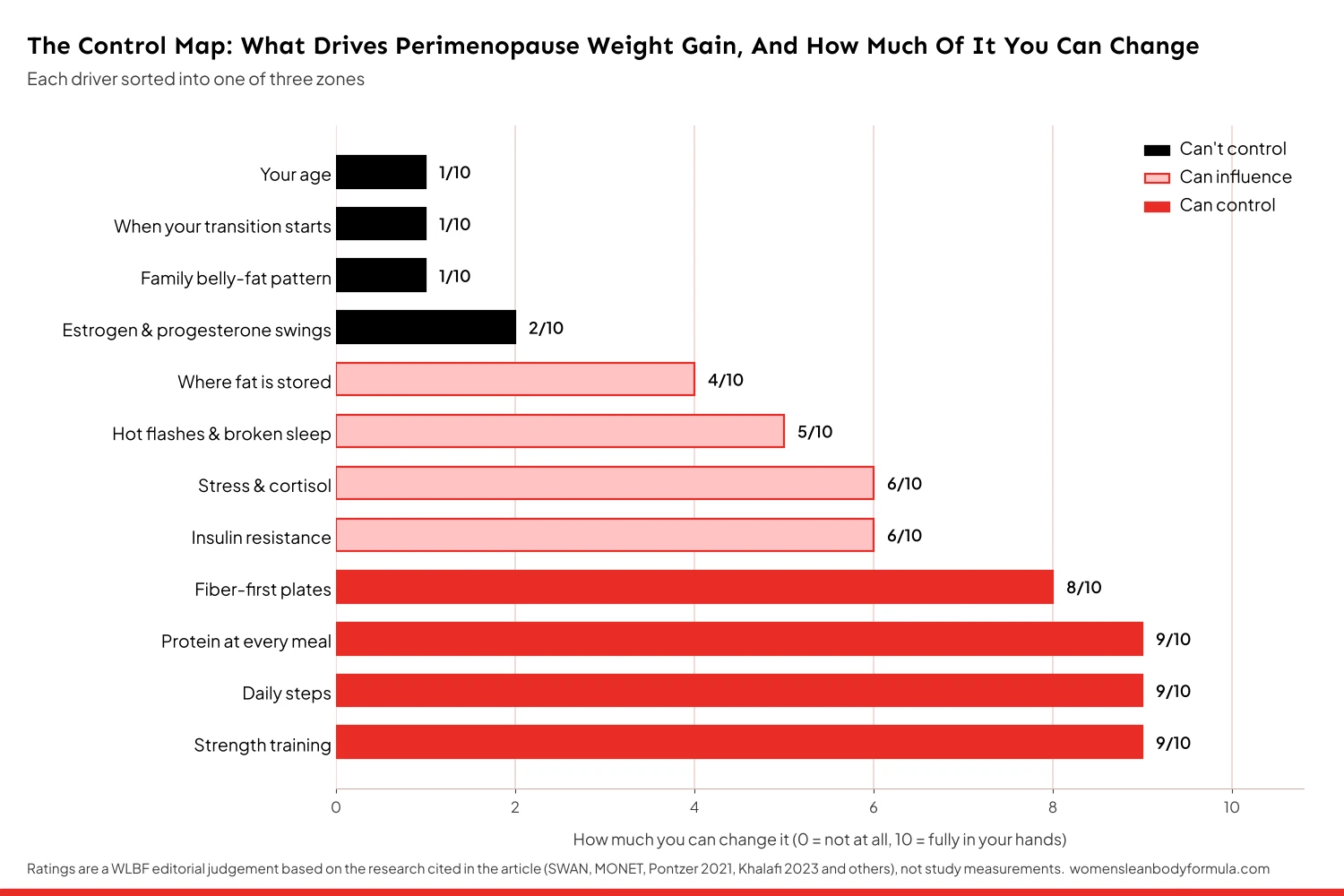
Look at the long bars. What feels biggest, like hormones and age, sits in the zone you can’t change. What feels small and boring, like steps and protein, is where you have nearly full control. Your effort has somewhere useful to go.
The 5 Levers You Can Pull This Month
You don’t need a new diet or a punishing workout plan. Start with one or two habits. Our rule of thumb: 70% consistency beats 100% for two weeks.
| Lever | Starting Dose | Why It Works |
|---|---|---|
| Strength training | 2 sessions a week, 20 to 30 minutes | Protects muscle and reduces body fat |
| Protein | About 25 to 30 g per meal | Gives muscle the building blocks to repair |
| Fiber | Work toward 25 to 29 g a day | Keeps you full and supports blood sugar |
| Steps | Add 1,000 to 2,000 a day to your current count | Replaces the everyday movement that quietly dropped |
| Sleep | Fixed wake time, cool bedroom | Steadies appetite and energy |
Strength Training For Perimenopause
If you only pick one lever, pick this one. A meta-analysis of 101 trials in 5,697 postmenopausal women found that exercise training increased muscle and cut fat mass, waist size and visceral fat.
Resistance training was best for muscle, aerobic or combined training for fat. Another review found resistance training improved body fat and metabolic risk in postmenopausal women.
Start with squats, wall push-ups and dumbbell rows. Our strength training for women in perimenopause guide walks you through a simple plan.
Protein Intake Over 40
Our stance at WLBF is a target of 1.2 to 1.6 g of protein per kilogram of body weight a day, with the standard 0.8 g/kg treated as a floor, not a goal.
An expert group on protein for older adults (PROT-AGE) recommends at least 1.0 to 1.2 g/kg a day for older adults, and more for active people, so our range sits at the active end. A large analysis of strength trainees found gains leveled off around 1.6 g/kg a day.
Your body can’t bank protein for later, so spread it out. One study found that eating protein evenly across three meals boosted muscle building by about 25% compared with saving most of it for dinner. For food ideas, see our guide to protein for perimenopause.
Fiber-First Plates
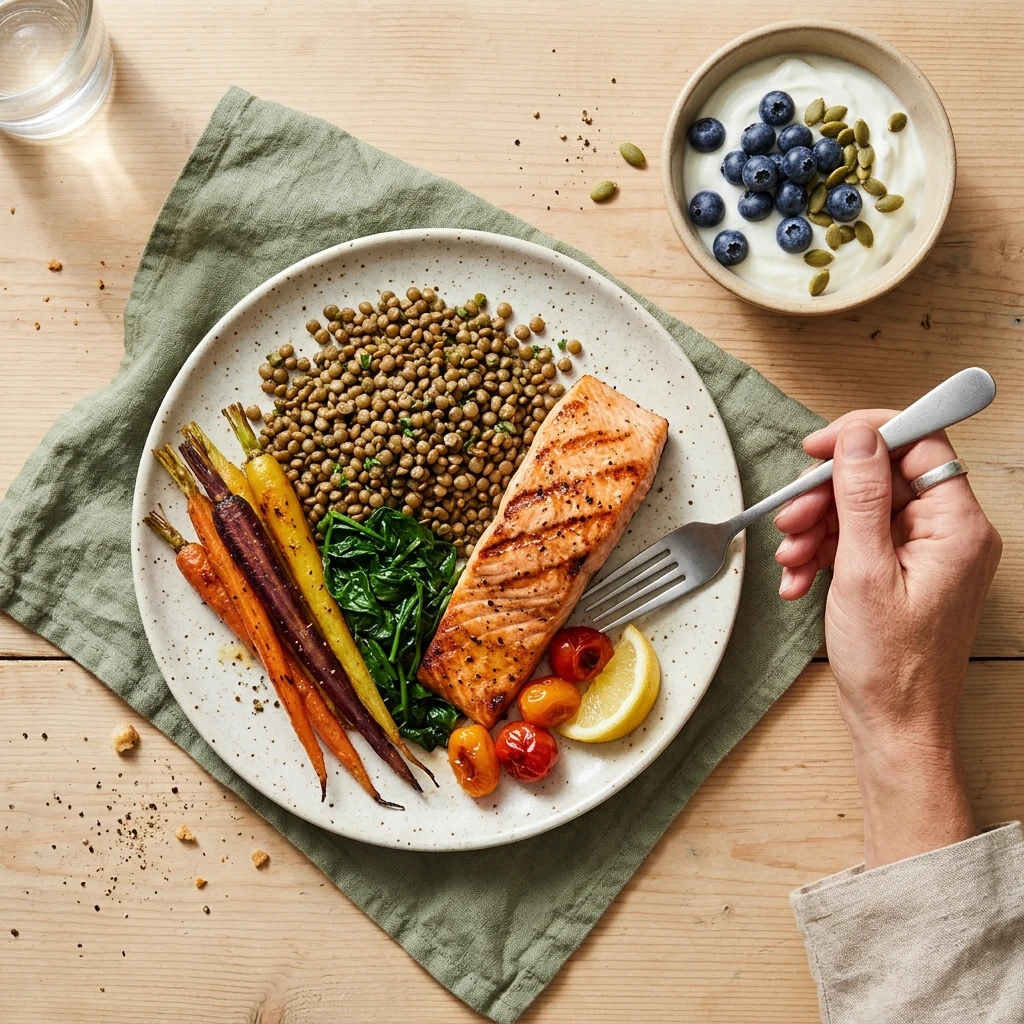
Fiber fills you up and slows the blood sugar rise after meals. A major Lancet review linked 25 to 29 g of fiber a day to lower rates of heart disease, stroke and type 2 diabetes. Beans, lentils, berries, oats, vegetables and whole grains make it easy.
Sleep And Stress
You can’t will away hot flashes, but you can make sleep easier. Keep your bedroom cool and dark, wake at the same time daily and go easy on evening alcohol. For stress, small and daily beats long and rare: a 10-minute walk or a phone-free half hour before bed.
Daily Steps
Steps quietly replace the movement that slipped away. In a pooled analysis of 15 studies, the drop in death risk leveled off around 8,000 to 10,000 steps a day for adults under 60. You don’t have to hit that tomorrow. Add a short walk after your biggest meal and build from there.
Do Hormone Therapy Or GLP-1 Medicines Help?
Hormone therapy (HT, also called HRT) is mainly a treatment for hot flashes and night sweats. Mayo Clinic experts note that HT isn’t recommended for preventing or treating weight gain, though it may help with fat distribution.
It doesn’t cause weight gain either: the Australasian Menopause Society calls that idea a myth. Better sleep can also make the other levers easier.
GLP-1 medicines are weight-management drugs that curb appetite. Tirzepatide (Zepbound), like semaglutide (Wegovy) before it, is approved for chronic weight management in adults with obesity, or overweight plus a weight-related condition.
They’re a medical decision, not a perimenopause shortcut. Whatever you choose, strength training and protein still protect your muscle. If you’re curious about either option, talk to your doctor.
Does Perimenopause Weight Gain Go Away?
The fast phase doesn’t last forever. In SWAN, the speed-up in fat gain and muscle loss continued until about two years after the final period, then leveled off. Weight you’ve already gained doesn’t vanish on its own, but steady habits can reduce belly fat and rebuild muscle at any age.

If you’re worried this will go on forever, here’s some relief. In SWAN, body composition stabilized after that two-year mark, and insulin resistance slowed to about 0.9% a year.
The weight won’t vanish by itself, but the headwind eases. If your focus is now on losing what you’ve gained, our guide on why it’s so hard to lose weight in perimenopause covers the “how” in depth.
When It’s Not Just Perimenopause
Perimenopause gets blamed unfairly sometimes. Get checked if you notice:
- Fast gain: several pounds a month, or weight gain with no clear pattern
- Thyroid signs: tiredness, feeling cold, dry skin or constipation. Hypothyroidism is more common in women and can cause weight gain
- New medications: some antidepressants, steroids and other drugs can affect weight
- Loud snoring or gasping at night: possible sleep apnea, which disrupts sleep and appetite
- Swelling or sudden belly growth: new, persistent swelling needs a doctor, not a diet
How To Get Your Doctor To Take You Seriously
Being told “it’s just your age” stings when you’re doing everything right. Preparation turns a vague chat into a useful one. Bring:
- Numbers: your weight and waist measurement over the last few months
- A symptom list: periods, sleep, hot flashes, mood and energy
- Specific questions: “Can we check my thyroid, blood sugar and iron?” and “Am I a candidate for hormone therapy?”
- A clear goal: “I want to protect my muscle and my heart health,” not just “I want to lose weight”
Still brushed off? Ask for a menopause-trained clinician.
Ready to turn your own Control Map into a plan you’ll actually follow? Grab our free guide and join the newsletter. Each week you’ll get one practical, research-checked step for the zone you can control, written for real women in perimenopause, with no shame, no gimmicks and no 22-year-old workout plans.

The Bottom Line
Perimenopause weight gain isn’t a character flaw or a broken metabolism. Fat gain speeds up and moves to your middle, muscle slips, movement drops and sleep frays. Those changes are real, and their fastest phase is temporary.
Use the Control Map. Let go of what you can’t change, nudge what you can influence, and put your energy into the levers that are fully yours: lifting, protein, fiber and steps, while you protect your sleep. Sustainability beats intensity every single time.
Glossary Of Key Terms
- Perimenopause: The years before your final period when hormone levels swing and periods become irregular, often starting in your 40s.
- Menopause Transition: The research term for the stretch of perimenopause that leads up to your final period.
- Final Menstrual Period (FMP): Your last period. Menopause is confirmed after 12 months without one.
- Visceral Fat: Deep belly fat around your organs, linked to heart disease and diabetes.
- Lean Mass: Everything that isn’t fat: muscle, bone and water.
- Insulin Resistance: When cells respond poorly to insulin, so your body needs more of it to manage blood sugar.
- Cortisol: A hormone your body releases under stress; long-term high stress is linked to more belly fat.
- Estrogen Dominance: A popular term for estrogen being high relative to progesterone; not a recognized medical diagnosis.
- Total Daily Energy Expenditure: All the calories you use in a day, from breathing to walking.
- Hormone Therapy (HT): Prescription estrogen, often with progesterone, used mainly to treat hot flashes and night sweats.
FAQ
How Much Weight Do Women Usually Gain In Perimenopause?
Large studies such as SWAN put the average at roughly 1 to 1.5 pounds a year through midlife. In the SWAN study, women gained about 2.1 kg (4.6 lb) over three years on average. Some women gain more, and some none, but body shape may still change. Gaining several pounds a month isn’t typical, so raise it with your doctor.
Why Does Perimenopause Weight Gain Go To The Belly?
As the menopause transition progresses, fat storage shifts away from the hips and thighs toward the abdomen. SWAN and other studies show visceral fat, the deep fat around your organs, rises during the transition, while fat burning drops. Insulin resistance and stress can add to this. In trials of postmenopausal women, exercise training reduced visceral fat.
Is Weight Gain Worse In Perimenopause Or After Menopause?
The fastest changes in body composition happen during the transition. SWAN found fat gain sped up and lean mass declined from the start of the transition until about two years after the final period. After that, body composition stabilized. Weight can still creep up slowly with age, so habits remain important after menopause too.
Does HRT Cause Weight Gain?
No. The Australasian Menopause Society calls the idea that hormone therapy causes weight gain a myth. It isn’t recommended as a weight-loss treatment, but it may help with how fat is distributed. For some women, better sleep from fewer night sweats makes healthy habits easier. Talk to your doctor about whether hormone therapy is right for you.
Is Estrogen Dominance Causing My Weight Gain?
Probably not in the way social media suggests. Early perimenopause does bring swings in estrogen and lower progesterone, but “estrogen dominance” is not a recognized medical diagnosis.
No good evidence shows detoxes or hormone-balancing supplements cause fat loss. The best-supported drivers are body composition changes, less movement, poor sleep and insulin resistance.
How Long Does Perimenopause Weight Gain Last?
Based on SWAN data, the fast phase lasts through the transition and about two years past your final period. Then fat gain and muscle loss slow down. Weight already gained doesn’t disappear by itself. Steady strength training, protein and activity can help you reduce belly fat and rebuild muscle at any stage.
Can You Prevent Perimenopause Weight Gain?
You can’t control your hormones or your age, but you can reduce how much the changes affect you. Strength training two to three times a week protects muscle, and protein at every meal supports it. Fiber, daily steps and good sleep help keep belly fat and blood sugar in check. Starting before or early in perimenopause gives you the biggest advantage.