
Plain-English Answers On Dose, Side Effects And Brain Fog, Plus A 5-Question Screen To Decide If It’s Right For You
Marie Curie
Physicist & two-time Nobel Prize winner
Nothing in life is to be feared; it is only to be understood. Now is the time to understand more, so that we may fear less.
Summary (TL;DR)
Creatine for women over 40 is one of the best-studied supplements around, and it works best as a helper. With regular strength training, 5 grams a day of plain creatine monohydrate adds small, real gains in lean muscle and leg strength after menopause. Brain fog benefits look promising but aren’t proven yet, and the best trials show no bone density boost. If you have kidney problems, bipolar disorder, or you’re pregnant, talk to your doctor first.
Creatine for women over 40 has gone from gym-bro powder to the supplement every midlife influencer swears by. Depending on the post, it fixes brain fog, bones or mood. If you’re tired of being sold to, that much enthusiasm is a red flag in itself.
Here’s the part more women need to hear at 40: muscle loss doesn’t wait for your 60s. It’s already underway in midlife, picks up through the menopause transition, and your strength fades two to five times faster than your muscle size. That’s the real reason creatine deserves a look.
So we read the trials, not the headlines. Below you’ll find what creatine does, what it doesn’t do, the dose that matches the research, and a simple screen to decide if you should start it or skip it.
Medical & Referral Disclaimer
This article is for general education only and isn’t medical advice. Creatine is a dietary supplement, not a treatment for perimenopause symptoms, menopause or any medical condition. Talk to your doctor or pharmacist before starting it, especially if you have kidney disease, a mood disorder, take prescription medication, or are pregnant or breastfeeding. Stop and seek advice if you notice anything unusual.
Key Takeaways
- Small but real muscle gains: In a 2026 meta-analysis of postmenopausal women, creatine added 0.37 kg of lean mass (5 trials) and 7.5 kg on the leg press (3 trials) compared with placebo.
- Lifting is the deal-breaker: Benefits showed up at 5 grams a day or more combined with resistance training. Low doses without training did nothing measurable.
- No proven bone density boost: A 2-year trial in 237 women found no change in bone mineral density, despite what many supplement blogs claim.
- Brain fog is a “maybe”: Early perimenopause trials show interesting signals, but a 2026 randomized trial found no reaction-time advantage over placebo.
- The dose is simple: 5 grams of creatine monohydrate a day, any time, with a meal. No loading phase needed.
- Early scale bumps are mostly water inside muscle, not fat.
- Some women should skip it or ask first: kidney disease, bipolar disorder, pregnancy or breastfeeding.

What Does Creatine Do For Women Over 40?
Creatine supports cellular energy by helping your muscles and brain recycle ATP, the molecule cells use for quick bursts of energy.
Your body makes some, and you get some from meat and fish. Supplementing tops up your stores, which can help you push out a few more reps, recover between sets and, over time, hold on to muscle as you age.
Think of ATP (adenosine triphosphate) as your cells’ spending money. Creatine, stored as phosphocreatine, is the quick-access savings account that keeps ATP production going. That’s why it helps most with short, hard efforts like lifting, climbing stairs or carrying heavy shopping bags.
Why Women’s Creatine Stores Are Different
You’ll often read that women store “70–80% less creatine” than men. That’s only half the story.
A review of creatine in women’s health notes that women have much lower total stores and eat less dietary creatine, but they also have about 10% higher creatine concentration inside muscle. In plain terms, the gap comes from less muscle and less meat on the plate. Your muscle isn’t “broken.”
Hormones matter too. Estrogen shifts affect how women make, move and use creatine, which is why researchers now flag perimenopause and postmenopause as stages worth studying, while admitting the perimenopause data is still limited.
The Muscle Clock Starts Earlier Than You Think
A quantitative review of aging muscle found women lose a median of about 0.37% of muscle mass a year across adulthood, rising to roughly 0.64–0.70% a year by age 75. The bigger shock? Strength drops two to five times faster than size.
The menopause transition speeds things up. The Study of Women’s Health Across the Nation (SWAN), which has followed thousands of US women through menopause, found lean mass starts slipping, and fat starts climbing as soon as the transition begins.
That’s when stairs feel steeper, and grocery bags feel heavier, even if your routine hasn’t changed.
Does Creatine For Women Over 40 Actually Build Muscle?
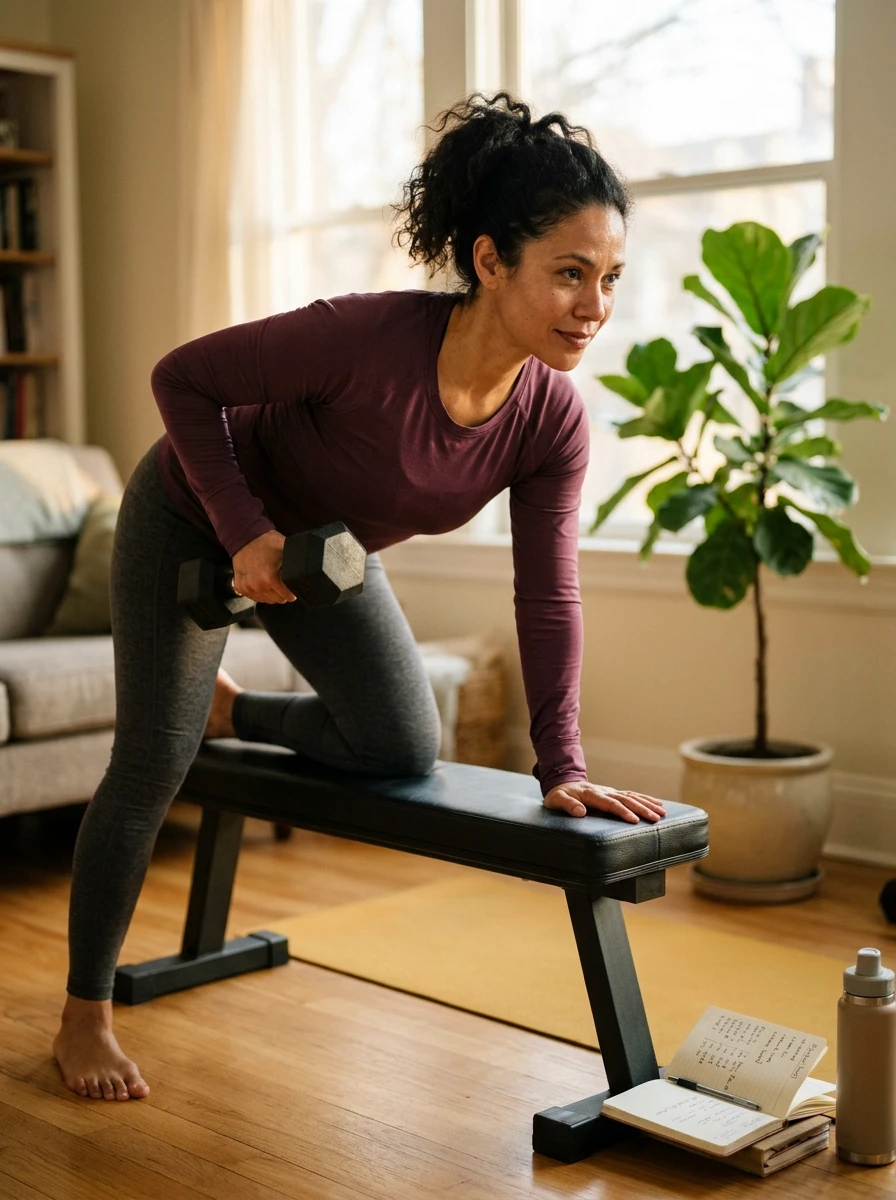
Yes, but only modestly, and only if you lift. A 2026 meta-analysis of seven trials in postmenopausal women found creatine added 0.37 kg of lean mass and 7.5 kg to leg-press strength versus placebo. The benefits showed up when women took 5 grams a day or more and did resistance training.
That’s from the most complete analysis so far, published in the Journal of the International Society of Sports Nutrition. Side effects were mild, similar to placebo, and kidney markers didn’t change.
The authors call the gains “small but meaningful.” We’d agree. Think of a heavier leg press and steadier stairs over months, rather than a new body.
An earlier meta-analysis of 10 trials in older women was more cautious. It found no overall effect on muscle mass or lower-body strength, only on upper-body strength. In trials lasting 24 weeks or more, though, both upper- and lower-body strength improved. Patience is part of the deal.
No Lifting, No Payoff
This is the part most creatine ads skip. In the 2026 analysis, trials that used 3 grams a day or less without resistance training showed no measurable effect. Creatine helps you do a bit more work in the gym. If there’s no gym work, there’s nothing for it to boost.
- Lift first: Women in the perimenopause trial lifted just twice a week, so two full-body sessions are a realistic starting point. Our guide to strength training for women in perimenopause shows you how to start.
- Feed the muscle: Creatine can’t build tissue out of thin air. Hit your daily protein floor first.
- Progress slowly: Add a little weight or one more rep each week. That steady push is what creatine supports.
Creatine For Women Over 50 And After Menopause
The longest trial we have run is two years. In this study of 237 postmenopausal women (average age 59), everyone lifted three times a week and walked six days a week. Creatine didn’t change bone mineral density at the hip or spine. It didn’t change one-rep max strength either.
It did help in quieter ways. The creatine group completed an 80-meter walk faster, kept better structure at the top of the thigh bone (a sign of bending strength), and women who completed the program gained more lean tissue.
For women over 50, that’s a fair summary: creatine may support function and muscle, but it isn’t a bone treatment.

| Outcome | What The Best Evidence Shows | Our Verdict |
|---|---|---|
| Lean muscle | +0.37 kg vs placebo (5 trials, 338 women) | Small, real benefit |
| Leg strength | +7.5 kg leg press vs placebo (3 trials) | Small, real benefit |
| Bone density | No change after 2 years (237 women) | Not supported |
| Walking speed | 80 m walk completed faster after 2 years | Promising |
| Memory | Modest boost, strongest in adults 66–76 | Promising |
| Perimenopause brain fog | No reaction-time edge vs placebo; small signals elsewhere | Not proven yet |
| Mood | Faster response when added to an SSRI (52 women, under medical care) | Only with your doctor |
Can Creatine Help With Perimenopause Brain Fog?
Maybe, but it isn’t proven. Brain scans suggest perimenopausal women have lower brain creatine, and memory studies in older adults look encouraging. But a 2026 randomized trial in perimenopausal women found no reaction-time advantage over placebo, only small signals in brain oxygen and sleep consistency.
Brain fog is one of the most frustrating parts of this stage. On Reddit, one woman described “suffering immensely” with brain fog before trying creatine. A week in, she wrote, “MY LEGS WANT TO ACTUALLY MOVE!!” It’s easy to see why stories of brain fog relief spread fast.
What The Brain Research Shows So Far
- Lower brain creatine: A small scan study of 12 perimenopausal women found brain creatine below levels seen in younger adults, and lower levels in some regions tracked with concentration problems.
- A recent perimenopause trial: In a 6-week trial of perimenopausal women, 38 lifted twice a week with creatine (after a 5-day loading phase) or placebo, and 13 didn’t train. On the Stroop test (a quick color-and-word thinking test), reaction times improved over time with no difference between creatine and placebo. Creatine users did show more oxygen in the front of the brain, steadier sleep timing and fewer days with temperature swings.
- A different form: A 36-woman trial of creatine hydrochloride found 1.5 grams a day improved reaction time and raised frontal brain creatine after 8 weeks.
- Memory with age: A meta-analysis of memory trials found a modest overall boost, strongest in adults aged 66–76 and close to zero in younger people.
- After a bad night: A single large dose (0.35 g per kg) improved thinking during sleep deprivation. That’s about 24 grams for a 70 kg woman. Treat it as a lab finding and stick with your daily 5 grams.

What About Mood?
In a trial of 52 women with major depression, adding 5 grams of creatine to an SSRI antidepressant led to faster improvement, starting as early as week two. That’s exciting, but these women were being treated for diagnosed depression. Creatine isn’t a replacement for treatment, and it isn’t something to add on your own.
Why The Creatine Hype Runs Ahead Of The Evidence
If creatine is this well studied, why does the online advice feel so inflated? Three reasons.
First, summaries simplify. Some AI search answers and supplement blogs say creatine “supports bone density.” The two strongest sources we have, the 2-year trial and the 2026 meta-analysis, found no bone density change. A small finding on bone shape got rounded up into a promise.
Second, much of the research comes from a small circle of scientists with industry ties, and they disclose it. One author of the 2026 meta-analysis chairs a scientific advisory board supported by creatine maker Alzchem.
The senior author of the perimenopause trial advises creatine companies and holds equity in one. The lead researcher behind the creatine hydrochloride work discloses creatine patents in a related 2026 paper.
None of that makes their findings false. It’s a reason to read the numbers instead of the headlines.
Third, the market moves faster than the science. When NOW Foods lab-tested 12 creatine gummy brands in 2024, 5 failed their label claim, with little to no creatine inside. If your supplement is a candy with a creatine label, the trials don’t apply to you.
Real women’s experiences are mixed, too. In one r/Menopause thread, a reader shared, “I didn’t see the benefits at first, but kept taking it out of habit.” Another said, “Creatine makes me feel awful.”
Both can be true. That’s why a quick screen beats blind enthusiasm. For a wider look at what’s worth buying, see our evidence-ranked perimenopause supplements.

The Start-Or-Skip Screen: Should You Take Creatine?
We built this 5-question screen around the research above. Questions 1–3 protect your health. Questions 4–5 protect your money.
| Question | If Your Answer Is… | What To Do | Why |
|---|---|---|---|
| 1. Do you have kidney disease or take medicine that affects your kidneys? | Yes | Pause. Ask your doctor first. | Mayo Clinic advises checking with your care team |
| 2. Are you pregnant, trying to conceive or breastfeeding? | Yes | Wait, or ask your OB-GYN. | Researchers still call for more pregnancy studies |
| 3. Do you have bipolar disorder or a history of mania? | Yes | Ask your psychiatrist first. | Two bipolar patients in one small study developed hypomania or mania |
| 4. Do you strength train at least twice a week? | No | Start lifting first. Creatine can wait. | No measurable effect without training |
| 5. Will you give it 12 weeks and judge it by strength, not the scale? | No | Skip for now. | Muscle stores take 3–4 weeks to fill without loading |
Here’s how to read your results:
- Any “yes” on questions 1–3: Talk to your doctor before starting. This isn’t a hard no; it’s a “not alone.”
- A “no” on question 4 or 5: Not yet. Build the habit first, then revisit creatine in a couple of months.
- Clear on all five: You’re a good fit. Start with 5 grams a day and log your lifts.
The 12-week test is simple. Write down three lifts in week one, like a goblet squat, a row and a hip hinge. Take your 5 grams daily, train twice a week and compare in week 12. Judge it by the weights, your energy on hard days and how stairs feel.
Treat week 12 as your first checkpoint: some trials needed 24 weeks for lower-body gains, so if you’re trending up, keep going. If nothing at all has moved, stopping is a reasonable call.

How Much Creatine Should A Woman Over 40 Take?
Take 5 grams of creatine monohydrate a day, every day, with a meal. You don’t need a loading phase; your muscles fill up in about three to four weeks without it. Researchers stress consistency, so pick a time you’ll remember, like breakfast or after training.
We recommend 5 grams because that’s where the 2026 analysis saw benefits in postmenopausal women. The International Society of Sports Nutrition’s position stand on creatine reports that doses up to 30 grams a day for five years have been safe and well tolerated in healthy people, so 5 grams sits well inside the safety range.
Loading means taking 20–25 grams a day for 5–7 days. According to a review of common creatine questions, it fills muscles faster but isn’t required. It also causes more of the early water gain that worries many women, so we skip it.
Monohydrate, Hydrochloride Or Gummies?
| Form | Research Behind It | Cost | Our Take |
|---|---|---|---|
| Creatine monohydrate powder | Used in nearly all muscle and safety trials | Lowest | Best choice |
| Creatine hydrochloride (HCl) | One small trial in midlife women; far less data | Higher | Fine, but no proven edge |
| Creatine gummies | Lab test: 5 of 12 brands had little to no creatine | Highest per gram | Skip unless independently tested |
A few practical tips:
- Watch the caffeine combo: Mayo Clinic notes that caffeine might reduce how well creatine works, though more research is needed. If coffee is your only option, don’t stress.
- Choose tested products: Look for third-party testing on the label rather than trusting marketing claims.
- Tell your doctor before blood work: Creatine breaks down into creatinine, the marker labs use to estimate kidney function, so your number can read a little higher without any kidney harm.
Creatine Side Effects: What’s Real And What’s Myth
Most creatine fears come from four places: the scale, your stomach, your hair or your kidneys.

Will Creatine Make You Gain Weight?
You might see a small, quick bump on the scale, mostly in the first days. Creatine pulls water into muscle cells, and the research review found that longer-term studies don’t show lasting water retention relative to muscle. Trials from one week to two years show no increase in fat mass.
That doesn’t make the number less upsetting. One woman posted that her “weight has gone up a few pounds and isn’t moving at all.” If that’s you, measure your waist and your lifts too. Our guide to body recomposition after 40 explains why the scale alone lies.
Does Creatine Cause Bloating?
Some women notice puffiness or stomach upset at first. The creatine research review links stomach trouble mainly to single doses above 10 grams, which is another reason we skip loading.
A single 5-gram serving with a meal stays well under that threshold. If your belly feels tight and swollen most days, it may not be creatine at all. Here’s how to tell perimenopause bloating from belly fat.
Will Creatine Make Your Hair Fall Out?
This fear traces back to a single 2009 study of male college rugby players, where a hormone called DHT rose after high-dose loading. The findings have never been replicated; the DHT levels stayed within normal clinical limits, and the study didn’t measure hair loss. There’s no evidence linking creatine to hair loss in women.
Is Creatine Hard On Your Kidneys?
In healthy people, the ISSN position is that there is no evidence of kidney harm. The 2026 meta-analysis found kidney markers unchanged in postmenopausal women.
The fear partly comes from creatinine lab readings being misread. If you already have kidney disease, though, the research is thin, and that’s exactly why it’s question one on our screen.
Want the rest of the midlife plan, without the hype? Get our free guide, 10 Actions That Support Permanent Weight Loss, and pair your creatine decision with the habits that matter most. Start this week, while your 12-week test is still a fresh idea in your head.

The Bottom Line
Creatine for women over 40 is worth considering if you already lift, or you’re ready to start. It won’t burn off fat or rebuild bone. What it can do is help you train a little harder and keep a little more of the lean muscle mass that keeps you strong and independent.
Run the Start-Or-Skip Screen. If you pass, take 5 grams of plain monohydrate daily, lift twice a week and check in at 12 weeks using your strength as the measure. If you don’t pass, nothing is lost. Strength training and enough protein do the heavy lifting either way.
Glossary Of Key Terms
- Creatine Monohydrate: The most common and most researched form of creatine, sold as a plain white powder.
- ATP (Adenosine Triphosphate): The molecule your cells use for fast energy, especially during short, intense effort.
- Phosphocreatine: The stored form of creatine in muscle and brain that quickly refills ATP.
- Sarcopenia: Age-related loss of muscle mass, strength and function.
- Lean Mass: Everything in your body that isn’t fat or bone, mostly muscle, organs and water.
- Loading Phase: Taking 20–25 grams of creatine a day for 5–7 days to fill muscle stores faster. Optional.
- Creatinine: A waste product of creatine that labs use to estimate kidney function.
- Bone Mineral Density (BMD): A measure of how much mineral is in your bones, used to screen for osteoporosis.
- Perimenopause: The years before your final period when hormones fluctuate, and symptoms often begin.
- Meta-Analysis: A study that pools results from several trials to get a clearer overall answer.
Frequently Asked Questions
Is Creatine Safe For Women Over 40?
For most healthy women, yes. The International Society of Sports Nutrition reports that doses up to 30 grams a day for five years have been safe in healthy people, and the standard 5 grams is far below that. A 2026 meta-analysis in postmenopausal women found side effects similar to placebo and no change in kidney markers.
Mayo Clinic calls creatine likely safe for many people for up to five years at recommended doses. The main exceptions are kidney disease, bipolar disorder, pregnancy and breastfeeding, where you should talk to your doctor first.
Why Did I Gain Weight After Starting Creatine?
Most early weight gain from creatine is water pulled into your muscle cells, not fat. It’s more noticeable if you did a loading phase with 20 grams or more a day. Research reviews show creatine doesn’t increase fat mass in trials lasting from one week to two years.
If you’ve gained a lot, consider other factors too, like sleep, stress, and calorie intake. Track your waist and strength alongside the scale for a truer picture.
Can I Take Creatine With Antidepressants Like Prozac?
In one 8-week trial, women with depression who added 5 grams of creatine to the SSRI escitalopram (the same drug class as Prozac) improved faster than those on placebo, and side effects were similar between groups. That’s one small trial, not proof of safety with every antidepressant.
Creatine has been linked to manic episodes in a small study of people with bipolar disorder, so always check with your prescriber first. Never use creatine to replace or adjust your medication.
Can I Take Creatine If I Take Lisinopril Or Other Blood Pressure Medicine?
There are no published trials on creatine with lisinopril specifically. Blood pressure medicines like lisinopril are often monitored with kidney blood tests, and creatine can nudge one of those markers, creatinine, slightly higher.
That can confuse your results even when your kidneys are fine. Ask your doctor before starting, and mention creatine before any blood work. If you have kidney disease, the research is limited, so get advice first.
Does Creatine Help With Weight Loss?
Creatine isn’t a fat burner, and it may nudge the scale up slightly at first. Its real value is supporting your strength training, which is what helps you hold on to muscle as you get leaner.
That matters after 40, when muscle loss can slow your progress. We break down the numbers in our review of fat loss supplements that hold up. It’s a training aid, and the training does the work.
When Is The Best Time To Take Creatine?
The best time is whenever you’ll take it every day. Researchers stress daily consistency to keep muscle stores topped up. Many women find it easiest to remember with breakfast or in a post-workout smoothie. Stick with the same 5 grams, whichever time you choose. If you miss a day, just carry on the next day.
Does Creatine Affect Your Hormones?
Creatine isn’t a hormone or an anabolic steroid. The only hormone worry comes from one small 2009 study in young male rugby players, where DHT rose but stayed in the normal range, and it has never been replicated.
Research in women has focused on the reverse question: how hormone shifts change the way women make and use creatine, which is why perimenopause is now a research priority. Bottom line: don’t expect creatine to restore hormonal balance.